A Probable Pollination Mode Before Angiosperms: Eurasian, Long-Proboscid Scorpionflies. 2009. D. Ren, et al., Science 326: 840-847.
Abstract: The head and mouthpart structures of 11 species of Eurasian scorpionflies represent three extinct and closely related families during a 62-million-year interval from the late Middle Jurassic to the late Early Cretaceous. These taxa had elongate, siphonate (tubular) proboscides and fed on ovular secretions of extinct gymnosperms. Five potential ovulate host-plant taxa co-occur with these insects: a seed fern, conifer, ginkgoopsid, pentoxylalean, and gnetalean
The presence of scorpionfly taxa suggests that siphonate proboscides fed on gymnosperm pollination drops and likely engaged in pollination mutualisms with gymnosperms during the mid-Mesozoic, long before the similar and independent coevolution of nectar-feeding flies, moths, and beetles on angiosperms. All three scorpionfly families became extinct during the later Early Cretaceous, coincident with global gymnosperm-to-angiosperm turnover.
Saturday, November 07, 2009
Died This Day: Alfred Russel Wallace
Wallace (Jan. 8, 1823 – Nov. 7, 1913) was a British naturalist and biogeographer. He was the first westerner to describe some of the most interesting natural habitats in the tropics. He is best known for devising a theory of the origin of species through natural selection made independently of Darwin.
Between 1854 and 1862, Wallace assembled evidence of natural selection in the Malay Archipelago, sending his conclusions to Darwin in England. Their findings were jointly presented to the Linnaean Society in 1858. Wallace found that Australian species were more primitive, in evolutionary terms, than those of Asia, and that this reflected the stage at which the two continents had become separated. He proposed an imaginary line (now known as Wallace's line) dividing the fauna of the two regions.
From Today In Science History
The Alfred Russel Wallace page HERE. More HERE.
Between 1854 and 1862, Wallace assembled evidence of natural selection in the Malay Archipelago, sending his conclusions to Darwin in England. Their findings were jointly presented to the Linnaean Society in 1858. Wallace found that Australian species were more primitive, in evolutionary terms, than those of Asia, and that this reflected the stage at which the two continents had become separated. He proposed an imaginary line (now known as Wallace's line) dividing the fauna of the two regions.From Today In Science History
The Alfred Russel Wallace page HERE. More HERE.
Friday, November 06, 2009
The Missing Link of Ecological Speciation
Polymorphic Butterfly Reveals the Missing Link in Ecological Speciation. 2009. N. L. Chamberlain, et al. Science 326: 847-850.
Heliconius butterflies display incredible color pattern variation across Central and South America, with closely related species usually sporting different colors. In Costa Rica, for example, the two most closely related species differ in color: One species is white and the other is yellow. In addition, both species display a marked preference to mate with butter-flies of the same color.
The Ecuadorian population examined by Kronforst and his colleagues shows the same white and yellow variation found in Costa Rica but has not yet reached a level of strong reproductive isolation. The entire population lives in close proximity and individuals of both colors come in contact with – and mate with – each other.
But, by studying the Ecuadorian population in captivity, the scientists found the two colors do not mate randomly. Despite the genetic similarity between the groups – white and yellow varieties differ only at the color-determining gene – yellow Ecuadorian individuals show a preference for those of the same color. White male butterflies, most of which are heterozygous at the gene that controls color, show no color preference.
"This subtle difference in mate preference between the color forms in Ecuador may be the first step in a process that could eventually result in two species, as we see in Costa Rica," says Kronforst. link
Scientists find a population of butterflies that appears to be splitting into 2 species.
Polymorphic mimicry in Heliconius cydno alithea in western Ecuador, where the white form mimics the white species Heliconius sapho and the yellow form mimics the yellow species Heliconius eleuchia. Credit: M. Kronforst & K. KunteResearchers have investigated the relationship between diverging color patterns in Heliconius butterflies and the long-term divergence of populations into new and distinct species.
Heliconius butterflies display incredible color pattern variation across Central and South America, with closely related species usually sporting different colors. In Costa Rica, for example, the two most closely related species differ in color: One species is white and the other is yellow. In addition, both species display a marked preference to mate with butter-flies of the same color.
The Ecuadorian population examined by Kronforst and his colleagues shows the same white and yellow variation found in Costa Rica but has not yet reached a level of strong reproductive isolation. The entire population lives in close proximity and individuals of both colors come in contact with – and mate with – each other.
But, by studying the Ecuadorian population in captivity, the scientists found the two colors do not mate randomly. Despite the genetic similarity between the groups – white and yellow varieties differ only at the color-determining gene – yellow Ecuadorian individuals show a preference for those of the same color. White male butterflies, most of which are heterozygous at the gene that controls color, show no color preference.
"This subtle difference in mate preference between the color forms in Ecuador may be the first step in a process that could eventually result in two species, as we see in Costa Rica," says Kronforst. link
Sabretoothed Pussy Cats
Sexual Dimorphism and Ontogenetic Growth in the American Lion (Panthera atrox) and Sabertoothed Cat (Smilodon fatalis) from Rancho La Brea. 2009. Meachen-Samuels, J. and W. Binder. Journal of Zoology.
This study, instead, uses per cent pulp cavity closure of the lower canine tooth which is solely a measure of relative age, combined with linear measurements of the dentaries to separate the sexes of these two extinct cats. Results show that P. atrox has similar, or slightly greater, levels of sexual dimorphism than P. leo, whereas S. fatalis shows little to no sexual dimorphism. Our results also demonstrate that both Panthera species continue to grow into adulthood, strengthening the case that it is necessary to incorporate a measure of age into studies of sexual dimorphism in large carnivores, living or extinct.
Although male American lions were considerably larger than females, male and female sabertoothed cats are indistinguishable in size. This suggests that sabertooths may have been less aggressive than their fellow felines.ABSTRACT: Sexual dimorphism has long been purported in the American lion Panthera atrox well-known from the asphalt deposits at Rancho La Brea. However, few studies have quantified this dimorphism. Along with the sabertoothed cat, Smilodon fatalis, we examine sexual dimorphism in dentaries from the Rancho La Brea tar pits using extant Panthera leo as a guide. Although growth rate in large carnivores declines after a certain age, it has been demonstrated to continue well beyond adulthood, therefore age must also be incorporated into a measure of sexual dimorphism in large carnivores. Prior studies demonstrated that tooth wear can be an inaccurate measure of age in Rancho La Brean carnivores, as it is affected by both diet and age.
This study, instead, uses per cent pulp cavity closure of the lower canine tooth which is solely a measure of relative age, combined with linear measurements of the dentaries to separate the sexes of these two extinct cats. Results show that P. atrox has similar, or slightly greater, levels of sexual dimorphism than P. leo, whereas S. fatalis shows little to no sexual dimorphism. Our results also demonstrate that both Panthera species continue to grow into adulthood, strengthening the case that it is necessary to incorporate a measure of age into studies of sexual dimorphism in large carnivores, living or extinct.
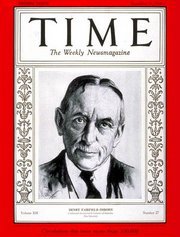
Died This Day: Henry Fairfield Osborn
August 8, 1857 - November 6, 1935
Osborn graduated at Princeton in 1877 and pursued his interest in the biological sciences and paleontology through additional study at several New York City medical schools and with Thomas Henry Huxley in Britain.
Returning to the United States, Osborn accepted a position at Princeton, teaching natural sciences from 1881 until 1891, when he moved to Columbia University to organize the Biology Department there, and in 1891, he also helped to organize the Department of Vertebrate Paleontology at the American Museum of Natural History acting as it’s first curator. Osborn's close association with American Museum continued for over 45 years, and included a long tenure as its President, 1908-1933. During these years the museum's collections expanded enormously and it became one of the preeminent research institutions for natural history in the world.
Osborn is noted for describing and naming both Tyrannosaurus rex and Albertosaurus in 1905, Pentaceratops in 1923, and Velociraptor in 1924. One of Osborn's favorite groups for study was the brontotheres, and he was the first to carry out comprehensive research on them. He also wrote an influential textbook, The Age of Mammals (1910).
Apart from his own research, Osborn is perhaps best remembered for the sponsorship of the five immensely successful Central Asiatic Expeditions during the 1920's and 30's led by Roy Chapman Andrews.
Entry from HERE and HERE.
Osborn graduated at Princeton in 1877 and pursued his interest in the biological sciences and paleontology through additional study at several New York City medical schools and with Thomas Henry Huxley in Britain.
Returning to the United States, Osborn accepted a position at Princeton, teaching natural sciences from 1881 until 1891, when he moved to Columbia University to organize the Biology Department there, and in 1891, he also helped to organize the Department of Vertebrate Paleontology at the American Museum of Natural History acting as it’s first curator. Osborn's close association with American Museum continued for over 45 years, and included a long tenure as its President, 1908-1933. During these years the museum's collections expanded enormously and it became one of the preeminent research institutions for natural history in the world.Osborn is noted for describing and naming both Tyrannosaurus rex and Albertosaurus in 1905, Pentaceratops in 1923, and Velociraptor in 1924. One of Osborn's favorite groups for study was the brontotheres, and he was the first to carry out comprehensive research on them. He also wrote an influential textbook, The Age of Mammals (1910).
Apart from his own research, Osborn is perhaps best remembered for the sponsorship of the five immensely successful Central Asiatic Expeditions during the 1920's and 30's led by Roy Chapman Andrews.
Entry from HERE and HERE.
Thursday, November 05, 2009
Proceratosaurus bradleyi
Cranial osteology and phylogenetic position of the theropod dinosaur Proceratosaurus bradleyi (Woodward, 1910) from the Middle Jurassic of England. 2009. O. Rauhut, et a. Zool. J. Linn. Soc. Published Online: 4 Nov 2009

ABSTRACT: The cranial osteology of the small theropod dinosaur Proceratosaurus from the Bathonian of Minchinhampton, England, is described in detail, based on new preparation and computed tomography (CT) scan images of the type, and only known, specimen.
Proceratosaurus is an unusual theropod with markedly enlarged external nares and a cranial crest starting at the premaxillary–nasal junction. The skull is highly pneumatic, with pneumatized nasals, jugals, and maxillae, as well as a highly pneumatic braincase, featuring basisphenoid, anterior tympanic, basipterygoid, and carotid recesses. The dentition is unusual, with small premaxillary teeth and much larger lateral teeth, with a pronounced size difference of the serrations between the mesial and distal carina. The first dentary tooth is somewhat procumbent and flexed anteriorly.
Phylogenetic analysis places Proceratosaurus in the Tyrannosauroidea, in a monophyletic clade Proceratosauridae, together with the Oxfordian Chinese taxon Guanlong. The Bathonian age of Proceratosaurus extends the origin of all clades of basal coelurosaurs back into the Middle Jurassic, and provides evidence for an early, Laurasia-wide, dispersal of the Tyrannosauroidea during the late Middle to Late Jurassic. link

ABSTRACT: The cranial osteology of the small theropod dinosaur Proceratosaurus from the Bathonian of Minchinhampton, England, is described in detail, based on new preparation and computed tomography (CT) scan images of the type, and only known, specimen.
Proceratosaurus is an unusual theropod with markedly enlarged external nares and a cranial crest starting at the premaxillary–nasal junction. The skull is highly pneumatic, with pneumatized nasals, jugals, and maxillae, as well as a highly pneumatic braincase, featuring basisphenoid, anterior tympanic, basipterygoid, and carotid recesses. The dentition is unusual, with small premaxillary teeth and much larger lateral teeth, with a pronounced size difference of the serrations between the mesial and distal carina. The first dentary tooth is somewhat procumbent and flexed anteriorly.
Phylogenetic analysis places Proceratosaurus in the Tyrannosauroidea, in a monophyletic clade Proceratosauridae, together with the Oxfordian Chinese taxon Guanlong. The Bathonian age of Proceratosaurus extends the origin of all clades of basal coelurosaurs back into the Middle Jurassic, and provides evidence for an early, Laurasia-wide, dispersal of the Tyrannosauroidea during the late Middle to Late Jurassic. link
Born This Day: J.B.S. Haldane
Haldane (Nov. 5, 1892 - Dec. 1, 1964) is best remembered along with E. B. Ford and R. A. Fisher one of the three major figures to develop the mathematical theory of population genetics. His greatest contribution was in a series of ten papers on "A Mathematical Theory of Natural and Artificial Selection" which was the major series of papers on the
mathematical theory of natural selection. It treated many major cases for the first time, showing the direction and rates of changes of gene frequencies. It also pioneered in investigating the interaction of natural selection with mutation and with migration.
Haldane's book, The Causes of Evolution (1932), summarized these results, especially in its extensive appendix. This body of work was a component of what came to be known as the "modern evolutionary synthesis", re-establishing natural selection as the premier mechanism of evolution by explaining it in terms of the mathematical consequences of Mendelian genetics. From Wikipedia. More info here.
mathematical theory of natural selection. It treated many major cases for the first time, showing the direction and rates of changes of gene frequencies. It also pioneered in investigating the interaction of natural selection with mutation and with migration.Haldane's book, The Causes of Evolution (1932), summarized these results, especially in its extensive appendix. This body of work was a component of what came to be known as the "modern evolutionary synthesis", re-establishing natural selection as the premier mechanism of evolution by explaining it in terms of the mathematical consequences of Mendelian genetics. From Wikipedia. More info here.
Died This Day: Alfred Sherwood Romer
Dec. 28, 1894 – Nov. 5, 1973
”Romer was director of the Museum of Comparative Zoology at Harvard University until his retirement in 1961 and was one the singularly most influential vertebrate paleontologists of the 20th Century. His work ranged over virtually every
conceivable subject within that field, although it was the osteology and taxonomy of the therapsids and other proto-mammals which was nearest his heart.
In addition to this work, Romer was acutely interested in the origin and initial adaptive radiation of tetrapods, and his work became the basis for a theory of tetrapod origins which was canon until the description of Acanthostega gunnari by Clack & Coates in the 1990s. Romer was ahead of his time in his defense of monophyly of Dinosauria though he did feel that Theropoda was not ancestral to birds.” link from EvoWiki.org
Romer’s book, Vertebrate Paleontology (1966), was for many years THE textbook on VP and is still well worth picking up. One of Romer’s students, Bob Carroll, wrote an updated version entitled, ‘Vertebrate Paleontology and Evolution’, in 1987. image
”Romer was director of the Museum of Comparative Zoology at Harvard University until his retirement in 1961 and was one the singularly most influential vertebrate paleontologists of the 20th Century. His work ranged over virtually every
conceivable subject within that field, although it was the osteology and taxonomy of the therapsids and other proto-mammals which was nearest his heart.In addition to this work, Romer was acutely interested in the origin and initial adaptive radiation of tetrapods, and his work became the basis for a theory of tetrapod origins which was canon until the description of Acanthostega gunnari by Clack & Coates in the 1990s. Romer was ahead of his time in his defense of monophyly of Dinosauria though he did feel that Theropoda was not ancestral to birds.” link from EvoWiki.org
Romer’s book, Vertebrate Paleontology (1966), was for many years THE textbook on VP and is still well worth picking up. One of Romer’s students, Bob Carroll, wrote an updated version entitled, ‘Vertebrate Paleontology and Evolution’, in 1987. image
Tuesday, November 03, 2009
Paleo Video: A Modern Day Dinosaur Extinction
As a follow up to the previous posting, here's a video by Jennifer Skene about the pachycephalosaurid research done by Jack Horner and Mark Goodwin.
Just for the record, I agree with their assessment of Dracorex being a juvenile Stygimoloch, but I'm not as convinced that both taxa are referable to Pachycephalosaurus.
Sunday, November 01, 2009
Dracorex and Stygimoloch = Juvenile Pachycephalosaurus
Extreme Cranial Ontogeny in the Upper Cretaceous Dinosaur Pachycephalosaurus. 2009. J. Horner and M. Goodwin. PLoS ONE 4(10): e7626.
Abstract [edit]: Dracorex hogwartsia (juvenile) and Stygimoloch spinifer (subadult) are reinterpreted as younger growth stages of Pachycephalosaurus wyomingensis (adult). This synonymy reduces the number of pachycephalosaurid taxa from the Upper Cretaceous of North America and demonstrates the importance of cranial ontogeny in evaluating dinosaur diversity and taxonomy. These growth stages reflect a continuum rather than specific developmental steps defined by “known” terminal morphologies.
The ontogenetically oldest adult, AMNH 1696, in (A) dorsal and (B) right lateral views. A younger adult, UCMP 556078 (cast) with inflation of the frontoparietal dome+lateral cranial elements and mature nasal and squamosal nodal ornamentation in (C) dorsal and (D) right lateral views. MPM 8111, a partial skull of “” in (E) dorsal and (F) left lateral views (reversed) illustrates the high narrow frontoparietal dome, squamosal nodes and horns characteristic of the subadult growth stage. Landmarks on the dorsal skull of MPM 8111 in orange (anterior) and red (posterior) constrain the position of the dome. The youngest growth stage in this cranial ontogenetic series is “Dracorex”, TCNI 2004.17.1 (cast) in (G) dorsal and (H) right lateral views. The position of the squamosal horns and nasal nodes are consistent in these four pachycephalosaurid skulls, which increase in overall length and size from youngest (G,H) to oldest (A,B). Scale bar is 5 cm.
Born This Day: Gavin de Beer
de Beer (Nov. 1, 1899 – June 21, 1972) was
an English zoologist and morphologist who contributed to experimental embryology, anatomy, and evolution. He refuted the germ-layer theory and developed the concept of paedomorphism - the retention of juvenile characteristics of ancestors in mature adults).
From examination of the fossil
Archaeopteryx, De Beer proposed mosaic evolution with piecemeal evolutionary changes to explain the combination of bird and reptile features.
From Today In Science History.
an English zoologist and morphologist who contributed to experimental embryology, anatomy, and evolution. He refuted the germ-layer theory and developed the concept of paedomorphism - the retention of juvenile characteristics of ancestors in mature adults).From examination of the fossil
Archaeopteryx, De Beer proposed mosaic evolution with piecemeal evolutionary changes to explain the combination of bird and reptile features.
From Today In Science History.
Born This Day: Alfred Wegener
Nov. 1, 1880 – Nov, 1930
From Today In Science History:
Visit The Paleomap Project
Alfred Lothar Wegener was a German meteorologist and geophysicist who first gave a well-developed hypothesis of continental drift. He suggested (1912) that about 250 million yrs ago all the present-day continents came from a single primitive land mass, the supercontinent Pangaea, which eventually broke up and gradually drifted apart. (A similar idea was proposed earlier by F.B. Taylor in 1910.) Others saw the fit of coastlines of South America and Africa, but Wegener added more geologic and paleontologic evidence that these two continents were once joined.
Saturday, October 31, 2009
Frankenstein Vs. The Brontosaurus
A Halloween treat! Two Frankenstein stories by Dick Briefer over at the Atomic Surgrey.
Friday, October 30, 2009
Early O2 Levels & The Origin of Life
A Late Archean Sulfidic Sea Stimulated by Early Oxidative Weathering of the Continents. 2009. C. T. Reinhard, et a;. Science 326: 713-716.
Scientists widely accept that around 2.4 billion years ago, the Earth's atmosphere underwent a dramatic change when oxygen levels rose sharply. Called the "Great Oxidation Event" (GOE), the oxygen spike marks an important milestone in Earth's history, the transformation from an oxygen-poor atmosphere to an oxygen-rich one paving the way for complex life to develop on the planet.
By analyzing 2.5 billion-year-old black shales from Western Australia.researchers have corroborated recent evidence that oxygen production began in Earth's oceans at least 100 million years before the GOE.
Specifically, the shales revealed that episodes of hydrogen sulfide accumulation in the oxygen-free deep ocean occurred nearly 100 million years before the GOE and up to 700 million years earlier than such conditions were predicted by past models for the early ocean.
Hydrogen sulfide in the ocean is a fingerprint of photosynthetic production of oxygen 2.5 billion years ago.
"Our data point to oxygen-producing photosynthesis long before concentrations of oxygen in the atmosphere were even a tiny fraction of what they are today" said Reinhard.
The researchers argue that the presence of small amounts of oxygen may have stimulated the early evolution of eukaryotes – organisms whose cells bear nuclei – millions of years prior to the GOE.
Scientists widely accept that around 2.4 billion years ago, the Earth's atmosphere underwent a dramatic change when oxygen levels rose sharply. Called the "Great Oxidation Event" (GOE), the oxygen spike marks an important milestone in Earth's history, the transformation from an oxygen-poor atmosphere to an oxygen-rich one paving the way for complex life to develop on the planet.
By analyzing 2.5 billion-year-old black shales from Western Australia.researchers have corroborated recent evidence that oxygen production began in Earth's oceans at least 100 million years before the GOE.
Specifically, the shales revealed that episodes of hydrogen sulfide accumulation in the oxygen-free deep ocean occurred nearly 100 million years before the GOE and up to 700 million years earlier than such conditions were predicted by past models for the early ocean.
Hydrogen sulfide in the ocean is a fingerprint of photosynthetic production of oxygen 2.5 billion years ago.
"Our data point to oxygen-producing photosynthesis long before concentrations of oxygen in the atmosphere were even a tiny fraction of what they are today" said Reinhard.
The researchers argue that the presence of small amounts of oxygen may have stimulated the early evolution of eukaryotes – organisms whose cells bear nuclei – millions of years prior to the GOE.
Thursday, October 29, 2009
Born This Day: Othniel Marsh
Oct. 29, 1831 - March 18, 1899
From Today In Science History:
Marsh was an American paleontologist who discovered and described 100’s of new fossil species. He made extensive scientific explorations of the western U.S. and contributed greatly to knowledge of extinct North American vertebrates. Marsh spent only four seasons in the field, between 1870 and 1873.
"The Great Bone Wars," were the result of his rivalry with Edward Drinker Cope, America's other great vertebrate paleontologist of the period. Each scientist hired field crews to unearth and ship back fossils as fast as possible. The rival crews were known to spy on each other, dynamite their own and each other's secret localities (to keep their opponents from digging there), and occasionally steal each other's fossils.
From Today In Science History:
Marsh was an American paleontologist who discovered and described 100’s of new fossil species. He made extensive scientific explorations of the western U.S. and contributed greatly to knowledge of extinct North American vertebrates. Marsh spent only four seasons in the field, between 1870 and 1873.
"The Great Bone Wars," were the result of his rivalry with Edward Drinker Cope, America's other great vertebrate paleontologist of the period. Each scientist hired field crews to unearth and ship back fossils as fast as possible. The rival crews were known to spy on each other, dynamite their own and each other's secret localities (to keep their opponents from digging there), and occasionally steal each other's fossils.
Tuesday, October 27, 2009
Darwin's Advanced Ideas On Evolution
Charles Darwin and the Origin of Life. 2009. J. Pereto, et al. Origins of Life and Evolution of Biospheres 39(5): 395-406. (This is an open access article).
"Darwin was convinced of the incredible importance of this issue for his theory and he had an amazingly modern materialist and evolutional vision about the transition of inanimate chemical matter into living matter, despite being very aware of Pasteur's experiments in opposition to spontaneous generation", said Juli PeretĂł.
The study, which is published in the latest issue of the journal Origins of Life and Evolution of Biospheres, demonstrates that Darwin had an advanced idea on the origin of the first species, and was troubled by the problem. "It is utterly wrong to think that he was invoking a divine intervention; it is also well documented that the mention of the 'Creator' in The Origin of the Species was an addition for appearance's sake that he later regretted", affirms PeretĂł.
According to the researchers, all Darwin's opinions on the origin of life can be found in his private correspondence and in his notebooks. The exception is a review of a book on foraminiferous microorganisms published in 1863 in the London social club Athenaeum, where Darwin "lets his opinion on the spontaneous generation be known".
A comment in a notebook dating back to 1837, in which Darwin explains that "the intimate relationship between the vital phenomena with chemistry and its laws makes the idea of spontaneous generation conceivable", gave the researchers their clue.
In another famous letter sent in 1871 to his friend, the English botanist and explorer Joseph D. Hooker, Charles Darwin imagines a small, warm pool where the inanimate matter would arrange itself into evolutionary matter, aided by chemical components and sufficient sources of energy.
In other letters, the naturalist admitted to colleagues such as Alfred Russel Wallace or Ernst Haeckel that spontaneous generation was important to the coherence of the theory. However, "at the same time, he acknowledged that science was not advanced enough to deal with the question (hence his reluctance to speak of it in public) and that he would not live to see it resolved", PeretĂł points out.
When Charles Darwin published The Origin of Species 150 years ago, he deliberately avoided the subject of the origin of life. This, coupled with the mention of the 'Creator' in the last paragraph of the book, led us to believe he was not willing to commit on the matter. Reseachers now refute that idea and show that the British naturalist did explain in other documents how our first ancestors could have come into being."All organic beings that have lived on Earth could be descended from some primordial form", explained Darwin in The Origin of Species in 1859. Despite this statement, the scientist took it upon himself to understand the evolutional processes underlying biodiversity.
"Darwin was convinced of the incredible importance of this issue for his theory and he had an amazingly modern materialist and evolutional vision about the transition of inanimate chemical matter into living matter, despite being very aware of Pasteur's experiments in opposition to spontaneous generation", said Juli PeretĂł.
The study, which is published in the latest issue of the journal Origins of Life and Evolution of Biospheres, demonstrates that Darwin had an advanced idea on the origin of the first species, and was troubled by the problem. "It is utterly wrong to think that he was invoking a divine intervention; it is also well documented that the mention of the 'Creator' in The Origin of the Species was an addition for appearance's sake that he later regretted", affirms PeretĂł.
According to the researchers, all Darwin's opinions on the origin of life can be found in his private correspondence and in his notebooks. The exception is a review of a book on foraminiferous microorganisms published in 1863 in the London social club Athenaeum, where Darwin "lets his opinion on the spontaneous generation be known".
A comment in a notebook dating back to 1837, in which Darwin explains that "the intimate relationship between the vital phenomena with chemistry and its laws makes the idea of spontaneous generation conceivable", gave the researchers their clue.
In another famous letter sent in 1871 to his friend, the English botanist and explorer Joseph D. Hooker, Charles Darwin imagines a small, warm pool where the inanimate matter would arrange itself into evolutionary matter, aided by chemical components and sufficient sources of energy.
In other letters, the naturalist admitted to colleagues such as Alfred Russel Wallace or Ernst Haeckel that spontaneous generation was important to the coherence of the theory. However, "at the same time, he acknowledged that science was not advanced enough to deal with the question (hence his reluctance to speak of it in public) and that he would not live to see it resolved", PeretĂł points out.
(I'm out of the country this week...)
Thursday, October 22, 2009
Died This Day: Roderick Murchison
Feb. 19, 1792 - Oct. 22, 1871
Murchison was a Scottish geologist who first differentiated the Silurian strata in the geologic sequence of Early Paleozoic strata (408-540 million years old). He believed in fossils as primary criteria. In 1831, he began researching the previously geologically unknown graywacke rocks of the Lower Paleozoic, found underlying the Old Red Sandstone in parts of Wales, which culminated in his major work the Silurian System (1839).
Murchison named the Silurian after an ancient British tribe that inhabited South Wales. He established the Devonian working with Adam Sedgwick (1839). He named the Permian (1841) after the Perm province in Russia where he made a geological survey in 1840-45. link
Murchison was a Scottish geologist who first differentiated the Silurian strata in the geologic sequence of Early Paleozoic strata (408-540 million years old). He believed in fossils as primary criteria. In 1831, he began researching the previously geologically unknown graywacke rocks of the Lower Paleozoic, found underlying the Old Red Sandstone in parts of Wales, which culminated in his major work the Silurian System (1839).
Murchison named the Silurian after an ancient British tribe that inhabited South Wales. He established the Devonian working with Adam Sedgwick (1839). He named the Permian (1841) after the Perm province in Russia where he made a geological survey in 1840-45. link
Wednesday, October 21, 2009
2 Million Year Old Tool-Making Hominins Inhabited Grasslands
Oldest Evidence of Toolmaking Hominins in a Grassland - Dominated Ecosystem. 2009. Plummer, T.W., et al. PLoS ONE 4(9): e7199.
The study documents what was previously speculated based on indirect evidence – that grassland-dominated ecosystems did, in fact, exist during the Plio-Pleistocene (ca. 2.5-1.5 million years ago) and that early human tool-makers were active in open settings.

A scatter of fossils and artifacts on pedestals within a grid of one meter squares. Photo: T. PlummerOther recent research shows that the Kanjera hominins obtained meat and bone marrow from a variety of animals and that they carried stone raw materials over surprisingly long distances in this grassland setting. A comparison with other Oldowan sites shows that by 2.0 million years ago, hominins, almost certainly of the genus Homo, lived in a wide range of habitats in East Africa, from open grassland to woodland and dry forest. link
Scientists have announced the discovery of the oldest archeological evidence of early human activities in a grassland environment, dating to 2 million years ago.The researchers provide the first documentation of both at the 2-million-year-old Oldowan archeological site of Kanjera South, Kenya, which has yielded both Oldowan artifacts and well-preserved faunal remains, allowing researchers to reconstruct past ecosystems.
The study documents what was previously speculated based on indirect evidence – that grassland-dominated ecosystems did, in fact, exist during the Plio-Pleistocene (ca. 2.5-1.5 million years ago) and that early human tool-makers were active in open settings.

A scatter of fossils and artifacts on pedestals within a grid of one meter squares. Photo: T. Plummer
Tuesday, October 20, 2009
Humans Are Still Evolving
Natural selection in a contemporary human population. 2009. Byars, S., et al. Proc.s Nat. Acad. Sci., published online in the October 19.
After adjusting for factors such as education and smoking, their models predict that the descendents of these women will be slightly shorter and heavier, will have lower blood pressure and cholesterol, will have their first child at a younger age, and will reach menopause later in life.
The changes may be slow and gradual, but the predicted rates of change are no different from those observed elsewhere in nature, the researchers say.
"The take-home message is that humans are currently evolving," said Stearns. "Natural selection is still operating." link
New research shows that Humans evolve at roughly the same rates as other living things.Taking advantage of data collected as part of a 60-year study of more than 2000 North American women in the Framingham Heart Study, researchers have analyzed a handful of traits important to human health. By measuring the effects of these traits on the number of children the women had over their lifetime, the researchers were able to estimate the strength of selection and make short-term predictions about how each trait might evolve in the future.
After adjusting for factors such as education and smoking, their models predict that the descendents of these women will be slightly shorter and heavier, will have lower blood pressure and cholesterol, will have their first child at a younger age, and will reach menopause later in life.
The changes may be slow and gradual, but the predicted rates of change are no different from those observed elsewhere in nature, the researchers say.
"The take-home message is that humans are currently evolving," said Stearns. "Natural selection is still operating." link
Killer Algae Killed Off The Dinosaurs
Hypothesis for the role of toxin-producing algae in Phanerozoic mass extinctions based on evidence from the geologic record and modern environments. 2009. J.W. Castle and J.H. Rodgers, Jr. Environmental Geosciences 16: 1-23
Researchers think the same thing happened during the five largest mass extinctions in Earth's history. Each time a large die off occurred, they found a spike in the number of fossil algae mats called stromatolites strewn around the planet.
Such blue-green algae structures that produce poisons and deplete oxygen were present in sufficient quantities to kill off untold numbers of plants and animals living on land or in the sea.
Other researchers have theorized that climate changes, sea level, volcanic activity, even asteroids were primary causes for deaths of more than 50 percent of life on Earth. Castle and Rodgers claim that these causes are contributors, but algae were the mass killer. They point out that asteroid-caused extinction, a popular theory for the end of dinosaurs, does not fit the evidence.
"The fossil record indicates that mass extinctions ... occurred in response to environmental changes at the end of the Cretaceous; however, these extinctions occurred more gradually than expected if caused solely by a catastrophic event." link and link
Algae, not asteroids, were the key to the end of the dinosaursToday, just about anywhere there is water, there can be toxic algae. The microscopic plants usually exist in small concentrations, but a sudden warming in the water or an injection of dust or sediment from land can trigger a bloom that kills thousands of fish, poisons shellfish, or even humans.
Researchers think the same thing happened during the five largest mass extinctions in Earth's history. Each time a large die off occurred, they found a spike in the number of fossil algae mats called stromatolites strewn around the planet.
Such blue-green algae structures that produce poisons and deplete oxygen were present in sufficient quantities to kill off untold numbers of plants and animals living on land or in the sea.
Other researchers have theorized that climate changes, sea level, volcanic activity, even asteroids were primary causes for deaths of more than 50 percent of life on Earth. Castle and Rodgers claim that these causes are contributors, but algae were the mass killer. They point out that asteroid-caused extinction, a popular theory for the end of dinosaurs, does not fit the evidence.
"The fossil record indicates that mass extinctions ... occurred in response to environmental changes at the end of the Cretaceous; however, these extinctions occurred more gradually than expected if caused solely by a catastrophic event." link and link
Sunday, October 18, 2009
Saturday, October 17, 2009
Happy Birthday to Julie Adams
Julie starred as Kay Lawrence in The Creature From The Black Lagoon (1954). Adams has had a long career in films and TV, recently appearing on 'Lost'.
Friday, October 16, 2009
Dr. Stephen Gatesy Talks on T. rex Locomotion at the CMNH Tonight
For the last 15 years, Dr. Stephen Gatesy, associate professor of biology at Brown University specializing in paleontology and evolutionary functional morphology, has used 3-D animation software to visualize and analyze bipedal locomotion in carnivorous dinosaurs like Tyrannosaurus rex.
He served as a scientific advisor for the American Museum of Natural History exhibition Dinosaurs: Ancient Fossils, New Discoveries now on at the CMNH. Gatesy will discuss the process and problems in reconstructing tyrannosaur locomotion and present his research on fossil footprints and the origins of bird flight.
For more information click here.

© Stephen Gatesy, Brown University
Watch Steve (and others) discusses dinosaur trackways [in Real Player]
He served as a scientific advisor for the American Museum of Natural History exhibition Dinosaurs: Ancient Fossils, New Discoveries now on at the CMNH. Gatesy will discuss the process and problems in reconstructing tyrannosaur locomotion and present his research on fossil footprints and the origins of bird flight.
For more information click here.

© Stephen Gatesy, Brown University
Watch Steve (and others) discusses dinosaur trackways [in Real Player]
Did 'Shiva' Crater In India Doom The Dinosaurs?
A mysterious basin off the coast of India could be the largest, multi-ringed impact crater the world has ever seen. And if a new study is right, it may have been responsible for killing the dinosaurs off 65 million years ago.
Three-dimensional reconstruction of the submerged Shiva crater (~500 km diameter) at the Mumbai Offshore Basin, western shelf of India from different cross-sectional and geophysical data. The overlying 4.3-mile-tick Cenozoic strata and water column were removed to show the morphology of the crater.“If we are right, this is the largest crater known on our planet,” Chatterjee said. “A bolide of this size, perhaps 40 kilometers (25 miles) in diameter creates its own tectonics.”
By contrast, the object that struck the Yucatan Peninsula, and is commonly thought to have killed the dinosaurs was between 8 and 10 km wide.
It's hard to imagine such a cataclysm. But if the team is right, the Shiva impact vaporized Earth's crust at the point of collision, leaving nothing but ultra-hot mantle material to well up in its place. It is likely that the impact enhanced the nearby Deccan Traps volcanic eruptions that covered much of western India. What's more, the impact broke the Seychelles islands off of the Indian tectonic plate, and sent them drifting toward Africa.
The geological evidence is dramatic. Shiva's outer rim forms a rough, faulted ring some 500 km in diameter, encircling the central peak, known as the Bombay High, which would be 3 miles tall from the ocean floor (about the height of Mount McKinley). Most of the crater lies submerged on India's continental shelf, but where it does come ashore it is marked by tall cliffs, active faults and hot springs. The impact appears to have sheared or destroyed much of the 30-mile-thick granite layer in the western coast of India.
Sankar Chatterjee will present his research at this month's Annual Meeting of the Geological Society of America in Portland, Oregon. link
Thursday, October 15, 2009
Happy 100th Birthday to Harry Redmond Jr.: The Last Survivor of Skull Island!
In last January's Video Watchdog, Mark F. Berry interviewed the last surviving member of the original KING KONG's special effects unit, who also told tales about his special effects pioneer father and how they devised the cinematic illusions for She, The Last Days of Pompeii, Lost Horizon and many other Classics. Mark also presented some previously unseen photos from the set of King Kong.
Mark is also the author of The Dinosaur Filmography that you can buy here or here
Darwinopterus: New Chinese Pterosaur
Evidence for modular evolution in a long-tailed pterosaur with a pterodactyloid skull. 2009. Junchang LĂŒ, et al. Prod. Royal Soc. B., published online before print October 14.
Abstract: The fossil record is a unique source of evidence for important evolutionary phenomena such as transitions between major clades. Frustratingly, relevant fossils are still comparatively rare, most transitions have yet to be documented in detail and the mechanisms that underpin such events, typified by rapid large scale changes and for which microevolutionary processes seem insufficient, are still unclear.
A new pterosaur (Mesozoic flying reptile) from the Middle Jurassic of China, Darwinopterus modularis gen. et sp. nov., provides the first insights into a prominent, but poorly understood transition between basal, predominantly long-tailed pterosaurs and the more derived, exclusively short-tailed pterodactyloids.
Darwinopterus exhibits a remarkable ‘modular’ combination of characters: the skull and neck are typically pterodactyloid, exhibiting numerous derived character states, while the remainder of the skeleton is almost completely plesiomorphic and identical to that of basal pterosaurs. This pattern supports the idea that modules, tightly integrated complexes of characters with discrete, semi-independent and temporally persistent histories, were the principal focus of natural selection and played a leading role in evolutionary transitions.
Abstract: The fossil record is a unique source of evidence for important evolutionary phenomena such as transitions between major clades. Frustratingly, relevant fossils are still comparatively rare, most transitions have yet to be documented in detail and the mechanisms that underpin such events, typified by rapid large scale changes and for which microevolutionary processes seem insufficient, are still unclear.
A new pterosaur (Mesozoic flying reptile) from the Middle Jurassic of China, Darwinopterus modularis gen. et sp. nov., provides the first insights into a prominent, but poorly understood transition between basal, predominantly long-tailed pterosaurs and the more derived, exclusively short-tailed pterodactyloids.
Darwinopterus exhibits a remarkable ‘modular’ combination of characters: the skull and neck are typically pterodactyloid, exhibiting numerous derived character states, while the remainder of the skeleton is almost completely plesiomorphic and identical to that of basal pterosaurs. This pattern supports the idea that modules, tightly integrated complexes of characters with discrete, semi-independent and temporally persistent histories, were the principal focus of natural selection and played a leading role in evolutionary transitions.
Read the story at National Geographic News.
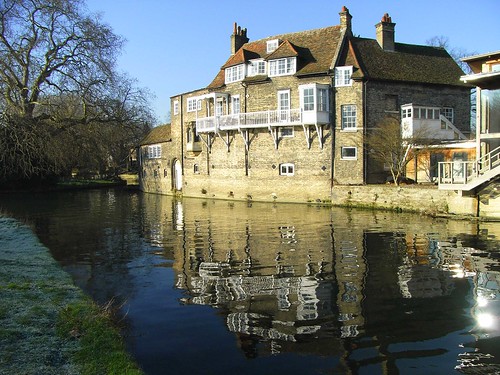
On This Day: Charles Darwin Accepted into Cambridge
In 1827, Charles Darwin was accepted into Christ's College at Cambridge, but did not start until winter term because he needed to catch up on some of his studies. A grandson of Erasmus Darwin of Lichfield, and of Josiah Wedgwood, he had entered the University of Edinburgh in 1825 to study medicine, intending to follow his father Robert's career as a doctor. However, Darwin found himself unenthusiastic about his studies, including that of geology.
Disappointing his family that he gave up on a medical career, he left Edinburgh without graduating in April 1827. His scholastic achievements at Cambridge were unremarkable, but after graduation. Today Cambridge has Darwin College, founded in 1964, for advanced study that only admits postgraduate students. From Today In Science History
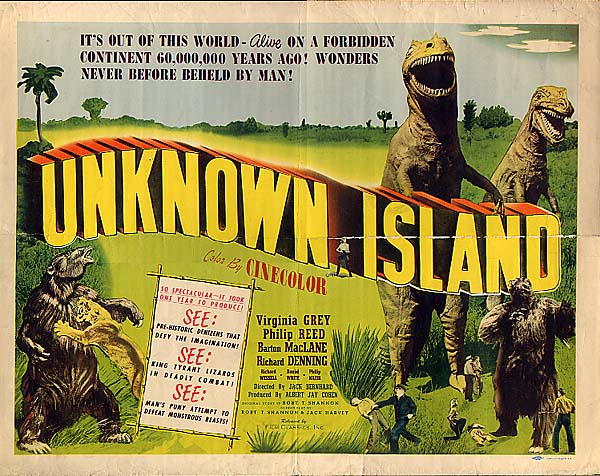
Debuted This Day (1948): Unknown Island
Written by Robert T. Shannon and directed by Bernhard, this ridiculaous little film features some of the worst ‘man dressed up as a T. rex’ effects ever. Not a bad little story though.
Wednesday, October 14, 2009
Born This Day: Jack Arnold

Jack Arnold (Oct. 14, 1916 - March 17, 1992) directed a number of classic SF films including The Creature From the Black Lagoon, Revenge of the Creature, The Incredible Shrinking Man, and It Came From Outer Space, as well as few not-so-classics (but still much loved) such as Monster on Campus. Throughout the ‘60’s and into the early 80’s he had a successful career as a TV producer and director.
Monday, October 12, 2009
Estimating the Sauropod Genome
Sauropod dinosaurs evolved moderately sized genomes unrelated to body size. 2009. C. Organ, et al. Proc. Royal. Soc. B. published online before print September 30.
Abstract: Sauropodomorph dinosaurs include the largest land animals to have ever lived, some reaching up to 10 times the mass of an African elephant. Despite their status defining the upper range for body size in land animals, it remains unknown whether sauropodomorphs evolved larger-sized genomes than non-avian theropods, their sister taxon, or whether a relationship exists between genome size and body size in dinosaurs, two questions critical for understanding broad patterns of genome evolution in dinosaurs.
Here we report inferences of genome size for 10 sauropodomorph taxa. The estimates are derived from a Bayesian phylogenetic generalized least squares approach that generates posterior distributions of regression models relating genome size to osteocyte lacunae volume in extant tetrapods. We estimate that the average genome size of sauropodomorphs was 2.02 pg (range of species means: 1.77–2.21 pg), a value in the upper range of extant birds (mean = 1.42 pg, range: 0.97–2.16 pg) and near the average for extant non-avian reptiles (mean = 2.24 pg, range: 1.05–5.44 pg). The results suggest that the variation in size and architecture of genomes in extinct dinosaurs was lower than the variation found in mammals.
A substantial difference in genome size separates the two major clades within dinosaurs, Ornithischia (large genomes) and Saurischia (moderate to small genomes). We find no relationship between body size and estimated genome size in extinct dinosaurs, which suggests that neutral forces did not dominate the evolution of genome size in this group.
Abstract: Sauropodomorph dinosaurs include the largest land animals to have ever lived, some reaching up to 10 times the mass of an African elephant. Despite their status defining the upper range for body size in land animals, it remains unknown whether sauropodomorphs evolved larger-sized genomes than non-avian theropods, their sister taxon, or whether a relationship exists between genome size and body size in dinosaurs, two questions critical for understanding broad patterns of genome evolution in dinosaurs.
Here we report inferences of genome size for 10 sauropodomorph taxa. The estimates are derived from a Bayesian phylogenetic generalized least squares approach that generates posterior distributions of regression models relating genome size to osteocyte lacunae volume in extant tetrapods. We estimate that the average genome size of sauropodomorphs was 2.02 pg (range of species means: 1.77–2.21 pg), a value in the upper range of extant birds (mean = 1.42 pg, range: 0.97–2.16 pg) and near the average for extant non-avian reptiles (mean = 2.24 pg, range: 1.05–5.44 pg). The results suggest that the variation in size and architecture of genomes in extinct dinosaurs was lower than the variation found in mammals.
A substantial difference in genome size separates the two major clades within dinosaurs, Ornithischia (large genomes) and Saurischia (moderate to small genomes). We find no relationship between body size and estimated genome size in extinct dinosaurs, which suggests that neutral forces did not dominate the evolution of genome size in this group.
Dinosaurs: Ancient Fossils, New Discoveries Opens at CMNH
The Cleveland Museum of Natural History is pleased to announce the opening of Dinosaurs: Ancient Fossils, New Discoveries, running until Jan. 31, 2010.

The exhibit focuses on current thinking about how dinosaur biology has evolved and changed dramatically over the past two decades, and highlights ongoing cutting-edge research by leading paleontologists around the world.
Highlights include a T. rex skeleton and a reconstruction of China’s famous ‘feathered dinosaur’ locality, complete with fleshed out models.
For more info click HERE
The exhibit focuses on current thinking about how dinosaur biology has evolved and changed dramatically over the past two decades, and highlights ongoing cutting-edge research by leading paleontologists around the world.
Highlights include a T. rex skeleton and a reconstruction of China’s famous ‘feathered dinosaur’ locality, complete with fleshed out models.
For more info click HERE
Qiaowanlong: New Asian Brachiosaurid
The first well-preserved Early Cretaceous brachiosaurid dinosaur in Asia. 2009. H.-L. You and D.-Q Li. Proc. R. Soc. B 276: 4077-4082.
Abstract: A new genus and species of brachiosaurid sauropods, Qiaowanlong kangxii gen. et sp. nov., is reported, representing the first well-preserved Early Cretaceous brachiosaurid in Asia and expanding the distribution of brachiosaurids undoubtedly into the Asian continent.
The new taxon was recovered from the late Early Cretaceous Xinminpu Group of Yujingzi Basin in northwestern Gansu Province, China, and is represented by a series of eight mid-cervical vertebrae, a right pelvic girdle and some unidentified bones.
The existence of deeply excavated cervical neural spines and a rising transition in the neural spine height among mid-cervical vertebrae clearly show the affinity of Qiaowanlong as a member of brachiosaurids.
Among brachiosaurids, Qiaowanlong shares a derived feature with the North American Early Cretaceous brachiosaurid Sauroposeidon: the lack of cranial centrodiapophyseal lamina. However, Qiaowanlong is unique in possessing a suite of features, such as a low central length/cotyle height ratio, bifurcated cervical neural spines and a much reduced ischium.
The discovery of Qiaowanlong and other new material indicates a diverse and abundant sauropod assemblage in China during the Early Cretaceous.
Abstract: A new genus and species of brachiosaurid sauropods, Qiaowanlong kangxii gen. et sp. nov., is reported, representing the first well-preserved Early Cretaceous brachiosaurid in Asia and expanding the distribution of brachiosaurids undoubtedly into the Asian continent.
The new taxon was recovered from the late Early Cretaceous Xinminpu Group of Yujingzi Basin in northwestern Gansu Province, China, and is represented by a series of eight mid-cervical vertebrae, a right pelvic girdle and some unidentified bones.
The existence of deeply excavated cervical neural spines and a rising transition in the neural spine height among mid-cervical vertebrae clearly show the affinity of Qiaowanlong as a member of brachiosaurids.
Among brachiosaurids, Qiaowanlong shares a derived feature with the North American Early Cretaceous brachiosaurid Sauroposeidon: the lack of cranial centrodiapophyseal lamina. However, Qiaowanlong is unique in possessing a suite of features, such as a low central length/cotyle height ratio, bifurcated cervical neural spines and a much reduced ischium.
The discovery of Qiaowanlong and other new material indicates a diverse and abundant sauropod assemblage in China during the Early Cretaceous.
Friday, October 09, 2009
Evolution of the Middle Ear
Evolutionary Development of the Middle Ear in Mesozoic Therian Mammals. 2009. Q. Ji, et al. Science 326: 278 – 281.
Abstract: The definitive mammalian middle ear (DMME) is defined by the loss of embryonic Meckel’s cartilage and disconnection of the middle ear from the mandible in adults. It is a major feature distinguishing living mammals from nonmammalian vertebrates.
We report a Cretaceous trechnotherian mammal with an ossified Meckel’s cartilage in the adult, showing that homoplastic evolution of the DMME occurred in derived therian mammals, besides the known cases of eutriconodonts. The mandible with ossified Meckel’s cartilage appears to be paedomorphic. Reabsorption of embryonic Meckel’s cartilage to disconnect the ear ossicles from the mandible is patterned by a network of genes and signaling pathways.
This fossil suggests that developmental heterochrony and gene patterning are major mechanisms in homplastic evolution of the DMME.
Abstract: The definitive mammalian middle ear (DMME) is defined by the loss of embryonic Meckel’s cartilage and disconnection of the middle ear from the mandible in adults. It is a major feature distinguishing living mammals from nonmammalian vertebrates.
We report a Cretaceous trechnotherian mammal with an ossified Meckel’s cartilage in the adult, showing that homoplastic evolution of the DMME occurred in derived therian mammals, besides the known cases of eutriconodonts. The mandible with ossified Meckel’s cartilage appears to be paedomorphic. Reabsorption of embryonic Meckel’s cartilage to disconnect the ear ossicles from the mandible is patterned by a network of genes and signaling pathways.
This fossil suggests that developmental heterochrony and gene patterning are major mechanisms in homplastic evolution of the DMME.
Archaeopteryx Grew Like a Dinosaur
Was dinosaurian physiology inherited by birds? – Reconciling slow growth in Archaeopteryx. 2009. G. Erickson, et al. PLoS ONE 4(10): e7390.
The bone types for the early birds Archaeopteryx, Jeholornis, and Sapeornis are comparable to those of same-sized dinosaurs. The opposite pattern holds for more advanced bird fossils such as the roughly 94 million-year-old Ichthyornis from North America. The bone is well-vascularized, which means that it was well-supplied with blood vessels (below), and the bone structure is woven, with randomly oriented bone fibers, indicating fast growth with no annual growth lines. This is the bone histology of modern birds.
Additional information came from physical examination of more than half of the Archaeopteryx specimens. Although the young Munich specimen did not have growth lines (a characteristic marker of annual growth in dinosaurs), both the larger London and Solnhofen specimens have peeling or delaminating bone suggestive of the presence of growth lines. This means that this animal grew for more than a year and that growth ceased for part of each year as is typical of small non-avian dinosaurs. Jeholornis and Sapeornis fossils also have growth lines that suggest they grew for more than a year. All of these traits point to a more reptilian growth pattern than seen in living birds.
The team outlines a growth curve (above) that indicates that Archaeopteryx reached adult size in about 970 days, that none of the known Archaeopteryx specimens are adults (confirming previous speculation), and that adult Archaeopteryx were probably the size of a raven, much larger than previously thought.
The first Archaeopteryx skeleton was found in Germany about the same time Darwin's Origin of Species was published. This was a fortuitously-timed discovery: because the fossil combined bird-like (feathers and a wishbone) and reptilian (teeth, three fingers on hands, and a long bony tail) traits, it helped convince many about the veracity of evolutionary theory. In fact, the first suggestion that birds are related to dinosaurs was made by early proponent of evolution Thomas Henry Huxley in the 1860's. Ten skeletons and an isolated feather have been found.
"Archaeopteryx had comparable metabolism to closely related Velociraptor," says Norell. "Although the genealogy of birds is well understood, the genesis of modern bird biology has been a huge mystery. We knew that they are a kind of dinosaur, but we now know that the transition into true birds—physiologically and metabolically—happened well after Archaeopteryx."
Adds Erickson: "We show that avian flight was achieved with the physiology of a dinosaur." link
New research shows that Archaeopteryx grew much slower than living birds and more like non-avian dinosaurs. This means rapid bone growth—long thought a prerequisite for flight—was not necessary for taking to the air.250-micron chips (below) from the long bones were taken from the Munich Archaeopteryx (above) as well as Jeholornis prima, a long-tailed specimen considered an early bird, and the short-tailed Sapeornis chaochengensi. The researchers also sampled the closest relatives among dinosaurs to the birds including Velociraptor and miniaturized species such as Mahakala omnogova that is similar in size to Archaeopteryx.
The bone types for the early birds Archaeopteryx, Jeholornis, and Sapeornis are comparable to those of same-sized dinosaurs. The opposite pattern holds for more advanced bird fossils such as the roughly 94 million-year-old Ichthyornis from North America. The bone is well-vascularized, which means that it was well-supplied with blood vessels (below), and the bone structure is woven, with randomly oriented bone fibers, indicating fast growth with no annual growth lines. This is the bone histology of modern birds.
Additional information came from physical examination of more than half of the Archaeopteryx specimens. Although the young Munich specimen did not have growth lines (a characteristic marker of annual growth in dinosaurs), both the larger London and Solnhofen specimens have peeling or delaminating bone suggestive of the presence of growth lines. This means that this animal grew for more than a year and that growth ceased for part of each year as is typical of small non-avian dinosaurs. Jeholornis and Sapeornis fossils also have growth lines that suggest they grew for more than a year. All of these traits point to a more reptilian growth pattern than seen in living birds.
The team outlines a growth curve (above) that indicates that Archaeopteryx reached adult size in about 970 days, that none of the known Archaeopteryx specimens are adults (confirming previous speculation), and that adult Archaeopteryx were probably the size of a raven, much larger than previously thought.
The first Archaeopteryx skeleton was found in Germany about the same time Darwin's Origin of Species was published. This was a fortuitously-timed discovery: because the fossil combined bird-like (feathers and a wishbone) and reptilian (teeth, three fingers on hands, and a long bony tail) traits, it helped convince many about the veracity of evolutionary theory. In fact, the first suggestion that birds are related to dinosaurs was made by early proponent of evolution Thomas Henry Huxley in the 1860's. Ten skeletons and an isolated feather have been found.
"Archaeopteryx had comparable metabolism to closely related Velociraptor," says Norell. "Although the genealogy of birds is well understood, the genesis of modern bird biology has been a huge mystery. We knew that they are a kind of dinosaur, but we now know that the transition into true birds—physiologically and metabolically—happened well after Archaeopteryx."
Adds Erickson: "We show that avian flight was achieved with the physiology of a dinosaur." link
Thursday, October 08, 2009
Loyal Alligators Display the Mating Habits of Birds
Multiyear multiple paternity and mate fidelity in the American alligator, Alligator mississippiensis. 2009. S.L. Lance, et al. Molecular Ecology Published Online 5 Oct 2009.
Alligators display the same loyalty to their mating partners as birds. The ten-year-study by scientists from the Savannah River Ecology Laboratory reveals that up to 70% of females chose to remain with their partner, often for many years.
While the females move freely through male territories, leading to high mate encounter rates, this study reveals that many alligators choose to mate with the same partner over many mating seasons. This amounts to the first evidence for partial mate fidelity in any crocodilian species and reveals a similarity in mating patterns between alligators and bird species.
"Given how incredibly open and dense the alligator population is at RWR we didn't expect to find fidelity," said Lance. "To actually find that 70% of our re-trapped females showed mate fidelity was really incredible. I don't think any of us expected that the same pair of alligators that bred together in 1997 would still be breeding together in 2005 and may still be producing nests together to this day."
Crocodilians are the sole surviving reptilian archosaurs, a group of ancient reptiles that includes dinosaurs and gave rise to birds. It is this evolutionary relationship to birds which means crocodilians are in a unique phylogenetic position to provide information about the ancestral mating systems of both birds and many dinosaurs. link
Alligators display the same loyalty to their mating partners as birds. The ten-year-study by scientists from the Savannah River Ecology Laboratory reveals that up to 70% of females chose to remain with their partner, often for many years.
While the females move freely through male territories, leading to high mate encounter rates, this study reveals that many alligators choose to mate with the same partner over many mating seasons. This amounts to the first evidence for partial mate fidelity in any crocodilian species and reveals a similarity in mating patterns between alligators and bird species.
"Given how incredibly open and dense the alligator population is at RWR we didn't expect to find fidelity," said Lance. "To actually find that 70% of our re-trapped females showed mate fidelity was really incredible. I don't think any of us expected that the same pair of alligators that bred together in 1997 would still be breeding together in 2005 and may still be producing nests together to this day."
Crocodilians are the sole surviving reptilian archosaurs, a group of ancient reptiles that includes dinosaurs and gave rise to birds. It is this evolutionary relationship to birds which means crocodilians are in a unique phylogenetic position to provide information about the ancestral mating systems of both birds and many dinosaurs. link
Wednesday, October 07, 2009
Dynamic Dinosaur Locomotion Realed from Trackway
Dynamic locomotor capabilities revealed by early dinosaur trackmakers from southern Africa. 2009. J. Wilson, et al. PLoS ONE 4(10): e7331.
When they analyzed the tracks, the researchers determined that ornithischians changed their way of walking as surface conditions changed. In the river bed, they crouched low, adopted a sprawling four-legged stance, and crept along flat-footed, dragging their feet. On the slope, they narrowed their stance, still walking on all fours, but picking up their feet. Once they reached the flat, stable ground on top, they switched to walking on two legs.
In contrast, the theropod that crossed the surface didn't vary its posture or gait. Remaining upright on two legs, it used claws on its toes to grip slippery surfaces.
The different walking styles also foreshadow evolutionary trends in the two dinosaur lines, Wilson said. Three separate times in their evolutionary history, ornithischians switched from walking mainly on two legs to walking exclusively on all four.
"It was thought that early in their evolutionary history, they had the capacity to do both, but at Moyeni they were caught in the act, and we can analyze how and perhaps why they did it," Marsicano said.
Theropods, on the other hand, never gave up their two-legged stance. But because their lineage is believed to have given rise to birds, the possibility that their gripping claws played a key role is interesting to consider. link
A new investigation of a fossilized tracksite in southern Africa shows how early dinosaurs made on-the-fly adjustments to their movements to cope with slippery and sloping terrain.The Moyeni tracksite in Lesotho contains more than 250 footprints made by a variety of four-legged animals near the beginning of the Jurassic Period (about 200 million years ago).
When they analyzed the tracks, the researchers determined that ornithischians changed their way of walking as surface conditions changed. In the river bed, they crouched low, adopted a sprawling four-legged stance, and crept along flat-footed, dragging their feet. On the slope, they narrowed their stance, still walking on all fours, but picking up their feet. Once they reached the flat, stable ground on top, they switched to walking on two legs.
In contrast, the theropod that crossed the surface didn't vary its posture or gait. Remaining upright on two legs, it used claws on its toes to grip slippery surfaces.
The different walking styles also foreshadow evolutionary trends in the two dinosaur lines, Wilson said. Three separate times in their evolutionary history, ornithischians switched from walking mainly on two legs to walking exclusively on all four.
"It was thought that early in their evolutionary history, they had the capacity to do both, but at Moyeni they were caught in the act, and we can analyze how and perhaps why they did it," Marsicano said.
Theropods, on the other hand, never gave up their two-legged stance. But because their lineage is believed to have given rise to birds, the possibility that their gripping claws played a key role is interesting to consider. link
More nice work by CMNH Research Associate, Jeff Wilson.
Tuesday, October 06, 2009
Alioramus altai: New Asian Tyrannosaur
A long-snouted, multihorned tyrannosaurid from the Late Cretaceous of Mongolia. 2009. S. Brussatte, et al. PNAS published online before print October 5, 2009
CT scans of the braincase show the large air sacks, huge olfactory bulbs, and the small inner ear expected for a tyrannosaur. Analysis of bone microstructure determined that the animal died as a nine year old, essentially a teenager at 85% of its adult size. link
The new Alioramus altai—a horned, long-snouted, gracile cousin of Tyrannosaurus rex—shared the same environment with larger, predatory relatives.The new specimen and species, A. altai, was found on a 2001 Museum expedition to the Gobi Desert of Mongolia led by Norell and Michael Novacek. In fact, it was found at the same site as a Tarbosaurus fossil. But although its skeleton is anatomically similar to this larger relative, A. altai is half the size; the reconstructed size is about 369 kg. Its teeth are slender, the skull has small and weak muscle attachments, and the skull has a long snout with eight horns that were probably about five inches in length, features never seen in a tyrannosaur before.
CT scans of the braincase show the large air sacks, huge olfactory bulbs, and the small inner ear expected for a tyrannosaur. Analysis of bone microstructure determined that the animal died as a nine year old, essentially a teenager at 85% of its adult size. link
Died This Day: Goerge Gaylord Simpson
June 16, 1902 - October 6, 1984
From Today In Science History:
Simpson is known for his contributions to evolutionary theory and to the
understanding of intercontinental migrations of animal species in past geological times. Simpson specialized in early fossil mammals, leading expeditions on four continents and discovering in 1953 the 50-million-year old fossil skulls of dawn horses in Colorado.
Simpson helped develop the modern biological theory of evolution, drawing on paleontology, genetics, ecology, and natural selection to show that evolution occurs as a result of natural selection operating in response to shifting environmental conditions. He spent most of his career as a paleontologist at the American Museum of Natural History. image.
From Today In Science History:
Simpson is known for his contributions to evolutionary theory and to the
understanding of intercontinental migrations of animal species in past geological times. Simpson specialized in early fossil mammals, leading expeditions on four continents and discovering in 1953 the 50-million-year old fossil skulls of dawn horses in Colorado.Simpson helped develop the modern biological theory of evolution, drawing on paleontology, genetics, ecology, and natural selection to show that evolution occurs as a result of natural selection operating in response to shifting environmental conditions. He spent most of his career as a paleontologist at the American Museum of Natural History. image.
Monday, October 05, 2009
Ardipithecus ramidus
Ardipithecus ramidus and the Paleobiology of Early Hominids. 2009. T. D. White, et al. Science 326: 75-86.

Abstract: Hominid fossils predating the emergence of Australopithecus have been sparse and fragmentary. The evolution of our lineage after the last common ancestor we shared with chimpanzees has therefore remained unclear. Ardipithecus ramidus, recovered in ecologically and temporally resolved contexts in Ethiopia’s Afar Rift, now illuminates earlier hominid paleobiology and aspects of extant African ape evolution.
More than 110 specimens recovered from 4.4-million-year-old sediments include a partial skeleton with much of the skull, hands, feet, limbs, and pelvis. This hominid combined arboreal palmigrade clambering and careful climbing with a form of terrestrial bipedality more primitive than that of Australopithecus. Ar. ramidus had a reduced canine/premolar complex and a little-derived cranial morphology and consumed a predominantly C3 plant–based diet (plants using the C3 photosynthetic pathway).
Its ecological habitat appears to have been largely woodland-focused. Ar. ramidus lacks any characters typical of suspension, vertical climbing, or knuckle-walking. Ar. ramidus indicates that despite the genetic similarities of living humans and chimpanzees, the ancestor we last shared probably differed substantially from any extant African ape. Hominids and extant African apes have each become highly specialized through very different evolutionary pathways.
This evidence also illuminates the origins of orthogrady, bipedality, ecology, diet, and social behavior in earliest Hominidae and helps to define the basal hominid adaptation, thereby accentuating the derived nature of Australopithecus.
Science has 11 articles about the new hominid.

Abstract: Hominid fossils predating the emergence of Australopithecus have been sparse and fragmentary. The evolution of our lineage after the last common ancestor we shared with chimpanzees has therefore remained unclear. Ardipithecus ramidus, recovered in ecologically and temporally resolved contexts in Ethiopia’s Afar Rift, now illuminates earlier hominid paleobiology and aspects of extant African ape evolution.
More than 110 specimens recovered from 4.4-million-year-old sediments include a partial skeleton with much of the skull, hands, feet, limbs, and pelvis. This hominid combined arboreal palmigrade clambering and careful climbing with a form of terrestrial bipedality more primitive than that of Australopithecus. Ar. ramidus had a reduced canine/premolar complex and a little-derived cranial morphology and consumed a predominantly C3 plant–based diet (plants using the C3 photosynthetic pathway).
Its ecological habitat appears to have been largely woodland-focused. Ar. ramidus lacks any characters typical of suspension, vertical climbing, or knuckle-walking. Ar. ramidus indicates that despite the genetic similarities of living humans and chimpanzees, the ancestor we last shared probably differed substantially from any extant African ape. Hominids and extant African apes have each become highly specialized through very different evolutionary pathways.
This evidence also illuminates the origins of orthogrady, bipedality, ecology, diet, and social behavior in earliest Hominidae and helps to define the basal hominid adaptation, thereby accentuating the derived nature of Australopithecus.
Science has 11 articles about the new hominid.
Kudos to Cleveland Museum of Natural History staff who were involved with the new find: Head of Physical Anthroplogy, Yohannes Haile-Selassie; former Director, Bruce Latimer; and PA research Associate, Scott Simpson.Watch the video from Science.
Samson Fails to Sell
A few weeks ago I noted that "Samson", a T. rex that had been loaned to the Carnegie Museum by its owner, had been put up for auction. Apparently it failed to sell.
Bouncing Back from the K/T Extinction
Rapid Resurgence of Marine Productivity After the Cretaceous-Paleogene Mass Extinction. 2009. J. SepĂșlveda, et al. Science 326: 129-132.
The findings provide observational evidence supporting models suggesting that global darkness after the impact was rather short. "Primary productivity came back quickly, at least in the environment we were studying," says Summons, referring to the near-shore environment represented by the Danish sediments.
"The atmosphere must have cleared up rapidly," he says. "People will have to rethink the recovery of the ecosystems. It can't be just the lack of food supply" that made it take so long to recover. link
Researchers have found that some forms of microscopic marine life — the so called "primary producers," or photosynthetic organisms such as algae and cyanobacteria in the ocean — recovered within about a century after the mass extinction 65 million years ago that killed off the dinosaurs . Previous research had indicated the process might have taken millions of years.The analysis clarified the sequence of events after the big impact. Immediately after the impact, certain areas of the ocean were devoid of oxygen and hostile to most algae, but close to the continent, microbial life was inhibited for only a relatively short period: in probably less than 100 years, algal productivity showed the first signs of recovery. In the open ocean, however, this recovery took much longer: previous studies have estimated that the global ocean ecosystem did not return to its former state until 1 to 3 million years following the impact.
The findings provide observational evidence supporting models suggesting that global darkness after the impact was rather short. "Primary productivity came back quickly, at least in the environment we were studying," says Summons, referring to the near-shore environment represented by the Danish sediments.
"The atmosphere must have cleared up rapidly," he says. "People will have to rethink the recovery of the ecosystems. It can't be just the lack of food supply" that made it take so long to recover. link
Subscribe to:
Posts (Atom)


.jpg)