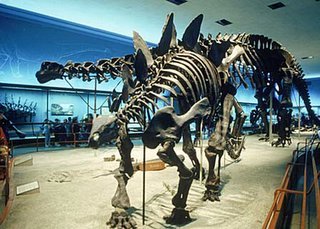
Improvement in argon-argon method pinpoints dinosaur demise with unprecedented precision.From the press release:


The ecology of Cambrian communities was remarkably modern, with networks of feeding relationships among marine species that lived hundreds of millions of years ago being remarkably similar to those of today.

The food web of the Burgess Shale from the Middle Cambrian; spheres represent species or groups of species, and the links between them show feeding relationships. The drawing shows a top predator, Anomalocaris, chasing one of its likely prey species, the trilobite Olenoides, with arrows indicating their positions in the food web. Image: N. D. MartinezThe researchers compiled data from the 505 million-year-old Burgess Shale in British Columbia, Canada and the even earlier Chengjiang Shale of eastern Yunnan Province, China, dating from 520 million years ago. Both fossil-rich assemblages are unusual because they have exquisitely preserved soft-body parts for a wide range of species. They determined who was eating whom by piecing together a variety of clues. There was the occasional smoking gun, such as fossilized gut contents in the carnivorous, cannibalistic priapulid worm Ottoia prolifica. However, in most cases, feeding interactions were inferred from where species lived and what body parts they had. For example, grasping claws, swimming lobes, big eyes, and toothy mouthparts suggest that Anomalocaris canadensis, a large, unusual organism with no modern descendents, was a formidable predator of trilobites and other arthropods, consistent with bite marks found on some fossils.
Researchers have published the most extensive survey to date of African mitochondrial DNA (mtDNA). Over 600 complete mtDNA genomes from indigenous populations across the continent show that these early human populations were small and isolated from each other for many tens of thousands of years.From the press release:


Most of us are happy to admit that we do not understand, say, string theory in physics, yet we are all convinced we understand evolution. In fact, as biologists are discovering, its consequences can be stranger than we ever imagined. Evolution must be the best-known yet worst-understood of all scientific theories.New Scientist presents 24 concise articles on various misconceptions about evolution and creationist myths HERE.
It will soon be 200 years since the birth of Charles Darwin and 150 years since the publication of On the Origin of Species, arguably the most important book ever written. In it, Darwin outlined an idea that many still find shocking – that all life on Earth, including human life, evolved through natural selection.
Darwin presented compelling evidence for evolution in On the Origin and, since his time, the case has become overwhelming. Countless fossil discoveries allow us to trace the evolution of today's organisms from earlier forms. DNA sequencing has confirmed beyond any doubt that all living creatures share a common origin. Innumerable examples of evolution in action can be seen all around us, from the pollution-matching pepper moth to fast-changing viruses such as HIV and H5N1 bird flu. Evolution is as firmly established a scientific fact as the roundness of the Earth.
And yet despite an ever-growing mountain of evidence, most people around the world are not taught the truth about evolution, if they are taught about it at all. Even in the UK, the birthplace of Darwin with an educated and increasingly secular population, one recent poll suggests less than half the population accepts evolution.
For those who have never had the opportunity to find out about biology or science, claims made by those who believe in supernatural alternatives to evolutionary theory can appear convincing. Meanwhile, even among those who accept evolution, misconceptions abound.

 developing phylogenetic systematics, a coherent theory of the investigation and presentation of the relations that exist among species. Contrary to the position generally held during his time, Hennig viewed historical inference as a strictly logical and scientific endeavor. He first summarized his ideas in 1950 in German which became more widely known with the publication of the English revision, Phylogenetic Systematics (Hennig, 1966).
1. Relationships among species are to be interpreted strictly genealogically, as sister-lineages, as clade relations. Empirically, a phylogenetic hypothesis may be determined.More info about Henning HERE. photo.
2. Synapomorphies provide the only evidence for identifying relative recency of common ancestry. Synapomorphies are understood to be the shared-derived (evolved, modified) features of organisms.
3. Maximum conformity to evidence is sought (his auxiliary principle). Choice among competing cladistic propositions (cladograms) is decided on the basis of the greatest amount of evidence, the largest number of synapomorphies explainable as homologues.
4. Whenever possible, taxonomy must be logically consistent with the inferred pattern of historical relationships. The rule of monophyly is to be followed, thereby each clade can have its unique place in the hierarchy of taxonomic names.
 He began is career making geologic maps of coalfields in Wales, noting the relationship between the underlying clay layers and fossil tree roots with local coal beds. This substantiated the theory that coal beds are formed in place.


“A rare Triceratops skeleton failed to find a buyer at a Christie's auction in Paris Wednesday after the top bid of 490,000 euros (782,000 dollars) fell short of the price sought by the dinosaur's owner. Christie's said it would over the coming two weeks still entertain post-auction offers for the massive three-horned dinosaur specimen that was the star attraction at the paleontology auction.
The auction on Wednesday marks the first time that such a dinosaur specimen has gone up for public sale since a T-Rex called "Sue" was sold in New York in October 1997. A sabre-toothed tiger cranium was sold for 72,000 euros, while a mammoth skull fetched 64,000 euros.
The auction has been criticized for encouraging private collectors to buy up artefacts of potential value to science. "This is part of our worldwide heritage," said Christian de Muizon, from the National Museum of Natural History in Paris.”

A new study of Moeritherium teeth suggests that it was semi-aquatic, eating freshwater plants and dwelling in swamps or river systems.From National Geographic News:

The world's oldest recorded tree is a 9,550 year old spruce in the Dalarna province of SwedenFrom the press release:
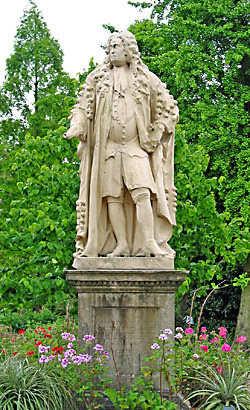
 manuscripts, and curiosities formed the basis for the British Museum in London. By the time he died, Sloane had amassed one of the world's largest and most varied collections of natural history specimens. His passion for the collection and his concern for its future upkeep after his death led him to write a will which clearly stated that it must "remain together and not be separated."
 be older than suggested by the Bible. In 1739 he was appointed keeper of the Jardin du Roi, a post he occupied until his death. There he worked on a comprehensive work on natural history, for which he is remembered, Histoire naturelle, générale et particulière. He began this work in 1749, and it dominated the rest of his life. It would eventually run to 44 volumes, including quadrupeds, birds, reptiles and minerals. He proposed (1778) that the Earth was hot at its creation and, from the rate of cooling, calculated its age to be 75,000 years, with life emerging some 40,000 years ago.
The fearsome Komodo dragon is the world's largest living lizard and can take very large animal prey: now a new international study has revealed how it can be such an efficient killing machine despite having a wimpy bite and a featherweight skull.From the press release:


"What truly assured Cope's (above right) place in the history of paleontology and even eclipsed his science was his bitter feud with Yale University paleontologist O.C. Marsh (above left). What began as a friendly rivalry in the late 1860s, broke out into all out war in 1872 and then raged on until Cope's death in 1897. Both Cope and Marsh were recipients of family fortunes and they used their wealth to discover new fossils and to reconstruct ancient life. This scramble literally propelled American science into the forefront of paleontology."Read about Cope HERE.


The figured topology and branch lengths are for the sampled tree with the highest likelihood (1,000 searches, log likelihood = –796,399.2). Support values are derived from 1,000 bootstrap replicates. Leaf stabilities are shown in blue above each branch. Taxa for which we collected new data are shown in green.Many relationships remain disputed, including those that are required to polarize key features of character evolution, and support for deep nodes is often low. Phylogenomic approaches, which use data from many genes, have shown promise for resolving deep animal relationships, but are hindered by a lack of data from many important groups.

One of the steps in turning genetic information into proteins leaves ‘genetic fingerprints’, even on regions of the DNA that are not involved in coding for the final protein. They estimate that such fingerprints affect at least a third of the genome, suggesting that while most DNA does not code for proteins, much of it is nonetheless biologically important – important enough, that is, to persist during evolution.To gauge how critical a particular stretch of DNA is, biologists often look at the detailed sequence of “letters” it consists of, and compare it with a corresponding stretch in related creatures like mice. If the stretch serves no purpose, the thinking goes, the two sequences will differ because of numerous mutations since the two species last shared an ancestor. In contrast, it’s believed that the sequences of important genes will be similar, or “conserved,” in different species, because animals with mutations in these genes did not survive. Biologists therefore regard conserved sequences as a sign of biological importance.


In a report at the 235th national meeting of the American Chemical Society, Ronald Breslow, described how our “left-handed” amino acid signature came from outer space.


 an International Congress that will focus on "Vertebrate palaeobogeography across Tethys, Mesogea, and the Mediterranean Sea" to be held on 28-29 September 2009.

In the first experiment of its kind conducted in nature, an evolutionary biologist has come up with strong evidence for one of Charles Darwin’s cornerstone ideas – adaptation to the environment accelerates the creation of new species.From the press release: