Sunday, January 08, 2006

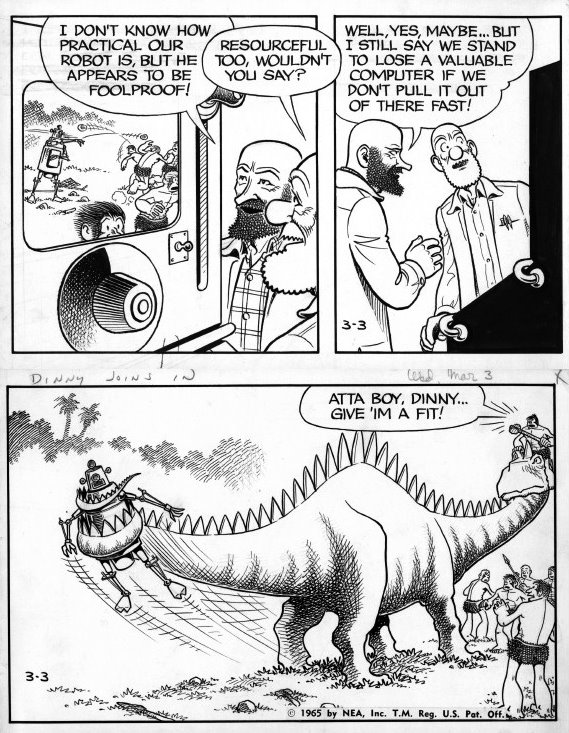
Classic Alley Oop


Alley Oop from The Holloway Pages.

Born This Day: Alfred Russel Wallace

Jan. 8, 1823 – Nov. 7, 1913

From Today In Science History:

Wallace was a British naturalist and biogeographer. He was the first westerner to describe some of the most interesting natural habitats in the tropics. He is best known for devising a theory of the origin of species through natural selection made independently of Darwin.

Between 1854 and 1862, Wallace assembled evidence of natural selection in the Malay Archipelago, sending his conclusions to Darwin in England. Their findings were jointly presented to the Linnaean Society in 1858. Wallace found that Australian species were more primitive, in evolutionary terms, than those of Asia, and that this reflected the stage at which the two continents had become separated. He proposed an imaginary line (now known as Wallace's line) dividing the fauna of the two regions.

The Alfred Russel Wallace page HERE. More HERE.

Saturday, January 07, 2006

Cats Climb New Family Tree


Top Cat from HERE.

The Late Miocene Radiation of Modern Felidae: A Genetic Assessment. W. E. Johnson et al. Science vol. 311: 73-77.

Abstract: Modern felid species descend from relatively recent (<11 million years ago) divergence and speciation events that produced successful predatory carnivores worldwide but that have confounded taxonomic classifications. A highly resolved molecular phylogeny with divergence dates for all living cat species, derived from autosomal, X-linked, Y-linked, and mitochondrial gene segments (22,789 base pairs) and 16 fossil calibrations define eight principal lineages produced through at least 10 intercontinental migrations facilitated by sea-level fluctuations. A ghost lineage analysis indicates that available felid fossils underestimate (i.e., unrepresented basal branch length) first occurrence by an average of 76%, revealing a low representation of felid lineages in paleontological remains. The phylogenetic performance of distinct gene classes showed that Y-chromosome segments are appreciably more informative than mitochondrial DNA, X-linked, or autosomal genes in resolving the rapid Felidae species radiation.

From Shaoni Bhattacharya at New Scientist.com comes this article:
Despite their occasional fierceness, the domestic cat diverged from its “roaring” cousins, such as lions, jaguar and tigers, 10.8 million years ago – just after the evolution of the ancestor of all modern cats. The revelation comes from a thorough new genetic analysis of the cat family tree.
Cats are “one of the world’s most successful carnivore families, inhabiting all continents except Antarctica”, say the researchers, but modern species evolved only relatively recently – about 11 million years ago.

Originating in Asia, they successfully traversed and colonized the globe, with the periodic rise and fall of the sea level facilitating their spread and evolution into new species, the new study suggests. The cat family tree has been notoriously difficult to decipher because there are few dated cat fossils and because most of today’s species appeared so recently.

Johnson’s team managed to piece together a tree by analysing DNA sequences from the 37 living cat species. They used DNA from the sex chromosomes, X and Y, and from mitochondria – structures in the cell which provide energy and are inherited only via the mother.

They suggest that after modern cats arose in Asia, the eight main lineages diverged during the course of at least 10 migrations across continents. The felines used geographical features such as the Bering land bridge, which once connected Eurasia to North America, and the Panamanian land bridge, connecting North and South America, to spread across the world. The team also suggests that 60% of the modern species arose in just the last million years.
Friday, January 06, 2006

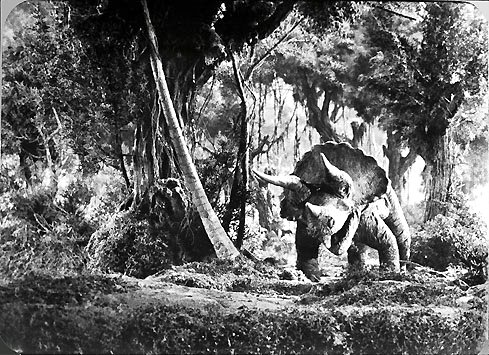
Kong’s Triceratops


Dan Varner sent along the above picture. It’s a Triceratops built by Marcel Delgado for Willis O’Brien’s aborted film project, “Creation”. A ceratopsian was, apparently, in the script for the original King Kong but was never filmed. Peter Jackson and his crew of skilled technicians created a new one that can be seen in the new spider pit sequence that Jackson did for the bonus features of the recently released 1933 King Kong DVD package.

Check out Dan’s art at www.oceansofkansas.com.

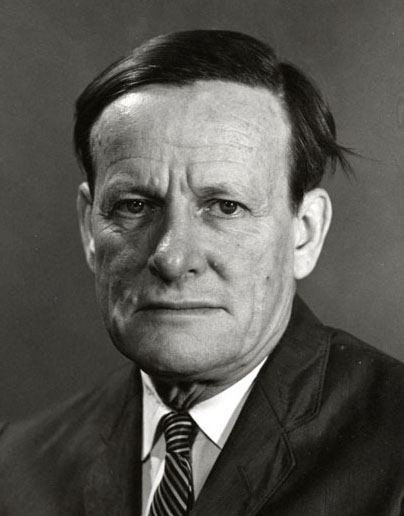
Born This Day: George Ledyard Stebbins

Jan. 6, 1906 - Jan. 19 2000.

From the University and Jepson Herbaria, U of California, Berkeley:

Along with Dobzhansky (1900 - 1975), animal systematist Ernst Mayr, and paleontologist George Gaylord Simpson (1902 - 1984), Stebbins is considered one of the "architects" of the modern evolutionary synthesis of the 1930s and 1940s, an intellectual watershed and historic turning point that brought together research in cytology, genetics, systematics, paleontology into a common evolutionary framework. This synthesis, which had the effect of reconciling the often opposing views of laboratory-oriented geneticists and natural history oriented systematists, made Charles Darwin's theory of evolution by natural selection the centerpiece of the new discipline of evolutionary biology.

In this role, Stebbins is credited with bringing a modern framework to the study of plant evolution, and he is perhaps best known for his book Variation and Evolution in Plants, published by Columbia University Press (NY) in 1950. In the 1940s, Stebbins also played an important role in organizing the nascent Society for the Study of Evolution, of which he became the third president in 1948, and used his position to speak out for the botanical side of evolutionary studies, a field that had been dominated by zoologists.

Photo from HERE.
Revised direct radiocarbon dating of the Vindija G1 Upper Paleolithic Neandertals. 2006. T. Higham et al. Proceedings of the National Academy of Sciences, published on-line Jan. 5.


From the Washington University at St. Louis press release:

Two Neandertal fossils excavated from Vindija Cave in Croatia in 1998, believed to be the last surviving Neandertals, may be 3,000-4,000 years older than originally thought.

The resultant ages are between 32,000 and 33,000 years ago, and perhaps slightly older. In 1998, the fossils had been radiocarbon dated to 28,000-29,000 years ago.

Since that time, the increasing application of direct radiocarbon dating to late Neandertal and early modern human fossils in Europe has greatly altered perceptions of the chronological relationships between Neandertals and modern humans during the time that the latter spread westward across Europe.

In particular, it has shown that many of the purportedly early modern human fossils are much more recent, while confirming the early ages of important fossil samples in central and eastern Europe. This work has been combined recently with refinements in the sample purification techniques for the radiocarbon dating bone and teeth, to provide more accurate, and usually older, dates for important fossil specimens.

H2 OK For 3416 Ma Microbes

Hydrogen-based carbon fixation in the earliest known photosynthetic organisms. 2006. M. M. Tice and D. R. Lowe. Geology: Vol. 34: 37–40.


Buck Reef Chert from HERE.

Abstract: Thin carbonaceous laminations preserved in shallow-water facies of the 3416 Million year old Buck Reef Chert, South Africa, have been interpreted to represent some of the oldest-known mats constructed by photosynthetic microbes. Preservation of these mats within a unit containing facies deposited at water depths ranging from 0 m to >200 m provides an opportunity to explore the electron donors employed in early microbial photosynthesis. The presence of siderite (FeCO3) as a primary sediment, lack of hematite (Fe2O3), and lack of cerium anomalies throughout the Buck Reef Chert imply that the entire water column was anoxic despite the presence of photosynthetic organisms.

Authigenic uranium (Ua = U–Th/3) correlates inversely with siderite abundance, suggesting that variations in carbonate rather than oxygen activity controlled uranium mobility. The inferred lack of oxygen and ferric minerals and the presence of dissolved Fe2+ in the water column imply that H2O, Fe2+, and H2S could not have served as primary electron donors for carbon fixation. It is most likely that Buck Reef Chert bacteria utilized H2 as the primary reductant for photosynthesis.

Thursday, January 05, 2006

Searching For Ancient Life On Mars

Search for past life on Mars: Physical and chemical characterization of minerals of biotic and abiotic origin: 1. Calcite. 2005. Fabien Stalport et al. Geophysical Research Letters vol. 32


During the first hundred million years of its history, Mars likely had a denser atmosphere, milder temperatures, and liquid water on its surface, leading astrobiologists to hypothesize that life once existed on that planet. However, the Viking landers missions found that Martian soil was depleted in organic molecules. Stalport et al. suggest that while these organic compounds might have short residence times in Martian soil, inorganic compounds could yield clues about the possibility that life had existed on Mars.

Noting that calcite can be formed by biomineralization, the authors sought to identify differences between 12 terrestrial calcite samples formed through biotic, abiotic, and diagenetic [biological, nonbiological, and compaction, etc.] mechanisms, the latter occurring as biomineralized [minerals absorbed into biological organisms] calcite metamorphoses into calcite that has lost fossil traces. Along with chemical compositions, biotic and abiotic calcites were analyzed for their ability to withstand high temperatures.

The authors found that biotic and diagenetic calcites contained quartz, feldspar, and magnesium impurities, while abiotic calcite contained no impurities. Moreover, abiotic calcite was the most resistant to thermal degradation.

The authors expect that their results will help guide on-site or sample-return studies of Martian minerals, to determine whether Martian carbonates contain biological signatures.

Ward Kimball(?) art from www.vintagetips.com.

Thai Rice Field Yields Mammal Fossils


© Paprikaas Animation Studios.

From Stefan Lovgren at National Geographic News comes this article:

Fossils from the prehistoric elephant-like Stegodon have been found in a rice field in a province three hours from Bangkok. Other specimens were also found deposited in a thin layer of fine gravel and sand mixed with organic matter about 5 meters below the surface, including skulls of a gavial (a crocodile-like reptile) and a spotted hyena, deer antlers, and a buffalo horn. The fossils are believed to be about 400,000 years old.

"I've never seen such a community of large mammals in one excavation," said Yaowalak Chaimanee, a government paleontologist.

The discovery may shed new light on the distribution of prehistoric species, including human ancestors, in the region. The site documents a period when Thailand had a more temperate climate, attracting animals from India and China.

"These southward distribution shifts are important to understand and date, because they may also explain the southward spread of Homo erectus populations and later … Homo sapiens," Yaowalak said. Scientists believe that, similar to the southward migration of mammals such as the Stegodon, populations of Homo erectus may also have moved south in Asia at one point.

Read the original article HERE.

Wednesday, January 04, 2006

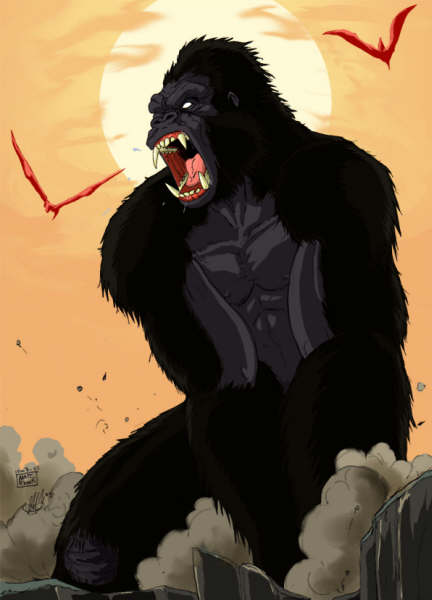
Kong Come Home

“Timmy’s fallen down the well, Kong! Go get help!”


Poster from www.impawards.com.

One of the new international posters for Jackson's King Kong.

Reversing Quagga Extinction


Painting by Franz Roubal, 1931.

Jon Lackman at Slate.com has this article on one man’s quest to resurrect an extinct mammal:

In what would be an unprecedented feat, a South African amateur scientist says he is going to bring an animal back from extinction: the quagga. A large mammal that descended from the zebra, the quagga filled South Africa's plains for millennia. But it fell to gun-toting European colonists and was last seen alive in 1883.

Reinhold Rau seems to be getting close to his goal with his latest foal, Henry (below), a grandchild and a great-grandchild of his original zebras. Henry's coloring and his stripes—faint, narrow, and few—strongly resemble 19th-century quagga. Alas, some stripes still remain on Henry's hocks, where quagga didn't have them. But one can imagine that one of Henry's children could be a full-fledged quagga.


© Quagga Project Association, South Africa.

How do you reverse extinction? And what is a quagga, anyway? Watch the slide show HERE to find out.

Find outmore about The Quagga Project HERE.

Tuesday, January 03, 2006

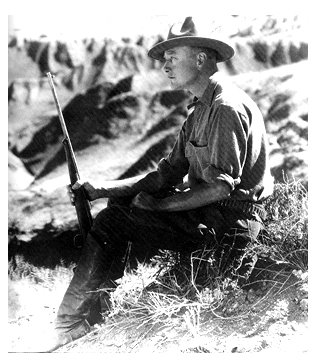
New Roy Chapman Andrews Site

WHALES, CAMPS & TRAILS
An Exploration of The Life & Work of
Roy Chapman Andrews 1884 - 1960


Photo © Natural History Museum, London.
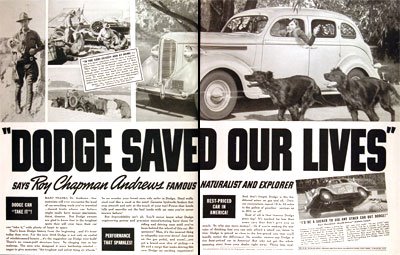
www.whalescampsandtrails.com is a new website set up by the palaeoblogger’s old friend & former Tyrrellite, Clive Coy, where you can discover and explore the fascinating life & times of the American naturalist, explorer and author, Roy Chapman Andrews.

While Indiana Jones is a creation of Hollywood, Roy Chapman Andrews was the flesh and blood equivalent. He actually did fight off a plague of poisonous snakes, sand storms, bandits, hostile armies in remote corners of the world, and was every bit as ruggedly photogenic as Harrison Ford.


Ad from HERE.

Andrews led a remarkable life, a quintessential American success story, beginning his career at the American Museum of Natural History mopping floors, retiring 35 years later as its Director. Expeditions led by Andrews to Korea, Northern China and Mongolia explored and mapped lands previously unknown to Westerners, discovered many new living animals, fossil mammals, dinosaurs, and the first dinosaur eggs described by science. All of these remarkable accomplishments by the time Andrews was 39 years old.

Visit the site HERE.

New Mammal Named After Chocolate Giant

A Tachyglossid-Like Humerus from the Early Cretaceous of South-Eastern Australia. 2005. P. A. Pridmore, et al. Journal of Mammalian Evolution, Vol. 12: 359 – 378.


Dinosaur Cove from HERE

From Hillary Mayell at National Geographic News comes this article:
A lost bet and a sweet tooth led to the announcement this week of a new mammal named after a chocolate brand.
Dubbed Kryoryctes cadburyi—as in Cadbury chocolate—the dinosaur-era mammal was roughly the size of a large cat, covered with quills, and toothless.

A distant relative of today's spiny anteater, the species lived about 106 million years ago alongside dinosaurs in what is now Australia. The material was recovered from Dinosaur Cove by Tom Rich and colleagues about 220 km southwest of Melbourne.

Rich had promised a cubic meter [35 cubic feet, or about a ton] of chocolate to anyone who came up with a mammal specimen. A single tiny mammal humerus was eventually indentified back in the lab.

Rich was thrilled that the dig had turned up an ancient mammal but somewhat dismayed at having to come up with a ton of chocolate, worth about U.S. $10,000. Fortunately, Cindy Hann, a teacher and volunteer from the Dinosaur Cove dig, came to his rescue. Hann had taught a boy whose father was the head of the Cadbury factory in Melbourne. He offered to make good on the chocolate bet.

"It turns out that it is technically impossible to make a cubic meter of chocolate, because the center would never solidify," Rich said. So the chocolate factory made a cubic meter of cocoa butter, the basis of all chocolate.

Because there was no way of knowing who had actually found the bone, Rich invited all of the volunteers who had participated in the Dinosaur Cove dig to the presentation of the prize at a local Cadbury chocolate factory.

After photos were taken of the giant slab of cocoa butter, the bone diggers were let loose in a room full of chocolate bars. "It was a bit like Willy Wonka," Wilson said. "There were chocolate bars on the counters, the tables. We carried out boxes and boxes of chocolate."

No Crunchy Frog though.

Read the original article HERE.

Monday, January 02, 2006

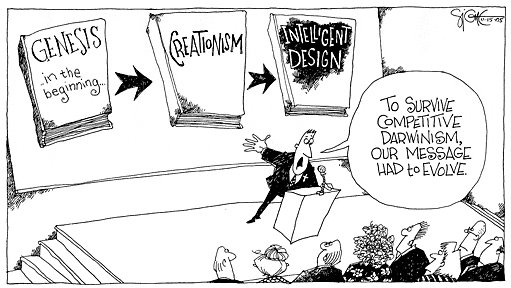
What Does 'I.D.' Stand For?


© Mike Luckovich

David Smillie in the Toronto Star has a great article on ‘intelligent design’. Here are a few excerpts, but it’s worth reading the whole thing:
“Our bodies are filled with similar examples of poor design. Why would an intelligent designer equip each of us with an appendix — an organ whose sole purpose is to become infected and periodically explode? If this was Intelligent Design, then it implies the designer hates us the way many interior designers hate the people who actually live in their creations.”

“First, ID could stand for Incompetent Design. Like the cousin you hired to build an addition to your house, this Designer simply wasn't up to the job. Which means the Designer can't be all-knowing (we wouldn't have had any flaws) or all-powerful (the flaws would have been fixed by now).

But what would it do to mainstream religion to teach students their creator was someone who just didn't do a very good job? A nice enough deity maybe, but not the sharpest knife in the drawer? I can't see hundreds of millions lining up to worship a second-rate creator.

Second, ID could stand for Infernal Design. Not to get needlessly Zoroastrian, but a lot of our design flaws make more sense if we assume we were created by someone who doesn't much like us and wants us dead. Which means that by worshipping the Designer, we're actually worshipping the bad guy.

There is a third possibility that comes to mind. ID could stand for Incomplete Design. What if the Designer is just beta-testing us to identify the bugs before rolling out Homo sapiens 2.0? Sure, we have lives that are nasty, brutish and short, but the designer doesn't really care and we have to muddle through so He can come up with something better for the next roll-out. And we're powerless to complain, because the Designer has a monopoly. I call this the "God as Microsoft" option.”
© Signe Wilkinson

Sunday, January 01, 2006

Bissette on Kong


The palaeoblogger hasn’t seen the new Kong movie, but ‘Sturdy’ Steve Bissette has and he’s impressed. Steve has done a great multi-part essay over at his MyRant blog that covers more aspects of the film and its history than you can shake a throttled pterydactyl at.

Steve probably knows more about film history than any other 10 people put together and has contributed many reviews & essays to newspapers & magazines too numerous to mention. His daily ‘rant’ is always worth a read.

You can go directly to his in-depth 'Off To Skull Island' essays on King Kong through these links:

Part the 1st: The S.S. Venture Sets Sail.
Part the 2nd: Harryhausen, O’Brien, & CGI .
Part the 3rd: Gargantua, Serkis & Kong.
Part the 4th: “Suspension of Disbelief”.
Part the 5th & Final: Black vs. Denham.

Note that Steve speaks his mind and therefore his site comes with a mild language warning. I don't agree with everything Steve says (or how he says it) but anything he writes is entertaining and informative!


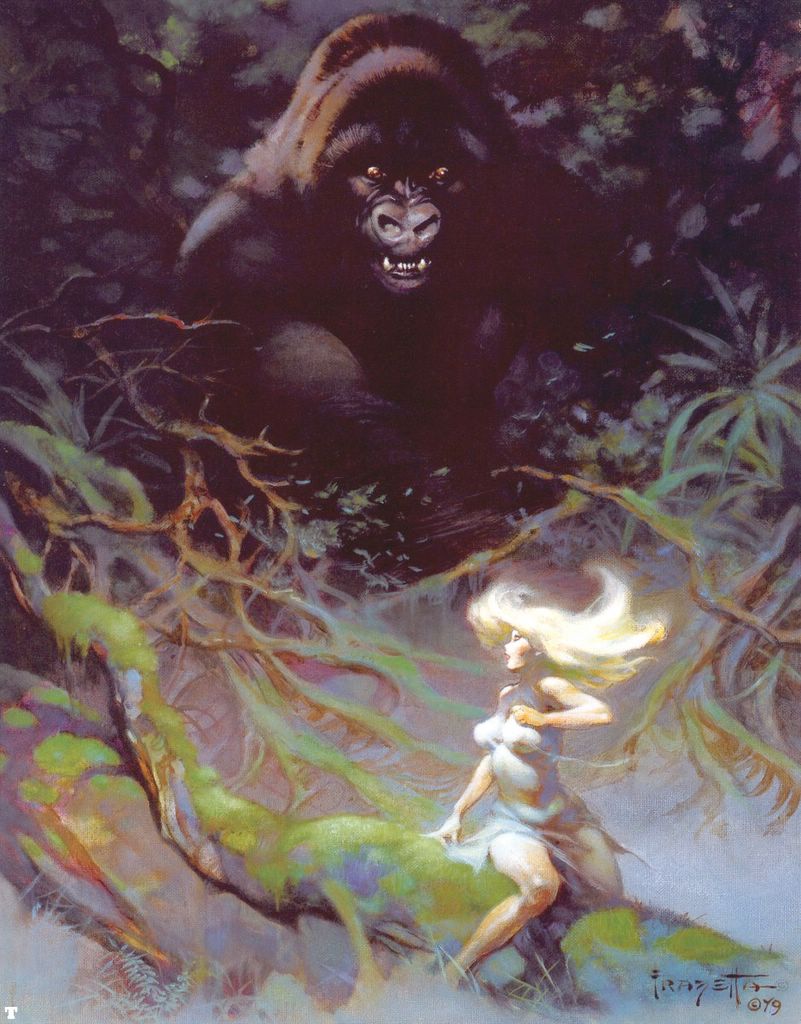
Art © Frank Frazetta

Earlier in 2005 Steve did a multi-part ‘Paleo-Path’ on the history of dinosaurs in the comics right here at the Palaeoblog.

You can go directly to all the entries via this link to the Paleo-Path Archives.

And, Steve is also co-teaching with Walter Ungerer a two-week University of Vermont on-line film class entitled, "Ways Of Seeing: Film as Art" which I’m sure is worth checking out.

Saturday, December 31, 2005

Marsupial Tooth Bolsters Land Bridge


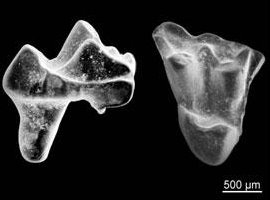
The upper right molar of the 66-million year old herpetotheriid marsupial, Maastrichtidelphys meurismeti. Photo courtesy Judd Case.
From ContraCosta.com comes this article:
The recent discovery of a 66-million-year-old marsupial tooth in the Netherlands provides fresh proof that a land bridge connected the North American and European continents during the age of dinosaurs.
St. Mary's College dean of science Judd Case and his colleague James Martin say the 2-millimeter fossil, which belongs to a newly discovered, extinct species, Maastrichtidelphys meurismeti, similar to an opossum, suggests that dinosaurs and small marsupials not only lived in Europe at the same time, but also traveled the same trans-Atlantic migration route from South Dakota to the Netherlands.

Taken together with other, recent finds of North American-type duck-bill dinosaurs and certain types of snakes in Northern Europe, it appears that animals used temporary land bridges to travel across the high polar latitudes 10 million years earlier than paleontologists had thought. The tooth may be tiny, said Case, but it will have a major impact on scientists' views of Cretaceous climate, geography and life.

Earth's geography was very different back then, said Case. The Atlantic was only half as wide. Sea levels were lower -- and significantly lower at two points, around 71 and 67 million years ago. And continents were connected. Case and Martin believe animals hopped from land mass to land mass above the 70-degree latitude line.

The discovery of a North American marsupial and duck-billed dinosaurs in Maastricht indicates that the polar crossing was no chilly experiment, but a temperate migration path in a world filled with new, flowering plants.

Friday, December 30, 2005

Unified Physics Theory Explains Constraints On Evolution

Unifying constructal theory for scale effects in running, swimming and flying. 2006. Adrian Bejan and James H. Marden. Journal of Experimental Biology, vol 209: 238-248.


Gamera from HERE.

Abstract: Biologists have treated the view that fundamental differences exist between running, flying and swimming as evident, because the forms of locomotion and the animals are so different: limbs and wings vs body undulations, neutrally buoyant vs weighted bodies, etc. Here we show that all forms of locomotion can be described by a single physics theory. The theory is an invocation of the principle that flow systems evolve in such a way that they destroy minimum useful energy (exergy, food). This optimization approach delivers in surprisingly direct fashion the observed relations between speed and body mass (Mb) raised to 1/6, and between frequency (stride, flapping) and Mb-1/6 and shows why these relations hold for running, flying and swimming. Animal locomotion is an optimized two-step intermittency: an optimal balance is achieved between the vertical loss of useful energy (lifting the body weight, which later drops), and the horizontal loss caused by friction against the surrounding medium. The theory predicts additional features of animal design: the Strouhal number constant, which holds for running as well as flying and swimming, the proportionality between force output and mass in animal motors, and the fact that undulating swimming and flapping flight occur only if the body Reynolds number exceeds approximately 30. This theory, and the general body of work known as constructal theory, together now show that animal movement (running, flying, swimming) and fluid eddy movement (turbulent structure) are both forms of optimized intermittent movement.

From the Duke University press release:
A single unifying physics theory can essentially describe how animals of every ilk, from flying insects to fish, get around since all animals bear the same stamp of physics in their design.
Researchers claim that so-called "constructal theory" can explain basic characteristics of locomotion for every creature -- how fast they get from one place to another and how rapidly and forcefully they step, flap or paddle in relation to their mass. Constructal theory is a powerful analytical approach to describing movement, or flows, in nature.
The findings challenge the notion that fundamental differences between apparently unrelated forms of locomotion exist. The findings also offer an explanation for remarkable universal similarities in animal design that had long puzzled scientists, the researchers said.

"From simple physics, based only on gravity, density and mass, you can explain within an order of magnitude many features of flying, swimming and running," said James Marden, professor of biology at Penn State. "It doesn't matter whether the animal has eight legs, four legs, two, even if it swims with no legs."

The findings may have implications for understanding animal evolution, Marden said. One view of evolution holds that it is not a purely deterministic process; that history is full of chance and historical contingency. It is the idea purported by Steven Jay Gould and others that if you were to "rewind the tape" and run it again, evolution would proceed down a different path, Marden said.


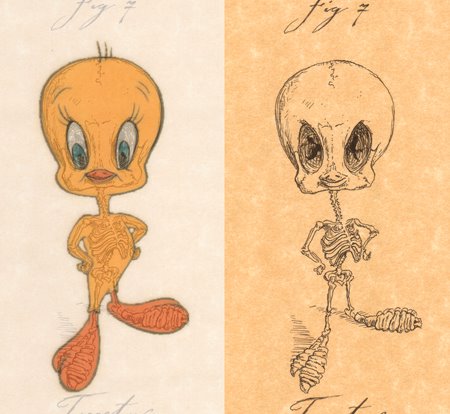
Fictional avian theropod, Tatisawapudycatus jonesi, by Michael Paulus from www.michaelpaulus.com.

"Our finding that animal locomotion adheres to constructal theory tells us that -- even though you couldn't predict exactly what animals would look like if you started evolution over on earth, or it happened on another planet -- with a given gravity and density of their tissues, the same basic patterns of their design would evolve again," Marden said.

Read the rest of the story HERE.

Where Is Animal X!?


Art © William Stout.

The Society for Animal X is a group trying to right a terrible wrong. There's no animal with a [common] name that starts with "X," thereby creating a nasty void in alphabet books. So they're going to find one.

Thanks to Mark Evanier and his Newsfromme.com site for the head’s up on this.


Art © estate of Vaughn Bode. Click image to enlarge.

China First To Collect Dino Fossils?

From the People’s Daily On-Line comes this report:

China was probably the first country in the world to collect dinosaur fossils, a scientist has said.

"The Yue Kingdom in today's southeastern China had dinosaur fossils in 494 B.C.," said Sun Erhu, a research fellow with the Chengdu Institute of Biology under the Chinese Academy of Sciences.

In that year, the invading Wu Kingdom sieged Yue Kingdom's capital Kuaiji and captured a "mammoth skeleton" that had to be carried with a cart, according to "Shi Ji", or Historical Records, compiled by famous Chinese historian Sima Qian. "I bet the skeleton was actually a dinosaur fossil," Sun said after years of research. "The kingdom of Wu thought it was priceless and asked the most knowledgeable people to evaluate it."

Sun said he read about such "mammoth skeletons" in earlier historical documents, too, and guessed these were the world's earliest collections of dinosaur fossils. "Most of them were captured during wars and were collected by the kings as treasures."


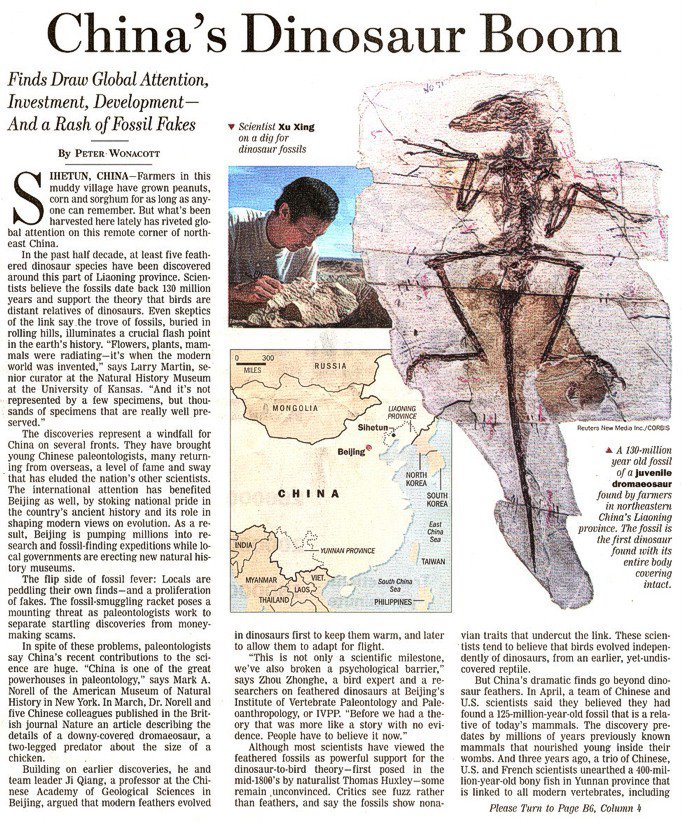
Wall Street Journal, May 13, 2002 from HERE.
Read the rest of the article HERE.

Wednesday, December 28, 2005

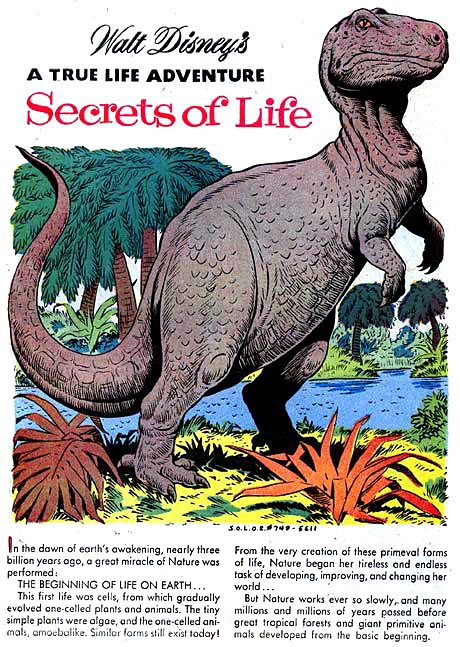
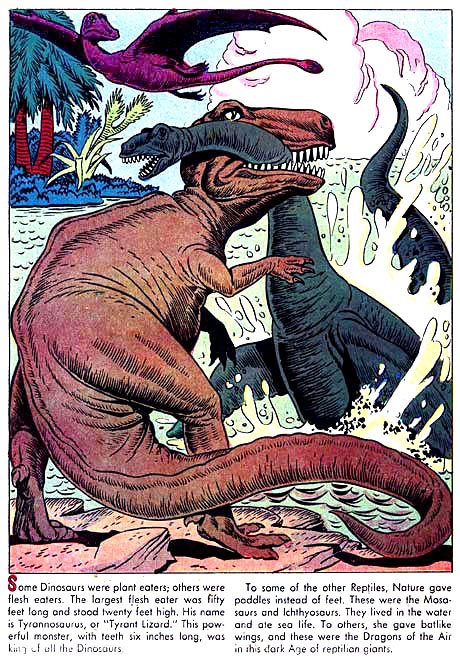
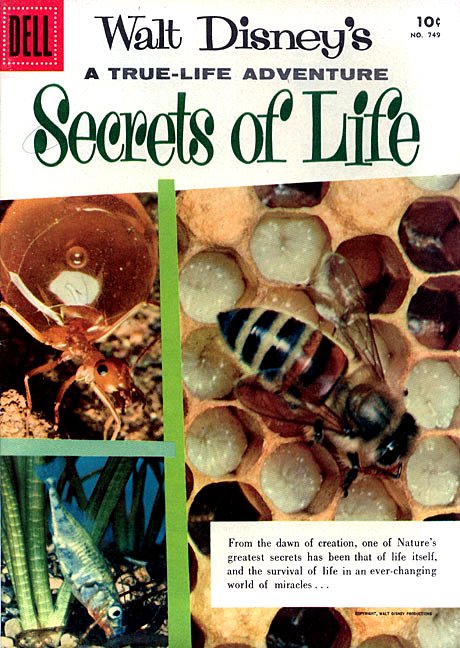
Secrets Of Life


This comic is based on SECRETS OF LIFE, a 1956 feature-length film in WALT DISNEY'S TRUE-LIFE ADVENTURES Academy Award-winning series of nature documentaries. This 33-page adaptation of the feature-length documentary opens with a splash-page depicting an Allosaurus. Then we're shown the origins of life on primitive Earth, with prehistoric invertebrates such as trilobites, scorpions and giant cockroaches.

As land-life flourishes, we're treated to shots of dinosaurs, including an improbable battle (below) between a Tyrannosaurus rex and a sea-going Pleisosaurus. Finally, we see the development of birds (this comic was produced decades before theories about feathered dinosaurs) and mammals, such as the saber-toothed Smilodon.


A back-cover summary of the contents of WALT DISNEY'S SECRETS OF LIFE, which reads:"Thus does Nature show us that in any small part of her broad world maybe seen and explored some of her many Secrets of Life - those strange and ingenious talents for survival with which she has equipped the life she created, whether they be found on the fantastic floor of her oceans, high on her frozen mountain peaks, above her earth or under its crust…or revealed to us in a single fragile flower and one tiny Honeybee."
All the above is from the Oddball Comics site of Scott Shaw!

Tuesday, December 27, 2005

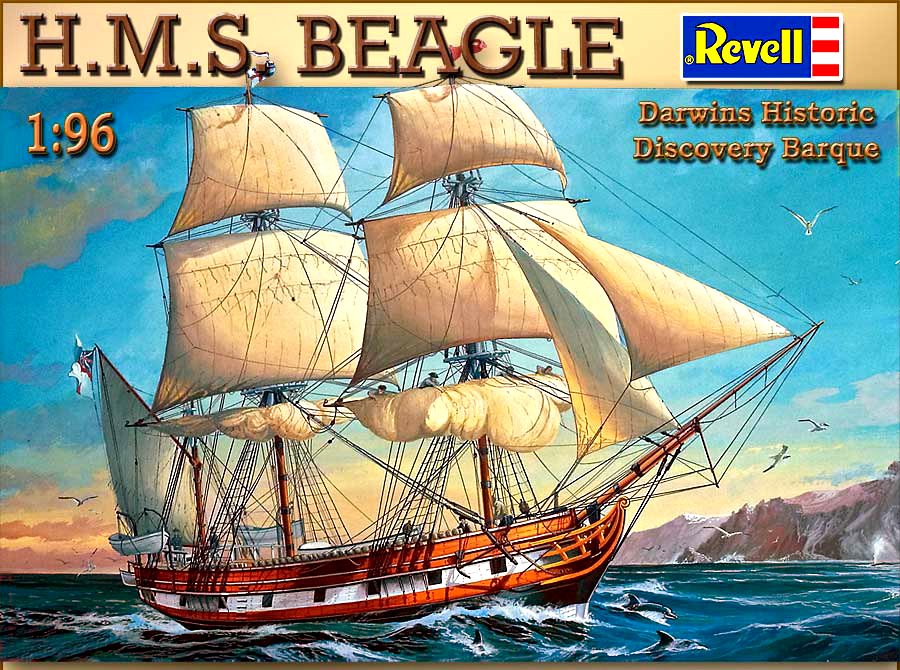
Set Sail Today: HMS Beagle


Image from HERE.

From Today In Science History:

In 1831, Charles Darwin set sail from Plymouth harbour on his voyage of scientific discovery aboard the HMS Beagle, a British Navy ship. The Captain Robert FitzRoy was sailing to the southern coast of South America in order to complete a government survey. Darwin had an unpaid position as the ship's naturalist, at age 22, just out of university.

Originally planned to be at sea for two years, the voyage lasted five years, making stops in Brazil, the Galapogos Islands, and New Zealand. From the observations he made and the specimens he collected on that voyage, Darwin developed his theory of biological evolution through natural selection, which he published 28 years after the Beagle left Plymouth.


The path of The HMS Beagle. © Pearson Education, Inc. Click to enlarge.

Dawn's Dinos


Photos © Dawn Crawford. Click to enlarge.

While I'm catching up on stuff here are some photos I should have run weeks ago!

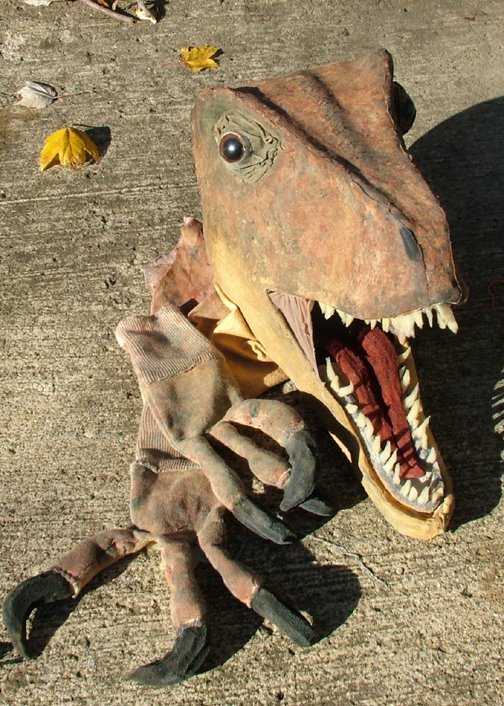
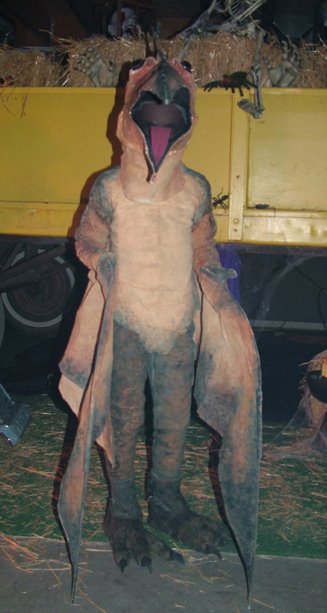
With a lot of imagination and time, palaeoblog reader Dawn Crawford made this Velociraptor costume for her 7 year old son to wear last October 31st. It was created with commonly found items and an airbrush.

Dawn says, "He had a blast wearing it and showing it off at Halloween parties."

Thanks for sending in the photos Dawn!

New Titanosaur Found

From Yahoo.news come this news:

Argentine paleontologists have discovered the largely intact skeleton of a young Titanosaurus that lived 71 million years ago.

"What's extraordinary about this is that the remains were articulated, as if the animal had fallen or lain down and remained that way. There were no signs that it was preyed on," local media reported geologist and paleontologist Bernardo Gonzalez Riga as saying.

Scientists discovered the remains of a foot "with all its toes and claws in an exceptional state of preservation," as well as the complete rear bones, tail, "and part of the pelvis," Gonzalez said. While the skeleton is almost complete from ribs to tale, there is no sign of the head and neck, which were likely washed away over the millennia, said Gonzalez.

Such finds are rare, said Gonzalez, adding that there are only one or two Titanosaurus in the world with complete feet. Gonzalez is a professor at Cuyo University, one of two universities with teams that excavated the remains.

An initial examination of the remains suggest a small young Titanousaurus about 10 meters long that weighed about 12 tons. The giant herbivores, which grew up to 35 meters long, lived during the late Cretaceous period (83-65 million years ago).

Monday, December 26, 2005

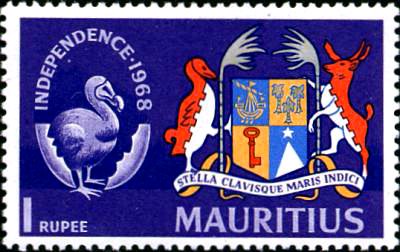
Dodo Graveyard Found In Mauritius


Stamp from HERE.

From BBC.co.uk comes this report:
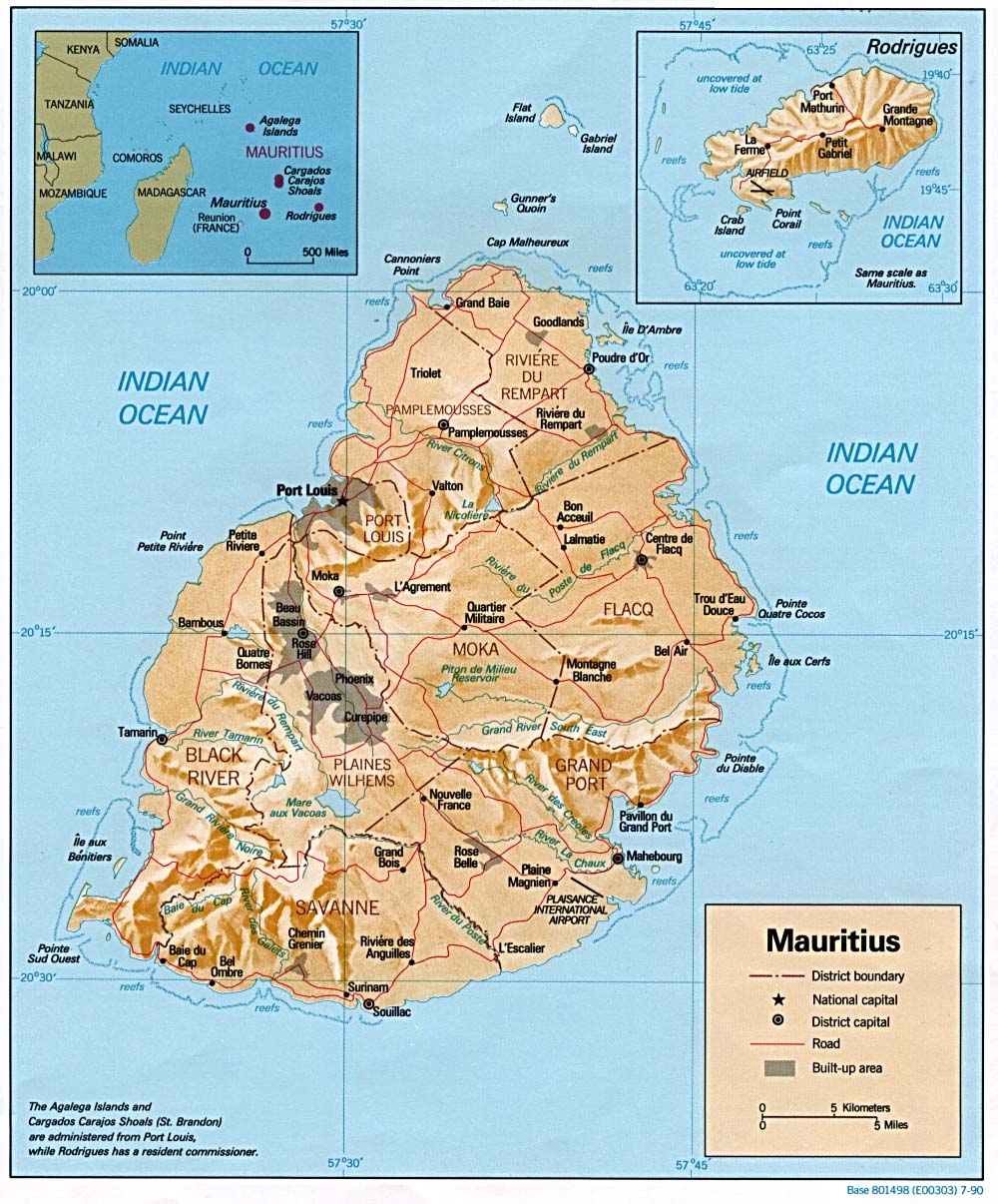
Scientists have discovered the "beautifully preserved" bones of about 20 dodos at a dig site in Mauritius.
Little is known about the dodo, a famous flightless bird thought to have become extinct in the 17th century. No complete skeleton has ever been found in Mauritius, and the last full set of bones was destroyed in a fire at a museum in Oxford, England, in 1755.

Researchers believe the bones are at least 2,000 years old, and hope to learn more about how dodos lived. A team of Dutch and Mauritian scientists discovered the bones in a swampy area near a sugar plantation on the south-east of the island. Dutch geologist Kenneth Rijsdijk, who led the dig, said DNA samples from the dodo bones could revolutionise understanding of how the birds lived.

The dodo was mocked by Portuguese and Dutch colonialists for its size and apparent lack of fear of armed, hungry hunters. It took its name from the Portuguese word for "fool", and was hunted to extinction within 200 years of Europeans landing on Mauritius.

The Art of Matt Frank


One of the Palaeoblog's many readers is Matt Frank. Matt is an art student at the University of Texas who shows great promise, so I’m pleased to present a few of his pieces.

You can see more art at Matt’s Gallery HERE.

If anyone needs an artist, and you like what you see, contact Matt at mattfrank85@hotmail.com


All art © Matt Frank

Sunday, December 25, 2005

Why Your Christmas Tree Is Not Extinct


Torus-Margo Pits Help Conifers Compete with Angiosperms. 2005. J. Pittermann, et al. Science 310: 1924.

From the University of Utah press release:

Conifers such as Christmas trees suffer a severe plumbing problem. The "pipes" (single-celled conduits called tracheids) that carry water through firs, pines and other conifers are 10 times shorter than those in flowering trees. But a University of Utah study suggests why conifers not only survive but thrive: efficient microscopic valves let water flow through conifers about as easily as it flows through other trees.

"When you are sitting around and admiring your Christmas tree, consider that it owes its existence in part to this clever microscopic valve," says John Sperry, a University of Utah biology professor who led the research team. "Without these valves, conifers could be much less common than they are, and conceivably their survival might be marginal."

Sperry says that if conifers had not evolved easy-flow valves to make up for the short length of their water pipes or conduits, "it is doubtful they could hold their own with angiosperms [flowering trees] in today's forests. It's doubtful they would dominate whole regions of North America."

In flowering trees, the pipes are multicellular conduits called vessels and are 10 times longer, or a few centimeters long (more than one inch). While scientists cannot really know if conifers might have gone extinct without their efficient type of water valve, "what this study shows is that without this valve, it would be 38 times harder for conifers to take up water, which would put them at a serious disadvantage in competition with flowering trees in temperate forests," says Sperry.
Read the rest of the press release HERE.

Saturday, December 24, 2005

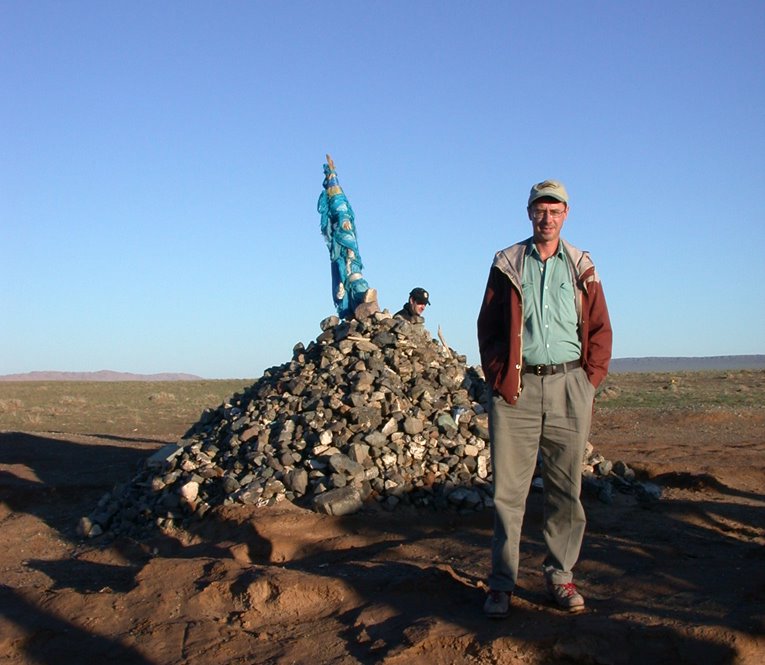
Gobi Xmas Wishes


Photo © Michael Ryan

If The Simpson’s has taught us anything it’s that Buddhism does not exclude any religion (well, most of them anyways). In that spirit I present this photo of the palaeoblogger’s friend, Darren Tanke, in the Gobi desert from last summer.

That’s a prayer mound not a Christmas tree but it still makes for a ‘seasonal’ feeling picture.

Merry Christmas everyone!

Evolution In Action


“Nothing in biology makes sense except in the light of evolution”, Theodosius Dobzhansky

The Dec. 23, 2005, issue of Science has a link to a 16 minute movie entitled, “Evolution In Action”. This link should take you to a low QT version of the film, but you can watch it in different formats at the Science current issue page.

If it doesn’t work just go to the Science home page HERE and click on the “Special Video Presentation” in the “Breakthrough of the Year” box.

Read the Science article about “Evolution In Action” HERE.

500 Million Year Old Animal Family Tree Bushy

Animal Evolution and the Molecular Signature of Radiations Compressed in Time. 2005. Antonis Rokas, Dirk Krüger, Sean B. Carroll. Science 310: 1933-1938.


Abstract: The phylogenetic relationships among most metazoan phyla remain uncertain. We obtained large numbers of gene sequences from metazoans, including key understudied taxa. Despite the amount of data and breadth of taxa analyzed, relationships among most metazoan phyla remained unresolved. In contrast, the same genes robustly resolved phylogenetic relationships within a major clade of Fungi of approximately the same age as the Metazoa. The differences in resolution within the two kingdoms suggest that the early history of metazoans was a radiation compressed in time, a finding that is in agreement with paleontological inferences. Furthermore, simulation analyses as well as studies of other radiations in deep time indicate that, given adequate sequence data, the lack of resolution in phylogenetic trees is a signature of closely spaced series of cladogenetic events.


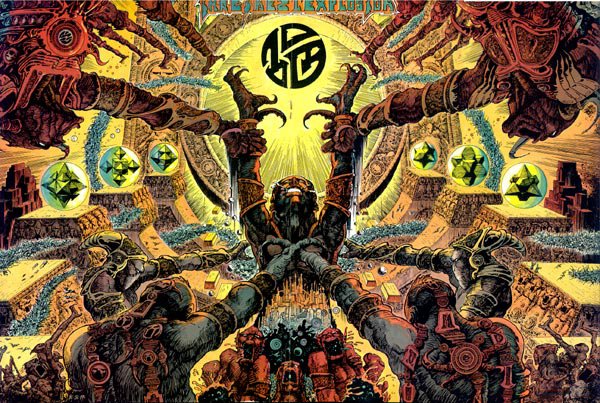
All art ©Philippe Druillet from www.druillet.com.

From the University of Wisconsin-Madison press release:

A branch-by-branch account of animal relationships over the past 500 million years is difficult to reconstruct because early animal evolution occurred in bunches. It seems that the periodic, frenetic bursts of evolution that occurred at certain times in the distant past make sorting out animal relationships -- the branches on the tree -- extraordinarily difficult.

Two decades ago, with the advent of methods to look at the family relationships of different organisms by analyzing DNA, scientists envisioned it would only be a matter of time before the various family trees for plants, animals, fungi and their kin would be resolved with genetic precision.

"[Now] it turns out that early in the origin of many types of animals, there were a lot of branching events in a short period of time," Carroll explains. Those type of episodes at key junctures in life's history -- for example, the rise of complex animals or the migration of vertebrates from the sea to land -- make the animal tree look very bushy and very murky.

The new study used a molecular approach to resolve the family tree of fungi, organisms that originated about the same time as animals. "In contrast to the animals, the tree of fungi, resolved neatly," Rokas explains. "The difficulty we are facing in telling animal relationships apart is evolution's signature that some very interesting evolutionary stuff happened here."

It is not as if evolution of new forms of animal life occurred over night, says Carroll, a UW-Madison professor of genetics. The problem is that the resolution of branches that may have taken a few million years to sprout get washed out in the much larger context of 500 million years of animal life on Earth.

"As you go into deep time, these bursts of evolutionary origins become harder to resolve," Carroll explains. In addition to the complications of deep time, animal life sometimes has a tendency to explode in radiations as organisms exploit new or newly vacant ecological niches. Famous examples of such radiations include, Darwin's finches in the Galapagos and cichlid fish in African lakes.

In that respect, the results of the new study support paleontological evidence of an explosive radiation at the dawn of animal life.

Friday, December 23, 2005

More New Dinos

A new primitive hadrosauroid dinosaur from the Early Cretaceous of Inner Mongolia (P.R. China). 2005. Pascal Godefroit, Hong Li and Chang-Yong Shang. Comptes Rendus Palevol. Vol. 4(8): 697-705.


Abstract: The right dentary of a new hadrosauroid dinosaur, Penelopognathus weishampeli, has been discovered in the Bayan Gobi Formation (Albian, Lower Cretaceous) of Inner Mongolia (P.R. China). This new taxon is characterised by its elongated, straight dental ramus, whose lateral side is pierced by about 20 irregularly distributed foramina. Its dentary teeth appear more primitive than those of Probactrosaurus, but more advanced than those of Altirhinus, both also from the Lower Cretaceous of the Gobi area. Non-hadrosaurid Hadrosauroidea were already well diversified in eastern Asia by Early Cretaceous time, suggesting an Asian origin for the hadrosauroid clade.

The ‘Giant of Ksour’, a Middle Jurassic sauropod dinosaur from Algeria. 2005. F. Mahammed et al., Comptes Rendus Palevol 4(8): 707-714.


Abstract: Continental strata of Early and Middle Jurassic age are seldom-exposed, and little is known of the history of sauropod dinosaurs prior to the neosauropod radiation of the end of the Middle Jurassic. Here, we report, in the Middle Jurassic of the Occidental Saharan Atlas (Algerian High Atlas), the discovery of a skeleton, including cranial material, of a new cetiosaurid sauropod. Chebsaurus algeriensis n. g., n. sp. represents the most complete Algerian sauropod available to date, only few remains were found before.

Images from HERE.