Monday, March 31, 2008

Korea-Mongolia International Dinosaur Project


In 2006 and 2007 I had the pleasure of working in Mongolian with the Korea-Mongolia International Dinosaur Project set up by Yuong Nam Lee with Philip Currie and Dr. Barsbold (I’ve posted on it before on this blog).

Yuong now has the official web page up HERE and it includes some of the video that I shot.

You can see more about my past Gobi fieldwork HERE.

You can join me for this year’s Nomadic Expeditions trip to the Gobi. Drop me a line through this Blog or the CMNH for more info.

Sunday, March 30, 2008

Proposed This Day: Geological Classification

In 1759, Italian geologist Giovanni Arduino (1714-1795) dated a letter to Professor A.Vallisneri the younger, in which Arduino proposed a classification of Earth's surface rocks according to four brackets of successively younger orders: Primary, Secondary, Tertiary and Quaternary. These are the four geological eras used today.

Wonder Woman © DC Comics, Feb., 1954
The volcanic rocks without fossils which he saw in the Atesine Alps that formed the cores of large mountains he called Primary. Overlying them, the fossil rich rocks of limestone and clay that were found on the prealpine flanks of the mountains he called Secondary. The less consolidated fossil-bearing rocks of the subalpine foothills, he named Tertiary, and the alluvial rock deposits in the plains were the Quaternary. link.

Saturday, March 29, 2008

Living Fossil Still Lives In Australia

Australia's Oldest Marsupial Fossils and their Biogeographical Implications. 2008. R. M. D. Beck et al. PLoS ONE 3(3)


From the press release:

The fossilised ankle and ear bones found on an Australian farm are those of Australia's earliest known marsupial, Djarthia, a primitive mouse-like creature that lived 55 million years ago.

A new study in the journal PLoS ONE has confirmed that Djarthia is also a primitive relative of the small marsupial known as the Monito del Monte – or "little mountain monkey" – from the dense humid forests of Chile and Argentina.

"The fossil ankle and ear bones of Djarthia make it clear that the Monito del Monte descends from a Djarthia-like ancestor, and so probably returned to South America from Australia before Gondwana broke up. The continents have been separated by deep ocean since about 40 million years ago."

Like the Monito del Monte, Djarthia was a little larger than a mouse and, likewise, its ankle bones show adaptations for climbing trees. It probably had a similar diet as well: the Monito del Monte eats insects and other small invertebrates and some fruits.

The Monito del Monte is nocturnal and its agility and prehensile tail make it an excellent climber. Females carry up to five young in a well-developed pouch.

Friday, March 28, 2008

Not A Triceratops


This photo of a "Triceratops" bone found on a bus in Peru(?) that has been making the rounds is not from a horned dinosaur, despite what the local officials think. Some guy at National Geographic News even goes on record saying that it's not.

Evolution 2008


Evolution 2008, June 20-24, 2008

The University of Minnesota, the Bell Museum of Natural History and its College of Biological Sciences is pleased to host “Evolution 2008," the joint annual meeting of the Society for the Study of Evolution (SSE), the Society of Systematic Biologists (SSB), and the American Society of Naturalists (ASN).

The meeting will be held on the Minneapolis campus of the University of Minnesota.

Head-Butting Pachycephalosaurs

Structural mechanics of pachycephalosaur crania
permitted head-butting behavior
. 2008. Eric Snively and Andrew Cox. Paleontologia Electronica 11 (Free PDF HERE)


Dome-headed pachycephalosaurus might have passed through a combative teenage stage in which they butted heads in violent clashes.
Our friend, Eric Snively, is in the news again. Since I can’t find the press release on either the U of A or Villanova web sites (for shame!), I’ve taken this from LiveScience.com:

To conjure the head-butting scenario, Snively and Cox developed computer models of the skulls of Homalocephale colathoceros and Pachycephalosaurus wyomingensis as well as a skull of a Pachycephalosaurine sub-adult. They based the models on photographs and reconstructions of the skulls.

They simulated the animals moving with closing speeds of both 6.7 mph and 15 mph (3 meters per second and 6.7 m/s), the latter being the maximum ramming speed given the likely hip heights and limb proportions of pachycephalosaurs. The resulting smash-ups provided information on the amount of force, how that stress was distributed along the skulls and ultimately the post-ramming state of the skulls.

The resulting force would rattle any football player today, but in the dino world, human linebackers would have packed a wimpy punch. "The highest forces we got for a large pachycephalosaur were about 14,000 Newtons, or about as much as T. rex would exert with one of its back teeth," Snively said.

"The stresses in big adults were usually far below those that would break the bone," Snively said. However, he noted, research by Goodwin and Jack Horner of Montana State University's Museum of the Rockies has shown that an adult pachycephalosaur would've had almost no blood vessels embedded in its dome.

"I would still argue that there is no evidence to support head-butting in pachycephalosaurs," said Goodwin, who was not involved in the current study.

Thursday, March 27, 2008

New Brazilian Croc - Guarinisuchus munizi

New dyrosaurid crocodylomorph and evidences for faunal turnover at the K–P transition in Brazil. 2008. J.A. Barbosa et al. Proc. Royal Soc. B. Published on-line March 25.

From AFP (Rio de Janeiro):
A fossil of a new species of prehistoric crocodile found in Brazil has led scientists to believe the reptile benefited from the extinction of dinosaurs to migrate from across the Atlantic.
Guarinisuchus munizi -- the "warrior of the seas," as the crocodile has been dubbed -- is believed to have had its origins in Africa some 200 million years ago. But the remains of a jaw, skull and vertebra discovered in Palaeocene deposits of northeastern Brazil suggests the species set off for new territory 62 million years ago, according to researchers.


"They left the African continent and are believed to have occupied zones in South America, and later regions in North America," paleontologist Maria Somalia Viana told a media conference in Rio de Janeiro.

The reptile, which grew to around three meters (10 feet) and was perfectly adapted to living in the ocean, apparently took advantage of the extinction of bigger marine lizards called mosasaurs to dominate the waters, another paleontologist, Alexander Kellner, said.

Wednesday, March 26, 2008

The First Hominin of Europe

The first hominin of Europe. 2008. Eudald Carbonell et al. Nature 452: 465-469.


a, Frontal view. Arrowheads point to the position of the anterior marginal tubercle, and the arch of the marked incisura submentalis. b, Superior view. Arrowheads point to the mental protuberance, the subvertical alveolar planum and the slight alveolar prominence. c, Median sagittal cross-section of the symphysis based on a three-dimensional computed tomography reconstruction. d, Distal view of the LP4 of ATE9-1. e, Occlusal view of the LP4; mesiodistal dimension: 8.9 mm; buccolingual dimension: 11.4 mm (estimated).
Abstract: The earliest hominin occupation of Europe is one of the most debated topics in palaeoanthropology. However, the purportedly oldest of the Early Pleistocene sites in Eurasia lack precise age control and contain stone tools rather than human fossil remains.

Here we report the discovery of a human mandible associated with an assemblage of Mode 1 lithic tools and faunal remains bearing traces of hominin processing, in stratigraphic level TE9 at the site of the Sima del Elefante, Atapuerca, Spain. Level TE9 has been dated to the Early Pleistocene (approximately 1.2–1.1 Myr), based on a combination of palaeomagnetism, cosmogenic nuclides and biostratigraphy. The Sima del Elefante site thus emerges as the oldest, most accurately dated record of human occupation in Europe, to our knowledge.

The study of the human mandible suggests that the first settlement of Western Europe could be related to an early demographic expansion out of Africa. The new evidence, with previous findings in other Atapuerca sites (level TD6 from Gran Dolina), also suggests that a speciation event occurred in this extreme area of the Eurasian continent during the Early Pleistocene, initiating the hominin lineage represented by the TE9 and TD6 hominins.

Earth - Heavy Metal = Delayed Origin of Life

Tracing the stepwise oxygenation of the Proterozoic ocean. 2008. C. Scott et al. Nature 452: 456-459.


A deficiency of oxygen and the heavy metal molybdenum in the ancient deep ocean may have delayed the evolution of animal life on Earth for nearly two billion years.
From the press release:

Following the initial rise of oxygen in the Earth’s atmosphere 2.4 billion years ago, oxygen was transferred to the surface ocean to support oxygen-demanding micro-organisms. However, the diversity of these single-celled life forms remained low, and their multi-cellular ancestors (animals) did not appear until about 600 million years ago.

For animal life to commence, survive and eventually expand on Earth, a threshold amount of oxygen – estimated to be on the order of 1 to 10 percent of present atmospheric levels of oxygen – was needed.

Suspecting that deficiencies in oxygen and molybdenum might explain this evolutionary lag, the team measured the abundance of molybdenum in ancient marine sediments over time to estimate how much of the metal had been dissolved in the seawater in which the sediments formed.


Black circles are euxinic examples; grey diamonds refer to non-euxinic, organic-rich shales. The gradient represents the diffuse stage 1–2 boundary as defined in the text. The arrow marks the Mount McRae 'whiff' interval7; the dashed area is the Great Oxidation Event as defined by the multiple sulphur isotope record.
By tracking molybdenum in shales rich in organic matter, researchers found the deep ocean remained oxygen and molybdenum-deficient after the first step. This condition may have had a negative impact on the evolution of early eukaryotes, our single-celled ancestors. The molybdenum record also shows that the deep ocean only became fully oxygenated by around 550 million years ago.

According to this research, the timing of the oxygenation steps suggests that significant events in Earth’s history are related. Scientists have long speculated that the evolution of the first animals was somehow linked to the so-called Snowball Earth hypothesis, where the Earth was covered from pole to pole in a thick sheet of ice for millions of years. Oxygenation of the oceans and the evolution of animal life occurred shortly after the last of Earth’s global glaciations.

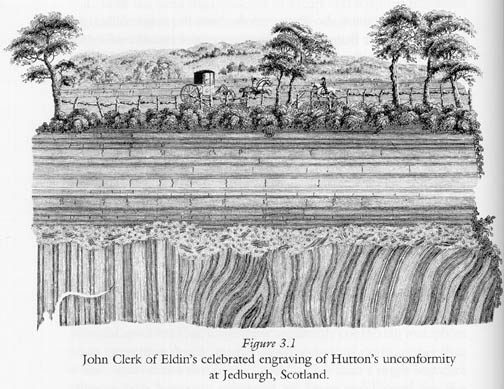
Died This Day: James Hutton

June 3, 1726 – March 26, 1797

Hutton is the 'Father of Uniformitarianism' which explains the features of the Earth's crust by means of natural processes over geologic time. Link


More Info Here

Tuesday, March 25, 2008

The taxonomic status of Megalosaurus bucklandii

The taxonomic status of Megalosaurus bucklandii (dinosauria, theropoda) from the middle Murassic of Oxfordshire, UK. 2008. R. B. J. Benson et al. Palaeontology 51: 419-424.


Abstract: The lectotype of the Middle Jurassic theropod dinosaur Megalosaurus bucklandii, a right dentary, can be diagnosed on the basis of two unique characters: a longitudinal groove on the ventral part of the lateral surface of the dentary and a slit-like anterior Meckelian foramen. This taxon, the first dinosaur to be scientifically described, is therefore valid.


Currently, however, no further material can be referred to this species with any certainty. Megalosaurus bucklandii occupies an uncertain systematic position but is not an abelisaurid or coelophysoid. Additionally, it does not possess the diagnostic dentary characters that are present in all known spinosauroids. Owing to this uncertainty, use of the family Megalosauridae should be discontinued until such time as its systematic position becomes clearer.

Monday, March 24, 2008

The World's Oldest Plant-Eating Lizard

An early herbivorous lizard from the lower Cretaceous of Japan. 2008. S. Evans and M. Manabe. Palaeontology 51: 487–498.


Kuwajimalla kagaensis. Image courtesy Utako Kikutani
From National Geographic News:

The 130-million-year-old jaw and skull bones from the oldest known plant-eating lizard, Kuwajimalla kagaensis, were unearthed in the Ishikawa Prefecture of Japan.

Prior to the new discovery, the oldest known plant-eating lizard was Dicothodon, which lived in North America about 100 million years ago. Even today, fully herbivorous, or plant-eating, lizards are rare, with only about 3 percent of modern lizards belonging to the group. Most lizards eat flesh, usually insects, or a combination of flesh and plants.

Thus the new fossil species could indicate that angiosperms were already in existence and perhaps widespread millions of years earlier than had been thought, the researchers say.

Currently the oldest evidence a flowering plant is a 125-million-year-old fossil from China.

Permian Extinction Not Due To Hydrogen Sulphide

End-Permian ozone shield unaffected by oceanic hydrogen sulphide and methane releases. 2008. Michael B. Harfoot et al. Nature Geoscience Published online: 23 March 2008


Scientists have ruled out a key hypothesis to explain Earth's greatest extinction, when 95 percent of marine species and 70 percent of land species were wiped out at the end of the Permian 250 million years ago.
From Physorg.com:

Researchers have now ruled out a leading theory that the oceans became starved of oxygen and rich with sulphide, causing marine life to die out. This theory suggests that clouds of hydrogen sulphide, produced as a by-product of intense vulcanism, poisoned life, and by attacking the ozone layer, allowed solar radiation to destroy its DNA.

According to their calculations, the lower levels of the atmosphere in the tropics would have acted as an oxidising buffer, preventing the hydrogen sulphide from seriously damaging the ozone layer.

"These gases seem unlikely to be the cause of coincident terrestrial biotic extinctions," the paper says.

Other theories for the extinction include an asteroid or a long period of vulcanism which caused a lethal mixture of acid rain and global warming.

Saturday, March 22, 2008

World's Oldest Easter Bunny

Early Eocene lagomorph (Mammalia) from Western India and the early diversification of Lagomorpha. K. Rose, et al., Proc. Royal Soc. B., published on-line Tuesday, February 19, 2008


Bones photographs courtesy Rose et al.
Bones that a scientist picked up on a trip to India (including the above ankle bones, far left) were later deemed to be the oldest known rabbit bones ever found, a new study says. The ancient rabbit would not likely have looked similar to the modern-day Spider-Man ‘villian’, White Rabbit (right).

The new bones also show that advanced rabbit-like features evolved earlier than thought—as far back as the early Eocene, which lasted from 54.8 to 33.7 million years ago, experts say.

Born This Day: Adam Sedgwick

March 22, 1785 - January 27, 1873

From Today In Science History:

Adam Sedgwich was an English geologist who first applied the name Cambrian to the geologic period of time, now dated at 570 to 505 million years ago. In 1818 he became Woodwardian Professor of Geology at Cambridge, holding a chair that had been endowed ninety years before by the natural historian John Woodward.

He lacked formal training in geology, but he quickly became an active researcher in geology and paleontology. Many years after Sedgwick's death, the geological museum at Cambridge was renamed the Sedgwick Museum of Geology in his honor. The museum is now part of the Department of Earth Sciences at Cambridge University

Metabolic Rates and Body Scaling

Effects of metabolic level on the body size scaling of metabolic rate in birds and mammals. 2008. D.S. Glazier. Proc. Royal Soc. B., published on-line Tuesday, March 18, 2008


Abstract: Metabolic rate is traditionally assumed to scale with body mass to the 3/4-power, but significant deviations from the ‘3/4-power law’ have been observed for several different taxa of animals and plants, and for different physiological states.

The recently proposed ‘metabolic-level boundaries hypothesis’ represents one of the attempts to explain this variation. It predicts that the power (log–log slope) of metabolic scaling relationships should vary between 2/3 and 1, in a systematic way with metabolic level.

Here, this hypothesis is tested using data from birds and mammals. As predicted, in both of these independently evolved endothermic taxa, the scaling slope approaches 1 at the lowest and highest metabolic levels (as observed during torpor and strenuous exercise, respectively), whereas it is near 2/3 at intermediate resting and cold-induced metabolic levels.

Remarkably, both taxa show similar, approximately U-shaped relationships between the scaling slope and the metabolic (activity) level. These predictable patterns strongly support the view that variation of the scaling slope is not merely noise obscuring the signal of a universal scaling law, but rather is the result of multiple physical constraints whose relative influence depends on the metabolic state of the organisms being analysed.

Friday, March 21, 2008

Krazy Kat: July 6, 1941


Our heroes: Krazy Kat, Ignatz Mouse (with brick) & Officer Pupp.
The July 6, 1941, colour Sunday page (below) comes from arguably the greatest comic strip ever (I would agree), “Krazy Kat”, taken from the Fantagraphics collection, “Krazy & Ignatz: A Ragout of Raspberries”, by George Herriman.


CLICK TO ENLARGE AND READ IN ALL ITS GLORY.
Krazy Kat was set in the mythical and ever changing desert landscape of Coconino County somewhere more or less in Arizona, and the stark beauty of its landscapes informed the strip and its inhabitants.

Pretty much every strip revolved around the desire of a mouse (Ignatz) to bean the Kat (Krazy) with a brick, and the need of the dog (Officer Pupp) to prevent this and put the mouse in jail. Complicating matters is the fact that Krazy is smitten with Ignatz and takes being beaned by the mouse as a sign of affection, much to the chagrin of Pupp who is sweet on Krazy -- ah, the sad beauty of life.

Herriman was part cartoonist & part poet, and ranks up there with Walt Whitman and Mark Twain as a genius storyteller and observer of the human condition. The strip ran from the 1920’s to 1944, always exclusively in Randolph Hearst’s newspapers.

The strip can look somewhat crude to the uninitiated eye, but its charm will win over the discerning mind. In this episode the eternal story of [Mouse + Brick + Kat] plays out even in the fossilized bones of the past.
I’m out of the office over Easter. I’ll post when I can; otherwise I should be back in a week or so

Orrorin tugenensis & The Origin of Bipedalism

Orrorin tugenensis Femoral Morphology and the Evolution of Hominin Bipedalism. 2008. Brian G. Richmond and William L. Jungers. Science 319: 1662 – 1665.


Abstract: Bipedalism is a key human adaptation and a defining feature of the hominin clade. Fossil femora discovered in Kenya and attributed to Orrorin tugenensis, at 6 million years ago, purportedly provide the earliest postcranial evidence of hominin bipedalism, but their functional and phylogenetic affinities are controversial.

We show that the O. tugenensis femur differs from those of apes and Homo and most strongly resembles those of Australopithecus and Paranthropus, indicating that O. tugenensis was bipedal but is not more closely related to Homo than to Australopithecus.


Femoral morphology indicates that O. tugenensis shared distinctive hip biomechanics with australopiths, suggesting that this complex evolved early in human evolution and persisted for almost 4 million years until modifications of the hip appeared in the late Pliocene in early Homo.

Earth's 565 Million Year Old Complex Ecosystem

Synchronous Aggregate Growth in an Abundant New Ediacaran Tubular Organism. 2008. Mary L. Droser and James G. Gehling. Science 319: 1660 – 1662.


Funisia dorothea seen branching in a fossil excavated in South Australia. Image credit: Droser lab, UC Riverside.
Two paleontologists studying ancient fossils they excavated in the South Australian outback argue that Earth’s ecosystem has been complex for hundreds of millions of years – at least since around 565 million years ago.
From the press release:

But in describing the ecology and reproductive strategies of Funisia dorothea, a tubular organism preserved as a fossil, the researchers found that the organism had multiple means of growing and propagating – similar to strategies used by most invertebrate organisms for propagation today.

Funisia dorothea grew in abundance, covering the seafloor, during the Neoproterozoic, a 100 million-year period ending around 540 million years ago in Earth’s history, during which no predators were around.


Droser and Gehling observed that Funisia appears as 30 cm-long tubes in the fossils. They also observed that the tubes commonly occur in closely-packed groups of five to fifteen individuals, displaying a pattern of propagation that often accompanies animal sexual reproduction.

“In Funisia, we are very likely seeing sexual reproduction in Earth’s early ecosystem – possibly the very first instance of sexual reproduction in animals on our planet.”

According to Droser and Gehling, the clusters of similarly sized individuals of Funisia are strongly suggestive of “spats,” huge numbers of offspring an organism gives birth to at once. Besides producing spats, the individual tubular organisms reproduced by budding, and grew by adding bits to their tips.

“Among living organisms, spat production results almost always from sexual reproduction and only very rarely from asexual reproduction,” Droser said.

Thursday, March 20, 2008

Betsy's Plesiosaur, Nichollsia borealis

Nichollsia borealis, one of the oldest and most complete plesiosaur fossils recovered in North America, and the oldest yet discovered from the Cretaceous Period, was uncovered in a Syncrude Canada Ltd. mine near Fort McMurray, Alberta, in 1994.


Two U of Calgary scientists, Dr. Patrick Druckenmiller and Dr. Anthony Russell have named the 2.6m long plesiosaur Nichollsia borealis in memory of the late Elizabeth (Betsy) Nicholls, former curator at the Royal Tyrrell Museum of Palaeontology. Nicholls was a renowned palaeontologist who is credited with transforming the understanding of prehistoric ocean life by describing the largest-ever marine reptile, a 23-metre-long ichthyosaur, discovered in northern British Columbia in 1999.


Elizabeth (Betsy) Nicholls conducting field work in northeastern B.C. Photo:Rolex Awards/Tomas Bertelsen.

“We chose this name because Betsy was a key player in the study of marine reptiles, a mentor to me, a former student of Tony, and a great person,” said Druckenmiller, who is now Curator of Earth Sciences at the University of Alaska Museum of the North in Fairbanks, Alaska. “We felt it was a fitting way to honour both her memory and her accomplishments in palaeontology.”

The fossil was discovered by machine operators Greg Fisher and Lorne Cundal in 1994 during routine mining operations at Syncrude’s Base Mine, about 35 kilometres north of Fort McMurray near the Athabasca River. Amazingly, the specimen was serendipitously exposed by one of Syncrude’s 100-ton electric shovels approximately 60 metres below ground surface. It is complete except for its left forelimb and shoulder blade.

Nichollsia is also very significant because it fills a 40-million-year gap in the plesiosaur fossil record and greatly increases the understanding of the ancient seaway that once split North America in two and whose shores abounded with dinosaurs.

“This individual was a pioneer in the marine waters that would eventually become the Cretaceous Western Interior Seaway, which ran the length of North America during much of the Cretaceous and was home to one of the world’s most diverse communities of marine reptiles,” Druckenmiller said. “It represents the oldest known forerunner of this amazing period in North American prehistory.”

Nichollsia borealis is currently on display in the Discoveries Gallery at the Royal Tyrrell Museum. The paper is published in Palaeontographica Abteilung A, but I can’t find a doi for it.