Frontal sinuses and head-butting in goats: a finite element analysis. 2008. Andrew A. Farke. Journal of Experimental Biology 211: 3085-3094.
Abstract: Frontal sinuses in goats and other mammals have been hypothesized to function as shock absorbers, protecting the brain from blows during intraspecific combat. Furthermore, sinuses are thought to form through removal of `structurally unnecessary' bone. These hypotheses were tested using finite element modeling.
Three-dimensional models of domesticated goat (Capra hircus) skulls were constructed, with variable frontal bone and frontal sinus morphology, and loaded to simulate various head-butting behaviors. In general, models with sinuses experienced higher strain energy values (a proxy for shock absorption) than did models with unvaulted frontal bones, and the latter often had higher magnitudes than models with solid vaulted frontal bones. Furthermore, vaulted frontal bones did not reduce magnitudes of principal strain on the surface of the endocranial cavity relative to models with unvaulted frontal bones under most loading conditions.
Thus, these results were only partially consistent with sinuses, or the bone that walls the sinuses, acting as shock absorbers. It is hypothesized that the keratinous horn sheaths and cranial sutures are probably more important for absorbing blows to the head. Models with sinuses did exhibit a more `efficient' distribution of stresses, as visualized by histograms in which models with solid frontal bones had numerous unloaded elements. This is consistent with the hypothesis that sinuses result at least in part from the removal of mechanically unnecessary bone.
Monday, October 13, 2008

Science Cafe Tonight In Cleveland

Join Dr. Catherine Badgley (Ecology & Evo. Biology, U. of Michigan) and Dr. Michael Ryan (Cleveland Museum of Natural History) for a lively discussion on palaeo and related topics. If you're in town for the SVP conference come on down for a pre-meeting warm up.
Date: October 13, 2008
Time: Drinks start at 6:30 PM, discussion starts around 7:00 PM
Location: Tasting Room, Great Lakes Brewing Company (2701 Carroll Ave, Cleveland)
What is vertebrate paleontology? Paleontology is the study of ancient life - plants, birds, insects, bacteria, and everything in between. Within paleontology, vertebrate paleontology (a.k.a. VP) focuses on animals with backbones (i.e., vertebrae).
Although dinosaurs garner much of the media attention, VP researchers also study ancient fishes, lizards, mammals, snakes, frogs, and a variety of other groups, many of which have no direct living descendants. And although discovering and naming new species is an important aspect of VP research, many scientists focus on other questions such as how these extinct animals lived and died, what ancient climates and ecosystems were like, and how these animals are related to each other.
Come join some of the leading researchers in vertebrate paleontology - including Dr. Catherine Badgley (President of the Society of Vertebrate Paleontology) and Dr. Michael Ryan - for a discussion of "hot topics" in VP and other issues folks will be discussing at the annual meeting.


Saturday, October 11, 2008
Collective Behavior in an Early Cambrian Arthropod
Collective Behavior in an Early Cambrian Arthropod. 2008. X.-G. Hou et al. Science 322: 224.

A unique set of fossils indicates that 525 million years ago marine animals congregated in Earth’s ancient oceans, most likely for migration, according to an international team of scientists.From the press release
Fossil evidence of collective behaviour is extremely rare. But what makes the find even more intriguing is that it indicates that such behaviour was occurring at the beginning of the ‘Cambrian explosion’ – a major event that saw a vast profusion of complex organisms enter the fossil record for the first time.
'What we see in these fossils are shrimp-like animals with a carapace and segmented body, which are similar to arthropods that we know existed in the Cambrian seas,’ said Derek Siveter. ‘What’s unique about the Yunnan [China] fossil material is that it shows individual specimens closely interlocked to form a chain, of which there are several examples.’
These chains may have formed for reproductive purposes, or they may represent a stage in the animal’s life cycle – if so there are no comparable occurrences in modern arthropods.
The team believes the congregation is more likely to be evidence of migratory activity, possibly associated with animals congregating as a defence against predators.
The fossil was preserved in the Chengjian Lagerstatte, a fossil-rich exceptional preservation deposit discovered in 1984 that has been dated to the Lower Cambrian period, 525 million years ago, making it around 10 million years older than Canada’s famous Burgess Shale.

Fossil evidence of collective behaviour is extremely rare. But what makes the find even more intriguing is that it indicates that such behaviour was occurring at the beginning of the ‘Cambrian explosion’ – a major event that saw a vast profusion of complex organisms enter the fossil record for the first time.
'What we see in these fossils are shrimp-like animals with a carapace and segmented body, which are similar to arthropods that we know existed in the Cambrian seas,’ said Derek Siveter. ‘What’s unique about the Yunnan [China] fossil material is that it shows individual specimens closely interlocked to form a chain, of which there are several examples.’
These chains may have formed for reproductive purposes, or they may represent a stage in the animal’s life cycle – if so there are no comparable occurrences in modern arthropods.
The team believes the congregation is more likely to be evidence of migratory activity, possibly associated with animals congregating as a defence against predators.
The fossil was preserved in the Chengjian Lagerstatte, a fossil-rich exceptional preservation deposit discovered in 1984 that has been dated to the Lower Cambrian period, 525 million years ago, making it around 10 million years older than Canada’s famous Burgess Shale.
Friday, October 10, 2008
Centrosaurus brinkmani Print by Mark Schultz

I did want to mention that the palaeoblog's good friend, Mark Schultz, has generously allowed me to produce a print based on the reconstruction he did for me of Centrosaurus brinkmani. The 12"x18" (approx.) colour print will be signed by Mark and available from me or at the CMNH table next Thursday and Friday for $20. 100% of the proceeds go to fund student field work in Alberta with the Southern Alberta Dinosaur Research Group.
Sauropod Gigantism
Sauropod Gigantism. 2008. Science 322: 200-201.

From National Geographic news:
To outgrow their predators, sauropods didn't just need lots of food. They also needed to develop fast, so they could attain their full size before being eaten, experts said. Sauropod bones show that they did indeed grow swiftly. A 10kg hatchling could become a 100000Kg grown-up in about 20 to 30 years—quick by dinosaur time.
"This tells us that they must have been warm-blooded and had a high metabolic rate compared to cold-blooded creatures," said the University of Bonn's Sander.
So why don't we see gigantic elephants and crocodiles roaming around today? Experts think that reptiles, such as crocodiles, still maintain the egg-laying advantage, but their cold blood prevents them from growing fast enough to reach a great size. Mammals have warm blood, but can't grow as big as sauropods due to their slow reproductive strategy and the need to chew their food.

From National Geographic news:
To outgrow their predators, sauropods didn't just need lots of food. They also needed to develop fast, so they could attain their full size before being eaten, experts said. Sauropod bones show that they did indeed grow swiftly. A 10kg hatchling could become a 100000Kg grown-up in about 20 to 30 years—quick by dinosaur time.
"This tells us that they must have been warm-blooded and had a high metabolic rate compared to cold-blooded creatures," said the University of Bonn's Sander.
So why don't we see gigantic elephants and crocodiles roaming around today? Experts think that reptiles, such as crocodiles, still maintain the egg-laying advantage, but their cold blood prevents them from growing fast enough to reach a great size. Mammals have warm blood, but can't grow as big as sauropods due to their slow reproductive strategy and the need to chew their food.

The Origin of Teeth
Dual epithelial origin of vertebrate oral teeth. 2008. V. Soukup et al. Nature 455: 795-798.

Abstract: The oral cavity of vertebrates is generally thought to arise as an ectodermal invagination. Consistent with this, oral teeth are proposed to arise exclusively from ectoderm, contributing to tooth enamel epithelium, and from neural crest derived mesenchyme, contributing to dentin and pulp. Yet in many vertebrate groups, teeth are not restricted only to the oral cavity, but extend posteriorly as pharyngeal teeth that could be derived either directly from the endodermal epithelium, or from the ectodermal epithelium that reached this location through the mouth or through the pharyngeal slits. However, when the oropharyngeal membrane, which forms a sharp ecto/endodermal border, is broken, the fate of these cells is poorly known.
Here, using transgenic axolotls with a combination of fate-mapping approaches, we present reliable evidence of oral teeth derived from both the ectoderm and endoderm and, moreover, demonstrate teeth with a mixed ecto/endodermal origin. Despite the enamel epithelia having a different embryonic source, oral teeth in the axolotl display striking developmental uniformities and are otherwise identical. This suggests a dominant role for the neural crest mesenchyme over epithelia in tooth initiation and, from an evolutionary point of view, that an essential factor in teeth evolution was the odontogenic capacity of neural crest cells, regardless of possible 'outside-in'or 'inside-out' influx of the epithelium.
Watch the video showing a stack of optic deconvoluted layers through 20 m thick cryostat section from an embryo after receiving both GFP ECT graft and DiI END injection.

Abstract: The oral cavity of vertebrates is generally thought to arise as an ectodermal invagination. Consistent with this, oral teeth are proposed to arise exclusively from ectoderm, contributing to tooth enamel epithelium, and from neural crest derived mesenchyme, contributing to dentin and pulp. Yet in many vertebrate groups, teeth are not restricted only to the oral cavity, but extend posteriorly as pharyngeal teeth that could be derived either directly from the endodermal epithelium, or from the ectodermal epithelium that reached this location through the mouth or through the pharyngeal slits. However, when the oropharyngeal membrane, which forms a sharp ecto/endodermal border, is broken, the fate of these cells is poorly known.
Here, using transgenic axolotls with a combination of fate-mapping approaches, we present reliable evidence of oral teeth derived from both the ectoderm and endoderm and, moreover, demonstrate teeth with a mixed ecto/endodermal origin. Despite the enamel epithelia having a different embryonic source, oral teeth in the axolotl display striking developmental uniformities and are otherwise identical. This suggests a dominant role for the neural crest mesenchyme over epithelia in tooth initiation and, from an evolutionary point of view, that an essential factor in teeth evolution was the odontogenic capacity of neural crest cells, regardless of possible 'outside-in'or 'inside-out' influx of the epithelium.
Watch the video showing a stack of optic deconvoluted layers through 20 m thick cryostat section from an embryo after receiving both GFP ECT graft and DiI END injection.
Thursday, October 09, 2008
Surviving the Permian-Triassic Extinction
Anomalously diverse Early Triassic ichnofossil assemblages in northwest Pangea: A case for a shallow-marine habitable zone. 2008. T.W. Beatty et al. Geology 36.

From Science Daily News:
Scientists have solved part of the mystery of where marine organisms that recovered from the biggest extinction on earth were housed. A team of researchers discovered that the shorelines of ancient Canada provided a refuge for marine organisms that escaped annihilation during the Permian-Triassic extinction event.
During the Permian, all the world's land masses joined together into a single supercontinent called Pangea. Near the end of the Permian, during the mass extinction, about 95 per cent of all marine species and 70 per cent of land species died and the recovery of life on Earth took longer than other extinction events because so much biodiversity was lost. There are several theories as to why this mass extinction event took place ranging from the heating of the Earth to a catastrophic event. The authors favour major climate change since increased temperatures and elevated CO2 levels are linked to oxygen stress that is key to the results of their research.
Researchers have been studying the Permian-Triassic extinction event for years, but mostly in Greenland and south China where formations represent areas of deep water and have very low levels of oxygen. The research team studied trace fossils along the ancient shorelines found in rock located in western Alberta, northeast British Columbia, and the barren landscapes of the Canadian Arctic. Trace fossils preserve the activity of organisms and can be burrows or other actions created by the ancestors of modern worms and marine arthropods. The dating of these shorelines is confirmed by the presence of distinct conodonts – a microfossil in which the passing of time is recorded by rapid evolutionary changes.
"These trace fossils present a record of ocean-bottom dwelling organisms and indicate locally well-oxygenated conditions in an ocean otherwise characterized by widespread anoxia," says Beatty - the lead author. "Within this habitable zone, the latest Permian extinction levels are reduced and the recovery time is minimized. The findings support the idea that reduced oxygen levels is a major cause of why the recovery from Earth's greatest extinction was delayed."

From Science Daily News:
Scientists have solved part of the mystery of where marine organisms that recovered from the biggest extinction on earth were housed. A team of researchers discovered that the shorelines of ancient Canada provided a refuge for marine organisms that escaped annihilation during the Permian-Triassic extinction event.
During the Permian, all the world's land masses joined together into a single supercontinent called Pangea. Near the end of the Permian, during the mass extinction, about 95 per cent of all marine species and 70 per cent of land species died and the recovery of life on Earth took longer than other extinction events because so much biodiversity was lost. There are several theories as to why this mass extinction event took place ranging from the heating of the Earth to a catastrophic event. The authors favour major climate change since increased temperatures and elevated CO2 levels are linked to oxygen stress that is key to the results of their research.
Researchers have been studying the Permian-Triassic extinction event for years, but mostly in Greenland and south China where formations represent areas of deep water and have very low levels of oxygen. The research team studied trace fossils along the ancient shorelines found in rock located in western Alberta, northeast British Columbia, and the barren landscapes of the Canadian Arctic. Trace fossils preserve the activity of organisms and can be burrows or other actions created by the ancestors of modern worms and marine arthropods. The dating of these shorelines is confirmed by the presence of distinct conodonts – a microfossil in which the passing of time is recorded by rapid evolutionary changes.
"These trace fossils present a record of ocean-bottom dwelling organisms and indicate locally well-oxygenated conditions in an ocean otherwise characterized by widespread anoxia," says Beatty - the lead author. "Within this habitable zone, the latest Permian extinction levels are reduced and the recovery time is minimized. The findings support the idea that reduced oxygen levels is a major cause of why the recovery from Earth's greatest extinction was delayed."
Nine Bowls of Ichthyosaur Soup
From a "They Might Be Giants" podcast comes the video for one of the songs from their 1st(?) kids LP.
Wednesday, October 08, 2008
The Colour Of Evolution
Speciation through sensory drive in cichlid fish. 2008. O. Seehausen et al. Nature 455: 620-626.

Click To Enlarge
From the press release:
A group of colorful fishes in Africa's Lake Victoria have been the focus of scientific efforts to unravel how new species form. This lake contains more than 500 species of cichlids, which play a leading role because of their rapid speciation and remarkable diversity.
Now a new study suggests that species of Lake Victorian cichlids became new species after changes in how they see led to changes in the mates that they selected. The group say that the phenomenon provides evidence that differences in sensory perception contribute to the development of new species.
For many years, scientists have linked evolution to the environment and suggested that new species arise when populations become geographically isolated from one another, thus forcing them to adapt differently. The idea that organisms living right next to each other can separate into two new species has been proposed, but difficult to prove.
The waters of Lake Victoria, which borders Uganda, Kenya, and Tanzania, are murky and red light penetrates deeper than blue light. In the shallow waters, the male fish tend to be green to blue, and in the deeper waters, the male fish are marked by a brilliant red. "These fish specialized to different microhabitats," Carleton explains, "which in this case is different depths. The visual system then specialized to the light environment at these depths and the mating colors shifted to match. Once this happened, these two groups no longer interbred and so became new species."
Previous research had identified long and short wavelength sensitive variants in one of the genes responsible for tuning the fish's vision to different depths. For this new study, the researchers sequenced hundreds of fish captured in the wild and showed that these visual variants segregate with depth and male color, supporting the idea that these fish have specialized to inhabit these micro niches.

Click To Enlarge
From the press release:
A group of colorful fishes in Africa's Lake Victoria have been the focus of scientific efforts to unravel how new species form. This lake contains more than 500 species of cichlids, which play a leading role because of their rapid speciation and remarkable diversity.
Now a new study suggests that species of Lake Victorian cichlids became new species after changes in how they see led to changes in the mates that they selected. The group say that the phenomenon provides evidence that differences in sensory perception contribute to the development of new species.
For many years, scientists have linked evolution to the environment and suggested that new species arise when populations become geographically isolated from one another, thus forcing them to adapt differently. The idea that organisms living right next to each other can separate into two new species has been proposed, but difficult to prove.
The waters of Lake Victoria, which borders Uganda, Kenya, and Tanzania, are murky and red light penetrates deeper than blue light. In the shallow waters, the male fish tend to be green to blue, and in the deeper waters, the male fish are marked by a brilliant red. "These fish specialized to different microhabitats," Carleton explains, "which in this case is different depths. The visual system then specialized to the light environment at these depths and the mating colors shifted to match. Once this happened, these two groups no longer interbred and so became new species."
Previous research had identified long and short wavelength sensitive variants in one of the genes responsible for tuning the fish's vision to different depths. For this new study, the researchers sequenced hundreds of fish captured in the wild and showed that these visual variants segregate with depth and male color, supporting the idea that these fish have specialized to inhabit these micro niches.
Fun In The Currie Lab
When potential graduate students ask me about places to study I always suggest that they talk to the graduate students of the advisors they might like to work for to get a better understanding of what they're in for. One of Phil Currie’s grad students, Miriam Reichel, put together this little video of some fun moments with all the students in the Currie lab, and gave me permission to post it here. Watch and learn. Enjoy!
Albertonykus borealis

One of the many stories I missed while I was away was the announcement of Albertonykus by Nick Longrich and Phil Currie. The link will take you to the National Geographic story.
Extinction By Asteroid A Rarity

Evidence suggests that 'sick Earth' extinctions more likely
Asteroids are the prime suspect only in the most recent of five mass extinctions, said USC earth scientist David Bottjer. The cataclysm 65 million years ago wiped out the dinosaurs.
"The other four have not been resolvable to a rock falling out of the sky," Bottjer said.
For example, Bottjer and many others have published studies suggesting that the end-Permian extinction 250 million years ago happened in essence because "the earth got sick." The latest research from Bottjer's group suggests a similar slow dying during the extinction 200 million years ago at the boundary of the Triassic and Jurassic eras.
At the 2008 Joint Annual Meeting of the Geological Society of America, USC doctoral student Sarah Greene drew similarities between ocean conditions at the Triassic-Jurassic boundary and after the end-Permian extinction. At both those times, bouquet-like structures of aragonite crystals formed on the ocean floor. Such structures are extremely rare in Earth's history, Greene said.
"The fact that these deposits have only been found at these two specific times that are associated with mass extinction suggests at the very least that maybe there's some shared ocean geochemistry … that could be related to the cause of the extinctions," Greene said.
"The Triassic-Jurassic extinction cause is totally up for grabs at the moment," she added.
Also at the meeting, USC doctoral student Rowan Martindale presented results from her studies of coral reefs during the Triassic-Jurassic extinction.
"The coral reefs look actually very similar to modern coral reefs," she said. "At the end-Triassic mass extinction, you lose all your reef systems. And nobody's figured out why that is."
Martindale identified two distinct types of ancient reefs: one dominated by coral and another consisting mainly of mud and debris, possibly held together by bacteria. A theory for the end-Triassic extinction needs to explain how both types of reefs could have been killed off, Martindale said.
The Joint Annual Meeting was held Oct. 5-9 in Houston. It was the first joint meeting of the Geological Society of America, the Soil Science Society of America, the American Society of Agronomy, the Crop Science Society of America and the Gulf Coast Association of Geological Societies.
Tuesday, October 07, 2008
Robots + Pterosaurs = Pterodrone

From the GSA press release:
Paleontologist Sankar Chatterjee of Texas Tech University, aeronautical engineer Rick Lind of the University of Florida, and their students, Andy Gedeon and Brian Roberts, have reached back in time 115 million years to one of the most successful flying creatures in Earth’s history, the pterodactyl, to conjure a robotic spy plane with next-generation capabilities.
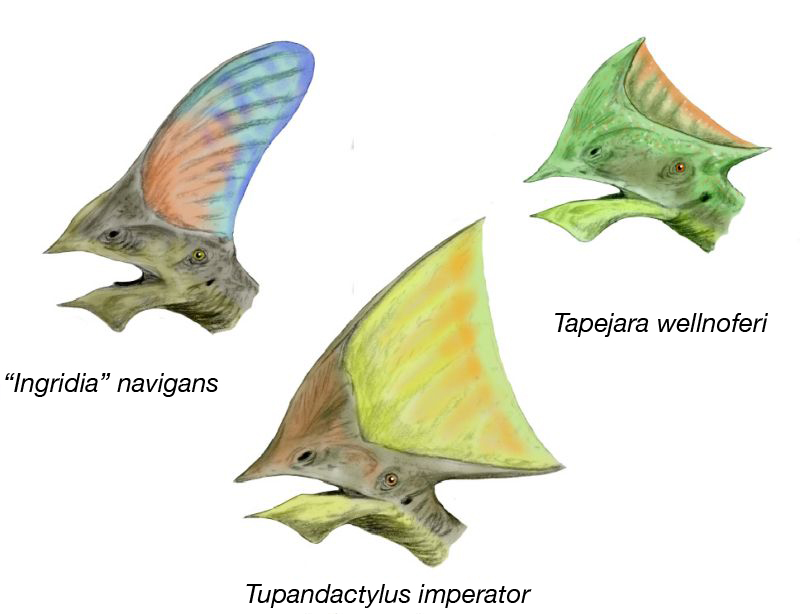
Mimicking the physical and biological characteristics of the Early Cretaceous Brazilian pterosaur Tapejara wellnhoferi — skin, blood vessels, muscles, tendons, nerves, cranial plate, skeletal structure, and more — the scientists are working to develop a Pterodrone — an unmanned aerial vehicle that not only flies but also walks and sails just like the original.
"The next generation of airborne drones won’t just be small and silent," says the multidisciplinary group, "they’ll alter their wing shapes using morphing techniques to squeeze through confined spaces, dive between buildings, zoom under overpasses, land on apartment balconies, or sail along the coastline."
The talk on Tuesday, 7 October, at the 2008 Joint Meeting of the Geological Society of America, Soil Science Society of America-American Society of Agronomy-Crop Science Society of America, and Gulf Coast Association of Geological Societies, in Houston, Texas, will provide illustrations of both the Tapejara and the proposed Pterodrone, with details on the richly improved ability of the robotic spy plane to gather data from sights, sounds, and smells in a variety of environments.

Monday, October 06, 2008
Died This Day: George Gaylord Simpson
June 16, 1902 - October 6, 1984
From Today In Science History:
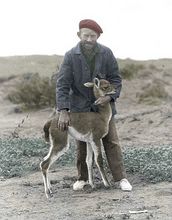 Simpson is known for his contributions to evolutionary theory and to the understanding of intercontinental migrations of animal species in past geological times. Simpson specialized in early fossil mammals, leading expeditions on four continents and discovering in 1953 the 50-million-year old fossil skulls of dawn horses in Colorado.
Simpson helped develop the modern biological theory of evolution, drawing on paleontology, genetics, ecology, and natural selection to show that evolution occurs as a result of natural selection operating in response to shifting environmental conditions. He spent most of his career as a paleontologist at the American Museum of Natural History. image.
From Today In Science History:
 Simpson is known for his contributions to evolutionary theory and to the understanding of intercontinental migrations of animal species in past geological times. Simpson specialized in early fossil mammals, leading expeditions on four continents and discovering in 1953 the 50-million-year old fossil skulls of dawn horses in Colorado.
Simpson helped develop the modern biological theory of evolution, drawing on paleontology, genetics, ecology, and natural selection to show that evolution occurs as a result of natural selection operating in response to shifting environmental conditions. He spent most of his career as a paleontologist at the American Museum of Natural History. image.
Saturday, October 04, 2008
New Argentinean Theropod, Aerosteon riocoloradensis
Evidence for Avian Intrathoracic Air Sacs in a New Predatory Dinosaur from Argentina. 2008. P.C. Sereno, et al. PLoS ONE 3(9):e3303.

In addition to describing the new theropod, Aerosteon riocoloradensis, The authors present a four-phase model for the evolution of avian air sacs and costosternal-driven lung ventilation based on the known fossil record of theropod dinosaurs and osteological correlates in extant birds:
(1) Phase I—Elaboration of paraxial cervical air sacs in basal theropods no later than the earliest Late Triassic.
(2) Phase II—Differentiation of avian ventilatory air sacs, including both cranial (clavicular air sac) and caudal (abdominal air sac) divisions, in basal tetanurans during the Jurassic. A heterogeneous respiratory tract with compliant air sacs, in turn, suggests the presence of rigid, dorsally attached lungs with flow-through ventilation.
(3) Phase III—Evolution of a primitive costosternal pump in maniraptoriform theropods before the close of the Jurassic.
(4) Phase IV—Evolution of an advanced costosternal pump in maniraptoran theropods before the close of the Jurassic.
In addition, they conclude:
(5) The advent of avian unidirectional lung ventilation is not possible to pinpoint, as osteological correlates have yet to be identified for uni- or bidirectional lung ventilation.
(6) The origin and evolution of avian air sacs may have been driven by one or more of the following three factors: flow-through lung ventilation, locomotory balance, and/or thermal regulation.

In addition to describing the new theropod, Aerosteon riocoloradensis, The authors present a four-phase model for the evolution of avian air sacs and costosternal-driven lung ventilation based on the known fossil record of theropod dinosaurs and osteological correlates in extant birds:
(1) Phase I—Elaboration of paraxial cervical air sacs in basal theropods no later than the earliest Late Triassic.
(2) Phase II—Differentiation of avian ventilatory air sacs, including both cranial (clavicular air sac) and caudal (abdominal air sac) divisions, in basal tetanurans during the Jurassic. A heterogeneous respiratory tract with compliant air sacs, in turn, suggests the presence of rigid, dorsally attached lungs with flow-through ventilation.
(3) Phase III—Evolution of a primitive costosternal pump in maniraptoriform theropods before the close of the Jurassic.
(4) Phase IV—Evolution of an advanced costosternal pump in maniraptoran theropods before the close of the Jurassic.
In addition, they conclude:
(5) The advent of avian unidirectional lung ventilation is not possible to pinpoint, as osteological correlates have yet to be identified for uni- or bidirectional lung ventilation.
(6) The origin and evolution of avian air sacs may have been driven by one or more of the following three factors: flow-through lung ventilation, locomotory balance, and/or thermal regulation.
Gene Expression In Alligators Suggests Birds Have 'Thumbs'
The Evolution of HoxD-11 Expression in the Bird Wing: Insights from Alligator mississippiensis. 2008. A.O. Vargas, et al. PLoS ONE 3(10):e3325.

From the press release:
Bird wings only have three fingers, having evolved from remote ancestors that, like humans and most reptiles, had five fingers. Biologists have typically used embryology to identify the evolutionary origin (homology) of structures; the three fingers of the bird wing develop from cartilage condensations that are found in the same positions in the embryo as fingers two, three and four of humans (the index, middle and ring fingers). However, the morphology of the fingers of early birds such as Archaeopteryx corresponds to that of fingers one, two and three in other reptiles (thumb, index and middle finger). The fossil record clearly shows that fingers four and five (ring and pinky finger) were lost and reduced in the dinosaur ancestors of birds.
Further, the lack of expression of the HoxD-11 gene in the first finger of the wing makes it most similar to finger one (the "thumb") of the mouse, consistent with comparative morphology. However, the mouse is only distantly related to birds; crocodilians, in turn, are bird's closest living relatives.
To see whether the evidence from mouse HoxD-11 expression held up, Vargas and colleagues have examined the expression of this gene in alligators; they found the expression to be, as in mice, absent only in finger one (the "thumb").
Developmental and evolutionary biologists are familiar with the phenomenon of homeotic transformations, in which one structure begins to develop at a different position within the body. A famous example is the case of the fruit fly mutant antennapaedia, which develops legs on its head instead of antennae. The new work by Vargas et al. rekindles the hypothesis that a "hometic frameshift" occurred in the evolution of the bird wing, such that fingers one, two and three began to develop from the embryological positions of fingers two, three and four.

From the press release:
Bird wings only have three fingers, having evolved from remote ancestors that, like humans and most reptiles, had five fingers. Biologists have typically used embryology to identify the evolutionary origin (homology) of structures; the three fingers of the bird wing develop from cartilage condensations that are found in the same positions in the embryo as fingers two, three and four of humans (the index, middle and ring fingers). However, the morphology of the fingers of early birds such as Archaeopteryx corresponds to that of fingers one, two and three in other reptiles (thumb, index and middle finger). The fossil record clearly shows that fingers four and five (ring and pinky finger) were lost and reduced in the dinosaur ancestors of birds.
Further, the lack of expression of the HoxD-11 gene in the first finger of the wing makes it most similar to finger one (the "thumb") of the mouse, consistent with comparative morphology. However, the mouse is only distantly related to birds; crocodilians, in turn, are bird's closest living relatives.
To see whether the evidence from mouse HoxD-11 expression held up, Vargas and colleagues have examined the expression of this gene in alligators; they found the expression to be, as in mice, absent only in finger one (the "thumb").
Developmental and evolutionary biologists are familiar with the phenomenon of homeotic transformations, in which one structure begins to develop at a different position within the body. A famous example is the case of the fruit fly mutant antennapaedia, which develops legs on its head instead of antennae. The new work by Vargas et al. rekindles the hypothesis that a "hometic frameshift" occurred in the evolution of the bird wing, such that fingers one, two and three began to develop from the embryological positions of fingers two, three and four.
Friday, October 03, 2008
Pachyrhinosaurus Endocast PDF from Larry Witmer

"In association with the publication of the NRC Canada monograph on the new species of Pachyrhinosaurus, P. lakustai (announced last night), I've put up a website providing a range of supplementary information pertaining to the braincase, cranial endocast, and inner ear.
The website provides (1) a link to the NRC page that announces and provides purchasing information for the monograph, (2) an authorized PDF of the Witmer & Ridgely paper, (3) a PDF of higher-resolution versions of the figures, (4) a single "super-PDF" file comprising items 2 & 3 plus a 3D PDF (more on 3D PDFs below), (5) a link to a Movies page with QuickTime animations and CT-slice movies, and (6) a link to a 3D PDF.
3D PDFs provide a means of letting anyone with Adobe Acrobat (including the free Reader) interactively manipulate the 3D models generated by our high-powered (and pricey) software. For example, they allow you to spin and resize things, make braincases transparent, turn on and off individual anatomical parts, etc. We provide 3D PDFs in three files sizes for users with varying interests, computer horsepower, and connection speeds."
Wednesday, October 01, 2008
New Pachyrhinosaurus Monongraph Out Now
 A New Horned Dinosaur from an Upper Cretaceous Bone Bed in Alberta by Philip Currie, Wann Langston, Jr., and Darren Tanke should be out now from the National Research Council Press in Canada.
 More than 25 years(!) in the making it has a cover painting by Mike Skrepnick, and will soon be one of the most important documents on ceratopsid anatomy every published.
If you're in Grande Prairie tonight go to Phil Currie's talk at 7:30pm in the GPRC Theatre and celebrate the latest addition to the ranks of Canada's most important group of dinosaurs. The new taxon name will also be revealed.
More Gobi Photos
OK, I'm back from the gobi but not quite back in my office. Here are a few photos to tie you over until the blog starts back up in ernest next week:

U of A grad student, Phil Bell, prospects in Khermeen Tsav close to our 2007 camp site, and one of the better spots to find Gobiteryx eggs.

Glorious Leader, Yueng-nam Lee (center) with Dr. Nam-Soo Kim and the MBC documentary director, Mrs. Lee, confer over how to best collect a nest of hadrosaur eggs.

U of A grad student, Robin Sissons is blown away by an old quarry at Nemegt. This day was sunny and warm, unlike the previous day that where it rained and was freezing cold...

Phil Currie cooks up dinner in the rain at Nemegt....

... after dinner we huddled around our camp fire in the rain trying to get warm. That's Eva Kopplehus, PC, and Robin from left to right.

Lou Jacobs celebrates his 60th birthday in the gobi - an excellent excuse for a party!

Robin pieces togather a protoceratopsian.

U of A grad student, Phil Bell, prospects in Khermeen Tsav close to our 2007 camp site, and one of the better spots to find Gobiteryx eggs.

Glorious Leader, Yueng-nam Lee (center) with Dr. Nam-Soo Kim and the MBC documentary director, Mrs. Lee, confer over how to best collect a nest of hadrosaur eggs.

U of A grad student, Robin Sissons is blown away by an old quarry at Nemegt. This day was sunny and warm, unlike the previous day that where it rained and was freezing cold...

Phil Currie cooks up dinner in the rain at Nemegt....

... after dinner we huddled around our camp fire in the rain trying to get warm. That's Eva Kopplehus, PC, and Robin from left to right.

Lou Jacobs celebrates his 60th birthday in the gobi - an excellent excuse for a party!

Robin pieces togather a protoceratopsian.
Subscribe to:
Posts (Atom)