
Thursday, February 25, 2010
7 Gigantic Dinosaurs


Monday, February 22, 2010
Died This Day: Sir Charles Lyell

Nov. 14, 1797 - Feb. 22, 1875
Sir Charles Lyell attended Oxford University at age 19. Lyell's father was an active naturalist. Lyell had access to an elaborate library including subjects such as Geology.
When Lyell was at Oxford, his interests were mathematics, classics, law and geology. He attended a lecture by William Buckland that triggered his enthusiasm for geology. Lyell originally started his career as a lawyer, but later turned to geology. He became an author of The Geological Evidence of the Antiquity of Man in 1863 and Principles of Geology. Lyell argued in this book that, at the time, presently observable geological processes were adequate to explain geological history. He thought the action of the rain, sea, volcanoes and earthquakes explained the geological history of more ancient times.
Lyell rebelled against the prevailing theories of geology of the time. He thought the theories were biased, based on the interpretation of Genesis. He thought it would be more practical to exclude sudden geological catastrophes to vouch for fossil remains of extinct species and believed it was necessary to create a vast time scale for Earth's history. This concept was called Uniformitarianism. The second edition of Principles of Geology introduced new ideas regarding metamorphic rocks. It described rock changes due to high temperature in sedimentary rocks adjacent to igneous rocks. His third volume dealt with paleontology and stratigraphy. Lyell stressed that the antiquity of human species was far beyond the accepted theories of that time.
Charles Darwin became his dear friend and correspondent. Darwin is quoted saying, "The greatest merit of the Principles was that it altered the whole tone of one's mind, and therefore that, when seeing a thing never seen by Lyell, one yet saw it through his eyes."
Image from King’s College London.
Sunday, February 21, 2010

Texacephale langstoni
Texacephale langstoni, a new genus of pachycephalosaurid (Dinosauria: Ornithischia) from the upper Campanian Aguja Formation, southern Texas, USA. 2009. N. Longrich, et al. Cretaceous Research 31: 274-284.
Abstract [edit]: Recent work in the Campanian Aguja Formation of Big Bend, Texas, has resulted in the recovery of two frontoparietal domes from a new genus of pachycephalosaur. Texacephale langstoni gen. et sp. nov. is diagnosed by a tall, arched nasal boss, flange-like processes articulating the dome with the peripheral elements, and a low pedicel separating the cerebral fossa from the skull roof.
The phylogenetic analysis presented here indicates that the Asian pachycephalosaurs form a monophyletic group, deeply nested within the Pachycephalosauridae, and that the basal members of the group are all North American. This finding indicates that pachycephalosaurids originated in North America, rather than Asia, as previously believed.
The biology of Texacephale and other Pachycephalosauridae are also discussed. The morphology of the dome in Texacephale and other pachycephalosaurs supports the hypothesis that pachycephalosaurids engaged in intraspecific combat, while the occurrence of Texacephale and other pachycephalosaurs in nearshore deposits argues that the pachycephalosaurs were not restricted to inland habitats.
Abstract [edit]: Recent work in the Campanian Aguja Formation of Big Bend, Texas, has resulted in the recovery of two frontoparietal domes from a new genus of pachycephalosaur. Texacephale langstoni gen. et sp. nov. is diagnosed by a tall, arched nasal boss, flange-like processes articulating the dome with the peripheral elements, and a low pedicel separating the cerebral fossa from the skull roof.
The phylogenetic analysis presented here indicates that the Asian pachycephalosaurs form a monophyletic group, deeply nested within the Pachycephalosauridae, and that the basal members of the group are all North American. This finding indicates that pachycephalosaurids originated in North America, rather than Asia, as previously believed.
The biology of Texacephale and other Pachycephalosauridae are also discussed. The morphology of the dome in Texacephale and other pachycephalosaurs supports the hypothesis that pachycephalosaurids engaged in intraspecific combat, while the occurrence of Texacephale and other pachycephalosaurs in nearshore deposits argues that the pachycephalosaurs were not restricted to inland habitats.
Saturday, February 20, 2010
Cenozoic Whale Evolution
Climate, Critters, and Cetaceans: Cenozoic Drivers of the Evolution of Modern Whales. 2010. F. G. Marx & M. D. Uhen. Science 327: 993-996.
Abstract [edit]: Modern cetaceans play an important role in the ocean ecosystem as apex predators and nutrient distributors, as well as evolutionary "stepping stones" for the deep sea biota.
Recent discussions on the impact of climate change and marine exploitation on current cetacean populations may benefit from insights into what factors have influenced cetacean diversity in the past.
Previous studies suggested that the rise of diatoms as dominant marine primary producers and global temperature change were key factors in the evolution of modern whales.
Based on a comprehensive diversity data set, we show that much of observed cetacean paleodiversity can indeed be explained by diatom diversity in conjunction with variations in climate as indicated by oxygen stable isotope records ( 18O)
Abstract [edit]: Modern cetaceans play an important role in the ocean ecosystem as apex predators and nutrient distributors, as well as evolutionary "stepping stones" for the deep sea biota.

Recent discussions on the impact of climate change and marine exploitation on current cetacean populations may benefit from insights into what factors have influenced cetacean diversity in the past.
Previous studies suggested that the rise of diatoms as dominant marine primary producers and global temperature change were key factors in the evolution of modern whales.
Based on a comprehensive diversity data set, we show that much of observed cetacean paleodiversity can indeed be explained by diatom diversity in conjunction with variations in climate as indicated by oxygen stable isotope records ( 18O)
Premiered This Day (1961): Reptilicus

Watch the Trailer
Friday, February 19, 2010
Ancient Plankton Feeders
100-Million-Year Dynasty of Giant Planktivorous Bony Fishes in the Mesozoic Seas. 2010. M. Friedman, et al. Science 327: 990-993.

Abstract: Large-bodied suspension feeders (planktivores), which include the most massive animals to have ever lived, are conspicuously absent from Mesozoic marine environments. The only clear representatives of this trophic guild in the Mesozoic have been an enigmatic and apparently short-lived Jurassic group of extinct pachycormid fishes.
Here, we report several new examples of these giant bony fishes from Asia, Europe, and North America. These fossils provide the first detailed anatomical information on this poorly understood clade and extend its range from the lower Middle Jurassic to the end of the Cretaceous, showing that this group persisted for more than 100 million years.
Modern large-bodied, planktivorous vertebrates diversified after the extinction of pachycormids at the Cretaceous-Paleogene boundary, which is consistent with an opportunistic refilling of vacated ecospace.
Read more at the Oxford Science Blog.

Abstract: Large-bodied suspension feeders (planktivores), which include the most massive animals to have ever lived, are conspicuously absent from Mesozoic marine environments. The only clear representatives of this trophic guild in the Mesozoic have been an enigmatic and apparently short-lived Jurassic group of extinct pachycormid fishes.
Here, we report several new examples of these giant bony fishes from Asia, Europe, and North America. These fossils provide the first detailed anatomical information on this poorly understood clade and extend its range from the lower Middle Jurassic to the end of the Cretaceous, showing that this group persisted for more than 100 million years.
Modern large-bodied, planktivorous vertebrates diversified after the extinction of pachycormids at the Cretaceous-Paleogene boundary, which is consistent with an opportunistic refilling of vacated ecospace.
Read more at the Oxford Science Blog.
Born This Day: William Diller Matthew
Matthew (Feb. 19, 1871 – Sept. 24, 1930) was a superb mammalian paleontologist and important biogeographic theorist, and also G. G. Simpson's primary mentor. He published voluminiously on the fossil record of 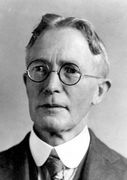 mammals and advocated a fully modern approach to taxonomy that emphasized tying scientific names to natural biological populations. His 1930 paper gives a clear statement of this position.
Matthew's key biogeographic theory was that waves of faunal migration repeatedly went from the northern continents southwards. This theory, which had obvious racial and political overtones, was justified by a "stabilist" view of paleogeography (i.e., that the continents had never moved from their modern positions), and by evidence from the relatively young fossil record of mammals, at the expense of other data that would have shown the more ancient interconnections among South America, Africa, India, and Australia. Remarkably, Matthew remained a Darwinian despite working for the autocratic orthogeneticist H. F. Osborn for three decades.
Info from HERE. Image from HERE.
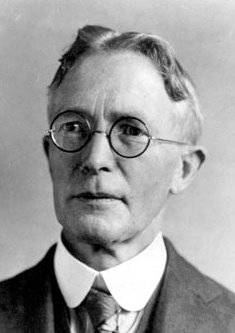 mammals and advocated a fully modern approach to taxonomy that emphasized tying scientific names to natural biological populations. His 1930 paper gives a clear statement of this position.
Matthew's key biogeographic theory was that waves of faunal migration repeatedly went from the northern continents southwards. This theory, which had obvious racial and political overtones, was justified by a "stabilist" view of paleogeography (i.e., that the continents had never moved from their modern positions), and by evidence from the relatively young fossil record of mammals, at the expense of other data that would have shown the more ancient interconnections among South America, Africa, India, and Australia. Remarkably, Matthew remained a Darwinian despite working for the autocratic orthogeneticist H. F. Osborn for three decades.
Info from HERE. Image from HERE.
Born This Day: Sven Anders Hedin
Hedin (Feb. 19,1865 - Nov. 26, 1952) was a Swedish explorer and geographer, born in Stockholm, who led four multi-year expeditions into Central Asia between 1897 and 1935. Although not as well known as Roy Chapman Andrews his work in the  regions revealed a wealth of cultural, archaeological and palaeontological wonders.
During his first major Asian expedition, he crossed the Pamirs, charted Lop Nor (Lake) in China, and finally arrived at Beijing. He then journeyed to Tibet by way of Mongolia, Siberia, and the Gobi Desert. Hedin explored Tibet and Xinjiang (Sinkiang), identified the sources of the Brahmaputra, Indus, and Sutlej rivers, and, in 1906, explored and named the Trans-Himalayas. In 1927 Hedin led an expedition of Chinese and Swedish scientists into Central Asia.
He wrote extensively about his adventures (e.g., Across the Gobi Desert, The Conquest of Tibet (1935), My Life as an Explorer (1926)) and they make for engaging and fascinating reading for anyone interested in the early days of exploring Central Asia. link
An excellent summary of Hedin’s life and expeditions into Central Asia can be found at the IDP News Archives image
 regions revealed a wealth of cultural, archaeological and palaeontological wonders.
During his first major Asian expedition, he crossed the Pamirs, charted Lop Nor (Lake) in China, and finally arrived at Beijing. He then journeyed to Tibet by way of Mongolia, Siberia, and the Gobi Desert. Hedin explored Tibet and Xinjiang (Sinkiang), identified the sources of the Brahmaputra, Indus, and Sutlej rivers, and, in 1906, explored and named the Trans-Himalayas. In 1927 Hedin led an expedition of Chinese and Swedish scientists into Central Asia.
He wrote extensively about his adventures (e.g., Across the Gobi Desert, The Conquest of Tibet (1935), My Life as an Explorer (1926)) and they make for engaging and fascinating reading for anyone interested in the early days of exploring Central Asia. link
An excellent summary of Hedin’s life and expeditions into Central Asia can be found at the IDP News Archives image
Born This Day: Sir Roderick Impey Murchison
Murchison (Feb. 19, 1792 - Oct. 22, 1871) was a Scottish geologist who first differentiated the Silurian strata in the geologic sequence of Early Paleozoic strata (408-540 million years old). He believed in fossils as primary criteria. In 1831, he began researching the previously geologically unknown graywacke rocks of the Lower Paleozoic, found underlying the Old Red Sandstone in parts of Wales, which culminated in his major work the Silurian System (1839).
Murchison named the Silurian after an ancient British tribe that inhabited South Wales. He established the Devonian working with Adam Sedgwick (1839). He named the Permian (1841) after the Perm province in Russia where he made a geological survey in 1840-45. link
Murchison named the Silurian after an ancient British tribe that inhabited South Wales. He established the Devonian working with Adam Sedgwick (1839). He named the Permian (1841) after the Perm province in Russia where he made a geological survey in 1840-45. link

Thursday, February 18, 2010
Bistahieversor sealeyi

Read the story by C. Dell’Amore at National Geographic News. Sadly, JVP does not provide DOI links for their articles.
Premiered This Day (1938): Bringing Up Baby

Coming in at #97 on the American Film Institute's list of greatest films, ‘Bringing Up Baby’, co-starring Cary Grant and Kate Hepburn, is acknowledged as the archetypical screwball comedy.
Directed by Howard Hawks in 1938, Grant plays paleontologist David Huxley who is trying to secure a $1,000,000.00 endowment for his museum. He meets up with Hepburn’s seemingly scatterbrained heiress,
 Susan Vance, who becomes determined to derail Grant’s next day wedding.
 Over the course of the next 24 hours Grant gets completely mired in Hepburn’s whirlwind ad hoc plans to catch her new (and completely reluctant) beau that includes hunting for her leopard (the ‘Baby’ of the title), having her steal his clothes, ending up in jail, falling in a stream, and finally losing his “intercostal clavicle” to Hepburn’s dog that was to be the final element needed complete the Brontosaurus skeleton he’s been working on for four years.
The fast-paced, witty script, sharp direction and comedic chemistry between Grant and Hepburn all combine to make this film worthy of multiple repeat viewings.
Triceracopter

“The Triceracopter is half Triceratops, half helicopter. Built as a sculpture in 1977 by artist Patricia Renick, it's now available now for the discerning collector/dinopilot”. link.
Thanks to Toni for the link.
Died This Day: Adolphe-Théodore Brongniart
Adolphe-Théodore Brongniart (Jan. 14, 1801 - Feb. 18, 1876) was a French botanist whose classification of fossil plants drew surprisingly accurate relations between extinct and existing forms prior to Charles Darwin's 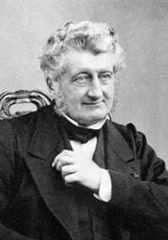 principles of organic evolution. His work earned him the distinction as the founder of modern paleobotany.
He was an early proponent of evolutionary theory. Brongniart published the first complete account of fossil plants (1828). His interpretations of the fossil record also contributed to our understanding of historical changes in climates and plant geography. link image
 principles of organic evolution. His work earned him the distinction as the founder of modern paleobotany.
He was an early proponent of evolutionary theory. Brongniart published the first complete account of fossil plants (1828). His interpretations of the fossil record also contributed to our understanding of historical changes in climates and plant geography. link image
Wednesday, February 17, 2010
60% Off Horned Dinosaurs

The Horned Dinosaur volume that I'm co-editing will, hopefully, be published very soon. Since the editors only get a couple of freebie copies for all our efforts, we not be able to give away copies to everyone who deserves one, as much as we would like to.
So, here's your chance to pre-order a copy at what will probably be the cheapest price you'll ever see it sold for.
The Origin of Insects
Arthropod relationships revealed by phylogenomic analysis of nuclear protein-coding sequences. 2010. J.C. C. Regier, et al. Nature, published online 10 February 2010


CLICK TO ENLARGE
© DC Comics

Speleonectes tulumensis is from a group of rare, blind, cave-dwelling crustaceans called remipede and are the crustaceans most closely related to the insects. Credit: Simon RichardsThe new study supports the hypothesis that the insects evolved from a group of crustaceans. So flies, honeybees, ants, and crickets all branched off the arthropod family tree from within the lineage that gave rise to today's crabs, shrimp, and lobsters. Another important finding is that the "Chelicerata" (a group that includes the spiders, scorpions, ticks, and mites) branched off very early, earlier than the millipedes, centipedes, crustaceans, and insects. That means that the spiders, for example, are more distantly related to the insects than many researchers previously thought. link

CLICK TO ENLARGE
Based on likelihood analyses of 62 nuclear protein-coding genes. Branch lengths are proportional to the amount of inferred sequence change, with the topology and analytical conditions identical to the degen1 analysis in Fig. 1. Line drawings of representatives of the major taxonomic groups show the morphological disparity across Arthropoda. Scale bar, nucleotide changes per site.

© DC Comics
Tuesday, February 16, 2010
Died Again This Day: Sandra Shaw

Arbogast on Film blog has nice appreciation of Sandra Shaw’s few famous film moments.
Born This Day: Ernst Heinrich August Haeckel
Haeckel (Feb, 16, 1834 - Aug. 9, 1919) was a German zoologist and evolutionist who was a strong proponent of Darwinism and proposed new notions of the evolutionary descent of man. He coined many words commonly used by biologists today, such as phylum, phylogeny, and ecology.
He is noted for the book, The evolution of man: a popular exposition of the principal points of human ontogeny and phylogeny link

He is noted for the book, The evolution of man: a popular exposition of the principal points of human ontogeny and phylogeny link
Born This Day: Jean-Baptiste-Julien d' Omalius d'Halloy
Feb. 16, 1783 - Jan. 15, 1875
d'Halloy was a Belgian geologist who was an early proponent of evolution and was acknowledged by Charles Darwin in his preface to ‘On The Origin of the Species’ for his opinions on the origin of new species through descent with modification.
He determined the stratigraphy of the Carboniferous and other rocks in Belgium and the Rhine provinces, and also made detailed studies of the Tertiary deposits of the Paris Basin. link
d'Halloy was a Belgian geologist who was an early proponent of evolution and was acknowledged by Charles Darwin in his preface to ‘On The Origin of the Species’ for his opinions on the origin of new species through descent with modification.
He determined the stratigraphy of the Carboniferous and other rocks in Belgium and the Rhine provinces, and also made detailed studies of the Tertiary deposits of the Paris Basin. link
Sunday, February 14, 2010


Subscribe to:
Posts (Atom)