Sunday, October 16, 2011

Born This Day: Giovanni Arduino

Arduino (Oct. 16, 1714 - March 21, 1795) was an Italian geologist, known as the father of Italian geology, who introduced the terms Primary, Secondary, Tertiary, and Quaternary in 1760 to classify four broad divisions of the Earth's rock surface, each earlier in deposition. Within each he recognized numerous minor strata, and had a clear paleontological interpretation of the age sequence of the fossil record.

The Primary order contained Paleozoic formations from the oldest, lowest basaltic rock from ancient volcanoes overlaid with metamorphic and sedimentary rocks which he saw in the Atesine Alps. He classified Mesozoic prealpine foothills as of the Secondary order, Tertiary in the subalpine hills and the Quaternary alluvial deposits in the plains. From Today In Science History

Saturday, October 15, 2011

The Golden Age of Lasers


CLICK TO ENLARGE
The Calgary-based band, The Forbidden Dimension, has a newly minted CD full of hot 'n spooky rock 'n roll tunes. Dino aficionados will recognize the Waterhouse Hawkins-inspired cover drawn by double threat musician/artist, Jackson Phibes, in this promo photo he sent me.

You can pick up a copy at all the better independent record shops (or you will be able to very soon), or you can order a copy from Saved By Vinyl.

Watch a live version of hit single, "Tor Johnston Mask" here.

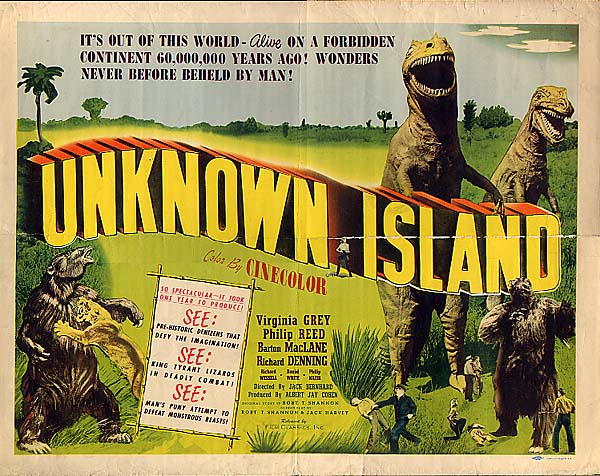
Premiered This Day: Unknown Island

This 1948 film written by Robert T. Shannon and directed by Jack Bernhard features some of the worst ‘man dressed up as a T. rex’ effects ever. Not a bad little story though.

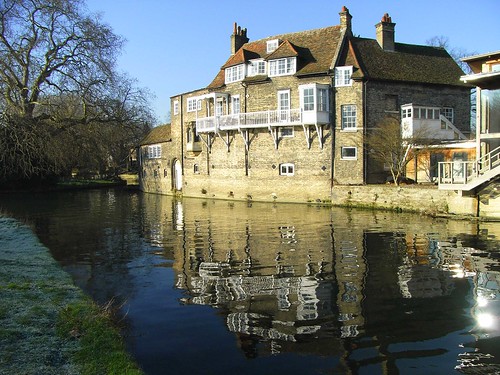
On This Day: Darwin Accepted Into Cambridge

In 1827, Charles Darwin was accepted into Christ's College at Cambridge, but did not start until winter term because he needed to catch up on some of his studies. A grandson of Erasmus Darwin of Lichfield, and of Josiah Wedgwood, he had entered the University of Edinburgh in 1825 to study medicine, intending to follow his father Robert's career as a doctor. However, Darwin found himself unenthusiastic about his studies, including that of geology.

Disappointing his family that he gave up on a medical career, he left Edinburgh without graduating in April 1827. His scholastic achievements at Cambridge were unremarkable, but after graduation. Today Cambridge has Darwin College, founded in 1964, for advanced study that only admits postgraduate students. From Today In Science History

Friday, October 14, 2011

Born This Day: Jack Arnold


Jack Arnold (Oct. 14, 1916 - March 17, 1992) directed a number of classic SF films including The Creature From the Black Lagoon, Revenge of the Creature, The Incredible Shrinking Man, and It Came From Outer Space, as well as few not-so-classics (but still much loved) such as Monster on Campus. Throughout the ‘60’s and into the early 80’s he had a successful career as a TV producer and director.

Wednesday, October 12, 2011

Humans Descended From Ancestor With Sixth Sense*

Electrosensory ampullary organs are derived from lateral line placodes in bony fishes. 2011. M. S. Modrell, et al. Nature Communications 2: article #496.


The Shark © DC Comics**
A new study finds that the vast majority of vertebrates are descended from a common ancestor that had a well-developed electroreceptive system.


People experience the world through five senses but sharks and certain other aquatic vertebrates have a sixth sense: They can detect weak electrical fields in the water and use this information to detect prey, communicate and orient themselves.

This ancestor was probably a predatory marine fish with good eyesight, jaws and teeth and a lateral line system for detecting water movements, visible as a stripe along the flank of most fishes. It lived around 500 million years ago. The vast majority of the approximately 65,000 living vertebrate species are its descendants.

Using the Mexican axolotl as a model to represent the evolutionary lineage leading to land animals, and paddlefish as a model for the branch leading to ray-finned fishes, the researchers found that electrosensors develop in precisely the same pattern from the same embryonic tissue in the developing skin, confirming that this is an ancient sensory system. link

* Title from the actual press release.
**(Well, Pluto was a planet back in 1963.)

Tuesday, October 11, 2011

Died This Day: Richard Denning


Denning (March 27, 1914 – Oct. 11, 1998) had a long career in Hollywood before moving into TV (notably Hawaii Five-O) in the 1960’s.

He had starring roles in a number of Sci-Fi flicks including Unknown Island (1948), Day the World Ended (1955), Creature with the Atom Brain (1955) and Black Scorpion (1957), but he takes a bow here for playing the greedy Dr. Mark Williams in 1954’s, Creature from the Black Lagoon.

Monday, October 10, 2011

Ichythosaur Vs. Kraken?

Triassic kraken: the Berlin ichthyosaur death assemblage interpreted as a giant cephalopod midden. 2011.M.A.S. McMenamin and S. McMenamin, 2011 GSA Annual Meeting in Minneapolis (9–12 October 2011).


In Triassic-aged rocks of Berlin-Ichthyosaur State Park in Nevada the remains of nine14m long ichthyosaurs, Shonisaurus popularis, can be found. These were the Triassic’s counterpart to today’s predatory giant squid-eating sperm whales. But the fossils at the Nevada site have a long history of perplexing researchers.

McMenamin noted different degrees of etching on the bones that suggests that the shonisaurs were not all killed and buried at the same time. It also looked like the bones had been purposefully rearranged (below). That it got him thinking about a particular modern predator that is known for just this sort of intelligent manipulation of bones.


In the fossil bed, some of the shonisaur vertebral disks are arranged in curious linear patterns with almost geometric regularity resembling a coleoid sucker. In other words, the vertebral disc “pavement” seen at the state park may represent the earliest known self portrait. link

But could an octopus really have taken out such huge swimming predatory reptiles? Watch this video :

Sunday, October 09, 2011

Reconstructing The Evolutionary History of Mollusks

Phylogenomics reveals deep molluscan relationships. 2011. K.M. Kocot, et al. Nature 477: 452-456.


N-Man © Steve Bissette
Deep genomic analysis of Molluscsa shows there is more than 1 way to make a brain.

Using genomics and computational approaches, scientists have reconstructed the evolutionary history of the entire phylum Molluscsa, ranging from giant squid to microscopic marine worm-like creatures.

One of the surprising outcomes of the study suggests that the formation of a complex brain in mollusks has independently occurred at least four times during the course of evolution. link

Nothing says Danger like a Giant Clam!


Watch the horror HERE

Friday, October 07, 2011

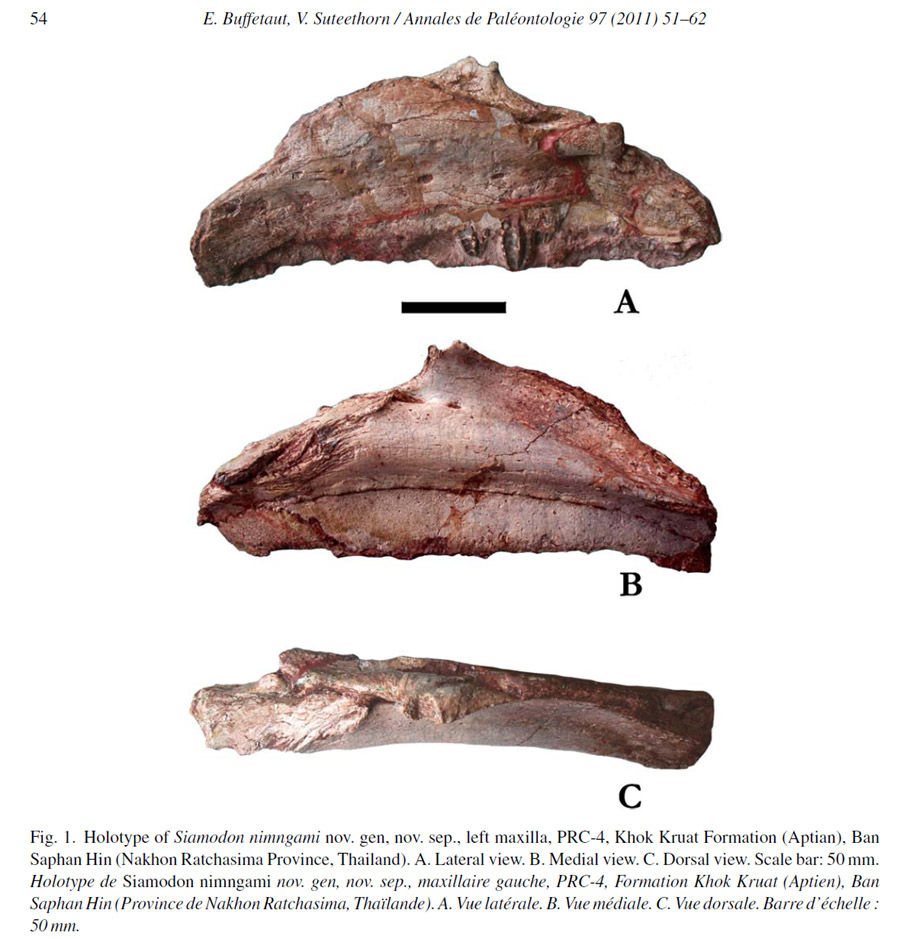
Siamodon nimngami, Iguanodontian from Thialand

A new iguanodontian dinosaur from the Khok Kruat Fm (Early Cretaceous, Aptian) of northeastern Thailand. 2011. E. Buffetaut and V. Suteethorn. Annales de Paléontologie 97: 51–62.


Abstract: A new taxon of ornithopod dinosaur is described as Siamodon nimngami nov. gen, nov. sep., on the basis of a well-preserved maxilla from the Khok Kruat Formation (Aptian) of northeastern Thailand. An isolated tooth and a braincase are referred to this taxon, and the status of other ornithopod specimens from Thailand and Laos is discussed.

S. nimngami is considered as an advanced iguanodontian, apparently close to Probactrosaurus, from which it differs by various characters of the maxilla. Siamodon is an addition to the already long list of advanced iguanodontian taxa from the late Early Cretaceous of Asia. The diversity and abundance of these forms may suggest that advanced iguanodontians first appeared in Asia, before spreading to other parts of the world.

Thursday, October 06, 2011

The Last Universal Common Ancestor of All Life

Evolution of vacuolar proton pyrophosphatase domains and volutin granules: clues into the early evolutionary origin of the acidocalcisome. 2011. M. J, Seufferheld, et al. Biology Direct: 6:50.


My Greatest Adventure, DC Comics
New evidence suggests that the Last Universal Common Ancestor (LUCA) was a sophisticated organism after all, with a complex structure recognizable as a cell.
The study builds on several years of research into a once-overlooked feature of microbial cells, a region with a high concentration of polyphosphate, a type of energy currency in cells.

This site actually represents the first known universal organelle (acidocalcisome), once thought to be absent from bacteria and their distantly related microbial cousins.


By comparing the sequences of the V-H+PPase genes from hundreds of organisms representing the three domains of life, the team constructed a "family tree" that showed that the V-H+PPase enzyme and the acidocalcisome it serves are very ancient, dating back to the LUCA, before the three main branches of the tree of life appeared.

"There are many possible scenarios that could explain this, but the best, the most parsimonious, the most likely would be that you had already the enzyme even before diversification started on Earth," said study co-author Gustavo Caetano-Anollés.

"The protein was there to begin with and was then inherited into all emerging lineages." link

Died This Day: George Gaylord Simpson

Simpson (June 16, 1902 - October 6, 1984) is known for his contributions to evolutionary theory and to the understanding of intercontinental migrations of animal species in past geological times. Simpson specialized in early fossil mammals, leading expeditions on four continents and discovering in 1953 the 50-million-year old fossil skulls of dawn horses in Colorado.

Simpson helped develop the modern biological theory of evolution, drawing on paleontology, genetics, ecology, and natural selection to show that evolution occurs as a result of natural selection operating in response to shifting environmental conditions. He spent most of his career as a paleontologist at the American Museum of Natural History. image. From Today In Science History.

Friday, September 30, 2011

Born This Day: Charles Lapworth

From Today In Science History:

Lapworth (Sept. 30, 1842 - March 13, 1920) was an English geologist who proposed what came to be called the Ordovician period (505 to 438 million years old) of geologic strata. Lapworth is famous for his work with marine fossils called graptolites.

By fastidiously collecting the tiny, colonial sea creatures, he figured out the original order of layered rocks that had been faulted and folded in England's Southern Uplands. This method of correlating rocks with graptolites became a model for similar research throughout the world.

In 1879, Lapworth proposed a new classification of Lower Paleozoic rocks with the Ordovician, between the redefined Cambrian and Silurian periods. The name comes from an ancient Welsh tribe, the Ordovices.

Thursday, September 29, 2011

Anatotitan, No More!

Cranial Growth and Variation in Edmontosaurs (Dinosauria: Hadrosauridae): Implications for Latest Cretaceous Megaherbivore Diversity in North America. 2011. N.E. Campione & D. C. Evans. PLoS ONE 6(9): e25186.


CLICK TO ENLARGE

Abstract: The well-sampled Late Cretaceous fossil record of North America remains the only high-resolution dataset for evaluating patterns of dinosaur diversity leading up to the terminal Cretaceous extinction event. Hadrosaurine hadrosaurids (Dinosauria: Ornithopoda) closely related to Edmontosaurus are among the most common megaherbivores in latest Campanian and Maastrichtian deposits of western North America. However, interpretations of edmontosaur species richness and biostratigraphy have been in constant flux for almost three decades, although the clade is generally thought to have undergone a radiation in the late Maastrichtian.

We address the issue of edmontosaur diversity for the first time using rigorous morphometric analyses of virtually all known complete edmontosaur skulls. Results suggest only two valid species, Edmontosaurus regalis from the late Campanian, and E. annectens from the late Maastrichtian, with previously named taxa,including the controversial Anatotitan copei, erected on hypothesized transitional morphologies associated with ontogenetic size increase and allometric growth.

A revision of North American hadrosaurid taxa suggests a decrease in both hadrosaurid diversity and disparity from the early to late Maastrichtian, a pattern likely also present in ceratopsid dinosaurs. A decline in the disparity of dominant megaherbivores in the latest Maastrichtian interval supports the hypothesis that dinosaur diversity decreased immediately preceding the end Cretaceous extinction event.

'Nuff Said!

Cowboys Vs Dinosaurs!


Jack Kirby + pterosaurs + cowboys = Good Fun over at Atomic Surgery

Thursday, September 15, 2011

Premiered This Day (1914): Gertie The Dinosaur

Winsor McCay (Sept. 26, 1987 – July 26, 1934) was one of the great American artists of the last century. He is best known for his newspaper comic strip Little Nemo in Slumberland that ran from 1905 to 1914, and the animated cartoon creation Gertie the Dinosaur (1914).

For this cartoon McCay hand drew each frame of film. He took it on a tour of the vaudeville circuit and delighted audiences by being able to ‘interact’ with Gertie. Gertie is considered by many as the first true animated character to be featured in a film.

Tuesday, September 13, 2011

Glass Lantern Field Slides Now Posted at the NMNH


This lantern slide is from a collection showing field excavations in Arizona, at the Grand Canyon and other unnamed locations in the Painted Desert.

A collection of newly digitized glass lantern slides, showing early 20th century paleontological digs and the preparation of fossils for display, is now available to the public from the Smithsonian Institution Archives and the National Museum of Natural History. Link from Wired.

Thanks to Matt Vavrek!

Laccognathus embryi


Ted Daeschler/ANSP (image), K. Monoyios (illo)

The 375-million-year-old Laccognathus embryi was d found at the same site as Tiktaalik, on Ellesmere Island in the remote Nunavut Territory of Arctic Canada. Laccognathus is a lobe-finned fish whose closest living relative is the lungfish. The creature probably grew to about 5 or 6 feet long and had a wide head with small eyes and robust jaws lined with large piercing teeth.

"Clearly these Late Devonian ecosystems were vicious places, and Laccognathus filled the niche of a large, bottom-dwelling, sit-and-wait predator with a powerful bite."

The researchers named the new species in honor of Dr. Ashton Embry, a Canadian geologist whose work in the Arctic islands paved the way for the authors' paleontological explorations.

The kind of fish known as Laccognathus (translates as pitted jaw) was previously only known from Eastern Europe. The discovery of Laccognathus embryi, the new species, extends the geographic range of Laccognathus to North America and confirms direct connection of the North American and European landmasses during the Devonian Period.

Published in JVP.

Saturday, September 10, 2011

Born This Day: Stephen Jay Gould


image
Sept. 10, 1941 - May 20. 2002
Here’s a nice piece on Gould by Henry Lowood from the Stanford Presidential Lectures in the Humanities and Arts.

Friday, September 09, 2011

Premiered This Day: Mighty Mightor!

"While on a hunting trip, Tor and his faithful companion Tog rescue an ancient hermit from a Tyrannosarus rex. Grateful, the old man gives Tor a club which possesses great powers. Tor raises the club and he becomes Mightor, and Tog is transferred into a fire-breathing dragon. Together they become champions of good and the nemesis of evil!" From the opening narration. link.

Mighty Mightor debuted this day in 1967 as part of the Moby Dick and Mighty Mightor Hanna-Barbera cartoon show.

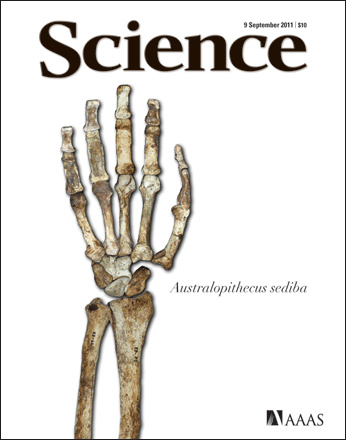
Australopithecus sediba

Australopithecus sediba at 1.977 Ma and Implications for the Origins of the Genus Homo. R. Pickering, et al. Science 333: 1421-1423.


Five papers based on Australopithecus sediba have been published in Science on Sept. 9, 2011. They include an analysis of the most complete hand ever described in an early hominin, the most complete undistorted pelvis ever discovered, the highest resolution and most accurate scan of an early human ancestors brain ever made, new pieces of the foot and ankle skeleton, and one of the most accurate dates ever achieved for an early hominin site in Africa.

Au. sediba (MH-1) skull reconstruction (opaque) with endocast (green, opaque) partially visible as a result of virtual craniotomy. Dr K. Carlson, U. Witwatersrand.
Abstract: Newly exposed cave sediments at the Malapa site include a flowstone layer capping the sedimentary unit containing the Australopithecus sediba fossils. Uranium-lead dating of the flowstone, combined with paleomagnetic and stratigraphic analysis of the flowstone and underlying sediments, provides a tightly constrained date of 1.977 ± 0.002 million years ago (Ma) for these fossils. This refined dating suggests that Au. sediba from Malapa predates the earliest uncontested evidence for Homo in Africa.


The cranium of the juvenile skeleton of Au.sediba. Pic courtesy of Lee Berger & U. Witwatersrand.

Born This Day: William Lonsdale


Painting by Dan Erickson of the Phaeton Group
William Lonsdale (Sept. 9, 1794 – Nov. 11, 1891 ) was an English geologist and paleontologist whose study of coral fossils found in Devon, suggested (1837) certain of them were intermediate between those typical of the older Silurian System (408 to 438 Ma) and those of the later Carboniferous System (286 to 360 Ma. Geologists Roderick Murchison and Adam Sedgwick agreed and named this new geologic system after its locale - the Devonian Period (1839).

Lonsdale's early career was as an army officer (1812-15) and later he became curator and librarian of the Geological Society of London (1829-42). He recognised that fossils showed how species changed over time, and more primitive organisms are found in lower strata.
From Today In Science History

Born This Day: Joseph Leidy


From The Academy of Natural Sciences:

Leidy (Sept. 9, 1823 - April 30, 1891) is known as the "Father of American Vertebrate Paleontology". He described the first relatively complete dinosaur skeleton, Hadrosaurus, and introduced many American and European scientists to the fossil riches of the American West. Leidy's consummate skill in comparative anatomy would allow him to identify and characterize even the most fragmentary fossil material.

Leidy was also the "Founder of American Parasitology," a Professor of Anatomy at the University of Pennsylvania, a pioneering protozoologists, an influential teacher of Natural History, an accomplished microscopist and scientific illustrator, and an expert on a variety of subjects encompasing the earth and natural sciences. He published scientific papers on more than a thousand extinct and living protozoa, fungi and invertebrates and vertebrates as well as an assortment of publications on human biology and medicine. He was also one of the earliest supporters of Charles Darwin.

Wednesday, September 07, 2011

Born This Day: Ferdinand Vandiveer Hayden

From Today In Science History

Hayden (Sept. 7, 1829 - Dec. 22, 1887) was an American geologist and explorer of the U.S. West. After finishing a medical school training (1853), his early career began in paleontology for James Hall, collecting fossils in the Badlands and the Upper Missouri Valley. It is believed he made the first North American discovery of dinosaur remains (1854) during this expedition.

His work in the Great Plains and Rocky Mountains helped lay the foundation of the U.S. Geological Survey. Hayden is credited with having the Yellowstone geyser area declared the first national park (1872).

Image and more info on Hayden HERE.

Born This Day: Comte Georges-Louis Leclerc de Buffon

Buffon (Sept. 7, 1707 – April 16, 1788) was a French naturalist, who formulated a crude theory of evolution and was the first to suggest that the earth might be older than suggested by the Bible.

In 1739 he was appointed keeper of the Jardin du Roi, a post he occupied until his death. There he worked on a comprehensive work on natural history, for which he is remembered, Histoire naturelle, générale et particulière. He began this work in 1749, and it dominated the rest of his life. It would eventually run to 44 volumes, including quadrupeds, birds, reptiles and minerals.

He proposed (1778) that the Earth was hot at its creation and, from the rate of cooling, calculated its age to be 75,000 years, with life emerging some 40,000 years ago.

From Today In Science History. Stamp from HERE.

More info on Buffon from UC-Berkeley.

Monday, September 05, 2011

Born This Day: Raquel Welch


The cinema's definitive cave woman!

Thursday, September 01, 2011

Died This Day: Luis Alvarez

Alvarez (June 13, 1911 - Sept. 1, 1988) was an American experimental physicist who was awarded the Nobel Prize for Physics in 1968 for work that included the discovery of many resonance particles --subatomic particles having extremely short lifetimes and occurring only in high-energy nuclear collisions.

In about 1980 Alvarez (left) helped his son, the geologist Walter Alvarez (right), publicize Walter's discovery of a worldwide layer of clay that has a high iridium content and which occupies rock strata at the geochronological boundary between the Mesozoic and Cenozoic eras; i.e., about 66.4 million years ago.

They postulated that the iridium had been deposited following the impact on Earth of an asteroid or comet and that the catastrophic climatic effects of this massive impact caused the extinction of the dinosaurs. Though initially controversial, this widely publicized theory gradually gained support as the most plausible explanation of the abrupt demise of the dinosaurs.

Read more HERE. Image from HERE.

Wednesday, August 31, 2011

On This Day: Charles Darwin Finds His Advocate For Sailing On The Beagle

In 1831, Charles Darwin was visiting Maer Hall, home of his uncle Josiah Wedgwood II, whom he told of his father, Robert Darwin's, opposition to him joining a two-year voyage on H.M.S. Beagle. Charles was enthusiastic about the opportunity, but his father objected to it as a waste of time, delaying his expected career in the clergy, and would not give his permission. His father said, however, he could be swayed to change his opinion if Charles found a man with common sense who would regard the proposed trip as being worthwhile.

Charles found that man in his uncle Josiah, who wrote a letter answering all of the objections in his favour. Josiah was Robert's brother-in-law, and as a family member was successful in influencing him to change his mind. From Today In Science History

Monday, August 29, 2011

Died This Day: Julie Ege


Nov. 12, 1943 – April 29, 2008
Julie had the lead role as Nala in the 1971 Hammer film, “Creatures The World Forgot”.

Saturday, August 27, 2011

Premiered This Day (1979): Planet of Dinsosaurs!


Well, it premiered in Sweden on this date. It took until Nov. 14, 1981 to make it to the USA.

Happy Birthday to Barbara Bach


Bach played Lana in the 1981 film Caveman.

Wednesday, August 17, 2011

Premiered This Day: The People That Time Forgot


Directed by Kevin O’Connor, this 1977 film starring Doug McClure was a sequel to “The Land That Time Forgot” (1975).

Monday, August 15, 2011

Rapid Recycling of The Earth's Crust

A young source for the Hawaiian plume. 2011. A. V. Sobolev, et al. Nature, Published online Aug. 10.
The recycling of the Earth's crust in volcanoes happens much faster than scientists have previously assumed.

Cave Carson © DC Comics
Rock of the oceanic crust, which sinks deep into the earth due to the movement of tectonic plates, reemerges through volcanic eruptions after around 500 million years. Previously, geologists thought this process would take about two billion years.


Some ocean islands, such as Hawaii, originate from the lowest part of the mantle as hot rock rises in cylindrical columns (mantle plumes), from a depth of nearly 3000 kilometres. Near the surface, it melts, because the pressure is reduced, and forms volcanoes. The plume originates from former ocean crust which early in the Earth's history sank to the bottom of the mantle. Previously, scientists had assumed that this recycling took about two billion years.


The chemical analysis of tiny glassy inclusions in olivine crystals from basaltic lava on Mauna Loa volcano in Hawaii has now surprised geologists: the entire recycling process requires at most half a billion years, four times faster than previously thought. link


Read all of the Cave Carson adventure here!

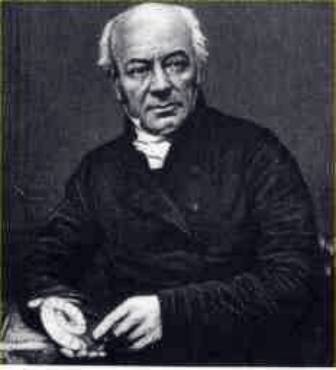
Died This Day: William Buckland

From The Victorian Web:

Buckland (March 12, 1784 – August 15, 1856) was the first man to identify and name a dinosaur (Megalosaurus), although the name dinosaur had not yet been coined by Richard Owen. Partly in response to the controversial works of Cuvier, Buckland wrote Reliquiae Diluvianae (1823) in which he argued that the evidence of geology alone demonstrated that a great flood had covered the entire globe. This move helped to make geology look more respectable in a religiously conservative England and perhaps to advance Buckland's own career at Oxford by making geology appear to be a respectable companion to the classics.

Buckland was a bit of an eccentric, given to outlandish dress and behavior. Although Buckland was immensely influential as a scientist, his rakish reputation gave many of his staid early Victorian contemporaries considerable difficulty in accepting his work.

More info from HERE. Image from HERE

Sunday, August 14, 2011

Tour The Age of Dinosaurs for 10 Cents!


However, I'm sure the cost has gone up since this ad first appeared in 1960.