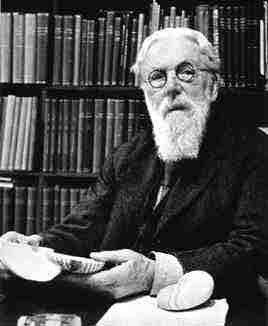
Primitive soft-bodied cephalopods from the Cambrian. 2010. M. R. Smith and J.-B. Caron. Nature 465: 469–472.
Abstract [edit]: We reinterpret the problematic Middle Cambrian animal Nectocaris pteryx as a primitive, non-mineralized cephalopod, based on new material from the Burgess Shale. Together with Nectocaris, the problematic Lower Cambrian taxa Petalilium and (probably) Vetustovermis form a distinctive clade, Nectocarididae, characterized by an open axial cavity with paired gills, wide lateral fins, a single pair of long, prehensile tentacles, a pair of non-faceted eyes on short stalks, and a large, flexible anterior funnel.
This clade extends the cephalopods’ fossil record by over 30 million years, and indicates that primitive cephalopods lacked a mineralized shell, were hyperbenthic, and were presumably carnivorous. The presence of a funnel suggests that jet propulsion evolved in cephalopods before the acquisition of a shell. The explosive diversification of mineralized cephalopods in the Ordovician may have an understated Cambrian ‘fuse’
Thursday, May 27, 2010
Nectocaris, A Primative Cephalopod from the Burges Shale
Jeyawati rugoculus
Congrats to Andrew MacDonald for describing Jeyawati rugoculus, a 91 million year old basal hadrosauroid from western New Mexico.
The partial skull and other fragments of Jeyawati were discovered by paleontologist Douglas Wolfe, principal investigator of the Zuni Basin Paleontological Project. Subsequent excavation and collection was carried out for 13 years with the aid of James Kirkland, state paleontologist with the Utah Geological Survey, and volunteers from the Southwest Paleontological Society, among others.
The research team published their findings in the May issue of the Journal of Vertebrate Paleontology. link
Born This Day: Sandra Shaw
Although Sandra Shaw (May 27, 1913 – Feb. 16, 2000) had a short film career comprising a few, mostly uncredited film roles in 1933, her most famous appearance is that of the person plucked from her sleep from an unnamed hotel by King Kong, and than casually dropped to her death when he realizes that she is not Ann Darrow (Fay Wray). The year that Kong was released she married Gary Cooper.
Arbogast on Film blog has nice appreciation of Sandra Shaw’s few famous film moments.
Wednesday, May 26, 2010
New Perspectives On Horned Dinosaurs Now Published
Well, I got my copy directly from Indiana University Press, so I'm assuming that it will soon be available from all the usual sources.
FYI, the cover is by the very talented Donna Sloan, who works at the Royal Tyrrell Museum. However, it does not actually actually represent one of the 8 new taxa described in the book; but it is a nice Chasmosaurus!
Measuirng A Dinosaur's Body Temperature
Body temperatures of modern and extinct vertebrates from 13C-18O bond abundances in bioapatite. 2010. R. A. Eagle, et al. PNAS published online before print May 24.
Researchers have described the first method for the direct measurement of the body temperatures of large extinct vertebrates—through the analysis of rare isotopes in the animals' bones, teeth, and eggshells.
The technique the team has developed to measure body temperature in extinct vertebrates looks at the concentrations of two rare isotopes—carbon-13 and oxygen-18. "These heavy isotopes like to bond, or clump together, and this clumping effect is dependent on temperature," says Robert Eagle. "At very hot temperatures, you get a more random distribution of these isotopes, less clumping. At low temperatures, you find more clumping."
In living creatures, this clumping can be seen in the crystalline lattice that makes up bioapatite—the mineral from which bone, tooth enamel, eggshells, and other hard body parts are formed. "When the mineral precipitates out of the blood—when you create bone or tooth enamel—the isotopic composition is frozen in place and can be preserved for millions of years," he adds.
"This is not quite like going back in time and sticking a thermometer up a creature's back end," says John Eiler, "but it's close." link
Sunday, May 23, 2010
Born This Day: Carolus Linnaeus
From the Linnean Society:
Linnaeus (May 23, 1707 – Jan. 10, 1778) was born in Sweden. He headed an expedition to Lapland in 1732, travelling 4,600 miles and crossing the Scandinavian Peninsula by foot to the Arctic Ocean. On the journey he discovered a hundred botanical
species. He undertook his medical degree in 1735 in the Netherlands. In 1735, he published Systema Naturae, his classification of plants based on their sexual parts.
His method of binomial nomenclature using genus and species names was further expounded when he published Fundamenta Botanica (1736) and Classes Plantarum (1738). This system used the flower and the number and arrangements of its sexual organs of stamens and pistils to group plants into twenty-four classes which in turn are divided into orders, genera and species.
In his publications, Linnaeus provided a concise, usable survey of all the world's plants and animals as then known, about 7,700 species of plants and 4,400 species of animals. These works helped to establish and standardize the consistent binomial nomenclature for species which he introduced on a world scale for plants in 1753, and for animals in 1758, and which is used today.
His Systema Naturae 10th edition, volume 1(1758), has accordingly been accepted by international agreement as the official starting point for zoological nomenclature. Scientific names published before then have no validity unless adopted by Linnaeus or by later authors. This confers a high scientific importance on the specimens used by Linnaeus for their preparation, many of which are in his personal collections now treasured by the Linnean Society.
He was granted nobility in 1761, becoming Carl von Linné. He continued his work of classification and as a physician, and remained Rector of the University until 1772.
Linnaeus (May 23, 1707 – Jan. 10, 1778) was born in Sweden. He headed an expedition to Lapland in 1732, travelling 4,600 miles and crossing the Scandinavian Peninsula by foot to the Arctic Ocean. On the journey he discovered a hundred botanical
species. He undertook his medical degree in 1735 in the Netherlands. In 1735, he published Systema Naturae, his classification of plants based on their sexual parts.His method of binomial nomenclature using genus and species names was further expounded when he published Fundamenta Botanica (1736) and Classes Plantarum (1738). This system used the flower and the number and arrangements of its sexual organs of stamens and pistils to group plants into twenty-four classes which in turn are divided into orders, genera and species.
In his publications, Linnaeus provided a concise, usable survey of all the world's plants and animals as then known, about 7,700 species of plants and 4,400 species of animals. These works helped to establish and standardize the consistent binomial nomenclature for species which he introduced on a world scale for plants in 1753, and for animals in 1758, and which is used today.
His Systema Naturae 10th edition, volume 1(1758), has accordingly been accepted by international agreement as the official starting point for zoological nomenclature. Scientific names published before then have no validity unless adopted by Linnaeus or by later authors. This confers a high scientific importance on the specimens used by Linnaeus for their preparation, many of which are in his personal collections now treasured by the Linnean Society.
He was granted nobility in 1761, becoming Carl von Linné. He continued his work of classification and as a physician, and remained Rector of the University until 1772.
Saturday, May 22, 2010
Born This Day: Sir Arthur Conan Doyle
From HERE:
Sir Arthur Conan Doyle (May 22, 1859 – July 7, 1930) was a British writer and creator of Sherlock Holmes. He was born in Edinburgh. His father and uncle were both book illustrators and his mother encouraged his son to explore the world of books. Doyle studied at Edinburgh University and in 1884 he married Louise Hawkins. Doyle qualified as doctor in 1885 and practiced medicine as an eye specialist in Hampshire until 1891 when he became a full time writer. Doyle's first novel about Sherlock Holmes,’ A Study in Scarlet’, was published in 1887.
During the South African war (1899-1902) Doyle served for a few months as senior physician at a field hospital, and wrote ‘The War in South Africa’, in which he defended England's policy. When his son Kingsley died from wounds incurred in World War I, the author dedicated himself in spiritualistic studies.
Doyle's stories of Professor George Edward Challenger in ‘The Lost World’ (1912). The model for the professor was William Rutherford, Doyle's teacher from Edinburgh. Doyle's practice, and other experiences, expeditions as ship's surgeon to the Arctic and West Coast of Africa, service in the Boer War, defenses of George Edalji and Oscar Slater, two men wrongly imprisoned, provided much material for his writings.
The Lost World:
Born This Day: Oliver Perry Hay
May 22, 1846 – Novemeber 2, 1930
Hay was an American paleontologist whose catalogs of fossil vertebrates greatly organized existing knowledge and became standard references. Hay's primary scientific interest was the study of the Pleistocene vertebrata of North America and he is renowned for his work on skull and brain anatomy. His first major work was his Bibliography and Catalogue of the Fossil Vertebrata of North America (1902), supplemented by two more volumes (1929-30). Hay also wrote on the evidence of early humans in North America. link
Friday, May 21, 2010
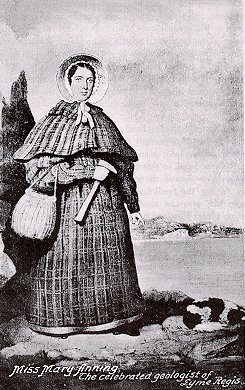
Born This Day: Mary Anning
May 21, 1799 - March 9, 1847
From Today in Science History:
Mary was an English fossil collector who made her first significant discovery at the age of 11 or 12 (sources differ on the details),
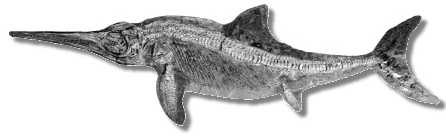
when she found a complete skeleton of an Ichthyosaurus, from the Jurassic period. The ten-meter (30 feet) long skeleton created a sensation and made her famous.
Anning's determination and keen scientific interest in fossils derived from her father's interest in fossil hunting, and a need for the income derived from them to support her family after his death. in 1810. She sold large fossils to noted paleontologists of the day, and smaller ones to the tourist trade. In 1823, Anning made another great discovery, found the first complete Plesiosaurus.
Later in her life, the Geological Society of London granted Anning an honorary membership.
From Today in Science History:
Mary was an English fossil collector who made her first significant discovery at the age of 11 or 12 (sources differ on the details),
when she found a complete skeleton of an Ichthyosaurus, from the Jurassic period. The ten-meter (30 feet) long skeleton created a sensation and made her famous.Anning's determination and keen scientific interest in fossils derived from her father's interest in fossil hunting, and a need for the income derived from them to support her family after his death. in 1810. She sold large fossils to noted paleontologists of the day, and smaller ones to the tourist trade. In 1823, Anning made another great discovery, found the first complete Plesiosaurus.
Later in her life, the Geological Society of London granted Anning an honorary membership.
Wednesday, May 19, 2010
Premiered This Day (1915): The Dinosaur & The Missing Link
On this day back in 1915, The Dinosaur and The Missing took its bow in US cinemas. It features the earliest work of a young Willis O'Brien who would go on to bring King Kong to life. Watch the film thanks to The Library of Congress.
Part 1:
Part 2:
Humans Came From Where?
Coherent and incoherent inference in phylogeography and human evolution. 2010. A. R. Templeton, PNAS 107: 14 6376-6381.
Templeton has determined that a recently published genetic analysis of deep human DNA evolution is mathematically erroneous and formally illogical. The flaws of the analysis are due to the incorrect application of a statistical method known as approximate Bayesian computation (ABC), which led the authors to support the validity of the controversial “Out of Africa” replacement hypothesis in a 2007 paper. Templeton has previously done a 2005 analysis that disputes this model, showing instead a trellis relationship between different human populations, supporting gene “admixture,” or intermingling.
Templeton got the notion to re-address the Fegundes paper when he noticed claims in a student’s paper using Bayes factors that were just too good to be true. Researching Bayes factors in the primary statistics literature, he found a 1999 paper that the probabilities generated by Bayes factors can be incoherent (result in conclusions that violate logic). He then re-read the Fegundes paper.
“When I first read the paper, I thought something was wrong with it, but I’ve got to admit I didn’t see the incoherence,” Templeton says. “I just saw these probabilities, and they didn’t make any sense to me, but I couldn’t quite pin it down. As soon as I read the 1999 paper, I went back to the 2007 one, and I saw that it was massively incoherent. It arrives at probabilities for different models of human evolution that violate the constraints of formal logic.” link
Born This Day: Carl Akeley
The Hall of African Mammals at the American Museum of Natural History exists thanks to the efforts of Carl Akeley (May 19, 1864 - Nov 17, 1926) who was the kind of adventurer that Indy Jones could only dream of being.

He died on an African expedition in 1926, ten years before this hall was completed and was buried in a place depicted in the Hall's famous Gorilla Diorama. Of course we approach collecting and conservation differently today, but Akeley is to be commended for his love of nature and his desire to present its hidden corners to the world.
From Today In Science History:
Carl Ethan Akeley was an American naturalist and explorer who developed the taxidermic method for mounting museum displays to show animals in their natural surroundings. His method of applying skin on a finely molded replica of the body of the animal gave results of unprecedented realism and elevated taxidermy from a craft to an art. He mounted the skeleton of the famous African elephant Jumbo. He invented the Akeley cement gun to use while mounting animals, and the Akeley camera which was used to capture the first movies of gorillas.
Tuesday, May 18, 2010
Megalodon Nursery Discovered In Panama
Ancient Nursery Area for the Extinct Giant Shark Megalodon from the Miocene of Panama. 2010. C. Pimiento, et al. PLoS ONE: 5 (5).
Paleontologists collected more than 400 fossil shark teeth from Panama´s 10-million-year-old Gatun Formation as part of ongoing work to reveal the origins of this narrow land-bridge that arose to connect North and South America about 3 million years ago. "The 28 teeth that we identified as C. megalodon were mostly from neonates and juveniles," said Pimiento. link
The six-foot-long babies of the world's biggest shark species, Carcharocles megalodon, frolicked in the warm shallow waters of an ancient shark nursery in what is now Panama."Adult giant sharks, at 60-70 feet in length, faced few predators, but young sharks faced predation from larger sharks," said Catalina Pimiento. "As in several modern shark species, juvenile giant sharks probably spent this vulnerable stage of their lives in shallow water where food was plentiful and large predators had difficulty maneuvering."
Paleontologists collected more than 400 fossil shark teeth from Panama´s 10-million-year-old Gatun Formation as part of ongoing work to reveal the origins of this narrow land-bridge that arose to connect North and South America about 3 million years ago. "The 28 teeth that we identified as C. megalodon were mostly from neonates and juveniles," said Pimiento. link
Monday, May 17, 2010
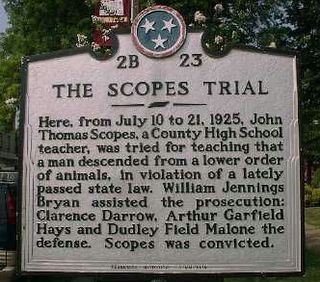
Scopes Monkey Trial Law Repealed
From Today In Science History:
On this day in 1967, the governor of Tennessee signed into law the repeal of the 1925 state law prohibiting the teaching of evolution.
The original law had made it "unlawful for any teacher in any of the Universities, Normals and all other public schools of the State which are supported in whole or in part by the public school funds of the State, to teach any theory that denies the story of the Divine Creation of man as taught in the Bible, and to teach instead that man has descended from a lower order of animals."
It was this law that was tested in what became known as the "Scopes monkey trial." Scopes was found guilty, but acquitted on a technicality upon appeal. The law itself remained a Tennessee state statute for 42 years.
Sunday, May 16, 2010
Saturday, May 15, 2010
Archaeopteryx Couldn’t Fly?
Narrow Primary Feather Rachises in Confuciusornis and Archaeopteryx Suggest Poor Flight Ability. 2010. R. L. Nudds and Gareth J. Dyke. Science 328: 887 – 889.
Abstract: The fossil birds Archaeopteryx and Confuciusornis had feathered wings resembling those of living birds, but their flight capabilities remain uncertain. Analysis of the rachises of their primary feathers shows that the rachises were much thinner and weaker than those of modern birds, and thus the birds were not capable of flight.
Only if the primary feather rachises were solid in cross-section (the strongest structural configuration), and not hollow as in living birds, would flight have been possible. Hence, if Archaeopteryx and Confuciusornis were flapping flyers, they must have had a feather structure that was fundamentally different from that of living birds.
Alternatively, if they were only gliders, then the flapping wing stroke must have appeared after the divergence of Confuciusornis, likely within the enantiornithine or ornithurine radiations.
Read the press release
Thursday, May 13, 2010
Died This Day: Georges Cuvier
“Cuvier's scientific achievements are difficult to overestimate. It was widely recounted that he could reconstruct a skeleton based on a single bone. His work is considered the foundation of vertebrate palaeontology.” link
Read about him at the University of California Museum of Paleontology.
Survival of The Burgess Shale Fauna
Ordovician faunas of Burgess Shale type. 2010. P. Van Roy, et al. Nature 465: 215-218.

Abstract: The renowned soft-bodied faunas of the Cambrian period, which include the Burgess Shale, disappear from the fossil record in the late Middle Cambrian, after which the Palaeozoic fauna dominates. The disappearance of faunas of Burgess Shale type curtails the stratigraphic record of a number of iconic Cambrian taxa. One possible explanation for this loss is a major extinction, but more probably it reflects the absence of preservation of similar soft-bodied faunas in later periods.
Here we report the discovery of numerous diverse soft-bodied assemblages in the Lower and Upper Fezouata Formations (Lower Ordovician) of Morocco, which include a range of remarkable stem-group morphologies normally considered characteristic of the Cambrian.
It is clear that biotas of Burgess Shale type persisted after the Cambrian and are preserved where suitable facies occur. The Fezouata biota provides a link between the Burgess Shale communities and the early stages of the Great Ordovician Biodiversification Event. link
Premiered This Day: Revenge of The Creature
The second of the three ‘Creature’ films, Revenge of the Creature (1955), was again directed by Jack Arnold, with Lori Nelson taking over the role of the damsel in distress.
Wednesday, May 12, 2010
A Formal Test of Common Ancestry
A formal test of the theory of universal common ancestry. 2010. D. L. Theobald. Nature: 465: 219-222.
According to biochemist Douglas Theobald, it doesn't really matter. "Let's say life originated independently multiple times, which UCA allows is possible," said Theobald. "If so, the theory holds that a bottleneck occurred in evolution, with descendants of only one of the independent origins surviving until the present. Alternatively, separate populations could have merged, by exchanging enough genes over time to become a single species that eventually was ancestral to us all. Either way, all of life would still be genetically related."
Harnessing powerful computational tools and applying Bayesian statistics, Theobald found that the evidence overwhelmingly supports UCA, regardless of horizontal gene transfer or multiple origins of life. Theobald said UCA is millions of times more probable than any theory of multiple independent ancestries.
Theobald is the first to formally test Darwin's theory across all three domains of life. The three domains include diverse life forms such as the Eukarya (organisms, including humans, yeast, and plants, whose cells have a DNA-containing nucleus) as well as Bacteria and Archaea (two distinct groups of unicellular microorganisms whose DNA floats around in the cell instead of in a nucleus). Theobald studied a set of 23 universally conserved, essential proteins found in all known organisms.
Just what did this universal common ancestor look like and where did it live? Theobald's study doesn't answer this question. Nevertheless, he speculated, "to us, it would most likely look like some sort of froth, perhaps living at the edge of the ocean, or deep in the ocean on a geothermal vent. At the molecular level, I'm sure it would have looked as complex and beautiful as modern life." link
More than 150 years ago, Darwin proposed the theory of universal common ancestry (UCA), linking all forms of life by a shared genetic heritage from single-celled microorganisms to humans. Until now, the theory has remained beyond the scope of a formal test. This week the results of the first large scale, quantitative test of the famous theory that underpins modern evolutionary biology were reported. It works!Recent molecular evidence indicates that primordial life may have undergone rampant horizontal gene transfer, which occurs frequently today when single-celled organisms swap genes using mechanisms other than usual organismal reproduction. In that case, some scientists argue, early evolutionary relationships were web-like, making it possible that life sprang up independently from many ancestors.
According to biochemist Douglas Theobald, it doesn't really matter. "Let's say life originated independently multiple times, which UCA allows is possible," said Theobald. "If so, the theory holds that a bottleneck occurred in evolution, with descendants of only one of the independent origins surviving until the present. Alternatively, separate populations could have merged, by exchanging enough genes over time to become a single species that eventually was ancestral to us all. Either way, all of life would still be genetically related."
Harnessing powerful computational tools and applying Bayesian statistics, Theobald found that the evidence overwhelmingly supports UCA, regardless of horizontal gene transfer or multiple origins of life. Theobald said UCA is millions of times more probable than any theory of multiple independent ancestries.
Theobald is the first to formally test Darwin's theory across all three domains of life. The three domains include diverse life forms such as the Eukarya (organisms, including humans, yeast, and plants, whose cells have a DNA-containing nucleus) as well as Bacteria and Archaea (two distinct groups of unicellular microorganisms whose DNA floats around in the cell instead of in a nucleus). Theobald studied a set of 23 universally conserved, essential proteins found in all known organisms.
Just what did this universal common ancestor look like and where did it live? Theobald's study doesn't answer this question. Nevertheless, he speculated, "to us, it would most likely look like some sort of froth, perhaps living at the edge of the ocean, or deep in the ocean on a geothermal vent. At the molecular level, I'm sure it would have looked as complex and beautiful as modern life." link
Tuesday, May 11, 2010
Glupping Food Caused Gigantic Dinos
Biology of the sauropod dinosaurs: the evolution of gigantism. 2010. P. M. Sanders, et al. Biology Review, published Online: 29 Apr.
'Chewing is a property of prototheria which no large herbivorous terrestrial mammal has got rid of,' Martin Sander says.
But chewing requires time – a resource that becomes scarce with increasing size. At the same time the following is true: the ones that chew need a large head, since molars and muscles have to be put somewhere. Not without reason elephants are quite big-headed. link
The Deutsche Forschungsgemeinschaft (German Research Foundation) has spent three million euros to find out that saurpods glupped their food, thus allowing them to reach gigantic sizes.Chewing helps to digest the food faster. By the grinding process it is broken down and at the same time its surface is enlarged. This way the digestive enzymes are able to attack the food more easily.
'Chewing is a property of prototheria which no large herbivorous terrestrial mammal has got rid of,' Martin Sander says.
But chewing requires time – a resource that becomes scarce with increasing size. At the same time the following is true: the ones that chew need a large head, since molars and muscles have to be put somewhere. Not without reason elephants are quite big-headed. link
Born This Day: Doug Mclure
Actor Doug Mclure (May 11, 1935 – February 5, 1995) takes a bow here for playing Bowen Tyler in the film adaptations of Edgar Rice Burroughs books, At the Earth’s Core, The Land That Time Forgot, and The People That Time Forgot.
The Chemistry of Archaeopteryx
Archaeopteryx feathers and bone chemistry fully revealed via synchrotron imaging. 2010. U. Bergmann, et al. PNAS, published online before print May 10, 2010.
The chemical maps show that portions of the feathers are not merely impressions of long-decomposed organic material—as was previously believed—but actual fossilized feathers that contain phosphorous and sulfur, elements that comprise modern bird feathers. Trace amounts of copper and zinc were also found in the 'dinobird's' bones; like birds today, the Archaeopteryx may have required these elements to stay healthy.
"We talk about the physical link between birds and dinosaurs, and now we have found a chemical link between them," said Roy Wogelius.. link
False color view of the Thermopolis Archaeopteryx. The image is a composite blend of scans of the elements phosphorus, silicon, sulfur, and iron. The bright colors in the wing areas show how part of the feather chemistry has been preserved. Image: K.G. Huntley/Stanford Synchrotron Radiation LightsourceBy recording how the X-rays interacted with the Thermopolis Archaeopteryx, researchers were able to identify very precisely the locations of chemical elements hidden within. From this, they created the first maps of the dinobird's chemistry, revealing half a dozen chemical elements that were actually part of the living animal itself. In almost every element studied, the researchers found significantly different concentrations in the fossil than in the rock that surrounds it, confirming that the observed elements are indeed remnants of the 'dinobird' and not merely chemicals that leached from the surrounding rock into the fossil.
The chemical maps show that portions of the feathers are not merely impressions of long-decomposed organic material—as was previously believed—but actual fossilized feathers that contain phosphorous and sulfur, elements that comprise modern bird feathers. Trace amounts of copper and zinc were also found in the 'dinobird's' bones; like birds today, the Archaeopteryx may have required these elements to stay healthy.
"We talk about the physical link between birds and dinosaurs, and now we have found a chemical link between them," said Roy Wogelius.. link
Friday, May 07, 2010
Neanderthal Genome Decoded
A Draft Sequence of the Neandertal Genome. 2010. Science 328: 710 – 722.
The current fossil record suggests that Neanderthals, or Homo neanderthalensis, diverged from the primate line that led to present-day humans, or Homo sapiens, some 400,000 years ago in Africa. Neanderthals migrated north into Eurasia, where they became a geographically isolated group that evolved independently from the line that became modern humans in Africa. They lived in Europe and western Asia, as far east as southern Siberia and as far south as the Middle East.
Approximately 30,000 years ago, Neanderthals disappeared. That makes them the most recent, extinct relative of modern humans, as both Neanderthals and humans share a common ancestor from about 800,000 years ago. Chimpanzees diverged from the same primate line some 5 million to 7 million years ago.
To understand the genomic differences between present-day humans and Neanderthals, the researchers compared subtle differences in the Neanderthal genome to the genomes found in DNA from the five people, as well as to chimpanzee DNA. An analysis of the genetic variation showed that Neanderthal DNA is 99.7 percent identical to present-day human DNA, and 98.8 percent identical to chimpanzee DNA. Present-day human DNA is also 98.8 percent identical to chimpanzee.
"The genomic calculations showed good correlation with the fossil record," said coauthor Jim Mullikin. According to our results, the ancestors of Neanderthals and modern humans went their separate ways about 400,000 years ago. link
DNA signatures found in present-day Europeans and Asians, but not in Africans.Researchers have produced the first whole genome sequence of the 3 billion letters in the Neanderthal genome, and the initial analysis suggests that up to 2 percent of the DNA in the genome of present-day humans outside of Africa originated in Neanderthals or in Neanderthals' ancestors.
The current fossil record suggests that Neanderthals, or Homo neanderthalensis, diverged from the primate line that led to present-day humans, or Homo sapiens, some 400,000 years ago in Africa. Neanderthals migrated north into Eurasia, where they became a geographically isolated group that evolved independently from the line that became modern humans in Africa. They lived in Europe and western Asia, as far east as southern Siberia and as far south as the Middle East.
Approximately 30,000 years ago, Neanderthals disappeared. That makes them the most recent, extinct relative of modern humans, as both Neanderthals and humans share a common ancestor from about 800,000 years ago. Chimpanzees diverged from the same primate line some 5 million to 7 million years ago.
To understand the genomic differences between present-day humans and Neanderthals, the researchers compared subtle differences in the Neanderthal genome to the genomes found in DNA from the five people, as well as to chimpanzee DNA. An analysis of the genetic variation showed that Neanderthal DNA is 99.7 percent identical to present-day human DNA, and 98.8 percent identical to chimpanzee DNA. Present-day human DNA is also 98.8 percent identical to chimpanzee.
"The genomic calculations showed good correlation with the fossil record," said coauthor Jim Mullikin. According to our results, the ancestors of Neanderthals and modern humans went their separate ways about 400,000 years ago. link
Died This Day: Skull Island Witch Doctor
Steve Clemente (born Esteban Clemento Morro Nov. 22, 1885—May 7, 1950) was a Mexican actor known for his many villainous roles. He began acting in his teens, signing up for his first movie, The Secret Man, in 1917. His later, numerous roles were usually bit parts and he was an expert knife thrower.
He was a known scene stealer and was famous for his villainous snarl. He later starred in such movies as The Most Dangerous Game (1932), playing Tartar, the second henchman of Count Zarrof and played the Witch King in King Kong (1933). From Wiki
Wednesday, May 05, 2010
Recreating Mammoth Hemoglobin: True Palaeobiology
Substitutions in woolly mammoth hemoglobin confer biochemical properties adaptive for cold tolerance. 2010. K. L. Campbel, et al. Nature Genetics, Published online 02 May 2010
Studies reveal special evolutionary adaptations that allowed the mammoth to cool its extremities down in harsh Arctic conditions to minimise heat loss.
"This is true palaeobiology, as we can study and measure how these animals functioned as if they were alive today."
"The resulting haemoglobin molecules are no different than 'going back in time' and taking a blood sample from a real mammoth," says Professor Campbell.
"We can now apply similar approaches to other extinct species, such as Australian marsupials," says team member Dr Jeremy Austin, who is currently using ancient DNA to study the evolution and extinction of the thylacine and Tasmanian Devil. link
A team of international researchers have recreated mammoth haemoglobin using ancient DNA preserved in bones from Siberian specimens 25,000 to 43,000 years old.The team converted the mammoth haemoglobin DNA sequences into RNA, and inserted them into modern-day E. coli bacteria, which then manufactured the authentic mammoth protein.
Studies reveal special evolutionary adaptations that allowed the mammoth to cool its extremities down in harsh Arctic conditions to minimise heat loss.
"This is true palaeobiology, as we can study and measure how these animals functioned as if they were alive today."
"The resulting haemoglobin molecules are no different than 'going back in time' and taking a blood sample from a real mammoth," says Professor Campbell.
"We can now apply similar approaches to other extinct species, such as Australian marsupials," says team member Dr Jeremy Austin, who is currently using ancient DNA to study the evolution and extinction of the thylacine and Tasmanian Devil. link
Born This Day: Elkanah Billings
From Today In Science History:
Billings (May 5, 1820 - June 14, 1896) was a Canadian geologist and paleontologist, who was the first Canadian paleontologist.
He published his first scientific paper on Trenton fossils in 1854. He launched a new monthly periodical, The Canadian Naturalist and Geologist in 1856, which he also edited and was the major contributor.
In Aug 1856 he was appointed staff paleontologist with the Canadian Geological Survey by William Edmond Logan, the founder of the Survey. Billings immediately began the task of identifying a 20-year backlog of fossils collected by the Survey. By 1863 he had published descriptions of no fewer than 526 new species of fossils.
The Billings medal, named in his honour, is awarded annually by the Paleontology Division of the Geological Association of Canada as a means of recognizing the most outstanding of its paleontologists.
Click HERE for more information on the Geological Association of Canada.
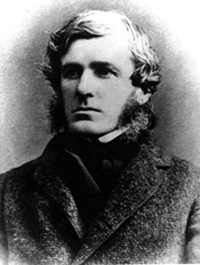
Portrait of Elkanah Billings GSC photo 69323 (c)
Billings (May 5, 1820 - June 14, 1896) was a Canadian geologist and paleontologist, who was the first Canadian paleontologist.
He published his first scientific paper on Trenton fossils in 1854. He launched a new monthly periodical, The Canadian Naturalist and Geologist in 1856, which he also edited and was the major contributor.In Aug 1856 he was appointed staff paleontologist with the Canadian Geological Survey by William Edmond Logan, the founder of the Survey. Billings immediately began the task of identifying a 20-year backlog of fossils collected by the Survey. By 1863 he had published descriptions of no fewer than 526 new species of fossils.
The Billings medal, named in his honour, is awarded annually by the Paleontology Division of the Geological Association of Canada as a means of recognizing the most outstanding of its paleontologists.
On April 27, 1869, the Director of the GSC, Sir William Logan wrote this curt note to the paleontologist Elkanah Billings: "Your constant absence from the office is a worrying annoyance, particularly as I have reason to suspect that it does not arrive from rheumatism".For more info on Billings click HERE.
Click HERE for more information on the Geological Association of Canada.
Portrait of Elkanah Billings GSC photo 69323 (c)
Monday, May 03, 2010
Nopcsa's Sauropod Dwarfs
Small body size and extreme cortical bone remodeling indicate phyletic dwarfism in Magyarosaurus dacus (Sauropoda: Titanosauria). 2010. K. Stein, et al. PNAS, Published online before print April 30.
In 1895, the sister of a eccentric palaeontologist Franz Baron Nopcsa discovered small dinosaur bones on their family estate in Transylvania. Nopcsa interpreted these as the remains of dwarfed animals that had once lived on an island. Among these finds were a number of bones belonging to a sauropod dinosaur which Nopcsa named Magyarosaurus dacus, after his native country. New research on the microanatomy of these bones prove that the little dinosaur was fully grown.
"Our study shows that dinosaurs on islands were subject to the same ecological and evolutionary processes that shape modern mammals," explains Martin Sander. "We were also able to demonstrate that the bigger bones found in that area belong to a different dinosaur species." Whether they come from stray animals who swam to the island from the mainland, or from large ancestors of the dwarf Magyarosaurus, remains a secret shrouded in the mists of pre-historic time. link
Sunday, May 02, 2010
Born This Day: Sir D'Arcy Thompson
From cscs.umich.edu:
D'Arcy Thompson (May 2, 1860 – June 21, 1948) was a British biologist whose masterwork, On Growth and Form, is a profound consideration of the shapes of living things, starting from the simple premise that "everything is the way it is because it got that way." Hence one must study not only
finished forms, but also the forces that moulded them: "the form of an object is a 'diagram of forces', in this sense, at least, that from it we can judge of or deduce the forces that are acting or have acted upon it."
Now by "forces" Thompson meant forces, and one of his great themes is the tremendous light cast on living things by using mathematics to describe their shapes and fairly simple physics and chemistry to explain them. In other words, Thompson wrote a thousand page treatise on self-organization long before the word existed.
one another. The most thoroughly worked out modern example of this is Raup's analysis of snail shell shapes with a morphospace.
With some simplification, the axes on the fish grids in here or the snails of the morphospace can be thought of as growth gradients. The evolutionary change between the species would then have been produced by a genetic change in the regulatory mechanisms controlling those gradients.
If we looked at these fish without the grids we might think that an evolutionary change from one into the other would be at least moderately complicated. The interest of D'Arcy Thompson's diagrams is then to show that shape changes could have been produced by heterochrony - a change in the rate or timing of development of some cell lines in the body relative to others.

Figure: a D'Arcy Thompson transformational diagram. The shapes of two species of fish have been plotted on Cartesian grids. Image from HERE.
D'Arcy Thompson (May 2, 1860 – June 21, 1948) was a British biologist whose masterwork, On Growth and Form, is a profound consideration of the shapes of living things, starting from the simple premise that "everything is the way it is because it got that way." Hence one must study not only
finished forms, but also the forces that moulded them: "the form of an object is a 'diagram of forces', in this sense, at least, that from it we can judge of or deduce the forces that are acting or have acted upon it."Now by "forces" Thompson meant forces, and one of his great themes is the tremendous light cast on living things by using mathematics to describe their shapes and fairly simple physics and chemistry to explain them. In other words, Thompson wrote a thousand page treatise on self-organization long before the word existed.
From Blackwell Publishing:D'Arcy Thompson found that related species superficially looking very different could in some cases be represented as simple Cartesian transformations of
one another. The most thoroughly worked out modern example of this is Raup's analysis of snail shell shapes with a morphospace.With some simplification, the axes on the fish grids in here or the snails of the morphospace can be thought of as growth gradients. The evolutionary change between the species would then have been produced by a genetic change in the regulatory mechanisms controlling those gradients.
If we looked at these fish without the grids we might think that an evolutionary change from one into the other would be at least moderately complicated. The interest of D'Arcy Thompson's diagrams is then to show that shape changes could have been produced by heterochrony - a change in the rate or timing of development of some cell lines in the body relative to others.

Figure: a D'Arcy Thompson transformational diagram. The shapes of two species of fish have been plotted on Cartesian grids. Image from HERE.
Saturday, May 01, 2010
Published This Day: Species Plantarum by Linnaeus
In 1753, Carolus Linnaeus published the first edition of his Species Plantarum in which he gave systematic names to plants that are still in use today. He was the first to frame principles for defining genera and species of organisms and to create a uniform system for naming them. He is often called the father of classification, and he extended the familiar scheme of dual Latin names to identify animals in 1758. The Species Plantarum was taken by international consent in 1905 as the starting point for modern botanical nomenclature. From Today In Science History.
Friday, April 30, 2010
The Development of Fossil Feathers
Exceptional dinosaur fossils show ontogenetic development of early feathers. 2010. Xing X., et al. Nature 464: 1338–1341

Abstract [edit]: We describe an early-juvenile specimen and a late-juvenile specimen, both referable to the oviraptorosaur Similicaudipteryx, recovered from the Lower Cretaceous Yixian Formation of western Liaoning, China. The two specimens have strikingly different remiges and rectrices, suggesting that a radical morphological change occurred during feather development, as is the case for modern feathers.
However, both the remiges and the rectrices are proximally ribbon-like in the younger specimen but fully pennaceous in the older specimen, a pattern not known in any modern bird.
In combination with the wide distribution of proximally ribbon-like pennaceous feathers and elongate broad filamentous feathers among extinct theropods, this find suggests that early feathers were developmentally more diverse than modern ones and that some developmental features, and the resultant morphotypes, have been lost in feather evolution.
Note: The blog will be taking a short break until the middle of next week.
Died This Day: Joseph Leidy
From The Academy of Natural Sciences:
Leidy is known as the "Father of American Vertebrate Paleontology". He described the first relatively complete dinosaur skeleton, Hadrosaurus, and introduced many American and European scientists to the fossil riches of the American West. Leidy's consummate skill in comparative anatomy would allow him to identify and characterize even the most fragmentary fossil material.
Leidy was also the "Founder of American Parasitology," a Professor of Anatomy at the University of Pennsylvania, a pioneering protozoologists, an influential teacher of Natural History, an accomplished microscopist and scientific illustrator, and an expert on a variety of subjects encompasing the earth and natural sciences. He published scientific papers on more than a thousand extinct and living protozoa, fungi and invertebrates and vertebrates as well as an assortment of publications on human biology and medicine. He was also one of the earliest supporters of Charles Darwin.
Tuesday, April 27, 2010
How To Make A Rib
Evidence for a Myotomal Hox/Myf Cascade Governing Nonautonomous Control of Rib Specification within Global Vertebral Domains. 2010. T. Vinagre, et al. Developmental Cell 18: 655-661

Mice have a ribcage with 12 pairs of ribs (top). When the gene Hox6 is activated in ribless regions of the embryo, extra ribs are formed, extending from the ribcage to the tail (bottom). Image: M. Mallo.
Making ribs is not the default state for vertebrates, but is actually an active process of balancing the activities of a remarkable class of genes - the Hox genes.
It was thought that the rib less region of the mouse embryo was the result of a rib-inhibiting programme, driven by Hox10 genes. Indeed, previous studies, in which Hox10 genes were inactivated in the embryo, generated mice with extra ribs. However, by forcing another class of Hox genes (Hox6) to be activated in future rib-less regions of the mouse embryo, scientists have bred mice that also have extra ribs, both in the neck area, and from just after the rib cage, all the way down to the tail, resembling a snake-like skeleton.
These two groups of Hox genes balance each other out: one actively promotes rib formation to produce the thoracic region, while the other blocks this activity in the lumbar region. The whole process relies on first hitting so-called muscle genes in the embryo, which then provide signals to switch on the 'rib' genes to make both ribs and muscle, in a coordinated process. link
Monday, April 26, 2010
Did Dinosaurs and Plants Evolve Together?
Testing coevolutionary hypotheses over geological timescales: interactions between Cretaceous dinosaurs and plants. 2010. R. J. Butler, et al. Biol. J. Linn Soc. 100: 1-15.
Abstract [edit]: Distributional data for Cretaceous dinosaur and plant groups were mapped onto palaeogeographical reconstructions in a series of time-slices. Within each time-slice, palaeocontinental surfaces were divided into a series of grids, each of which was scored as present, absent or inapplicable (unsampled) for each group. Distributions were compared statistically to determine whether the putative coevolving groups co-occurred within grid squares more or less frequently than expected by chance.
Pairwise comparisons were made between herbivorous dinosaur clades and major plant groups (e.g. cycads, angiosperms) on a global scale. Only three nonrepeated associations of marginal significance were recovered, demonstrating that, in general, current knowledge of the spatiotemporal distributions of these groups provides little support for coevolutionary hypotheses.
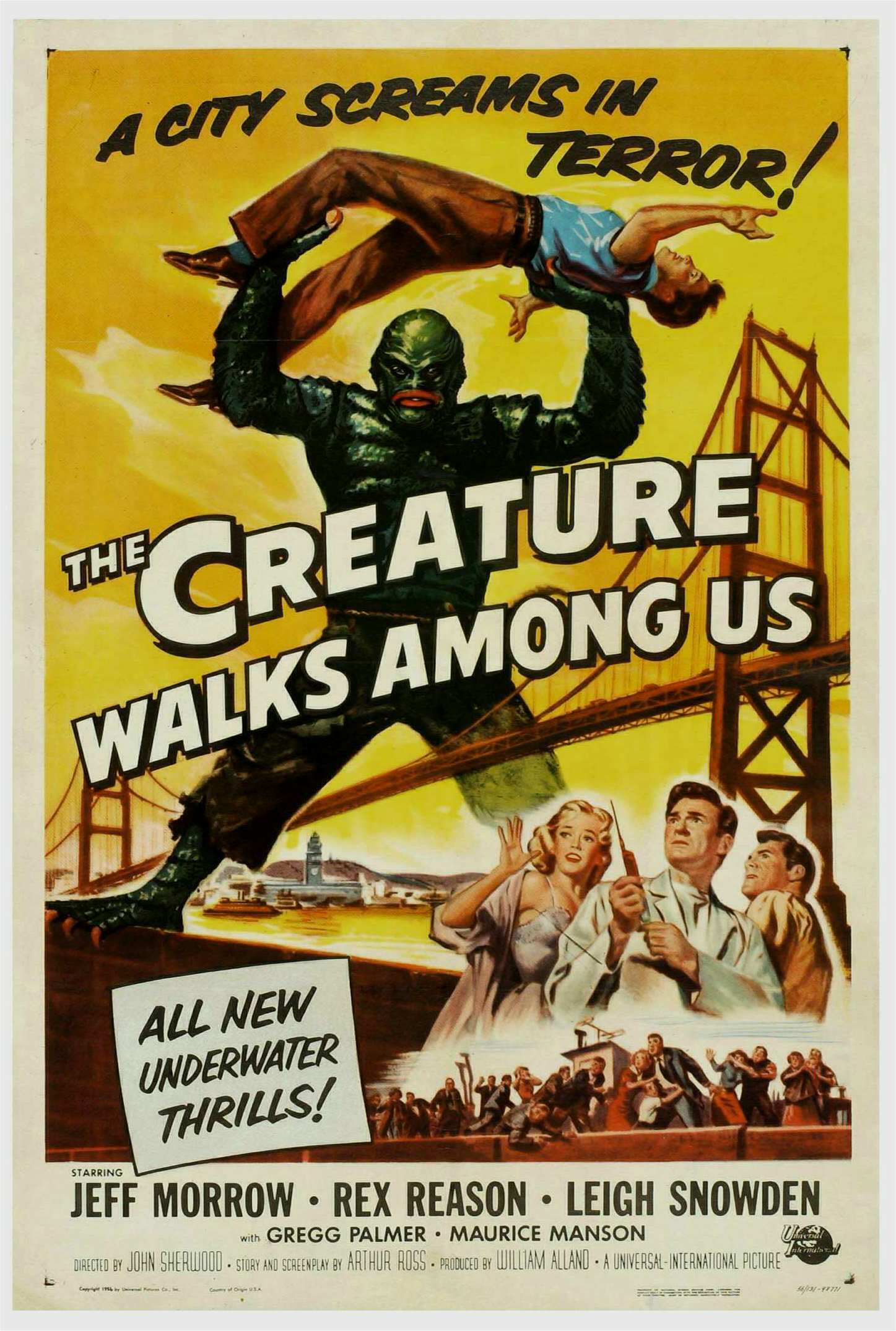
Premiered This Day: The Creature Walks Among Us
Back on this day in 1956 the second sequel to The Creature From the Black Lagoon debuted. It's long been considered the weakest film in the trilogy, and it's hard to argue this given that they drag The Creature out of the Amazon, burn him in a fire, and convert him into an air-breathing humanoid with no hope of ever returning to the lagoon. But, when viewed today, the film reveals some deeper tones than I'm sure were originally intended.
The plot and language of the film can now be taken to speak directly to the hot-button topics of genetic manipulation of animals and foods, and man's destructive meddling with nature leading to accelerated rates of extinction. The movie moves beyond being a simple “monster on the rampage” story and actually has some pointed comments to make about science and politics. It's well worth watching on one of those upcoming hot, humid summer nights.
Watch the film in 8 minutes thanks to the Castle Films Super 8mm edited home version:
Died This Day: Eduard Suess
Suess (Aug. 20, 1831 – April 26, 1914) was an Austrian geologist who helped lay the basis for paleogeography and tectonics.
He was an authority on structural geology, especially of mountains, and postulated the existence of the giant land mass Gondwanaland.
While he was a professor (1857–1901) at the Univ. of Vienna, he also served for more than 20 years in the Austrian parliament. His Austrian-born son, Hans Suess, became a geochemist who pioneered radiocarbon dating techniques and was a founding faculty member of the University of California, San Diego.
From Today In Science History
He was an authority on structural geology, especially of mountains, and postulated the existence of the giant land mass Gondwanaland.While he was a professor (1857–1901) at the Univ. of Vienna, he also served for more than 20 years in the Austrian parliament. His Austrian-born son, Hans Suess, became a geochemist who pioneered radiocarbon dating techniques and was a founding faculty member of the University of California, San Diego.
From Today In Science History
Sunday, April 25, 2010
Dinosaur Land in Muskoka, Ontario
Cartoonist and rock ‘n roller, Tom Bagley, also one of the 7 Deadly Sinners, recently sent me this past from his past – a childhood visit to Dinosaur Land in Muskoka, Ontario. That’s Tom (left) and his brother helping Mary Anning excavate an ichythosaur. This place seems to have literally vanished off the face of the Earth, so if anyone has any info about it I’d appreciate hearing it.
Tom adds:
Tom adds:
"They even had a caveman village down in a valley that I'm sure was pretty spectacular. The coolest part was that you went into a little theatre that ran "A World Is Born" (the "Rite of Spring" sequence from Fantasia) continuously."
Humans & Neanderthals Interbred Twice?
An examination of the DNA of 1,983 people from around the globe suggests that extinct human species such as Homo neanderthalensis or Homo heidelbergensis interbred with our own ancestors during two separate periods, and their genes remain in our DNA today. The findings mean Neanderthals did not completely disappear, but “there is a little bit of Neanderthal left over in almost all humans.”
Read the story at PhysOrg.
Saturday, April 24, 2010
Cretaceous Dino Deep Freeze
Valanginian isotope variation in glendonites and belemnites from Arctic Svalbard: Transient glacial temperatures during the Cretaceous greenhouse. 2010. G.D. Price and E. V. Nunn. Geology 38: 251-254.
The drop is estimated to have occurred some 137 million years ago during a time when dinosaurs roamed the Earth, and would have seen the islands fall from an average of 13°C (ocean temperature) to as low as four degrees.
Despite being located in the Arctic Circle, Svalbard was home to numerous species of dinosaur and was typically characterised by warm, shallow seas and swamps. But the researchers found evidence in fossils and carbonate materials preserved in marine rocks in the region of a transient shift to cooler glacial conditions around 137 million years ago.
“But over a period of a few hundred or a few thousand years, ocean temperatures fell from an average of 13°C to between eight and four degrees.

“Although a short episode of cool polar conditions is potentially at odds with a high CO2 world, our data demonstrates the variability of climate over long timescales.” link
Scientists studying fossils and minerals from Arctic Svalbard, in Norway, have discovered evidence that the ‘greenhouse’ climate of the Cretaceous period was punctuated by a sudden drop in global temperatures.

The drop is estimated to have occurred some 137 million years ago during a time when dinosaurs roamed the Earth, and would have seen the islands fall from an average of 13°C (ocean temperature) to as low as four degrees.
Despite being located in the Arctic Circle, Svalbard was home to numerous species of dinosaur and was typically characterised by warm, shallow seas and swamps. But the researchers found evidence in fossils and carbonate materials preserved in marine rocks in the region of a transient shift to cooler glacial conditions around 137 million years ago.
“But over a period of a few hundred or a few thousand years, ocean temperatures fell from an average of 13°C to between eight and four degrees.

“Although a short episode of cool polar conditions is potentially at odds with a high CO2 world, our data demonstrates the variability of climate over long timescales.” link
Friday, April 23, 2010
Born This Day: James Flavin
Flavin (May 14, 1906 – April 23, 1976) starred in his first film (The Airmail Mystery) in 1932. After that he played mostly supporting characters in nearly four hundred films between 1932 and 1971, and in almost a hundred television episodes. He takes a bow here for playing Second Mate Briggs in King Kong (1933).
Thursday, April 22, 2010
Wednesday, April 21, 2010
Died This Day: Mark Twain
I’d forgotten that Mark Twain (November 30, 1835 – April 21, 1910) had written about dinosaurs.
"When the mighty brontosaurus came striding into camp, she regarded it as an acquisition, I considered it a calamity; that is a good sample of the lack of harmony that prevails in our views of things. She wanted to domesticate it, I wanted to make it a present of the homestead and move out. She believed it could be tamed by kind treatment and would be a good pet; I said a pet twenty-one feet high and eighty-four feet long would be no proper thing to have about the place, because, even with the best intentions and without meaning any harm, it could sit down on the house and mash it, for any one could see by the look of its eye that it was absent-minded." - Eve's Diary
"The less said about the pterodactyl the better. It was a spectacle, that beast! a mixture of buzzard and alligator, a sarcasm, an affront to all animated nature, a butt for the ribald jests of an unfeeling world. After some ages Nature perceived that to put feathers on a reptile does not ennoble it, does not make it a bird, but only a sham, a joke, a grotesque curiosity, a monster; also that there was no useful thing for the pterodactyl to do, and nothing likely to turn up in the future that could furnish it employment. And so she abolished it." - "Flies and Russians," Fables of Man
From Twainquotes.com. Thanks to Judy!
Subscribe to:
Posts (Atom)