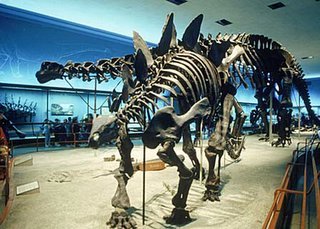
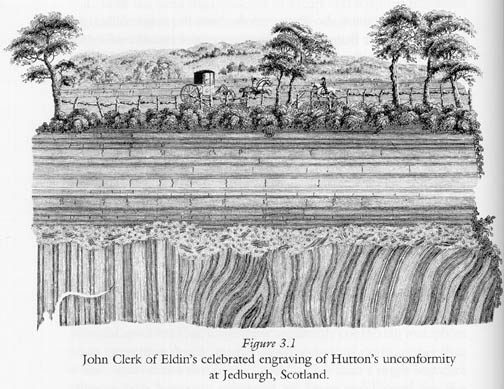
Gressly (July 17, 1814 - April 13, 1865) was a Swiss geologist and paleontologist who originated the study of stratigraphic facies when he discovered lateral differences in the character and fossil content of strata in the Jura Mountains, reflecting a variation of the original environment of deposition.
The "Gressly's lizard" dinosaur was named Gresslyosaurus (1857) to honour Amanz Gressly and to replace the preoccupied Dinosaurus Ruetimeyer 1856). It is now synonymized with Plateosaurus. From Today in Science History
Friday, April 13, 2012
Wednesday, April 11, 2012
Free, Online journal, eLife, to Compete with Nature and Science
From BBC News:
One of the world's largest research charities, the Wellcome Trust, is to establish a free, online publication called eLife to compete with established academic journals.
They say their new title could be a "game changer" forcing other publishing houses to increase free access.
More than 9,000 scientists are boycotting a leading paid-for publisher for restricting access to their papers.
The Wellcome Trust's move is the latest salvo in a battle about ownership of, and access to, the published work of scientists that has been simmering underneath the sedate surface of scientific research for years.
Saturday, April 07, 2012
Born This Day: Kenneth Oakley
From Today in Science History:
Oakley (April 7, 1911 - November 2, 1981) was an English physical anthropologist, geologist, and paleontologist best known for his work in the relative dating of fossils by fluorine content. While working for
the British Natural History Museum, Oakley become famous in 1953 for exposing the 'Piltdown Man' forgery.
"A skull had been "unearthed" in 1912, in Piltdown, England, and had for decades been said to represent the "missing link" in human evolution. Oakley developed a method, based on a French minerologist's theory that bones would gradually absorb fluorine from surrounding soil, to measure the fluorine levels in bones. With this and other tests he proved the bones to be a modern human braincase and an orangutan jawbone chemically stained to appear ancient. image
Oakley (April 7, 1911 - November 2, 1981) was an English physical anthropologist, geologist, and paleontologist best known for his work in the relative dating of fossils by fluorine content. While working for
the British Natural History Museum, Oakley become famous in 1953 for exposing the 'Piltdown Man' forgery. "A skull had been "unearthed" in 1912, in Piltdown, England, and had for decades been said to represent the "missing link" in human evolution. Oakley developed a method, based on a French minerologist's theory that bones would gradually absorb fluorine from surrounding soil, to measure the fluorine levels in bones. With this and other tests he proved the bones to be a modern human braincase and an orangutan jawbone chemically stained to appear ancient. image
Friday, April 06, 2012
Created This Day: The American Museum of Natural History
In 1869, the American Museum of Natural History in New York City was officially created with the signing of a bill by the Governor of New York, John Thompson Hoffman.
The museum began from the efforts of Albert Smith Bickmore, one-time student of Harvard zoologist Louis Agassiz, who was successful in his proposal to create a natural history museum in New York City, with the support of William E. Dodge, Jr., Theodore Roosevelt, Sr., Joseph Choate, and J. Pierpont Morgan. It opened to the public 27 Apr 1871.
With a series of exhibits, the Museum’s collection went on view for the first time in the Central Park Arsenal, the Museum’s original home, on the eastern side of Central Park.
Also, on this day in 1930, Hostess Twinkies were invented by bakery executive James Dewar.
From Today in Science History.
The museum began from the efforts of Albert Smith Bickmore, one-time student of Harvard zoologist Louis Agassiz, who was successful in his proposal to create a natural history museum in New York City, with the support of William E. Dodge, Jr., Theodore Roosevelt, Sr., Joseph Choate, and J. Pierpont Morgan. It opened to the public 27 Apr 1871.
With a series of exhibits, the Museum’s collection went on view for the first time in the Central Park Arsenal, the Museum’s original home, on the eastern side of Central Park.
Also, on this day in 1930, Hostess Twinkies were invented by bakery executive James Dewar.
From Today in Science History.
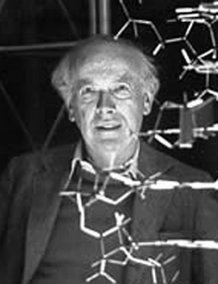
Born This Day: James Watson
From Today In Science History:
Watson was born on this day in 1928. An American geneticist and biophysicist, he shared the 1962 Nobel Prize for Physiology or Medicine (with Francis Crick and Maurice Wilkins) for the discovery of "the molecular structure of nucleic acids and
its significance for information transfer in living material." Deoxyribonucleic acid (DNA) is the substance contained in cells that controls heredity.
Crick and Watson began their collaboration in 1951, and published their paper on the double helix structure on 2 Apr 1953 in Nature. This accomplishment became a cornerstone of genetics and was widely regarded as one of the most important discoveries of 20th-century biology.
image.
Watson was born on this day in 1928. An American geneticist and biophysicist, he shared the 1962 Nobel Prize for Physiology or Medicine (with Francis Crick and Maurice Wilkins) for the discovery of "the molecular structure of nucleic acids and
its significance for information transfer in living material." Deoxyribonucleic acid (DNA) is the substance contained in cells that controls heredity.Crick and Watson began their collaboration in 1951, and published their paper on the double helix structure on 2 Apr 1953 in Nature. This accomplishment became a cornerstone of genetics and was widely regarded as one of the most important discoveries of 20th-century biology.
image.
Thursday, April 05, 2012
Premiered This Day: One Million B.C.
Directed by Hal Roach, and starring Victor Mature, Carole Landis, and Lon Chaney, Jr., this film is noted for its lizards dressed up as dinosaurs, and as being the inspiration for the better known 1967 version starring Raquel Welch.
Yutyrannus, A Giant Feathered Tyrannosauroid From China
A gigantic feathered dinosaur from the Lower Cretaceous of China. X. Xu, et al. Nature 484: 92–95.
Abstract: Numerous feathered dinosaur specimens have recently been recovered from the Middle–Upper Jurassic and Lower Cretaceous deposits of northeastern China, but most of them represent small animals. Here we report the discovery of a gigantic new basal tyrannosauroid, Yutyrannus huali gen. et sp. nov., based on three nearly complete skeletons representing two distinct ontogenetic stages from the Lower Cretaceous Yixian Formation of Liaoning Province, China.
Y. huali shares some features, particularly of the cranium, with derived tyrannosauroids, but is similar to other basal tyrannosauroids in possessing a three-fingered manus and a typical theropod pes. Morphometric analysis suggests that Y. huali differed from tyrannosaurids in its growth strategy.
Most significantly, Y. huali bears long filamentous feathers, thus providing direct evidence for the presence of extensively feathered gigantic dinosaurs and offering new insights into early feather evolution.
Abstract: Numerous feathered dinosaur specimens have recently been recovered from the Middle–Upper Jurassic and Lower Cretaceous deposits of northeastern China, but most of them represent small animals. Here we report the discovery of a gigantic new basal tyrannosauroid, Yutyrannus huali gen. et sp. nov., based on three nearly complete skeletons representing two distinct ontogenetic stages from the Lower Cretaceous Yixian Formation of Liaoning Province, China.
Y. huali shares some features, particularly of the cranium, with derived tyrannosauroids, but is similar to other basal tyrannosauroids in possessing a three-fingered manus and a typical theropod pes. Morphometric analysis suggests that Y. huali differed from tyrannosaurids in its growth strategy.
Most significantly, Y. huali bears long filamentous feathers, thus providing direct evidence for the presence of extensively feathered gigantic dinosaurs and offering new insights into early feather evolution.
Died This Day: Hermann Muller
The
father of radiation genetics, Muller (Dec. 21, 1890 – April 5, 1967) began his career with T.H. Morgan studying mutations in fruit flies. He was the first to increase the mutation rate using heat, later using 50 kilovolt X-rays to induce an even greater incidence of mutations. Muller was awarded the Nobel Prize for Physiology or Medicine in 1946.
Muller long warned about needless exposures to radiation and their associated risks of cancer and heritable genetic effects. By the late 1940s, the nuclear weapons testing program had begun and Muller was a vocal critic of the Atomic Energy Commission's views on the hazards of worldwide fallout.
father of radiation genetics, Muller (Dec. 21, 1890 – April 5, 1967) began his career with T.H. Morgan studying mutations in fruit flies. He was the first to increase the mutation rate using heat, later using 50 kilovolt X-rays to induce an even greater incidence of mutations. Muller was awarded the Nobel Prize for Physiology or Medicine in 1946.Muller long warned about needless exposures to radiation and their associated risks of cancer and heritable genetic effects. By the late 1940s, the nuclear weapons testing program had begun and Muller was a vocal critic of the Atomic Energy Commission's views on the hazards of worldwide fallout.
Born This Day: Alpheus Hyatt
From Today in Science History:
Hyatt (April 5, 1838 - Jan. 15, 1902) was a U.S. zoologist and paleontologist who studied invertebrate fossil records, the evolution of the
cephalopods (a class of mollusks including squids and octopuses) and the development of primitive organisms.
Along with E. Cope, Hyatt was the most prominent American neo-Lamarckian. Based on the analogy of ontogeny with phylogeny, Hyatt claimed that lineages, like individuals, had cycles of youth, old age, and death (extinction). This idea became the bulwark of orthogenetic theories in the U.S.
Hyatt was the founder and first editor of the American Naturalist, and first president of Woods Hole laboratory.
Hyatt (April 5, 1838 - Jan. 15, 1902) was a U.S. zoologist and paleontologist who studied invertebrate fossil records, the evolution of the
cephalopods (a class of mollusks including squids and octopuses) and the development of primitive organisms. Along with E. Cope, Hyatt was the most prominent American neo-Lamarckian. Based on the analogy of ontogeny with phylogeny, Hyatt claimed that lineages, like individuals, had cycles of youth, old age, and death (extinction). This idea became the bulwark of orthogenetic theories in the U.S.
Hyatt was the founder and first editor of the American Naturalist, and first president of Woods Hole laboratory.
Friday, March 30, 2012
Monday, March 26, 2012
Died This Day: James Hutton
Hutton (June 3, 1726 – March 26, 1797) is the 'Father of Uniformitarianism' which explains the features of the Earth's crust by means of natural processes over geologic time. Link
Saturday, March 24, 2012
Thursday, March 22, 2012
Born This Day: Adam Sedgwick
Adam Sedgwich (March 22, 1785 - January 27, 1873) was an English geologist who first applied the name Cambrian
to the geologic period of time, now dated at 570 to 505 million years ago. In 1818 he became Woodwardian Professor of Geology at Cambridge, holding a chair that had been endowed ninety years before by the natural historian John Woodward.
He lacked formal training in geology, but he quickly became an active researcher in geology and paleontology. Many years after Sedgwick's death, the geological museum at Cambridge was renamed the Sedgwick Museum of Geology in his honor. The museum is now part of the Department of Earth Sciences at Cambridge University. From Today In Science History.
to the geologic period of time, now dated at 570 to 505 million years ago. In 1818 he became Woodwardian Professor of Geology at Cambridge, holding a chair that had been endowed ninety years before by the natural historian John Woodward.He lacked formal training in geology, but he quickly became an active researcher in geology and paleontology. Many years after Sedgwick's death, the geological museum at Cambridge was renamed the Sedgwick Museum of Geology in his honor. The museum is now part of the Department of Earth Sciences at Cambridge University. From Today In Science History.
Monday, March 19, 2012
Philip Currie Awarded The Explorer's Medal
Congratulations to Philip Currie who was awarded The Explorer's Medal this past weekend in New York City at The Explorers Club's annual dinner.
The Explorers Club Medal is the highest honor that can be bestowed by the Club. It is awarded for extraordinary contributions directly in the field of exploration, scientific research, or to the welfare of humanity. Previous recipients include Roy Chapman Andrews, Sir Edmund Hillary, and the crew of Apollo 11.
Details HERE
Sunday, March 18, 2012
Died This Day: Othniel Charles Marsh
In 1866, the Peabody Museum of Natural History was founded with a gift from George Peabody. The same year his nephew, O.C. Marsh (Oct. 29, 1831 - Mar. 18, 1899), was also named its Professor of Paleontology, the first such appointment in the United States. In 1869 Marsh used the inheritance from his uncle to start to amass large collections of vertebrate fossils. He went on to long and successful career as a vertebrate paleontologist, most of which was spent feuding with is rival, E.D.Cope.Marsh and Cope started their careers on a cordial basis, but the relationship soon soured over an incident involving Cope's fossil of Elasmosaurus. Embarrassingly, Marsh pointed out that its backbones were mounted backwards. To settle the argument the men agreed to let Joseph Leidy decide who was right. Leidy promptly removed the head from one end and placed it on what Cope had thought was the tail. Cope than frantically tried to collect all of the copies of a recently printed publication that contained his erroneous reconstruction. From Today In Science History:
Saturday, March 17, 2012
Died This Day: Jack Arnold

Jack Arnold (Oct. 14, 1916 - March 17, 1992) directed a number of classic SF films including The Creature From the Black Lagoon, Revenge of the Creature, The Incredible Shrinking Man, and It Came From Outer Space, as well as few not-so-classics (but still much loved) such as Monster on Campus. Throughout the ‘60’s and into the early 80’s he had a successful career as a TV producer and director.
Wednesday, March 14, 2012
New Stone Age Fossils from SW China
Human Remains from the Pleistocene-Holocene Transition of Southwest China Suggest a Complex Evolutionary History for East Asians. 2012. D. Curnoe, et al. PLoS ONE 7(3): e31918
Dated to just 14,500 to 11,500 years old, these people would have shared the landscape with modern-looking people at a time when China's earliest farming cultures were beginning.
While Asia today contains more than half of the world's population, scientists still know little about how modern humans evolved there after our ancestors settled Eurasia some 70,000 years ago, notes Professor Curnoe.
Until now, no fossils younger than 100,000 years old have been found in mainland East Asia resembling any species other than our own (Homo sapiens). This indicated the region had been empty of our evolutionary cousins when the first modern humans appeared. The new discovery suggests this might not have been the case after all and throws the spotlight once more on Asia. link
Fossils from two caves in south-west China have revealed a previously unknown Stone Age people and give a rare glimpse of a recent stage of human evolution with startling implications for the early peopling of Asia.The fossils are of a people with a highly unusual mix of archaic and modern anatomical features and are the youngest of their kind ever found in mainland East Asia.
Dated to just 14,500 to 11,500 years old, these people would have shared the landscape with modern-looking people at a time when China's earliest farming cultures were beginning.
While Asia today contains more than half of the world's population, scientists still know little about how modern humans evolved there after our ancestors settled Eurasia some 70,000 years ago, notes Professor Curnoe.
Until now, no fossils younger than 100,000 years old have been found in mainland East Asia resembling any species other than our own (Homo sapiens). This indicated the region had been empty of our evolutionary cousins when the first modern humans appeared. The new discovery suggests this might not have been the case after all and throws the spotlight once more on Asia. link
Don't Bogart That Fossil!
A reply to Martill - The Bearable Heaviness of Liability. 2012. Langer, M. C., et al. Geoscientist Online, Special 12 March 2012

Planning on collecting fossils somewhere other than your home country? Then you should read this article (a response to this one). I particularly like their closing line;
"Finally, fossils are not for everyone. They are invaluable cultural/scientific treasures that should not sit in a mobster’s living room!"

Planning on collecting fossils somewhere other than your home country? Then you should read this article (a response to this one). I particularly like their closing line;
"Finally, fossils are not for everyone. They are invaluable cultural/scientific treasures that should not sit in a mobster’s living room!"
Tuesday, March 13, 2012
Gryphoceratops & Unescoceratops, New Leptoceratopsids
New leptoceratopsids from the Upper Cretaceous of Alberta, Canada. 2012. Cret. Res.:35: 69-80.
Abstract: Two new leptoceratopsid neoceratopsians are described based on partial dentaries collected from the Dinosaur Park (Campanian) and Milk River (Santonian) formations of Alberta. The new Campanian taxon has a unique dentary tooth shape not shared by other leptoceratopsid taxa, which has implications for the evolution of the Leptoceratopsidae. The Santonian specimen represents the oldest known leptoceratopsid (w83 Ma), and probably represents the smallest adult-sized ceratopsian known from North America.
Press release is HERE
Abstract: Two new leptoceratopsid neoceratopsians are described based on partial dentaries collected from the Dinosaur Park (Campanian) and Milk River (Santonian) formations of Alberta. The new Campanian taxon has a unique dentary tooth shape not shared by other leptoceratopsid taxa, which has implications for the evolution of the Leptoceratopsidae. The Santonian specimen represents the oldest known leptoceratopsid (w83 Ma), and probably represents the smallest adult-sized ceratopsian known from North America.
Press release is HERE
Subscribe to:
Posts (Atom)