Sunday, January 15, 2012

Died This Day: Jean-Baptiste-Julien d' Omalius d' Halloy

d'Halloy (Feb. 16, 1783 - Jan. 15, 1875) was a Belgian geologist who was an early proponent of evolution and was acknowledged by Charles Darwin in his preface to ‘On The Origin of the Species’ for his opinions on the origin of new species through descent with modification.

He determined the stratigraphy of the Carboniferous and other rocks in Belgium and the Rhine provinces, and also made detailed studies of the Tertiary deposits of the Paris Basin. link

Tuesday, January 10, 2012

Died This Day: Carolus Linnaeus

Born May 23, 1707 – Jan. 10, 1778.

From the Linnean Society:

Linnaeus was born in 1707 in Sweden. He headed an expedition to Lapland in 1732, travelling 4,600 miles and crossing the Scandinavian Peninsula by foot to the Arctic Ocean. On the journey he discovered a hundred botanical species. He undertook his medical degree in 1735 in the Netherlands. In 1735, he published Systema Naturae, his classification of plants based on their sexual parts.

His method of binomial nomenclature using genus and species names was further expounded when he published Fundamenta Botanica (1736) and Classes Plantarum (1738). This system used the flower and the number and arrangements of its sexual organs of stamens and pistils to group plants into twenty-four classes which in turn are divided into orders, genera and species.

In his publications, Linnaeus provided a concise, usable survey of all the world's plants and animals as then known, about 7,700 species of plants and 4,400 species of animals. These works helped to establish and standardize the consistent binomial nomenclature for species which he introduced on a world scale for plants in 1753, and for animals in 1758, and which is used today.

His Systema Naturae 10th edition, volume 1(1758), has accordingly been accepted by international agreement as the official starting point for zoological nomenclature. Scientific names published before then have no validity unless adopted by Linnaeus or by later authors. This confers a high scientific importance on the specimens used by Linnaeus for their preparation, many of which are in his personal collections now treasured by the Linnean Society.

He was granted nobility in 1761, becoming Carl von Linné. He continued his work of classification and as a physician, and remained Rector of the University until 1772.

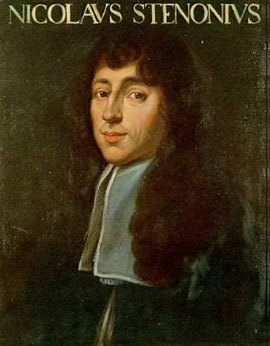
Born This Day: Nicolaus Steno

Steno (Jan. 10 – Nov. 26, 1686) was a Danish geologist and anatomist who first made unprecedented discoveries in anatomy, then established some of the most important principles of modern geology. He was Danish royal anatomist for 2 years.

Interested by the characteristics and origins of minerals, rocks, and fossils, he published in Prodromus (1669) the law of superposition (if a series of sedimentary rocks has not been overturned, upper layers are younger and lower layers are older) and the law of original horizontality (although strata may be found dipping steeply, they were initially deposited nearly horizontal.) link

Sunday, January 08, 2012

Born This Day: Alfred Russel Wallace

From Today In Science History:

Wallace (Jan. 8, 1823 – Nov. 7, 1913) was a British naturalist and biogeographer. He was the first westerner to describe some of the most interesting natural habitats in the tropics. He is best known for devising a theory of the origin of species through natural selection made independently of Darwin.

Between 1854 and 1862, Wallace assembled evidence of natural selection in the Malay Archipelago, sending his conclusions to Darwin in England. Their findings were jointly presented to the Linnaean Society in 1858. Wallace found that Australian species were more primitive, in evolutionary terms, than those of Asia, and that this reflected the stage at which the two continents had become separated. He proposed an imaginary line (now known as Wallace's line) dividing the fauna of the two regions.

The Alfred Russel Wallace page HERE. More HERE.

Friday, January 06, 2012

Died This Day: Jean-Étienne Guettard

Guettard (Sept. 22, 1715 - Jan. 6, 1786) was a French geologist and mineralogist who made the first survey to make a geologically map of France and to study the exposed rock strata of the Paris Basin.

He was first to identify several fossil species from the Paris area. Noting that certain plants occurred only in association with certain minerals and rocks, he travelled and mapped plant distributions and the occurrence of various minerals and rocks. The publication of his map in 1751 marks the beginning of the science of geology.

He also recognized erosion by running water, how subterranean water made caves and the battering of cliffs by the seas. He discovered the volcanoes of the Auvergne and the surrounding landscape shaped by past eruptions, cinder layers, old soils and solidified lava. From Today In Science History. image

Died This Day: Gregor Mendel

From Today In Science History:

Mendel (July 22, 1822 – Jan. 6, 1884) was an Austrian pioneer in the study of heredity. He spent his adult life with the Augustinian monastery in Brunn, where as a geneticist,
botanist and plant experimenter, he was the first to lay the mathematical foundation of the science of genetics, in what came to be called Mendelism.

Over the period 1856-63, Mendel grew and analyzed over 28,000 pea plants. He carefully studied for each their plant height, pod shape, pod color, flower position, seed color, seed shape and flower color. He made two very important generalizations from his pea experiments, known today as the Laws of Heredity. Mendel coined the present day terms in genetics: recessiveness and dominance.

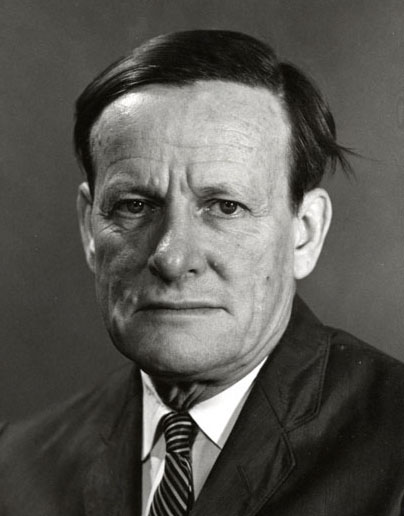
Born This Day: George Ledyard Stebbins

From the U Calif., Berkeley:

Along with Dobzhansky (1900 - 1975), animal systematist Ernst Mayr, and paleontologist George Gaylord Simpson (1902 - 1984), Stebbins (Jan. 6, 1906 - Jan. 19 2000) is considered one of the "architects" of the modern evolutionary synthesis of the 1930s and 1940s, an intellectual watershed and historic turning point that brought together research in cytology, genetics, systematics, paleontology into a common evolutionary framework. This synthesis, which had the effect of reconciling the often opposing views of laboratory-oriented geneticists and natural history oriented systematists, made Charles Darwin's theory of evolution by natural selection the centerpiece of the new discipline of evolutionary biology.

In this role, Stebbins is credited with bringing a modern framework to the study of plant evolution, and he is perhaps best known for his book Variation and Evolution in Plants, published by Columbia University Press (NY) in 1950. In the 1940s, Stebbins also played an important role in organizing the nascent Society for the Study of Evolution, of which he became the third president in 1948, and used his position to speak out for the botanical side of evolutionary studies, a field that had been dominated by zoologists. Photo .

Friday, December 23, 2011

Died This Day: Ernest B. Schoedsack


Cooper and Schoedsack (right)
Ernest Beaumont Schoedsack (June 8, 1893 – Dec. 23, 1979) was an American film, director and producer. With his partner, Merian C. Cooper, their first significant collaboration was the spectacular documentary, Grass (1925), which enjoyed a popular theatrical release in the wake of the success of Nanook of the North (1922).

They are best known for King Kong (1933), which was co-written by Schoedsack's wife, Ruth Rose. He also directed Son of Kong (1933), Dr. Cyclops (1940) and Mighty Joe Young (1949). From TCM.

Thursday, December 22, 2011

Died This Day: Kenneth Tobey

Tobey (Mar. 23, 1917 - Dec. 22, 2002) made a career of playing “take charge, men of authority”, such as Capt. Hendry in Howard Hawkes, “The Thing From Another World” (1951), and just about every TV series throughout the 60’s and 70’s. More than a few of his appearances were in SF stories, and he played Col. Jack Evans in The Beast from 20,000 Fathoms (1953).

Premiered This Day: Son of Kong


With the fantastic success of “King Kong”, RKO tried to cash in by rushing this sequel into production and release within the same year (1933). It did not do nearly as well, but animator Willis O’Brien did manage to bring some of the same charm to the big white ape that he did to Kong.

Friday, December 16, 2011

Premiered This Day: Betty Boop's Museum


In 1932 Betty Boop had her own “Night in the Museum”.

Wednesday, December 14, 2011

Walking Lungfish & The Evolution of Terrestrial Locomotion

Behavioral evidence for the evolution of walking and bounding before terrestriality in sarcopterygian fishes 2011. H.M. King, et al. PNAS published ahead of print December 12.


Extensive video analysis reveals that the African lungfish can use its thin pelvic limbs to not only lift its body off the bottom surface but also propel itself forward. Both abilities were previously thought to originate in early tetrapods, the limbed original land-dwellers that appeared later than the lungfish's ancestors.

The observation reshuffles the order of evolutionary events leading up to terrestriality, the adaptation to living on land. It also suggests that fossil tracks long believed to be the work of early tetrapods could have been produced instead by lobe-finned ancestors of the lungfish.

"The lungfish is in a really great and unique position in terms of how it is related to fishes and to tetrapods," said King. "Lungfish are very closely related to the animals that were able to evolve and come out of the water and onto land, but that was so long ago that almost everything except the lungfish has gone extinct."


The lungfish's ability to use its thin limbs to support its body may be helped by the reduced demands of gravity underwater, the authors proposed. By filling its lungs with air, the lungfish may increase the buoyancy of its front end, enabling the scrawny hindlimbs to lift the entire body off the ground. link

Died This Day: Louis Agassiz


May 28, 1807 - Dec. 14, 1873

(Jean) Louis (Rodolphe) Agassiz was a Swiss-born U.S. naturalist, geologist, and teacher who made revolutionary contributions to the study of natural science with landmark work on glacier activity and extinct fishes. Agassiz began his work in Europe, having studied at the University of Munich and then as chair in natural history in Neuchatel in Switzerland. While there he published his landmark multi-volume description and classification of fossil fish.

In 1846 Agassiz came to the U.S. to lecture before Boston's Lowell Institute. Offered a professorship of Zoology and Geology at Harvard in 1848, he decided to stay, becoming a citizen in 1861. His innovative teaching methods altered the character of natural science education in the U.S. Link

More info HERE

Wednesday, November 30, 2011

Thescelosaurus assiniboiensis

A new basal ornithopod dinosaur (Frenchman Formation, Saskatchewan, Canada), and implications for late Maastrichtian ornithischian diversity in North America. 2011. Brown, C.M., et al. Zoological Journal of the Linnean Society. 163: 1157-1198


Abstract [edit]: A small, articulated basal ornithopod skeleton from the Frenchman Formation (late Maastrichtian) of Saskatchewan, previously referred to the taxon Thescelosaurus, differs from both recognized species of this taxon (Thescelosaurus neglectus and Thescelosaurus garbanii). We recognize this specimen as the holotype of a new species, Thescelosaurus assiniboiensis sp. nov.

Identification of a third species of Thescelosaurus from the late Maastrichtian of North America suggests that this taxon was more diverse than previously recognized, and shows an increase in diversity from the Campanian through the late Maastrichtian, contrasting the trends seen in most other ornithischian clades.

Sauropod Osteoderms

Sauropod dinosaur osteoderms from the Late Cretaceous of Madagascar. 2011. K. Curry Rogers, et al. Nature Communications 2, article number:564.


Abstract: Osteoderms are bones embedded within the dermis, and are common to select members of most major tetrapod lineages. The largest known animals that bear osteoderms are members of Titanosauria, a diverse clade of sauropod dinosaurs.

Here we report on two titanosaur osteoderms recovered from the Upper Cretaceous Maevarano Formation of Madagascar. Each osteoderm was discovered in association with a partial skeleton representing a distinct ontogenetic stage of the titanosaur Rapetosaurus krausei. Combined, these specimens provide novel insights into the arrangement and function of titanosaur osteoderms.

Taphonomic data confirm that Rapetosaurus developed only limited numbers of osteoderms in its integument. The adult-sized osteoderm is the most massive integumentary skeletal element yet discovered, with an estimated volume of 9.63 litres. Uniquely, this specimen possesses an internal cavity equivalent to more than half its total volume. Large, hollow osteoderms may have functioned as mineral stores in fecund, rapidly growing titanosaurs inhabiting stressed environments.

Monday, November 28, 2011

A Stopmotion History of The World


Created By Kalle Mattson, Kevin Parry, and Friends. Link from Neatorama.

Thursday, November 24, 2011

Published This Day: The Origin of The Species

From Today In Science History:

In 1859, The Origin of Species by Means of Natural Selection was published in England to great acclaim. In this groundbreaking book by British naturalist Charles Darwin, he argued that species are the result of a gradual biological evolution in which nature encourages, through natural selection, the propagation of those species best suited to their environments. This book is unquestionably one of the most influential in the history of science.

Tuesday, November 22, 2011

Cuspicephalus scarfi - The 'Torydactyl'

A monofenestratan pterosaur from the Kimmeridge Clay Formation (Upper Jurassic, Kimmeridgian) of Dorset, England. 2011. D.M. Martill and S. Etches. Acta Palaeontologica Polonica, in press.


The pterosaur Cuspicephalus scarfi is named after Gerald Scarfe, the political cartoonist whose pen demonised Mrs Thatcher as a pointy nosed ‘torydactyl’. The new discovery was so-called because of its extremely long pointy head, which is most unusual for a pterosaur. The skull is 326 mm long – similar in size to a stork or heron.

The species was found by fossil collector Steve Etches in Kimmeridge Bay, Dorset. The specimen is 155 million years old from the Late Jurassic period and is the most substantial pterosaur skull to be found in the UK for nearly 200 years. It is now on display in Dorset’s Museum of Jurassic Marine Life.

Mr Scarfe said: “I'm thrilled and flattered - I never thought Mrs Thatcher would do anything for me - even if it is to be immortalized as a 155 million year old fossil". link

Eric Idle on Intelligent Design. Or Michael Palin on Shakespeare. Maybe Both.


Go read it at The New Yorker

Sunday, November 20, 2011

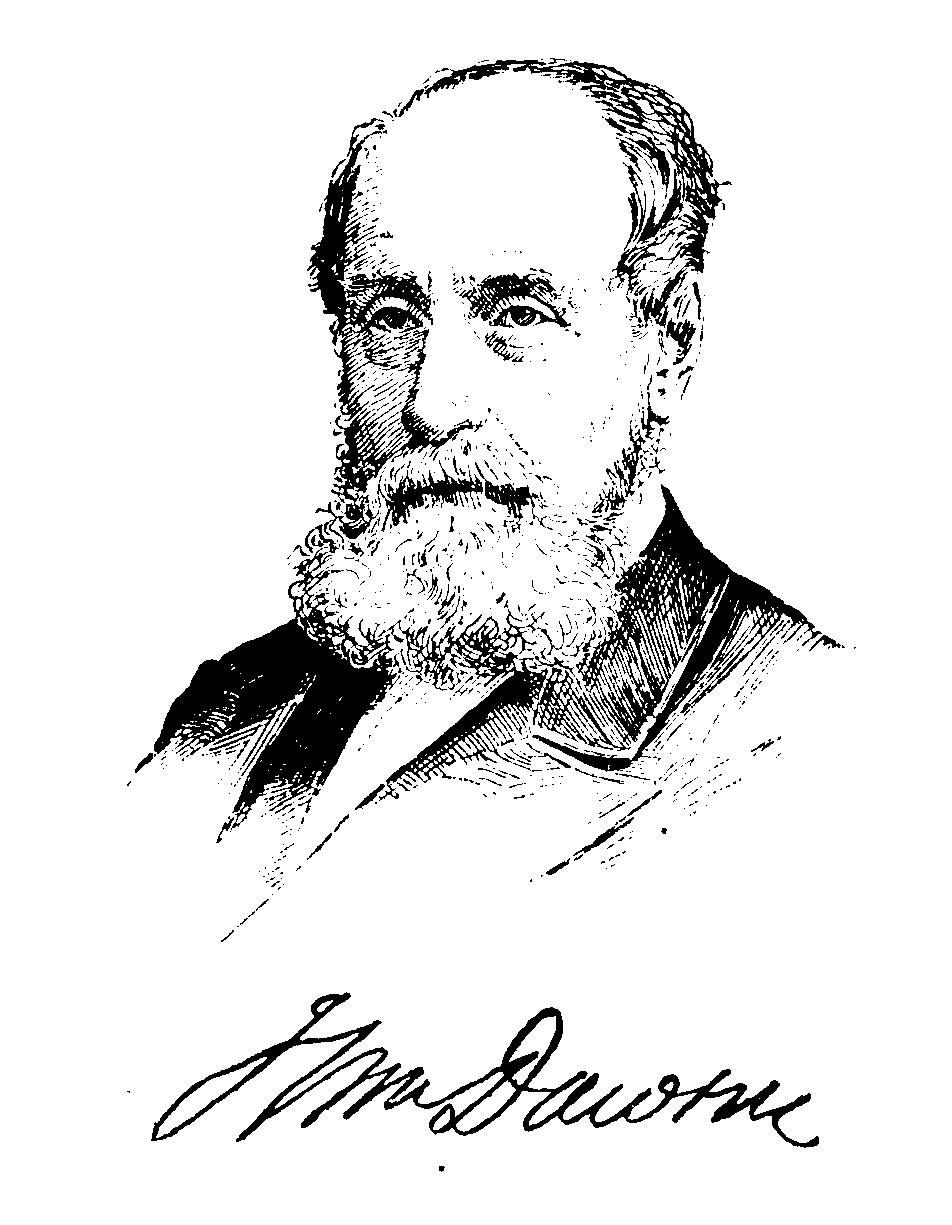
Died This Day: John William Dawson

Dawson (Oct. 30, 1820 - Nov. 20, 1899>) was a Canadian geologist who made numerous contributions to paleobotany and extended the knowledge of Canadian geology. Dawson was born and raised in Pictou, Nova Scotia, where the many sandstone and coal formations provided fertile ground for his first scientific explorations, which culminated in the publication of Acadian Geology. He made many important discoveries of fossil life, great and small. These included fossil plants, trackways of lowly invertebrates, footprints, skeletons of reptiles and amphibians, millipedes and the earliest land snails. When the famous geologist Charles Lyell visited coal deposits in Pictou, Dawson acted as his guide.

In 1851, Dawson and Lyell teamed up again to examine the interiors of fossil tree trunks at Joggins, Nova Scotia. They discovered the remains of some of the earliest known reptiles, Hylonomus lyelli, along with other rare fossils, propelling this part of the world into the international spotlight.

Dawson became principal of McGill College in Montreal in 1854, which he made into a reputable institution. He remained there, teaching geology and palaeontology and acting as librarian, until his retirement. One of his lifelong dreams was realized in 1882 when Peter Redpath gave money to McGill for the construction and establishment of a museum, naming Dawson as director. Today the Peter Redpath Museum of Natural History houses many specimens from Dawson's personal collection.

Info from HERE and HERE. Images from HERE and HERE.