University of Chicago paleontologist Paul Sereno and Gabrielle Lyon will accept Project Exploration’s Presidential Award for Excellence in Science Mentoring on Jan. 6 at a White House ceremony.
Sereno and Lyon co-founded the non-profit Project Exploration as a science education organization in 1999 to make science accessible to the public―particularly minority youth and girls―through personalized experiences with science and scientists.
Nearly 1000 Chicago Public School middle and high school students have participated in programs over the past nine years.
The award recognizes the crucial role that mentoring plays in the academic and personal development of students studying science or engineering and who belong to minorities that are underrepresented in those fields. link
Monday, January 04, 2010
Died This Day: Clarence Edward Dutton
Dutton (May 15, 1841 - Jan. 4, 1912) was an American geologist  who in 1887 was put in charge of the division of volcanic geology and seismology. His investigation of the Charleston earthquake of 1886, published in the reports of that survey, attracted wide attention and helped to develop scientific interest in the study of earthquake phenomena.
He is acknowledged as being the pioneer seismologist who developed and named the principle of isostasy.
Info from Wikipedia
 who in 1887 was put in charge of the division of volcanic geology and seismology. His investigation of the Charleston earthquake of 1886, published in the reports of that survey, attracted wide attention and helped to develop scientific interest in the study of earthquake phenomena.
He is acknowledged as being the pioneer seismologist who developed and named the principle of isostasy.
Info from Wikipedia


Sunday, January 03, 2010

Friday, January 01, 2010
Plant Evolution Caught In The Act
The Rate and Molecular Spectrum of Spontaneous Mutations in Arabidopsis thaliana. 2009. S. Ossowski, et al. Science 327: 92–94.

Adventure Comics #371 © DC ComicsMutations are the raw material of evolution. Charles Darwin already recognized that evolution depends on heritable differences between individuals: those who are better adapted to the environment have better chances to pass on their genes to the next generation. A species can only evolve if the genome changes through new mutations, with the best new variants surviving the sieve of selection.
Scientists wanted to scrutinize the signature of evolution before selection occurs. To this end, they followed all genetic changes in five lines of the mustard relative Arabidopsis thaliana (below) that occurred during 30 generations. In the genome of the final generation they then searched for differences to the genome of the original ancestor.

Image: Detlef WeigelThe painstakingly detailed comparison of the entire genome revealed that in over the course of only a few years some 20 DNA building blocks, so called base pairs, had been mutated in each of the five lines. "The probability that any letter of the genome changes in a single generation is thus about one in 140 million," explains Michael Lynch.
To find these tiny alterations in the 120 million base pair genome of Arabidopsis was only possibly because of new methods that allowed us to screen the entire genome with high precision and in very short time.
Apart from the speed of new mutations, the study revealed that not every part of the genome is equally affected. With four different DNA letters, there are six possible changes—but only one of these is responsible for half of all the mutations found.
In addition, scientists can now calculate more precisely when species split up. Arabidopsis thaliana and its closest relative, Arabidopsis lyrata, differ in a large number of traits including size and smell of flowers or longevity: Arabidopsis lyrata plants often live for years, while Arabidopsis thaliana plants normally survive only for a few months. Colleagues had previously assumed that only five million years had passed by since the two species went their separate ways. The new data suggest instead that the split occurred already 20 million years ago. Similar arguments might affect estimates of when in prehistory animals and plants were first domesticated.
The results show that in sufficiently large populations, every possible mutation in the genome should be present. The new findings easily explain why weeds become quickly resistant to herbicides. In a large weed population, a few individuals might have a mutation in just the right place in their genome to help them withstand the herbicide. link

Adventure Comics #371 © DC Comics
Scientists wanted to scrutinize the signature of evolution before selection occurs. To this end, they followed all genetic changes in five lines of the mustard relative Arabidopsis thaliana (below) that occurred during 30 generations. In the genome of the final generation they then searched for differences to the genome of the original ancestor.

Image: Detlef Weigel
To find these tiny alterations in the 120 million base pair genome of Arabidopsis was only possibly because of new methods that allowed us to screen the entire genome with high precision and in very short time.
Apart from the speed of new mutations, the study revealed that not every part of the genome is equally affected. With four different DNA letters, there are six possible changes—but only one of these is responsible for half of all the mutations found.
In addition, scientists can now calculate more precisely when species split up. Arabidopsis thaliana and its closest relative, Arabidopsis lyrata, differ in a large number of traits including size and smell of flowers or longevity: Arabidopsis lyrata plants often live for years, while Arabidopsis thaliana plants normally survive only for a few months. Colleagues had previously assumed that only five million years had passed by since the two species went their separate ways. The new data suggest instead that the split occurred already 20 million years ago. Similar arguments might affect estimates of when in prehistory animals and plants were first domesticated.
The results show that in sufficiently large populations, every possible mutation in the genome should be present. The new findings easily explain why weeds become quickly resistant to herbicides. In a large weed population, a few individuals might have a mutation in just the right place in their genome to help them withstand the herbicide. link
Born This Day: Carole Landis

Jan. 1, 1919 - July 5, 1948
Landis became a popular pin-up with servicemen during World War II. She was an accomplished writer; her 1944 book Four Jills in a Jeep was later made into a movie. After a turbulent love life she commited suicide at age 29.
Monday, December 28, 2009
Elkanah Billings & The Ediacaran Fauna

From Ottawa Citizen has a nice long article on Elkanah Billings and his work on the Ediacaran fauna in Canada:
"Only during this decade did the global scientific community approve the Ediacaran as the first major revision to the calendar of Earth's history in more than a century. It was a stunning and long-overdue vindication of Ottawa's pioneer paleontologist [Billings], who first theorized -- in a solitary stance among his doubting contemporaries -- that the strange, ring-like markings from Newfoundland might be faint relics of a more sophisticated, multicellular form of life before such life was supposed to exist."
Chinese Black Market Fossils
From The Sydney Morning Herald comes a report on the black market trade in fossils from China:
Why the trade has grown so large is that China has become the centre of the world's fossil industry. This is not just down to China's size, but to the extraordinary level of fossil preservation in at least three large sites.
China's fossil riches face a threat not just from treasure hunters, though. In a well-intentioned effort to crack down on the black market trade - which has taken many of the best specimens into private collections before scientists even know of their existence - the Chinese Government is planning draconian new measures to prevent their export.
"There's a feeling that China is haemorrhaging fossils and people are making a lot of money,'' David Unwin, a palaeontologist at the University of Leicester, says. ''It's China's national heritage that's being lost."
But he and others are worried the new legislation will restrict ''the ability of people to collect fossils or for fossils to end up in museums".
Born This Day: Alfred Sherwood Romer
”Romer (Dec. 28, 1894 – Nov. 5, 1973) was director of the Museum of Comparative Zoology at Harvard University until his retirement in 1961 and was one the singularly most influential vertebrate paleontologists of the 20th Century. His work ranged over virtually every 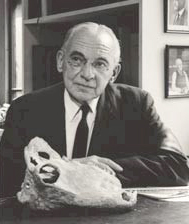 conceivable subject within that field, although it was the osteology and taxonomy of the therapsids and other proto-mammals which was nearest his heart.
In addition to this work, Romer was acutely interested in the origin and initial adaptive radiation of tetrapods, and his work became the basis for a theory of tetrapod origins which was canon until the description of Acanthostega gunnari by Clack & Coates in the 1990s. Romer was ahead of his time in his defense of monophyly of Dinosauria though he did feel that Theropoda was not ancestral to birds.” link from EvoWiki.org
Romer’s book, Vertebrate Paleontology (1966), was for many years THE textbook on VP and is still well worth picking up. One of Romer’s students, Bob Carroll, wrote an updated version entitled, ‘Vertebrate Paleontology and Evolution’, in 1987. image
 conceivable subject within that field, although it was the osteology and taxonomy of the therapsids and other proto-mammals which was nearest his heart.
In addition to this work, Romer was acutely interested in the origin and initial adaptive radiation of tetrapods, and his work became the basis for a theory of tetrapod origins which was canon until the description of Acanthostega gunnari by Clack & Coates in the 1990s. Romer was ahead of his time in his defense of monophyly of Dinosauria though he did feel that Theropoda was not ancestral to birds.” link from EvoWiki.org
Romer’s book, Vertebrate Paleontology (1966), was for many years THE textbook on VP and is still well worth picking up. One of Romer’s students, Bob Carroll, wrote an updated version entitled, ‘Vertebrate Paleontology and Evolution’, in 1987. image
Sunday, December 27, 2009
Set Sail Today: HMS Beagle
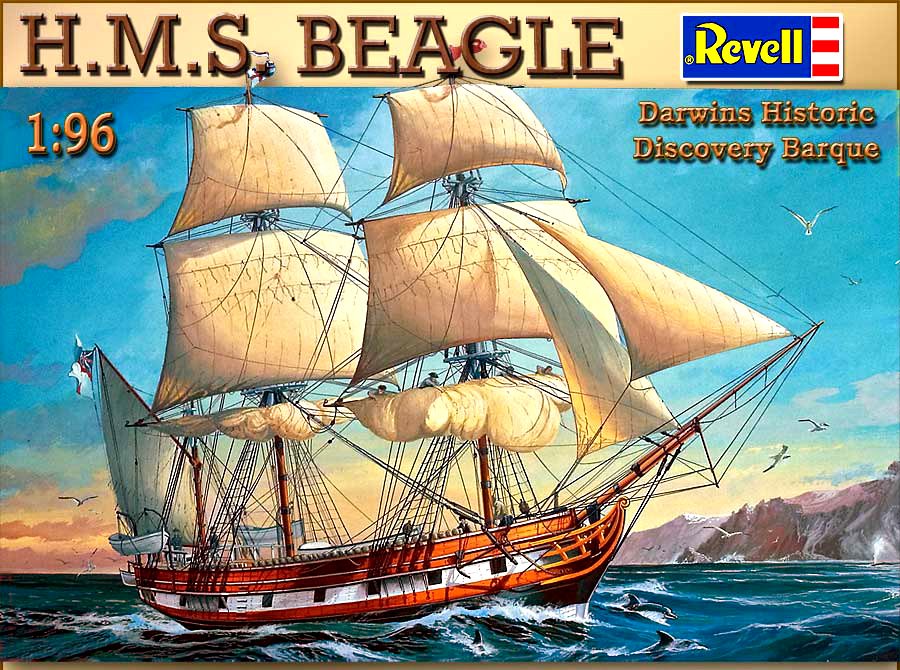
In 1831, Charles Darwin set sail from Plymouth harbour on his voyage of scientific discovery aboard the HMS Beagle, a British Navy ship. The Captain Robert FitzRoy was sailing to the southern coast of South America in order to complete a government survey. Darwin had an unpaid position as the ship's naturalist, at age 22, just out of university.
Originally planned to be at sea for two years, the voyage lasted five years, making stops in Brazil, the Galapogos Islands, and New Zealand. From the observations he made and the specimens he collected on that voyage, Darwin developed his theory of biological evolution through natural selection, which he published 28 years after the Beagle left Plymouth.

The path of The HMS Beagle. © Pearson Education, Inc.
Click to enlarge.
Friday, December 25, 2009
Early Whale Was A Suction Feeder
The morphology and systematics of Mammalodon colliveri (Cetacea: Mysticeti), a toothed mysticete from the Oligocene of Australia. 2009. E. Fitzgerald. Zool. J. Linn. Soc., published online 21 Dec.

New work supports Charles Darwin's speculation in The Origin of Species that some of the earliest baleen whales may have been suction feeders, and that their mud grubbing served as a precursor to the filter feeding of today's giants of the deep. Mammalodon colliveri, a primitive toothed baleen whale from the Oligocene, may have used its tongue and short, blunt snout to suck small prey from sand and mud on the seafloor

Fantastic Four © Marvel ComicsAlthough Mammalodon had a total body length of about 3 m, it was a bizarre early offshoot from the lineage leading to the 30 metre long blue whale. The new research shows that Mammalodon is a dwarf, having evolved into a relatively tiny form from larger ancestors. link

New work supports Charles Darwin's speculation in The Origin of Species that some of the earliest baleen whales may have been suction feeders, and that their mud grubbing served as a precursor to the filter feeding of today's giants of the deep. Mammalodon colliveri, a primitive toothed baleen whale from the Oligocene, may have used its tongue and short, blunt snout to suck small prey from sand and mud on the seafloor

Fantastic Four © Marvel Comics
Wednesday, December 23, 2009
Belalugosisaurus
The birdlike raptor Sinornithosaurus was venomous. 2009. E. Gong, et al. PNAS, Published online before print Dec. 14.
Sinornithosaurus had special depressions on the side of its face thought by the investigators to have housed a poison gland, connected by a long lateral depression above the tooth row that delivered venom to a series of long, grooved teeth on the upper jaw. This arrangement is similar to the venom-delivery system in modern rear-fanged snakes and lizards. The researchers believe it to be specialized for predation on birds.

David A. Burnham, PhD University of Kansas Biodiversity Institute
Sinornithosaurus had special depressions on the side of its face thought by the investigators to have housed a poison gland, connected by a long lateral depression above the tooth row that delivered venom to a series of long, grooved teeth on the upper jaw. This arrangement is similar to the venom-delivery system in modern rear-fanged snakes and lizards. The researchers believe it to be specialized for predation on birds.


David A. Burnham, PhD University of Kansas Biodiversity Institute
"You wouldn't have seen it coming," said Burnham. "It would have swooped down behind you from a low-hanging tree branch and attacked from the back. It wanted to get its jaws around you. Once the teeth were embedded in your skin the venom could seep into the wound. The prey would rapidly go into shock, but it would still be living, and it might have seen itself being slowly devoured by this raptor." link
Tuesday, December 22, 2009
Discovered This Day: 1st Living Coelacanth
From Today In Science History:
In 1938, a coelacanth, a primitive fish thought extinct, was discovered. Marjorie Courtenay-Latimer was curator of the museum in the port town of East London, northeast of Cape Town, South Africa, and always interested in seeing unusual specimens. Hendrik Goosen, captain of the trawler Nerine, called her to see his catch of the day before, made at about 70-m depth, off the Chalumna River southwest of East London. She spotted an unusual 5-ft fish in his "trash" fish pile. It was pale mauvy-blue with iridescent silver markings. She sent a sketch to Dr J.L.B. Smith, a senior lecturer in chemistry from Rhodes University in Grahamstown for identification. It was hailed as the zoological discovery of the century and equated to finding a living dinosaur!

In 1938, a coelacanth, a primitive fish thought extinct, was discovered. Marjorie Courtenay-Latimer was curator of the museum in the port town of East London, northeast of Cape Town, South Africa, and always interested in seeing unusual specimens. Hendrik Goosen, captain of the trawler Nerine, called her to see his catch of the day before, made at about 70-m depth, off the Chalumna River southwest of East London. She spotted an unusual 5-ft fish in his "trash" fish pile. It was pale mauvy-blue with iridescent silver markings. She sent a sketch to Dr J.L.B. Smith, a senior lecturer in chemistry from Rhodes University in Grahamstown for identification. It was hailed as the zoological discovery of the century and equated to finding a living dinosaur!
“December 22, 1938, Captain Goosen and the Nerine put into East London harbour with the usual catch of sharks, rays, starfish and rat-tail fish. But there was one unusual fish amongst the catch that had been caught in about 70 meters, near the mouth of the Chalumna River. Once ashore Captain Goosen left word at the Museum that there were several specimens at the ship for Miss Latimer. At first she said that she was too busy because she was hard at work cleaning and articulating the fossil reptile bones collected from Tarkastad. But as it was so near Christmas time she decided to go and wish the crew a “Happy Christmas” and took a taxi to the docks. There, attracted by a blue fin amid the pile of sharks, she found a magnificent fish. She and her assistant put it in a bag and persuaded a reluctant taxi driver to take it to the museum in the boot of the car. It measured 150 cm and weighed 57.5 kg. From its hard bony scales with sharp, prickly spines and paired fins looking rather like legs, she knew that it must be some kind of primitive fish.Learn more about Latimeria chalumnae at the Australian Museum fish web page.
But her greatest problem was to preserve it until it could be identified. It was extremely hot, the fish, was too big to go into a bath and she could not find any organization willing to store it in a freezer. Although she was told by experts that it was only a type of rock cod and that she was making a fuss about nothing, she persisted in her attempts to save the fish for science. At first it was wrapped in cloths soaked in formalin but eventually, on the 26th, Mr. Center, a taxidermist, skinned it. Unfortunately the internal organs were thrown away. Marjorie went home disappointed and worried that she had not saved all the soft parts. What she had done, however, was to write immediately to her friend, JLB Smith, and send him her famous sketch of the strange fish.”
Miss Courtenay-Latimer's sketch of the first coelacanth which she posted to JLB Smith.

Died This Day: Kenneth Tobey
Tobey (Mar. 23, 1917 - Dec. 22, 2002) made a career of playing “take charge, men of authority”, such as Capt. Hendry in Howard Hawkes, “The Thing From Another World” (1951), and just about every TV series throughout the 60’s and 70’s. More than a few of his appearances were in SF stories, and he played Col. Jack Evans in The Beast from 20,000 Fathoms (1953).


Premiered This Day (1933): Son of Kong

Monday, December 21, 2009
Born This Day: Sewell Wright
From the ever eloquent Today In Science History:
 Wright (Dec. 21, 1889 – March 3, 1988) was an American geneticist who was one of the founders of modern theoretical population genetics. He researched the effects of inbreeding and crossbreeding with guinea pigs, and later on the effects of gene action on inherited characteristics. He adopted statistical techniques to develop evolutionary theory.
Wright is best known for his concept of genetic drift, called the Sewell Wright effect - that when small populations of a species are isolated, out of pure chance the few individuals who carry certain relatively rare genes may fail to transmit them. The genes may therefore disappear and their loss may lead to the emergence of new species, although natural selection has played no part in the process.
Check out genetic drift at The Biology Project at The University of Arizona.
Learn more about Wright HERE. Image from HERE
 Wright (Dec. 21, 1889 – March 3, 1988) was an American geneticist who was one of the founders of modern theoretical population genetics. He researched the effects of inbreeding and crossbreeding with guinea pigs, and later on the effects of gene action on inherited characteristics. He adopted statistical techniques to develop evolutionary theory.
Wright is best known for his concept of genetic drift, called the Sewell Wright effect - that when small populations of a species are isolated, out of pure chance the few individuals who carry certain relatively rare genes may fail to transmit them. The genes may therefore disappear and their loss may lead to the emergence of new species, although natural selection has played no part in the process.
Check out genetic drift at The Biology Project at The University of Arizona.
Learn more about Wright HERE. Image from HERE

Friday, December 18, 2009
Ancient DNA Uncovers Late-surviving Alaskan Megafauna
Ancient DNA reveals late survival of mammoth
and horse in interior Alaska. 2009. J. Halle, et al., PNAS, published online before print December 17.
 Extinct woolly mammoths and ancient American horses may have been grazing the North American steppe for several thousand years longer than previously thought. After plucking ancient DNA from frozen soil in central Alaska, a team of researchers uncovered "genetic fossils" of both species locked in permafrost samples dated to between 7,600 and 10,500 calendar years.
This new evidence suggests that at least one population of these now-extinct mammals endured longer in the continental interior, challenging the conventional view that these and other large species, or megafauna, disappeared from the Americas about 12,000 years ago.
Cores samples offer a clear picture of the local Alaskan fauna at the end of the last ice age. The oldest sediments, dated to about 11,000 years ago, contain remnant DNA of Arctic hare, bison, and moose; all three animals were also found in higher, more recent layers, as would be expected. But one core, deposited between 7,600 and 10,500 years ago, confirmed the presence of both mammoth and horse DNA.
"At this point, mammoths and horses were barely holding on. We may actually be working with the DNA of some of the last members of these species in North America," link
and horse in interior Alaska. 2009. J. Halle, et al., PNAS, published online before print December 17.

This new evidence suggests that at least one population of these now-extinct mammals endured longer in the continental interior, challenging the conventional view that these and other large species, or megafauna, disappeared from the Americas about 12,000 years ago.
Cores samples offer a clear picture of the local Alaskan fauna at the end of the last ice age. The oldest sediments, dated to about 11,000 years ago, contain remnant DNA of Arctic hare, bison, and moose; all three animals were also found in higher, more recent layers, as would be expected. But one core, deposited between 7,600 and 10,500 years ago, confirmed the presence of both mammoth and horse DNA.
"At this point, mammoths and horses were barely holding on. We may actually be working with the DNA of some of the last members of these species in North America," link
Died This Day: Sir Richard Owen
From Today In Science History:
 Owen (July 20, 1804 – Dec. 18, 1892) was an English anatomist and paleontologist who is remembered for his contributions to the study of fossil animals and for his strong opposition to the views of Charles Darwin.
He coined the word "Dinosaur" meaning "terrible reptile" (1842). Owen synthesized French anatomical work, especially from Cuvier and Geoffroy, with German transcendental anatomy. He gave us many of the terms still used today in anatomy and evolutionary biology, including "homology". In 1856, he was appointed Superintendent of the British Museum (Natural History).
 Owen (July 20, 1804 – Dec. 18, 1892) was an English anatomist and paleontologist who is remembered for his contributions to the study of fossil animals and for his strong opposition to the views of Charles Darwin.
He coined the word "Dinosaur" meaning "terrible reptile" (1842). Owen synthesized French anatomical work, especially from Cuvier and Geoffroy, with German transcendental anatomy. He gave us many of the terms still used today in anatomy and evolutionary biology, including "homology". In 1856, he was appointed Superintendent of the British Museum (Natural History).
Died This Day: Theodosius Dobzhansky
From Today In Science History:
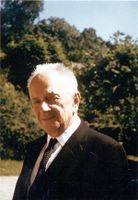 Dobzhansky (Jan. 25, 1900 – Dec. 18, 1975) was an Ukrainian-American geneticist and evolutionist whose work had a major influence on 20th-century thought and research on genetics and evolutionary theory. He made the first significant synthesis of Charles Darwin's theory of evolution with Gregor Mendel's theory of genetics in his book Genetics and the Origin of Species (1937).
From 1918 his research gave experimental evidence that genes could vary far more than geneticists had previously believed. Thus, successful species tend to have a wide variety of genes that, while redundant in its present environment, do provide a species as a whole with genetic diversity. Such diversity enables the species to adapt effectively to changes in the surrounding environment - the basis for modern evolutionary theory.
 Dobzhansky (Jan. 25, 1900 – Dec. 18, 1975) was an Ukrainian-American geneticist and evolutionist whose work had a major influence on 20th-century thought and research on genetics and evolutionary theory. He made the first significant synthesis of Charles Darwin's theory of evolution with Gregor Mendel's theory of genetics in his book Genetics and the Origin of Species (1937).
From 1918 his research gave experimental evidence that genes could vary far more than geneticists had previously believed. Thus, successful species tend to have a wide variety of genes that, while redundant in its present environment, do provide a species as a whole with genetic diversity. Such diversity enables the species to adapt effectively to changes in the surrounding environment - the basis for modern evolutionary theory.
Died This Day: Jean-Baptiste de Monet, Chevalier de Lamarck
Aug.1, 1744 – Dec. 18, 1829
From Today in Science History:
Pioneer French biologist who is noted for his speculations about the evolution of living things, particularly his theory that acquired traits are inheritable (such as giraffes who, he said, through stretching to reach tall trees, make their necks longer, and then pass on longer necks to their offspring.) This Lamarckism idea is controverted by Darwinian theory.
He published a flora of France (1778) and a system of classification for invertebrate animals, published in his Histoire naturelle des animaux sans vertebres (7 vols, 1815-22). In 1809 Lamarck published his theory of evolution (in Philosophie zoologique). Lamarck's speculations about the physical and natural world found little favour among his contemporaries and he died blind and in poverty.
From info on Lamarck from The Victorian Web.
From Today in Science History:
Pioneer French biologist who is noted for his speculations about the evolution of living things,
 particularly his theory that acquired traits are inheritable (such as giraffes who, he said, through stretching to reach tall trees, make their necks longer, and then pass on longer necks to their offspring.) This Lamarckism idea is controverted by Darwinian theory.
He published a flora of France (1778) and a system of classification for invertebrate animals, published in his Histoire naturelle des animaux sans vertebres (7 vols, 1815-22). In 1809 Lamarck published his theory of evolution (in Philosophie zoologique). Lamarck's speculations about the physical and natural world found little favour among his contemporaries and he died blind and in poverty.
From info on Lamarck from The Victorian Web.
Thursday, December 17, 2009
Born This Day: Father of Carbon-14 Dating
Dec 17, 1908 – Sept. 8, 1980
 Libby was an American chemist who won the Nobel Prize for Chemistry in 1960 for developing the technique of carbon-14 dating. Duing WWII he worked on the Manhattan Project. Libby was responsible for the gaseous diffusion separation and enrichment of the Uranium-235 which was used in the atomic bomb.
On 18 May 1952, he determined that the age of Stonehenge was 1848 BC, based on analysis of radioisotopes in charcoal. He also discovered that tritium could be used for dating water.
Subscribe to:
Posts (Atom)