Monday, December 31, 2012

Man Tried for the Moon (Henry Boltinoff, Showcase, 1962)


Art by Henry Boltinoff, Showcase #41< DC Comics, 1962 

Plus some Science Facts from Showcase #40:


Thursday, December 27, 2012

Sunday, December 16, 2012

Died This Day: Eugene Dubois

Eugene Dubois (Jan. 28, 1858-Dec. 16, 1940) joined the Dutch Army as a medical officer, and used spare time from his medical duties to search for fossils, first in Sumatra and then in Java. He searched on the banks of the Solo River, with two assigned engineers and a crew of convict labourers to help him. In September 1890, his workers found a human, or human-like, fossil at Koedoeng Broeboes. This consisted of the right side of the chin of a lower jaw and three attached teeth. In August 1891 he found a primate molar tooth.

Two months later and one meter away was found an intact skullcap, the fossil which would be known as Java Man. In August 1892, a third primate fossil, an almost complete left thigh bone, was found between 10 and 15 meters away from the skullcap.

In 1894 Dubois published a description of his fossils, naming them Pithecanthropus erectus (now Home erectus), describing it as neither ape nor human, but something intermediate. In 1895 he returned to Europe to promote the fossil and his interpretation. A few scientists enthusiastically endorsed Dubois' work, but most disagreed with his interpretation. Many scientists pointed out similarities between the Java Man skullcap and Neandertal fossils.

Around 1900 Dubois ceased to discuss Java Man, and hid the fossils in his home while he moved on to other research topics. geology and paleontology. It was not until 1923 that Dubois, under pressure from scientists, once again allowed access to the Java Man fossils. That and the discovery of similar fossils caused it to once again become a topic of debate.


Skull cap (Trinil 2, holotype of Home erectus) from HERE.

Thursday, December 13, 2012

Paleozoic Soft Tissue Preservation in Ostracods

A Silurian myodocope with preserved soft-parts: cautioning the interpretation of the shell-based ostracod record. Siviter, D.J., et al. Proc. R Soc. B 280 (1752), Feb., 2013.

Ventral view of the fossil Pauline avibella. Credit: D.J. Siveter, D. E. G. Briggs, D. J. Siveter, M. D. Sutton & S. C. Joomun.
Abstract: Ostracod crustaceans are the most abundant fossil arthropods. The Silurian Pauline avibella gen. et sp. nov., from the Herefordshire Lagerstätte, UK, is an extremely rare Palaeozoic example with soft-part preservation. Based on its soft-part morphology, especially the exceptionally preserved limbs and presence of lateral eyes, it is assigned to the myodocopid myodocopes. The ostracod is very large, with an epipod on the fifth limb pair, as well as gills implying the presence of a heart and an integrated respiratory–circulatory system as in living cylindroleberidid myodocopids. Features of its shell morphology, however, recall halocyprid myodocopes and palaeocopes, encouraging caution in classifying ostracods based on the carapace alone and querying the interpretation of their shell-based fossil record, especially for the Palaeozoic, where some 500 genera are presently assigned to the Palaeocopida.

Wednesday, December 12, 2012

"Mad Men" Palaeontologists!

Go read the full story HERE

Gigantism in Sauropods

High C/N ratio (not low-energy content) of vegetation may have driven gigantism in sauropod dinosaurs and perhaps omnivory and/or endothermy in their juveniles. Wilkinson, D.M., and G. D. Ruxton. Functional Ecology, published online Dec 11, 2012.


Summary:

1. Sauropod dinosaurs were the largest terrestrial animals ever, and the combination of selective pressures that might have lead to such extraordinary sizes has long been discussed.

2. Here, we argue that a previous suggestion that large size may be a response to unusually high C/N ratios in available plant foods has been prematurely discarded. C/N ratios were likely to be high during much of the Mesozoic, and C/N ratio is entirely different from gross energy density as a measure of the value of a plant as food. In addition, we use recently published allometric equations for herbivore nitrogen and carbon use to make tentative calculations which suggest that if Mesozoic C/N ratios were greater than extant ones, this would have selected for one of two strategies: gigantism in ectothermic herbivores or endothermy (and selective foraging on high N material) in very small herbivores.

3. We speculate that smaller-bodied juvenile sauropods might have had a broader omnivorous diet and/or had higher mass-specific metabolic rates than adults. The former is potentially testable by changes in dentition; the latter matches evidence of high growth rates of juvenile sauropods. press release

Born This Day: Erasmus Darwin

Erasmus (Dec. 12, 1731 – April 18, 1802) was a prominent English physician, poet, philosopher, botanist, naturalist and the grandfather of naturalist Charles Darwin and the biologist Francis Galton. Erasmus Darwin was one of the leading intellectuals of 18th century England.

As a naturalist, he formulated one of the first formal theories on evolution in Zoonomia, or, The Laws of Organic Life (1794-1796). Although he did not come up with natural selection, he did discuss ideas that his grandson elaborated on sixty years later, such as how life evolved from a single common ancestor, forming "one living filament".

Although some of his ideas on how evolution might occur are quite close to those of Lamarck, Erasmus Darwin also talked about how competition and sexual selection could cause changes in species. link

Download Zoonomia HERE

Sunday, December 09, 2012

In The Dawn of History

From Strange Adventures #3, 1950

Friday, December 07, 2012

Born This Day: Louis Dollo

Louis Antoine Marie Joseph Dollo (Dec. 7, 1857 – April 19, 1931) was a French vertebrate paleontologist who stated Dollo's Law of Irreversibility whereby in evolution an organism never returns exactly to its former state such that complex structures, once lost, are not regained in their original form. (While generally true, some exceptions are known.)

He began as an assistant (1882), became keeper of mammals (1891) at the Royal Museum of Natural History in Brussels where he stayed most of his life. He was a specialist in fossil fishes, reptiles, birds, and their palaeoecology. He supervised the excavation of the famous, multiple Iguanodons found in 1878 by miners deep underground, at Bernissart, Belgium. image From Today In Science History

Thursday, December 06, 2012

Nyasasaurus parringtoni, The Oldest Dinosaur?

The oldest dinosaur? A Middle Triassic dinosauriform from Tanzania. 2012. Nesbitt, S., et al. Biol. Lett.. 2013 9 1 20120949

Abstract: The rise of dinosaurs was a major event in vertebrate history, but the timing of the origin and early diversification of the group remain poorly constrained. Here, we describe Nyasasaurus parringtoni gen. et sp. nov., which is identified as either the earliest known member of, or the sister–taxon to, Dinosauria. Nyasasaurus possesses a unique combination of dinosaur character states and an elevated growth rate similar to that of definitive early dinosaurs. It demonstrates that the initial dinosaur radiation occurred over a longer timescale than previously thought (possibly 15 Myr earlier), and that dinosaurs and their immediate relatives are better understood as part of a larger Middle Triassic archosauriform radiation. The African provenance of Nyasasaurus supports a southern Pangaean origin for Dinosauria. Press release

Wednesday, December 05, 2012

Monday, December 03, 2012

RIP, Jack Lerbekmo

Jack Lerbekmo,Professor Emeritus in the Department of Earth Sciences, University of Alberta, passed away on Thursday, November 29.

To paraphrase David Eberth, our understanding of the Cretaceous - Paleocene chronostrat record in the Western Canadian Sedimentary Basin owes much to him. All of us who work in that area owe him a huge debt.

His U of Alberta web page is here.

Sunday, December 02, 2012

Born This Day: Frank Reicher

Frank Reicher (Dec. 2, 1875 – Jan. 19, 1965) was born in Munich,Germany and had a long career in Hollywood. He appeared in over 200 films, often playing small roles in minor films, and he directed over three dozen silent movies.

He is best know for playing Capt. Englehorn in King King (1933), and it’s quickie sequel Son of Kong from later that same year.

Saturday, December 01, 2012

Died This Day: Godfrey Harold Hardy

Hardy (Feb. 7, 1877 – Dec. 1, 1947) was an English mathematician known for his work in number theory and mathematical analysis. Although Hardy considered himself a pure mathematician, he nevertheless worked in applied mathematics when he formulated a law that describes how proportions of dominant and recessive genetic traits will propagate in a large population (1908). Hardy considered it unimportant but it has proved of major importance in blood group distribution. As it was also independently discovered by Weinberg, it is known as the Hardy-Weinberg principle.

The Hardy-Weinberg equation

Died This Day: J. B. S. Haldane

Haldane (Nov. 5, 1892 - Dec. 1, 1964) is best remembered along with E. B. Ford and R. A. Fisher one of the three major figures to develop the mathematical theory of population genetics. His greatest contribution was in a series of ten papers on "A Mathematical Theory of Natural and Artificial Selection" which was the major series of papers on the mathematical theory of natural selection. It treated many major cases for the first time, showing the direction and rates of changes of gene frequencies. It also pioneered in investigating the interaction of natural selection with mutation and with migration.
Haldane's book, The Causes of Evolution (1932), summarized these results, especially in its extensive appendix. This body of work was a component of what came to be known as the "modern evolutionary synthesis", re-establishing natural selection as the premier mechanism of evolution by explaining it in terms of the mathematical consequences of Mendelian genetics. From Wikipedia. More info here.

Friday, November 30, 2012

Born This Day: Robert Broom

Robert Broom (Nov. 30, 1866 – April 6, 1951) was a South African doctor and paleontologist. From 1903 to 1910 he was professor of zoology and geology at Victoria College, Stellenbosch, South Africa, and subsequently he became keeper of vertebrate paleontology at the South African Museum, Cape Town.

Broom was first known for his study of mammal-like reptiles. After Raymond Dart's discovery of the Taung Child, an infant australopithecine, Broom's interest in paleoanthropology was heightened. In 1934 he jojned the staff of the Transvaal Museum in Pretoria as an Assistant in Palaeontology.

In the following years, he made a series of spectacular finds, including fragments from six hominids in Sterkfontein, which he named Plesianthropus transvaalensis. In 1937, Broom made his most famous discovery of Paranthropus robustus. These discoveries helped support Dart's claims for the Taung species.

The remainder of Broom's career was devoted to the exploration of these sites and the interpretation of the many early hominid remains discovered there. In 1946 he proposed the Australopithecinae subfamily. From Princeton.edu


Sunday, November 25, 2012

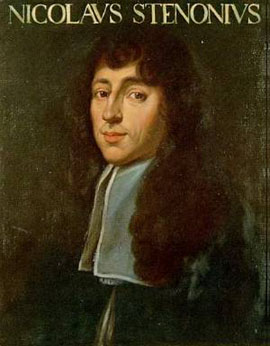
Died This Day: Nicolaus Steno

Steno (a.k.a. Niels Steensen, or Stensen)(Jan. 10 – Nov. 26, 1686) was a Danish geologist and anatomist who first made unprecedented discoveries in anatomy, then established some of the most important principles of modern geology. He was Danish royal anatomist for 2 years.

Interested by the characteristics and origins of minerals, rocks, and fossils, he published in Prodromus (1669) the law of superposition (if a series of sedimentary rocks has not been overturned, upper layers are younger and lower layers are older) and the law of original horizontality (although strata may be found dipping steeply, they were initially deposited nearly horizontal.) link image

Saturday, November 24, 2012

Born This Day: Edwin Conklin

Conkin (Nov. 24, 1963 - Nov. 21, 1952) was an American biologist and embryologist. In 1905 he discovered that the contents of a tunicate's egg weren't uniform. Different parts of it were differently colored. When the mother egg began to divide, the new daughter cells that came from different colored areas became, as they split away, different types of tissue. The yellow stuff in the egg produced muscle cells, for instance, and the grayish stuff became the gut.

In addition to his work in embryology, he published a number of works on evolution. He estimated he made a thousand public lectures interpreting evolution to religious and lay groups. He was a leading critic of society's response to advanced technology. From Today in Science History

Published This Day: The Origin of The Species

From Today In Science History:

In 1859, The Origin of Species by Means of Natural Selection was published in England to great acclaim. In this groundbreaking book by British naturalist Charles Darwin, he argued that species are the result of a gradual biological evolution in which nature encourages, through natural selection, the propagation of those species best suited to their environments. This book is unquestionably one of the most influential in the history of science.

Died This Day: Richard Carlson

Carlson (April 29, 1912 – Nov. 24, 1977) starred as Dr. David Reid in the classic Creature From The Black Lagoon (1957). You know that he was the “good” scientist ‘cuz he got the girl, even though he let a cover story for Nature skulk back into the Lagoon.