Wednesday, October 01, 2008

Darwin's Barnacles

From Today In Science History:

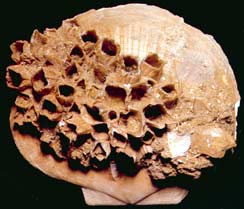
On this day in 1846, ten years after his voyage on the Beagle, Darwin began his study of barnacles, which was to appear in four volumes on living and fossil Cirripedes (barnacles).

For his observations, he had a single lens microscope made to his own design. Intended to be more practical, it did not fine focusing and had a larger stage than the Beagle microscope to take shallow dishes for aqueous dissections. image

Died This Day: Louis Leakey

Aug 7, 1903 – October 1, 1972.


Louis and Mary Leakey

From Today In Science History:

Leakey, an archaeologist and anthropologist, was born in Kabete, Kenya, of English missionaries parents. Leakey was largely responsible for convincing scientists that Africa, rather than Java or China, was the most significant area to search for evidence of human origins. Leakey led fossil-hunting expeditions to eastern Africa from the 1920's.

He married Mary D. Nicol in 1936 and the couple discovered many important fossils together. In 1964, on an expedition to the Olduvai Gorge in Tanzania, he found fossil remains of, he believed, the earliest member of the genus of human beings. He named the species Homo habilis.

Arctic Dinos on NOVA


From NOVA comes this e-mail blast about an upcoming show on Arctic Dinos. It sounds like it’ll focus on Tony Fiorillo’s work in Alaska.

From the PR blurb: “This Tuesday, October 7, we invite you to follow a unique field expedition, covered exclusively by NOVA, as it sets out for Alaska's North Slope to answer the intriguing question: how did dinosaurs survive in the gloom of the dark and frigid polar regions? Researchers combine extreme engineering and perilous fossil hunting--including blasting a deep tunnel into the permafrost to collect fossils trapped beneath the icy soil--to reveal provocative evidence as to how the polar dinosaurs lived and to their final extinction.”

Sunday, September 07, 2008

Gobi Update


Sorry for the lack of recent updates but access to the net is limited in the Gobi.

We’ve been in the Gobi for almost 3 weeks now, with time lost at the start for the usual field preparations and truck breakdowns en route, sandstorms, lack of roads, etc. The crew size has fluctuated around 40 and includes the researchers (12), the Mongolian support crew and a film crew from NBC Korea that is doing a documentary about this year’s expedition, and various other hangers on.

Our base camp is in a region known as Khermeen Tsav, a series of deep canyons with badland exposures from the Late Cretaceous. This is the region where we finished up at the end of the 2007 field season (we only spent 7 days here at that time). If you have access to Google Earth we are at approximately N 43’ 28. 289; E 99’ 49.587. To date the site has been productive with a number of important small lizard and mammal skulls, eggs, and various dinosaurs. A few days ago one of the U of Alberta students, Phil Bell, found a disarticulated Tarbosaurus skull on the edge of a cliff at we’ve started quarrying (see above photo). Yoshi Kobayashi has also found an articulated ankylosaur that is our second big quarry. We are also collecting an ankylosaur monolith abandoned by the Russians almost 30 years ago. The Russians tended to collect their articulated skeletons by digging a trench all the way around it, building a box around the specimen, and then filing the box with plaster. Collecting these ‘monoliths’ was not a problem because they also brought bulldozers with them.

We’ve also done a number of short term remote camps, including trips to Bugeen Tsav that produced several turtle bone beds (‘ponds’), and the Nemegt Basin. We’ve had several days of rain and cold weather (~0C at night at Nemegt), but, generally it’d been hot and dry. The current plans are to be back in Ulannbaatar around Sept. 24th and I should be back in NA sometime about Oct 3.

More when I get back.

Friday, September 05, 2008

Born This Day: Raquel Welch


The cinema's best known cave woman!

[a palaeoblog autopost]

Monday, September 01, 2008

Saturday, August 09, 2008

SVP 2008 Cleveland, Ohio


Before I hit the road again here's a sneak peak at the colour version of this year's SVP logo that will appear on the t-shirts for sale at the conference. Both the logo and the colour art are by Bill Stout.

The Society of Vertebrate Paleontology has all the info on the conference.

See you soon!

Hypacrosaurus Growth Rates

Relative growth rates of predator and prey dinosaurs reflect effects of predation. 2008. L. Cooper et al. Proc. Royal Soc. B. Published on-line August 05, 2008.

From the press release:

With long limbs and a soft body, the duck-billed hadrosaur had few defenses against predators such as tyrannosaurs. But new research on the bones of this plant-eating dinosaur suggests that it had at least one advantage: It grew to adulthood much faster than its predators, giving it superiority in size.

Scientists compared growth rate data from the hadrosaur, Hypacrosaurus, to three predators: the tyrannosaurs Albertosaurus and its gigantic relative Tyrannosaurus rex, as well as the small Velociraptor-like Troodon.

The research suggests that it took 10 to 12 years for Hypacrosaurus to become fully grown. Tyrannosaurs, however, reached adulthood after 20 to 30 years, said Drew Lee.
"Our duck-billed dinosaur grew three to five times faster than any potential predators that lived alongside it," Lee said. "By the time the duck-billed dinosaur was fully grown, the tyrannosaurs were only half grown – it was a huge size difference."

Hypacrosaurus also reached sexual maturity early, at only two or three years of age, Cooper said.

"That's another added bonus when facing predators – if you can keep reproducing, you're set," she said. "It's the stuff of evolution."

Cooper conducted the original analysis of the hadrosaur while an undergraduate student at Montana State University. Working with scientists Jack Horner and Mark Taper, Cooper looked at thin sections of the long leg bones of a specimen of Hypacrosaurus and counted and measured the growth rings, which each represent one year of life.

"We were shocked at how fast they grew. If you look at a cross section of the bone of a nestling or even from within the egg, there are huge spaces in which blood supply was going through the bone, which means they were growing like crazy," she said.

Wednesday, August 06, 2008

SADRG Update 3

We finished off our month in southern Alberta and had - once again - great success. Many thanks to everyone who helped out! We collected two hadrosaurs, lots of juvenile hadrossaur material from a bone bed, a couple of pachycephalosaur skull caps, plus tons of other stuff, and found some excellent prospects for next year.

I`ve got a limited amount of time before I head over to Mongolia, but I wanted to post a few photos before I left.


A crew works the `Foremost Hadrosaur`.


David Evans pedestals the Foremost Hadrosaur


Another view of the spectacular Milk River badlands.


Fording the river to get to the 4most hadrosaur.


The field crew at the end of week 3.

Back row (L to R): Nick Campione (UofT), David Evans (ROM-UofT), Me (CMNH), Ian Morrison (ROM), Derek Larson (UofA), Jaime Boyle (CASE), Ryan Schott (UofT), Calib Brown(UofC), Nick Longrich(UofC), Cecil Nesmo.

Front row (L to R): Wendy Sloboda, Bregita Petro (UofT), Evan Scott (CASE), Vern (The Crocodile Man) Lewis (UofT), Robin Sissons (UofA), Mike Densmore (Harvard), and Ace Tech David Lloyd (RTMP; who took all these photos!).

Other folks who joined us over the 4 weeks included Dave Eberth (RTMP), Jill Gallimore (UofT), Tristan Birkemeier (Wyo Dino Ctr), plus a few that I`m sure I`ve forgotten.


The `dump`hadrosaur ready to flip. This duck-bill was 1st shown to Wann Langston, Jr., sometime in the early 60`s. The ROM`s Ian Morrison was in charge of this quarry.


The block flipped beautifully thanks to help from Kevin Kruger and Wendy`s husband, Keith. Unfortunately, the winches on their trucks could not handle the 4-5 ton block.


Our hero! Fortunately a rigging crew in the area lent us a hand and pulled the block up to praire level for us.


One of the rig crew helps oversee the pull.


Helping the block along. That`s Kevin K. in the foreground.


The block ready to be transported.
Monday, July 28, 2008

Died This Day: Francis Crick

June 8, 1916 – July 28, 2004

From Today In Science History:

Crick was a British biophysicist, who, with James Watson and Maurice Wilkins, received the 1962 Nobel Prize for Physiology or Medicine for their determination of the molecular structure of deoxyribonucleic acid (DNA), the chemical substance ultimately responsible for hereditary control of life functions.


Crick and Watson began their collaboration in 1951, and published their paper on the double helix structure on April 2, 1953 in Nature. This accomplishment became a cornerstone of genetics and was widely regarded as one of the most important discoveries of 20th-century biology.
[ a palaeoblog autopost]

Tuesday, July 22, 2008

Born This Day: Gregor Mendel

July 22, 1822 – Jan. 6, 1884

From Today In Science History:

Mendel was an Austrian pioneer in the study of heredity. He spent his adult life with the Augustinian monastery in Brunn, where as a geneticist,
botanist and plant experimenter, he was the first to lay the mathematical foundation of the science of genetics, in what came to be called Mendelism.

Over the period 1856-63, Mendel grew and analyzed over 28,000 pea plants. He carefully studied for each their plant height, pod shape, pod color, flower position, seed color, seed shape and flower color. He made two very important generalizations from his pea experiments, known today as the Laws of Heredity. Mendel coined the present day terms in genetics: recessiveness and dominance.

[ a palaeoblog autopost]

Sunday, July 20, 2008

Born This Day: Sir Richard Owen

July 20, 1804 – Dec. 18, 1892

From Today In Science History:

Owen was an English anatomist and paleontologist who is remembered for his contributions to the study of fossil animals and for his strong opposition to the views of Charles Darwin.

He coined the word "Dinosaur" meaning "terrible reptile" (1842). Owen synthesized French anatomical work, especially from Cuvier and Geoffroy, with German transcendental anatomy. He gave us many of the terms still used today in anatomy and evolutionary biology, including "homology". In 1856, he was appointed Superintendent of the British Museum (Natural History).

[ a palaeoblog autopost]

Monday, July 14, 2008

Born This Day: Florence Bascom


July 14, 1862 – June 18, 1945

From Today In Science History:
Bascom was an American geologist and teacher. She was the first woman to receive a doctorate from Johns Hopkins University. Two years later she launched the geology department at Bryn Mawr. Bascom was the first woman to work as a geologist for the U.S. Geological Survey and to be made a fellow of the Geological Society of America. Bascom was an expert in crystallography, mineralogy, and petrography. She is known for inventing techniques that used microscopic analysis in the study of the oil-bearing rocks.
[ a palaeoblog autopost]

Friday, July 11, 2008

SADRG Update #2

A few more photos from the Southern Alberta Dinosaur Research Group:


Swimming in the Milk River after a hard day in "Club Med Bone Bed".


David Eberth (background) collects a bentonite for dating from above one of the newly discovered ceratopsian bone beds in the Oldman Formation. David Evans (ROM) is in the foreground.

A few of the students working with us:


Robin Sessons, U of Alberta grad student.


Caleb Brown, U of Calgary grad student.


Derek Larsons, U of Alberta grad student.


Plus, David Lloyd, RTMP technician.

Monday, July 07, 2008

Died This Day: Sir Arthur Conan Doyle

May 22, 1859 – July 7, 1930

From HERE:

Sir Arthur Conan Doyle was a British writer and creator of Sherlock Holmes. He was born in Edinburgh. His father and uncle were both book illustrators and his mother encouraged his son to explore the world of books. Doyle studied at Edinburgh University and in 1884 he married Louise Hawkins. Doyle qualified as doctor in 1885 and practiced medicine as an eye specialist in Hampshire until 1891 when he became a full time writer. Doyle's first novel about Sherlock Holmes,’ A Study in Scarlet’, was published in 1887.

During the South African war (1899-1902) Doyle served for a few months as senior physician at a field hospital, and wrote ‘The War in South Africa’, in which he defended England's policy. When his son Kingsley died from wounds incurred in World War I, the author dedicated himself in spiritualistic studies.


Doyle's stories of Professor George Edward Challenger in ‘The Lost World’ (1912). The model for the professor was William Rutherford, Doyle's teacher from Edinburgh. Doyle's practice, and other experiences, expeditions as ship's surgeon to the Arctic and West Coast of Africa, service in the Boer War, defenses of George Edalji and Oscar Slater, two men wrongly imprisoned, provided much material for his writings.

The Lost World:


[ a palaeoblog autopost]

Sunday, July 06, 2008

SADRG Update #1

The Southern Alberta Dinosaur Research Group is just finishing off the first of four weeks in southern Alberta working in the badlands adjacent to the Milk and Oldman rivers. Dr. Michael Ryan (your palaeoblogger) from the Cleveland Museum of Natural Museum and Dr. David Evans from the Royal Ontario Museum have a crew of about 15 people per week working on a series of projects including the collection of two potentially new duck-billed dinosaurs, and the on-going excavation of a juvenile duck-billed dinosaur bone bed from the Belly River Group and earlier sediments. The crews are made up of collaborators such as Dr. Nick Longrich from the U of Calgary; technician Ian Morrison, undergrad and grad students from the U of Toronto; Technician David Lloyd from the Royal Tyrrell Museum; grad students from U of Calgary and Alberta; with undergrad students from Case Western Reserve U. to arrive later this month (I’m sure that I’ve forgetting someone).

It’s been a busy week and I’ve not taken many photos but here’s a short selection:


The rattler that greeted us as we set up camp.


The red arrow points to the first hadrosaur quarry that we opened this week. Here the crew is removing overburden.


More overburden removal in the same quarry. The specimen is the brown bone exposed in the sandstone under the hard capstone. The specimen was originally reported to Wann Langston, Jr., in 1960.


David Evans takes a break in the quarry.


Ian Morrison (white cap) does the impossible by fixing a broken jackhammer starter spring with a multitool. A week of jack hammering was required to take off the capstone.


U of T undergrad, Jill Gallimore, rocks out in the quarry


A double rainbow seen from camp after a recent evening thunderstorm.

Saturday, July 05, 2008

Born This Day: Ernst Mayr


Any student of biology, or anyone with an interest in the natural world, will be familiar with Ernst Mayr who passed away on February 3rd in Bedford, Mass. Born in Kempton, Germany he joined the American Museum of Natural History as a curator in 1931. In 1953 he left the museum to work at Harvard University where he stayed until his retirement in 1975.

While working on the problem of speciation in the birds of New Guinea, Mayr realized that the multitude of species and and subspecies that he saw could best be explained as being a snapshot of evolution in action. He suggested that new species could arise when the range of one species was fractured long enough for members in different parts of the range to evolve characters that would not allow individuals to reproduce when they were brought back together again. This lead to him developing the “biological species concept” in which species are defined as populations of interbreeding organisms rather than just a collection of characters. This idea, along with his theory of “allopatric speciation” was published in his book “Systematics and the Origin of the Species” (1942) and later contributed to the “Punctuated Equilibrium” theory of Niles Eldredge and Stephen Jay Gould.

Ernst Mayr was himself inspired by the work of geneticist Theodosius Dobzhansky on the fruit fly Drosophila melanogaster and his book “Genetics and the Origin of the Species” (1937). These two men, together with the paleontologist George Gaylord Simpson, combined the sciences of genetics, zoology and paleontology into what is now known as “the new synthesis” that provides the modern experimental underpinning to the concepts that Charles Darwin presented in his book, “On the Origin of the Species” .

For anyone interested in learning more about modern evolutionary theory I’d recommend Mayr’s recent book “What Evolution Is” (2002). It’s written in an engaging and readable format from the perspective of someone who’s thought about evolution all his life.

[ a palaeoblog autopost]

Sunday, June 29, 2008

Died This Day: Thomas Huxley

May 4, 1825 - June 29, 1895

From the UC Berkeley Page:

Huxley was born in Ealing, near London, the seventh of eight children in a family that was none too affluent. At 21, Huxley signed on as assistant surgeon on the H.M.S. Rattlesnake, a Royal Navy frigate assigned to chart the seas around Australia and New Guinea. Huxley collected and studied marine invertebrates, in particular cnidarians, tunicates, and cephalopod mollusks. After leaving the Navy in 1854, Huxley managed to secure a lectureship at the School of Mines in London.

Huxley was a passionate defender of Darwin's theory -- so passionate that he has been called "Darwin's Bulldog" – and also a great biologist in his own right, who did original research in zoology and paleontology.

He is best known for his famous debate in June 1860, at the British Association meeting at Oxford. His opponent, Archbishop Samuel Wilberforce, was not-so-affectionately known as "Soapy Sam" for his renowned slipperiness in debate. During the debate, Archbishop Wilberforce ridiculed evolution and asked Huxley whether he was descended from an ape on his grandmother's side or his grandfather's. Accounts vary as to exactly what happened next, but according to one telling of the story, Huxley muttered "The Lord hath delivered him into my hands," and then rose to give a brilliant defense of Darwin's theory, concluding with the rejoinder, "I would rather be the offspring of two apes than be a man and afraid to face the truth."

All accounts agree that Huxley trounced Wilberforce in the debate, defending evolution as the best explanation yet advanced for species diversity.

However, Huxley did not blindly follow Darwin's theory, and critiqued it even as he was defending it. In particular, where Darwin had seen evolution and a slow, gradual, continuous process, Huxley thought that an evolving lineage might make rapid jumps, or saltations. As he wrote to Darwin just before publication of the Origin of Species, "You have loaded yourself with an unnecessary difficulty in adopting Natura non facit saltum [Nature does not make leaps] so unreservedly."


Huxley's most famous writing, published in 1863, is Evidence on Man's Place in Nature. This book, published only five years after Darwin's Origin of Species, was a comprehensive review of what was known at the time about primate and human paleontology and ethology. More than that, it was the first attempt to apply evolution explicitly to the human race. Huxley explicitly presented evidence for human evolution.

Huxley founded a remarkable dynasty of English scientists and thinkers. His son Leonard was a noted biographer and "man of letters." Leonard's oldest son Julian was one of the authors of the evolutionary synthesis of the early 20th century; Julian's son Francis became a noted anthropologist. Julian's brother Aldous Huxley was a novelist, screenwriter and essayist; his best-known book is the anti-utopia Brave New World.

[ a palaeoblog autopost]

Happy Birthday to Ray Harryhausen


Visit Ray's official site.

[a palaeoblog autopost]

Friday, June 27, 2008

Drumheller IGA T. rex Is Back


The newly repainted T. rex has reappeared on the IGA here in Drumheller.

I'm finishing up my week here at the RTMP editing the 'Horned Dino' book, and will be off shortly to southern Alberta with a big crew for the month of July.