Someday I’m going to write a very short book with that title.
But if you go to Prehistoric Forest in MarbleHead, OH, these are just some of the critters you’ll see. These photos are from HERE, which is just part of the ’Roadside Dinosaur’ page at the Roadside Architecture web page.
Here’s a great shot of two dinosaurs at the Calgary Zoo.
Monday, April 30, 2007
Me On The Radio
A couple of months ago I was interviewed by Robyn Williams, the host of The Australian Broadcasting Corporation's 'The Science Show.' The interview was done through the CBC’s ‘Quirks & Quarks’ radio show where host Bob MacDonald interviewed Australian scientists and Robyn interviewed Canadians. The Canadian version of the show was broadcast last weekend but I forgot about it.
Fortunately the CBC archives ‘Q&Q’ so you can listen to it HERE. Scroll down to the section on my interview and listen to it in your favourite format.
Sunday, April 29, 2007
Pterosaurs & Cope's Rule
Cope's Rule in the Pterosauria, and differing perceptions of Cope's Rule at different taxonomic levels. 2007 D. W. E. HONE, M. J. BENTON. Journal of Evolutionary Biology 20: 1164–1170.
Abstract: The remarkable extinct flying reptiles, the pterosaurs, show increasing body size over 100 million years of the Late Jurassic and Cretaceous, and this seems to be a rare example of a driven trend to large size (Cope's Rule). The size increases continue throughout the long time span, and small forms disappear as larger pterosaurs evolve. Mean wingspan increases through time.
Examining for Cope's Rule at a variety of taxonomic levels reveals varying trends within the Pterosauria as a whole, as pterodactyloid pterosaurs increase in size at all levels of examination, but rhamphorhynchoid pterosaurs show both size increase and size decrease in different analyses. These results suggest that analyses testing for Cope's Rule at a single taxonomic level may give misleading results.
Abstract: The remarkable extinct flying reptiles, the pterosaurs, show increasing body size over 100 million years of the Late Jurassic and Cretaceous, and this seems to be a rare example of a driven trend to large size (Cope's Rule). The size increases continue throughout the long time span, and small forms disappear as larger pterosaurs evolve. Mean wingspan increases through time.
Examining for Cope's Rule at a variety of taxonomic levels reveals varying trends within the Pterosauria as a whole, as pterodactyloid pterosaurs increase in size at all levels of examination, but rhamphorhynchoid pterosaurs show both size increase and size decrease in different analyses. These results suggest that analyses testing for Cope's Rule at a single taxonomic level may give misleading results.
Friday, April 27, 2007
Dino Skin Found In Japan
From Mainichi Daily News:
The 120-million-year-old fossilized skin traces, which show round and polygonal scales measuring between 3 and 5 mm in diameter, was found in the Kitatanicho district of Katsuyama.
Fukui Prefectural Dinosaur Museum Deputy Director Yoichi Azuma hailed the discovery. "We've had to rely on overseas
data for reproducing dinosaur skin, but now domestic data is available. There is a possibility that clearer fossils of dinosaur skin traces will be found in the same area," said Azuma.
Experts believe the skin comes from the leg of a herbivorous dinosaur, judging by the shape, but say it's difficult to identify its species without any fossilized skeletal remains.
The 120-million-year-old fossilized skin traces, which show round and polygonal scales measuring between 3 and 5 mm in diameter, was found in the Kitatanicho district of Katsuyama.
Fukui Prefectural Dinosaur Museum Deputy Director Yoichi Azuma hailed the discovery. "We've had to rely on overseas
data for reproducing dinosaur skin, but now domestic data is available. There is a possibility that clearer fossils of dinosaur skin traces will be found in the same area," said Azuma.Experts believe the skin comes from the leg of a herbivorous dinosaur, judging by the shape, but say it's difficult to identify its species without any fossilized skeletal remains.
World's Oldest T.rex?
Evidence of a giant tyrannosaurid (Dinosauria: Theropoda) from the Upper Cretaceous (?Campanian) of Montana. 2007. M.A. Urban and M.C. Lamanna. Annals of Carnegie Museum 75: 231-235.
Right lacrimal of ?Tyrannosaurus sp., (CM 9401), in lateral (A) and (B) medial views. [figure modified from Hurum and Sabath 2003]Michael and Matt report on an isolated right lacrimal from a tyrannosaurid, probably from the upper Campanian, Judith River Fm., Fergus County, Montana that was previously associated with the holotype of the giant crocodylian Deinosuchus rugosus. Its size and shape make it comparable and tentatively referable to T. rex. If correctly assigned it’s the oldest-known NA record of a Tyrannosaurus-sized tyrannosaurid, and possibly the oldest occurrence of the genus.
Thursday, April 26, 2007
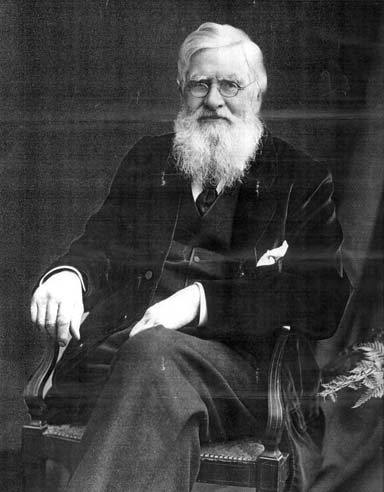
On This Day: Alfred Wallace Set Sail
From Today In Science History:
“In 1848, Welsh botanist Alfred Russell Wallace and Henry Walter Bates sailed from Liverpool for the Amazon. Their expeditions yielded insights into natural history and evolution for the both of them.
Wallace left earlier and collected in the Malay Archipelago. Wallace independently reached the same conclusions as Darwin regarding natural selection and wrote a paper read to the Linnaen Society on 1st July 1858.
Bates spent 11 years in Amazonia amassing large collections of insects that were sent back to museums and collectors in Europe. Bates was quick to embrace Darwin's and Wallace's theory of evolution by natural selection. Bates' own theory, Batesian mimicry, provided evidence for evolution by natural selection.”
Wednesday, April 25, 2007
High Arctic Champsosaurs
A fossil champsosaur population from the high Arctic: Implications for Late Cretaceous paleotemperatures. 2007. D. Vandermark, J. A. Tarduno, and D. B. Brinkman. Palaeogeography, Palaeoclimatology, Palaeoecology 248: 49-59.
Abstract: During the Late Cretaceous, Axel Heiberg Island of the high Canadian Arctic supported a sizable population of champsosaurs, a basal archosauromorph, amongst a community including turtles and a variety of freshwater fishes. Here we report that a large portion of the available champsosaur fossil assemblage is comprised of elements from subadults.
This dominance of subadults is similar to that seen from low latitude sites and suggests that the champsosaur population was a well-established facet of the ecological community. Because of the sensitivity of juveniles to ice formation, the make-up of the Arctic champsosaur population further indicates that the Late Cretaceous (Coniacian–Turonian) saw an interval of extreme warmth and low seasonality.
The Coniacian–Turonian date makes these choristoderes amongst the earliest in North America, apart from the Jurassic Cteniogenys and a single limb bone from the mid-Cretaceous.
Abstract: During the Late Cretaceous, Axel Heiberg Island of the high Canadian Arctic supported a sizable population of champsosaurs, a basal archosauromorph, amongst a community including turtles and a variety of freshwater fishes. Here we report that a large portion of the available champsosaur fossil assemblage is comprised of elements from subadults.
This dominance of subadults is similar to that seen from low latitude sites and suggests that the champsosaur population was a well-established facet of the ecological community. Because of the sensitivity of juveniles to ice formation, the make-up of the Arctic champsosaur population further indicates that the Late Cretaceous (Coniacian–Turonian) saw an interval of extreme warmth and low seasonality.
The Coniacian–Turonian date makes these choristoderes amongst the earliest in North America, apart from the Jurassic Cteniogenys and a single limb bone from the mid-Cretaceous.
Tuesday, April 24, 2007
Mass Extinctions Caused by Cosmic Radiation?
Cosmic rays produced at the edge of our galaxy have devastated life on Earth every 62 million years.

"Those terrible cosmic rays!" Is there nothing they can't do?
The researchers discovered that high rates of extinction in the cycle coincide almost perfectly with periodic "excursions" of the solar system outside the central plane of the Milky Way galaxy.
At regular intervals, the system's wanderings take it up and down through the thin central portion of the disk. The sun reaches its farthest distance from the central plane every 62 million years.
During these periods, which include some of the largest mass extinctions known from the fossil record, Earth is bombarded with high levels of cosmic radiation.
Mikhail Medvedev and Adrian Melott, both of the University of Kansas, presented their new theory at a meeting of the American Physical Society earlier this month.
Monday, April 23, 2007
Prototaxites the 'Humongous fungus'
Devonian landscape heterogeneity recorded by a giant fungus. 2007. C. K. Boyce, et al. Geology 35: 399–402.
From the press release:
New evidence has resolved the mysterious identity of one of the weirdest organisms that ever lived. Prototaxites has generated controversy for more than a century. Originally classified as a conifer, scientists later argued that it was instead a lichen, various types of algae or a fungus. Whatever it was, it stood in tree-like trunks more than 20 feet tall, making it the largest-known organism on land in its day.
The organism is a fungus.
Prototaxites lived worldwide from approximately 420 million to 350 million years ago. During this period, which spans part of the Silurian and Devonian periods of geologic time, terrestrial Earth looked quite alien in comparison to the modern world.
Simple vascular plants, the ancestors of the familiar conifers, ferns and flowering plants of today, began to diversify on land during the Devonian Period. "Initially, they’re just stems. They don’t have roots. They don’t have leaves. They don’t have anything like that," Boyce said.
Millipedes, wingless insects and worms were among the other organisms making a living on land by then, but no backboned animals had yet evolved out of the oceans.
Canadian paleontologist Charles Dawson published the first research on Prototaxites in 1859, based on specimens found along the shores of Gaspé Bay in Quebec, Canada.
From the press release:
New evidence has resolved the mysterious identity of one of the weirdest organisms that ever lived. Prototaxites has generated controversy for more than a century. Originally classified as a conifer, scientists later argued that it was instead a lichen, various types of algae or a fungus. Whatever it was, it stood in tree-like trunks more than 20 feet tall, making it the largest-known organism on land in its day.
The organism is a fungus.
Prototaxites lived worldwide from approximately 420 million to 350 million years ago. During this period, which spans part of the Silurian and Devonian periods of geologic time, terrestrial Earth looked quite alien in comparison to the modern world.
Simple vascular plants, the ancestors of the familiar conifers, ferns and flowering plants of today, began to diversify on land during the Devonian Period. "Initially, they’re just stems. They don’t have roots. They don’t have leaves. They don’t have anything like that," Boyce said.
Millipedes, wingless insects and worms were among the other organisms making a living on land by then, but no backboned animals had yet evolved out of the oceans.
Canadian paleontologist Charles Dawson published the first research on Prototaxites in 1859, based on specimens found along the shores of Gaspé Bay in Quebec, Canada.
Earth's First Rainforest
Ecological gradients within a Pennsylvanian mire forest. 2007. W. A. DiMichele, et al. Geology 35: 415–418.

The 300 million year old forest discovered in the underground workings of a coalmine in Illinois is composed of a bizarre mixture of extinct plants: abundant club mosses, more than 40 metres high, towering over a sub-canopy of tree ferns, intermixed with shrubs and tree-sized horsetails. Nowhere elsewhere on the planet is it possible to (literally) walk through such an extensive swathe of Carboniferous rainforest.
The fossil forest is the largest ever found, covering over 10,000 hectares, an area 10 km by 10 km. The fossils preserve a unique snapshot of what tropical rainforests were like 300 million year ago.
The fossils show that the Earth's first rainforests were highly diverse and that the kinds of tree species changed across the ancient landscape. The forest dates from the Carboniferous period, 300 million years ago, when most of the world's coal resources were formed.

Detail of a pteridosperm, an extinct seed-producing fern-like plant. Width across image about six centimeters. Photo: H. Falcon-LangFrom the press release:
The 300 million year old forest discovered in the underground workings of a coalmine in Illinois is composed of a bizarre mixture of extinct plants: abundant club mosses, more than 40 metres high, towering over a sub-canopy of tree ferns, intermixed with shrubs and tree-sized horsetails. Nowhere elsewhere on the planet is it possible to (literally) walk through such an extensive swathe of Carboniferous rainforest.
The fossil forest is the largest ever found, covering over 10,000 hectares, an area 10 km by 10 km. The fossils preserve a unique snapshot of what tropical rainforests were like 300 million year ago.
The fossils show that the Earth's first rainforests were highly diverse and that the kinds of tree species changed across the ancient landscape. The forest dates from the Carboniferous period, 300 million years ago, when most of the world's coal resources were formed.
Sunday, April 22, 2007
Mark Schulz & His "Usual Suspects"
In addition to his next “"Various Drawings"(Vol. 3) art collection coming out this summer, Mark Schultz will also be part of the TwoMorrows “Modern Masters” series. Each book provides a well-illustrated overview of an artist's career to date and an in-depth interview. Mark recently sent me this cover prelim for the ‘MM’ book and graciously said that I could post it here.
Nice to see that our “SubHuman” heroine, Krill Stromer, makes a cameo appearance with Jack, Hannah and Conan(!).
Friday, April 20, 2007
The Art of Heinrich Harder
Check out The Wonderful Paleo Art of Heinrich Harder. (1858-1935):


Thanks to the Incoming Signals blog.


Thanks to the Incoming Signals blog.
Born This Day: Willi Henning
April 20, 1913 – Nov. 5, 1976
From the Willi Hennig Society :
Hennig is best known for
developing phylogenetic systematics, a coherent theory of the investigation and presentation of the relations that exist among species. Contrary to the position generally held during his time, Hennig viewed historical inference as a strictly logical and scientific endeavor. He first summarized his ideas in 1950 in German which became more widely known with the publication of the English revision, Phylogenetic Systematics (Hennig, 1966).

image.
Major Hennigian principles are:
From the Willi Hennig Society :
Hennig is best known for
developing phylogenetic systematics, a coherent theory of the investigation and presentation of the relations that exist among species. Contrary to the position generally held during his time, Hennig viewed historical inference as a strictly logical and scientific endeavor. He first summarized his ideas in 1950 in German which became more widely known with the publication of the English revision, Phylogenetic Systematics (Hennig, 1966).
image.
Major Hennigian principles are:
1. Relationships among species are to be interpreted strictly genealogically, as sister-lineages, as clade relations. Empirically, a phylogenetic hypothesis may be determined.More info about Henning HERE. photo.
2. Synapomorphies provide the only evidence for identifying relative recency of common ancestry. Synapomorphies are understood to be the shared-derived (evolved, modified) features of organisms.
3. Maximum conformity to evidence is sought (his auxiliary principle). Choice among competing cladistic propositions (cladograms) is decided on the basis of the greatest amount of evidence, the largest number of synapomorphies explainable as homologues.
4. Whenever possible, taxonomy must be logically consistent with the inferred pattern of historical relationships. The rule of monophyly is to be followed, thereby each clade can have its unique place in the hierarchy of taxonomic names.
Born This Day: Sir William Logan
April 20, 1798 – June 22, 1875
From Today in Science History:
Logan was a Canadian geologist dubbed the "Father of Canadian Geology."
He began is career making geologic maps of coalfields in Wales, noting the relationship between the underlying clay layers and fossil tree roots with local coal beds. This substantiated the theory that coal beds are formed in place.
When he began as director (1842-69) of the new Geological Survey of Canada, its geology was virtually unknown. He produced the monumental Report on the Geology of Canada (1863) which recorded 20 years of research, fieldwork, plotting maps, preparing reports, and examining fossil and mineral specimens.
Image and more info from Natural Resources Canada. For a more colourful summary of the man and his life go HERE.
From Today in Science History:
Logan was a Canadian geologist dubbed the "Father of Canadian Geology."
He began is career making geologic maps of coalfields in Wales, noting the relationship between the underlying clay layers and fossil tree roots with local coal beds. This substantiated the theory that coal beds are formed in place.When he began as director (1842-69) of the new Geological Survey of Canada, its geology was virtually unknown. He produced the monumental Report on the Geology of Canada (1863) which recorded 20 years of research, fieldwork, plotting maps, preparing reports, and examining fossil and mineral specimens.
Image and more info from Natural Resources Canada. For a more colourful summary of the man and his life go HERE.
Thursday, April 19, 2007
Surfing To Mongolia

I recently came across this photo that Philip Currie took of us at the Flaming Cliffs last summer. If you’d like to be part of our team this year you can sign up for the two week field program at the CMNH programs page HERE; scroll down to “Dinosaurs in the Gobi desert”.
Reconciling The Divergence of Placental Mammals
Robust Time Estimation Reconciles Views of the Antiquity of Placental Mammals. 2007. Kitazoe Y., et al., PLoS ONE 2(4): e384.
From the press release:
Despite great progress over the past decade, the evolutionary history of placental mammals remains controversial. While a consensus is emerging on the topology of the evolutionary tree, although with occasional disagreement, divergence times remain uncertain. Both paleontological and morphological studies suggest that the radiation of placental orders and super orders occurred close to the Cretaceous–Tertiary (K–T) boundary about 65 million years ago (mya). In contrast, molecular studies have suggested markedly older origins for many superordinal groups and that some extant orders diversified before the K–T boundary.
However, this discrepancy may not be real, but rather appear because of the violation of implicit assumptions in the estimation procedures, such as abrupt acceleration of evolutionary rate entangled with gradual variation and large-scale convergent evolution in molecular level.
Researchers have identified a strong and short-term acceleration of mitochondrial genome along the lineage leading to Laurasiatheria. The revised time at the root of placental mammals was much younger than the preceding reports, 84 million years ago instead of around 122 million years ago. As a result, the estimated distribution of molecular divergence times is broadly consistent with quantitative analysis of the North American fossil record and traditional morphological views. They emphasize the necessity to scrutinize the implicit assumptions adopted by the models of molecular evolution and to develop procedures which rely little on those assumptions.
From the press release:
Despite great progress over the past decade, the evolutionary history of placental mammals remains controversial. While a consensus is emerging on the topology of the evolutionary tree, although with occasional disagreement, divergence times remain uncertain. Both paleontological and morphological studies suggest that the radiation of placental orders and super orders occurred close to the Cretaceous–Tertiary (K–T) boundary about 65 million years ago (mya). In contrast, molecular studies have suggested markedly older origins for many superordinal groups and that some extant orders diversified before the K–T boundary.
However, this discrepancy may not be real, but rather appear because of the violation of implicit assumptions in the estimation procedures, such as abrupt acceleration of evolutionary rate entangled with gradual variation and large-scale convergent evolution in molecular level.
Researchers have identified a strong and short-term acceleration of mitochondrial genome along the lineage leading to Laurasiatheria. The revised time at the root of placental mammals was much younger than the preceding reports, 84 million years ago instead of around 122 million years ago. As a result, the estimated distribution of molecular divergence times is broadly consistent with quantitative analysis of the North American fossil record and traditional morphological views. They emphasize the necessity to scrutinize the implicit assumptions adopted by the models of molecular evolution and to develop procedures which rely little on those assumptions.
Figure: Molecular divergence times and evolutionary rates of placental mammals.A and B show the MVS-FIR and ML-FLOG trees, respectively. The numbers 1–61 denote the ancestral nodes. The red numbers 1–8 indicate the internal nodes with fossil constraints which are as follows: 1, 49–61; 2, 52–58; 3, 45–63; 4, 43–60; 5, <63;>12; 7, 36–55; 8, 54–65 (all in mya) [see 4], [15]. The colors of the branches denote inferred evolutionary rates (in units of ×10−9/site per year) as follows: black, <0.2;>0.7.
CT Scanning


When I was in Alberta last month Eric Snively and I had some CT scanning done at Canada Diagnostics in Calgary. Hopefully we'll have the research completed to present at SVP this year.
Yes, Eric was on crutches at that time.
Subscribe to:
Posts (Atom)