Saturday, November 24, 2012

Born This Day: Edwin Conklin

Conkin (Nov. 24, 1963 - Nov. 21, 1952) was an American biologist and embryologist. In 1905 he discovered that the contents of a tunicate's egg weren't uniform. Different parts of it were differently colored. When the mother egg began to divide, the new daughter cells that came from different colored areas became, as they split away, different types of tissue. The yellow stuff in the egg produced muscle cells, for instance, and the grayish stuff became the gut.

In addition to his work in embryology, he published a number of works on evolution. He estimated he made a thousand public lectures interpreting evolution to religious and lay groups. He was a leading critic of society's response to advanced technology. From Today in Science History

Published This Day: The Origin of The Species

From Today In Science History:

In 1859, The Origin of Species by Means of Natural Selection was published in England to great acclaim. In this groundbreaking book by British naturalist Charles Darwin, he argued that species are the result of a gradual biological evolution in which nature encourages, through natural selection, the propagation of those species best suited to their environments. This book is unquestionably one of the most influential in the history of science.

Died This Day: Richard Carlson

Carlson (April 29, 1912 – Nov. 24, 1977) starred as Dr. David Reid in the classic Creature From The Black Lagoon (1957). You know that he was the “good” scientist ‘cuz he got the girl, even though he let a cover story for Nature skulk back into the Lagoon.

Thursday, November 22, 2012

Born This Day: Skull Island Witch Doctor

Steve Clemente (born Esteban Clemento Morro Nov. 22, 1885—May 7, 1950) was a Mexican actor known for his many villainous roles. He began acting in his teens, signing up for his first movie, The Secret Man, in 1917. His later, numerous roles were usually bit parts and he was an expert knife thrower.

He was a known scene stealer and was famous for his villainous snarl. He later starred in such movies as The Most Dangerous Game (1932), playing Tartar, the second henchman of Count Zarrof and played the Witch King in King Kong (1933). From Wiki

Tuesday, November 20, 2012

Born This Day: Robert Armstrong

Armstrong (Nov. 20, 1890 – April 20, 1973) took Fay Wray to Skull Island in 1933. He returned later the same year to find The Son of Kong, only to lose him as the island sank, as these things are prone to doing.

Thursday, November 15, 2012

Farish Jenkins, RIP

The Boston Globe has a nice article about the late paleontologist, Farish Jenkins, who passed away earlier this year.

Tuesday, November 13, 2012

Fantasia Premieres (1940)


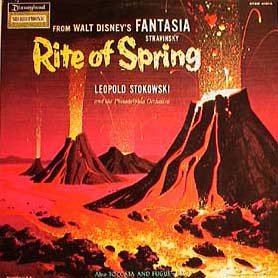
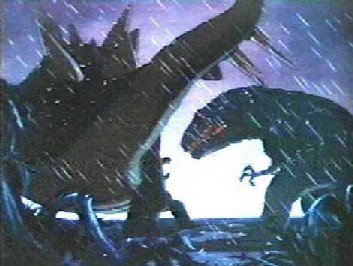
Walt Disney’s epic film, Fantasia, opened this day on Broadway in New York City in 1940. The film featured Leopold Stokowski and the Philadelphia Orchestra performing a number of pieces of classical music to the film’s animated visuals. Igor Stravinsky’s “Rite of Spring” provided the score for the evolution of the Earth including a wonderful sequence on the extinction of the dinosaurs at the end of the Cretaceous. Many school teachers actually showed this sequence in science class up through the 1970's as it was one of the most accurate animated depictions to that date.

Born This Day: Helen Mack


Nov 13, 1913 – August 13, 1986
Helen starred as Helene Peterson in “Son of Kong”, the quickie follow up to “King Kong”. Once again Carl Denham leads a beautiful girl into danger on Skull Island.

Monday, November 12, 2012

Born This Day: Julie Ege


Nov. 12, 1943 – April 29, 2008
The late Julie Ege had the lead role as Nala in the 1971 Hammer film, “Creatures The World Forgot”.

Saturday, November 10, 2012

Xenoceratops - A New Centrosaur From Alberta


Art © Mark Schultz, 2012
Abstract: Xenoceratops foremostensis gen. et. sp. nov., a new centrosaurine ceratopsid from the Foremost Formation (Campanian) of Alberta, is described based on frill material from at least three adult-sized individuals collected from a low-density bone bed. The material can be assigned to Centrosaurinae based on features of the preserved squamosal. Although the parietals are incomplete, the shape of the diagnostic parietal can be inferred from several overlapping serial elements. The parietal of the new taxon shares with all other centrosaurines, except Centrosaurus apertus, spike-like ornamentation at the posterolateral (P3) locus under traditional coding methods. At approximately 78 Ma, it is the oldest known Canadian ceratopsid, approximately 0.5 Ma older than Albertaceratops from the lower Oldman Formation of Canada and approximately 1.0 Ma younger than Diabloceratops from the Wahweap Formation of Utah. A phylogenetic analysis resolves the new taxon as the basalmost centrosaurine and places Centrosaurus brinkmani as the sister taxon to Styracosaurus albertensis. The type species of Centrosaurus brinkmani is moved to a new genus.

Watch David Evans explain it all on Canada Am.


Died This Day: Gideon Mantell

Mantell (Feb. 3, 1790 – Nov. 10, 1852), a physician of Lewes in Sussex in southern England, had for years been collecting fossils in the sandstone of Tilgate forest, and he had discovered bones belonging to three extinct species: a giant crocodile, a plesiosaur, and Buckland's Megalosaurus. But in 1822 he found several teeth that "possessed characters so remarkable" that they had to have come from a fourth and distinct species of Saurian. After consulting numerous experts, Mantell finally recognized that the teeth bore an uncanny resemblance to the teeth of the living iguana, except that they were twenty times larger.
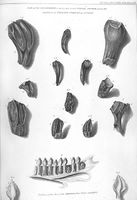
In this paper, the second published description of a dinosaur, he concluded that he had found the teeth of a giant lizard, which he named Iguanodon, or "Iguana-tooth."

Mantell illustrated his announcement with a single lithographed plate. Mantell included at the bottom of the plate a drawing of a recent iguana jaw, which is shown four times natural size, and for further comparison, he added views of the inner and outer surface of a single iguana tooth, "greatly magnified."

The traditional story that Mantell's wife found the first teeth in 1822, while the doctor was visiting a patient, appears, alas, to be unfounded.

Info and plate from HERE.

Monday, October 15, 2012

Premiered This Day: Unknown Island

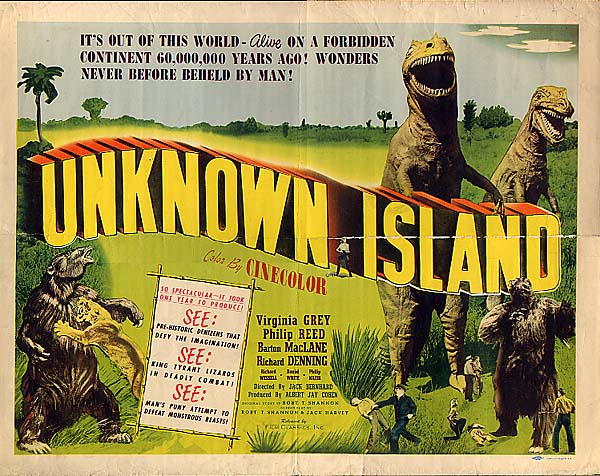
This 1948 film written by Robert T. Shannon and directed by Jack Bernhard features some of the worst ‘man dressed up as a T. rex’ effects ever. Not a bad little story though.

Sunday, October 14, 2012

Born This Day: Jack Arnold


Jack Arnold (Oct. 14, 1916 - March 17, 1992) directed a number of classic SF films including The Creature From the Black Lagoon, Revenge of the Creature, The Incredible Shrinking Man, and It Came From Outer Space, as well as few not-so-classics (but still much loved) such as Monster on Campus. Throughout the ‘60’s and into the early 80’s he had a successful career as a TV producer and director.

Monday, October 01, 2012

Died This Day: Louis Leakey


Louis and Mary Leakey

From Today In Science History:

Leakey (Aug 7, 1903 – October 1, 1972), an archaeologist and anthropologist, was born in Kabete, Kenya, of English missionaries parents. Leakey was largely responsible for convincing scientists that Africa, rather than Java or China, was the most significant area to search for evidence of human origins. Leakey led fossil-hunting expeditions to eastern Africa from the 1920's.

He married Mary D. Nicol in 1936 and the couple discovered many important fossils together. In 1964, on an expedition to the Olduvai Gorge in Tanzania, he found fossil remains of, he believed, the earliest member of the genus of human beings. He named the species Homo habilis.

Sunday, September 30, 2012

Debuted This Day (1960): The Flintstones


'Nuff Said!

Born This Day: Charles Lapworth

From Today In Science History:

Lapworth (Sept. 30, 1842 - March 13, 1920) was an English geologist who proposed what came to be called the Ordovician period (505 to 438 million years old) of geologic strata. Lapworth is famous for his work with marine fossils called graptolites.

By fastidiously collecting the tiny, colonial sea creatures, he figured out the original order of layered rocks that had been faulted and folded in England's Southern Uplands. This method of correlating rocks with graptolites became a model for similar research throughout the world.

In 1879, Lapworth proposed a new classification of Lower Paleozoic rocks with the Ordovician, between the redefined Cambrian and Silurian periods. The name comes from an ancient Welsh tribe, the Ordovices.

Friday, September 28, 2012

ROM Dino Comic

Did you know that the Royal Ontario Museum did a comic book to go with their excellent new dinosaur show, "Ultimate Dinosaurs"? And that it was illustrated by Gabriel Morrissette with colours by Bernie Mireault? Me either! Bernie kindly sent me this image:

And speaking of Bernie, he has a great new book out, "To Get Her" that you can buy HERE (I did!).

You may know Bernie from his terrific comic, The Jam, and well as being the creator of Dr. Robot (why is this not a TV series!).

Bernie also recently posted a thoughtful article about his experience at the En Masse table during the most recent Montreal Comic Con.

Saturday, August 11, 2012

Died This Day: Lorenz Oken

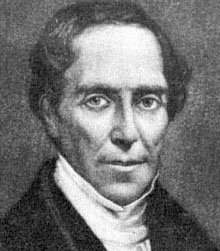
Lorenz Oken (Aug. 1, 1779 - Aug. 11, 1851) was a German naturalist who offered early evolutionary ideas and stimulated comparative anatomy. He theorized (incorrectly) that the skull was a modified vertebra, but formed some fundamental concepts which stimulated further thought from later scientists.

In Die Zeugung, he discussed “the infusoria”—elementary units of living organisms—into which all flesh can be broken down. Higher animals, he proposed, consisted of constituent animalcules. Entities, whether plants or animals, became organisms by the fusion of these primal animals. Those elements lose all individuality and create a higher unity. From Today In Science History

More here

Monday, July 30, 2012