Thursday, September 08, 2011

Wednesday, September 07, 2011
Born This Day: Ferdinand Vandiveer Hayden
From Today In Science History
Hayden (Sept. 7, 1829 - Dec. 22, 1887) was an American geologist and explorer of the U.S. West. After finishing a medical school training (1853), his early career began in paleontology for James Hall, collecting fossils in the Badlands and the Upper Missouri Valley. It is believed he made the first North American discovery of dinosaur remains (1854) during this expedition.
His work in the Great Plains and Rocky Mountains helped lay the foundation of the U.S. Geological Survey. Hayden is credited with having the Yellowstone geyser area declared the first national park (1872).
Image and more info on Hayden HERE.
Hayden (Sept. 7, 1829 - Dec. 22, 1887) was an American geologist and explorer of the U.S. West.
 After finishing a medical school training (1853), his early career began in paleontology for James Hall, collecting fossils in the Badlands and the Upper Missouri Valley. It is believed he made the first North American discovery of dinosaur remains (1854) during this expedition.
His work in the Great Plains and Rocky Mountains helped lay the foundation of the U.S. Geological Survey. Hayden is credited with having the Yellowstone geyser area declared the first national park (1872).
Image and more info on Hayden HERE.


Born This Day: Comte Georges-Louis Leclerc de Buffon
Buffon (Sept. 7, 1707 – April 16, 1788) was a French naturalist, who formulated a crude theory of evolution and was the first to suggest that the earth might 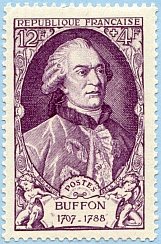 be older than suggested by the Bible.
In 1739 he was appointed keeper of the Jardin du Roi, a post he occupied until his death. There he worked on a comprehensive work on natural history, for which he is remembered, Histoire naturelle, générale et particulière. He began this work in 1749, and it dominated the rest of his life. It would eventually run to 44 volumes, including quadrupeds, birds, reptiles and minerals.
He proposed (1778) that the Earth was hot at its creation and, from the rate of cooling, calculated its age to be 75,000 years, with life emerging some 40,000 years ago.
From Today In Science History. Stamp from HERE.
More info on Buffon from UC-Berkeley.
 be older than suggested by the Bible.
In 1739 he was appointed keeper of the Jardin du Roi, a post he occupied until his death. There he worked on a comprehensive work on natural history, for which he is remembered, Histoire naturelle, générale et particulière. He began this work in 1749, and it dominated the rest of his life. It would eventually run to 44 volumes, including quadrupeds, birds, reptiles and minerals.
He proposed (1778) that the Earth was hot at its creation and, from the rate of cooling, calculated its age to be 75,000 years, with life emerging some 40,000 years ago.
From Today In Science History. Stamp from HERE.
More info on Buffon from UC-Berkeley.
Monday, September 05, 2011

Saturday, September 03, 2011

Thursday, September 01, 2011
Died This Day: Luis Alvarez
Alvarez (June 13, 1911 - Sept. 1, 1988) was an American experimental physicist who was awarded the Nobel Prize for Physics in 1968 for work that included the discovery of many resonance particles --subatomic particles having extremely short lifetimes and occurring only in high-energy nuclear collisions. 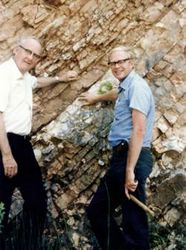
In about 1980 Alvarez (left) helped his son, the geologist Walter Alvarez (right), publicize Walter's discovery of a worldwide layer of clay that has a high iridium content and which occupies rock strata at the geochronological boundary between the Mesozoic and Cenozoic eras; i.e., about 66.4 million years ago.
They postulated that the iridium had been deposited following the impact on Earth of an asteroid or comet and that the catastrophic climatic effects of this massive impact caused the extinction of the dinosaurs. Though initially controversial, this widely publicized theory gradually gained support as the most plausible explanation of the abrupt demise of the dinosaurs.
Read more HERE. Image from HERE.
Wednesday, August 31, 2011
On This Day: Charles Darwin Finds His Advocate For Sailing On The Beagle
In 1831, Charles Darwin was visiting Maer Hall, home of his uncle Josiah Wedgwood II, whom he told of his father, Robert Darwin's, opposition to him joining a two-year voyage on H.M.S. Beagle. Charles was enthusiastic about the opportunity, but his father objected to it as a waste of time, delaying his expected career in the clergy, and would not give his permission. His father said, however, he could be swayed to change his opinion if Charles found a man with common sense who would regard the proposed trip as being worthwhile.
Charles found that man in his uncle Josiah, who wrote a letter answering all of the objections in his favour. Josiah was Robert's brother-in-law, and as a family member was successful in influencing him to change his mind. From Today In Science History

Charles found that man in his uncle Josiah, who wrote a letter answering all of the objections in his favour. Josiah was Robert's brother-in-law, and as a family member was successful in influencing him to change his mind. From Today In Science History
Monday, August 29, 2011
Died This Day: Julie Ege

Nov. 12, 1943 – April 29, 2008
Saturday, August 27, 2011
Premiered This Day (1979): Planet of Dinsosaurs!


Wednesday, August 17, 2011
Premiered This Day: The People That Time Forgot

Monday, August 15, 2011
Rapid Recycling of The Earth's Crust
A young source for the Hawaiian plume. 2011. A. V. Sobolev, et al. Nature, Published online Aug. 10.
Cave Carson © DC Comics
Rock of the oceanic crust, which sinks deep into the earth due to the movement of tectonic plates, reemerges through volcanic eruptions after around 500 million years. Previously, geologists thought this process would take about two billion years.

Some ocean islands, such as Hawaii, originate from the lowest part of the mantle as hot rock rises in cylindrical columns (mantle plumes), from a depth of nearly 3000 kilometres. Near the surface, it melts, because the pressure is reduced, and forms volcanoes. The plume originates from former ocean crust which early in the Earth's history sank to the bottom of the mantle. Previously, scientists had assumed that this recycling took about two billion years.

The chemical analysis of tiny glassy inclusions in olivine crystals from basaltic lava on Mauna Loa volcano in Hawaii has now surprised geologists: the entire recycling process requires at most half a billion years, four times faster than previously thought. link
The recycling of the Earth's crust in volcanoes happens much faster than scientists have previously assumed.

Cave Carson © DC Comics


Died This Day: William Buckland
From The Victorian Web:
Buckland (March 12, 1784 – August 15, 1856) was the first man to identify and name a dinosaur (Megalosaurus), although the name dinosaur had not yet been coined by Richard Owen. Partly in response to the controversial works of Cuvier, Buckland wrote Reliquiae Diluvianae (1823) in which he argued that the evidence of geology alone demonstrated that a great flood had covered the entire globe. This move helped to make geology look more respectable in a religiously conservative England and perhaps to advance Buckland's own career at Oxford by making geology appear to be a respectable companion to the classics.
Buckland was a bit of an eccentric, given to outlandish dress and behavior. Although Buckland was immensely influential as a scientist, his rakish reputation gave many of his staid early Victorian contemporaries considerable difficulty in accepting his work.
More info from HERE. Image from HERE
Buckland (March 12, 1784 – August 15, 1856) was the first man to identify and name a dinosaur (Megalosaurus), although the name dinosaur had not yet been coined by Richard Owen. Partly in response to the controversial works of Cuvier, Buckland wrote Reliquiae Diluvianae (1823) in which he argued that the evidence of geology alone demonstrated that a
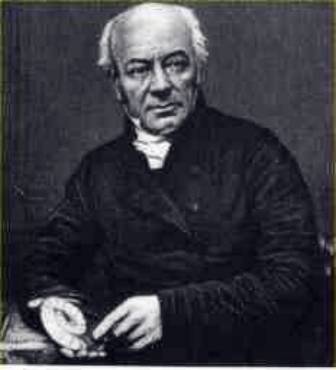 great flood had covered the entire globe. This move helped to make geology look more respectable in a religiously conservative England and perhaps to advance Buckland's own career at Oxford by making geology appear to be a respectable companion to the classics.
Buckland was a bit of an eccentric, given to outlandish dress and behavior. Although Buckland was immensely influential as a scientist, his rakish reputation gave many of his staid early Victorian contemporaries considerable difficulty in accepting his work.
More info from HERE. Image from HERE
Sunday, August 14, 2011
Tour The Age of Dinosaurs for 10 Cents!

Friday, July 22, 2011
Born This Day: Gregor Mendel
From Today In Science History:
Mendel (July 22, 1822 – Jan. 6, 1884) was an Austrian pioneer in the study of heredity. He spent his adult life with the Augustinian monastery in Brunn, where as a geneticist,
botanist and plant experimenter, he was the first to lay the mathematical foundation of the science of genetics, in what came to be called Mendelism.
Over the period 1856-63, Mendel grew and analyzed over 28,000 pea plants. He carefully studied for each their plant height, pod shape, pod color, flower position, seed color, seed shape and flower color. He made two very important generalizations from his pea experiments, known today as the Laws of Heredity. Mendel coined the present day terms in genetics: recessiveness and dominance.
Mendel (July 22, 1822 – Jan. 6, 1884) was an Austrian pioneer in the study of heredity. He spent his adult life with the Augustinian monastery in Brunn, where as a geneticist,

botanist and plant experimenter, he was the first to lay the mathematical foundation of the science of genetics, in what came to be called Mendelism.
Over the period 1856-63, Mendel grew and analyzed over 28,000 pea plants. He carefully studied for each their plant height, pod shape, pod color, flower position, seed color, seed shape and flower color. He made two very important generalizations from his pea experiments, known today as the Laws of Heredity. Mendel coined the present day terms in genetics: recessiveness and dominance.
Wednesday, July 20, 2011
Born This Day: Sir Richard Owen
From Today In Science History:
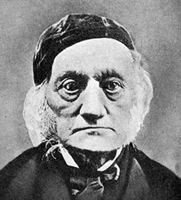 Owen (July 20, 1804 – Dec. 18, 1892) was an English anatomist and paleontologist who is remembered for his contributions to the study of fossil animals and for his strong opposition to the views of Charles Darwin.
He coined the word "Dinosaur" meaning "terrible reptile" (1842). Owen synthesized French anatomical work, especially from Cuvier and Geoffroy, with German transcendental anatomy. He gave us many of the terms still used today in anatomy and evolutionary biology, including "homology". In 1856, he was appointed Superintendent of the British Museum (Natural History).
 Owen (July 20, 1804 – Dec. 18, 1892) was an English anatomist and paleontologist who is remembered for his contributions to the study of fossil animals and for his strong opposition to the views of Charles Darwin.
He coined the word "Dinosaur" meaning "terrible reptile" (1842). Owen synthesized French anatomical work, especially from Cuvier and Geoffroy, with German transcendental anatomy. He gave us many of the terms still used today in anatomy and evolutionary biology, including "homology". In 1856, he was appointed Superintendent of the British Museum (Natural History).
[ a palaeoblog autopost]
Tuesday, July 19, 2011


Monday, July 18, 2011
The Paleo-Loner

For starters here's a link to an on-going dino-comic by Jim Lawson at his blog, Paleo-Loner
Tuesday, July 05, 2011
Died This Day: Carol Landis

Jan. 1, 1919 - July 5, 1948
Landis became a popular pin-up with servicemen during World War II. She was an accomplished writer; her 1944 book Four Jills in a Jeep was later made into a movie. After a turbulent love life she commited suicide at age 29.
Born This Day: Ernst Mayr

While working on the problem of speciation in the birds of New Guinea, Mayr realized that the multitude of species and and subspecies that he saw could best be explained as being a snapshot of evolution in action. He suggested that new species could arise when the range of one species was fractured long enough for members in different parts of the range to evolve characters that would not allow individuals to reproduce when they were brought back together again. This lead to him developing the “biological species concept” in which species are defined as populations of interbreeding organisms rather than just a collection of characters. This idea, along with his theory of “allopatric speciation” was published in his book “Systematics and the Origin of the Species” (1942) and later contributed to the “Punctuated Equilibrium” theory of Niles Eldredge and Stephen Jay Gould.
Ernst Mayr was himself inspired by the work of geneticist Theodosius Dobzhansky on the fruit fly Drosophila melanogaster and his book “Genetics and the Origin of the Species” (1937). These two men, together with the paleontologist George Gaylord Simpson, combined the sciences of genetics, zoology and paleontology into what is now known as “the new synthesis” that provides the modern experimental underpinning to the concepts that Charles Darwin presented in his book, “On the Origin of the Species” .
For anyone interested in learning more about modern evolutionary theory I’d recommend Mayr’s recent book “What Evolution Is” (2002). It’s written in an engaging and readable format from the perspective of someone who’s thought about evolution all his life.
[ a palaeoblog autopost]
Subscribe to:
Posts (Atom)