
Saturday, August 27, 2011
Premiered This Day (1979): Planet of Dinsosaurs!


Wednesday, August 17, 2011
Premiered This Day: The People That Time Forgot

Monday, August 15, 2011
Rapid Recycling of The Earth's Crust
A young source for the Hawaiian plume. 2011. A. V. Sobolev, et al. Nature, Published online Aug. 10.
Cave Carson © DC Comics
Rock of the oceanic crust, which sinks deep into the earth due to the movement of tectonic plates, reemerges through volcanic eruptions after around 500 million years. Previously, geologists thought this process would take about two billion years.

Some ocean islands, such as Hawaii, originate from the lowest part of the mantle as hot rock rises in cylindrical columns (mantle plumes), from a depth of nearly 3000 kilometres. Near the surface, it melts, because the pressure is reduced, and forms volcanoes. The plume originates from former ocean crust which early in the Earth's history sank to the bottom of the mantle. Previously, scientists had assumed that this recycling took about two billion years.

The chemical analysis of tiny glassy inclusions in olivine crystals from basaltic lava on Mauna Loa volcano in Hawaii has now surprised geologists: the entire recycling process requires at most half a billion years, four times faster than previously thought. link
The recycling of the Earth's crust in volcanoes happens much faster than scientists have previously assumed.

Cave Carson © DC Comics


Died This Day: William Buckland
From The Victorian Web:
Buckland (March 12, 1784 – August 15, 1856) was the first man to identify and name a dinosaur (Megalosaurus), although the name dinosaur had not yet been coined by Richard Owen. Partly in response to the controversial works of Cuvier, Buckland wrote Reliquiae Diluvianae (1823) in which he argued that the evidence of geology alone demonstrated that a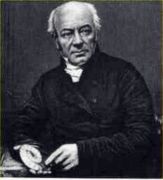 great flood had covered the entire globe. This move helped to make geology look more respectable in a religiously conservative England and perhaps to advance Buckland's own career at Oxford by making geology appear to be a respectable companion to the classics.
Buckland was a bit of an eccentric, given to outlandish dress and behavior. Although Buckland was immensely influential as a scientist, his rakish reputation gave many of his staid early Victorian contemporaries considerable difficulty in accepting his work.
More info from HERE. Image from HERE
Buckland (March 12, 1784 – August 15, 1856) was the first man to identify and name a dinosaur (Megalosaurus), although the name dinosaur had not yet been coined by Richard Owen. Partly in response to the controversial works of Cuvier, Buckland wrote Reliquiae Diluvianae (1823) in which he argued that the evidence of geology alone demonstrated that a
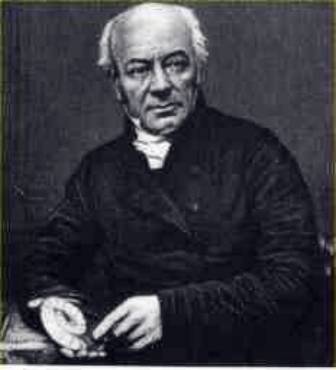 great flood had covered the entire globe. This move helped to make geology look more respectable in a religiously conservative England and perhaps to advance Buckland's own career at Oxford by making geology appear to be a respectable companion to the classics.
Buckland was a bit of an eccentric, given to outlandish dress and behavior. Although Buckland was immensely influential as a scientist, his rakish reputation gave many of his staid early Victorian contemporaries considerable difficulty in accepting his work.
More info from HERE. Image from HERE
Sunday, August 14, 2011
Tour The Age of Dinosaurs for 10 Cents!

Friday, July 22, 2011
Born This Day: Gregor Mendel
From Today In Science History:
Mendel (July 22, 1822 – Jan. 6, 1884) was an Austrian pioneer in the study of heredity. He spent his adult life with the Augustinian monastery in Brunn, where as a geneticist,
botanist and plant experimenter, he was the first to lay the mathematical foundation of the science of genetics, in what came to be called Mendelism.
Over the period 1856-63, Mendel grew and analyzed over 28,000 pea plants. He carefully studied for each their plant height, pod shape, pod color, flower position, seed color, seed shape and flower color. He made two very important generalizations from his pea experiments, known today as the Laws of Heredity. Mendel coined the present day terms in genetics: recessiveness and dominance.
Mendel (July 22, 1822 – Jan. 6, 1884) was an Austrian pioneer in the study of heredity. He spent his adult life with the Augustinian monastery in Brunn, where as a geneticist,

botanist and plant experimenter, he was the first to lay the mathematical foundation of the science of genetics, in what came to be called Mendelism.
Over the period 1856-63, Mendel grew and analyzed over 28,000 pea plants. He carefully studied for each their plant height, pod shape, pod color, flower position, seed color, seed shape and flower color. He made two very important generalizations from his pea experiments, known today as the Laws of Heredity. Mendel coined the present day terms in genetics: recessiveness and dominance.
Wednesday, July 20, 2011
Born This Day: Sir Richard Owen
From Today In Science History:
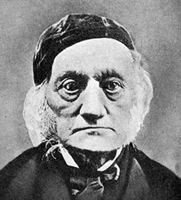 Owen (July 20, 1804 – Dec. 18, 1892) was an English anatomist and paleontologist who is remembered for his contributions to the study of fossil animals and for his strong opposition to the views of Charles Darwin.
He coined the word "Dinosaur" meaning "terrible reptile" (1842). Owen synthesized French anatomical work, especially from Cuvier and Geoffroy, with German transcendental anatomy. He gave us many of the terms still used today in anatomy and evolutionary biology, including "homology". In 1856, he was appointed Superintendent of the British Museum (Natural History).
 Owen (July 20, 1804 – Dec. 18, 1892) was an English anatomist and paleontologist who is remembered for his contributions to the study of fossil animals and for his strong opposition to the views of Charles Darwin.
He coined the word "Dinosaur" meaning "terrible reptile" (1842). Owen synthesized French anatomical work, especially from Cuvier and Geoffroy, with German transcendental anatomy. He gave us many of the terms still used today in anatomy and evolutionary biology, including "homology". In 1856, he was appointed Superintendent of the British Museum (Natural History).
[ a palaeoblog autopost]
Tuesday, July 19, 2011

Monday, July 18, 2011
The Paleo-Loner

For starters here's a link to an on-going dino-comic by Jim Lawson at his blog, Paleo-Loner
Tuesday, July 05, 2011
Died This Day: Carol Landis

Jan. 1, 1919 - July 5, 1948
Landis became a popular pin-up with servicemen during World War II. She was an accomplished writer; her 1944 book Four Jills in a Jeep was later made into a movie. After a turbulent love life she commited suicide at age 29.
Born This Day: Ernst Mayr

While working on the problem of speciation in the birds of New Guinea, Mayr realized that the multitude of species and and subspecies that he saw could best be explained as being a snapshot of evolution in action. He suggested that new species could arise when the range of one species was fractured long enough for members in different parts of the range to evolve characters that would not allow individuals to reproduce when they were brought back together again. This lead to him developing the “biological species concept” in which species are defined as populations of interbreeding organisms rather than just a collection of characters. This idea, along with his theory of “allopatric speciation” was published in his book “Systematics and the Origin of the Species” (1942) and later contributed to the “Punctuated Equilibrium” theory of Niles Eldredge and Stephen Jay Gould.
Ernst Mayr was himself inspired by the work of geneticist Theodosius Dobzhansky on the fruit fly Drosophila melanogaster and his book “Genetics and the Origin of the Species” (1937). These two men, together with the paleontologist George Gaylord Simpson, combined the sciences of genetics, zoology and paleontology into what is now known as “the new synthesis” that provides the modern experimental underpinning to the concepts that Charles Darwin presented in his book, “On the Origin of the Species” .
For anyone interested in learning more about modern evolutionary theory I’d recommend Mayr’s recent book “What Evolution Is” (2002). It’s written in an engaging and readable format from the perspective of someone who’s thought about evolution all his life.
[ a palaeoblog autopost]
Wednesday, June 29, 2011

Thursday, June 16, 2011
Born This Day: George Gaylord Simpson
"Life is the most important thing about the world, the most important thing about life is evolution. Thus, by consciously seeking what is most meaningful, I moved from poetry to mineralogy to paleontology to evolution." G.G. SimpsonFrom the web site supporting the excellent PBS show “Evolution”:
As one of the founders of the "modern synthesis" of evolution, paleontologist George Gaylord Simpson (June 16, 1902 - Oct 6, 1984) argued that the fossil record supports Darwin's theory that natural
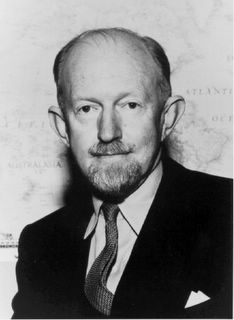 selection acting on random variation in a population is the driving force behind evolution. Simpson was among the first to use mathematical methods in paleontology, and he also took into account newly discovered genetic evidence for evolution in his study of paleontology.
In his 1944 book, Tempo and Mode in Evolution, Simpson divided evolutionary change into "tempo," the rate of change, and "mode," the manner or pattern of change, with tempo being a basic factor of mode. Simpson saw paleontology, revealing the long history of life on earth, as a unique field through which to study the history of evolution.
The early part of the twentieth century saw evolutionary theory embattled by disagreements over Darwin's emphasis on natural selection. The then-newly rediscovered work of Gregor Mendel in the nineteenth century was an uncomfortable fit with evolution, as many scientists saw it. They weren't at all certain that natural populations contained enough genetic variation for natural selection to create new species. So they entertained other explanations, including inheritance of acquired characteristics, "directed" variation toward a goal, or sudden large mutations that resulted in new species.
In the field of paleontology, the scientist who did most to resolve these questions was George Gaylord Simpson, who was on the staff of the American Museum of Natural History for 30 years.
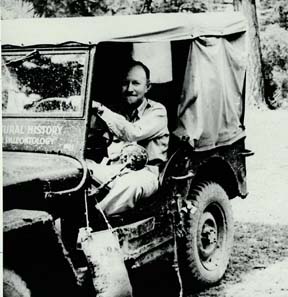 At a time when other paleontologists were convinced that the fossil record could best be explained by directed variation, Simpson disagreed. He said that fossil patterns needed no mystical or goal-oriented processes to explain them. For example, where others saw the modern horse as having arisen in a single advance toward the specialized form, Simpson saw the path as that of an irregular tree that had many side-branches leading off to extinction.
Simpson argued that the evolution of mammals, as seen in their fossilized remains, fit perfectly well with the new mechanisms of population genetics being studied at the time. He used the then-new mathematical methods to clarify how evolution occurred in "gene pools" in populations, not in individual members of the population.
Importantly, he showed that gaps in the fossil record reflected periods of substantial change through rapid "quantum evolution" in small populations, leaving little fossil evidence behind. At other times, he observed, rates of change could be so slow as to seem almost nonexistent.
Read more about Simpson HERE.
Wednesday, June 15, 2011
The Mismeasure of The Mismeasure of Man
The Mismeasure of Science: Stephen Jay Gould versus Samuel George Morton on Skulls and Bias. 2011. J.E. Lewis, et al. PLoS Biol 9(6): e1001071.

Apparently it was Gould, not Morton, who got it wrong.
Stephen Jay Gould, the prominent evolutionary biologist and science historian, argued that “unconscious manipulation of data may be a scientific norm” because “scientists are human beings rooted in cultural contexts, not automatons directed toward external truth”, a view now popular in social studies of science.
In support of his argument Gould presented the case of Samuel George Morton, a 19th-century physician and physical anthropologist famous for his measurements of human skulls. Morton was considered the objectivist of his era, but Gould reanalyzed Morton's data and in his prize-winning book The Mismeasure of Man argued that Morton skewed his data to fit his preconceptions about human variation. Morton is now viewed as a canonical example of scientific misconduct.
But did Morton really fudge his data? Are studies of human variation inevitably biased, as per Gould, or are objective accounts attainable, as Morton attempted? We investigated these questions by remeasuring Morton's skulls and reexamining both Morton's and Gould's analyses.
Our results resolve this historical controversy, demonstrating that Morton did not manipulate data to support his preconceptions, contra Gould. In fact, the Morton case provides an example of how the scientific method can shield results from cultural biases.
Thanks to Sukie for the link!

Apparently it was Gould, not Morton, who got it wrong.
In support of his argument Gould presented the case of Samuel George Morton, a 19th-century physician and physical anthropologist famous for his measurements of human skulls. Morton was considered the objectivist of his era, but Gould reanalyzed Morton's data and in his prize-winning book The Mismeasure of Man argued that Morton skewed his data to fit his preconceptions about human variation. Morton is now viewed as a canonical example of scientific misconduct.
But did Morton really fudge his data? Are studies of human variation inevitably biased, as per Gould, or are objective accounts attainable, as Morton attempted? We investigated these questions by remeasuring Morton's skulls and reexamining both Morton's and Gould's analyses.
Our results resolve this historical controversy, demonstrating that Morton did not manipulate data to support his preconceptions, contra Gould. In fact, the Morton case provides an example of how the scientific method can shield results from cultural biases.
Thanks to Sukie for the link!
Tuesday, June 14, 2011
More Proof For Competitive Exclusion
Phylogenetic limiting similarity and competitive exclusion. 2011. C. Violle, et al. Ecology Letters

Metal Men © DC Comics
A new study provides support for Darwin's hypothesis that the struggle for existence is stronger between more closely related species than those distantly related. While ecologists generally accept the premise, this new study contains the strongest direct experimental evidence yet to support its validity.
"We found that species extinction occurred more frequently and more rapidly between species of microorganisms that were more closely related, providing strong support for Darwin's theory, which we call the phylogenetic limiting similarity hypothesis," said Lin Jiang.

The researchers set up 165 microcosms that contained either an individual bacterivorous protist species or a pairing of two species, along with three types of bacteria for the organisms to eat.
The study results showed that all species survived until the end of the experiment when alone in a microcosm. However, in more than half of the experiments in which protists were paired together, one of the two species dominated, leading to the extinction of the other species.
The researchers found that the frequency and speed of this extinction process -- called competitive exclusion -- was significantly greater between species that were more closely related. In addition, in microcosms where both competitors coexisted for the duration of the experiment, the abundance of the inferior competitor was reduced more as the phylogenetic relatedness between the two competitors increased. link

Metal Men © DC Comics
"We found that species extinction occurred more frequently and more rapidly between species of microorganisms that were more closely related, providing strong support for Darwin's theory, which we call the phylogenetic limiting similarity hypothesis," said Lin Jiang.

The study results showed that all species survived until the end of the experiment when alone in a microcosm. However, in more than half of the experiments in which protists were paired together, one of the two species dominated, leading to the extinction of the other species.
The researchers found that the frequency and speed of this extinction process -- called competitive exclusion -- was significantly greater between species that were more closely related. In addition, in microcosms where both competitors coexisted for the duration of the experiment, the abundance of the inferior competitor was reduced more as the phylogenetic relatedness between the two competitors increased. link
Died This Day: Elkanah Billings
From Today In Science History:
Billings (May 5, 1820 - June 14, 1896) was a Canadian geologist and paleontologist, who was the first Canadian paleontologist. He published his first scientific paper on Trenton fossils in 1854. He launched a new monthly periodical, The Canadian Naturalist and Geologist in 1856, which he also edited and was the major contributor.
In Aug 1856 he was appointed staff paleontologist with the Canadian Geological Survey by William Edmond Logan, the founder of the Survey. Billings immediately began the task of identifying a 20-year backlog of fossils collected by the Survey. By 1863 he had published descriptions of no fewer than 526 new species of fossils.
The Billings medal, named in his honour, is awarded annually by the Paleontology Division of the Geological Association of Canada as a means of recognizing the most outstanding of its paleontologists.
Click HERE for more information on the Geological Association of Canada.
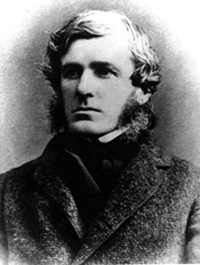
Portrait of Elkanah Billings GSC photo 69323 (c)
Billings (May 5, 1820 - June 14, 1896) was a Canadian geologist and paleontologist, who was the first Canadian paleontologist.
 He published his first scientific paper on Trenton fossils in 1854. He launched a new monthly periodical, The Canadian Naturalist and Geologist in 1856, which he also edited and was the major contributor.
In Aug 1856 he was appointed staff paleontologist with the Canadian Geological Survey by William Edmond Logan, the founder of the Survey. Billings immediately began the task of identifying a 20-year backlog of fossils collected by the Survey. By 1863 he had published descriptions of no fewer than 526 new species of fossils.
The Billings medal, named in his honour, is awarded annually by the Paleontology Division of the Geological Association of Canada as a means of recognizing the most outstanding of its paleontologists.
On April 27, 1869, the Director of the GSC, Sir William Logan wrote this curt note to the paleontologist Elkanah Billings: "Your constant absence from the office is a worrying annoyance, particularly as I have reason to suspect that it does not arrive from rheumatism".For more info on Billings click HERE.
Click HERE for more information on the Geological Association of Canada.
Portrait of Elkanah Billings GSC photo 69323 (c)
Monday, June 13, 2011
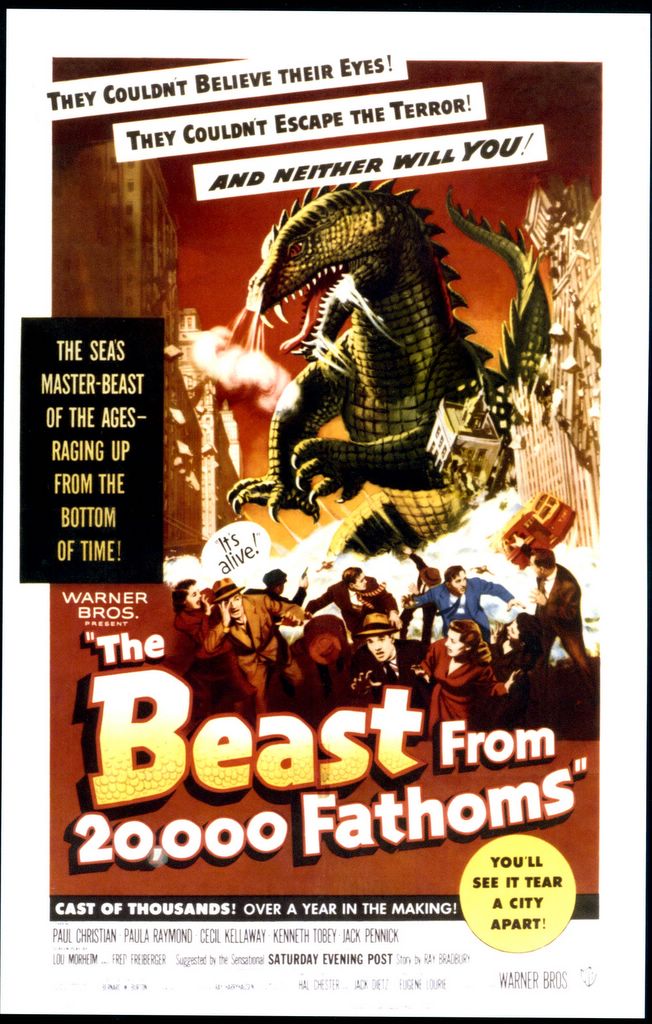
Premiered This Day: The Beast From 20,000 Fathoms
Sunday, June 12, 2011
Forbidden Knowledge of The Dinosaurs

CLICK TO ENLARGE

Friday, June 10, 2011
Born This Day: E. O. Wilson

Wilson's On Human Nature (1978) won the Pulitzer Prize; Biophilia (1984) suggests that human attraction to other living things is innate; and Consilience (1998) urges wider integration of the sciences. Other books by Wilson are Insect Societies (1971), The Diversity of Life (1992), The Ants, with Bert Hölldobler (1990; Pulitzer Prize), and The Future of Life (2002).
Wednesday, June 08, 2011
Born This Day: Ernest Schoedsack

Cooper and Schoedsack (right)
They are best known for King Kong (1933), which was co-written by Schoedsack's wife, Ruth Rose. He also directed Son of Kong (1933), Dr. Cyclops (1940) and Mighty Joe Young (1949). From TCM.
Died This Day: Ruth Rose

The photo from King Kong (above) is of Bruce Cabot, Fay Wray and Robert Armstrong, but Rose clearly modeled the characters they played after Schoedsack, herself, and Cooper.
Born This Day: Francis Crick
From Today In Science History:
Crick (June 8, 1916 – July 28, 2004) was a British biophysicist, who, with James Watson and Maurice Wilkins, received the 1962 Nobel Prize for Physiology or Medicine for their determination of the molecular structure of deoxyribonucleic acid (DNA), the chemical substance ultimately responsible for hereditary control of life functions.

Crick and Watson began their collaboration in 1951, and published their paper on the double helix structure on April 2, 1953 in Nature. This accomplishment became a cornerstone of genetics and was widely regarded as one of the most important discoveries of 20th-century biology.
Crick (June 8, 1916 – July 28, 2004) was a British biophysicist, who, with James Watson and Maurice Wilkins, received the 1962 Nobel Prize for Physiology or Medicine for their determination of the molecular structure of deoxyribonucleic acid (DNA), the chemical substance ultimately responsible for hereditary control of life functions.

Sunday, June 05, 2011

Friday, June 03, 2011
Born This Day: James Hutton
Hutton (June 3, 1726 - March 26, 1797) is considered to be the father of modern geology. He is accredited with proposing that observed geologic processes have been occurring at a uniform rate since the creation of earth, also know as the theory of unconformities. This led to his controversial suggestion that the earth is incredibly old.
 Hutton began to notice geologic processes on his land in the 1750’s by following his soil during rainstorms when it would erode into the sea. He also noticed how long the process took and began to apply this idea to other parts of geology. If it took this long for some soil to move a few miles than how long did it take to form the cliffs by the sea? He also took note of other features in the landscape such as angular unconformities. A breakthrough point occurred for Hutton when he found Siccar’s Point. This site shows the build up of sediment over a long period of time as well as other geologic processes. It was this idea of continuous processes that fascinated Hutton for the rest of his life.
Hutton subsequently moved back to Edinburgh, and became very involved with the Royal Society of Edinburgh. In 1785 he had his friend Joseph Black read his lecture on his theories of earth. This was the first time that his full theory had been made public. He was met with much anger and rejection. Even though we take his ideas for granted today, at the time he was presenting this the oldest proposed age of earth was around six thousand years, as laid forth by the church. While he was able to convince a few by showing them prime field examples such as Glen Tilt and Siccar’s Point, for many it remained too radical an idea to consider.
Text modified from HERE. Image from HERE.
 Hutton began to notice geologic processes on his land in the 1750’s by following his soil during rainstorms when it would erode into the sea. He also noticed how long the process took and began to apply this idea to other parts of geology. If it took this long for some soil to move a few miles than how long did it take to form the cliffs by the sea? He also took note of other features in the landscape such as angular unconformities. A breakthrough point occurred for Hutton when he found Siccar’s Point. This site shows the build up of sediment over a long period of time as well as other geologic processes. It was this idea of continuous processes that fascinated Hutton for the rest of his life.
Hutton subsequently moved back to Edinburgh, and became very involved with the Royal Society of Edinburgh. In 1785 he had his friend Joseph Black read his lecture on his theories of earth. This was the first time that his full theory had been made public. He was met with much anger and rejection. Even though we take his ideas for granted today, at the time he was presenting this the oldest proposed age of earth was around six thousand years, as laid forth by the church. While he was able to convince a few by showing them prime field examples such as Glen Tilt and Siccar’s Point, for many it remained too radical an idea to consider.
Text modified from HERE. Image from HERE.
Wednesday, June 01, 2011
Congratulations to Chris McGarrity, M.Sc.

Monday, May 30, 2011
Cretaceous Feathers From Spain
Feather diversity in the Barremian (Early Cretaceous) of Las Hoyas, Spain. 2011. J. Marugan-Lobon and R. Vullo. Comptes Rendus Palevol 10: 219-223.

Abstract: The preservation of feathers is a rare phenomenon in the fossil record. In this study, we report 11 isolated feathers from the Early Cretaceous of the Konservat-Lagerstätte of Las Hoyas, Spain. Most of them are preserved as a carbonised thin layer, but there are also imprints. The specimens are relatively small, and unambiguously correspond to body contour feathers, although it is very difficult to match them to a particular taxon (among avian or non-avian theropods).
Among the fossils, there is an almost complete remige, a well-preserved fragment of a possible ornamental rectrice feather, and possibly a semiplume. Furthermore, some specimens appear to have different colour patterns, such as stripes or patches.
Saturday, May 28, 2011
Born This Day: Louis Agassiz
(Jean) Louis (Rodolphe) Agassiz (May 28, 1807 - Dec. 14, 1873) was a Swiss-born U.S. naturalist, geologist, and teacher who made revolutionary contributions to the study of natural science with landmark work on glacier activity and extinct fishes. Agassiz began his work in Europe, having studied at the University of Munich and then as chair in natural history in Neuchatel in Switzerland. While there he published his landmark multi-volume description and classification of fossil fish.
In 1846 Agassiz came to the U.S. to lecture before Boston's Lowell Institute. Offered a professorship of Zoology and Geology at Harvard in 1848, he decided to stay, becoming a citizen in 1861. His innovative teaching methods altered the character of natural science education in the U.S. Link
More info HERE
Friday, May 27, 2011
Died This Day: Sandra Shaw

Arbogast on Film blog has nice appreciation of Sandra Shaw’s few famous film moments.
An Ordovician Anomalocaridid
A giant Ordovician anomalocaridid. 2010. P. Van Roy and. E.G. Briggs. Nature 473: 510–513.

Image: Esben Horn
Fossils from this period suggested these marine predators grew to be about two feet long. Until now, scientists also thought these strange invertebrates—which had long spiny head limbs presumably used to snag worms and other prey, and a circlet of plates around the mouth—died out at the end of the Cambrian.
The anomalocaridid fossils reveal a series of blade like filaments in each segment across the animal's back, which scientists think might have functioned as gills.
The specimens are just part of a new trove of fossils from Morocco that includes thousands of examples of soft-bodied marine fauna dating back to the early Ordovician period, 488 to 472 million years ago. The animals found in Morocco inhabited a muddy sea floor in fairly deep water, and were trapped by sediment clouds that buried them and preserved their soft bodies. link

Image: Esben Horn
Scientists have discovered a giant fossilized anomalocaridid from the Ordovician that measures one meter in length meaning these animals existed for 30 million years longer than previously realized.Anomalocaridids were the largest animals of the Cambrian period, known for the "Cambrian Explosion" that saw the sudden appearance of all the major animal groups and the establishment of complex ecosystems about 540 to 500 million years ago.
Fossils from this period suggested these marine predators grew to be about two feet long. Until now, scientists also thought these strange invertebrates—which had long spiny head limbs presumably used to snag worms and other prey, and a circlet of plates around the mouth—died out at the end of the Cambrian.
The anomalocaridid fossils reveal a series of blade like filaments in each segment across the animal's back, which scientists think might have functioned as gills.
The specimens are just part of a new trove of fossils from Morocco that includes thousands of examples of soft-bodied marine fauna dating back to the early Ordovician period, 488 to 472 million years ago. The animals found in Morocco inhabited a muddy sea floor in fairly deep water, and were trapped by sediment clouds that buried them and preserved their soft bodies. link
Tuesday, May 24, 2011
Born This Day: William Whewell
Whewell (May 24, 1846 - Feb. 23, 1934) was a British scientist, best known for his survey of the scientific method and for creating scientific words. He founded mathematical crystallography and developed Mohr's classification of minerals.
He created the words scientist and physicist by analogy with the word artist. They soon replaced the older term natural philosopher. Other useful words were coined to help his friends: biometry for Lubbock; Eocine, Miocene and Pliocene for Lyell; and for Faraday, anode, cathode, diamagnetic, paramagnetic, and ion (whence the sundry other particle names ending -ion).
In metereology, Whewell devised a self-recording anemometer. He was second only to Newton for work on tidal theory. He died as a result of being thrown from his horse. From Today In Science History.
Sunday, May 22, 2011
Fossil Hunting at Lyme Regis

These photos show Paddy Howe, the geologist at the Lyme Regis Museum, and some friends fossil hunting on the blue lias ledges. What they found was this partial icthyosaur pabble. Very cool!

Born This Day: Sir Arthur Conan Doyle

Sir Arthur Conan Doyle (May 22, 1859 – July 7, 1930) was a British writer and creator of Sherlock Holmes. He was born in Edinburgh. His father and uncle were both book illustrators and his mother encouraged his son to explore the world of books. Doyle studied at Edinburgh University and in 1884 he married Louise Hawkins. Doyle qualified as doctor in 1885 and practiced medicine as an eye specialist in Hampshire until 1891 when he became a full time writer. Doyle's first novel about Sherlock Holmes,’ A Study in Scarlet’, was published in 1887.

Doyle's stories of Professor George Edward Challenger in ‘The Lost World’ (1912). The model for the professor was William Rutherford, Doyle's teacher from Edinburgh. Doyle's practice, and other experiences, expeditions as ship's surgeon to the Arctic and West Coast of Africa, service in the Boer War, defenses of George Edalji and Oscar Slater, two men wrongly imprisoned, provided much material for his writings.
Born This Day: Oliver Perry Hay
May 22, 1846 – Novemeber 2, 1930
Hay was an American paleontologist whose catalogs of fossil vertebrates greatly organized existing knowledge and became standard references. Hay's primary scientific interest was the study of the Pleistocene vertebrata of North America and he is renowned for his work on skull and brain anatomy. His first major work was his Bibliography and Catalogue of the Fossil Vertebrata of North America (1902), supplemented by two more volumes (1929-30). Hay also wrote on the evidence of early humans in North America. link
Hay was an American paleontologist whose catalogs of fossil vertebrates greatly organized existing knowledge and became standard references. Hay's primary scientific interest was the study of the Pleistocene vertebrata of North America and he is renowned for his work on skull and brain anatomy. His first major work was his Bibliography and Catalogue of the Fossil Vertebrata of North America (1902), supplemented by two more volumes (1929-30). Hay also wrote on the evidence of early humans in North America. link
Saturday, May 21, 2011
Born This Day: Mary Anning
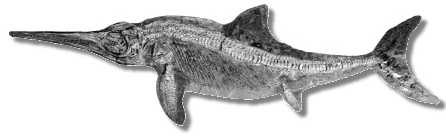
Mary Anning (May 21, 1799 - March 9, 1847)was an English fossil collector who made her first significant discovery at the age of 11 or 12 (sources differ on the details),  when she found a complete skeleton of an Ichthyosaurus, from the Jurassic period. The ten-meter (30 feet) long skeleton created a sensation and made her famous.
Anning's determination and keen scientific interest in fossils derived from her father's interest in fossil hunting, and a need for the income derived from them to support her family after his death. in 1810. She sold large fossils to noted paleontologists of the day, and smaller ones to the tourist trade. In 1823, Anning made another great discovery, found the first complete Plesiosaurus.
Later in her life, the Geological Society of London granted Anning an honorary membership.
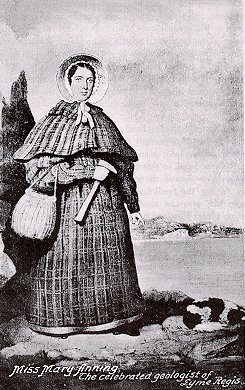 when she found a complete skeleton of an Ichthyosaurus, from the Jurassic period. The ten-meter (30 feet) long skeleton created a sensation and made her famous.
Anning's determination and keen scientific interest in fossils derived from her father's interest in fossil hunting, and a need for the income derived from them to support her family after his death. in 1810. She sold large fossils to noted paleontologists of the day, and smaller ones to the tourist trade. In 1823, Anning made another great discovery, found the first complete Plesiosaurus.
Later in her life, the Geological Society of London granted Anning an honorary membership.


Friday, May 20, 2011
Fossil Evidence on Origin of the Mammalian Brain
Fossil Evidence on Origin of the Mammalian Brain. 2011. T. Rowe, et al. Science 332: 955-957.

Hadrocodium wui by Mark A. Klingler (CMNH).

CT scans indicate that the nasal cavity and related smell regions were enlarged in the pre-mammal fossils, along with areas of the brain that process olfactory information. Both characteristics indicate an improved sense of smell in pre-mammals.
The study also looked at the influence of body hair development on brain size. For example, the paper clip-sized Hadrocodium sported fur, and evidence from fossilized pelts or skin of closely related animals hints that Morganuocodon likely had hair too. The authors speculate that hairy early mammals were quick to develop a keen sense of touch or tactile sensitivity, along with enhanced motor coordination.

Rather than being used for warmth, body hairs initially served as tiny air traffic controllers, allowing pre-mammals to navigate small crevices and avoid harm. This heightened tactile sensitivity eventually lead to the formation of intricate sensory fields in the neocortex of mammalian brain, the authors propose.
In both fossils, the size of the cerebellum (the region of the brain responsible for sensory-motor integration) grew so large it began to ripple over into folds; this increase in size supports the idea that early mammals developed advanced neuromuscular coordination. link

The Leader © Marvel Comics

Hadrocodium wui by Mark A. Klingler (CMNH).
Mammals first evolved their characteristic large brains to enable a stronger sense of smell, according to a new study.By reconstructing fossils of two Early Jurassic Period mammals--Morganuocodon and Hadrocodium--the authors provide new evidence that the mammalian brain evolved in three major stages: first by improvements in sense of smell or olfaction; next by an increase in touch or tactile sensitivity from body hair; and third by improved neuromuscular coordination or the ability to produce skilled muscle movement using the senses.

CT scans indicate that the nasal cavity and related smell regions were enlarged in the pre-mammal fossils, along with areas of the brain that process olfactory information. Both characteristics indicate an improved sense of smell in pre-mammals.
The study also looked at the influence of body hair development on brain size. For example, the paper clip-sized Hadrocodium sported fur, and evidence from fossilized pelts or skin of closely related animals hints that Morganuocodon likely had hair too. The authors speculate that hairy early mammals were quick to develop a keen sense of touch or tactile sensitivity, along with enhanced motor coordination.

Rather than being used for warmth, body hairs initially served as tiny air traffic controllers, allowing pre-mammals to navigate small crevices and avoid harm. This heightened tactile sensitivity eventually lead to the formation of intricate sensory fields in the neocortex of mammalian brain, the authors propose.
In both fossils, the size of the cerebellum (the region of the brain responsible for sensory-motor integration) grew so large it began to ripple over into folds; this increase in size supports the idea that early mammals developed advanced neuromuscular coordination. link

The Leader © Marvel Comics
Born This Day: Edward B. Lewis
Lewis (May 20, 1918 - July 21, 2004) was an American developmental geneticist who was awarded the 1995 Nobel Prize for Physiology or Medicine for discovering the functions that control early embryonic development with co-winners Christiane Nüsslein-Volhard and Eric F. Wieschaus. They identified and classified 15 key genes that determine the body plan and formation of body segments of the fruit fly Drosophila melanogaster.

FF © Marvel Comics
Lewis studied the next step, the homeotic genes that govern the development of a larval segment into a specific body segment. Lewis found a co-linearity in time and space between the order of the genes in the bithorax complex and their effect regions in the segments. From Today In Science History

FF © Marvel Comics
Xilousuchus is An Archosaur
A sail-backed suchian from the Heshanggou Formation (Early Triassic: Olenekian) of China. 2011. S. Nesbitt, et al. Earth and Environmental Science Transactions of the Royal Society of Edinburgh 101: 271-284.

Art by S. NesbittThe only known specimen of the 247 million year old Xilousuchus sapingensis has been reclassified as an archosaur. The specimen – a skull and 10 vertebrae – was found in the Heshanggou Formation in northern China.
The fossil was originally classified as an archosauriform, a "cousin" of archosaurs, rather than a true archosaur, but that was before the discovery of more complete early archosaur specimens from other parts of the Triassic period. The researchers examined bones from the specimen in detail, comparing them to those from the closest relatives of archosaurs, and discovered that X. sapingensis differed from virtually every archosauriform.

Art by S. NesbittAmong their findings was that bones at the tip of the jaw that bear the teeth likely were not downturned as much as originally thought when the specimen was first described in the 1980s. They also found that neural spines of the neck formed the forward part of a sail similar to that found on another ancient archosaur called Arizonasaurus, a very close relative of Xilousuchus found in Arizona.
The new research places X. sapingensis firmly within the archosaur family tree, providing evidence that the early members of the crocodile and bird family trees evolved earlier than previously thought. link

Art by S. Nesbitt
The fossil was originally classified as an archosauriform, a "cousin" of archosaurs, rather than a true archosaur, but that was before the discovery of more complete early archosaur specimens from other parts of the Triassic period. The researchers examined bones from the specimen in detail, comparing them to those from the closest relatives of archosaurs, and discovered that X. sapingensis differed from virtually every archosauriform.

Art by S. Nesbitt
The new research places X. sapingensis firmly within the archosaur family tree, providing evidence that the early members of the crocodile and bird family trees evolved earlier than previously thought. link
This article is from a special issue of Earth and Environmental Science Transactions of the Royal Society of Edinburgh on Late Triassic Terrestrial Biotas and the Rise of Dinosaurs.
Subscribe to:
Posts (Atom)