From Today In Science History:
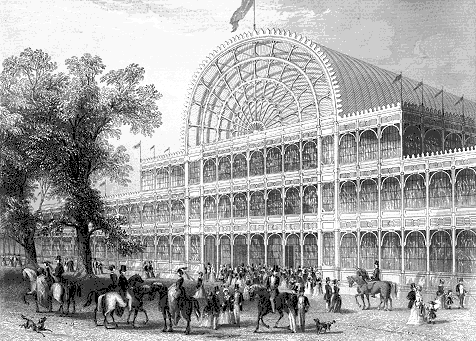
In 1936, London's famed Crystal Palace, constructed for the International Exhibition of 1851, was destroyed in the most spectacular fire seen in Britain for many years. It started about 8 pm and spread with such amazing rapidity that within half an hour the great building was ablaze from end to end. Flames rose 300-ft despite the efforts of 90 engines and 500 firemen. Only the two towers escaped destruction. When built, constructed mainly of glass and iron, it was nicknamed "The Crystal Palace" by Punch magazine.
In 1854 the sculptor Benjamin Waterhouse Hawkins installed three construct full-size concrete restorations of Iguanodon, Hylaeosaurus, and Megalosaurus on the grounds of Sydenham Park, home of the Crystal Palace.
Monday, November 30, 2015

Born This Day: Robert Broom
Robert Broom (Nov. 30, 1866 – April 6, 1951) was a South African doctor and paleontologist. From 1903 to 1910 he was professor of zoology and geology at Victoria College, Stellenbosch, South Africa, and subsequently he became keeper of vertebrate paleontology at the South African Museum, Cape Town.
Broom was first known for his study of mammal-like reptiles. After Raymond Dart's discovery of the Taung Child, an infant australopithecine, Broom's interest in paleoanthropology was heightened. In 1934 he jojned the staff of the Transvaal Museum in Pretoria as an Assistant in Palaeontology.
In the following years, he made a series of spectacular finds, including fragments from six hominids in Sterkfontein, which he named Plesianthropus transvaalensis. In 1937, Broom made his most famous discovery of Paranthropus robustus. These discoveries helped support Dart's claims for the Taung species.
The remainder of Broom's career was devoted to the exploration of these sites and the interpretation of the many early hominid remains discovered there. In 1946 he proposed the Australopithecinae subfamily. From Princeton.edu

Broom was first known for his study of mammal-like reptiles. After Raymond Dart's discovery of the Taung Child, an infant australopithecine, Broom's interest in paleoanthropology was heightened. In 1934 he jojned the staff of the Transvaal Museum in Pretoria as an Assistant in Palaeontology.
In the following years, he made a series of spectacular finds, including fragments from six hominids in Sterkfontein, which he named Plesianthropus transvaalensis. In 1937, Broom made his most famous discovery of Paranthropus robustus. These discoveries helped support Dart's claims for the Taung species.
The remainder of Broom's career was devoted to the exploration of these sites and the interpretation of the many early hominid remains discovered there. In 1946 he proposed the Australopithecinae subfamily. From Princeton.edu


Sunday, November 29, 2015

Saturday, November 28, 2015
Died This Day: Karl Ernst von Baer
Von Baer (Feb 29, 1792 - Nov 28, 1876) was a Prussian-Estonian embryologist who discovered the mammalian egg (1827) and the notochord. He established the new science of comparative embryology alongside  comparative anatomy with the publication of two landmark volumes (in 1828 and 1837) covering the range of existing knowledge of the prebirth developments of vertebrates.
He showed that mammalian eggs were not the follicles of the ovary but microscopic particles inside the follicles. He described the development of the embryo from layers of tissue, which he called germ layers, and demonstrated similarities in the embryos of different species of vertebrates.
From Today In Science History
 comparative anatomy with the publication of two landmark volumes (in 1828 and 1837) covering the range of existing knowledge of the prebirth developments of vertebrates.
 He showed that mammalian eggs were not the follicles of the ovary but microscopic particles inside the follicles. He described the development of the embryo from layers of tissue, which he called germ layers, and demonstrated similarities in the embryos of different species of vertebrates.
From Today In Science History
Born This Day: Dunkinfield Henry Scott

Painting by Mary Parrish
Scott (Nov. 28, 1854 – Jan. 29, 1934) was an English paleobotanist and leading authority of his time on the structure of fossil plants, one of those who laid the foundations of paleobotany. He conducted experiments in the Jodrell Laboratory in Kew Gardens, where he became its honorary keeper (1892-1906). In collaboration with W.C. Williamson, he wrote three papers on fossil-plant morphology (1894-95).Scott continued writing papers after Williamson's death and in which he described many otherwise unknown fossil plants. He wrote the classic Studies in Fossil Botany, which greatly popularized the subject.
From Today In Science History

Friday, November 27, 2015
Chocolat D'Aiguebelle Fossil Trading Cards

From Prehistosaurio
Read more about these cards at the great Paleo-blog, Love In The Time of Chasmosaurs.
Thursday, November 26, 2015
Died This Day: Sven Ander Hedin
Hedin (Feb. 19,1865 - Nov. 26, 1952) was a Swedish explorer and geographer, born in Stockholm, who led four multi-year expeditions into Central Asia between 1897 and 1935. Although not as well known as Roy Chapman Andrews his work in the  regions revealed a wealth of cultural, archaeological and palaeontological wonders.
During his first major Asian expedition, he crossed the Pamirs, charted Lop Nor (Lake) in China, and finally arrived at Beijing. He then journeyed to Tibet by way of Mongolia, Siberia, and the Gobi Desert. Hedin explored Tibet and Xinjiang (Sinkiang), identified the sources of the Brahmaputra, Indus, and Sutlej rivers, and, in 1906, explored and named the Trans-Himalayas. In 1927 Hedin led an expedition of Chinese and Swedish scientists into Central Asia.
He wrote extensively about his adventures (e.g., Across the Gobi Desert, The Conquest of Tibet (1935), My Life as an Explorer (1926)) and they make for engaging and fascinating reading for anyone interested in the early days of exploring Central Asia. link
An excellent summary of Hedin’s life and expeditions into Central Asia can be found at the IDP News Archives image
 regions revealed a wealth of cultural, archaeological and palaeontological wonders.
During his first major Asian expedition, he crossed the Pamirs, charted Lop Nor (Lake) in China, and finally arrived at Beijing. He then journeyed to Tibet by way of Mongolia, Siberia, and the Gobi Desert. Hedin explored Tibet and Xinjiang (Sinkiang), identified the sources of the Brahmaputra, Indus, and Sutlej rivers, and, in 1906, explored and named the Trans-Himalayas. In 1927 Hedin led an expedition of Chinese and Swedish scientists into Central Asia.
He wrote extensively about his adventures (e.g., Across the Gobi Desert, The Conquest of Tibet (1935), My Life as an Explorer (1926)) and they make for engaging and fascinating reading for anyone interested in the early days of exploring Central Asia. link
An excellent summary of Hedin’s life and expeditions into Central Asia can be found at the IDP News Archives image

Wednesday, November 25, 2015
Those Darn Pterosaurs!

Concept art for Creation (unproduced) by Willis O'Brien

Concept art for King Kong By Byron Crabbe

Concept Art for One Million Years B.C. by Ray Harryhausen
From HERE
Tuesday, November 24, 2015

Monday, November 23, 2015
Born This Day: Paula Raymond

Paula (center) played the role of plucky Lee Hunter, assistant to paleontologist Dr. Thurgood Elson (Cecil Kellaway) (right) in Ray Harryhausen's, The Beast of 20,000 Fathoms (1953).
Sunday, November 22, 2015
Born This Day: Steve Clemente
Steve Clemente (born Esteban Clemento Morro Nov. 22, 1885—May 7, 1950) was a Mexican actor known for his many villainous roles. He began acting in his teens, signing up for his first movie, The Secret Man, in 1917. His later, numerous roles were usually bit parts and he was an expert knife thrower.
He was a known scene stealer and was famous for his villainous snarl. He later starred in such movies as The Most Dangerous Game (1932), playing Tartar, the second henchman of Count Zarrof and played the Witch King in King Kong (1933). From Wiki


He was a known scene stealer and was famous for his villainous snarl. He later starred in such movies as The Most Dangerous Game (1932), playing Tartar, the second henchman of Count Zarrof and played the Witch King in King Kong (1933). From Wiki
Saturday, November 21, 2015
DIGGING INTO DINOMANIA! By Stephen Bissette
PALAEOBLOG takes a break from its usual postings to present an excerpt from Stephen R. Bissette's Behind-the-Scenes Peek at a Magnificent New Book about the Prehistory of Prehistoric Pop Culture excerpted from the upcoming MONSTER! #24, available soon from CreateSpace and amazon.com.
 By Stephen R. Bissette
[The complete 10,00+ word interview and article will be published at the end of December 2015 in MONSTER! #24, available soon from CreateSpace and amazon.com; just search for “MONSTER! #24 Tim Paxton” later in December…]
Now and then, a truly essential book surfaces.
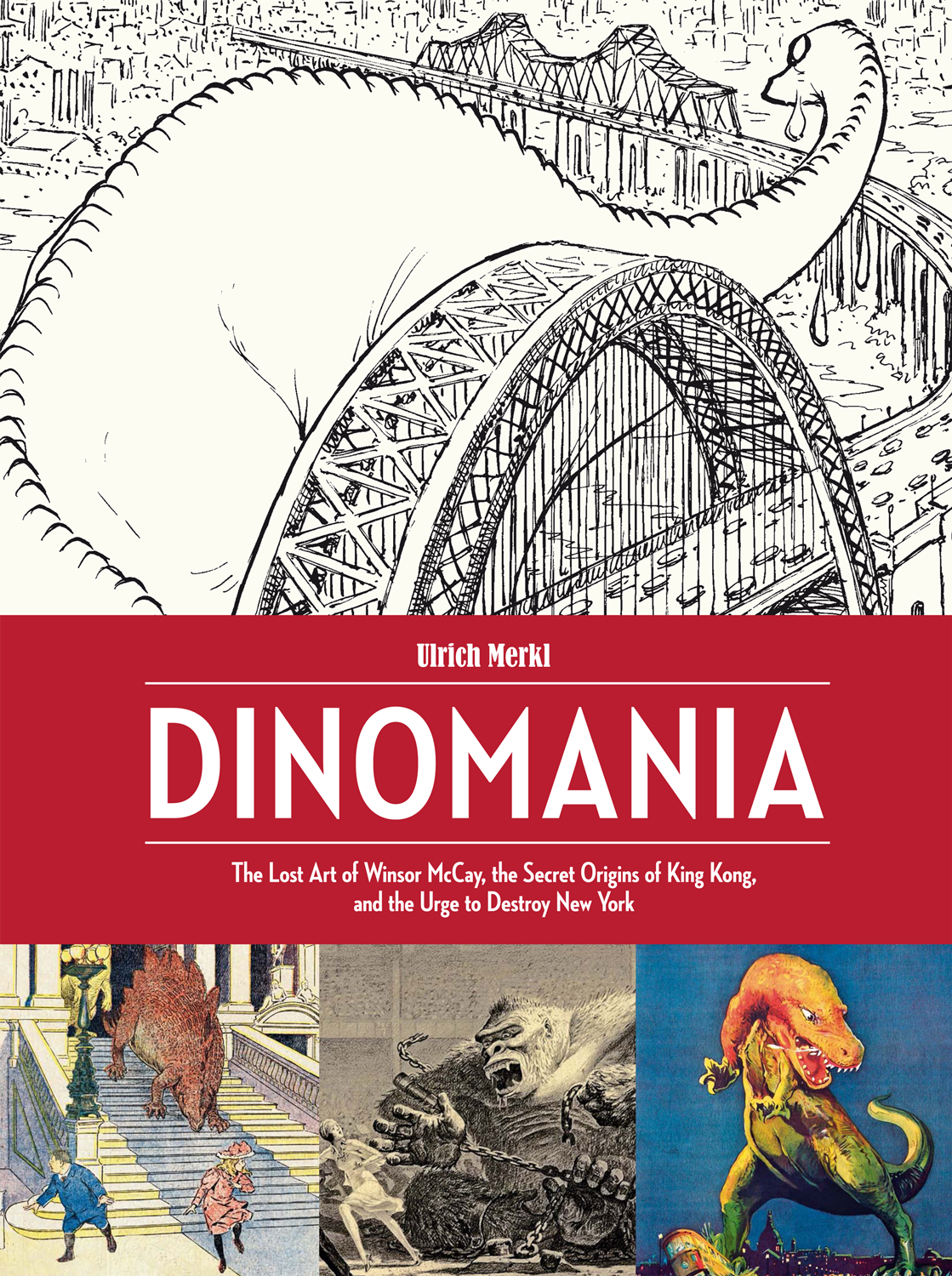
The new book Dinomania is one of those essential tomes…Dr. Ulrich Merkl dedicated his efforts to complete a new book near and dear to my heart (I was, in fact, one of three consultants who followed through with research assistance, when asked, during the project’s gestation and completion). The fruits of his labor were just released, or unleashed (November 23, 2015): Dinomania: The Lost Art of Winsor McCay, The Secret Origins of King Kong, and the Urge to Destroy New York (2015), from Fantagraphics Books.
The book is an astonishing overview of 19th century and early 20th century “Dinomania,” and as such essential for all MONSTER! readers. Dr. Merkl shares a wealth of information, insights, rare never-before-reprinted artwork and cartoons, and more of interest to dinosaur lovers, comics scholars, giant monster movie addicts, genre devotees, and Winsor McCay fans, including an entirely “new” (as in never-before-seen) body of work by McCay. “On p. 257-260, we have the complete text of McCay’s original GERTIE lecture, exactly as he performed it in vaudeville,” Dr. Merkl explains. “The text was thought lost, but I discovered it exactly 100 years after McCay conceived it. I think it’s important.” Absolutely.
This is Merkl’s first book published by an American publisher (Fantagraphics), at almost half the price of his now-rare Rarebit Fiend book. But—rest assured that Fantagraphics does often go with limited print runs (they have here), and they do let books drop out of print, especially books as specialized as this one.

Interview excerpt:
Stephen R Bissette: When and where did you first see evidence of the McCay ("Bob McKay") Dino comics art?
DR. ULRICH MERKL: I first saw them in Russ Cochran’s Graphic Gallery catalog no. 7 from 1976 which I obtained when I started collecting original comic art in 1984 at the age of 18. That was when I first came across Robert McCay by name, in an auction catalogue that was already nine years old. I’ve been admiring those Dino pages ever since, until they turned up again on the market in the fall of 2010 (at Russ Cochran’s again).
SRB: Do you remember your first impressions—what did you think when you initially laid eyes on those pages?
UM: At first glance they looked like pure Winsor McCay: an original idea turned into a powerful graphic by a hand with the surest touch — but strangely signed by “Bob McCay,” his son. This raised two questions:
1) If this Bob McCay was such a fantastic cartoonist, how come nobody had ever heard about it or seen his work? And
2) If the drawings were by Winsor (and I was convinced of that from the outset)—why would he sign his own work with his son’s name?
As these two Dino half-pages were practically the only thing by “Bob McCay” anyone had ever seen, experts and collectors soon reached a summary verdict: “Robert must obviously have imitated his father’s style so precisely that we cannot tell the one from the other.” Given the lack of in-depth research, this has been the state of play for decades.
SRB: Those images have bothered me since I first saw them reprinted in a British instructional cartooning book. The lack of context—they seemed to exist in a void—was troubling and compelling, all at the same time.
UM: Personally, I find it astonishing that even McCay specialists saw no problem in ascribing, without compunction, such perfectly crafted comic strips to a completely unresearched artist who appeared out of the blue, all because of a signature. What ever happened to critical style analysis? Could it really be that these masterpieces, which so resemble the work of Winsor McCay, were actually drawn by “Bob McCay,” as the author’s mark claimed?
Over the years I would peer at those pictures over and over again, but I didn’t do anything about it. With the benefit of hindsight, that was a good thing, because I would not have found anything significant anyway. For one thing, I knew too little about Winsor McCay back then, and for another, back in the pre-Internet Stone Age I would not have tracked down most of the relevant information and visual material anyway.
Fast forward 25 years. In the fall of 2010 the two Dino half-pages were back on the market, resold by the same collector who bought them in 1976 and then looked after them for 34 years. This time I had the bit between my teeth. Surely this was a promising clue. You can’t file art of that quality in a drawer with a label that says “not sure”. Why would a Dino comic languish in obscurity? And what was all this about Bob McCay, or rather his mark? I had an essay in mind, ten pages or maybe twenty.
SRB: And then it grew and grew—I know how that is!
UM: Once you start getting serious about a thing, once you start digging down, and not copying what you find on the Internet but going to the sources, things take on a life of their own. The ten pages turned into fifty, I kept discovering more material, then it was 100 pages. Every answer I found raised three new questions. The ripples kept spreading wider, more and more amazing pictures emerged from the dust of history, and sooner or later I had 200 pages. What began simply as a Dino comic strip has led me to the huge phenomenon of dinomania, and after four years I found myself holding a supersized, 296-page monster book with 670 illustrations. It turned out that the two Dino half-pages signed “Bob McCay” were fragments from Winsor McCay’s last grand project, a newspaper strip in Sunday-page format about the odyssey of a dinosaur who awakes from a long, deep sleep and starts getting into trouble with human civilization. Drawn in summer 1934 on the crest of that first great wave of dinomania that quietly took shape in 1854 and had ridden a storm of popularity since 1905. When McCay had finished five or six pages of his strip, he died quite suddenly in July 1934, and the material never endured into a published strip.

SRB: At what point did the scope of this project open up to include your detective work on the whole of prehistoric-themed comic art, and how and when did that collecting/archiving portion of the venture begin in earnest?
UM: It soon became clear that the Dino pages were fragments from something bigger, and that the strip was part of a wave of general Dinomania in which Winsor McCay had played a key role. For one year, I was gathering everything I found about Dinomania, giant-monster monster movies, and related topics: comic strips, newspaper articles, editorial cartoons, children’s magazines, and so on. I started with absolutely zero in December 2010, and in the fall of 2011, I had what is probably the world’s second largest collection of vintage dinosaur images (the largest should be yours, I guess).
Look for “MONSTER! #24 in Decmeber; just search "Monster! Tim Paxton” at Amazon.com
Bonus: Read Stephen R. Bissette's exclusive PALAEOBLOG's 10 Part series, "The Palaeo-Path", on the history of dinosaurs in comics: 1, 2, 3, 4, 5, 6, 7, 8, 9, 10.
[The complete 10,00+ word interview and article will be published at the end of December 2015 in MONSTER! #24, available soon from CreateSpace and amazon.com; just search for “MONSTER! #24 Tim Paxton” later in December…]
Now and then, a truly essential book surfaces.
The new book Dinomania is one of those essential tomes…Dr. Ulrich Merkl dedicated his efforts to complete a new book near and dear to my heart (I was, in fact, one of three consultants who followed through with research assistance, when asked, during the project’s gestation and completion). The fruits of his labor were just released, or unleashed (November 23, 2015): Dinomania: The Lost Art of Winsor McCay, The Secret Origins of King Kong, and the Urge to Destroy New York (2015), from Fantagraphics Books.
The book is an astonishing overview of 19th century and early 20th century “Dinomania,” and as such essential for all MONSTER! readers. Dr. Merkl shares a wealth of information, insights, rare never-before-reprinted artwork and cartoons, and more of interest to dinosaur lovers, comics scholars, giant monster movie addicts, genre devotees, and Winsor McCay fans, including an entirely “new” (as in never-before-seen) body of work by McCay. “On p. 257-260, we have the complete text of McCay’s original GERTIE lecture, exactly as he performed it in vaudeville,” Dr. Merkl explains. “The text was thought lost, but I discovered it exactly 100 years after McCay conceived it. I think it’s important.” Absolutely.
This is Merkl’s first book published by an American publisher (Fantagraphics), at almost half the price of his now-rare Rarebit Fiend book. But—rest assured that Fantagraphics does often go with limited print runs (they have here), and they do let books drop out of print, especially books as specialized as this one.

Interview excerpt:
Stephen R Bissette: When and where did you first see evidence of the McCay ("Bob McKay") Dino comics art?
DR. ULRICH MERKL: I first saw them in Russ Cochran’s Graphic Gallery catalog no. 7 from 1976 which I obtained when I started collecting original comic art in 1984 at the age of 18. That was when I first came across Robert McCay by name, in an auction catalogue that was already nine years old. I’ve been admiring those Dino pages ever since, until they turned up again on the market in the fall of 2010 (at Russ Cochran’s again).
SRB: Do you remember your first impressions—what did you think when you initially laid eyes on those pages?
UM: At first glance they looked like pure Winsor McCay: an original idea turned into a powerful graphic by a hand with the surest touch — but strangely signed by “Bob McCay,” his son. This raised two questions:
1) If this Bob McCay was such a fantastic cartoonist, how come nobody had ever heard about it or seen his work? And
2) If the drawings were by Winsor (and I was convinced of that from the outset)—why would he sign his own work with his son’s name?
As these two Dino half-pages were practically the only thing by “Bob McCay” anyone had ever seen, experts and collectors soon reached a summary verdict: “Robert must obviously have imitated his father’s style so precisely that we cannot tell the one from the other.” Given the lack of in-depth research, this has been the state of play for decades.
SRB: Those images have bothered me since I first saw them reprinted in a British instructional cartooning book. The lack of context—they seemed to exist in a void—was troubling and compelling, all at the same time.
UM: Personally, I find it astonishing that even McCay specialists saw no problem in ascribing, without compunction, such perfectly crafted comic strips to a completely unresearched artist who appeared out of the blue, all because of a signature. What ever happened to critical style analysis? Could it really be that these masterpieces, which so resemble the work of Winsor McCay, were actually drawn by “Bob McCay,” as the author’s mark claimed?
Over the years I would peer at those pictures over and over again, but I didn’t do anything about it. With the benefit of hindsight, that was a good thing, because I would not have found anything significant anyway. For one thing, I knew too little about Winsor McCay back then, and for another, back in the pre-Internet Stone Age I would not have tracked down most of the relevant information and visual material anyway.
Fast forward 25 years. In the fall of 2010 the two Dino half-pages were back on the market, resold by the same collector who bought them in 1976 and then looked after them for 34 years. This time I had the bit between my teeth. Surely this was a promising clue. You can’t file art of that quality in a drawer with a label that says “not sure”. Why would a Dino comic languish in obscurity? And what was all this about Bob McCay, or rather his mark? I had an essay in mind, ten pages or maybe twenty.
SRB: And then it grew and grew—I know how that is!
UM: Once you start getting serious about a thing, once you start digging down, and not copying what you find on the Internet but going to the sources, things take on a life of their own. The ten pages turned into fifty, I kept discovering more material, then it was 100 pages. Every answer I found raised three new questions. The ripples kept spreading wider, more and more amazing pictures emerged from the dust of history, and sooner or later I had 200 pages. What began simply as a Dino comic strip has led me to the huge phenomenon of dinomania, and after four years I found myself holding a supersized, 296-page monster book with 670 illustrations. It turned out that the two Dino half-pages signed “Bob McCay” were fragments from Winsor McCay’s last grand project, a newspaper strip in Sunday-page format about the odyssey of a dinosaur who awakes from a long, deep sleep and starts getting into trouble with human civilization. Drawn in summer 1934 on the crest of that first great wave of dinomania that quietly took shape in 1854 and had ridden a storm of popularity since 1905. When McCay had finished five or six pages of his strip, he died quite suddenly in July 1934, and the material never endured into a published strip.

SRB: At what point did the scope of this project open up to include your detective work on the whole of prehistoric-themed comic art, and how and when did that collecting/archiving portion of the venture begin in earnest?
UM: It soon became clear that the Dino pages were fragments from something bigger, and that the strip was part of a wave of general Dinomania in which Winsor McCay had played a key role. For one year, I was gathering everything I found about Dinomania, giant-monster monster movies, and related topics: comic strips, newspaper articles, editorial cartoons, children’s magazines, and so on. I started with absolutely zero in December 2010, and in the fall of 2011, I had what is probably the world’s second largest collection of vintage dinosaur images (the largest should be yours, I guess).
Look for “MONSTER! #24 in Decmeber; just search "Monster! Tim Paxton” at Amazon.com
Bonus: Read Stephen R. Bissette's exclusive PALAEOBLOG's 10 Part series, "The Palaeo-Path", on the history of dinosaurs in comics: 1, 2, 3, 4, 5, 6, 7, 8, 9, 10.
Friday, November 20, 2015
Devonian Lycopod Forest in Svalbard
Lycopsid forests in the early Late Devonian paleoequatorial zone of Svalbard. 2015. Geology

Researchers have unearthed an ancient fossil forest with preserved tree stumps dating to 380 million years ago preserved in Svalbard, a Norwegian archipelago in the Arctic Ocean.
The forests grew near the equator during the late Devonian period, and could provide an insight into the cause of a 15-fold reduction in levels of carbon dioxide (CO2) in the atmosphere around that time, thought to be largely caused by a change in vegetation from diminutive plants to the first large forest trees.
The team found that the forests in Svalbard were formed mainly of lycopod trees, better known for growing millions of years later in coal swamps that eventually turned into coal deposits – such as those in South Wales. They also found that the forests were extremely dense, with very small gaps – around 20cm – between each of the trees, which probably reached about 4m high.
Read more at: Phys. Org.

Researchers have unearthed an ancient fossil forest with preserved tree stumps dating to 380 million years ago preserved in Svalbard, a Norwegian archipelago in the Arctic Ocean.
The forests grew near the equator during the late Devonian period, and could provide an insight into the cause of a 15-fold reduction in levels of carbon dioxide (CO2) in the atmosphere around that time, thought to be largely caused by a change in vegetation from diminutive plants to the first large forest trees.
The team found that the forests in Svalbard were formed mainly of lycopod trees, better known for growing millions of years later in coal swamps that eventually turned into coal deposits – such as those in South Wales. They also found that the forests were extremely dense, with very small gaps – around 20cm – between each of the trees, which probably reached about 4m high.
Read more at: Phys. Org.
Born This Day: Robert Armstrong

Wednesday, November 18, 2015
Probrachylophosaurus bergei, New Hadrosaur from the Judith River Fm of Montana
A New Brachylophosaurin Hadrosaur (Dinosauria: Ornithischia) with an Intermediate Nasal Crest from the Campanian Judith River Formation of Northcentral Montana. 2015. Freedman Fowler and Horner, PLoS One.


Probrachylophosaurus bergei is a previously missing link between a preceding species, Acristavus, which lived about 81 million years ago, and later form Brachylophosaurus, which lived about 77.5 million years ago. PR

Tuesday, November 17, 2015
Premiered This Day (1918): The Ghost of Slumber Mountain

Both O’Brien and Hawley star as the ghost of Mad Dick and Uncle Jack Holmes, respectively.
Monday, November 16, 2015
Palaeoxonodon - The 3-in-1 Jurassic Mammal
A lower jaw of Palaeoxonodon from the Middle Jurassic of the Isle of Skye, Scotland, sheds new light on the diversity of British stem therians. 2015.

On an expedition in Scotland, researchers recently discovered the fossilized remains of a mouse-sized mammal dating back around 170 million years to the Middle Jurassic. The fossil represents a lower jaw belonging to a species of 'stem therian' mammal called Palaeoxonodon that was previously known solely from isolated teeth.
Palaeoxonodon is an important species for understanding the evolution of molar teeth in modern mammals.
The latest discovery indicates that three species previously described on the basis of individual fossilized teeth actually belong to just one species.
"This new fossil provides a wealth of novel information about an important species of early 'pre-tribosphenic mammal," said Dr. Roger Close, lead author of the Palaeontology study. PR

On an expedition in Scotland, researchers recently discovered the fossilized remains of a mouse-sized mammal dating back around 170 million years to the Middle Jurassic. The fossil represents a lower jaw belonging to a species of 'stem therian' mammal called Palaeoxonodon that was previously known solely from isolated teeth.
Palaeoxonodon is an important species for understanding the evolution of molar teeth in modern mammals.
The latest discovery indicates that three species previously described on the basis of individual fossilized teeth actually belong to just one species.
"This new fossil provides a wealth of novel information about an important species of early 'pre-tribosphenic mammal," said Dr. Roger Close, lead author of the Palaeontology study. PR
Subscribe to:
Posts (Atom)