Friday, April 15, 2005

The Young Earth From Turok #58

As discussed in today's previous post on the history of dinosaur comics (Part 5), here is an example of the "Young Earth" strip from Turok, Son of Stone #58. Once again, many thanks to Bob H. from the Jack Kirby Comics Blog for this great set of scans.


'Young Earth' and 'Turok, Son of Stone' are (c) their current copyright holders.

Fossilized Eggs Found In Dino Skeleton

A Pair of Shelled Eggs Inside A Female Dinosaur. Tamaki Sato, Yen-nien Cheng, Xiao-chun Wu, Darla K. Zelenitsky, and Yu-fu Hsiao. 2005. Science 15 April 2005: 375.

From National Geographic News.Com:

Scientists have discovered for the first time a dinosaur with shelled eggs inside her belly. The find yields insight into how dinosaurs made babies and supports the theory that modern birds and dinosaurs are close relatives.

"I don't think too many people had expected [us] to discover a specimen that actually had eggs inside its body. It's something we wanted to have, but it's very surprising we actually got it," said Tamaki Sato, a paleontologist at the Canadian Museum of Nature in Ottawa.

Many scientists believe birds evolved from dinosaurs. In their effort to prove this hypothesis, scientists appreciate hard evidence of similarities between the two types of creatures, including their reproductive biology.

"We can give a hypothesis, but it's often very difficult to confirm the hypothesis," Sato said. "Our specimen gives direct, undoubted evidence" that dinosaurs shared with birds some aspects of reproductive behavior.
The research is based on a dinosaur pelvis that contains a single pair of shelled eggs inside the body cavity. The dinosaur specimen was discovered in China's Jiangxi Province, a few hundred miles north of Hong Kong.

This is the first time shelled eggs have been found inside a dinosaur. Previously, only egglike structures have been found in dinosaur skeletons, Sato said.
The researchers describe the eggs as looking like pineapple-size potatoes. "Compared to a chicken egg, they are much more elongated," Sato said. Measured lengthwise, the eggs are each 7.9 inches (20 centimeters) in diameter. They measure 2.4 to 3.1 inches (6 to 8 centimeters) in diameter at the "waist."

Based on an analysis of the pelvis, Sato and colleagues identified the dinosaur as an oviraptorosaurian, a subgroup of the theropods. Theropods, which include Tyrannosaurus rex, are considered the most birdlike of the dinosaurs.

Steve R. Bissette's The Paleo Path: The History of Dino-Comics - Part 5

Note: The following is modified from Steve Bissette's introduction to the new collection of the comic book PALEO by Jim Lawson.

This Week - Part 2 of:


At the time that “Danger in the Nest” appeared in TUROK it was just another storytelling experiment. For a couple of issues, TUROK’s editor had toyed with various approaches to fleshing out each issue with the tried-and-true single-page informative pieces (inside cover sequential pieces “Brontosaurus” and “The Secret of Fire,” the illustrated text piece “Dimetrodon” back cover, all in #7, March-May, 1957; “Duckbill and His Relatives” and “The Tools of Early Man” inside cover pieces in #8). The first ‘back-up’ strip was “Lotor Goes House Hunting” in #7, in which a mother raccoon seeks shelter for her brood (including the titular young raccoon) amid a flood in the ‘lost valley,’ stalked by hungry saurians. It was a step in the right direction, but still relied on the blatant appeal of a somewhat anachronistic furry warm-blooded mammal protagonist (admittedly a clear step away from human protagonists, but not by much) anthropomorphized by the writer (“’It’s vacant! Come on in!’ Mother Raccoon chirrups happily...”). “Danger in the Nest” eschewed such devices with neat abandon, assuming the reader could and would empathize with a cold-blooded (as it was presumed all prehistoric reptiles were, at that time) protagonist without reliance on Beatrix Potter-like, or Aesopian, conceits.


TUROK’s editor realized they were on to something, as Newman and Maxon were back in the very next issue, working with even greater assurance in the four-pager “The Plight of the Plesiosaur.” A wounded young plesiosaur’s hunting skills are compromised by his injury; he seeks and finds plentiful fresh-water prey inland, until the intrusion of a hungry Tyrannosaurus rex drives him back out to sea. Again, the suspense generated was genuine, the situation and characterizations (Maxon again makes his animals seem nothing more, or less, than living animals, but they are indeed characters) believable throughout, and the short feature was a delight. The slight imposition to the final panel of a moral appropriate to the Eisenhower era (“...some instinct of self-preservation tells the Plesiosaur that the open sea is where he belongs...”) did not compromise the modest accomplishment of the narrative, any more than the completely bogus paleontology did (typically placing species which were separated from one another by millions of years and tens of thousands of miles, being from different geological eras and geographic regions; a failing of almost all dinosaur comics, yesterday and today).


What was important -- and fresh -- was that the conjectured behavior of the dinosaurs and prehistoric creatures was convincing at a ‘gut’ level. Shorn of the need to artificially inflate these incredible animals into the stature of ‘monsters,’ interact with anachronistic human beings, or motivate them to attack contemporary metropolitan areas, Newman and Maxon were free -- for the first time in comics history, or, for that matter, arguably any medium outside of science and pop science texts -- to portray prehistoric animals as animals.

These new kinds of stories relied upon extrapolating possible behaviors for the extinct creatures from that of contemporary life forms: a mother Pteranodon behaving like a protective bird, a hungry plesiosaur seeking easier feeding grounds. Though the writer and cartoonist were hardly paleontologists, they did a credible job with their layman knowledge of zoology and prehistoric life, creating a tactile sense of time, place, and reality that was innovative.


These were situations readers young and old could relate to on a primal level no narrative medium had previously tapped: and comics were the ideal medium for such stories. As demonstrated in even the finest ‘paleo’ short stories and novels, from the venerable BEFORE THE DAWN (1934) by mathematician Eric Temple Bell (writing as ‘John Taine’) to paleontologist Robert Bakker’s recent RAPTOR RED (1995), the written word alone does not lend itself to ‘pure’ dinosaur fiction. Those damned latin species names stop a reader’s eye dead, and the repetition of either species names or personalized monikers or ‘nicknames’ become intrusive; further, the contemporary vernacular of even the most careful author wrenches us out of the primordial narrative. In comics, however, we see the creatures, identify and distinguish them by sight, and know with a glance their diets, strengths, and vulnerabilities. Identifying markings, patterns, or coloration allow both artist and reader to individualize the creatures themselves in a way that is difficult at best via text alone, and the body language of the drawn creatures invites a primal bond between reader and animal almost impossible to evoke with such urgency in literature. Comics, as a medium, is perfectly suited to this ideosyncratic genre, and the appeal of dinosaurs to the traditional comics readership is universal.

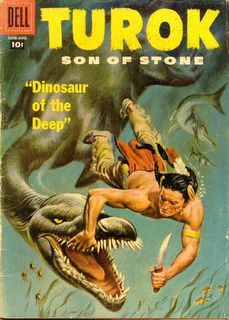
TUROK’s editor was so sure this creative team was on to something that the splash panel of “The Plight of the Plesiosaur” labeled this self-contained parable as the maiden voyage of a new series, entitled "Young Earth." And so began a comics series that appeared in almost every issue of TUROK, SON OF STONE for well over a decade. My collection peters out with TUROK #80 (Sept. 1972), at which point in my collecting days I decided the quality of the comic had dwindled past the point of interest; and there, in its usual spot between chapters of the main TUROK story, sits “Young Earth: Today’s Stone Age Man,” still drawn by Rex Maxon with his characteristic clarity, care, and sense of life (Maxon’s art also graced the latter-day “Gold Key Club Comics” one-pagers dedicated to “Dinosauria,” excerpting art from “Young Earth” narratives to accompany dry text pieces on prehistoric creatures).

“Young Earth” was a revelation: the first true dinosaur comic book series, focusing solely on the prehistoric animals (and, later, on prehistoric man) in compact, concise narratives. Newman’s scripts were marvelously evocative and concise; Maxon’s sketchy, energetic art enlivened the series for the duration of TUROK’s run.

Though the birth of this series, and its impressive longevity, seemed (and remains) inconsequential to those who chart the ebb and flow of comics history and pop culture, it was significant, anticipating all that was to come, including Delgado’s AGE OF REPTILES, my own TYRANT, and the book you now hold in your hands.

So pause a moment, please, and tip your head to Paul S. Newman and Rex Maxon, unsung heroes in comics history, and pioneer creators in our chronology.

'Turok, Son of Stone' is (c) the current copyright holder.

Next Week: Part 6 - "Classics" Illustrated.

Read Part 4 of the series by clicking HERE.

Thanks to the Grand Comic Book Database for the colour covers used in this posting.

Extra thanks to 'Battlin' Bob H. of the KIRBY COMICS BLOG for the last minute Turok scans! Go check out one of my favourite Kirby creations by clicking HERE.

Steve R. Bissette
is an artist, writer and film historian who lives in Vermont. He is noted for, amongst many things, his long run as illustrator of SWAMP THING for DC Comics in the 1980's and for self-publishing the acclaimed horror anthology TABOO and a 'real' dinosaur comic TYRANT(R).

Thursday, April 14, 2005

New Amphibians From The Permian Of Africa

Permian tetrapods from the Sahara show climate-controlled endemism in Pangaea. CHRISTIAN A. SIDOR, F. ROBIN O'KEEFE, ROSS DAMIANI, J. SÉBASTIEN STEYER, ROGER M. H. SMITH, HANS C. E. LARSSON, PAUL C. SERENO, OUMAROU IDE & ABDOULAYE MAGA. 2005. Nature 434: 886 - 889.


From the abstract from the latest issue of Nature:

“New fossils from the Upper Permian Moradi Formation of northern Niger provide an insight into the faunas that inhabited low-latitude, xeric environments near the end of the Palaeozoic era ( 251 million years ago). We describe here two new temnospondyl amphibians, the cochleosaurid Nigerpeton ricqlesi gen. et sp. nov. and the stem edopoid Saharastega moradiensis gen. et sp. nov., as relicts of Carboniferous lineages that diverged 40–90 million years earlier. Coupled with a scarcity of therapsids, the new finds suggest that faunas from the poorly sampled xeric belt that straddled the Equator during the Permian period differed markedly from well-sampled faunas that dominated tropical-to-temperate zones to the north and south. Our results show that long-standing theories of Late Permian faunal homogeneity are probably oversimplified as the result of uneven latitudinal sampling.”

Wednesday, April 13, 2005

The Face Of The Earliest Human

Virtual cranial reconstruction of Sahelanthropus tchadensis. CHRISTOPH P. E. ZOLLIKOFER, MARCIA S. PONCE DE LEÓN, DANIEL E. LIEBERMAN, FRANCK GUY, DAVID PILBEAM, ANDOSSA LIKIUS, HASSANE T. MACKAYE, PATRICK VIGNAUD & MICHEL BRUNET. 2005. Nature 434: 755-759.


From the cover of Nature vol. 434, April 7, 2005

From Ted Chamberlain and Sean Markey at National Geographic News.com:

Does this facial reconstruction depict our earliest known human ancestor? In 2002 paleontologists digging in Chad, Africa, unearthed a skull and other seven-million-year-old fossils of Sahelanthropus tchadensis. Bent by millennia of interment, the skull had a deformed shape that made it tough to tag as totally human.

Now new fossil finds and a high-tech skull reconstruction (not shown) strongly suggest the species was human, after all. This would make it the oldest known human ancestor.

The breakthrough came when researchers recently discovered two new jawbones and a specialized tooth near the site of the original fossil find. A computer reconstruction revealed that these skull pieces fell into place when arranged along the lines of a human skull. Their alignment also hinted at a spine connection typical of upright-walking primates—in other words, humans and human ancestors.

Into Africa

Affinities of 'hyopsodontids' to elephant shrews and a Holarctic origin of Afrotheria SHAWN P. ZACK, TONYA A. PENKROT, JONATHAN I. BLOCH & KENNETH D. ROSE. 2005. Nature 434: 497 - 501.

From the University of Florida press release:

A University of Florida scientist has found the first evidence for origins in North America of a mammal thought to be endemic to Africa. Long considered the cradle of many mammal species, Africa no longer lives up to that image with the discovery in the Wyoming badlands of 54 million-year-old skeletal remains of the first elephant shrew, said Jonathan Bloch, a UF paleontologist who describes his team’s finding in today’s issue of the journal Nature.

“Elephant shrews – part of a group that includes elephants, sea cows and aardvarks, are thought to be endemic to Africa – yet we have found evidence of their beginnings in North America,” Bloch said. “This research has broad implications because it indicates there may have been a great deal more interchange in terms of how animals moved around the world as the continents broke up than previously thought.”

“It is at least possible that primates, like primitive elephant shrews, evolved in North America and spread from there into Europe, Asia and Africa,” said Bloch, who works at the Florida Museum of Natural History on the UF campus. The first modern mammals appeared about 55 million years ago, roughly 10 million years after the mass extinction of the dinosaurs that had dominated them. In this Eocene period arose the first modern primates, the first recognizable horses and many other mammals, Bloch said.

“After the extinction of the dinosaurs 65 million years ago, there was an explosion of diversity,” he said. “Mammals had a huge celebration with all the big predators gone and they just kind of took over. They went crazy, filling all the open ecological niches they couldn’t have exploited while the dinosaurs were still around.”

About 55 million years ago, a dramatic short-term global warming event took place. It lasted 100,000 years at the most, but it brought about the emergence of a huge assortment of new creatures all over the globe, Bloch said. With the warmer climates, the animals’ ranges expanded, he said. As the once giant land mass, or supercontinent, known as Gondwana separated into smaller continents, land bridges temporarily formed that allowed generations of animals to migrate from one part of the world to another, he said.

Once the continents disconnected, animals were thought to have been isolated, Bloch said. But the recent Wyoming discovery suggests the ancestor of certain mammals now living in Africa, such as elephants and primates, could have entered Africa from elsewhere, he said.

Tuesday, April 12, 2005

Feathered Dinos Roost In Toronto

The Royal Ontario Museum in Toronto, Canada, is also hosting an exhibit on feathered dinosaurs entitled, “ Feathered Dinosaurs and the Origins of Flight”. You can read more about it HERE in this article from the Globe & Mail newspaper.

One of the nice features of the exhibit's web page is this feature on the dinosaur palaeontologists who have worked at the ROM:


Read the bios of the Great ROM Dinosaur Hunters HERE or click on the following names: Hans-Deiter Sues, Gord Edmund, Loris Russell, Levi Sternberg, or William Parks

Died This Day: Edward Drinker Cope

(July28, 1840 - April 12, 1987)

From the excellent evolution pages at the University of California at Berkeley web site:

Edward Drinker Cope was an American paleontologist and evolutionist. He was one of the founders of the Neo- Lamarckian school of evolutionary thought. This school believed that changes in developmental (embryonic) timing, not natural selection, was the driving force of evolution. In 1867, Cope suggested that most changes in species occurred by coordinated additions to the ontogeny of all the individuals in a species. Speciation proceeded by the addition of stages to the end of embryonic sequences of development and by compression of earlier stages into the earlier parts of the developmental sequence. That is, a new developmental stage would be tacked onto the end of the developmental process, pushing the old end stage further back in development. Cope thought that groups of species that shared similar developmental patterns could be grouped into more inclusive groups (i.e. genera, families, and so on).

Cope led many natural history surveys in the American West for the precursors of the U.S. Geological Survey. He made many important finds on his trips, including dinosaur discoveries in western North America. Although he is best remembered today for his prolific description of new dinosaur species, and for his notorious ‘fossil war’ with rival O. C. Marsh, Cope was primarily a herpetologist and mammalogist who described many genera and species that are still used today.

Monday, April 11, 2005

Mammoth Uncovered In California

From RedNova.com:


The remarkably well-preserved remnants of an estimated half-million-year-old mammoth - including both tusks - were discovered at a new housing development in Southern California. An onsite paleontologist found the remains, which include 50 percent to 70 percent of the Ice Age creature, as crews cleared away hillsides to prepare for building, Mayor Pro Tem Clint Harper said.

Paleontologist Mark Roeder estimated the mammoth was about 12 feet tall, Harper said. Roeder believed it was not a pygmy or imperial mammoth, but he had not yet determined its exact type, Harper said. Harper said the first bones were spotted several days ago and a special crew was called in after Roeder found more remnants, including the 6- and 7-foot-long tusks.

Moorpark in Ventura County is about 30 miles west-northwest of downtown Los Angeles. Other Ice Age creatures have been found in recent years around Southern California, including a mastodon in Simi Valley, a mammoth in Oceanside and a pygmy mammoth on the Channel Islands.

Ordovician Extinction Linked to Gamma Ray Explosion

From BBC News.com:


A gamma ray burst could have caused the Ordovician extinction 450 million years ago, killing 60% of marine invertebrates at a time when life was largely confined to the sea.

These cosmic blasts are the most powerful explosions in the Universe. The scientists think a 10-second burst near Earth could deplete up to half of the planet's ozone layer. With the ozone layer devastated, the Sun's ultraviolet radiation could have killed off much of the life on land and near the surface of oceans and lakes.

Gamma ray bursts are rare occurrences, but scientists estimate that at least one must have occurred near the Earth in the past one billion years. "A gamma ray burst originating within 6,000 light-years from Earth would have a devastating effect on life," said co-author Dr Adrian Melott, an astronomer at the University of Kansas, US.

"We don't know exactly when one came, but we're rather sure it did come - and left its mark. What's most surprising is that just a 10-second burst can cause years of devastating ozone damage.

Read the full story HERE:

Sabre-Tooth Bite A Pussy Cat

Bite club: comparative bite force in big biting mammals and the prediction of predatory behaviour in fossil taxa. S. Wroe, C McHenry and J Thomason. 2005. Proceedings of the Royal Society Biological Sciences Vol. 272: 619-625.


The saber-toothed tiger would seem to have been an exceptional chomper, but its roar was probably worse than its bite, according to a report published online 23 March in the Proceedings of The Royal Society B: Biological Sciences. By calculating the ratio of bite force to body mass for 39 living and extinct carnivorous mammals, researchers determined that the Tasmanian devil tops the chart with a relative bite 40% stronger than that of the African lion. In contrast, the extinct saber-toothed tiger had one of the weakest bites for its size, suggesting it may have killed by stabbing.

Early Earth Atmosphere Favorable To Life

From a press release from the University of Colorado:


A new University of Colorado at Boulder study indicates Earth in its infancy probably had substantial quantities of hydrogen in its atmosphere, a surprising finding that may alter the way many scientists think about how life began on the planet.

Published in the April 7 issue of Science Express, the online edition of Science Magazine, the study concludes traditional models estimating hydrogen escape from Earth's atmosphere several billions of years ago are flawed. The new study indicates up to 40 percent of the early atmosphere was hydrogen, implying a more favorable climate for the production of pre-biotic organic compounds like amino acids, and ultimately, life.

The paper was authored by doctoral student Feng Tian, Professor Owen Toon and Research Associate Alexander Pavlov of CU-Boulder's Laboratory for Atmospheric and Space Physics with Hans De Sterck of the University of Waterloo. The study was supported by the NASA Institute of Astrobiology and NASA's Exobiology Program. "I didn't expect this result when we began the study," said Tian, a doctoral student in CU-Boulder's Astrobiology Center at LASP and chief author of the paper. "If Earth's atmosphere was hydrogen-rich as we have shown, organic compounds could easily have been produced."

Scientists believe Earth was formed about 4.6 billion years ago, and geologic evidence indicates life may have begun on Earth roughly a billion years later. "This study indicates that the carbon dioxide-rich, hydrogen-poor Mars and Venus-like model of Earth's early atmosphere that scientists have been working with for the last 25 years is incorrect," said Toon. In such atmospheres, organic molecules are not produced by photochemical reactions or electrical discharges.

The new study indicates the escape of hydrogen from Earth's early atmosphere was probably two orders of magnitude slower than scientists previously believed, said Tian. The lower escape rate is based in part on the new estimates for past temperatures in the highest reaches of Earth's atmosphere some 5,000 miles in altitude where it meets the space environment.

While previous calculations assumed Earth's temperature at the top of the atmosphere to be well over 1,500 degrees F several billion years ago, the new mathematical models show temperatures would have been twice as cool back then. The new calculations involve supersonic flows of gas escaping from Earth's upper atmosphere as a planetary wind, according to the study.

Despite somewhat higher ultraviolet radiation levels from the sun in Earth's infancy, the escape rate of hydrogen would have remained low, Tian said. The escaping hydrogen would have been balanced by hydrogen being vented by Earth's volcanoes several billion years ago, making it a major component of the atmosphere.

In 1953, University of Chicago graduate student Stanley Miller sent an electrical current through a chamber containing methane, ammonia, hydrogen and water, yielding amino acids, considered to be the building blocks of life. "I think this study makes the experiments by Miller and others relevant again," Toon said. "In this new scenario, organics can be produced efficiently in the early atmosphere, leading us back to the organic-rich soup-in-the-ocean concept."

Psychosaurus


I'm now back from my research trip to Canada and should be back to posting regularly (including more 'real science') very soon. In the meantime here is a great painting by Pete Von Sholly who has a fun site full of new Turok, Son of Stone faux covers featuring dinosaurs drawn based on their correct anatomy. Go check them out at Psychosaurus by clicking HERE. I'll be featuring more on Pete and his work sometime soon.

A couple of quick asides on my trip to Alberta. While there I helped Philip Currie finish up and send back the page proofs for the new book on Dinosaur Provincial Park to the publisher, University of Indiana Press. This volume should be out in time for the Symposium on Dinosaur Park being held at the Royal Tyrrell Museum this September as part of their 20th anniversary celebrations. For more info on this go to the Museum web page at www.tyrrellmuseum.com.

To Andy F.: I'll be in touch re: CT scanning as soon as I'm caught up here!

Saturday, April 09, 2005

Jurassic Park For Mammoths

Stefan Lovgren from National Geographic.Com reports on new efforts to bring the Mammoth back from extinction:

A team of Japanese genetic scientists aims to bring woolly mammoths back to life and create a Jurassic Park-style refuge for resurrected species. The effort has garnered new attention as a frozen mammoth is drawing crowds at the 2005 World Exposition in Aichi, Japan.


The team of scientists, which is not associated with the exhibit, wants to do more than just put a carcass on display. They aim to revive the Ice Age plant-eaters, 10,000 years after they went extinct.

Their plan: to retrieve sperm from a mammoth frozen in tundra, use it to impregnate an elephant, and then raise the offspring in a safari park in the Siberian wild. "If we create a mammoth, we will know much more about these animals, their history, and why they went extinct," said Kazufumi Goto, head scientist at the Mammoth Creation Project. The venture is privately funded and includes researchers from various institutions in Japan.

Many mammoth experts scoff at the idea, calling it scientifically impossible and even morally irresponsible. "DNA preserved in ancient tissues is fragmented into thousands of tiny pieces nowhere near sufficiently preserved to drive the development of a baby mammoth," said Adrian Lister, a paleontologist at University College London in England.

The scientists with the Mammoth Creation Project are hoping to find a mammoth that is sufficiently well preserved in the ice to enable them to extract sperm DNA from the frozen remains. They will then inject the sperm DNA into a female elephant, the mammoth's modern-day counterpart. By repeating the procedure with offspring, scientists say, they could produce a creature that is 88 percent mammoth within 50 years.

The team has already picked out a home for living mammoths in northern Siberia. The preserve, dubbed Pleistocene Park, could feature not only mammoths, but also extinct species of deer, woolly rhinoceroses, and even saber-toothed cats, he said.

Feathered Dinosaur Show Continues At The CMNH


The Feathered Dinosaur Show is breaking all records at the Cleveland Museum of Natural History. If you've not seen the show yet be sure to get down to the Museum as soon as you can. It's the perfect afternoon out for the family and kids will love the life-like T. rex and Velociraptor.

Friday, April 08, 2005

Steve R. Bissette's The Paleo Path: The History of Dino-Comics - Part 4

Note: The following is modified from Steve Bissette's introduction to the new collection of the comic book PALEO by Jim Lawson.


The first true 'dinosaur comics' to appear regularly on the newsstand evolved within a title that was arguably inspired by TOR, fusing the increasingly-popular western comics genre with the lively 'caveman-and-dinos' universe. Dell Comics' TUROK, SON OF STONE debuted in Dell Four Color #596 (1954), trapping "two Indian braves' Turok and Ander in a remote "lost valley" in the American west, where they would remain for over two decades. My friend and fellow Kubert School classmate Fred Greenberg once described TUROK as "the first existential comic," and he's right; Turok and Ander were forever trapped in their lost valley, and knew they'd never escape, but had to keep trying to find a way out nevertheless.

The debut issue was drawn by TARZAN comic strip artist Rex Maxon, who occasionally returned to the series. But Maxon's steady and lasting contribution to TUROK -- and, though no one has ever before acknowledged it, to comics history and the evolution of the dinosaur comic genre -- was launched without fanfare in TUROK #8 (June-August, 1957).


Maxon's stint on this first TUROK adventure featured a T. rex clearly patterned after the portly blue carnosaur in a Rudolph Zallinger painting, but Maxon's brisk, lively art for the rest of his TUROK tenure (particularly the 'Young Earth' stories) did not slavishly rely upon his reference files, nor did he succumb to the temptation to lend his prehistoric creatures expressive faces contrary to their true natures and forms.


This skill came to the fore in Maxon's delineation of #8's four-page 'back-up' strip "Danger at the Nest," in which a mother Pteranodon defends her treetop nest from a raiding Dimetrodon. The uncredited script -- presumably by series writer Paul S. Newman -- was a model of efficient, unpretentious storytelling, and Maxon's artwork rendered its prehistoric creatures without a hint of anthromorphizing.


But within this simple narrative, something unique was born: this was not an illustrated text page, or dressed-out pop science tidbits, but a fully-realized narrative. The fusion of text captions and sequential art told the tale with direct economy, clarity, and mounted genuine suspense without cheating. Note, too, the spare but elegant use of just two word balloons, used not to lend the pterosaurs speech, but to indicate (on the story's second page) the sound the mother makes feigning injury to lure the predator away from her nest -- a cry echoed neatly by her hatchlings' call for food in the final panel. Thus, the 'sound' evoked by the use of just two word balloons enhanced the kinetic "you are there" immediacy of the strip.

Furthermore, in both text and art, these were animals acting like, and presented as, animals. Without stretching believability or relying on the sort of devices comics usually required in stories involving animals (i.e., human narrators, framing panels featuring human characters, lending speech or human thought to the animal protagonists, etc.), the writer invited the reader to empathize with these creatures, particularly the protagonist. Sly references are made to emotions, but none so emphatically as to break the spell. This mother Pteranodon "proudly eyes here first young breaking his shell...," "...realizes she cannot fight off the lumbering reptile -- her only hope is to lure him away...," "...cleverly back[s] away, just out of his range...," "...as she is about to fly off triumphantly, her wing is caught...," "...sees with relief the Dimetrodon hunting far from her nest...," and "...wonders how her first hatched young is making out...". Even the ravenous carnivore is afforded a moment of empathy, as he "eagerly" scrabbles toward his prey. Thus, for the first time, prehistoric animals moving within their own environment were shown interacting, capable of a range of emotions -- pride, calculation, hope, cleverness, triumph, disappointment, relief, and wonder -- rendered in primal enough terms to remain animals.

Next Week: Part 5 - The second of two parts on Turok, Son of Stone.

Read Part 3 of the series by clicking HERE.

Steve R. Bissette is an artist, writer and film historian who lives in Vermont. He is noted for, amongst many things, his long run as illustrator of SWAMP THING for DC Comics in the 1980's and for self-publishing the acclaimed horror anthology TABOO and a 'real' dinosaur comic TYRANT(R).

Thursday, April 07, 2005

Born This Day: Kenneth (Page) Oakley

April 7, 1911 - November 2, 1981

From Today in Science History:

English physical anthropologist, geologist, and paleontologist best known for his work in the relative dating of fossils by fluorine content. While working for the British Natural History Museum, Oakley become famous in 1953 for exposing a forgery. A "Piltdown Man" skull had been "unearthed" in 1912, in Piltdown, England, and had for decades been said to represent the "missing link" in human evolution. Oakley developed a method, based on a French minerologist's theory that bones would gradually absorb fluorine from surrounding soil, to measure the fluorine levels in bones. With this and other tests he proved the true age of the bones to be a modern human braincase and an orangutan jawbone. The bones of the forgery had been chemically stained to appear ancient.

Wednesday, April 06, 2005

Happy Birthday to The American Museum of Natural History

From Today in Science History:

In 1869, the American Museum of Natural History in New York City was officially created with the signing of a bill by the Governor of New York, John Thompson Hoffman. The museum began from the efforts of Albert Smith Bickmore, one-time student of Harvard zoologist Louis Agassiz, who was successful in his proposal to create a natural history museum in New York City, with the support of William E. Dodge, Jr., Theodore Roosevelt, Sr., Joseph Choate, and J. Pierpont Morgan. It opened to the public 27 Apr 1871. With a series of exhibits, the Museum’s collection went on view for the first time in the Central Park Arsenal, the Museum’s original home, on the eastern side of Central Park.

RTMP Research Trip

For those who like to know these things the palaeoblogger has been in Alberta since April 1 (no foolin') to do work at the Royal Tyrrell Museum of Palaeontology. On Sunday, April 2, I helped Phil Currie lead a tour of the restricted (non-public area) of Dinosaur Provincial Park for a group of about 60 1st year geology students from the U of Calgary. The day was topped off with steaks at the Patricia Steak Pit where I caught up with RTMP field experience volunteers Cathy Falls and Don Cretin. Together we worked on plans for collecting in the southern part of Alberta in July.

Monday and Tuesday have been taken up with working on specimen photography of the Sage Creek ceratopsid body for a manuscript in progress, helping Phil finish the final edits on the up-coming volume on Dinosaur Provincial Park (due out this Fall), working with Post-Doc Francois Therrien identifying ceratopsid material for a project on limb ontogeny (with Eric Snively), and prepping material for CT scanning in Calgary.

More as things progress....

Tuesday, April 05, 2005

Happy Birthday to the British Museum

From Today in Science History:

In 1753, the British Museum was founded by an Act of Parliament. Since then, the museum has been collecting, conserving and studying millions of artifacts. The British Museum was among the first museums to recognize that in-house scientific expertise was essential, both for the care of its collections and for their proper interpretation. Its Research Laboratory was founded in 1920 with the appointment of Dr Alexander Scott as its first scientist.