Tuesday, April 18, 2006

Mapusaurus: The Newest Big Theropod


Photo of cast of Mapusaurus by Rodolfo Coria

From James Owen at National Geographic News:

The new species, named Mapusaurus roseae, is possibly even larger than its close relative Giganotosaurus, which in 1995 took T. rex's crown as the world's biggest known carnivorous dinosaur. While more than matching T. rex for size, Mapusaurus appears to have been a sleeker, more agile predator, with teeth designed for slicing flesh rather than crushing bones.

At least seven of the animals were uncovered together in a mass fossil graveyard in western Patagonia, a region famous for giant-dinosaur remains. Living some 100 million years ago, the largest specimen was more than 12.5 meters long. The find is also one of the first to suggest giant meat-eating dinosaurs lived in groups. "The burial is formed 100 percent by Mapusaurus bones," he added. "The chances they had been deposited randomly are extremely low."

Coria and Currie say Mapusaurus might have hunted the greatest dinosaur of all: a 102-metric-ton, 38-meter-long plant-eater named Argentinosaurus.

Rodolfo Coria, professor at the Carmen Funes Museum in Plaza Huincul, Argentina, found the fossils in the foothills of the Andes mountains.

Coria and fellow paleontologist Philip Currie of the University of Alberta in Canada describe the find in the latest issue of the journal Geodiversitas.

Monday, April 17, 2006

Godzilla Loves Rice!


Art © Tom Bagley

Tom Bagley’s Godzilla drawing can be found in the new book, “Starting Out: The Essential Guide To Cooking On Your Own”, by author Julie Van Rosendaal and illustrated by Tom, out now from Whitecap Books.

It’s the perfect cooking survival guide for palaeo-grad students, beginner chefs and young adults. Designed to help new chefs find independence, this handy book is filled with indispensable tips and information on basic cooking techniques, stocking cupboards and pantries, and fixing cooking disasters.

However, if you’re looking for a recipe that contains more “eye of newt” you should click on over to Tom's website or check out the blog he’s 1/7th of.

And now that Easter is over we can all get back to celebrating the most important holiday of the year -- HALLOWEEN! (what's a few days, give or take?) So, for all those budding young palae-anatomists out there here's some recommended reading:


© Kipling West

Written & illustrated by the wickedly talented Kipling West. You should go to her website now!

Sunday, April 16, 2006

Dinos On Radio Netherlands


Photo of Chasmosaurus irvinensis © M. Ryan. I snapped this earlier today in front of the Canadian Museum of Nature.

Radio Netherlands recently did a piece on “Palaeontology of the Third Millennium”.
Palaeontology has come a long way since the ancient Greeks discovered the fossilised skeletons of huge beasts and interpreted them in a way they could understand.

These new methods weren't invented by the palaeontologists themselves. Usually, they are 'borrowed' from other sciences. Chemistry is an important tool, as is molecular biology or anatomy; even virtual reality might help. No longer are fossilized bones stored carefully in glass cases, never to be touched again. Instead, they are cut in slices, ground into powder, dissolved in acids, analysed in mass spectrometers, and scrutinized at the molecular level under an electron microscope.
You can listen to the broadcast HERE.

Died This Day: Comte Georges-Louis Buffon

Sept. 7, 1707 – April 16, 1788

From Today In Science History:

Buffon was a French naturalist, who formulated a crude theory of evolution and was the first to suggest that the earth might be older than suggested by the Bible. In 1739 he was appointed keeper of the Jardin du Roi, a post he occupied until his death. There he worked on a comprehensive work on natural history, for which he is remembered, Histoire naturelle, générale et particulière. He began this work in 1749, and it dominated the rest of his life. It would eventually run to 44 volumes, including quadrupeds, birds, reptiles and minerals. He proposed (1778) that the Earth was hot at its creation and, from the rate of cooling, calculated its age to be 75,000 years, with life emerging some 40,000 years ago.

More info on Buffon from UC-Berkeley.
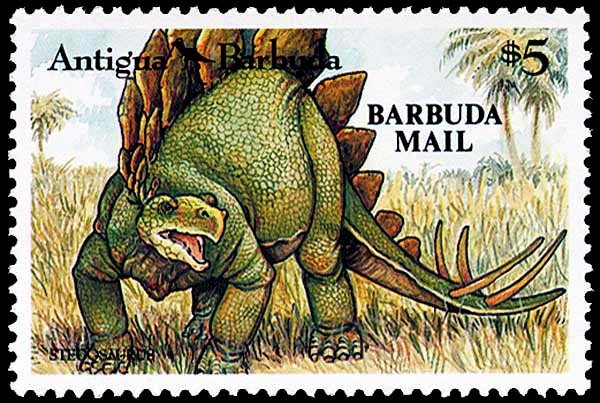
Stamp from HERE.

How Not To Become A Fossil

Assessing the fidelity of the fossil record by using marine bivalves. 2006. J. W. Valentine et al. PNAS early publication, April 14, 2006

The best way to avoid becoming a fossil is to be small and live in deep, tropical waters.
"Everyone talks about how imperfect the fossil record is, but not many people do anything about it," said co-author Dr. David Jablonski. "We're not doing this for the sake of knowing more about clams, but for knowing more about how to answer biological questions in the fossil record more rigorously."

The co-authors focused on bivalves (clams, scallops, oysters, cockles and their kin), because they serve paleontologists the way geneticists use mice or fruit flies as model systems. Jablonski called the clam "a real bellweather" for understanding many long-term changes in biodiversity.

Perhaps fittingly, parasitic clams fared the worst. "They live inside the burrow of another animal, like a shrimp, or they live parasitically upon the soft tissues of another organism. These guys have a lousy fossil record," Kidwell said. "If you're living inside the tissues, or directly attached to the tissues of another organism and it dies, then you're attached to a corpse of decaying organic matter, which is not favorable to shell preservation."


Surprisingly, they found that burrowing clams living within sediments were no more likely to become fossils than similarly sized varieties that lived out in the open. The team also found that shell composition played virtually no role in distorting the bivalve fossil record. That study showed, contrary to longstanding expectations, that clams with durable shells were not better represented in the fossil record than those more prone to dissolving.

Saturday, April 15, 2006

Catfishing

A catfish that can strike its prey on land. 2006. Sam Van Wassenbergh et al. Nature 440: 881.


A close-up of two eel catfish heads from HERE. © S. Devaere

From BBC.com:

The eel catfish, Channallabes apus, is able to propel itself out of the water and bend its head downwards to capture insects in its jaws. The 30-40cm fish is found in the muddy swamps of the tropics of western Africa.

The Belgian researchers hope this discovery will help to explain how fish moved from sea to land millions of years ago.

The fish captures its prey by propelling itself onto the shore, raising the front part of its body and bending its head downwards over the insect. Usually, the fish uses suction to feed underwater; but because air is much less dense than water, the fish needs to employ a new strategy to catch its food.

"The way it positions its head prevents the prey from being pushed away," said Mr Van Wassenbergh. "This way it can place its jaws over the prey; and when it is strongly between the jaws, the fish will return to the water where it can further ingest the insect."

C. apus has a specially adapted spine which gives it extra flexibility, allowing it to tilt its head. The fish uses the rest of its long body to maintain stability while it is out of the water.

Watch the video HERE.

Evolution vs. Creationism In The Classroom At GSA-NC In Akron


Image from HERE

The Department of Geology and Environmental Science at the University of Akron will host the North-Central Regional Earth Science Conference of the Geological Society of America next Thursday and Friday, 20-21 April, with pre-and post-conference field trips, and workshops on Saturday, April 22. Highlights include talks on global climate change, evolution vs. creationism in the classroom, water resources management, and the only Civil War battle fought in Ohio.

Approximately 400 geoscientists from around the country are expected to attend the 40th annual meeting of the North-Central Section of the Geological Society of America. The meeting takes place at the University of Akron Student Center, Akron, OH.

MEETING HIGHLIGHTS INCLUDE:

"Countering Creationism in the Classroom"
Friday, 21 April,1:00-5:00 p.m., University of Akron Theater
Thirteen 20-minute presentations will cover topics ranging from "young earth" and intelligent design to culturally-based nonscientific attitudes and biases and the challenges of advancing scientific literacy. Convener, Dr. Lisa Park at the University of Akron.

View abstracts of the talks at HERE.

Teaching Evolution in the K-12 Classroom.
Sponsored by Central Section, National Association of Geoscience Teachers. Sat., 22 Apr., 9 a.m.-4 p.m.

Classroom techniques for teaching the basic concepts of evolution and the diversity of life throughout the K-12 curriculum. Fee: US$5, includes resource packet and continental breakfast. For more information please contact Pam Keiper (pkeiper@cmnh.org) at the Cleveland Museum of Natural History for more information.

And, the themed session, Recent Advances in Systematics, Evolution, and Paleobiology of Fossil Vertebrates, run by Darin Croft, Case Western Reserve University and the palaeoblogger. This session will highlight current research in vertebrate paleontology, with an emphasis on evolution, systematics, and paleobiology of dinosaurs and Cenozoic mammals.

For further information regarding on field trips, please contact the field trip czar, Joe Hannibal, 216-231-4600 ext. 3233, hannibal@cmnh.org.

Thursday, April 13, 2006

Aggressive Bluebirds Affect Their Evolution

Aggressive behaviour affects selection on morphology by influencing settlement patterns in a passerine bird. 2006. Renée A. Duckworth. Proceedings of the Royal Academy B. Early on-line publication.
In findings that may offer insight into how evolution operates, a Duke University evolutionary ecologist reported evidence that aggressive male western bluebirds out-compete less aggressive males for preferred breeding territories.
From the Duke University press release:

Duckworth found that more-aggressive and milder mannered birds also tended to breed in different settings that favor different body types. This study suggests the birds may play more active roles in their own natural selection than traditional models of evolution would support.

"The traditional view of evolution is that organisms are passive creatures on which natural selection operates," said Duckworth. "[but] by selecting the environment in which they live, animals can actively affect the natural selection they experience," Duckworth said.

“The main message of this study is that the ability of organisms to choose their environment needs to be made a more explicit part of evolutionary theory."

Read the rest of the article HERE.
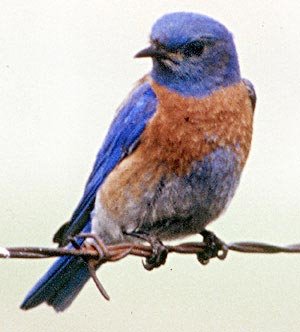
Western Bluebird from HERE

Wednesday, April 12, 2006

Oldest Australopithecus Found In Ethiopia

Asa Issie, Aramis and the origin of Australopithecus. 2006. Tim D. White et al., Nature 440: 883-889.


Image from HERE

Abstract: The origin of Australopithecus, the genus widely interpreted as ancestral to Homo, is a central problem in human evolutionary studies. Australopithecus species differ markedly from extant African apes and candidate ancestral hominids such as Ardipithecus, Orrorin and Sahelanthropus. The earliest described Australopithecus species is Au. anamensis, the probable chronospecies ancestor of Au. afarensis. Here we describe newly discovered fossils from the Middle Awash study area that extend the known Au. anamensis range into northeastern Ethiopia. The new fossils are from chronometrically controlled stratigraphic sequences and date to about 4.1–4.2 million years ago. They include diagnostic craniodental remains, the largest hominid canine yet recovered, and the earliest Australopithecus femur. These new fossils are sampled from a woodland context. Temporal and anatomical intermediacy between Ar. ramidus and Au. afarensis suggest a relatively rapid shift from Ardipithecus to Australopithecus in this region of Africa, involving either replacement or accelerated phyletic evolution.

From the UC – Berkeley press release:
New fossils discovered in the Afar desert of eastern Ethiopia are a missing link between our ape-man ancestors some 3.5 million years ago and more primitive hominids a million years older.
The fossils are from the most primitive species of Australopithecus, known as Au. anamensis, and date from about 4.1 million years ago, said Tim White, one of the team's leaders. The hominid Australopithecus has often been called an ape-man because, though short-statured, small-brained and big-toothed, it walked on two legs unlike the great apes.

More primitive hominids in the genus Ardipithecus date from between 4.4 million and 7 million years ago and were much more ape-like, though they, too, walked on two legs.

"This new discovery closes the gap between the fully blown Australopithecines and earlier forms we call Ardipithecus," White said. "We now know where Australopithecus came from before 4 million years ago."

"It is fair to say that some species of Ardipithecus gave rise to Australopithecus," he said.

In all, teeth and jawbones of eight individuals were found at Asa Issie, all from about 4.1 million years ago as dated by paleomagnetic and argon-argon methods. A partial thigh bone and hand and foot bones were very similar to the Lucy bones found 60 kilometers away in Hadar and dating from 3 million to 3.4 million years ago. The large, thick-enameled teeth were judged by the research team to be closest to Au. anamensis, and ancestral to Au. afarensis.

Congradulations to the CMNH's Dr. Yohannes Haile-Selassie who is a co-author on the paper.

Read the rest of the article HERE.

Died This Day: Edward Drinker Cope

July 28, 1840 – April 12, 1897


Art © Mark Schultz

From NiagaraMuseum.com:
"What truly assured Cope's (above right) place in the history of paleontology and even eclipsed his science was his bitter feud with Yale University paleontologist O.C. Marsh (above left). What began as a friendly rivalry in the late 1860s, broke out into all out war in 1872 and then raged on until Cope's death in 1897. Both Cope and Marsh were recipients of family fortunes and they used their wealth to discover new fossils and to reconstruct ancient life. This scramble literally propelled American science into the forefront of paleontology."
Read about Cope HERE.

New Biggest T. rex Skull


Photo by John Little. © Montana State University 2005

From the Montana State University press release:
The world's largest Tyrannosaurus rex skull, unearthed nearly 40 years ago in eastern Montana, is now on display at the Museum of the Rockies at Montana State University in Bozeman.
The skull measures measures 59 inches long from its snout to the back of its skull. By the same standard, the Field's Sue is a close runner-up at 55.4 inches long according to Jack Horner, the Museum's curator of paleontology.

Skull fragments from the specimen, known as MOR 008, were found in the Hell Creek Formation near Billings in the late 1960s and collected by Bill McMannis, an MSU geologist. Museum preparator Carrie Ancell began their reconstruction in the late 1980s, and preparator Michael Holland finished the job this year.

A single vertebra is the only other piece of MOR 008 that has been found besides the skull.

"We are going to try and figure out how old the animal was when it died by using histology, the study of the microscopic structure of fossil remains," Horner said. "The specimen contains several characteristics that suggest this individual was mature, and perhaps quite old when it died."

MOR 008 is one of three T-rex skulls in the Museum of the Rockies collection, all of which are on display in the Hall of Horns and Teeth. All of them were found in Montana. The Museum has part of twelve T-rexes, more than any other institution in the world.

Tuesday, April 11, 2006

Harryhausen Interview


Ray Harryhausen talked with Christopher Bahn of The A.V. Club about his life and his new book, The Art Of Ray Harryhausen, which looks back at his career from his high-school days building mammoths out of his mother's discarded fur coat to his latest work as a bronze sculptor.

Bahn also blogs at Incoming Signals which always features links to lots of great stories and arcane trivia.

I meant to post this a few weeks ago when it went up but it got lost in the shuffle. Thanks to good buddy Eric Snively for letting me know about this.

Crisis? What Crisis?

Global Warming and Extinctions of Endemic Species from Biodiversity Hotspots. 2006. J.R. Malcolm et al., Conservation Biology 20: 538
The Earth could see massive waves of species extinctions around the world if global warming continues unabated, according to a new study published in the scientific journal Conservation Biology.

Supertramp from HERE.

From the Conservation Biology press release:

The study expands on a much-debated 2004 paper published in the journal Nature that suggested a quarter of the world's species would be committed to extinction by 2050 as a result of global warming. The results reinforce the massive species extinction risks identified in the 2004 study.

Using vegetation models, the research is one of the first attempts to assess the potential effects of climate change on terrestrial biodiversity on a global scale rather than just looking at individual species. Scientists looked specifically at the effect that climate change would have on 25 of the 34 globally outstanding "biodiversity hotspots" – areas containing a large number of species unique to these regions alone, yet facing enormous threats.

"The hotspots studied in this paper are essentially refugee camps for many of our planet's most unique plant and animal species. If those areas are no longer habitable due to global warming then we will quite literally be destroying the last sanctuaries many of these species have left."


Image from HERE.

Areas particularly vulnerable to climate change include the tropical Andes, the Cape Floristic region of South Africa, Southwest Australia, and the Atlantic forests of Brazil, Paraguay and Argentina.

Monday, April 10, 2006

An Oscar Mayer Stegosaurus

It must have been a slow news day at the THE PUEBLO CHIEFTAIN but Scott Smith whipped up a story on Stegosaurus.

He even got some great quotes from Ken Carpenter.


Image from HERE.

The Stegosaurus also happens to be Colorado's official state fossil. So please take the time to learn a little more about one of the earliest inhabitants of our neighborhood . . .

But does that mean that the Stegosaurus was stupid? No one really knows for sure, but Ken Carpenter, dinosaur expert at the Denver Museum of Nature & Science, put it this way:

"Smart is a relative term," he said. "Compared to a bacteria, (stegosaurs) were very smart; compared to a dog, they were kind of dumb; compared to sheep . . . well, close. Sheep are really stupid."

OK, so the Stegosaurus was never in danger of being class valedictorian. But Carpenter also noted that the animal's brain - often described as being the size of a walnut, pingpong ball or golf ball - was actually larger than first believed. "Definitely bigger than a walnut," he said.

"It looks like an Oscar Mayer wiener that's bent. It's very long."

Get your Wienermobile facts HERE

Read the rest of the article HERE.

Perils of Field Work


Photo © M. Ryan

The photo of Laonastes that I ran a few days ago reminded me of the above photo I took on July 17 of last year. After a few weeks of field work along the Milk River, David Evans, myself, and the rest of our crew packed up to leave. On that final morning Evans got up the nerve to look under the couch he'd been sleeping on for two weeks and found this. You can even see the cute little toes.

Sunday, April 09, 2006

Piled Higher & Deeper

It's Sunday so let's read the funnies:


© 1997-2002 Jorge Cham. CLICK TO ENLARGE..

© 1997-2002 Jorge Cham. CLICK TO ENLARGE..

© 1997-2002 Jorge Cham. CLICK TO ENLARGE..

The comic strip "Piled Higher and Deeper" has appeared in The Stanford Daily for the past seven years, and in the MIT, Carnegie Mellon University and Caltech newspapers, among others. The author, Jorge Cham, got his PhD in Mechanical Engineering at Stanford University, and is now an "Instructor" at the California Institute of Technology (Caltech).

Thanks to ReBecca Hunt for pointing me to this site.

How Ants Evolved

Phylogeny of the Ants: Diversification in the Age of Angiosperms. 2006. Corrie S. Moreau, et al. Science Vol. 312.: 101 – 104.

From LiveScience.com:
The emergence of flowering plants 100 million years ago may have led to the explosion in ant diversity that occurred around the same time, scientists say.
The 11,800 known species of modern ants probably arose from a single species millions of years ago, but scientists previously knew little about ants' evolutionary history. Researchers analyzed fossilized ants trapped in amber and discovered that the ancestors of modern ants first scurried along the ground 140 to 168 million years ago.

These ants, however, were diversifying at a very slow rate. Then flowers, also known as angiosperms, sprouted onto the scene.

"An event happened 100 million years ago and ants started diversifying like crazy," study co-author Corrie Moreau of Harvard University told LiveScience. "This is also the time when we start seeing the first angiosperm forests."

These forests dropped more litter to the ground, creating more niches and complicated habitats for ants to specialize and diversify in. Today the greatest ant diversity is observed in plant debris and just under the soil. Forest canopies also provided interesting new homes for ants, including some that have learned to glide back to their home tree if the fall.

Other insects experienced a boom with the coming of flowers. These insects also lived among the debris, creating a massive new food source for ants. The flowering plants would make pretty good ant snacks themselves.
Strange Tales © Marvel Comices

Flintstone Chopper


Some Sunday morning fun. Über-rich Canadian toymaker and sometime comic book artist, Todd McFarlane, has a new line of figures due to hit the market soon based on various Hanna-Barbara cartoon characters. Dig the Styracosaurus handle bars on Fred Flintstone’s chopper.

For more pix go HERE.

Saturday, April 08, 2006

The Truth About De-Evolution

"They tell us that we lost our tails
evolving up from little snails
I say that's all just wind in sails
Are we not men?"

Laonastes aenigmamus Not Rare?

From BBC.co.uk:
A rodent that "came back from the dead" after supposedly going extinct millions of years ago appears to be more common than previously thought.

Image: Peter Clyne

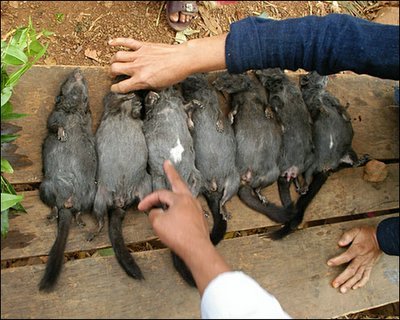
The Laotian rock rat, known locally as the kha-nyou, was identified as a species new to science in 2005. It was spotted at a hunter's market in Laos by researchers from the Wildlife Conservation Society (WCS).

A return visit has uncovered more specimens, suggesting the squirrel-like animal may not be that rare. On a recent visit to a hunter's market in Laos, WCS conservationist Peter Clyne found the rats to be quite common, photographing several specimens."

The creature was originally thought to belong to an entirely new rodent family more closely related to rodents in Africa and South America than in Asia. However, after a detailed search through the fossil records of the Natural History Museum in London, the mammal is now believed to be the sole survivor of an ancient group of rodents that died out 11 million years ago.