Sir Charles Lyell (Nov. 14, 1797 - Feb. 22, 1875) attended Oxford University at age 19. Lyell's father was an active naturalist. Lyell had access to an elaborate library including subjects such as Geology.
When Lyell was at Oxford, his interests were mathematics, classics, law and geology. He attended a lecture by William Buckland that triggered his enthusiasm for geology. Lyell originally started his career as a lawyer, but later turned to geology. He became an author of The Geological Evidence of the Antiquity of Man in 1863 and Principles of Geology. Lyell argued in this book that, at the time, presently observable geological processes were adequate to explain geological history. He thought the action of the rain, sea, volcanoes and earthquakes explained the geological history of more ancient times.
Lyell rebelled against the prevailing theories of geology of the time. He thought the theories were biased, based on the interpretation of Genesis. He thought it would be more practical to exclude sudden geological catastrophes to vouch for fossil remains of extinct species and believed it was necessary to create a vast time scale for Earth's history. This concept was called Uniformitarianism. The second edition of Principles of Geology introduced new ideas regarding metamorphic rocks. It described rock changes due to high temperature in sedimentary rocks adjacent to igneous rocks. His third volume dealt with paleontology and stratigraphy. Lyell stressed that the antiquity of human species was far beyond the accepted theories of that time.
Charles Darwin became his dear friend and correspondent. Darwin is quoted saying, "The greatest merit of the Principles was that it altered the whole tone of one's mind, and therefore that, when seeing a thing never seen by Lyell, one yet saw it through his eyes."
Image from King’s College London.
Sunday, November 14, 2010

Saturday, November 13, 2010
Fantasia Debuts (1940)
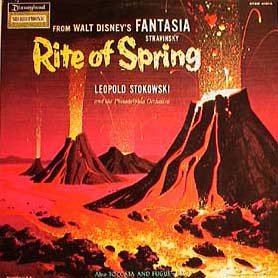
Walt Disney’s epic film, Fantasia, opened this day on Broadway in New York City in 1940.
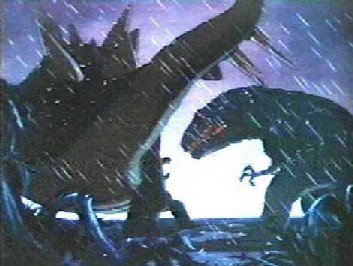 The film featured Leopold Stokowski and the Philadelphia Orchestra performing a number of pieces of classical music to the film’s animated visuals. Igor Stravinsky’s “Rite of Spring” provided the score for the evolution of the Earth including a wonderful sequence on the extinction of the dinosaurs at the end of the Cretaceous. Many school teachers actually showed this sequence in science class -- that’s where I first saw it!


Born This Day: Helen Mack

Nov 13, 1913 – August 13, 1986
Friday, November 12, 2010
Born This Day: Julie Ege

Nov. 12, 1943 – April 29, 2008
Wednesday, November 10, 2010
Died This Day: Gideon Mantell
Mantell (Feb. 3, 1790 – Nov. 10, 1852), a physician of Lewes in Sussex in southern England, had for years been collecting fossils in the sandstone of Tilgate forest, 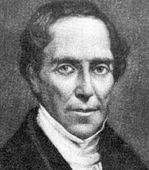 and he had discovered bones belonging to three extinct species: a giant crocodile, a plesiosaur, and Buckland's Megalosaurus. But in 1822 he found several teeth that "possessed characters so remarkable" that they had to have come from a fourth and distinct species of Saurian. After consulting numerous experts, Mantell finally recognized that the teeth bore an uncanny resemblance to the teeth of the living iguana, except that they were twenty times larger.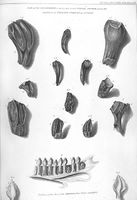
In this paper, the second published description of a dinosaur, he concluded that he had found the teeth of a giant lizard, which he named Iguanodon, or "Iguana-tooth."
Mantell illustrated his announcement with a single lithographed plate. Mantell included at the bottom of the plate a drawing of a recent iguana jaw, which is shown four times natural size, and for further comparison, he added views of the inner and outer surface of a single iguana tooth, "greatly magnified."
The traditional story that Mantell's wife found the first teeth in 1822, while the doctor was visiting a patient, appears, alas, to be unfounded.
Info and plate from HERE.
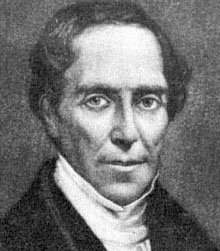 and he had discovered bones belonging to three extinct species: a giant crocodile, a plesiosaur, and Buckland's Megalosaurus. But in 1822 he found several teeth that "possessed characters so remarkable" that they had to have come from a fourth and distinct species of Saurian. After consulting numerous experts, Mantell finally recognized that the teeth bore an uncanny resemblance to the teeth of the living iguana, except that they were twenty times larger.
In this paper, the second published description of a dinosaur, he concluded that he had found the teeth of a giant lizard, which he named Iguanodon, or "Iguana-tooth."
Mantell illustrated his announcement with a single lithographed plate. Mantell included at the bottom of the plate a drawing of a recent iguana jaw, which is shown four times natural size, and for further comparison, he added views of the inner and outer surface of a single iguana tooth, "greatly magnified."
The traditional story that Mantell's wife found the first teeth in 1822, while the doctor was visiting a patient, appears, alas, to be unfounded.
Info and plate from HERE.
Born This Day: Francis Maitland Balfour
Balfour (Nov. 10, 1851 – July 19, 1882) was a British zoologist and a founder of modern embryology. Influenced by the work of Michael Foster, with whom he wrote Elements of Embryology (1883), Balfour  showed the evolutionary connection between vertebrates and certain invertebrates (similar to research being done by Aleksandr Kovalevski).
Balfour proposed the term Chordata for all animals possessing a notochord at some stage in their development. He also did pioneer work on the development of the kidneys and related organs, as well as the spinal nervous system. While convalescing from typhoid fever in Switzerland, he died at the young age of 30 from a fall while attempting an ascent of the unconquered Aiguille Blanche of Mont Blanc. From Today In Science History
 showed the evolutionary connection between vertebrates and certain invertebrates (similar to research being done by Aleksandr Kovalevski).
Balfour proposed the term Chordata for all animals possessing a notochord at some stage in their development. He also did pioneer work on the development of the kidneys and related organs, as well as the spinal nervous system. While convalescing from typhoid fever in Switzerland, he died at the young age of 30 from a fall while attempting an ascent of the unconquered Aiguille Blanche of Mont Blanc. From Today In Science History
Sunday, November 07, 2010
Died This Day: Alfred Russel Wallace
Wallace (Jan. 8, 1823 – Nov. 7, 1913) was a British naturalist and biogeographer. He was the first westerner to describe some of the most interesting natural habitats in the tropics. He is best known for devising a theory of the origin of species through natural selection made independently of Darwin.
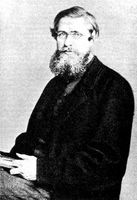 Between 1854 and 1862, Wallace assembled evidence of natural selection in the Malay Archipelago, sending his conclusions to Darwin in England. Their findings were jointly presented to the Linnaean Society in 1858. Wallace found that Australian species were more primitive, in evolutionary terms, than those of Asia, and that this reflected the stage at which the two continents had become separated. He proposed an imaginary line (now known as Wallace's line) dividing the fauna of the two regions.
From Today In Science History
The Alfred Russel Wallace page HERE. More HERE.
 Between 1854 and 1862, Wallace assembled evidence of natural selection in the Malay Archipelago, sending his conclusions to Darwin in England. Their findings were jointly presented to the Linnaean Society in 1858. Wallace found that Australian species were more primitive, in evolutionary terms, than those of Asia, and that this reflected the stage at which the two continents had become separated. He proposed an imaginary line (now known as Wallace's line) dividing the fauna of the two regions.
From Today In Science History
The Alfred Russel Wallace page HERE. More HERE.
Saturday, November 06, 2010
Died This Day: Henry Fairfield Osborn
Osborn graduated (August 8, 1857 - November 6, 1935) from Princeton in 1877 and pursued his interest in the biological sciences and paleontology through additional study at several New York City medical schools and with Thomas Henry Huxley in Britain.  Returning to the United States, Osborn accepted a position at Princeton, teaching natural sciences from 1881 until 1891, when he moved to Columbia University to organize the Biology Department there, and in 1891, he also helped to organize the Department of Vertebrate Paleontology at the American Museum of Natural History acting as it’s first curator. Osborn's close association with American Museum continued for over 45 years, and included a long tenure as its President, 1908-1933. During these years the museum's collections expanded enormously and it became one of the preeminent research institutions for natural history in the world.
Osborn is noted for describing and naming both Tyrannosaurus rex and Albertosaurus in 1905, Pentaceratops in 1923, and Velociraptor in 1924. One of Osborn's favorite groups for study was the brontotheres, and he was the first to carry out comprehensive research on them. He also wrote an influential textbook, The Age of Mammals (1910).
Apart from his own research, Osborn is perhaps best remembered for the sponsorship of the five immensely successful Central Asiatic Expeditions during the 1920's and 30's led by Roy Chapman Andrews.
Entry from HERE and HERE.
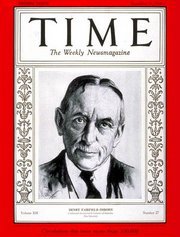 Returning to the United States, Osborn accepted a position at Princeton, teaching natural sciences from 1881 until 1891, when he moved to Columbia University to organize the Biology Department there, and in 1891, he also helped to organize the Department of Vertebrate Paleontology at the American Museum of Natural History acting as it’s first curator. Osborn's close association with American Museum continued for over 45 years, and included a long tenure as its President, 1908-1933. During these years the museum's collections expanded enormously and it became one of the preeminent research institutions for natural history in the world.
Osborn is noted for describing and naming both Tyrannosaurus rex and Albertosaurus in 1905, Pentaceratops in 1923, and Velociraptor in 1924. One of Osborn's favorite groups for study was the brontotheres, and he was the first to carry out comprehensive research on them. He also wrote an influential textbook, The Age of Mammals (1910).
Apart from his own research, Osborn is perhaps best remembered for the sponsorship of the five immensely successful Central Asiatic Expeditions during the 1920's and 30's led by Roy Chapman Andrews.
Entry from HERE and HERE.
Friday, November 05, 2010
Died This Day: Alfred Sherwood Romer
”Romer (Dec. 28, 1894 – Nov. 5, 1973) was director of the Museum of Comparative Zoology at Harvard University until his retirement in 1961 and was one the singularly most influential vertebrate paleontologists of the 20th Century. His work ranged over virtually every  conceivable subject within that field, although it was the osteology and taxonomy of the therapsids and other proto-mammals which was nearest his heart.
In addition to this work, Romer was acutely interested in the origin and initial adaptive radiation of tetrapods, and his work became the basis for a theory of tetrapod origins which was canon until the description of Acanthostega gunnari by Clack & Coates in the 1990s. Romer was ahead of his time in his defense of monophyly of Dinosauria though he did feel that Theropoda was not ancestral to birds.” link from EvoWiki.org
Romer’s book, Vertebrate Paleontology (1966), was for many years THE textbook on VP and is still well worth picking up. One of Romer’s students, Bob Carroll, wrote an updated version entitled, ‘Vertebrate Paleontology and Evolution’, in 1987. image
 conceivable subject within that field, although it was the osteology and taxonomy of the therapsids and other proto-mammals which was nearest his heart.
In addition to this work, Romer was acutely interested in the origin and initial adaptive radiation of tetrapods, and his work became the basis for a theory of tetrapod origins which was canon until the description of Acanthostega gunnari by Clack & Coates in the 1990s. Romer was ahead of his time in his defense of monophyly of Dinosauria though he did feel that Theropoda was not ancestral to birds.” link from EvoWiki.org
Romer’s book, Vertebrate Paleontology (1966), was for many years THE textbook on VP and is still well worth picking up. One of Romer’s students, Bob Carroll, wrote an updated version entitled, ‘Vertebrate Paleontology and Evolution’, in 1987. image
Born This Day: J.B.S. Haldane
Haldane (Nov. 5, 1892 - Dec. 1, 1964) is best remembered along with E. B. Ford and R. A. Fisher one of the three major figures to develop the mathematical theory of population genetics. His greatest contribution was in a series of ten papers on "A Mathematical Theory of Natural and Artificial Selection" which was the major series of papers on the  mathematical theory of natural selection. It treated many major cases for the first time, showing the direction and rates of changes of gene frequencies. It also pioneered in investigating the interaction of natural selection with mutation and with migration.
Haldane's book, The Causes of Evolution (1932), summarized these results, especially in its extensive appendix. This body of work was a component of what came to be known as the "modern evolutionary synthesis", re-establishing natural selection as the premier mechanism of evolution by explaining it in terms of the mathematical consequences of Mendelian genetics. From Wikipedia. More info here.
 mathematical theory of natural selection. It treated many major cases for the first time, showing the direction and rates of changes of gene frequencies. It also pioneered in investigating the interaction of natural selection with mutation and with migration.
Haldane's book, The Causes of Evolution (1932), summarized these results, especially in its extensive appendix. This body of work was a component of what came to be known as the "modern evolutionary synthesis", re-establishing natural selection as the premier mechanism of evolution by explaining it in terms of the mathematical consequences of Mendelian genetics. From Wikipedia. More info here.
Tuesday, October 26, 2010
More On Darwinius
Darwinius masillae is a Haplorhine — Reply to Williams et al. (2010) . 2010. J. of Human Evolution 59: 574-579

Darwinius is now placed within the anthropoid line of primate evolution. One of the new cladistic analyses was made by excluding fossil taxa consisting only of small fragments like single teeth or jaws. This led to a more robust result with many fewer and more strongly supported cladistic trees.
More on the research and story behind Darwinius masillae.
Thanks to Jorn for sending me the press release.

A new investigation of the skeleton of Darwinius masillae, known as ‘Ida’, confirms and strengthens earlier conclusions of the team working on the fossil.Researchers have presented several cladistic analyses reaffirming Darwinius as a haplorhine primate related to anthropoid or higher primates (monkeys and apes). The new study discusses and refutes studies by Seiffert and others (2009) in Nature, and Williams and others (2010) in Journal of Human Evolution that sought to dismiss Darwinius as a strepsirrhine primate (related to lemurs and lorises).
Darwinius is now placed within the anthropoid line of primate evolution. One of the new cladistic analyses was made by excluding fossil taxa consisting only of small fragments like single teeth or jaws. This led to a more robust result with many fewer and more strongly supported cladistic trees.
More on the research and story behind Darwinius masillae.
Thanks to Jorn for sending me the press release.
Monday, October 25, 2010
Early Eocene Amber from India
Biogeographic and evolutionary implications of a diverse paleobiota in amber from the early Eocene of India. 2010. J. Rust, et al. PNAS, Published online before print October 25.

David Grimaldi/AMNH
Bees, termites, spiders, and flies entombed in a newly-excavated amber deposit are challenging the assumption that India was an isolated island-continent in the Early Eocene, or 52-50 million years ago. Arthropods found in the Cambay deposit from western India are not unique—as would be expected on an island—but rather have close evolutionary relationships with fossils from other continents. The amber is also the oldest evidence of a tropical broadleaf rainforest in Asia.
Amber from broadleaf trees is rare in the fossil record until the Tertiary, or after the dinosaurs went extinct. It was during this era that flowering plants rather than conifers began to dominate forests and developed the ecosystem that still straddles the equator today. The new amber, and amber from Colombia that is 10 million years older, indicates that tropical forests are older than previously thought.
The amber has been chemically linked to Dipterocarpaceae, a family of hardwood trees that currently makes up 80 percent of the forest canopy in Southeast Asia. ossilized wood from this family was found as well, making this deposit the earliest record of these plants in India and showing that this family is nearly twice as old as was commonly believed. It most likely originated when portions of the southern supercontinent Gondwana were still connected. link

David Grimaldi/AMNH
Amber from broadleaf trees is rare in the fossil record until the Tertiary, or after the dinosaurs went extinct. It was during this era that flowering plants rather than conifers began to dominate forests and developed the ecosystem that still straddles the equator today. The new amber, and amber from Colombia that is 10 million years older, indicates that tropical forests are older than previously thought.
The amber has been chemically linked to Dipterocarpaceae, a family of hardwood trees that currently makes up 80 percent of the forest canopy in Southeast Asia. ossilized wood from this family was found as well, making this deposit the earliest record of these plants in India and showing that this family is nearly twice as old as was commonly believed. It most likely originated when portions of the southern supercontinent Gondwana were still connected. link
The Emergence of Modern Humans in East Asia
Human remains from Zhirendong, South China, and modern human emergence in East Asia. 2010. W. Liu, et al. PNAS, Published online before print October 25.

The discovery of early modern human fossil remains in the Zhirendong (Zhiren Cave) in south China that are at least 100,000 years old provides the earliest evidence for the emergence of modern humans in eastern Asia, at least 60,000 years older than the previously known modern humans in the region.
The Zhirendong fossils have a mixture of modern and archaic features that contrasts with earlier modern humans in east Africa and southwest Asia, indicating some degree of human population continuity in Asia with the emergence of modern humans.
The Zhirendong humans indicate that the spread of modern human biology long preceded the cultural and technological innovations of the Upper Paleolithic and that early modern humans co-existed for many tens of millennia with late archaic humans further north and west across Eurasia. link

The discovery of early modern human fossil remains in the Zhirendong (Zhiren Cave) in south China that are at least 100,000 years old provides the earliest evidence for the emergence of modern humans in eastern Asia, at least 60,000 years older than the previously known modern humans in the region.
The Zhirendong fossils have a mixture of modern and archaic features that contrasts with earlier modern humans in east Africa and southwest Asia, indicating some degree of human population continuity in Asia with the emergence of modern humans.
The Zhirendong humans indicate that the spread of modern human biology long preceded the cultural and technological innovations of the Upper Paleolithic and that early modern humans co-existed for many tens of millennia with late archaic humans further north and west across Eurasia. link
Friday, October 22, 2010
Philip Currie Receives Alberta Order of Excellence

From the web site:
Dr. Phil Currie is an internationally renowned palaeontologist whose scientific accomplishments have led to a greater understanding of dinosaurs and their historic significance. He was instrumental in the development of Alberta’s Royal Tyrrell Museum and has made major contributions to palaeontology on both the Canadian and the world stage through his extensive field work, academic research, writing and teaching.
Read his full bio here.
Cannibalism in T. rex
Cannibalism in Tyrannosaurus rex. 2010. N. Longrich, et al. PLoS ONE 5(10): e13419

The marks are definitely the result of feeding, although scientists aren’t sure whether they are the result of scavengers or the end result of fighting, Longrich said, adding that if two T. rex fought to the death, the victor might have made a meal out of his adversary. “Modern big carnivores do this all the time,” he said. “It’s a convenient way to take out the competition and get a bit of food at the same time.”
However, the marks appear to have been made some time after death, Longrich said, meaning that if one dinosaur killed another, it might have eaten most of the meat off the more accessible parts of the carcass before returning to pick at the smaller foot and arm bones. link

The marks are definitely the result of feeding, although scientists aren’t sure whether they are the result of scavengers or the end result of fighting, Longrich said, adding that if two T. rex fought to the death, the victor might have made a meal out of his adversary. “Modern big carnivores do this all the time,” he said. “It’s a convenient way to take out the competition and get a bit of food at the same time.”
However, the marks appear to have been made some time after death, Longrich said, meaning that if one dinosaur killed another, it might have eaten most of the meat off the more accessible parts of the carcass before returning to pick at the smaller foot and arm bones. link
Born This Day: Constantine Samuel Rafinesque
Rafinesque (Oct 22, 1783 – Sept. 18, 1840) was a naturalist, traveler, and writer who made major and controversial contributions to botany and ichthyology. Rafinesque believed that each variety of a species is a  "deviant," which, through reproduction, may become a permanent species; thus, he anticipated, to some extent, part of Charles Darwin's theory of evolution.
Although Rafinesque's scientific abilities were recognized in his lifetime, he was also severely criticized for sometimes doing careless work and for his tendency to establish new genera and species. Throughout his life he traveled extensively, collected specimens wherever he went, and wrote and published constantly. From Today In Science History
Image and more info here.
 "deviant," which, through reproduction, may become a permanent species; thus, he anticipated, to some extent, part of Charles Darwin's theory of evolution.
Although Rafinesque's scientific abilities were recognized in his lifetime, he was also severely criticized for sometimes doing careless work and for his tendency to establish new genera and species. Throughout his life he traveled extensively, collected specimens wherever he went, and wrote and published constantly. From Today In Science History
Image and more info here.
Died This Day: Sir Roderick Murchison
Murchison (Feb. 19, 1792 - Oct. 22, 1871) was a Scottish geologist who first differentiated the Silurian strata in the geologic sequence of Early Paleozoic strata (408-540 million years old). He believed in fossils as primary criteria. In 1831, he began researching the previously geologically unknown graywacke rocks of the Lower Paleozoic, found underlying the Old Red Sandstone in parts of Wales, which culminated in his major work the Silurian System (1839).
Murchison named the Silurian after an ancient British tribe that inhabited South Wales. He established the Devonian working with Adam Sedgwick (1839). He named the Permian (1841) after the Perm province in Russia where he made a geological survey in 1840-45. link
Murchison named the Silurian after an ancient British tribe that inhabited South Wales. He established the Devonian working with Adam Sedgwick (1839). He named the Permian (1841) after the Perm province in Russia where he made a geological survey in 1840-45. link

Thursday, October 21, 2010
Evolution of Sexual Organs in Plants
Single amino acid change alters the ability to specify male or female organ identity. 2010. C.A. Airoldi, et al. PNAS, published ahead of print October 18.
"Snapdragons are on the cusp of splitting the job of making male and female organs between these two genes, a key moment in the evolutionary process," says Brendan Davies.
By tracing back through the evolutionary 'tree' for flowering plants, the researchers calculate the gene duplication took place around 120 million years ago. But the mutation which separates how snapdragons and rock cress use this extra gene happened around 20 million years later.
"Our research is an excellent example of how a chance imperfection sparks evolutionary change. If we lived in a perfect world, it would be a much less interesting one, with no diversity and no chance for new species to develop." link

New research has uncovered a snapshot of evolution in progress, by tracing how a gene mutation over 100 million years ago led flowers to make male and female parts in different ways.In a number of plants, the gene involved in making male and female organs has duplicated to create two, very similar, copies. In rockcress (Arabidopsis), one copy still makes male and female parts, but the other copy has taken on a completely new role: it makes seed pods shatter open. In snapdragons (Antirrhinum), both genes are still linked to sex organs, but one copy makes mainly female parts, while still retaining a small role in male organs – but the other copy can only make male.
"Snapdragons are on the cusp of splitting the job of making male and female organs between these two genes, a key moment in the evolutionary process," says Brendan Davies.
By tracing back through the evolutionary 'tree' for flowering plants, the researchers calculate the gene duplication took place around 120 million years ago. But the mutation which separates how snapdragons and rock cress use this extra gene happened around 20 million years later.
"Our research is an excellent example of how a chance imperfection sparks evolutionary change. If we lived in a perfect world, it would be a much less interesting one, with no diversity and no chance for new species to develop." link
Friday, October 15, 2010
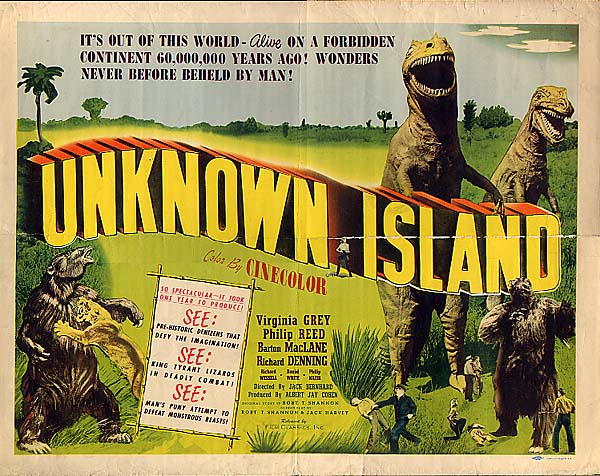
Debuted This Day (1948): Unknown Island
Written by Robert T. Shannon and directed by Bernhard, this ridiculaous little film features some of the worst ‘man dressed up as a T. rex’ effects ever. Not a bad little story though.

Sarahsaurus aurifontanalis, A New Sauropodomorph
Dispersal and diversity in the earliest North American sauropodomorph dinosaurs, with a description of a new taxon. T. Rowe, et al. Proc. R. Soc. B published online before print October 6, 2010

A new sauropodomorph from Arizona, Sarahsaurus aurifontanalis, lived about 190 million years ago (Early Jurassic Period) and was 14 feet long and weighed about 250 pounds.
Evidence from Sarahsaurus and two other early sauropodomorphs suggests that each migrated into North America at the end of the Triassic Period 200 million years ago in separate waves long after the Triassic extinction, and that no such dinosaurs migrated there before the extinction.
Sarahsaurus had physical traits usually associated with gigantic animals. For example, its thigh bones were long and straight like pillars, yet were not much larger than a human's thigh bones. Sarahsaurus shows that sauropodmorphs started out small and later evolved to a very large size.

Click to Enlarge"We've never found anything like this in western North America," he said. "Its hand is smaller than my hand, but if you line the base of the thumbs up, this small hand is much more powerfully built than my hand and it has these big claws. It's a very strange animal. It's doing something with its hands that involved great strength and power, but we don't know what."
Sarahsaurus is named in honor of Sarah (Mrs. Ernest) Butler, an Austin philanthropist and long time supporter of the arts and sciences. Butler chaired a fundraising committee for the Dino Pit, an interactive exhibit Rowe helped create at the Austin Nature and Science Center that encourages children to dig up their own fossil replicas.
"I told her if she really raised a million dollars to build the Dino Pit, I'd name a dinosaur after her," he said. link

Evidence from Sarahsaurus and two other early sauropodomorphs suggests that each migrated into North America at the end of the Triassic Period 200 million years ago in separate waves long after the Triassic extinction, and that no such dinosaurs migrated there before the extinction.
Sarahsaurus had physical traits usually associated with gigantic animals. For example, its thigh bones were long and straight like pillars, yet were not much larger than a human's thigh bones. Sarahsaurus shows that sauropodmorphs started out small and later evolved to a very large size.

Click to Enlarge
Sarahsaurus is named in honor of Sarah (Mrs. Ernest) Butler, an Austin philanthropist and long time supporter of the arts and sciences. Butler chaired a fundraising committee for the Dino Pit, an interactive exhibit Rowe helped create at the Austin Nature and Science Center that encourages children to dig up their own fossil replicas.
"I told her if she really raised a million dollars to build the Dino Pit, I'd name a dinosaur after her," he said. link
Earth's Oldest Animal?
From Hans-Dieter Sues at National Geographic News:

Princeton geoscientist Adam Maloof holds a chunk of limestone from South Australia that may contain the oldest animal fossils discovered to date. The fossils, visible as red shapes, suggest the existence of sponge-like animals well over 635 million years ago. © Dr. Adam Maloof, Princeton Univ.
Read Hans' blog

Read Hans' blog
Thursday, October 14, 2010
Xenozoic - The Complete Series by Mark Schultz Coming Soon

Welcome to the Xenozoic Age, a post-apocalyptic landscape where dinosaurs roam freely…and humanity is the endangered species!Coming in about a month or sooner will be the complete Xenozoic Tales by Mark Schultz, gathered together for the first time under one cover with the slightly modified title of Xenozoic . The package is designed by the award-winning Randy Dahlk & features a new cover and chapter heading art by Schultz. I’ve seen the 1st copy off the press and the book looks terrific, with superb art reproduction that shows off the tonal qualities Mark’s inks.
You can order your copy from Flesk Publications
Born This Day: Jack Arnold

Jack Arnold (Oct. 14, 1916 - March 17, 1992) directed a number of classic SF films including The Creature From the Black Lagoon, Revenge of the Creature, The Incredible Shrinking Man, and It Came From Outer Space, as well as few not-so-classics (but still much loved) such as Monster on Campus. Throughout the ‘60’s and into the early 80’s he had a successful career as a TV producer and director.
Wednesday, September 29, 2010
Born This Day: Trofim Lysenko
Lysenko (Sept. 29, 1898 – Nov. 20, 1976) was a Soviet biologist and agronomist  who not only believed the Mendelian theory of heredity to be wrong, but with Stalin's support for two decades actively obstructed the course of Soviet biology. He caused the imprisonment and death of many of the country's eminent biologists.
He followed I. V. Michurin's fanciful idea that plants could be forced to adapt to any environmental conditions, for example converting summer wheat to winter wheat by storing the seeds in ice. As director of the Institute of Genetics of the Soviet Academy of Sciences (1940-65) his interference contributed to the disastrous decline of Soviet agriculture. After Stalin's death in 1956, he lost support and eventually in 1965 was exiled to an experimental farm. From Today In Science History
 who not only believed the Mendelian theory of heredity to be wrong, but with Stalin's support for two decades actively obstructed the course of Soviet biology. He caused the imprisonment and death of many of the country's eminent biologists.
He followed I. V. Michurin's fanciful idea that plants could be forced to adapt to any environmental conditions, for example converting summer wheat to winter wheat by storing the seeds in ice. As director of the Institute of Genetics of the Soviet Academy of Sciences (1940-65) his interference contributed to the disastrous decline of Soviet agriculture. After Stalin's death in 1956, he lost support and eventually in 1965 was exiled to an experimental farm. From Today In Science History
Sunday, September 26, 2010

Happy Birthday to Martine Beswick
Beswick played Nupondi in One Million Years B.C. and also starred in Prehistoric Women, in addition to many roles on TV.

Happy Birthday to Victoria Vetri

She also had a small role in Rosemary’s Baby under her stage name of Andrea Dorian taken from the ill-fated ship, Andrea Doria.
Friday, September 24, 2010
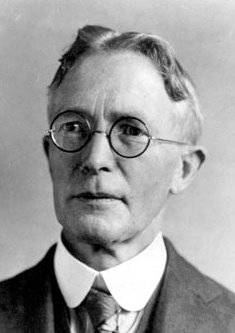
Died This Day: William Diller Matthew
Matthew (Feb. 19, 1871 – Sept. 24, 1930) was a superb mammalian paleontologist and important biogeographic theorist, and also G. G. Simpson's primary mentor. Matthew published voluminiously on the fossil record of 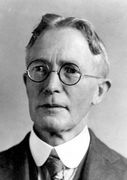 mammals and advocated a fully modern approach to taxonomy that emphasized tying scientific names to natural biological populations. His 1930 paper gives a clear statement of this position.
Matthew's key biogeographic theory was that waves of faunal migration repeatedly went from the northern continents southwards. This theory, which had obvious racial and political overtones, was justified by a "stabilist" view of paleogeography (i.e., that the continents had never moved from their modern positions), and by evidence from the relatively young fossil record of mammals, at the expense of other data that would have shown the more ancient interconnections among South America, Africa, India, and Australia. Remarkably, Matthew remained a Darwinian despite working for the autocratic orthogeneticist H. F. Osborn for three decades.
Info from HERE. Image from HERE.
 mammals and advocated a fully modern approach to taxonomy that emphasized tying scientific names to natural biological populations. His 1930 paper gives a clear statement of this position.
Matthew's key biogeographic theory was that waves of faunal migration repeatedly went from the northern continents southwards. This theory, which had obvious racial and political overtones, was justified by a "stabilist" view of paleogeography (i.e., that the continents had never moved from their modern positions), and by evidence from the relatively young fossil record of mammals, at the expense of other data that would have shown the more ancient interconnections among South America, Africa, India, and Australia. Remarkably, Matthew remained a Darwinian despite working for the autocratic orthogeneticist H. F. Osborn for three decades.
Info from HERE. Image from HERE.
Thursday, September 23, 2010
Utahceratops & Kosmoceratops
New Horned Dinosaurs from Utah Provide Evidence for Intracontinental Dinosaur Endemism. 2010. S. Sampson, et al. PLoS One 5(9): e12292.
Two remarkable new species of horned dinosaurs have been found in Grand Staircase-Escalante National Monument, southern Utah. The giant plant-eaters were inhabitants of the "lost continent" of Laramidia, formed when a shallow sea flooded the central region of North America, isolating the eastern and western portions of the continent for millions of years during the Late Cretaceous Period.

Art by Mark Hallett
Kosmoceratops richardsoni (KOZ-mo-SARA-tops RICH-ard-SON-i); the first part of the name refers to kosmos, Latin for "ornate," and ceratops, meaning "horned face." The latter part of the name honors Scott Richardson, the volunteer who discovered two skulls of this animal. Kosmoceratops has sideways oriented eye horns, although much longer and more pointed than in Utahceratops. In all, Kosmoceratops possesses a total of 15 horns—one over the nose, one atop each eye, one at the tip of each cheek bone, and ten across the rear margin of the bony frill—making it the most ornate-headed dinosaur known.

Utahceratops by Lukas Panzarin
The bigger of the two new dinosaurs, with a skull 2.3 m long, is Utahceratops gettyi (U-tah-SARA-tops get-EE-i). The first part of the name combines the state of origin with ceratops, Greek for "horned face." The second part of the name honors Mike Getty, paleontology collections manager at the Utah Museum of Natural History and the discoverer of this animal. In addition to a large horn over the nose, Utahceratops has short and blunt eye horns that project strongly to the side rather than upward, much more like the horns of modern bison than those of Triceratops or other ceratopsians.
More info & pictures here.
Two remarkable new species of horned dinosaurs have been found in Grand Staircase-Escalante National Monument, southern Utah. The giant plant-eaters were inhabitants of the "lost continent" of Laramidia, formed when a shallow sea flooded the central region of North America, isolating the eastern and western portions of the continent for millions of years during the Late Cretaceous Period.

Art by Mark Hallett

Utahceratops by Lukas Panzarin
More info & pictures here.
Nice work by everyone on this paper! Congrats to my old pal & Palaeo Extraordinairie, Mike Getty, who deserves to have a whole clade of dinosaurs named after him!
Monday, September 20, 2010
Concavenator corcovatus
A bizarre, humped Carcharodontosauria (Theropoda) from the Lower Cretaceous of Spain. 2010. F. Ortega, et al. Nature 467: 203-206.

CLICK TO ENLARGEAbstract: Carcharodontosaurs were the largest predatory dinosaurs, and their early evolutionary history seems to be more intricate than was previously thought. Until recently, carcharodontosaurs were restricted to a group of large theropods inhabiting the Late Cretaceous Gondwanan land masses, but in the last few years Laurasian evidence has been causing a reevaluation of their initial diversification.
Here we describe an almost complete and exquisitely preserved skeleton of a medium-sized (roughly six metres long) theropod fromthe Lower Cretaceous series (Barremian stage) Konservat-Lagerstatte of Las Hoyas in Cuenca, Spain.
Cladistic analysis supports the idea that the new taxon Concavenator corcovatus is a primitive member of Carcharodontosauria, exhibiting two unusual features: elongation of the neurapophyses of two presacral vertebrae forming a pointed, hump-like structure and a series of small bumps on the ulna. We think that these bumps are homologous to quill knobs present on some modern birds; the knobs are related to the insertion area of follicular ligaments that anchor the roots of the flight feathers (remiges) to the arm.
We propose that Concavenator has integumentary follicular structures inserted on the ulna, as in modern birds. Because scales do not have follicles, we consider the structures anchored to the Concavenator arms to be non-scale skin appendages homologous to the feathers of modern birds. If this is true, then the phylogenetic bracket for the presence of non-scale skin structures homologous to feathers in theropod dinosaurs would be extended to the Neotetanurae, enlarging the scope for explaining the origin of feathers in theropods.

CLICK TO ENLARGE
Here we describe an almost complete and exquisitely preserved skeleton of a medium-sized (roughly six metres long) theropod fromthe Lower Cretaceous series (Barremian stage) Konservat-Lagerstatte of Las Hoyas in Cuenca, Spain.
Cladistic analysis supports the idea that the new taxon Concavenator corcovatus is a primitive member of Carcharodontosauria, exhibiting two unusual features: elongation of the neurapophyses of two presacral vertebrae forming a pointed, hump-like structure and a series of small bumps on the ulna. We think that these bumps are homologous to quill knobs present on some modern birds; the knobs are related to the insertion area of follicular ligaments that anchor the roots of the flight feathers (remiges) to the arm.
We propose that Concavenator has integumentary follicular structures inserted on the ulna, as in modern birds. Because scales do not have follicles, we consider the structures anchored to the Concavenator arms to be non-scale skin appendages homologous to the feathers of modern birds. If this is true, then the phylogenetic bracket for the presence of non-scale skin structures homologous to feathers in theropod dinosaurs would be extended to the Neotetanurae, enlarging the scope for explaining the origin of feathers in theropods.
Friday, September 17, 2010
Styracosaurus Maquette

Thursday, September 16, 2010
Summarizing T. rex
Tyrannosaur Paleobiology: New Research on Ancient Exemplar Organisms. 2010. S. L. Brusatte, et al. Science 329: 1481-1485.

Tyrant © & ™ S. R. Bissette
Abstract: Tyrannosaurs, the group of dinosaurian carnivores that includes Tyrannosaurus rex and its closest relatives, are icons of prehistory. They are also the most intensively studied extinct dinosaurs, and thanks to large sample sizes and an influx of new discoveries, have become ancient exemplar organisms used to study many themes in vertebrate paleontology.
A phylogeny that includes recently described species shows that tyrannosaurs originated by the Middle Jurassic but remained mostly small and ecologically marginal until the latest Cretaceous. Anatomical, biomechanical, and histological studies of T. rex and other derived tyrannosaurs show that large tyrannosaurs could not run rapidly, were capable of crushing bite forces, had accelerated growth rates and keen senses, and underwent pronounced changes during ontogeny. The biology and evolutionary history of tyrannosaurs provide a foundation for comparison with other dinosaurs and living organisms.

Tyrant © & ™ S. R. Bissette
A phylogeny that includes recently described species shows that tyrannosaurs originated by the Middle Jurassic but remained mostly small and ecologically marginal until the latest Cretaceous. Anatomical, biomechanical, and histological studies of T. rex and other derived tyrannosaurs show that large tyrannosaurs could not run rapidly, were capable of crushing bite forces, had accelerated growth rates and keen senses, and underwent pronounced changes during ontogeny. The biology and evolutionary history of tyrannosaurs provide a foundation for comparison with other dinosaurs and living organisms.
This Day In History: Darwin Arrives at Galapagos

Wednesday, September 15, 2010
Xixiasaurus henanensis, New Troodontid from China
A new troodontid theropod from the Late Cretaceous of central China, and the radiation of Asian troodontids. 2010. Lü, J.−C., et al. Acta Palaeontologica Polonica 55 (3): 381–388.

CLICK TO ENLARGEAbstract: A new troodontid dinosaur, Xixiasaurus henanensis gen. et sp. nov., from the Upper Cretaceous Majiacun Formation of the Xixia Basin, Henan Province, is erected, based on a partial skull. It is characterized by bearing 22 maxillary teeth, a distinct opening on the lateral surface of the base of nasal process of the premaxilla, the rostral end of the upper jaw forming a tapered U−shape, and the mandibular symphyseal region slightly inflected medially.
Xixiasaurus is most closely related to the Mongolian Byronosaurus among troodontids. Byronosaurus, Urbacodon, and Xixiasaurus may form a new clade, suggesting an endemic radiation of troodontids across Asia, including multiple taxa without dental serrations. The discovery of Xixiasaurus in the Xixia Basin may imply that the Xixiasaurus−bearing Majiacun Formation is Campanian in age.

CLICK TO ENLARGE
Xixiasaurus is most closely related to the Mongolian Byronosaurus among troodontids. Byronosaurus, Urbacodon, and Xixiasaurus may form a new clade, suggesting an endemic radiation of troodontids across Asia, including multiple taxa without dental serrations. The discovery of Xixiasaurus in the Xixia Basin may imply that the Xixiasaurus−bearing Majiacun Formation is Campanian in age.
Debuted This Day (1914): Gertie The Dinosaur
Winsor McCay (Sept. 26, 1987 – July 26, 1934) was one of the great American artists of the last century. He is best known for his newspaper comic strip Little Nemo in Slumberland that ran from 1905 to 1914, and the animated cartoon creation Gertie the Dinosaur (1914).
For this cartoon McCay hand drew each frame of film. He took it on a tour of the vaudeville circuit and delighted audiences by being able to ‘interact’ with Gertie. Gertie is considered by many as the first true animated character to be featured in a film.
For this cartoon McCay hand drew each frame of film. He took it on a tour of the vaudeville circuit and delighted audiences by being able to ‘interact’ with Gertie. Gertie is considered by many as the first true animated character to be featured in a film.
Saturday, September 11, 2010

Friday, September 10, 2010
Born This Day: Stephen Jay Gould
Here’s a nice piece on Gould by Henry Lowood from the Stanford Presidential Lectures in the Humanities and Arts.

Thursday, September 09, 2010
Born This Day: Joseph Leidy
Sept. 9, 1823 - April 30, 1891

From The Academy of Natural Sciences:
Leidy is known as the "Father of American Vertebrate Paleontology". He described the first relatively complete dinosaur skeleton, Hadrosaurus, and introduced many American and European scientists to the fossil riches of the American West. Leidy's consummate skill in comparative anatomy would allow him to identify and characterize even the most fragmentary fossil material.
Leidy was also the "Founder of American Parasitology," a Professor of Anatomy at the University of Pennsylvania, a pioneering protozoologists, an influential teacher of Natural History, an accomplished microscopist and scientific illustrator, and an expert on a variety of subjects encompasing the earth and natural sciences. He published scientific papers on more than a thousand extinct and living protozoa, fungi and invertebrates and vertebrates as well as an assortment of publications on human biology and medicine. He was also one of the earliest supporters of Charles Darwin.

From The Academy of Natural Sciences:
Leidy is known as the "Father of American Vertebrate Paleontology". He described the first relatively complete dinosaur skeleton, Hadrosaurus, and introduced many American and European scientists to the fossil riches of the American West. Leidy's consummate skill in comparative anatomy would allow him to identify and characterize even the most fragmentary fossil material.
Leidy was also the "Founder of American Parasitology," a Professor of Anatomy at the University of Pennsylvania, a pioneering protozoologists, an influential teacher of Natural History, an accomplished microscopist and scientific illustrator, and an expert on a variety of subjects encompasing the earth and natural sciences. He published scientific papers on more than a thousand extinct and living protozoa, fungi and invertebrates and vertebrates as well as an assortment of publications on human biology and medicine. He was also one of the earliest supporters of Charles Darwin.
Born This Day: Father of The Devonian Period
William Lonsdale (Sept. 9, 1794 – Nov. 11, 1891 ) was an English geologist and paleontologist whose study of coral fossils found in Devon, suggested (1837) certain of them were intermediate between those typical of the older Silurian System (408 to 438 Ma) and those of the later Carboniferous System (286 to 360 Ma. Geologists Roderick Murchison and Adam Sedgwick agreed and named this new geologic system after its locale - the Devonian Period (1839).
Lonsdale's early career was as an army officer (1812-15) and later he became curator and librarian of the Geological Society of London (1829-42). He recognised that fossils showed how species changed over time, and more primitive organisms are found in lower strata.
From Today In Science History

Lonsdale's early career was as an army officer (1812-15) and later he became curator and librarian of the Geological Society of London (1829-42). He recognised that fossils showed how species changed over time, and more primitive organisms are found in lower strata.
From Today In Science History
Tuesday, September 07, 2010
Born This Day: Comte Georges-Louis de Buffon
Buffon (Sept. 7, 1707 – April 16, 1788) was a French naturalist, who formulated a crude theory of evolution and was the first to suggest that the earth might 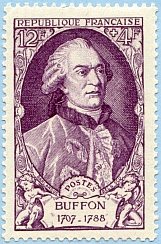 be older than suggested by the Bible.
In 1739 he was appointed keeper of the Jardin du Roi, a post he occupied until his death. There he worked on a comprehensive work on natural history, for which he is remembered, Histoire naturelle, générale et particulière. He began this work in 1749, and it dominated the rest of his life. It would eventually run to 44 volumes, including quadrupeds, birds, reptiles and minerals.
He proposed (1778) that the Earth was hot at its creation and, from the rate of cooling, calculated its age to be 75,000 years, with life emerging some 40,000 years ago.
From Today In Science History. Stamp from HERE.
More info on Buffon from UC-Berkeley.
 be older than suggested by the Bible.
 In 1739 he was appointed keeper of the Jardin du Roi, a post he occupied until his death. There he worked on a comprehensive work on natural history, for which he is remembered, Histoire naturelle, générale et particulière. He began this work in 1749, and it dominated the rest of his life. It would eventually run to 44 volumes, including quadrupeds, birds, reptiles and minerals.
He proposed (1778) that the Earth was hot at its creation and, from the rate of cooling, calculated its age to be 75,000 years, with life emerging some 40,000 years ago.
From Today In Science History. Stamp from HERE.
More info on Buffon from UC-Berkeley.
Monday, September 06, 2010
Whither Taxonomy?

"Just as our planet's organisms have begun dying off, the scientists who classify them have also begun to decline, and this could have dire implications."Writer Matthew Hart in the Globe and Mail looks at the problem created by the decreasing number of taxonomists in science.
Sunday, September 05, 2010

Saturday, September 04, 2010
Origin of The Brain
Profiling by Image Registration Reveals Common Origin of Annelid Mushroom Bodies and Vertebrate Pallium. 2010. R. Tomer, et al. Cell 142: 800-809.

Art by Steve Ditko

This ancestral structure was likely a group of densely packed cells, which received and processed information about smell and directly controlled locomotion. It may have enabled our ancestors crawling over the sea floor to identify food sources, move towards them, and integrate previous experiences into some sort of learning. link

Art by Steve Ditko
Scientists have discovered a true counterpart of the vertebrate cerebral cortex in an invertebrate, a marine worm.It has long been clear that, in evolutionary terms, we share our pallium with other vertebrates, but beyond that was mystery. This is because even invertebrates that are clearly related to us – such as the fish-like amphioxus – appear to have no similar brain structures, nothing that points to a shared evolutionary past. But EMBL scientists have now found brain structures related to the vertebrate pallium in a very distant cousin – the marine ragworm Platynereis dumerilii, a relative of the earthworm - which last shared an ancestor with us around 600 million years ago.

A virtual Platynereis brain (left), created by averaging microscopy images of the brains of 36 different individuals, onto which scientists mapped gene activity (right). Perspective shows the brain as viewed from inside a Platynereis larvae, at 48 hours’ old. EMBL/R.Tomer"Two stunning conclusions emerge from this finding", explains Arendt: "First, the pallium is much older than anyone would have assumed, probably as old as higher animals themselves. Second, we learn that it came out of 'the blue' – as an adaptation to early marine life in Precambrian oceans."
This ancestral structure was likely a group of densely packed cells, which received and processed information about smell and directly controlled locomotion. It may have enabled our ancestors crawling over the sea floor to identify food sources, move towards them, and integrate previous experiences into some sort of learning. link
Wednesday, September 01, 2010
Born This Day: Edgar Rice Burroughs

Pellucidar is the hollow Earth milieu for a series of stories featuring David Innes and his inventor friend Abner Perry which they discover using an "iron mole" to burrow 500 miles into the Earth's crust where they find a prehistoric land. From Wikipedia
Went Extinct This Day (1914): The Passsenger Pigeon
In 1914, the Passenger Pigeon (Ectopistes migratorius) became extinct as the last surviving bird of the colorful native American species of dove died at the Cincinnati Zoo. The passenger pigeon was hunted to extinction; the fact that it traveled and nested in large flocks made it easy to slaughter.
From Today In Science History



From Today In Science History
Died This Day: Luis Alvarez
Alverez (June 13, 1911 - Sept. 1, 1988) was an American experimental physicist who was awarded the Nobel Prize for Physics in 1968 for work that included the discovery of many resonance particles --subatomic particles having extremely short lifetimes and occurring only in high-energy nuclear collisions. 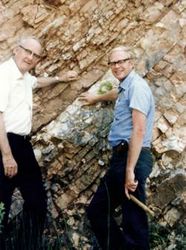
In about 1980 Alvarez (left) helped his son, the geologist Walter Alvarez (right), publicize Walter's discovery of a worldwide layer of clay that has a high iridium content and which occupies rock strata at the geochronological boundary between the Mesozoic and Cenozoic eras; i.e., about 66.4 million years ago.
They postulated that the iridium had been deposited following the impact on Earth of an asteroid or comet and that the catastrophic climatic effects of this massive impact caused the extinction of the dinosaurs. Though initially controversial, this widely publicized theory gradually gained support as the most plausible explanation of the abrupt demise of the dinosaurs.
Read more HERE. Image from HERE.

In about 1980 Alvarez (left) helped his son, the geologist Walter Alvarez (right), publicize Walter's discovery of a worldwide layer of clay that has a high iridium content and which occupies rock strata at the geochronological boundary between the Mesozoic and Cenozoic eras; i.e., about 66.4 million years ago.
They postulated that the iridium had been deposited following the impact on Earth of an asteroid or comet and that the catastrophic climatic effects of this massive impact caused the extinction of the dinosaurs. Though initially controversial, this widely publicized theory gradually gained support as the most plausible explanation of the abrupt demise of the dinosaurs.
Read more HERE. Image from HERE.
Subscribe to:
Posts (Atom)