Wednesday, December 19, 2007

KID 2007 Expedition

Time for a few quick updates where we shovel the city of Ottawa out of its latest snowstorm. I don't think I've posted any photos from my time with the KID expedition in Mongolia this past summer. You can get my summary of last year's work at my Phaeton web site HERE; I'll have an update for 2007 on that site soon.


Just some of the the 2007 crew.


One of several vehicle problems we had.


Yoshi and Dr. Song work on the sauropod that Yoshi found in 2006. In just under two weeks the crew completely collected the >60% complete skeleton.


Puzzling over how to move the pelvic block.


Dr. Darla.


In the middle of nowhere we had to replace an engine in one of the trucks. Dr. Lee shots some pool as we wait for our drivers to get the job done.


Our camp at Kermin Tsav I


Yosuki and friend.


Khermin Tsav II

Ulzi - ace mechanic, tech and driver!

More Photos


CMNH Ace photographer, Liz Russell, photographs the U of A Centrosaurus skull that I'm having prepped.


Katie Russell and David Chapman mold a small Dunkleosteous that we'll be selling in the new year. This small specimen will be a nice alternative for museum's who don't have space for or can't afford the larger cast we also sell (see below). Many thanks to David and Katie for burning the midnight oil to finish this before Christmas!


The CMNH Dunkleosteous skull cast on display at the State Museum of Pennsylvania in Harrisburg.


Bob Sullivan (left) explains Dracorex to funny book artist, Mark Schultz on our recent visit to Harrisburg.


One of the Coelophysis displays in Harrisburg.

Styracosaurus

My paper with Rob Holmes and Tony Russell revising Styracosaurus came out in the recent issue of JVP. However, there was a major snafu in that the only table in it was NOT included in the paper (the one with all the measurements). After Xmas I'll be making PDF's of the paper with the table included and sending them out to all the usual suspects. If you'd like one as well drop me a line....

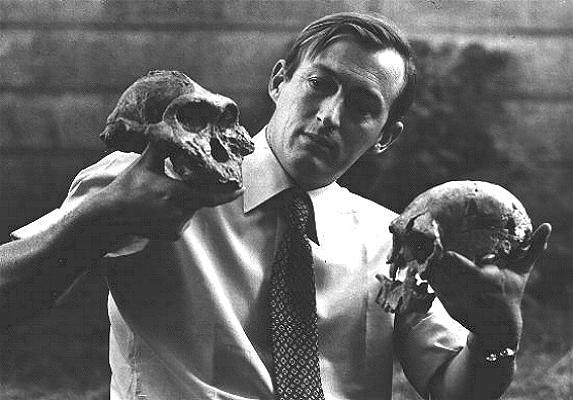
Born This Day (1944): Richard Leakey


image

From Today In Science History:

Leakey is a Kenyan physical anthropologist, paleontologist and second of three sons of noted anthropologists Louis Leakey and Mary Leakey. At an early age, he decided he wanted nothing to do with paleoanthropology and started a expedition business. In 1964, he led an expedition to a fossil site which sparked his interest in paleontology. Since then he has been responsible for extensive fossil finds of human ancestral forms in East Africa, including a Homo habilis skull found in 1972, and a Homo erectus skull found in 1975.

His discoveries showed that man's ancestors used tools, which shows intelligence, and lived in eastern Africa at least 3 million years ago - almost doubling the previously accepted age of human origins.

Learn more about The Leakey Foundation HERE.

Tuesday, December 18, 2007

Died This Day: Theodosius Dobzhansky

.Jan. 25, 1900 – Dec. 18, 1975

From Today In Science History:

Dobzhansky was an Ukrainian-American geneticist and evolutionist whose work had a major influence on 20th-century thought and research on genetics and evolutionary theory. He made the first significant synthesis of Charles Darwin's theory of evolution with Gregor Mendel's theory of genetics in his book Genetics and the Origin of Species (1937).

From 1918 his research gave experimental evidence that genes could vary far more than geneticists had previously believed. Thus, successful species tend to have a wide variety of genes that, while redundant in its present environment, do provide a species as a whole with genetic diversity. Such diversity enables the species to adapt effectively to changes in the surrounding environment - the basis for modern evolutionary theory.

Died This Day: Sir Richard Owen

July 20, 1804 – Dec. 18, 1892

From Today In Science History:

Owen was an English anatomist and paleontologist who is remembered for his contributions to the study of fossil animals and for his strong opposition to the views of Charles Darwin.

He coined the word "Dinosaur" meaning "terrible reptile" (1842). Owen synthesized French anatomical work, especially from Cuvier and Geoffroy, with German transcendental anatomy. He gave us many of the terms still used today in anatomy and evolutionary biology, including "homology". In 1856, he was appointed Superintendent of the British Museum (Natural History).

Saturday, December 15, 2007

Born This Day: Joseph Barrell

Dec. 15, 1869 – May 4, 1919

From Today In Science History:

Barrell was an American geologist who proposed that sedimentary rocks were produced by the action of rivers, winds, and ice, as well as by marine sedimentation. In 1916, he indicated that the coloration of many Devonian rocks was bright red because they had been baked dry, like bricks, in arid conditions. Also, this severe climate was a driving force in the evolution of air-breathing vertebrates, including tetrapods.

In 1917, he used the new results of radioactive dating to reinterpret Earth's age at a few billion years, though many geologists still preferred an age of 100 million years. Barrell emphasized that geological processes vary in intensity in a cyclical rather than a uniform fashion, thus current rates of geological change should not be used as a guide to the past,as in prior estimates.

Thursday, December 13, 2007

Season Greetings!

I'll be away from internet access for most of the next three weeks, so postings will slow down (but not stop) until after the new year. Have a warm and safe holiday season!

Carcharodontosaurus iguidensis


Photo courtesy S. Brusatte, U Bristol; graphic courtesy S. Powell, U Bristol.
A 95-million-year-old fossil jawbone belonging to a new species of dinosaur dubbed Carcharodontosaurus iguidensis.

From National Geographic News the latest "It's bigger than T. rex!" story:

At about 14 meters long, the species is among the largest meat-eating dinos that ever lived. Carcharodontosaurus was first described based on two fossil teeth recovered in the 1920s that have since been lost. The only previously named species from the genus, C. saharicus, was described from a single fossil skull found by Sereno in Morocco in 1996.

Subtle differences in the new Niger skull suggested that it belonged to a distinct species—a suspicion now confirmed following detailed examination, Brusatte said.

It's published in the latest JVP.

Wednesday, December 12, 2007

Born This Day: Erasmus Darwin

Dec. 12, 1731 – April 18, 1802.

Erasmus was a prominent English physician, poet, philosopher, botanist, naturalist and the grandfather of naturalist Charles Darwin and the biologist Francis Galton. Erasmus Darwin was one of the leading intellectuals of 18th century England.

As a naturalist, he formulated one of the first formal theories on evolution in Zoonomia, or, The Laws of Organic Life (1794-1796). Although he did not come up with natural selection, he did discuss ideas that his grandson elaborated on sixty years later, such as how life evolved from a single common ancestor, forming "one living filament".

Although some of his ideas on how evolution might occur are quite close to those of Lamarck, Erasmus Darwin also talked about how competition and sexual selection could cause changes in species. link

Download Zoonomia HERE

Tuesday, December 11, 2007

New Antarctic Sauropodomorph: Glacialisaurus

Anatomy of a basal sauropodomorph dinosaur from the Early Jurassic Hanson Formation of Antarctica. 2007. Nathan D. Smith and Diego Pol. Acta Palaeontologica Polonica 52 (4): 657-674

From the press release:

The new primitive sauropodomorph Glacialisaurus hammeri from the Early Jurassic has been discovered in Antarctica. The description is based on partial foot, leg and ankle bones found on Mt. Kirkpatrick near the Beardmore Glacier in Antarctica at an elevation of more than 13,000 feet.


“The fossils were painstakingly removed from the ice and rock using jackhammers, rock saws and chisels under extremely difficult conditions over the course of two field seasons,” said Nathan Smith, a graduate student at The Field Museum. “They are important because they help to establish that primitive sauropodomorph dinosaurs were more broadly distributed than previously thought, and that they coexisted with their cousins, the true sauropods.”

Glacialisaurus hammeri was about 20-25 feet long and weighed about 4-6 tons . It was named after Dr. William Hammer, a professor at Augustana College who led the two field trips to Antarctica that uncovered the fossils. Glacialisaurus belongs to the sauropodomorph family Massopsondylidae, which may represent a secondary radiation of basal sauropodomorphs during the Early Jurassic.

The recent discovery of a possible sauropod at roughly the same location in Antarctica lends additional evidence to the theory that the earliest sauropods coexisted with their basal sauropodomorph cousins during the Late Triassic and Early Jurassic.

In Memorium: Karol Sabath


Zofia Kielan-Jaworowska has a nicely written obituary for Karol Sabath (1963-2007) in the latest volume of Acta Palaeontologica Polonica.

Eotriceratops on 'Quirks & Quarks'


David Eberth talked about the newest Albertan ceratopsid on last week's "Quirks & Quarks", CBC's weekly national science show. Listen to it in your favourite format HERE


Monday, December 10, 2007

Spanish Dinosaur Graveyard

From National Geographic News:


Photograph courtesy José Luis Sanz/Autonomous University, Madrid
A scientist excavates the fossilized skeleton of a titanosaur in eastern Spain. A huge "graveyard" of some 8,000 fossils found there is the largest and most diverse cache of dino-era remains ever found in Europe, experts say.

Sunday, December 09, 2007

Check Out The Holiday Gift Guide

Don't forget to check out the Palaeoblog's HOLIDAY GIFT GUIDE.

Here's something I forgot to put on the list:


The recent album by the band ARTICHOKE.

Tugrikin Shire Protoceratops

Last summer we spent a day at Tugrikin Shire. This year we came came apon a group of men poaching a Protoceratops (just like we did last year!). At noon they hopped on their motorcycles to go home for lunch...


Prospecting the area.


That's Clive Coy in the foreground. To the right of the shadow on the low hill in the background is where both the AMNH and Hayashibara collected their Protoceratops nests.


The base of the formation is heavily bioturbated. That's a Protoceratops skeleton that has been chewed to pieces with burrows running through it.

Dr. David Fastovsky offers these insights into the locality.

Saturday, December 08, 2007

Bayn Zag Museum

If you go the famous "Flaming Cliffs" (Bayn Zag) in Mongolia during the summer you'll find that an enterpernurical family has set up a booth on top of the cliffs where they sell cold drink, rocks and few fossils. This is the point where the tour buses pull up, disengorge the tourists for their 10 minute photo op, and then blast off to the next stop.

If you ask the older of the two sisters working for their parents she’s take you over to the nearby ger that is the "Bayn Zag Museum". Inside you’ll see a variety of fossils, including some Tarbosaurus bones, a sad looking Protoceratops, and photos of Roy Chapman Andrews, et al. The young girl wants to be a palaeontologist when she grows up, but does feel that she can do it in Mongolia. She seems sincere in her ambitions and is very knowledgeable about what’s in the ger.

Phil, Eva and I stopped in at the end of one of our prospecting days at the Cliffs.


The museum


Born This Day: John Smith

Dec. 8, 1924 – Nov. 22, 2003

From Today In Science History:

Smith was an English microbiologist who was a pioneer in the field of nucleic acid research. He helped to establish the structure of RNA and to discover the methylation of the bases in bacterial DNA. The RNA structure information was crucial to the double-stranded model of DNA proposed by Watson and Crick.

He contributed to the methodology involved in the unravelling of the secrets of the genome. In the early 1960s, Smith became involved in unravelling the process whereby the sequence of bases in DNA determines the assembly of the different amino acid sequences of proteins which are responsible for all our bodily functions (structural, enzymatic, hormonal, and so on), a process known as protein synthesis.

Born This Day: Thomas Robert Cech

Born 8 Dec 1947

From Today In Science History:

Cech was an American biochemist and molecular biologist who, with Sidney Altman, was awarded the 1989 Nobel Prize for Chemistry for their discoveries concerning RNA (ribonucleic acid). Prior to Cech's research on RNA, most scientists believed that proteins were the only catalysts in living cells. Cech showed that RNA could have an independent catalytic function, a "ribozyme", aiding a chemical reaction without being consumed or changed.

Friday, December 07, 2007

“Chance Favours The Prepared Mind”


The Eternals © Marvel Comics
In 1884, during a lecture presented at the University of Lille, Louis Pasteur made his much-quoted remark, "In the fields of observation chance favours only the prepared mind" (Dans les champs de l'observation le hasard ne favorise que les esprits préparés).

From Today In Science History

Dinos Stop Progress In Oz


Small herbivorous dinosaurs dubbed Leaellynasaura amicagraphica roam along the water's edge in southeastern Australia in an artist's depiction. The species lived about 115 million years ago when the continent was within the Antarctic Circle.

From National Geographic News:

Plans to build a massive desalination plant to supply fresh water to drought-stricken Melbourne created a media outcry last week, because pipes for the plant will run though the fossil beds where L. amicagraphica and other ancient species have been unearthed. The fossil bed—part of a site dubbed Dinosaur Cove—sits at the mouth of the Powlett River near Kilcunda in Australia's southeastern state of Victoria

Despite the media outcry, Australian water minister Tim Holding told the Herald-Sun newspaper last week that the remains would not be at risk.

"The existence of these fossilized remains in no way impacts on the ability of us to construct or operate a desalination plant on the site," Holding said.

And we all know that governments always make the best decisions for the preservation of fossils….

Died This Day: Theodor Schwann


Dec. 7, 1810 - Jan. 11, 1882

From Today In Science History

Schwann was a German physiologist who founded modern histology by defining the cell in Mikroskopische Untersuchungen (1839) as the basic unit of animal structure that makes elementary parts (such as teeth, bone, muscle, cartilage, nerve tissue) by cell differentiation. This laid the foundations for the cell theory.

Schwann also worked on fermentation and discovered the enzyme pepsin. Schwann cells are named after him. He also formulated basic principles of embryology (that the egg is a single cell that develops into a complete organism); and coined the term metabolism. image

“Eating” Darwin’s Dust

Life in Darwin's dust: intercontinental transport and survival of microbes in the nineteenth century. 2007. A.A. Gorbushin, et al. Environmental Microbiology 9: 2911-2922.

Abstract: Charles Darwin, like others before him, collected aeolian dust over the Atlantic Ocean and sent it to Christian Gottfried Ehrenberg in Berlin. Ehrenberg's collection is now housed in the Museum of Natural History and contains specimens that were gathered at the onset of the Industrial Revolution.

Geochemical analyses of this resource indicated that dust collected over the Atlantic in 1838 originated from the Western Sahara, while molecular-microbiological methods demonstrated the presence of many viable microbes. Older samples sent to Ehrenberg from Barbados almost two centuries ago also contained numbers of cultivable bacteria and fungi.

Many diverse ascomycetes, and eubacteria were found. Scanning electron microscopy and cultivation suggested that Bacillus megaterium, a common soil bacterium, was attached to historic sand grains, and it was inoculated onto dry sand along with a non-spore-forming control, the Gram-negative soil bacterium Rhizobium sp. NGR234. On sand B. megaterium quickly developed spores, which survived for extended periods and even though the numbers of NGR234 steadily declined, they were still considerable after months of incubation. Thus, microbes that adhere to Saharan dust can live for centuries and easily survive transport across the Atlantic.

Born This Day: Louis Dollo

Dec. 7, 1857 – April 19, 1931

From Today In Science History

Louis Antoine Marie Joseph Dollo was a French vertebrate paleontologist who stated Dollo's Law of Irreversibility whereby in evolution an organism never returns exactly to its former state such that complex structures, once lost, are not regained in their original form. (While generally true, some exceptions are known.)

He began as an assistant (1882), became keeper of mammals (1891) at the Royal Museum of Natural History in Brussels where he stayed most of his life. He was a specialist in fossil fishes, reptiles, birds, and their palaeoecology. He supervised the excavation of the famous, multiple Iguanodons found in 1878 by miners deep underground, at Bernissart, Belgium. image

Thursday, December 06, 2007

'Lucy' Now A Graphic Novel


“Lucy” is now a graphic novel from Norbert and Liberatore.

You can preview the volume HERE.

'Slushball' Earth

Snowball Earth prevention by dissolved organic carbon remineralization. 2007. W. Richard Peltier, et al. Nature 450, 813-818.


Poster by Chad Kerychuk and courtesy the Digital Dream Machine Blog. 'Superman' and 'The Fortress of Solitude' are ™ and © DC Comics.

Abstract:The 'snowball Earth' hypothesis posits the occurrence of a sequence of glaciations in the Earth's history sufficiently deep that photosynthetic activity was essentially arrested. Because the time interval during which these events are believed to have occurred immediately preceded the Cambrian explosion of life, the issue as to whether such snowball states actually developed has important implications for our understanding of evolutionary biology.

Here we couple an explicit model of the Neoproterozoic carbon cycle to a model of the physical climate system. We show that the drawdown of atmospheric oxygen into the ocean, as surface temperatures decline, operates so as to increase the rate of remineralization of a massive pool of dissolved organic carbon. This leads directly to an increase of atmospheric carbon dioxide, enhanced greenhouse warming of the surface of the Earth, and the prevention of a snowball state.

BBC: Prehistoric Life


Kieran Shepherd of the CMN points us to this BBC site with lots of interesting links to palaeo and dino articles, and archived radio shows.

Wednesday, December 05, 2007

New Plesiosaur?

From AP Press:

Our old buddy Jørn Hurum makes the news again with the “remains of a bus-sized prehistoric "monster" reptile found on a remote Arctic island may be a new species never before recorded by science.”

Initial excavation of a site on the Svalbard islands in August yielded the remains, teeth, skull fragments and vertebrae of a reptile estimated to measure nearly 40 feet long, said Jørn Hurum of the University of Oslo.

"It seems the monster is a new species," he told The Associated Press.

The reptile appears be the same species as another sea predator whose remains were found nearby on Svalbard last year. His team described those 150-million-year-old remains as belonging to a short-necked plesiosaur measuring more than 30 feet — "as long as a bus ... with teeth larger than cucumbers."

The short-necked plesiosaur was a voracious reptile often compared to the Tyrannosaurus rex of the oceans.

Hurum said the team had only managed to excavate a 3-meter (yard) area of the find. The Norwegian-led team plans to present more detailed findings early next year, and return to Svalbard, 300 miles north of Norway's mainland, to excavate further next year.

This may be the same material reported on HERE.

Tuesday, December 04, 2007

Dinosaur Mummy

You don't need me to point you to this week's story on the "dinosaur mummy".

Even in the field dinosaur paleontology, where hyperbole reigns when it comes to press releases, has this much ever been said about so little? And what ever happened to the hadrosaur “Leonardo”, the other “greatest dinosaur mummy ever found?”

Died This Day: The Father of Fruit Fly Research

Sept. 25, 1866 – Dec. 4, 1945

From Today In Science History:

Thomas Hunt Morgan was an American zoologist and geneticist, famous for his experimental research with the fruit fly by which he established the chromosome theory of heredity. He discovered that a number of genetic variations were inherited together and that this was because their controlling genes occurred on the same chromosome. In 1908, Morgan began breeding experiments with the fruit fly Drosophila melanogaster.

His study of the characteristics inherited by mutants ultimately enabled him to determine the precise behaviour and exact localization of genes.
Morgan and his colleagues produced the first chromosome maps in 1911. Though this work was not widely accepted initially, Morgan was awarded a Nobel Prize for physiology or medicine in 1933.

image

Sunday, December 02, 2007

Walter and Kissinger Murals Unveiled At Carniege Musuem


All art © Walters and Kissinger
From Science News:

On Nov. 21, the Carnegie Museum of Natural History in Pittsburgh unveiled the world's largest dinosaur mural, a 180-foot-long portrayal of creatures and plants that lived in the western United States about 150 million years ago.

The mural includes Brachiosaurus, Stegosaurus, flying reptiles, and the mammal Fruitafossor. Remains of these creatures have been found in the Morrison formation, a set of strata found in a swath that stretches from Wyoming to New Mexico.

Philadelphia-based paleoartists Robert F. Walters and Tess Kissinger painted the Morrison mural. "We've been working on this mural for 2 years," says Walters. "The fact we've painted a record breaker is just starting to sink in."

Thanks to Sukie for the head’s up.

How Our Ancestors Were Like Gorillas

Extended Male Growth in a Fossil Hominin Species. 2007. C. A. Lockwood et al., Science 318: 1443-1446.

From the press release:

Researchers examined fossils from 1.5 to 2 million years ago and found that in one of our close relatives, Paranthropus robustus, the males continued to grow well into adulthood, just as they do in gorillas. This resulted in a much bigger size difference between males and females than we see today.

“It’s common knowledge that boys mature later than girls, but in humans the difference is actually much less marked than in some other primates. Male gorillas continue to grow long after their wisdom teeth have come through, and they don't reach what is referred to as dominant "silverback" status until many years after the females have already started to have offspring. Our research makes us think that, in this fossil species, one older male was probably dominant in a troop of females. This situation was risky for the males and they suffered high rates of predation as a result of both their social structure and pattern of growth.”

The pattern of growth also gives a better understanding of who is male and who is female in this sample of skulls and it turns out that there are far more males in the fossil sample. Because fossils from the most prolific site, Swartkrans, are thought to have been deposited by predators such as leopards and hyenas, it appears that males were getting killed more often than females.

Major Plant Diversification < 5 Million Years Ago

Using plastid genome-scale data to resolve enigmatic relationships among basal angiosperms. 2007. M.J. Moore et al., PNAS early on-line pub.


Phylogenetic relationships among the major lineages of flowering plants based on plastid genome sequences. Pictured counter-clockwise from the root at the base of the circle tree are: Amborella trichopoda, Nymphaea odorata, Illicium floridanum, Chloranthus angustifolius, Piper longum, Liriodendron tulipifera, Ceratophyllum demersum, Ranunculus ficaria, Pelargonium exstipulatum, Helianthus annuus, Yucca filamentosa, Triticum aestivum, and Acorus americanus. New Caledonia, home to Amborella trichopoda, is shown in the background. credit: Gwen Gage


From the press release:

The evolutionary Tree of Life for flowering plants has been revealed using the largest collection of genomic data of these plants to date. Scientists found that the two largest groups of flowering plants, monocots (grasses and their relatives) and eudicots (including sunflowers and tomatoes), are more closely related to each other than to any of the other major lineages.

The analyses also confirmed that a unique species of plant called Amborella, found only on the Pacific island of New Caledonia, represents the earliest diverging lineage of flowering plants.

The University of Florida team also showed that the major diversification of flowering plants, so stunning that the researchers are calling it the “Big Bang,” took place in the comparatively short period of less than five million years. This resulted in all five major lineages of flowering plants present today.

“Flowering plants today comprise around 400,000 species,” said Pam Soltis. “To think that the burst that gave rise to almost all of these plants occurred in less than five million years is pretty amazing—especially when you consider that flowering plants as a group have been around for at least 130 million years.”