Wednesday, February 28, 2007

Got (Mammoth) Milk?

Stone Age Europeans could survive extreme cold, wild animals and disease -- but not milk.
From Tom Spears in the Ottawa Citizen:

Tests on skeletons from Europeans who lived around 5000 BC show they all shared the genetic trait we call "lactose intolerance," which meant that adults who drank milk would suffer bloating and diarrhea.

But suddenly, that all changed. With the arrival of dairy herds, the gene that lets some adults digest milk became the single greatest key to survival all across Europe, a new study says.

Today, more than 90 per cent of northern Europeans can digest milk as adults. That's a complete rewriting of the genetic blueprint carried by Neolithic peoples of 5000 BC.

The gene that produces lactase was probably a minor little mutation that popped up occasionally in small numbers all along, says genetics expert Earl Brown of the University of Ottawa.

"It would be like the one extra blade on your Swiss Army knife that you never use. It's just hanging on your belt," he said. "Then suddenly you need it. And anyone who has that blade has a big evolutionary advantage."

You’re right in noticing a slow down in postings. Acute tendonitis is limiting my time at the keyboard and that has to be spent on ‘real' work. Things will normalize when they do….

Viaduct? Why A Duck? V-Ducks?

Redicting resource partitioning and community organization of filter-feeding dabbling ducks from functional morphology. 2007. D. Brent Gurd. American Naturalist 169:334-343.

From the press release:

Ecologists continue to debate how different species manage to coexist. If two species use identical resources, such as food, invariably one will be more efficient and out-compete the other. The classical explanation is that each species has evolved morphological or physiological traits that allow it to exploit some resources more efficiently than all other species.

Such partitioning of resources essentially provides each species with exclusive access to resources necessary for its survival. Although coexistence is often attributed to interspecific differences in morphology, direct evidence is relatively rare.

Dabbling ducks, which include the ubiquitous mallard, are a good example. Dabbling ducks are primarily filter-feeders. They use lamellae, which are comb-like projections on the bill, to sieve food particles from pond water. Many ecologists, including Darwin, suggested that ducks coexist because interspecific differences in the spacing of bill lamellae allow each species to consume food particles of different sizes. New Research by Brent Gurd has demonstrated that interspecific differences in lamellar length, not spacing, allow ducks to partition food by size.

To test his idea, Gurd created virtual bills using computer software typically used by engineers to design complex machinery. "The software allowed me to create exact, three-dimensional replicas of duck bills complete with articulating joints" said Gurd. "The replicas allowed me to determine the particle sizes each duck could ingest and the rate at which they could ingest them."

I'm always intersted in research that helps shed light on why multiple morphologically similar species can co-exist in a small region.

Daffy and The Dinosaur:

Saturday, February 24, 2007

Prehistoric Whale Found in Vineyard


Kamandi © DC Comics
From Monica Larner at the Wine Enthusiast:

Sixteen football-sized vertebrae belonging to a prehistoric whale dating back 5 million years ago were uncovered February 22 on the estate of Castello Banfi, in Montalcino, Tuscany. According to paleontologists, it could be the oldest whale ever found in this part of Italy, an area that was once covered with as much as 82 feet of water before the sea started its slow retreat millions of years ago to it’s current location some 18 miles away.

The whale is estimated to be 33 feet long, and is completely intact with the animal’s head pointed uphill towards the castle. “The whale dates from the Pliocene era when the Mediterranean was at its biggest”, says paleontologist Simone Casati. When the excavation is complete, Casati says the skeleton will be moved to Florence.


The whale vertebrae in foreground. Photo: Monica Larner
The nearly 7,000-acre estate produces 300,000 cases of top wines such as Brunello and Supertuscans.

Published This Day: Descent of Man

On this day in 1871, Charles Darwin's book "Descent of Man, and Selection in Relation to Sex" was published in London.

Friday, February 23, 2007

Productivity Across The K/T Boundary

Faunal evidence for reduced productivity and uncoordinated recovery in Southern Hemisphere Cretaceous-Paleogene boundary sections. 2007. M. Aberhan,et al. Geology 35: 227-230.

Abstract [edit]: A catastrophic bolide impact is widely recognized as the trigger of the mass extinction that occurred 65 million years ago at the Cretaceous-Tertiary boundary, when animals such as dinosaurs (on land) and ammonites (in the sea) became extinct.


Devil Dinosaur created by Jack Kirby but © Marvel Comics
One possible killing mechanisms involves a global collapse of food chains due to the shutdown of photosynthesis by sun-blocking dust clouds and soot from fires. It is still unclear whether the intensity of these perturbations is related to the distance from the impact site in today’s Mexico and whether it is related to paleolatitude.

The ecological composition of organisms from high southern latitudes that lived on the sea floor at that time, such as clams, snails, corals, and sea urchins, changed significantly across the boundary and in a way that was consistent with the scenario of reduced availability of food after the impact event: Animals were less abundant for some time; starvation-resistant groups and animals not relying directly on photosynthetic organisms as a food source became more dominant; individuals with larval stages that do not need to feed on phytoplankton became proportionally more common; the average body size of individuals within communities became smaller; and individuals with low metabolic rates or inactive lifestyles became better represented.

A return to pre-extinction conditions of the various ecological attributes occurred over unequal time spans, indicating that recovery from the mass extinction was uncoordinated with respect to ecological traits.

Robert Reisz Honoured At AAAS Meeting

From Biology News:

Robert Reisz is being honoured for more than 35 years of research excellence by joining the ranks of the American Association for the Advancement of Science (AAAS). The society inducted him as a fellow during its annual conference held last week.

"I am humbled that they chose me, and I think it was because my research has had an impact in my field," says Reisz, a paleontologist at the University of Toronto. "I like to look at the very beginnings of major evolutionary events – to that time when mammals and reptiles and birds were just becoming separate from each other. It was an exciting time in history, about 270 million years ago – it was between ice ages, just like the time we are living in now – and I think my work has led to a greater understanding of what happened then."

Reisz earned three degrees in zoology at McGill University during the 1960s and 1970s, culminating in a doctorate in 1975. After spending a year at UCLA, he began research at the University of Toronto where he remains.

His research has spanned several countries, including Russia, Germany, the United States and Canada. His most recent discovery – finding 190-million-year-old dinosaur embryos in South Africa in 2005 – is part of a time period that is about 100 million years younger than the one he usually studies. image

Thursday, February 22, 2007

The Docs With X-Ray Eyes

From Jeanna Bryner at LiveScience.com comes an article on Elizabeth Brainerd, Stephen Gatesy and David Baier on their use of new 3-D video techniques to study the skeletons of animals on the move.
Scientists are filming alligators as they trot along treadmills and pigeons on the fly in wind tunnels. But rather than a view of flesh and muscles, a “This will be like having X-ray vision—you'll be able to see through skin and muscle and watch a skeleton move in 3-D," said lead scientist Elizabeth Brainerd of Brown University. “Imagine animated X-ray movies of flying bats or flexing knees."
Click HERE to watch a pig walk.


Speaking of Steve reminds me of this photo I've had kicking around for a while. Taken at the end of the 1985 field season in DPP, this motley crew includes Steve Gatesy (center, back row with the unruly head of hair), me beside him, Don Brinkman from the RTMP (keeling, far right, 2nd row), and Per Ahlberg on the ground in front. Where are they all now I wonder?

Neanderthals' “Frozen” To Death

A sharp freeze could have dealt the killer blow that finished off our evolutionary cousins the Neanderthals, according to a new study.

From “1,000,000 Years Ago” (1953) © Joe Kubert
CLICK TO ENLARGE
From BBC News:

The ancient humans are thought to have died out in most parts of Europe by about 35,000 years ago. Now new data from their last known refuge in southern Iberia indicates the final population was probably beaten by a cold spell some 24,000 years ago.

Sediment cores drilled from the sea bed near the Balearic Islands show the average sea-surface temperature plunged to 8C. Modern-day sea surface temperatures in the same region vary from 14C to 20C.

Gorham's Cave on Gibraltar shows evidence of occupation by groups of Neanderthals until 24,000 years ago. But thereafter, researchers have found no signs of their presence.

Wednesday, February 21, 2007

Today In History: DNA Structure Discovered

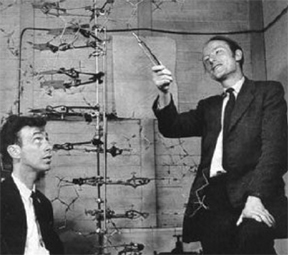
On this day in 1953 Francis Crick (right)and J. Watson (left) discovered the structure of the DNA molecule.

Molecular Visualizations of DNA:

DNA Analysis Reveals Rapid Population Shift In Pleistocene Cave Bears

Sudden replacement of cave bear mitochondrial DNA in the late Pleistocene. 2007. M. Hofreiter et al. Current Biology 17, R122-R123.
Studying DNA obtained from teeth of ancient cave bears, researchers have been able to identify a shift in a particular population of the bears inhabiting a European valley in the late Pleistocene era.
From the press release:

To investigate the stability of ancient cave bear populations over time, the researchers studied mitochondrial DNA sequence from 29 cave bear teeth from three geographically close caves in the Ach Valley, near the Danube River in modern-day southern Germany.

The findings indicated that while four sequence types (known as haplotypes) corresponded to bears 28,000 to 38,000 years old, a fifth DNA haplotype was found only in bears that were 28,000 years old or younger. These data suggested that what had been a stable, long-established cave bear population became disrupted around 28,000 years ago and was replaced by a new, genetically distinct cave bear group.

The timing of the disruption appears to roughly coincide with the arrival of modern humans in the Ach Valley, thought to have occurred by 32,000 years ago. The researchers suggest that human influence in the form of hunting and competition for sheltering caves may represent a plausible explanation for the disruption in the cave bear population. image


Phylogenetic tree of 26 published cave bear haplotypes and temporal relationship of the two haplogroups in the Ach Valley.

(A) Phylogenetic positions of the sequences from two reproductively isolated cave bear populations from Austria (dotted arrows) and from the Ach Valley (normal arrows). Haplotypes from the older sequence group from the Ach Valley fall within the same clade as those from the higher elevation site (2,000 m) in Austria (blue arrows), while the younger haplotype from the Ach Valley clusters with haplotypes from the lower elevation site (1,300 m above sea level) in Austria (red arrows). (B) Radiocarbon dates for the fossil teeth from the Ach Valley. The different sequence groups are shown in the same colors as in (A).

Monday, February 19, 2007

Born This Day: Sven Anders Hedin

Feb. 19,1865 - Nov. 26, 1952

Hedin was a Swedish explorer and geographer, born in Stockholm, who led four multi-year expeditions into Central Asia between 1897 and 1935. Although not as well known as Roy Chapman Andrews his work in the regions revealed a wealth of cultural, archaeological and palaeontological wonders.

During his first major Asian expedition, he crossed the Pamirs, charted Lop Nor (Lake) in China, and finally arrived at Beijing. He then journeyed to Tibet by way of Mongolia, Siberia, and the Gobi Desert. Hedin explored Tibet and Xinjiang (Sinkiang), identified the sources of the Brahmaputra, Indus, and Sutlej rivers, and, in 1906, explored and named the Trans-Himalayas. In 1927 Hedin led an expedition of Chinese and Swedish scientists into Central Asia.

He wrote extensively about his adventures (e.g., Across the Gobi Desert, The Conquest of Tibet (1935), My Life as an Explorer (1926)) and they make for engaging and fascinating reading for anyone interested in the early days of exploring Central Asia. link

An excellent summary of Hedin’s life and expeditions into Central Asia can be found at the IDP News Archives image

Happy Birthday To: Don Glut

Author of The Dinosaur Dictionary, The Dinosaur Scrapbook, and the on-going Dinosaur Encyclopedia volumes, amongst dozens of other writing credits including a fun run on the above title.

Weirdest Dinosaur Names


NeatoRama presents a compilation of weird dinosaur (& other fossil critter) names. That's Bambiraptor above.

Born This Day: Sir Roderick Impey Murchison

Feb. 19, 1792 - Oct. 22, 1871

Murchison was a Scottish geologist who first differentiated the Silurian strata in the geologic sequence of Early Paleozoic strata (408-540 million years old). He believed in fossils as primary criteria. In 1831, he began researching the previously geologically unknown graywacke rocks of the Lower Paleozoic, found underlying the Old Red Sandstone in parts of Wales, which culminated in his major work the Silurian System (1839).


An eurypterid, a prehistoric sea scorpion from PBS.org.
Murchison named the Silurian after an ancient British tribe that inhabited South Wales. He established the Devonian working with Adam Sedgwick (1839). He named the Permian (1841) after the Perm province in Russia where he made a geological survey in 1840-45. link

Born This Day: William Diller Matthew

Feb. 19, 1871 – Sept. 24, 1930

Matthew was a superb mammalian paleontologist and important biogeographic theorist, and also G. G. Simpson's primary mentor. Matthew published voluminiously on the fossil record of mammals and advocated a fully modern approach to taxonomy that emphasized tying scientific names to natural biological populations. His 1930 paper gives a clear statement of this position.

Matthew's key biogeographic theory was that waves of faunal migration repeatedly went from the northern continents southwards. This theory, which had obvious racial and political overtones, was justified by a "stabilist" view of paleogeography (i.e., that the continents had never moved from their modern positions), and by evidence from the relatively young fossil record of mammals, at the expense of other data that would have shown the more ancient interconnections among South America, Africa, India, and Australia. Remarkably, Matthew remained a Darwinian despite working for the autocratic orthogeneticist H. F. Osborn for three decades.

Info from HERE. Image from HERE.

Sunday, February 18, 2007

Paleofest at The Burpee Musuem


If you’re in the Rockford/Chicago area this weekend why not take in the final day of Paleofest at the Burpee Museum? Guests include folks like Karen Chin, Tom Williamson, Peter Larson of ‘Sue’ fame, and Thomas Carr.

Friday, February 16, 2007

Skeleton In Motion


Via: VideoSift

While I’m not a big fan of graffiti, this is pretty cool. The artwork was done by Bonom and Lork at the Etterbeek train station, Belgium.

Thanks to NeatoRama!

Born This Day: Ernst Heinrich August Haeckel

Feb, 16, 1834 - Aug. 9, 1919.

Haeckel was a German zoologist and evolutionist who was a strong proponent of Darwinism and proposed new notions of the evolutionary descent of man. He coined many words commonly used by biologists today, such as phylum, phylogeny, and ecology.

He is noted for the book, The evolution of man: a popular exposition of the principal points of human ontogeny and phylogeny link

Born This Day: Jean-Baptiste-Julien d' Omalius d'Halloy

Feb. 16, 1783 - Jan. 15, 1875

d'Halloy was a Belgian geologist who was an early proponent of evolution and was acknowledged by Charles Darwin in his preface to ‘On The Origin of the Species’ for his opinions on the origin of new species through descent with modification.

He determined the stratigraphy of the Carboniferous and other rocks in Belgium and the Rhine provinces, and also made detailed studies of the Tertiary deposits of the Paris Basin. link

Regressive Evolution in Cavefish

Regressive Evolution in the Mexican Cave Tetra, Astyanax mexicanus. 2007. M. Protas et al. Current Biology
"Regressive evolution," or the reduction of traits over time, is the result of either natural selection or genetic drift, according to new a study on cavefish.
From the press release:

Previously, scientists could not determine which forces contributed to regressive evolution in cave-adapted species, and many doubt the role of natural selection in this process. Darwin himself, who famously questioned the role of natural selection in eye loss in cave fishes, said, "As it is difficult to imagine that eyes, although useless, could be in any way injurious to animals living in darkness, I attribute their loss wholly to disuse."

Cave adaptations have evolved in many species independently, and each cave species can be considered a replicate of the same evolutionary experiment that asks how species change in perpetual darkness. This makes cavefish a rich source for the examination of the evolutionary process.

Their results suggest that eyes and pigmentation regressed through different mechanisms. Mutations in cave populations that affected eye or lens size invariably caused size reductions. This observation is consistent with evolution by natural selection and inconsistent with evolution by genetic drift. By contrast, mutations in cave populations that affected pigmentation sometimes caused increases instead of decreases in pigment cell density, consistent with evolution by random processes and genetic drift.

Allaying Darwin's doubts about the role of natural selection in eye loss, the researchers suggest that the high metabolic cost of maintaining the retina is the source of selection against eyes in the cave. By contrast, no such great cost is associated with pigmentation—thus, the two traits regress for different reasons.