


'Young Earth' and 'Turok, Son of Stone' are (c) their current copyright holders.


 Scientists have discovered for the first time a dinosaur with shelled eggs inside her belly. The find yields insight into how dinosaurs made babies and supports the theory that modern birds and dinosaurs are close relatives.

 It was a step in the right direction, but still relied on the blatant appeal of a somewhat anachronistic furry warm-blooded mammal protagonist (admittedly a clear step away from human protagonists, but not by much) anthropomorphized by the writer (“’It’s vacant! Come on in!’ Mother Raccoon chirrups happily...”). “Danger in the Nest” eschewed such devices with neat abandon, assuming the reader could and would empathize with a cold-blooded (as it was presumed all prehistoric reptiles were, at that time) protagonist without reliance on Beatrix Potter-like, or Aesopian, conceits.


 What was important -- and fresh -- was that the conjectured behavior of the dinosaurs and prehistoric creatures was convincing at a ‘gut’ level. Shorn of the need to artificially inflate these incredible animals into the stature of ‘monsters,’ interact with anachronistic human beings, or motivate them to attack contemporary metropolitan areas, Newman and Maxon were free -- for the first time in comics history, or, for that matter, arguably any medium outside of science and pop science texts -- to portray prehistoric animals as animals.
 These new kinds of stories relied upon extrapolating possible behaviors for the extinct creatures from that of contemporary life forms: a mother Pteranodon behaving like a protective bird, a hungry plesiosaur seeking easier feeding grounds. Though the writer and cartoonist were hardly paleontologists, they did a credible job with their layman knowledge of zoology and prehistoric life, creating a tactile sense of time, place, and reality that was innovative.

 As demonstrated in even the finest ‘paleo’ short stories and novels, from the venerable BEFORE THE DAWN (1934) by mathematician Eric Temple Bell (writing as ‘John Taine’) to paleontologist Robert Bakker’s recent RAPTOR RED (1995), the written word alone does not lend itself to ‘pure’ dinosaur fiction. Those damned latin species names stop a reader’s eye dead, and the repetition of either species names or personalized monikers or ‘nicknames’ become intrusive; further, the contemporary vernacular of even the most careful author wrenches us out of the primordial narrative.
 In comics, however, we see the creatures, identify and distinguish them by sight, and know with a glance their diets, strengths, and vulnerabilities. Identifying markings, patterns, or coloration allow both artist and reader to individualize the creatures themselves in a way that is difficult at best via text alone, and the body language of the drawn creatures invites a primal bond between reader and animal almost impossible to evoke with such urgency in literature. Comics, as a medium, is perfectly suited to this ideosyncratic genre, and the appeal of dinosaurs to the traditional comics readership is universal.

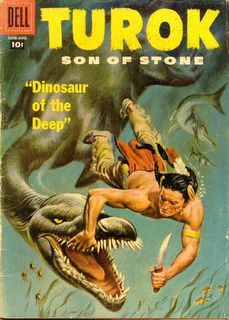 “Young Earth” was a revelation: the first true dinosaur comic book series, focusing solely on the prehistoric animals (and, later, on prehistoric man) in compact, concise narratives. Newman’s scripts were marvelously evocative and concise; Maxon’s sketchy, energetic art enlivened the series for the duration of TUROK’s run.


“New fossils from the Upper Permian Moradi Formation of northern Niger provide an insight into the faunas that inhabited low-latitude, xeric environments near the end of the Palaeozoic era ( 251 million years ago). We describe here two new temnospondyl amphibians, the cochleosaurid Nigerpeton ricqlesi gen. et sp. nov. and the stem edopoid Saharastega moradiensis gen. et sp. nov., as relicts of Carboniferous lineages that diverged 40–90 million years earlier. Coupled with a scarcity of therapsids, the new finds suggest that faunas from the poorly sampled xeric belt that straddled the Equator during the Permian period differed markedly from well-sampled faunas that dominated tropical-to-temperate zones to the north and south. Our results show that long-standing theories of Late Permian faunal homogeneity are probably oversimplified as the result of uneven latitudinal sampling.”

Does this facial reconstruction depict our earliest known human ancestor? In 2002 paleontologists digging in Chad, Africa, unearthed a skull and other seven-million-year-old fossils of Sahelanthropus tchadensis. Bent by millennia of interment, the skull had a deformed shape that made it tough to tag as totally human.
Now new fossil finds and a high-tech skull reconstruction (not shown) strongly suggest the species was human, after all. This would make it the oldest known human ancestor.
The breakthrough came when researchers recently discovered two new jawbones and a specialized tooth near the site of the original fossil find. A computer reconstruction revealed that these skull pieces fell into place when arranged along the lines of a human skull. Their alignment also hinted at a spine connection typical of upright-walking primates—in other words, humans and human ancestors.
 “Elephant shrews – part of a group that includes elephants, sea cows and aardvarks, are thought to be endemic to Africa – yet we have found evidence of their beginnings in North America,” Bloch said. “This research has broad implications because it indicates there may have been a great deal more interchange in terms of how animals moved around the world as the continents broke up than previously thought.”

 This school believed that changes in developmental (embryonic) timing, not natural selection, was the driving force of evolution. In 1867, Cope suggested that most changes in species occurred by coordinated additions to the ontogeny of all the individuals in a species. Speciation proceeded by the addition of stages to the end of embryonic sequences of development and by compression of earlier stages into the earlier parts of the developmental sequence. That is, a new developmental stage would be tacked onto the end of the developmental process, pushing the old end stage further back in development. Cope thought that groups of species that shared similar developmental patterns could be grouped into more inclusive groups (i.e. genera, families, and so on).


A new University of Colorado at Boulder study indicates Earth in its infancy probably had substantial quantities of hydrogen in its atmosphere, a surprising finding that may alter the way many scientists think about how life began on the planet.
Published in the April 7 issue of Science Express, the online edition of Science Magazine, the study concludes traditional models estimating hydrogen escape from Earth's atmosphere several billions of years ago are flawed. The new study indicates up to 40 percent of the early atmosphere was hydrogen, implying a more favorable climate for the production of pre-biotic organic compounds like amino acids, and ultimately, life.
The paper was authored by doctoral student Feng Tian, Professor Owen Toon and Research Associate Alexander Pavlov of CU-Boulder's Laboratory for Atmospheric and Space Physics with Hans De Sterck of the University of Waterloo. The study was supported by the NASA Institute of Astrobiology and NASA's Exobiology Program. "I didn't expect this result when we began the study," said Tian, a doctoral student in CU-Boulder's Astrobiology Center at LASP and chief author of the paper. "If Earth's atmosphere was hydrogen-rich as we have shown, organic compounds could easily have been produced."
Scientists believe Earth was formed about 4.6 billion years ago, and geologic evidence indicates life may have begun on Earth roughly a billion years later. "This study indicates that the carbon dioxide-rich, hydrogen-poor Mars and Venus-like model of Earth's early atmosphere that scientists have been working with for the last 25 years is incorrect," said Toon. In such atmospheres, organic molecules are not produced by photochemical reactions or electrical discharges.
The new study indicates the escape of hydrogen from Earth's early atmosphere was probably two orders of magnitude slower than scientists previously believed, said Tian. The lower escape rate is based in part on the new estimates for past temperatures in the highest reaches of Earth's atmosphere some 5,000 miles in altitude where it meets the space environment.
While previous calculations assumed Earth's temperature at the top of the atmosphere to be well over 1,500 degrees F several billion years ago, the new mathematical models show temperatures would have been twice as cool back then. The new calculations involve supersonic flows of gas escaping from Earth's upper atmosphere as a planetary wind, according to the study.
Despite somewhat higher ultraviolet radiation levels from the sun in Earth's infancy, the escape rate of hydrogen would have remained low, Tian said. The escaping hydrogen would have been balanced by hydrogen being vented by Earth's volcanoes several billion years ago, making it a major component of the atmosphere.
In 1953, University of Chicago graduate student Stanley Miller sent an electrical current through a chamber containing methane, ammonia, hydrogen and water, yielding amino acids, considered to be the building blocks of life. "I think this study makes the experiments by Miller and others relevant again," Toon said. "In this new scenario, organics can be produced efficiently in the early atmosphere, leading us back to the organic-rich soup-in-the-ocean concept."

A team of Japanese genetic scientists aims to bring woolly mammoths back to life and create a Jurassic Park-style refuge for resurrected species. The effort has garnered new attention as a frozen mammoth is drawing crowds at the 2005 World Exposition in Aichi, Japan.

The team of scientists, which is not associated with the exhibit, wants to do more than just put a carcass on display. They aim to revive the Ice Age plant-eaters, 10,000 years after they went extinct.
Their plan: to retrieve sperm from a mammoth frozen in tundra, use it to impregnate an elephant, and then raise the offspring in a safari park in the Siberian wild. "If we create a mammoth, we will know much more about these animals, their history, and why they went extinct," said Kazufumi Goto, head scientist at the Mammoth Creation Project. The venture is privately funded and includes researchers from various institutions in Japan.
Many mammoth experts scoff at the idea, calling it scientifically impossible and even morally irresponsible. "DNA preserved in ancient tissues is fragmented into thousands of tiny pieces nowhere near sufficiently preserved to drive the development of a baby mammoth," said Adrian Lister, a paleontologist at University College London in England.
The scientists with the Mammoth Creation Project are hoping to find a mammoth that is sufficiently well preserved in the ice to enable them to extract sperm DNA from the frozen remains. They will then inject the sperm DNA into a female elephant, the mammoth's modern-day counterpart. By repeating the procedure with offspring, scientists say, they could produce a creature that is 88 percent mammoth within 50 years.
The team has already picked out a home for living mammoths in northern Siberia. The preserve, dubbed Pleistocene Park, could feature not only mammoths, but also extinct species of deer, woolly rhinoceroses, and even saber-toothed cats, he said.


 The debut issue was drawn by TARZAN comic strip artist Rex Maxon, who occasionally returned to the series. But Maxon's steady and lasting contribution to TUROK -- and, though no one has ever before acknowledged it, to comics history and the evolution of the dinosaur comic genre -- was launched without fanfare in TUROK #8 (June-August, 1957).


 Furthermore, in both text and art, these were animals acting like, and presented as, animals. Without stretching believability or relying on the sort of devices comics usually required in stories involving animals (i.e., human narrators, framing panels featuring human characters, lending speech or human thought to the animal protagonists, etc.), the writer invited the reader to empathize with these creatures, particularly the protagonist. Sly references are made to emotions, but none so emphatically as to break the spell. This mother Pteranodon "proudly eyes here first young breaking his shell...," "...realizes she cannot fight off the lumbering reptile -- her only hope is to lure him away...," "...cleverly back[s] away, just out of his range...," "...as she is about to fly off triumphantly, her wing is caught...," "...sees with relief the Dimetrodon hunting far from her nest...," and "...wonders how her first hatched young is making out...".
 Even the ravenous carnivore is afforded a moment of empathy, as he "eagerly" scrabbles toward his prey. Thus, for the first time, prehistoric animals moving within their own environment were shown interacting, capable of a range of emotions -- pride, calculation, hope, cleverness, triumph, disappointment, relief, and wonder -- rendered in primal enough terms to remain animals.
 English physical anthropologist, geologist, and paleontologist best known for his work in the relative dating of fossils by fluorine content. While working for the British Natural History Museum, Oakley become famous in 1953 for exposing a forgery. A "Piltdown Man" skull had been "unearthed" in 1912, in Piltdown, England, and had for decades been said to represent the "missing link" in human evolution. Oakley developed a method, based on a French minerologist's theory that bones would gradually absorb fluorine from surrounding soil, to measure the fluorine levels in bones. With this and other tests he proved the true age of the bones to be a modern human braincase and an orangutan jawbone. The bones of the forgery had been chemically stained to appear ancient.