Saturday, October 31, 2015
Friday, October 30, 2015
The Feeding Style of Man's 500 Million Year Old Ancestor
Cambrian cinctan echinoderms shed light on feeding in the ancestral deuterostome. 2015. Proc. Roy. Soc.B
Reconstruction of Protocinctus. Credit: O. Sanisidro
Scientists have used computer simulations to reconstruct the feeding style of Protocinctus mansillaensis, an echinoderm that is a common ancestor shared between humans and starfish, which lived 510 million years.The results of the computer simulations show that the animal fed by actively drawing water into its mouth using internal gill slits, rather than passively waiting for food to come to it. Because the fossil represents one of the earliest ever echinoderms, this also suggests that the ancestor of echinoderms and vertebrates employed the same feeding strategy. Read more at Phys Org.
Thursday, October 29, 2015
When Giant Mushrooms Ruled The Earth
Excavating Prototaxites
From around 420 to 350 million years ago, when land plants were still the relatively new kids on the evolutionary block and “the tallest trees stood just a few feet high,” giant spires of life poked from the Earth. “The ancient organism boasted trunks up to 24 feet (8 meters) high and as wide as three feet (one meter),” said National Geographic in 2007. With the help of a fossil dug up in Saudi Arabia scientists finally figured out what the giant creature was - the fungus, Prototaxites
Read more at Smithsonianmag.org
Wednesday, October 28, 2015
Vertebrate Penis Only Evolved Once
Resurrecting embryos of the tuatara, Sphenodon punctatus, to resolve vertebrate phallus evolution. 2015. Biology Letters
New research on 100-year old data indicates that the vertebrate penis only evolved once.
Using a 3D model generated from slides of thin-sectioned tuatara - a rhynchocephalian reptile that shares a common ancestor with living squamates (lizards & snakes; see cladogram below) - embryos, the team found genital swellings, a precursor to penis development in many vertebrates. In the tuatara, the developments do not mature, like many modern bird species, they cease developing, thus adults have no penis. But the swellings clearly show the possibility, which the team suggests, offers a strong argument to the case of the penis developing from a common ancestor.
Cladogram showing relationships of extant members of the Sauria.1. Tuatara, 2. Lizards, 3. Snakes, 4. Crocodiles, 5. Birds (& dinosaurs). From here
Yes, DC Comics has a 'superhero' from New Zealand called 'The Tuatara'!
Some dodgy evolutionary biology from writer, E. Nelson Bridwell
Read more at Phys Org. And thanks to MonsterRobot!
Tuesday, October 27, 2015
Paleonauts by Mark Schultz
Paleonauts © Mark Schultz
This strip and more great art by Mark Schultz can be found in his latest collection, "Portfolio: The Complete Various Drawings by Mark Schultz" from Flesk Publications, or other fine booksellers.
Mark will also be at the CMNH's 2nd Annual DinoFest, Nov. 14, running a family class on drawing dinosaurs & giving a public talk - sign up early!
Monday, October 26, 2015
Sunday, October 25, 2015
Saturday, October 24, 2015
Premiered This Day: Trog
"A sympathetic anthropologist (Joan Crawford!) uses drugs and surgery to try to communicate with a primitive troglodyte found living in a local cave."Directed in 1970 by Hammer Films veteran, Freddie Francis, this was Crawford's last film. Notable for lifting the dinosaur scenes done by Willis H. O'Brien and Ray Harryhausen for the Irwin Allen-produced film The Animal World.
"After seeing this film, Joan Crawford supposedly joked that if it hadn't been for her end-of-life conversion to Christian Science, she might have committed suicide due to her embarrassment at having been in it." link
Friday, October 23, 2015
Rapid Evolution in Parasitic Wasps
Sequential divergence and the multiplicative origin of community diversity. 2015. PNAS.
A parasitic wasp (Diachasma alloeum) that preys upon a fruit fly species known as an apple maggot. Researchers found that the wasp evolved after the fruit flies evolved into new species when they began laying their eggs and mating on apple trees, as opposed to their native hawthorn tree hosts. Three different kinds of parasitoid wasps were collected from a number of different fly host plant environments in the wild.
Analyses in the lab showed that all three of the different kinds of wasps had diverged from others of the same kind, both genetically and with respect to host-associated physiology and behavior.
"In a sense," Smith said, "they have caught an entire community of parasitoids actively ecologically diverging in response to a historically documented host plant shift of their fly host."
From Phys Org.
Thursday, October 22, 2015
Chelonoidis donfaustoi, New Tortoise Species Form The Galapagos
Description of a New Galapagos Giant Tortoise Species (Chelonoidis; Testudines: Testudinidae) from Cerro Fatal on Santa Cruz Island. 2015. PLoS One
Scientists have discivered that the two giant tortoise populations on the Santa Cruz island are genetically different species. The researchers 'baptized' [as the press release states] the new species Chelonoidis donfaustoi, in honor of Fausto Llerena, the caretaker of Lonesome George, a male Pinta Island tortoise and the last known survivor of his species.
The skull of the museum specimen UWZS 32700, holotype for Chelonoidis sp. nov. from Cerro Fatal in Santa Cruz
Died This Day: Sir Roderick Impey Murchison
Murchison (Feb. 19, 1792 - Oct. 22, 1871) was a Scottish geologist who first differentiated the Silurian strata in the geologic sequence of Early Paleozoic strata (408-540 million years old). He believed in fossils as primary criteria. In 1831, he began researching the previously geologically unknown graywacke rocks of the Lower Paleozoic, found underlying the Old Red Sandstone in parts of Wales, which culminated in his major work the Silurian System (1839).
Murchison named the Silurian after an ancient British tribe that inhabited South Wales. He established the Devonian working with Adam Sedgwick (1839). He named the Permian (1841) after the Perm province in Russia where he made a geological survey in 1840-45. link
Wednesday, October 21, 2015
Arvinachelys goldeni, New Fossil Baenid Turtle from Utah
A new species of baenid turtle from the Kaiparowits Formation (Upper Cretaceous: Campanian) of southern Utah. Lively, J.R. 2015. Journal of Vertebrate Paleontology.
An artist's depiction of the turtle Arvinachelys goldeni as it would have appeared in life 76 milion years ago in southern Utah. Credit: Victor Leshyk
The pig-nosed turtle's scientific name derives from arvina, a Latin word for pig fat or bacon¬, and chelys, Latin for tortoise. And goldeni honors Jerry Golden, a volunteer fossil preparator at the Natural History Museum of Utah, who prepared the new holotype specimen—and many others in the museum's collections.
"Volunteers are involved in every aspect of what we do, from field work and digging up specimens to preparing them," said Randall Irmis, curator of paleontology at the museum and associate professor at the University of Utah. "In 2014, volunteers provided 14,500 hours of work. It's a massive contribution. We couldn't do what we do without them. We really consider them key team members. From: Phys Org.
Tuesday, October 20, 2015
Life On Earth Started 4.1 Billion Years Ago
Potentially biogenic carbon preserved in a 4.1 billion-year-old zircon. 2015. PNAS
UCLA geochemists have found evidence that life likely existed on Earth at least 4.1 billion years ago—300 million years earlier than previous research suggested. The discovery indicates that life may have begun shortly after the planet formed 4.54 billion years ago.
The new research suggests that life existed prior to the massive bombardment of the inner solar system that formed the moon's large craters 3.9 billion years ago.
Scientists had long believed the Earth was dry and desolate during that time period. The planet was probably much more like it is today than previously thought.
Saturday, October 17, 2015
Born This Day: Julie Adams
Julie starred as Kay Lawrence in The Creature From The Black Lagoon (1954). Adams has had a long career in films and TV, recently appearing on 'Lost'.
Thursday, October 15, 2015
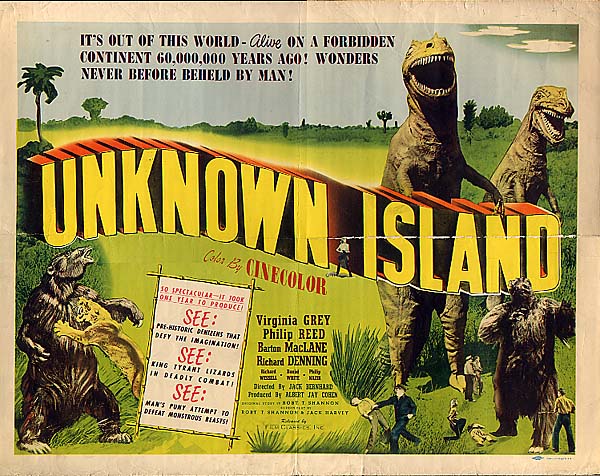
Premiered This Day: Unknown Island
This 1948 film written by Robert T. Shannon and directed by Jack Bernhard features some of the worst ‘man dressed up as a T. rex’ effects ever. Not a bad little story though.
Wednesday, October 14, 2015
Born This Day: Jack Arnold
Jack Arnold (Oct. 14, 1916 - March 17, 1992) directed a number of classic SF films including The Creature From the Black Lagoon, Revenge of the Creature, The Incredible Shrinking Man, and It Came From Outer Space, as well as few not-so-classics (but still much loved) such as Monster on Campus. Throughout the ‘60’s and into the early 80’s he had a successful career as a TV producer and director.
Tuesday, October 13, 2015
Born This Day: Sir John William Dawson
Dawson (Oct. 13, 1820 - Nov. 20, 1899>) was a Canadian geologist who made numerous contributions to paleobotany
and extended the knowledge of Canadian geology. Dawson was born and raised in Pictou, Nova Scotia, where the many sandstone and coal formations provided fertile ground for his first scientific explorations, which culminated in the publication of Acadian Geology. He made many important discoveries of fossil life, great and small. These included fossil plants, trackways of lowly invertebrates, footprints, skeletons of reptiles and amphibians, millipedes and the earliest land snails. When the famous geologist Charles Lyell visited coal deposits in Pictou, Dawson acted as his guide.
In 1851, Dawson and Lyell teamed up again to examine the interiors of fossil tree trunks at Joggins,
Nova Scotia. They discovered the remains of some of the earliest known reptiles, Hylonomus lyelli, along with other rare fossils, propelling this part of the world into the international spotlight.
and extended the knowledge of Canadian geology. Dawson was born and raised in Pictou, Nova Scotia, where the many sandstone and coal formations provided fertile ground for his first scientific explorations, which culminated in the publication of Acadian Geology. He made many important discoveries of fossil life, great and small. These included fossil plants, trackways of lowly invertebrates, footprints, skeletons of reptiles and amphibians, millipedes and the earliest land snails. When the famous geologist Charles Lyell visited coal deposits in Pictou, Dawson acted as his guide.In 1851, Dawson and Lyell teamed up again to examine the interiors of fossil tree trunks at Joggins,
Nova Scotia. They discovered the remains of some of the earliest known reptiles, Hylonomus lyelli, along with other rare fossils, propelling this part of the world into the international spotlight.
Monday, October 12, 2015
Saturday, October 10, 2015
Weird Tales - A Million Years Later!
From Prehistosaurio
Subscribe to:
Posts (Atom)