From Today In Science History:
Leakey (Aug 7, 1903 – October 1, 1972), an archaeologist and anthropologist, was born in Kabete, Kenya, of English missionaries parents. Leakey was largely responsible for convincing scientists that Africa, rather than Java or China, was the most significant area to search for evidence of human origins. Leakey led fossil-hunting expeditions to eastern Africa from the 1920's.
He married Mary D. Nicol in 1936 and the couple discovered many important fossils together. In 1964, on an expedition to the Olduvai Gorge in Tanzania, he found fossil remains of, he believed, the earliest member of the genus of human beings. He named the species Homo habilis.
Saturday, August 07, 2010

Tuesday, August 03, 2010

Discovered This Day: The La Brea Tar Pits

In 1769, The La Brea Tar Pits in Los Angeles, California were first noticed by a Spanish expedition. Juan Crespi, a Franciscan friar with the expedition of Gaspar de Portola (the first Spanish governor of the Californias), in 1769-70, wrote "The 3rd, we proceeded for three hours on a good road; to the right were extensive swamps of bitumen which is called chapapote. We debated whether this substance, which flows melted from underneath the earth, could occasion so many earthquakes."
The name La Brea comes from the Spanish word for "tar." A scientific publication first recorded the fossils found there in 1875, the work of Professor William Denton. Evidence exists that prehistoric native Americans used and traded the asphalt. From Today In Science History


Saturday, July 31, 2010
Born This Day: Discoverer of Earth’s Molten Core
Richard Dixon Oldham (July 31, 1858 – July 15, 1936) was an Irish geologist and seismologist who discovered evidence for the existence of the Earth's liquid core in 1906.
In studying seismograms of the great 1897 Indian Earthquake he identified P (primary) and S (secondary) waves. It is interesting that he did not get a clue to the presence of the core from the S waves, which are actually incapable of being transmitted through the liquid of the outer core. (The liquid core does not transmit the shear wave energy released during an earthquake.)
Rather he noted the existence of a shadow zone in which P waves from an earthquake in the opposite hemisphere of the earth failed to appear. From Today in Science History


Friday, July 30, 2010
Evolution of The Inner Ear
Fossil evidence on evolution of inner ear cochlea in Jurassic mammals. 2010. Zhe-Xi Luo, et al. Proc. Of the Royal Soc. B. Published online before print July 28.

Click to enlarge
Abstract: The coiled cochlea is a key evolutionary innovation of modern therian mammals. We report that the Late Jurassic mammal Dryolestes, a relative to modern therians, has derived bony characteristics of therian-like innervation, but its uncoiled cochlear canal is less derived than the coiled cochlea of modern therians. This suggests a therian-like innervation evolved before the fully coiled cochlea in phylogeny.
The embryogenesis of the cochlear nerve and ganglion in the inner ear of mice is now known to be patterned by neurogenic genes, which we hypothesize to have influenced the formation of the auditory nerve and its ganglion in Jurassic therian evolution, as shown by their osteological correlates in Dryolestes, and by the similar base-to-apex progression in morphogenesis of the ganglion in mice, and in transformation of its canal in phylogeny. The cochlear innervation in Dryolestes is the precursory condition in the curve-to-coil transformation of the cochlea in mammalian phylogeny.
This provides the timing of the evolution, and where along the phylogeny the morphogenetic genes were co-opted into patterning the cochlear innervation, and the full coiling of the cochlea in modern therians. link

Sunday, July 25, 2010
Southern Alberta Dinosaur Project 2010 Photos #2

On yet another rainy day we drove to Eastend, SK, to check out the T. rex Discovery Centre.


Touring the T. rex Centre. That's CMNH Kirtlandia, Geoff Goodman, above.


Eastend also has a small cultural museum downtown with a nice Triceratops skull and Torosaurus frill, as well as other displays, such as the above.


Nic C. collects part of a tyrannosaurid skull.

Finishing up field jackets in camp. Magdeline, U of Calgary Phrynosoma researcher, looks on from above.

CWRU Work Study student, Matt Clemens, is unsure of the wisdom of defying the storm gods today.

The students tour Dinosaur Provincial Park. At the Centrosaurus BB, top row: Geoff, Kentaro, Eric the CO; Bottom row: Matt, Evan, David Lloyd (RTMP Tech), Danielle D. (Carleton U.).

Chris Magarity, U of T grad student and summer RTMP tech, works on his thesis at the museum in the off hours. Chris and his wonderful wife, Kelly, spent much of their days off helping us out in the field.
Born This Day: Rosalind Franklin
Rosalind Franklin (July 25, 1920 - Apr. 16, 1958) was an English scientist who contributed to the discovery of the molecular structure of deoxyribonucleic acid (DNA), a constituent of chromosomes that serves to encode genetic information.
Beginning in 1951, she made careful X-ray diffraction photographs of DNA, leading her to suspect the helical form of the molecule, at least under the conditions she had used.

Beginning in 1951, she made careful X-ray diffraction photographs of DNA, leading her to suspect the helical form of the molecule, at least under the conditions she had used.
Thursday, July 22, 2010
Born This Day: Gregor Mendel
From Today In Science History:
Mendel (July 22, 1822 – Jan. 6, 1884) was an Austrian pioneer in the study of heredity. He spent his adult life with the Augustinian monastery in Brunn, where as a geneticist,
botanist and plant experimenter, he was the first to lay the mathematical foundation of the science of genetics, in what came to be called Mendelism.
Over the period 1856-63, Mendel grew and analyzed over 28,000 pea plants. He carefully studied for each their plant height, pod shape, pod color, flower position, seed color, seed shape and flower color. He made two very important generalizations from his pea experiments, known today as the Laws of Heredity. Mendel coined the present day terms in genetics: recessiveness and dominance.
Mendel (July 22, 1822 – Jan. 6, 1884) was an Austrian pioneer in the study of heredity. He spent his adult life with the Augustinian monastery in Brunn, where as a geneticist,

botanist and plant experimenter, he was the first to lay the mathematical foundation of the science of genetics, in what came to be called Mendelism.
Over the period 1856-63, Mendel grew and analyzed over 28,000 pea plants. He carefully studied for each their plant height, pod shape, pod color, flower position, seed color, seed shape and flower color. He made two very important generalizations from his pea experiments, known today as the Laws of Heredity. Mendel coined the present day terms in genetics: recessiveness and dominance.
Friday, July 02, 2010
Southern Alberta Dinosaur Project 2010 Photos
I'm back in the field with David Evans from the ROM, hence the lack of posts for the past few weeks. Here are few recent photos:

Reopening a theropod quarry

Collecting a hadrosaur femur from the Milk River Ridge

Students mapping in the ceratopsid bone bed.

Nic Campione hard at work.

Prepping on a rainy day.

Reopening a theropod quarry

Collecting a hadrosaur femur from the Milk River Ridge

Students mapping in the ceratopsid bone bed.

Nic Campione hard at work.

Prepping on a rainy day.
Monday, June 21, 2010
Born This Day: Gavin de Beer
de Beer (Nov. 1, 1899 – June 21, 1972) was  an English zoologist and morphologist who contributed to experimental embryology, anatomy, and evolution. He refuted the germ-layer theory and developed the concept of paedomorphism - the retention of juvenile characteristics of ancestors in mature adults).
From examination of the fossil
Archaeopteryx, De Beer proposed mosaic evolution with piecemeal evolutionary changes to explain the combination of bird and reptile features.
From Today In Science History.
 an English zoologist and morphologist who contributed to experimental embryology, anatomy, and evolution. He refuted the germ-layer theory and developed the concept of paedomorphism - the retention of juvenile characteristics of ancestors in mature adults).
From examination of the fossil
Archaeopteryx, De Beer proposed mosaic evolution with piecemeal evolutionary changes to explain the combination of bird and reptile features.
From Today In Science History.
Wednesday, June 16, 2010
Born This Day: George Gaylord Simpson
"Life is the most important thing about the world, the most important thing about life is evolution. Thus, by consciously seeking what is most meaningful, I moved from poetry to mineralogy to paleontology to evolution." G.G. SimpsonFrom the web site supporting the excellent PBS show “Evolution”:
As one of the founders of the "modern synthesis" of evolution, paleontologist George Gaylord Simpson (June 16, 1902 - Oct 6, 1984) argued that the fossil record supports Darwin's theory that natural
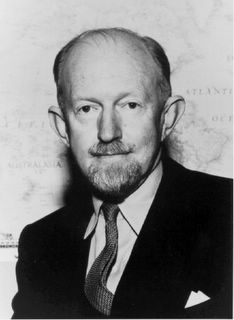 selection acting on random variation in a population is the driving force behind evolution. Simpson was among the first to use mathematical methods in paleontology, and he also took into account newly discovered genetic evidence for evolution in his study of paleontology.
In his 1944 book, Tempo and Mode in Evolution, Simpson divided evolutionary change into "tempo," the rate of change, and "mode," the manner or pattern of change, with tempo being a basic factor of mode. Simpson saw paleontology, revealing the long history of life on earth, as a unique field through which to study the history of evolution.
The early part of the twentieth century saw evolutionary theory embattled by disagreements over Darwin's emphasis on natural selection. The then-newly rediscovered work of Gregor Mendel in the nineteenth century was an uncomfortable fit with evolution, as many scientists saw it. They weren't at all certain that natural populations contained enough genetic variation for natural selection to create new species. So they entertained other explanations, including inheritance of acquired characteristics, "directed" variation toward a goal, or sudden large mutations that resulted in new species.
In the field of paleontology, the scientist who did most to resolve these questions was George Gaylord Simpson, who was on the staff of the American Museum of Natural History for 30 years.
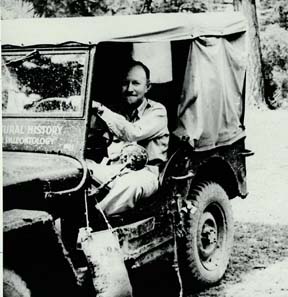 At a time when other paleontologists were convinced that the fossil record could best be explained by directed variation, Simpson disagreed. He said that fossil patterns needed no mystical or goal-oriented processes to explain them. For example, where others saw the modern horse as having arisen in a single advance toward the specialized form, Simpson saw the path as that of an irregular tree that had many side-branches leading off to extinction.
Simpson argued that the evolution of mammals, as seen in their fossilized remains, fit perfectly well with the new mechanisms of population genetics being studied at the time. He used the then-new mathematical methods to clarify how evolution occurred in "gene pools" in populations, not in individual members of the population.
Importantly, he showed that gaps in the fossil record reflected periods of substantial change through rapid "quantum evolution" in small populations, leaving little fossil evidence behind. At other times, he observed, rates of change could be so slow as to seem almost nonexistent.
Read more about Simpson HERE.
FYI, I'm now, more or less, in the field for the summer. I'll post when I can, and will, hopefully, have lots of field photos for the blog.
Monday, June 14, 2010
Ojoceratops fowleri

Ojoceratops fowleri, one of the largest known horned dinosaurs, was discovered in 2005 by Montana State University Ph.D. student Denver Fowler in the Four Corners area in the Bisti/De-Na-Zin Wilderness.
The discovery of the Ojoceratops bones, the events surrounding it and the details about the new ceratopsid dinosaur were released Thursday in a study published in the book New Perspectives On Horned Dinosaurs.
"Ojoceratops is a very distinctive beast," Robert M. Sullivan, senior curator of paleontology and geology at the State Museum of Pennsylvania, said in a news released issued by the New Mexico Museum of Natural History & Science. Sullivan led the series of expeditions to recover the bones.
Sullivan described the dinosaur in the Patriot-News on Tuesday as a three-horned vegetarian bigger than a hippopotamus and smaller than an elephant, about 17 to 20 feet in length.
"Based on other bones, such as the lower jaw and predentary, found in the same rock formation, Ojoceratops rivaled the size of Torosaurus and some of the larger specimens of Triceratops," Lucas said. From: The Santa Fe New Mexican
Warm-Blooded Mesozoic Marine Reptiles
Regulation of Body Temperature by Some Mesozoic Marine Reptiles. 2010. A. Bernard, et al. Science 328: 1379 – 1382.
Abstract: What the body temperature and thermoregulation processes of extinct vertebrates were are central questions for understanding their ecology and evolution. The thermophysiologic status of the great marine reptiles is still unknown, even though some studies have suggested that thermoregulation may have contributed to their exceptional evolutionary success as apex predators of Mesozoic aquatic ecosystems.
We tested the thermal status of ichthyosaurs, plesiosaurs, and mosasaurs by comparing the oxygen isotope compositions of their tooth phosphate to those of coexisting fish. Data distribution reveals that these large marine reptiles were able to maintain a constant and high body temperature in oceanic environments ranging from tropical to cold temperate.
Their estimated body temperatures, in the range from 35°±2°C to 39°±2°C, suggest high metabolic rates required for predation and fast swimming over large distances offshore.
Abstract: What the body temperature and thermoregulation processes of extinct vertebrates were are central questions for understanding their ecology and evolution. The thermophysiologic status of the great marine reptiles is still unknown, even though some studies have suggested that thermoregulation may have contributed to their exceptional evolutionary success as apex predators of Mesozoic aquatic ecosystems.


We tested the thermal status of ichthyosaurs, plesiosaurs, and mosasaurs by comparing the oxygen isotope compositions of their tooth phosphate to those of coexisting fish. Data distribution reveals that these large marine reptiles were able to maintain a constant and high body temperature in oceanic environments ranging from tropical to cold temperate.
Their estimated body temperatures, in the range from 35°±2°C to 39°±2°C, suggest high metabolic rates required for predation and fast swimming over large distances offshore.
Died This Day: Elkanah Billings
From Today In Science History:
Billings (May 5, 1820 - June 14, 1896) was a Canadian geologist and paleontologist, who was the first Canadian paleontologist. He published his first scientific paper on Trenton fossils in 1854. He launched a new monthly periodical, The Canadian Naturalist and Geologist in 1856, which he also edited and was the major contributor.
In Aug 1856 he was appointed staff paleontologist with the Canadian Geological Survey by William Edmond Logan, the founder of the Survey. Billings immediately began the task of identifying a 20-year backlog of fossils collected by the Survey. By 1863 he had published descriptions of no fewer than 526 new species of fossils.
The Billings medal, named in his honour, is awarded annually by the Paleontology Division of the Geological Association of Canada as a means of recognizing the most outstanding of its paleontologists.
Click HERE for more information on the Geological Association of Canada.
Portrait of Elkanah Billings GSC photo 69323 (c)
Billings (May 5, 1820 - June 14, 1896) was a Canadian geologist and paleontologist, who was the first Canadian paleontologist.
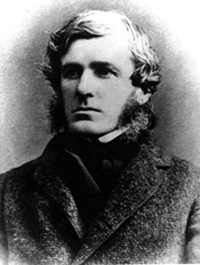 He published his first scientific paper on Trenton fossils in 1854. He launched a new monthly periodical, The Canadian Naturalist and Geologist in 1856, which he also edited and was the major contributor.
In Aug 1856 he was appointed staff paleontologist with the Canadian Geological Survey by William Edmond Logan, the founder of the Survey. Billings immediately began the task of identifying a 20-year backlog of fossils collected by the Survey. By 1863 he had published descriptions of no fewer than 526 new species of fossils.
The Billings medal, named in his honour, is awarded annually by the Paleontology Division of the Geological Association of Canada as a means of recognizing the most outstanding of its paleontologists.
On April 27, 1869, the Director of the GSC, Sir William Logan wrote this curt note to the paleontologist Elkanah Billings: "Your constant absence from the office is a worrying annoyance, particularly as I have reason to suspect that it does not arrive from rheumatism".For more info on Billings click HERE.
Click HERE for more information on the Geological Association of Canada.
Portrait of Elkanah Billings GSC photo 69323 (c)
Sunday, June 13, 2010
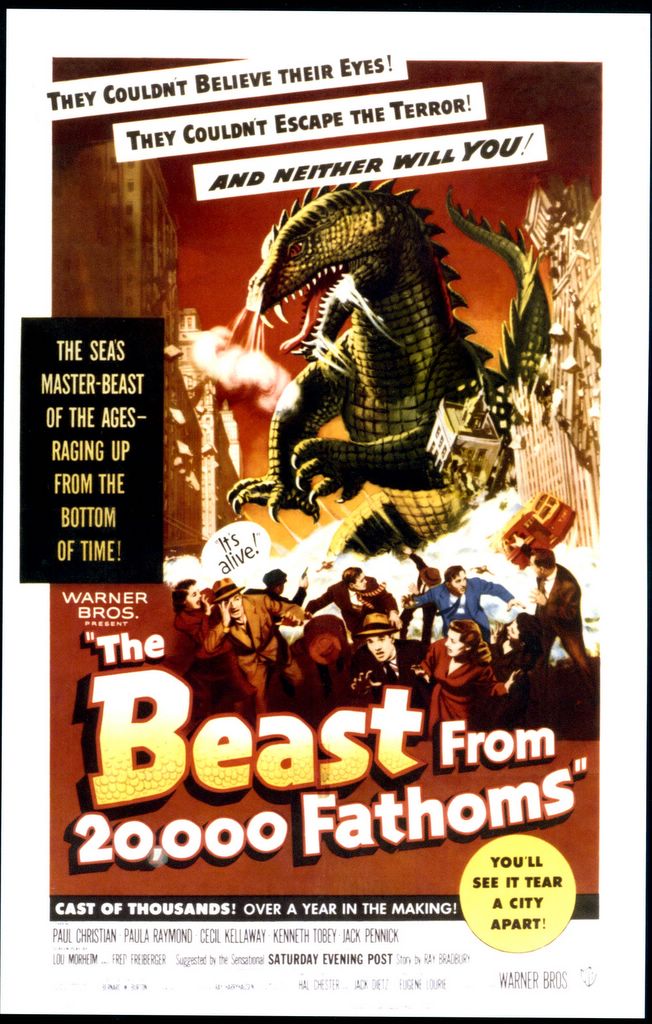
Premiered This Day: The Beast From 20,000 Fathoms
Born This Day: Luis Alvarez
Alvarez (June 13, 1911 - Sept. 1, 1988) was an American experimental physicist who was awarded the Nobel Prize for Physics in 1968 for work that included the discovery of many resonance particles --subatomic particles having extremely short lifetimes and occurring only in high-energy nuclear collisions. 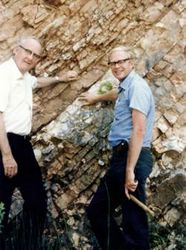
In about 1980 Alvarez (left) helped his son, the geologist Walter Alvarez (right), publicize Walter's discovery of a worldwide layer of clay that has a high iridium content and which occupies rock strata at the geochronological boundary between the Mesozoic and Cenozoic eras; i.e., about 66.4 million years ago. They postulated that the iridium had been deposited following the impact on Earth of an asteroid or comet and that the catastrophic climatic effects of this massive impact caused the extinction of the dinosaurs.
Though initially controversial, this widely publicized theory gradually gained support as the most plausible explanation of the abrupt demise of the dinosaurs.
Read more HERE. Image from HERE.
Thursday, June 10, 2010
Dinosaur Hunting by Boat in Alberta

2010 marks the 100th anniversary of the first scow-based dinosaur-hunting expeditions in Alberta, Canada. These flat-bottomed boats were used by Barnum Brown of the American Museum of Natural History as floating field camps between 1910 and 1913. When Brown left Canada, the Sternberg family of dinosaur hunters, working for the Geological Survey of Canada, also used them from 1913-1916.
Royal Tyrrell Museum technician, Darren Tanke, has for the past 8 years been working towards a Centennial re-enactment of the first AMNH trip, making and equipping a 1:1 scale of the AMNH scow. In late June of this year he and a dedicated crew will launch their scow (the Peter C. Kaisen; named after a Barnum Brown assistant) from the city of Red Deer, Alberta, and over a 5 week period float down the Red Deer River, ending in Dinosaur Provincial Park around August 7th. Along the way they'll be looking for dinosaur fossils and reliving history.
The blog 2010 Dino Hunting By Boat details the scow’s construction and the trip.
Wednesday, June 09, 2010
Dinosaur Eggs & Babies: Remarkable Fossils from South Africa

Read the story HERE. More info at the ROM.
Ken Carpenter - New Director of the Prehistoric Museum in Price

Paleontologist Ken Carpenter, a curator at the Denver Museum of Nature and Science, takes over this month as director of the Prehistoric Museum in Price, Utah.
Read the story HERE
Subscribe to:
Posts (Atom)