
Saturday, October 31, 2009
Frankenstein Vs. The Brontosaurus


Friday, October 30, 2009
Early O2 Levels & The Origin of Life
A Late Archean Sulfidic Sea Stimulated by Early Oxidative Weathering of the Continents. 2009. C. T. Reinhard, et a;. Science 326: 713-716.
Scientists widely accept that around 2.4 billion years ago, the Earth's atmosphere underwent a dramatic change when oxygen levels rose sharply. Called the "Great Oxidation Event" (GOE), the oxygen spike marks an important milestone in Earth's history, the transformation from an oxygen-poor atmosphere to an oxygen-rich one paving the way for complex life to develop on the planet.

By analyzing 2.5 billion-year-old black shales from Western Australia.researchers have corroborated recent evidence that oxygen production began in Earth's oceans at least 100 million years before the GOE.
Specifically, the shales revealed that episodes of hydrogen sulfide accumulation in the oxygen-free deep ocean occurred nearly 100 million years before the GOE and up to 700 million years earlier than such conditions were predicted by past models for the early ocean.
Hydrogen sulfide in the ocean is a fingerprint of photosynthetic production of oxygen 2.5 billion years ago.
"Our data point to oxygen-producing photosynthesis long before concentrations of oxygen in the atmosphere were even a tiny fraction of what they are today" said Reinhard.

The not-very-bright Aquaman © DC Comics
The researchers argue that the presence of small amounts of oxygen may have stimulated the early evolution of eukaryotes – organisms whose cells bear nuclei – millions of years prior to the GOE.
Scientists widely accept that around 2.4 billion years ago, the Earth's atmosphere underwent a dramatic change when oxygen levels rose sharply. Called the "Great Oxidation Event" (GOE), the oxygen spike marks an important milestone in Earth's history, the transformation from an oxygen-poor atmosphere to an oxygen-rich one paving the way for complex life to develop on the planet.

Specifically, the shales revealed that episodes of hydrogen sulfide accumulation in the oxygen-free deep ocean occurred nearly 100 million years before the GOE and up to 700 million years earlier than such conditions were predicted by past models for the early ocean.
Hydrogen sulfide in the ocean is a fingerprint of photosynthetic production of oxygen 2.5 billion years ago.
"Our data point to oxygen-producing photosynthesis long before concentrations of oxygen in the atmosphere were even a tiny fraction of what they are today" said Reinhard.

The not-very-bright Aquaman © DC Comics
Thursday, October 29, 2009
Born This Day: Othniel Marsh
Oct. 29, 1831 - March 18, 1899
From Today In Science History:
Marsh was an American paleontologist who discovered and described 100’s of new fossil species. He made extensive scientific explorations of the western U.S. and contributed greatly to knowledge of extinct North American vertebrates. Marsh spent only four seasons in the field, between 1870 and 1873.
"The Great Bone Wars," were the result of his rivalry with Edward Drinker Cope, America's other great vertebrate paleontologist of the period. Each scientist hired field crews to unearth and ship back fossils as fast as possible. The rival crews were known to spy on each other, dynamite their own and each other's secret localities (to keep their opponents from digging there), and occasionally steal each other's fossils.
Tuesday, October 27, 2009
Darwin's Advanced Ideas On Evolution
Charles Darwin and the Origin of Life. 2009. J. Pereto, et al. Origins of Life and Evolution of Biospheres 39(5): 395-406. (This is an open access article).
Credit: Armin Cifuentes
"Darwin was convinced of the incredible importance of this issue for his theory and he had an amazingly modern materialist and evolutional vision about the transition of inanimate chemical matter into living matter, despite being very aware of Pasteur's experiments in opposition to spontaneous generation", said Juli Peretó.
The study, which is published in the latest issue of the journal Origins of Life and Evolution of Biospheres, demonstrates that Darwin had an advanced idea on the origin of the first species, and was troubled by the problem. "It is utterly wrong to think that he was invoking a divine intervention; it is also well documented that the mention of the 'Creator' in The Origin of the Species was an addition for appearance's sake that he later regretted", affirms Peretó.
According to the researchers, all Darwin's opinions on the origin of life can be found in his private correspondence and in his notebooks. The exception is a review of a book on foraminiferous microorganisms published in 1863 in the London social club Athenaeum, where Darwin "lets his opinion on the spontaneous generation be known".
A comment in a notebook dating back to 1837, in which Darwin explains that "the intimate relationship between the vital phenomena with chemistry and its laws makes the idea of spontaneous generation conceivable", gave the researchers their clue.
In another famous letter sent in 1871 to his friend, the English botanist and explorer Joseph D. Hooker, Charles Darwin imagines a small, warm pool where the inanimate matter would arrange itself into evolutionary matter, aided by chemical components and sufficient sources of energy.
In other letters, the naturalist admitted to colleagues such as Alfred Russel Wallace or Ernst Haeckel that spontaneous generation was important to the coherence of the theory. However, "at the same time, he acknowledged that science was not advanced enough to deal with the question (hence his reluctance to speak of it in public) and that he would not live to see it resolved", Peretó points out.

Credit: Armin Cifuentes
When Charles Darwin published The Origin of Species 150 years ago, he deliberately avoided the subject of the origin of life. This, coupled with the mention of the 'Creator' in the last paragraph of the book, led us to believe he was not willing to commit on the matter. Reseachers now refute that idea and show that the British naturalist did explain in other documents how our first ancestors could have come into being."All organic beings that have lived on Earth could be descended from some primordial form", explained Darwin in The Origin of Species in 1859. Despite this statement, the scientist took it upon himself to understand the evolutional processes underlying biodiversity.
"Darwin was convinced of the incredible importance of this issue for his theory and he had an amazingly modern materialist and evolutional vision about the transition of inanimate chemical matter into living matter, despite being very aware of Pasteur's experiments in opposition to spontaneous generation", said Juli Peretó.
The study, which is published in the latest issue of the journal Origins of Life and Evolution of Biospheres, demonstrates that Darwin had an advanced idea on the origin of the first species, and was troubled by the problem. "It is utterly wrong to think that he was invoking a divine intervention; it is also well documented that the mention of the 'Creator' in The Origin of the Species was an addition for appearance's sake that he later regretted", affirms Peretó.
According to the researchers, all Darwin's opinions on the origin of life can be found in his private correspondence and in his notebooks. The exception is a review of a book on foraminiferous microorganisms published in 1863 in the London social club Athenaeum, where Darwin "lets his opinion on the spontaneous generation be known".
A comment in a notebook dating back to 1837, in which Darwin explains that "the intimate relationship between the vital phenomena with chemistry and its laws makes the idea of spontaneous generation conceivable", gave the researchers their clue.
In another famous letter sent in 1871 to his friend, the English botanist and explorer Joseph D. Hooker, Charles Darwin imagines a small, warm pool where the inanimate matter would arrange itself into evolutionary matter, aided by chemical components and sufficient sources of energy.
In other letters, the naturalist admitted to colleagues such as Alfred Russel Wallace or Ernst Haeckel that spontaneous generation was important to the coherence of the theory. However, "at the same time, he acknowledged that science was not advanced enough to deal with the question (hence his reluctance to speak of it in public) and that he would not live to see it resolved", Peretó points out.
(I'm out of the country this week...)
Thursday, October 22, 2009
Died This Day: Roderick Murchison
Feb. 19, 1792 - Oct. 22, 1871
Murchison was a Scottish geologist who first differentiated the Silurian strata in the geologic sequence of Early Paleozoic strata (408-540 million years old). He believed in fossils as primary criteria. In 1831, he began researching the previously geologically unknown graywacke rocks of the Lower Paleozoic, found underlying the Old Red Sandstone in parts of Wales, which culminated in his major work the Silurian System (1839).
Murchison named the Silurian after an ancient British tribe that inhabited South Wales. He established the Devonian working with Adam Sedgwick (1839). He named the Permian (1841) after the Perm province in Russia where he made a geological survey in 1840-45. link

Wednesday, October 21, 2009
2 Million Year Old Tool-Making Hominins Inhabited Grasslands
Oldest Evidence of Toolmaking Hominins in a Grassland - Dominated Ecosystem. 2009. Plummer, T.W., et al. PLoS ONE 4(9): e7199.
Tor by Joe Kubert
The researchers provide the first documentation of both at the 2-million-year-old Oldowan archeological site of Kanjera South, Kenya, which has yielded both Oldowan artifacts and well-preserved faunal remains, allowing researchers to reconstruct past ecosystems.
The study documents what was previously speculated based on indirect evidence – that grassland-dominated ecosystems did, in fact, exist during the Plio-Pleistocene (ca. 2.5-1.5 million years ago) and that early human tool-makers were active in open settings.

A scatter of fossils and artifacts on pedestals within a grid of one meter squares. Photo: T. PlummerOther recent research shows that the Kanjera hominins obtained meat and bone marrow from a variety of animals and that they carried stone raw materials over surprisingly long distances in this grassland setting. A comparison with other Oldowan sites shows that by 2.0 million years ago, hominins, almost certainly of the genus Homo, lived in a wide range of habitats in East Africa, from open grassland to woodland and dry forest. link
Scientists have announced the discovery of the oldest archeological evidence of early human activities in a grassland environment, dating to 2 million years ago.

Tor by Joe Kubert
The study documents what was previously speculated based on indirect evidence – that grassland-dominated ecosystems did, in fact, exist during the Plio-Pleistocene (ca. 2.5-1.5 million years ago) and that early human tool-makers were active in open settings.

A scatter of fossils and artifacts on pedestals within a grid of one meter squares. Photo: T. Plummer
Tuesday, October 20, 2009
Humans Are Still Evolving
Natural selection in a contemporary human population. 2009. Byars, S., et al. Proc.s Nat. Acad. Sci., published online in the October 19.

Superman © DC Comics
After adjusting for factors such as education and smoking, their models predict that the descendents of these women will be slightly shorter and heavier, will have lower blood pressure and cholesterol, will have their first child at a younger age, and will reach menopause later in life.
The changes may be slow and gradual, but the predicted rates of change are no different from those observed elsewhere in nature, the researchers say.
"The take-home message is that humans are currently evolving," said Stearns. "Natural selection is still operating." link

Superman © DC Comics
New research shows that Humans evolve at roughly the same rates as other living things.Taking advantage of data collected as part of a 60-year study of more than 2000 North American women in the Framingham Heart Study, researchers have analyzed a handful of traits important to human health. By measuring the effects of these traits on the number of children the women had over their lifetime, the researchers were able to estimate the strength of selection and make short-term predictions about how each trait might evolve in the future.
After adjusting for factors such as education and smoking, their models predict that the descendents of these women will be slightly shorter and heavier, will have lower blood pressure and cholesterol, will have their first child at a younger age, and will reach menopause later in life.
The changes may be slow and gradual, but the predicted rates of change are no different from those observed elsewhere in nature, the researchers say.
"The take-home message is that humans are currently evolving," said Stearns. "Natural selection is still operating." link
Killer Algae Killed Off The Dinosaurs
Hypothesis for the role of toxin-producing algae in Phanerozoic mass extinctions based on evidence from the geologic record and modern environments. 2009. J.W. Castle and J.H. Rodgers, Jr. Environmental Geosciences 16: 1-23

Click to enlarge
Researchers think the same thing happened during the five largest mass extinctions in Earth's history. Each time a large die off occurred, they found a spike in the number of fossil algae mats called stromatolites strewn around the planet.
Such blue-green algae structures that produce poisons and deplete oxygen were present in sufficient quantities to kill off untold numbers of plants and animals living on land or in the sea.
Other researchers have theorized that climate changes, sea level, volcanic activity, even asteroids were primary causes for deaths of more than 50 percent of life on Earth. Castle and Rodgers claim that these causes are contributors, but algae were the mass killer. They point out that asteroid-caused extinction, a popular theory for the end of dinosaurs, does not fit the evidence.
"The fossil record indicates that mass extinctions ... occurred in response to environmental changes at the end of the Cretaceous; however, these extinctions occurred more gradually than expected if caused solely by a catastrophic event." link and link

Click to enlarge
Algae, not asteroids, were the key to the end of the dinosaursToday, just about anywhere there is water, there can be toxic algae. The microscopic plants usually exist in small concentrations, but a sudden warming in the water or an injection of dust or sediment from land can trigger a bloom that kills thousands of fish, poisons shellfish, or even humans.
Researchers think the same thing happened during the five largest mass extinctions in Earth's history. Each time a large die off occurred, they found a spike in the number of fossil algae mats called stromatolites strewn around the planet.
Such blue-green algae structures that produce poisons and deplete oxygen were present in sufficient quantities to kill off untold numbers of plants and animals living on land or in the sea.
Other researchers have theorized that climate changes, sea level, volcanic activity, even asteroids were primary causes for deaths of more than 50 percent of life on Earth. Castle and Rodgers claim that these causes are contributors, but algae were the mass killer. They point out that asteroid-caused extinction, a popular theory for the end of dinosaurs, does not fit the evidence.
"The fossil record indicates that mass extinctions ... occurred in response to environmental changes at the end of the Cretaceous; however, these extinctions occurred more gradually than expected if caused solely by a catastrophic event." link and link
Sunday, October 18, 2009

Saturday, October 17, 2009
Happy Birthday to Julie Adams

Julie starred as Kay Lawrence in The Creature From The Black Lagoon (1954). Adams has had a long career in films and TV, recently appearing on 'Lost'.
Friday, October 16, 2009
Dr. Stephen Gatesy Talks on T. rex Locomotion at the CMNH Tonight
"An Animated Approach to Dinosaur Locomotion"
Dr. Stephen Gatesy
Fri, Oct 16, 2009, 7:30 pm

For the last 15 years, Dr. Stephen Gatesy, associate professor of biology at Brown University specializing in paleontology and evolutionary functional morphology, has used 3-D animation software to visualize and analyze bipedal locomotion in carnivorous dinosaurs like Tyrannosaurus rex.Dr. Stephen Gatesy
Fri, Oct 16, 2009, 7:30 pm

He served as a scientific advisor for the American Museum of Natural History exhibition Dinosaurs: Ancient Fossils, New Discoveries now on at the CMNH. Gatesy will discuss the process and problems in reconstructing tyrannosaur locomotion and present his research on fossil footprints and the origins of bird flight.
For more information click here.

© Stephen Gatesy, Brown University
Watch Steve (and others) discusses dinosaur trackways [in Real Player]
Did 'Shiva' Crater In India Doom The Dinosaurs?
A mysterious basin off the coast of India could be the largest, multi-ringed impact crater the world has ever seen. And if a new study is right, it may have been responsible for killing the dinosaurs off 65 million years ago.

Three-dimensional reconstruction of the submerged Shiva crater (~500 km diameter) at the Mumbai Offshore Basin, western shelf of India from different cross-sectional and geophysical data. The overlying 4.3-mile-tick Cenozoic strata and water column were removed to show the morphology of the crater.“If we are right, this is the largest crater known on our planet,” Chatterjee said. “A bolide of this size, perhaps 40 kilometers (25 miles) in diameter creates its own tectonics.”
By contrast, the object that struck the Yucatan Peninsula, and is commonly thought to have killed the dinosaurs was between 8 and 10 km wide.
It's hard to imagine such a cataclysm. But if the team is right, the Shiva impact vaporized Earth's crust at the point of collision, leaving nothing but ultra-hot mantle material to well up in its place. It is likely that the impact enhanced the nearby Deccan Traps volcanic eruptions that covered much of western India. What's more, the impact broke the Seychelles islands off of the Indian tectonic plate, and sent them drifting toward Africa.
The geological evidence is dramatic. Shiva's outer rim forms a rough, faulted ring some 500 km in diameter, encircling the central peak, known as the Bombay High, which would be 3 miles tall from the ocean floor (about the height of Mount McKinley). Most of the crater lies submerged on India's continental shelf, but where it does come ashore it is marked by tall cliffs, active faults and hot springs. The impact appears to have sheared or destroyed much of the 30-mile-thick granite layer in the western coast of India.
Sankar Chatterjee will present his research at this month's Annual Meeting of the Geological Society of America in Portland, Oregon. link
Thursday, October 15, 2009
Happy 100th Birthday to Harry Redmond Jr.: The Last Survivor of Skull Island!
In last January's Video Watchdog, Mark F. Berry interviewed the last surviving member of the original KING KONG's special effects unit, who also told tales about his special effects pioneer father and how they devised the cinematic illusions for She, The Last Days of Pompeii, Lost Horizon and many other Classics. Mark also presented some previously unseen photos from the set of King Kong.
 Mark is also the author of The Dinosaur Filmography that you can buy here or here


Darwinopterus: New Chinese Pterosaur
Evidence for modular evolution in a long-tailed pterosaur with a pterodactyloid skull. 2009. Junchang Lü, et al. Prod. Royal Soc. B., published online before print October 14.
 Abstract: The fossil record is a unique source of evidence for important evolutionary phenomena such as transitions between major clades. Frustratingly, relevant fossils are still comparatively rare, most transitions have yet to be documented in detail and the mechanisms that underpin such events, typified by rapid large scale changes and for which microevolutionary processes seem insufficient, are still unclear.
A new pterosaur (Mesozoic flying reptile) from the Middle Jurassic of China, Darwinopterus modularis gen. et sp. nov., provides the first insights into a prominent, but poorly understood transition between basal, predominantly long-tailed pterosaurs and the more derived, exclusively short-tailed pterodactyloids.

Click to enlargeDarwinopterus exhibits a remarkable ‘modular’ combination of characters: the skull and neck are typically pterodactyloid, exhibiting numerous derived character states, while the remainder of the skeleton is almost completely plesiomorphic and identical to that of basal pterosaurs. This pattern supports the idea that modules, tightly integrated complexes of characters with discrete, semi-independent and temporally persistent histories, were the principal focus of natural selection and played a leading role in evolutionary transitions.

A new pterosaur (Mesozoic flying reptile) from the Middle Jurassic of China, Darwinopterus modularis gen. et sp. nov., provides the first insights into a prominent, but poorly understood transition between basal, predominantly long-tailed pterosaurs and the more derived, exclusively short-tailed pterodactyloids.

Click to enlarge
Read the story at National Geographic News.
On This Day: Charles Darwin Accepted into Cambridge
In 1827, Charles Darwin was accepted into Christ's College at Cambridge, but did not start until winter term because he needed to catch up on some of his studies. A grandson of Erasmus Darwin of Lichfield, and of Josiah Wedgwood, he had entered the University of Edinburgh in 1825 to study medicine, intending to follow his father Robert's career as a doctor. However, Darwin found himself unenthusiastic about his studies, including that of geology.
Disappointing his family that he gave up on a medical career, he left Edinburgh without graduating in April 1827. His scholastic achievements at Cambridge were unremarkable, but after graduation. Today Cambridge has Darwin College, founded in 1964, for advanced study that only admits postgraduate students. From Today In Science History

Disappointing his family that he gave up on a medical career, he left Edinburgh without graduating in April 1827. His scholastic achievements at Cambridge were unremarkable, but after graduation. Today Cambridge has Darwin College, founded in 1964, for advanced study that only admits postgraduate students. From Today In Science History
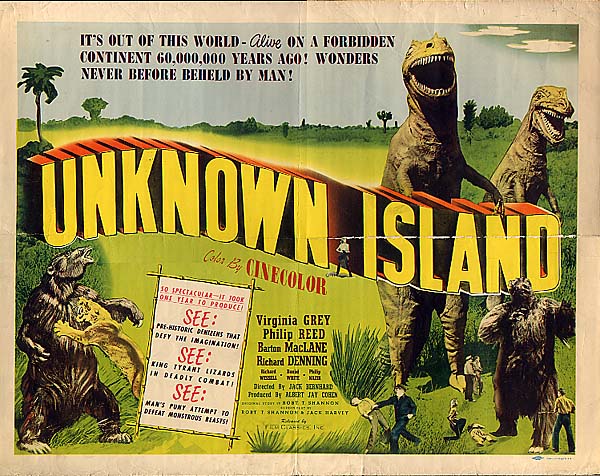
Debuted This Day (1948): Unknown Island
Written by Robert T. Shannon and directed by Bernhard, this ridiculaous little film features some of the worst ‘man dressed up as a T. rex’ effects ever. Not a bad little story though.

Wednesday, October 14, 2009
Born This Day: Jack Arnold

Jack Arnold (Oct. 14, 1916 - March 17, 1992) directed a number of classic SF films including The Creature From the Black Lagoon, Revenge of the Creature, The Incredible Shrinking Man, and It Came From Outer Space, as well as few not-so-classics (but still much loved) such as Monster on Campus. Throughout the ‘60’s and into the early 80’s he had a successful career as a TV producer and director.
Monday, October 12, 2009
Estimating the Sauropod Genome
Sauropod dinosaurs evolved moderately sized genomes unrelated to body size. 2009. C. Organ, et al. Proc. Royal. Soc. B. published online before print September 30.

And then we took a blood sample for analysis...
Abstract: Sauropodomorph dinosaurs include the largest land animals to have ever lived, some reaching up to 10 times the mass of an African elephant. Despite their status defining the upper range for body size in land animals, it remains unknown whether sauropodomorphs evolved larger-sized genomes than non-avian theropods, their sister taxon, or whether a relationship exists between genome size and body size in dinosaurs, two questions critical for understanding broad patterns of genome evolution in dinosaurs.
Here we report inferences of genome size for 10 sauropodomorph taxa. The estimates are derived from a Bayesian phylogenetic generalized least squares approach that generates posterior distributions of regression models relating genome size to osteocyte lacunae volume in extant tetrapods. We estimate that the average genome size of sauropodomorphs was 2.02 pg (range of species means: 1.77–2.21 pg), a value in the upper range of extant birds (mean = 1.42 pg, range: 0.97–2.16 pg) and near the average for extant non-avian reptiles (mean = 2.24 pg, range: 1.05–5.44 pg). The results suggest that the variation in size and architecture of genomes in extinct dinosaurs was lower than the variation found in mammals.
A substantial difference in genome size separates the two major clades within dinosaurs, Ornithischia (large genomes) and Saurischia (moderate to small genomes). We find no relationship between body size and estimated genome size in extinct dinosaurs, which suggests that neutral forces did not dominate the evolution of genome size in this group.

And then we took a blood sample for analysis...
Here we report inferences of genome size for 10 sauropodomorph taxa. The estimates are derived from a Bayesian phylogenetic generalized least squares approach that generates posterior distributions of regression models relating genome size to osteocyte lacunae volume in extant tetrapods. We estimate that the average genome size of sauropodomorphs was 2.02 pg (range of species means: 1.77–2.21 pg), a value in the upper range of extant birds (mean = 1.42 pg, range: 0.97–2.16 pg) and near the average for extant non-avian reptiles (mean = 2.24 pg, range: 1.05–5.44 pg). The results suggest that the variation in size and architecture of genomes in extinct dinosaurs was lower than the variation found in mammals.
A substantial difference in genome size separates the two major clades within dinosaurs, Ornithischia (large genomes) and Saurischia (moderate to small genomes). We find no relationship between body size and estimated genome size in extinct dinosaurs, which suggests that neutral forces did not dominate the evolution of genome size in this group.
Dinosaurs: Ancient Fossils, New Discoveries Opens at CMNH
The Cleveland Museum of Natural History is pleased to announce the opening of Dinosaurs: Ancient Fossils, New Discoveries, running until Jan. 31, 2010.

The exhibit focuses on current thinking about how dinosaur biology has evolved and changed dramatically over the past two decades, and highlights ongoing cutting-edge research by leading paleontologists around the world.
Highlights include a T. rex skeleton and a reconstruction of China’s famous ‘feathered dinosaur’ locality, complete with fleshed out models.
For more info click HERE
Qiaowanlong: New Asian Brachiosaurid
The first well-preserved Early Cretaceous brachiosaurid dinosaur in Asia. 2009. H.-L. You and D.-Q Li. Proc. R. Soc. B 276: 4077-4082.
Abstract: A new genus and species of brachiosaurid sauropods, Qiaowanlong kangxii gen. et sp. nov., is reported, representing the first well-preserved Early Cretaceous brachiosaurid in Asia and expanding the distribution of brachiosaurids undoubtedly into the Asian continent.
The new taxon was recovered from the late Early Cretaceous Xinminpu Group of Yujingzi Basin in northwestern Gansu Province, China, and is represented by a series of eight mid-cervical vertebrae, a right pelvic girdle and some unidentified bones.

The existence of deeply excavated cervical neural spines and a rising transition in the neural spine height among mid-cervical vertebrae clearly show the affinity of Qiaowanlong as a member of brachiosaurids.
Among brachiosaurids, Qiaowanlong shares a derived feature with the North American Early Cretaceous brachiosaurid Sauroposeidon: the lack of cranial centrodiapophyseal lamina. However, Qiaowanlong is unique in possessing a suite of features, such as a low central length/cotyle height ratio, bifurcated cervical neural spines and a much reduced ischium.
The discovery of Qiaowanlong and other new material indicates a diverse and abundant sauropod assemblage in China during the Early Cretaceous.
Abstract: A new genus and species of brachiosaurid sauropods, Qiaowanlong kangxii gen. et sp. nov., is reported, representing the first well-preserved Early Cretaceous brachiosaurid in Asia and expanding the distribution of brachiosaurids undoubtedly into the Asian continent.
The new taxon was recovered from the late Early Cretaceous Xinminpu Group of Yujingzi Basin in northwestern Gansu Province, China, and is represented by a series of eight mid-cervical vertebrae, a right pelvic girdle and some unidentified bones.

Among brachiosaurids, Qiaowanlong shares a derived feature with the North American Early Cretaceous brachiosaurid Sauroposeidon: the lack of cranial centrodiapophyseal lamina. However, Qiaowanlong is unique in possessing a suite of features, such as a low central length/cotyle height ratio, bifurcated cervical neural spines and a much reduced ischium.
The discovery of Qiaowanlong and other new material indicates a diverse and abundant sauropod assemblage in China during the Early Cretaceous.
Subscribe to:
Posts (Atom)