From Today In Science History:
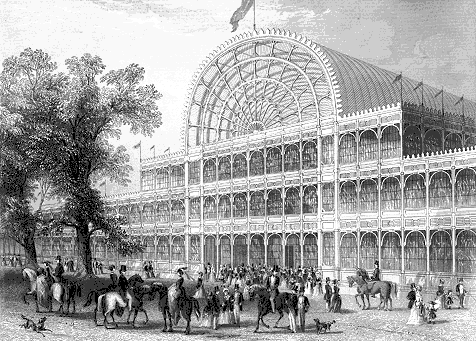
In 1936, London's famed Crystal Palace, constructed for the International Exhibition of 1851, was destroyed in the most spectacular fire seen in Britain for many years. It started about 8 pm and spread with such amazing rapidity that within half an hour the great building was ablaze from end to end. Flames rose 300-ft despite the efforts of 90 engines and 500 firemen. Only the two towers escaped destruction. When built, constructed mainly of glass and iron, it was nicknamed "The Crystal Palace" by Punch magazine.
In 1854 the sculptor Benjamin Waterhouse Hawkins installed three construct full-size concrete restorations of Iguanodon, Hylaeosaurus, and Megalosaurus on the grounds of Sydenham Park, home of the Crystal Palace.
Friday, November 30, 2007

Human Ancestors had Harems
Extended Male Growth in a Fossil Hominin Species. 2007. Charles A. Lockwood, et al. Science 318: 1443 – 1446.
Abstract: In primates that are highly sexually dimorphic, males often reach maturity later than females, and young adult males do not show the size, morphology, and coloration of mature males. Here we describe extended male development in a hominin species, Paranthropus robustus.
Ranking a large sample of facial remains on the basis of dental wear stages reveals a difference in size and robusticity between young adult and old adult males. Combined with estimates of sexual dimorphism, this pattern suggests that male reproductive strategy focused on monopolizing groups of females, in a manner similar to that of silverback gorillas. However, males appear to have borne a substantial cost in the form of high rates of predation.
More info at National Geographic News.


Thursday, November 29, 2007
Permian-Triassic Extinction
Changes in the global carbon cycle occurred as two episodes during the Permian–Triassic crisis. 2007. Shuceng Xie et al. Geology 35:1083-1086.
Earth witnessed its most severe mass extinction 250 million years ago. This extinction has been thought to be abrupt and probably caused by an extraterrestrial impact. However, Xie et al. present several lines of geochemical evidence from a South China section (an optimal section to study the biotic crisis) that indicates a two-episodic global change in association with the ecological crisis.
The global carbon cycle, the enhanced terrestrial weathering, the marine photic zone euxinia, the faunal mass extinction, and the cyanobacterial expansion all occurred as two episodes, showing a close coupling among the ocean, the atmosphere, and the land system at that time. In particular, Xie et al. found that the first episode occurred before the presumed bolide impact.
The temporal sequence of these two events suggests that the biotic crisis was a consequence of prolonged and episodic changes in the marine and continental systems, and argues against an extraterrestrial impact as the main cause.
Earth witnessed its most severe mass extinction 250 million years ago. This extinction has been thought to be abrupt and probably caused by an extraterrestrial impact. However, Xie et al. present several lines of geochemical evidence from a South China section (an optimal section to study the biotic crisis) that indicates a two-episodic global change in association with the ecological crisis.

The global carbon cycle, the enhanced terrestrial weathering, the marine photic zone euxinia, the faunal mass extinction, and the cyanobacterial expansion all occurred as two episodes, showing a close coupling among the ocean, the atmosphere, and the land system at that time. In particular, Xie et al. found that the first episode occurred before the presumed bolide impact.
The temporal sequence of these two events suggests that the biotic crisis was a consequence of prolonged and episodic changes in the marine and continental systems, and argues against an extraterrestrial impact as the main cause.
The Origin of Subduction
Subduction origin on early Earth: A hypothesis. 2007. Vicki L. Hansen Geology 35: 1059-1062.
How and when plate tectonics began has been enthusiastically debated for decades; since the advent of the plate tectonics theory in the early 1960s. Hansen’s paper presents a hypothesis for how plate tectonics might have begun on early Earth. According to this hypothesis, spatial and temporal overlap of internal mantle flow (“endogenic”, or internal process) and a large bolide impact (“exogenic”, or external) triggered two signature processes of plate tectonics: spreading, which leads to the formation of new crust, and Subduction, which leads to the recycling of crust.
The spatial and temporal intersection of the triggering endogenic and exogenic processes could have occurred variably across early Earth; thus, plate tectonic mechanisms could have begun at different places and different times.
Hansen’s hypothesis postulates that the ability of a terrestrial planet to develop plate tectonics results from a balance between the strength of its surface layer and the size of bolide impact it can survive—both of these factors can be related to planet size. Hansen’s hypothesis may allow us to predict if other planets could have evolved plate tectonics, and as such, might be Earth-like in character. The tectonic evolution of early Earth likely played key roles in concentrating Earth’s rich resources, and perhaps the formation and evolution of life.
How and when plate tectonics began has been enthusiastically debated for decades; since the advent of the plate tectonics theory in the early 1960s. Hansen’s paper presents a hypothesis for how plate tectonics might have begun on early Earth. According to this hypothesis, spatial and temporal overlap of internal mantle flow (“endogenic”, or internal process) and a large bolide impact (“exogenic”, or external) triggered two signature processes of plate tectonics: spreading, which leads to the formation of new crust, and Subduction, which leads to the recycling of crust.

The spatial and temporal intersection of the triggering endogenic and exogenic processes could have occurred variably across early Earth; thus, plate tectonic mechanisms could have begun at different places and different times.
Hansen’s hypothesis postulates that the ability of a terrestrial planet to develop plate tectonics results from a balance between the strength of its surface layer and the size of bolide impact it can survive—both of these factors can be related to planet size. Hansen’s hypothesis may allow us to predict if other planets could have evolved plate tectonics, and as such, might be Earth-like in character. The tectonic evolution of early Earth likely played key roles in concentrating Earth’s rich resources, and perhaps the formation and evolution of life.

China's Palaeo-Black Market
National Geographic News has an interesting article on trouble a-brewin' with China's new "peasant palaeontologists",
"Armed with only tractors and farm tools, Chinese peasants recently attacked police who had come to seize dinosaur bones the farmers had found. The clash called attention to the rise of a new type of dinosaur hunter in China's fossil-rich countryside: the "peasant paleontologist."
The rebellion also set in motion the first court test of a 2006 Chinese law banning "unauthorized" excavation, possession, sale, and export of dinosaur fossils. Offenders are subject to lengthy prison terms or, in serious cases, the death penalty."
Wednesday, November 28, 2007
Died This Day: Karl Ernst von Baer
Feb 29, 1792 - Nov 28, 1876
Von Baer was a Prussian-Estonian embryologist who discovered the mammalian egg (1827) and the notochord. He established the new science of comparative embryology alongside comparative anatomy with the publication of two landmark volumes (in 1828 and 1837) covering the range of existing knowledge of the prebirth developments of vertebrates.
He showed that mammalian eggs were not the follicles of the ovary but microscopic particles inside the follicles. He described the development of the embryo from layers of tissue, which he called germ layers, and demonstrated similarities in the embryos of different species of vertebrates.
From Today In Science History
Von Baer was a Prussian-Estonian embryologist who discovered the mammalian egg (1827) and the notochord. He established the new science of comparative embryology alongside
 comparative anatomy with the publication of two landmark volumes (in 1828 and 1837) covering the range of existing knowledge of the prebirth developments of vertebrates.
He showed that mammalian eggs were not the follicles of the ovary but microscopic particles inside the follicles. He described the development of the embryo from layers of tissue, which he called germ layers, and demonstrated similarities in the embryos of different species of vertebrates.
From Today In Science History
Born This Day: Dunkinfield Henry Scott
Nov. 28, 1854 – Jan. 29, 1934

Scott continued writing papers after Williamson's death and in which he described many otherwise unknown fossil plants. He wrote the classic Studies in Fossil Botany, which greatly popularized the subject.
From Today In Science History

Painting by Mary Parrish
Scott was an English paleobotanist and leading authority of his time on the structure of fossil plants, one of those who laid the foundations of paleobotany. He conducted experiments in the Jodrell Laboratory in Kew Gardens, where he became its honorary keeper (1892-1906). In collaboration with W.C. Williamson, he wrote three papers on fossil-plant morphology (1894-95).Scott continued writing papers after Williamson's death and in which he described many otherwise unknown fossil plants. He wrote the classic Studies in Fossil Botany, which greatly popularized the subject.
From Today In Science History
Tuesday, November 27, 2007
Xenoposeidon proneneukus
An unusual new neosauropod dinosaur from the Lower Cretaceous Hastings Beds Group of East Sussex, England. 2007. Taylor, Michael P. and Darren Naish. Palaeontology 50 (6): 1547-1564.

Images © University of Portsmouth
From National Geographic News:
The newly revealed herbivore was identified from a fragment of backbone stored at the Natural History Museum in London since the 1890s. The fossil laid unnoticed until 2006, when it was chanced upon by visiting dinosaur researcher Mike Taylor from the University of Portsmouth in England.
Having spent the previous five years "doing nothing but looking at sauropod vertebrae," he immediately realized the half-complete fossil bone was "something strange," Taylor said.
 Investigation of the 30cm fossil subsequently revealed an unknown species that lived some 140 million years ago. The newly named Xenoposeidon proneneukus was likely typical for a sauropod, with a huge body, long neck, and stout legs. But its many unusual spinal features puts it in a new family of dinosaurs, the study says.
Visit Mike’s Website for more info.

Images © University of Portsmouth
The newly revealed herbivore was identified from a fragment of backbone stored at the Natural History Museum in London since the 1890s. The fossil laid unnoticed until 2006, when it was chanced upon by visiting dinosaur researcher Mike Taylor from the University of Portsmouth in England.
Having spent the previous five years "doing nothing but looking at sauropod vertebrae," he immediately realized the half-complete fossil bone was "something strange," Taylor said.

Visit Mike’s Website for more info.
Monday, November 26, 2007
Eureka! Aaron Phillips Makes The News

Student Aaron Phillips, foreground, collects samples from bone beds on what was the eastern shore of the Western Interior Seaway. After slowly dissolving the rocks in acid, he was left with a jumble of thousands of teeth and bone fragments to sort under the microscope.
The Fall issue of Eureka, the Alumni magazine of Carleton University (where I obtained my B.Sc. in Biology) has a cover article on me. Nothing you’ve not read about before but it also features an article on Vertebrate Palaeontology graduate student, Aaron Phillips, and a link to alumnus Ryan North’s Dinosaur Comics.
Eotriceratops xerinsularis

From The Dinosaur of the Day at Nature News.com:
Eotriceratops xerinsularis was recently described in the Canadian Journal of Earth Sciences from the upper Horseshoe Canyon Formation of Alberta. It was first discovered by Barnum Brown from the AMNH back in the 1910's but he decided it wasn’t worth his while to collected it. About a decade ago it was rediscovered by the cook working for Dr. Philip Currie who was (and still is) collecting material from another old Barnum quarry in Dry Island Provincial Park, the Albertosaurus bone bed.
At 68 million years of age Eotriceratops is the earliest known member the Triceratops group, and shares their distinctive horns and solid frill (abstract of research paper).
“Until we found Eotriceratops, there was a significant gap in our knowledge about the dinosaurs that lived in Alberta and North America from 69 to 67 million years ago. The discovery of Eotriceratops is an important step in helping us understand the history of latest Cretaceous dinosaur evolution on this continent,” says Don Brinkman, head curator at the Royal Tyrrell Museum and one of the discovery team.
The thing was not in great condition when found. Dave Eberth, another researcher from the Tyrrell told the Edmonton Journal, “Basically, it’s a road kill. It looks like somebody ran over it in a Cretaceous Hummer.”
Died This Day: Nicolaus Steno
Jan. 10 – Nov. 26, 1686
Steno (a.k.a. Niels Steensen, or Stensen) was a Danish geologist and anatomist who first made unprecedented discoveries in anatomy, then established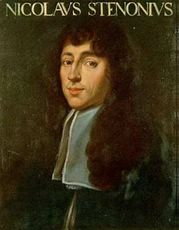 some of the most important principles of modern geology. He was Danish royal anatomist for 2 years.
Interested by the characteristics and origins of minerals, rocks, and fossils, he published in Prodromus (1669) the law of superposition (if a series of sedimentary rocks has not been overturned, upper layers are younger and lower layers are older) and the law of original horizontality (although strata may be found dipping steeply, they were initially deposited nearly horizontal.) link image
Steno (a.k.a. Niels Steensen, or Stensen) was a Danish geologist and anatomist who first made unprecedented discoveries in anatomy, then established
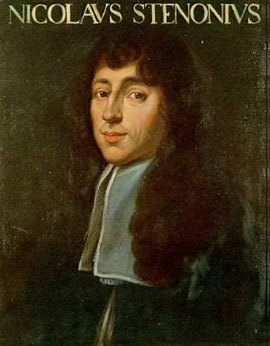 some of the most important principles of modern geology. He was Danish royal anatomist for 2 years.
Interested by the characteristics and origins of minerals, rocks, and fossils, he published in Prodromus (1669) the law of superposition (if a series of sedimentary rocks has not been overturned, upper layers are younger and lower layers are older) and the law of original horizontality (although strata may be found dipping steeply, they were initially deposited nearly horizontal.) link image
Died This Day: Sven Anders Hedin
Feb. 19,1865 - Nov. 26, 1952
Hedin was a Swedish explorer and geographer, born in Stockholm, who led four multi-year expeditions into Central Asia between 1897 and 1935. Although not as well known as Roy Chapman Andrews his work in the regions revealed a wealth of cultural, archaeological and palaeontological wonders.
During his first major Asian expedition, he crossed the Pamirs, charted Lop Nor (Lake) in China, and finally arrived at Beijing. He then journeyed to Tibet by way of Mongolia, Siberia, and the Gobi Desert. Hedin explored Tibet and Xinjiang (Sinkiang), identified the sources of the Brahmaputra, Indus, and Sutlej rivers, and, in 1906, explored and named the Trans-Himalayas. In 1927 Hedin led an expedition of Chinese and Swedish scientists into Central Asia.
He wrote extensively about his adventures (e.g., Across the Gobi Desert, The Conquest of Tibet (1935), My Life as an Explorer (1926)) and they make for engaging and fascinating reading for anyone interested in the early days of exploring Central Asia. link
An excellent summary of Hedin’s life and expeditions into Central Asia can be found at the IDP News Archives image
Hedin was a Swedish explorer and geographer, born in Stockholm, who led four multi-year expeditions into Central Asia between 1897 and 1935. Although not as well known as Roy Chapman Andrews his work in the
 regions revealed a wealth of cultural, archaeological and palaeontological wonders.
During his first major Asian expedition, he crossed the Pamirs, charted Lop Nor (Lake) in China, and finally arrived at Beijing. He then journeyed to Tibet by way of Mongolia, Siberia, and the Gobi Desert. Hedin explored Tibet and Xinjiang (Sinkiang), identified the sources of the Brahmaputra, Indus, and Sutlej rivers, and, in 1906, explored and named the Trans-Himalayas. In 1927 Hedin led an expedition of Chinese and Swedish scientists into Central Asia.
He wrote extensively about his adventures (e.g., Across the Gobi Desert, The Conquest of Tibet (1935), My Life as an Explorer (1926)) and they make for engaging and fascinating reading for anyone interested in the early days of exploring Central Asia. link
An excellent summary of Hedin’s life and expeditions into Central Asia can be found at the IDP News Archives image
Sunday, November 25, 2007

Saturday, November 24, 2007
Published This Day: Origin of the Species
From Today In Science History:
In 1859, The Origin of Species by Means of Natural Selection was published in England to great acclaim. In this groundbreaking book by British naturalist Charles Darwin, he argued that species are the result of a gradual biological evolution in which nature encourages, through natural selection, the propagation of those species best suited to their environments. This book is unquestionably one of the most influential in the history of science.

In 1859, The Origin of Species by Means of Natural Selection was published in England to great acclaim. In this groundbreaking book by British naturalist Charles Darwin, he argued that species are the result of a gradual biological evolution in which nature encourages, through natural selection, the propagation of those species best suited to their environments. This book is unquestionably one of the most influential in the history of science.
Friday, November 23, 2007
Self-Organizing DNA Duplexes
End-to-End Stacking and Liquid Crystal Condensation of 6– to 20–Base Pair DNA Duplexes. 2007. M. Nakata, et al. Science 318: 1276 – 1279.
From the press release:
Since the formation of molecular chains as uniform as DNA by random chemistry is essentially impossible, Clark said, scientists have been seeking effective ways for simple molecules to spontaneously self-select, ‘chain-up’ and self-replicate. The new study shows that in a mixture of tiny fragments of DNA, those molecules capable of forming liquid crystals selectively condense into droplets in which conditions are favorable for them to be chemically linked into longer molecules with enhanced liquid crystal-forming tendencies, he said.
“We found this to be a remarkable result,” Clark said. “It means that small molecules with the ability to pair up the right way can seek each other out and collect together into drops that are internally self-organized to facilitate the growth of larger pairable molecules.
From the press release:

Reseacrhers have discovered some unexpected forms of liquid crystals of ultrashort DNA molecules immersed in water, providing a new scenario for a key step in the emergence of life on Earth.Short segments of DNA can assemble into several distinct liquid crystal phases that self-orient parallel to one another and stack into columns when placed in a water solution. Life is widely believed to have emerged as segments of DNA- or RNA-like molecules in a prebiotic ‘soup’ solution of ancient organic molecules.
Since the formation of molecular chains as uniform as DNA by random chemistry is essentially impossible, Clark said, scientists have been seeking effective ways for simple molecules to spontaneously self-select, ‘chain-up’ and self-replicate. The new study shows that in a mixture of tiny fragments of DNA, those molecules capable of forming liquid crystals selectively condense into droplets in which conditions are favorable for them to be chemically linked into longer molecules with enhanced liquid crystal-forming tendencies, he said.
“We found this to be a remarkable result,” Clark said. “It means that small molecules with the ability to pair up the right way can seek each other out and collect together into drops that are internally self-organized to facilitate the growth of larger pairable molecules.
As The World Turned
Inconsistencies Between Pangean Reconstructions and Basic Climate Controls. 2007. C. M. Rowe, et al. Science 318: 1284 – 1286.
Abstract: The supercontinent Pangea dominated our planet from the Permian into the Jurassic. Paleomagnetic reconstructions have been used to estimate the atitudinal position of Pangea during this 100-million-year period.
Atmospheric circulation, recorded by eolian sandstones in the southwestern United States, shows a broad sweep of northeasterly winds over their northernmost extent, curving to become northwesterly in the south: This evidence is consistent with paleomagnetic reconstructions of the region straddling the equator in the Early Permian but is at odds with its northward movement to about 20°N by the Early Jurassic.
At least one of the following scenarios must be true:
- The latitude based on paleomagnetism is incorrect; the interpretation of how winds shaped the dunes is mistaken;
- the basic climate controls in the Jurassic were different from those of today;
- or the paleogeographic reconstructions available are insufficient to adequately reproduce the wind fields responsible for dune formation.
Wednesday, November 21, 2007
Born This Day: Alfred Henry Sturtevant
Nov. 21, 1891 – April 5, 1970
Sturtevant was an American geneticist who in 1913 developed a technique for mapping the location of specific genes of the chromosomes in the fruit fly Drosophila. Sturtevant's method for "chromosome mapping", relies on the analysis of groups of linked genes.
In a classic paper in genetics (1913), he described the location of six sex-linked genes as deduced by the way in which they associate with each other. Sturtevant later discovered the so-called 'position effect', in which the expression of a gene depends on its position in relation to other genes.
He also demonstrated that crossing over between chromosomes is prevented in regions where a part of the chromosome material is inserted the wrong way round.
From Today In Science History
Sturtevant was an American geneticist who in 1913 developed a technique for mapping the location of specific genes of the chromosomes in the fruit fly Drosophila. Sturtevant's method for "chromosome mapping", relies on the analysis of groups of linked genes.



In a classic paper in genetics (1913), he described the location of six sex-linked genes as deduced by the way in which they associate with each other. Sturtevant later discovered the so-called 'position effect', in which the expression of a gene depends on its position in relation to other genes.
He also demonstrated that crossing over between chromosomes is prevented in regions where a part of the chromosome material is inserted the wrong way round.
From Today In Science History
Largest Sea Scorpion Discovered
Giant claw reveals the largest ever arthropod. 2007. S.J. Braddy, et al. Biology Letters, published on-line Nov. 20, 2007.
From National Geographic News:
Jaekelopterus rhenaniae measured some 2.5 meters long, scientists estimate, based on the length of its 46-centimeter, spiked claw. The 390-million-year-old sea scorpion was the top predator of its day, slicing up fish and cannibalizing its own kind in coastal swamp waters, fossil experts say.

Jaekelopterus rhenaniae illo & photo courtesy Biology LettersThe find shows that arthropods—animals such as insects, spiders, and crabs, which have hard external skeletons, jointed limbs, and segmented bodies—once grew much larger than previously thought, said paleobiologist Simon Braddy of the University of Bristol in the United Kingdom.
Smaller sea scorpions are known to have crawled ashore to mate or shed their outer skins. But "there's no way this monster bug would have been able to do that, because it was just too big," Braddy said.
"Its legs were relatively flimsy compared to the size of its body," he added. Without water buoying the big beast up, its legs would have collapsed under the weight of its body, Braddy said.
From National Geographic News:
Jaekelopterus rhenaniae measured some 2.5 meters long, scientists estimate, based on the length of its 46-centimeter, spiked claw. The 390-million-year-old sea scorpion was the top predator of its day, slicing up fish and cannibalizing its own kind in coastal swamp waters, fossil experts say.

Jaekelopterus rhenaniae illo & photo courtesy Biology Letters
Smaller sea scorpions are known to have crawled ashore to mate or shed their outer skins. But "there's no way this monster bug would have been able to do that, because it was just too big," Braddy said.
"Its legs were relatively flimsy compared to the size of its body," he added. Without water buoying the big beast up, its legs would have collapsed under the weight of its body, Braddy said.
Tuesday, November 20, 2007
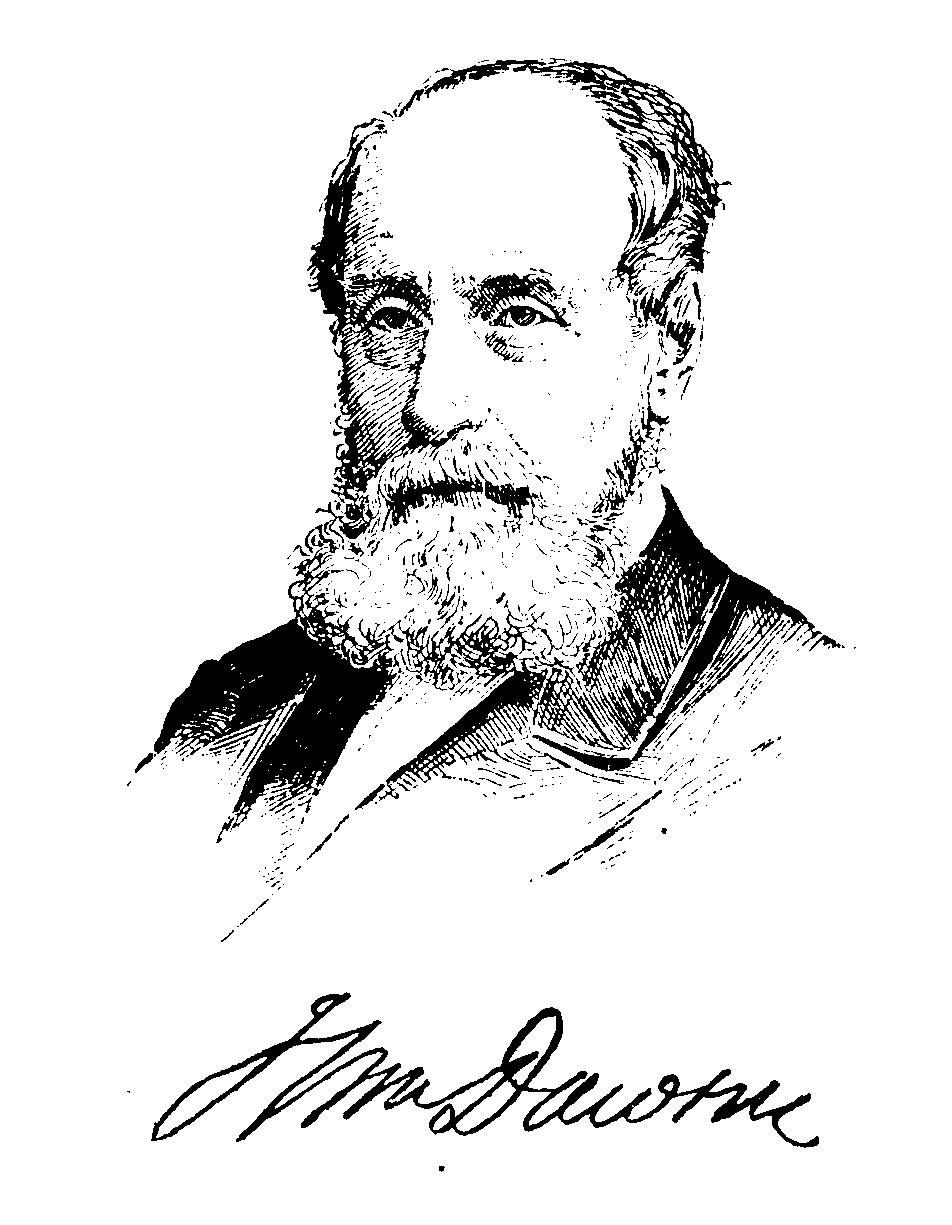
Died This Day: Sir John William Dawson
October 30, 1820 - November 20, 1899
Dawson was a Canadian geologist who made numerous contributions to paleobotany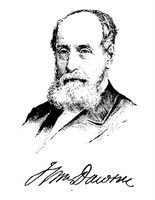 and extended the knowledge of Canadian geology. Dawson was born and raised in Pictou, Nova Scotia, where the many sandstone and coal formations provided fertile ground for his first scientific explorations, which culminated in the publication of Acadian Geology. He made many important discoveries of fossil life, great and small. These included fossil plants, trackways of lowly invertebrates, footprints, skeletons of reptiles and amphibians, millipedes and the earliest land snails. When the famous geologist Charles Lyell visited coal deposits in Pictou, Dawson acted as his guide.
In 1851, Dawson and Lyell teamed up again to examine the interiors of fossil tree trunks at Joggins,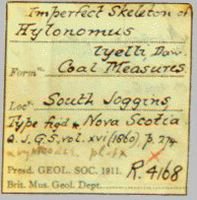 Nova Scotia. They discovered the remains of some of the earliest known reptiles, Hylonomus lyelli, along with other rare fossils, propelling this part of the world into the international spotlight.
Dawson became principal of McGill College in Montreal in 1854, which he made into a reputable institution. He remained there, teaching geology and palaeontology and acting as librarian, until his retirement. One of his lifelong dreams was realized in 1882 when Peter Redpath gave money to McGill for the construction and establishment of a museum, naming Dawson as director. Today the Peter Redpath Museum of Natural History houses many specimens from Dawson's personal collection.
Info from HERE and HERE. Images from HERE and HERE.
Dawson was a Canadian geologist who made numerous contributions to paleobotany
 and extended the knowledge of Canadian geology. Dawson was born and raised in Pictou, Nova Scotia, where the many sandstone and coal formations provided fertile ground for his first scientific explorations, which culminated in the publication of Acadian Geology. He made many important discoveries of fossil life, great and small. These included fossil plants, trackways of lowly invertebrates, footprints, skeletons of reptiles and amphibians, millipedes and the earliest land snails. When the famous geologist Charles Lyell visited coal deposits in Pictou, Dawson acted as his guide.
In 1851, Dawson and Lyell teamed up again to examine the interiors of fossil tree trunks at Joggins,
 Nova Scotia. They discovered the remains of some of the earliest known reptiles, Hylonomus lyelli, along with other rare fossils, propelling this part of the world into the international spotlight.
Dawson became principal of McGill College in Montreal in 1854, which he made into a reputable institution. He remained there, teaching geology and palaeontology and acting as librarian, until his retirement. One of his lifelong dreams was realized in 1882 when Peter Redpath gave money to McGill for the construction and establishment of a museum, naming Dawson as director. Today the Peter Redpath Museum of Natural History houses many specimens from Dawson's personal collection.
Info from HERE and HERE. Images from HERE and HERE.
Subscribe to:
Posts (Atom)