I'll be away for most of the next two weeks, helping out with the 'student field workshop' in Dinosaur Provincial Park starting this weekend and doing some filming with the Discovery channel. I doubt that I'll have much access to the 'net but I'll update when I can.
See you in the funny papers!
Wednesday, May 30, 2007
RTMP Ceratopsian Exhibit

Go HERE and click on the the 'webdoc, click to view' beside the ceratopsid photograph to view the slideshow.


Tuesday, May 29, 2007
Hatchling Stegosaurus Footprints
Researchers at the Morrison Natural History Museum have discovered two rare hatchling dinosaur footprints in the foothills west of Denver, near the town of Morrison.
The fossil footprints represent the first hatchling Stegosaurus footprints ever found, according to Dr. Robert T. Bakker, the museum's curator of paleontology. Stegosaurus was first discovered in Morrison in 1877 and is Colorado's state fossil.
 The tracks can be eclipsed by a fifty-cent piece, suggesting that hatchling Stegos were about the size of newborn human baby.
"The tracks are so crisply preserved that I can imagine the sound of tiny feet splashing up water when the baby dinosaurs came to this ancient river to drink and cool down," remarks Museum Director Matthew Mossbrucker, who found the tracks.
The fossils will go on permanent display at the Morrison Natural History Museum Memorial Day weekend as part of its annual "Dinosaur Days" event, which runs from 9 a.m. to 5 p.m. Saturday, May 26 through Monday May 28.
To find out more about Dinosaur Days and special events around the new footprints, visit www.mnhm.org.
The fossil footprints represent the first hatchling Stegosaurus footprints ever found, according to Dr. Robert T. Bakker, the museum's curator of paleontology. Stegosaurus was first discovered in Morrison in 1877 and is Colorado's state fossil.

"The tracks are so crisply preserved that I can imagine the sound of tiny feet splashing up water when the baby dinosaurs came to this ancient river to drink and cool down," remarks Museum Director Matthew Mossbrucker, who found the tracks.
The fossils will go on permanent display at the Morrison Natural History Museum Memorial Day weekend as part of its annual "Dinosaur Days" event, which runs from 9 a.m. to 5 p.m. Saturday, May 26 through Monday May 28.
To find out more about Dinosaur Days and special events around the new footprints, visit www.mnhm.org.
Thursday, May 24, 2007
Remembering The War That Time Forgot

I’ll be out of town over the long weekend so postings may be light until Tuesday.
Swimming Dinos?
Were non-avian theropod dinosaurs able to swim? Supportive evidence from an Early Cretaceous trackway, Cameros Basin (La Rioja, Spain). 2007. R. Ezquerra, et al. Geology 35: 507-510.

From the press release:
An extraordinary underwater trackway with 12 consecutive prints provides the most compelling evidence to-date that some dinosaurs were swimmers. The 15m long trackway, located in La Virgen del Campo track site in Spain's Cameros Basin, contains the first long and continuous record of swimming by a non-avian therapod dinosaur.
The trackway from the early Cretaceous 125 million years ago consists of 6 asymmetrical pairs of 2-3 scratch marks each. Each set of scratch marks, preserved in a layer of sandstone, averages approximately 50cm in length and 15cm wide. The spacing between them suggests an underwater stride of 243-271cm.
The S-shaped prints paint a picture of a large floating animal clawing the sediment as it swam in approximately 3.2m of water. Ripple marks on the surface of the site indicate the dinosaur was swimming against a current, struggling to maintain a straight path.
"The dinosaur swam with alternating movements of the two hind limbs, a pelvic paddle swimming motion," said Costeur. "It is a swimming style of amplified walking with movements similar to those used by modern bipeds, including aquatic birds."
Wednesday, May 23, 2007
Sinosauropteryx Feather Debate Continues
A new Chinese specime indicates that ‘protofeathers’ in the Early Cretaceous theropod dinosaur Sinosauropteryx are degraded collogen fibres. 2007. Lingham-Soliar T., et al. Proc. R. Soc. Lond. B. PDF download
From Nature News.com:
The discovery calls into question the theory that the first feathers evolved not for flight but for insulation, and that they made their first appearance in relatively early dinosaur lineages that later evolved into modern birds. If these dinosaurs didn't have feathers, or feather-like structures, then feathers may have evolved at a later time, and been used for flight right from the start.
The fossil represents a dinosaur called Sinosauropteryx, which lived in the Early Cretaceous period roughly 140 million years ago. The specimen, found in Liaoning Province, China, has distinctive patterns seen in its skin. Previous studies of other related dinosaurs with similar markings have led experts to conclude that these dinosaurs were covered with downy 'protofeathers'.
But Theagarten Lingham-Soliar from the University of KwaZulu-Natal in Durban, South Africa, and his colleagues now say otherwise. Instead, they argue that these structures are degraded remains of collagen fibres, the main connective tissue in animals.
Lingham-Soliar and his colleagues produced high-resolution microscopic images of the fossil that, he says, show that these structures represent degraded soft tissue. The regular pattern of the fibres suggests that Sinosauropteryx had a frill of skin along its neck, back and tail. And the random orientation of some of the fibres, previously attributed to protofeathers, are more likely to indicate breakages in the regular pattern of collagen fibres as the dinosaur decomposed.
Feathery dinosaurs might not have been as common as experts thought, according to researchers who analysed a fossil of a creature previously thought to have feathers, and found instead that it was bald.

From Nature News.com:
The discovery calls into question the theory that the first feathers evolved not for flight but for insulation, and that they made their first appearance in relatively early dinosaur lineages that later evolved into modern birds. If these dinosaurs didn't have feathers, or feather-like structures, then feathers may have evolved at a later time, and been used for flight right from the start.
The fossil represents a dinosaur called Sinosauropteryx, which lived in the Early Cretaceous period roughly 140 million years ago. The specimen, found in Liaoning Province, China, has distinctive patterns seen in its skin. Previous studies of other related dinosaurs with similar markings have led experts to conclude that these dinosaurs were covered with downy 'protofeathers'.
But Theagarten Lingham-Soliar from the University of KwaZulu-Natal in Durban, South Africa, and his colleagues now say otherwise. Instead, they argue that these structures are degraded remains of collagen fibres, the main connective tissue in animals.
Lingham-Soliar and his colleagues produced high-resolution microscopic images of the fossil that, he says, show that these structures represent degraded soft tissue. The regular pattern of the fibres suggests that Sinosauropteryx had a frill of skin along its neck, back and tail. And the random orientation of some of the fibres, previously attributed to protofeathers, are more likely to indicate breakages in the regular pattern of collagen fibres as the dinosaur decomposed.
Evolution of Tetrapod Limbs
An autopodial-like pattern of Hox expression in the fins of a basal actinopterygian fish. 2007. M.C. Davis, et al. Nature 447: 473-476.

Anterior to the left; distal to top. HoxD expression in Polyodon supports the notion that late-phase HoxD expression is primitive to tetrapods and to osteichthyes in general. Red bars denote: a, acquisition of late-phase HoxD expression; b, loss of non-metapterygial radials; c, loss of the dermal fin fold; d, loss of the metapterygium; e, loss of late-phase HoxD expression. Blue cartoons depict conserved late-phase HoxD seen in Polyodon and tetrapods (here represented by the hind limb of the chicken, Gallus).
Abstract: Comparative analyses of Hox gene expression and regulation in teleost fish and tetrapods support the long-entrenched notion that the distal region of tetrapod limbs, containing the wrist, ankle and digits, is an evolutionary novelty.
Data from fossils support the notion that the unique features of tetrapod limbs were assembled over evolutionary time in the paired fins of fish.
The challenge in linking developmental and palaeontological approaches has been that developmental data for fins and limbs compare only highly derived teleosts and tetrapods; what is lacking are data from extant taxa that retain greater portions of the fin skeletal morphology considered primitive to all bony fish. Here, we report on the expression and function of genes implicated in the origin of the autopod in a basal actinopterygian, Polyodon spathula.
Polyodon exhibits a late-phase, inverted collinear expression of 5' HoxD genes, a pattern of expression long considered a developmental hallmark of the autopod and shown in tetrapods to be controlled by a 'digit enhancer' region. These data show that aspects of the development of the autopod are primitive to tetrapods and that the origin of digits entailed the redeployment of ancient patterns of gene activity.
In The CMNH VP Dept.

Volunteer Katie Russell paints a median dorsal cast of a Dunkleosteous

Senior Project student Ben does data entry

Volunteer Dale (left) & Senior Project Student Michael prep Devonan fish fossils

Technician Gary Jackson preps a sub-adult Centrosaurus skull collected by George Sternberg in 1920 in Dinosaur Provincial Park. The specimen is on loan from the University of Alberta and is being prepped for a project I'm working on with MSC student Caleb Brown at the U of Calgary.
"Synthetic" Evolution In The Lab
Structural Insights into the Evolution of a Non-Biological Protein: Importance of Surface Residues in Protein Fold Optimization. 2007. M.D. Smith, et al. PLOS One 2(5): e467.

The three-dimensional structure (ribbon diagram) of protein DX as a crystallogrpahic dimer. Photo:John Chaput
The building blocks of proteins are 20 different amino acids that are strung together and folded to make the unique globular shape, stability and function of every protein. The mixing and matching of the amino acid chain like numbers in the lottery are what favor the odds in nature of finding just the right combinations to help generate biological diversity.
To select the raw ingredients to create the proteins the researchers began their quest by further evolving a protein that had been previously selected from a pool of random sequences. They started with a small protein stretch 80 amino acids long. This basic protein segment acts as a protein scaffold that can be selected for the ability to strongly clutch its target molecule, ATP.
There was only one problem, the parental protein could bind ATP, but it wasn’t very stable without it. They decided to speed up protein evolution once again by randomly mutating the parental sequence with a selection specially designed to improve protein stability. After subjecting the protein fragments to several rounds of this selective environmental pressure, only the ‘survival of the fittest’ ATP binding protein fragments remained.
The remaining fragments were identified and amino acid sequences compared with one another. Surprisingly, They had bested nature’s designs, as the test tube derived protein was not only stable, but could bind ATP twice as tight as anything nature had come up with before.
In a surprising result, just two amino acids changes in the protein sequence were found to enhance the binding, solubility and heat stability.
"We have the distinct advantage over nature of being able to freeze the evolution of our lab-evolved proteins at different time points to begin to tease apart this random process and relate it to the final protein function," said Chaput.

The three-dimensional structure (ribbon diagram) of protein DX as a crystallogrpahic dimer. Photo:John Chaput
The building blocks of proteins are 20 different amino acids that are strung together and folded to make the unique globular shape, stability and function of every protein. The mixing and matching of the amino acid chain like numbers in the lottery are what favor the odds in nature of finding just the right combinations to help generate biological diversity.
To select the raw ingredients to create the proteins the researchers began their quest by further evolving a protein that had been previously selected from a pool of random sequences. They started with a small protein stretch 80 amino acids long. This basic protein segment acts as a protein scaffold that can be selected for the ability to strongly clutch its target molecule, ATP.
There was only one problem, the parental protein could bind ATP, but it wasn’t very stable without it. They decided to speed up protein evolution once again by randomly mutating the parental sequence with a selection specially designed to improve protein stability. After subjecting the
 protein fragments to several rounds of this selective environmental pressure, only the ‘survival of the fittest’ ATP binding protein fragments remained.
The remaining fragments were identified and amino acid sequences compared with one another. Surprisingly, They had bested nature’s designs, as the test tube derived protein was not only stable, but could bind ATP twice as tight as anything nature had come up with before.
In a surprising result, just two amino acids changes in the protein sequence were found to enhance the binding, solubility and heat stability.
"We have the distinct advantage over nature of being able to freeze the evolution of our lab-evolved proteins at different time points to begin to tease apart this random process and relate it to the final protein function," said Chaput.
Born This Day: Carl Linnaeus
Born 23 May 23, 1707 – Jan. 10, 1778.
From the Linnean Society:
Linnaeus was born in 1707 in Sweden. He headed an expedition to Lapland in 1732, travelling 4,600 miles and crossing the Scandinavian Peninsula by foot to the Arctic Ocean. On the journey he discovered a hundred botanical species. He undertook his medical degree in 1735 in the Netherlands. In 1735, he published Systema Naturae, his classification of plants based on their sexual parts.
His method of binomial nomenclature using genus and species names was further expounded when he published Fundamenta Botanica (1736) and Classes Plantarum (1738). This system used the flower and the number and arrangements of its sexual organs of stamens and pistils to group plants into twenty-four classes which in turn are divided into orders, genera and species.
In his publications, Linnaeus provided a concise, usable survey of all the world's plants and animals as then known, about 7,700 species of plants and 4,400 species of animals. These works helped to establish and standardize the consistent binomial nomenclature for species which he introduced on a world scale for plants in 1753, and for animals in 1758, and which is used today.
His Systema Naturae 10th edition, volume 1(1758), has accordingly been accepted by international agreement as the official starting point for zoological nomenclature. Scientific names published before then have no validity unless adopted by Linnaeus or by later authors. This confers a high scientific importance on the specimens used by Linnaeus for their preparation, many of which are in his personal collections now treasured by the Linnean Society.
He was granted nobility in 1761, becoming Carl von Linné. He continued his work of classification and as a physician, and remained Rector of the University until 1772.
From the Linnean Society:
Linnaeus was born in 1707 in Sweden. He headed an expedition to Lapland in 1732, travelling 4,600 miles and crossing the Scandinavian Peninsula by foot to the Arctic Ocean. On the journey he discovered a hundred botanical
 species. He undertook his medical degree in 1735 in the Netherlands. In 1735, he published Systema Naturae, his classification of plants based on their sexual parts.
His method of binomial nomenclature using genus and species names was further expounded when he published Fundamenta Botanica (1736) and Classes Plantarum (1738). This system used the flower and the number and arrangements of its sexual organs of stamens and pistils to group plants into twenty-four classes which in turn are divided into orders, genera and species.
In his publications, Linnaeus provided a concise, usable survey of all the world's plants and animals as then known, about 7,700 species of plants and 4,400 species of animals. These works helped to establish and standardize the consistent binomial nomenclature for species which he introduced on a world scale for plants in 1753, and for animals in 1758, and which is used today.
His Systema Naturae 10th edition, volume 1(1758), has accordingly been accepted by international agreement as the official starting point for zoological nomenclature. Scientific names published before then have no validity unless adopted by Linnaeus or by later authors. This confers a high scientific importance on the specimens used by Linnaeus for their preparation, many of which are in his personal collections now treasured by the Linnean Society.

He was granted nobility in 1761, becoming Carl von Linné. He continued his work of classification and as a physician, and remained Rector of the University until 1772.
Tuesday, May 22, 2007
Born This Day: Sir Arthur Conan Doyle
May 22, 1859 – July 7, 1930
From HERE:
Sir Arthur Conan Doyle was a British writer and creator of Sherlock Holmes. He was born in Edinburgh. His father and uncle were both book illustrators and his mother encouraged his son to explore the world of books. Doyle studied at Edinburgh University and in 1884 he married Louise Hawkins. Doyle qualified as doctor in 1885 and practiced medicine as an eye specialist in Hampshire until 1891 when he became a full time writer. Doyle's first novel about Sherlock Holmes,’ A Study in Scarlet’, was published in 1887.
During the South African war (1899-1902) Doyle served for a few months as senior physician at a field hospital, and wrote ‘The War in South Africa’, in which he defended England's policy. When his son Kingsley died from wounds incurred in World War I, the author dedicated himself in spiritualistic studies.

Doyle's stories of Professor George Edward Challenger in ‘The Lost World’ (1912). The model for the professor was William Rutherford, Doyle's teacher from Edinburgh. Doyle's practice, and other experiences, expeditions as ship's surgeon to the Arctic and West Coast of Africa, service in the Boer War, defenses of George Edalji and Oscar Slater, two men wrongly imprisoned, provided much material for his writings.
The Lost World:
From HERE:
Sir Arthur Conan Doyle was a British writer and creator of Sherlock Holmes. He was born in Edinburgh. His father and uncle were both book illustrators and his mother encouraged his son to explore the world of books. Doyle studied at Edinburgh University and in 1884 he married Louise Hawkins. Doyle qualified as doctor in 1885 and practiced medicine as an eye specialist in Hampshire until 1891 when he became a full time writer. Doyle's first novel about Sherlock Holmes,’ A Study in Scarlet’, was published in 1887.
During the South African war (1899-1902) Doyle served for a few months as senior physician at a field hospital, and wrote ‘The War in South Africa’, in which he defended England's policy. When his son Kingsley died from wounds incurred in World War I, the author dedicated himself in spiritualistic studies.

The Lost World:
Born This Day: Oliver Perry Hay
May 22, 1846 – Novemeber 2, 1930
Hay was an American paleontologist whose catalogs of fossil vertebrates greatly organized existing knowledge and became standard references. Hay's primary scientific interest was the study of the Pleistocene vertebrata of North America and he is renowned for his work on skull and brain anatomy. His first major work was his Bibliography and Catalogue of the Fossil Vertebrata of North America (1902), supplemented by two more volumes (1929-30). Hay also wrote on the evidence of early humans in North America. link
Hay was an American paleontologist whose catalogs of fossil vertebrates greatly organized existing knowledge and became standard references. Hay's primary scientific interest was the study of the Pleistocene vertebrata of North America and he is renowned for his work on skull and brain anatomy. His first major work was his Bibliography and Catalogue of the Fossil Vertebrata of North America (1902), supplemented by two more volumes (1929-30). Hay also wrote on the evidence of early humans in North America. link
Monday, May 21, 2007
Born This Day: Mary Anning
21 May 1799 - 9 Mar 1847
From Today in Science History:
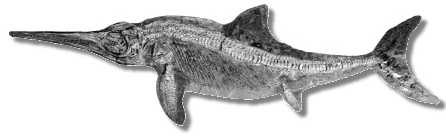
Mary was an English fossil collector who made her first significant discovery at the age of 11 or 12 (sources differ on the details), when she found a complete skeleton of an Ichthyosaurus, from the Jurassic period. The ten-meter (30 feet) long skeleton created a sensation and made her famous.
Anning's determination and keen scientific interest in fossils derived from her father's interest in fossil hunting, and a need for the income derived from them to support her family after his death. in 1810. She sold large fossils to noted paleontologists of the day, and smaller ones to the tourist trade. In 1823, Anning made another great discovery, found the first complete Plesiosaurus.
Later in her life, the Geological Society of London granted Anning an honorary membership.

Listen to an MP3 clip of the Mary Anning song by the Articokes HERE.
From Today in Science History:
Mary was an English fossil collector who made her first significant discovery at the age of 11 or 12 (sources differ on the details),
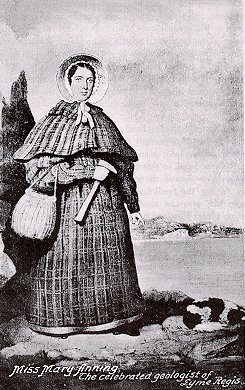 when she found a complete skeleton of an Ichthyosaurus, from the Jurassic period. The ten-meter (30 feet) long skeleton created a sensation and made her famous.
Anning's determination and keen scientific interest in fossils derived from her father's interest in fossil hunting, and a need for the income derived from them to support her family after his death. in 1810. She sold large fossils to noted paleontologists of the day, and smaller ones to the tourist trade. In 1823, Anning made another great discovery, found the first complete Plesiosaurus.
Later in her life, the Geological Society of London granted Anning an honorary membership.
Listen to an MP3 clip of the Mary Anning song by the Articokes HERE.
Sunday, May 20, 2007
Bigger is Smarter
Overall, not relative, brain size predicts intelligence.When it comes to estimating the intelligence of various animal species, it may be as simple measuring overall brain size. In fact, making corrections for a species' body size may be a mistake.
"Scientists have generally assumed that this pattern occurs because larger animals require larger nervous systems to coordinate their larger bodies. But our results suggest a simpler reason: larger species are typically smarter."

The findings imply that a re-evaluation may be in order for many previous studies that have compared brain size across different animal species, including ancestral hominids.
More from our friends over at Atomic Surgery.
Friday, May 18, 2007
Mark Schultz's Who's Who

CLICK TO ENLARGE
Jack Tenrec & Hannah Dunde © Mark Schultz. Krill Stromer © Michael Ryan & Mark Schultz.
If you’re in Des Moines, Iowa, this weekend Mark is making an appearance at a convention there.
T.rex’s Secret ‘Superweapon’
A team of Alberta scientists has solved the mystery of the mightiest dinosaur's devastating bite: a "unique" evolutionary leap in snout construction -- a fused nasal bone -- that turned Tyrannosaurus rex into a "zoological superweapon."From Canada’s Regina-Leader Post:
The find explains how the dinosaur could inflict its monstrous chomp -- the most powerful ever among land creatures -- on spiky Triceratops or other prey without breaking its own teeth, jaws or skull.

"The tyrannosaur had small arms, and could not grab on to its prey," said University of Alberta biologist Eric Snively, whose study on the famously ferocious dinosaur's colossal crunch -- co-authored with physicist Donald Henderson of Alberta's Royal Tyrrell Museum of Paleontology and University of Calgary information technologist Doug Phillips. "So it couldn't afford to be that delicate. It had to bite into bone, and drive its teeth through bone."
Read the complete press release HERE.
After much threatening by the Palaeoblogger, Eric put together a press release on one of his recently published papers that we reported on HERE, and has now got some nice coverage for it.
Here’s a hint for all you soon-to-be/recently graduated Ph.D.’s—write some press releases and get some media coverage of your interesting and very cool work. This is ridiculously easy to do! Talk to your university or museum media relations people and tell them what you’re working on or have published—they are always interested in new stories that will promote your institution (and you). They’ll help you craft a press release and send it out to the wire services. Then sit back and wait for the Cadillacs full of money to roll up to your office door.
Thursday, May 17, 2007
Born This Day: Thomas Davidson
May 17, 1817 – Oct. 14, 1885
Davison was a Scottish naturalist and paleontologist who became known as an authority on brachiopods. His major work, Monograph of British Fossil Brachiopoda, was published by the Palaeontographical Society. Together with supplements, this comprised six quarto volumes with more than 200 plates drawn on stone by the author. Upon his death, he bequeathed his fine collection of recent and fossil brachiopoda to the British Museum.
Davison was a Scottish naturalist and paleontologist who became known as an authority on brachiopods. His major work, Monograph of British Fossil Brachiopoda, was published by the Palaeontographical Society. Together with supplements, this comprised six quarto volumes with more than 200 plates drawn on stone by the author. Upon his death, he bequeathed his fine collection of recent and fossil brachiopoda to the British Museum.


New Aegyptopithecus Skull
A remarkable female cranium of the early Oligocene anthropoid Aegyptopithecus zeuxis (Catarrhini, Propliopithecidae). 2007. E.L.Simons, et at. PNAS Published online before print May 15, 2007.
From the press release:
A reconstruction of the brain of the second and most intact cranium found of Aegyptopithecus zeuxis suggests that the species "had a brain that might have been even smaller than that of a modern lemur's," said Simons. "This means the big-brained monkeys and apes developed their large brains at a later point in time."

Aegyptopithecus' brain is smaller than once thought. "But other features in these skulls, and in many other Aegyptopithecus fossil pieces collected at the Egyptian site over four decades, suggest that this primate was already branching away from its lemurlike ancestry," he said.
"We also find that the visual cortex was large, which means that like many primates, this species likely had very acute vision," he said. "So the visual sense, which is regarded as a very important feature of anthropoids, or higher primates, had already expanded."
The shape of the animal's eye sockets also suggests Aegyptopithecus was active in the daytime, like modern and ancient higher primates. In contrast, many but not all modern prosimians -- the group that includes lemurs -- are active at night, he said.
From the press release:
A reconstruction of the brain of the second and most intact cranium found of Aegyptopithecus zeuxis suggests that the species "had a brain that might have been even smaller than that of a modern lemur's," said Simons. "This means the big-brained monkeys and apes developed their large brains at a later point in time."

Comparison of female (Left) and male (Right) crania of Aegyptopithecus zeuxis, with unassociated mandibles.After comparing the known skulls which are of the same age, Simons and his collaborators concluded that the new one came from a female that might have weighed about five and a half pounds, while the first one was from a male of more than twice that size. This size difference between the Aegyptopithecus genders is comparable to that of gorillas, which genetically are humans' second-closest relatives.
Aegyptopithecus' brain is smaller than once thought. "But other features in these skulls, and in many other Aegyptopithecus fossil pieces collected at the Egyptian site over four decades, suggest that this primate was already branching away from its lemurlike ancestry," he said.
"We also find that the visual cortex was large, which means that like many primates, this species likely had very acute vision," he said. "So the visual sense, which is regarded as a very important feature of anthropoids, or higher primates, had already expanded."
The shape of the animal's eye sockets also suggests Aegyptopithecus was active in the daytime, like modern and ancient higher primates. In contrast, many but not all modern prosimians -- the group that includes lemurs -- are active at night, he said.
Monday, May 14, 2007
New Condorraptor Unearthed
From ZeeNews:
Buneos Aires, May 11: Paleontologists unearthed a flesh-eating dinosaur some 150 million years old in southern Argentina with all its joints in place, the first time such a beast has been dug up so intact, one of the finders told AFP on Friday.
The seven-meter (23-foot) tall, two-legged dinosaur, dubbed Condorraptor, was found fossilized with parts of its jaw and head showing in rock near the village of Cerro Condor in Patagonia, at a site where paleontologists had been working for five years.
"It is an unprecedented discovery. It is the first time in the world that a carnivorous dinosaur of the Middle Jurassic period has been found fully jointed," said Pablo Puerta, a paleontologist at the Egidio Feruglio museum in the town of Trelew.
Working in the southern province of Chubut, the team led by the German dinosaur specialist Oliver Rauhut uncovered the fossil using a giant crane to shift rock.
Puerta said it will take about a year to fully uncover the dinosaur. It could then go on display at the Trelew museum.
Note: I'm still on the road for the next few days.
Subscribe to:
Posts (Atom)