Directed by Carl Gottlieb and starring Ringo Starr, this film is probably best known for introducing Starr to his future wife, Barbara Bach. Famed Animator Jim Danforth oversaw the creation of the dinosaurs.
A more interesting film with overtones of The Creature From The Black Lagoon (0:57) is Island of the Fish Men, also starring Bach.
Friday, April 17, 2015

Wednesday, April 15, 2015
Premiered This Day: Women of The Prehistoric Planet


Died This Day: Wallace Beery

His career spanned the transition from silent movies to the talkies. He won an Academy award in 1931 for his starring role in The Champ, becomeing one of Hollywood's top stars in the 1930's. The hard-drinking Beery was implicated in the beating death of Ted Healy, the original leader of the Three Stooges. Beery is presented here for his starring role as Prof. Challenger in the 1925 movie, The Lost World.
Tuesday, April 14, 2015
Herb Trimpe, R.I.P.

The Incredible Hulk © Marvel Comics
Artist Herb Trimpe passed away on April 13, 2015, at the young age of 75 years. A giant of an artist, he worked mostly at Marvel and was known as most readers favourite Hulk artist. He drew more then a few dinosaurs and had a long run illustrating Marvel's Godzilla book back in the 80's.
Mark Evanier has a nice piece on Herb here
Llallawavis scagliai, a New Mesembriornithinae 'Terror Bird'
A new Mesembriornithinae (Aves, Phorusrhacidae) provides new insights into the phylogeny and sensory capabilities of terror birds. 2015. Degrange, F.J., et al., JVP

A new species of South American fossil terror bird called Llallawavis scagliai ("Scaglia's Magnificent Bird") is shedding light on the diversity of the group and how these giant extinct predators interacted with their environment. The new specimen also reveals details of anatomy that rarely preserve in the fossil record, including the auditory region of the skull, voice box, complete trachea, bones for focusing the eye.
Terror birds, or phorusracids as they are known scientifically, were carnivorous flightless birds up to 3 meters (10 ft) in height with tall hooked beaks. These birds were the predominant predators during the Cenozoic Age in South America. PR

A new species of South American fossil terror bird called Llallawavis scagliai ("Scaglia's Magnificent Bird") is shedding light on the diversity of the group and how these giant extinct predators interacted with their environment. The new specimen also reveals details of anatomy that rarely preserve in the fossil record, including the auditory region of the skull, voice box, complete trachea, bones for focusing the eye.
Terror birds, or phorusracids as they are known scientifically, were carnivorous flightless birds up to 3 meters (10 ft) in height with tall hooked beaks. These birds were the predominant predators during the Cenozoic Age in South America. PR
Monday, April 13, 2015
Died This Day: Amanz Gressly

Gressly (July 17, 1814 - April 13, 1965) was a Swiss geologist and paleontologist who was a pioneer, and regarded by some as the founder, of paleogeography. He is known for his work identifying stratigraphic facies (“aspects de terrain”) recognizing lateral regional variations in the character and fossil content of rock strata resulting from the environmental differences at the time of original deposition.
He wrote Observations Géologiques sur le Jura Soleurois on his studies of facies (a term he coined) he found in the Jura Mountains. His fossil collection had 25,000 specimens. He was appointed as an assistant to Louis Agassiz at Neuchâtel. The dinosaur Gresslyosaurus (Platyosaurus) was named in 1857 to honour him. From Today In Science History
Ocean Acidification & the Permo-Triassic Mass Extinction
Ocean acidification and the Permo-Triassic mass extinction. 2015. Clarkson, et al. Science

In the latest Permian, increased ocean alkalinity primed the Earth system with a low level of atmospheric CO2 and a high ocean buffering capacity. The first phase of extinction was coincident with a slow injection of carbon into the atmosphere, and ocean pH remained stable. During the second extinction pulse, however, a rapid and large injection of carbon caused an abrupt acidification event that drove the preferential loss of heavily calcified marine biota. PR

Art by Basil Wolverton
Changes to the Earth's oceans, caused by extreme volcanic activity, triggered the greatest extinction of all time 252 million years ago that wiped out more than 90 per cent of marine species and more than two-thirds of the animals living on land.Abstract[edit]: Ocean acidification triggered by Siberian Trap volcanism was a possible kill mechanism for the Permo-Triassic Boundary mass extinction, but direct evidence for an acidification event is lacking.
In the latest Permian, increased ocean alkalinity primed the Earth system with a low level of atmospheric CO2 and a high ocean buffering capacity. The first phase of extinction was coincident with a slow injection of carbon into the atmosphere, and ocean pH remained stable. During the second extinction pulse, however, a rapid and large injection of carbon caused an abrupt acidification event that drove the preferential loss of heavily calcified marine biota. PR
Sunday, April 12, 2015
Died This Day: Edward Drinker Cope

Art © Mark Schultz
"What truly assured Cope's (July 28, 1840 – April 12, 1897; above right) place in the history of paleontology and even eclipsed his science was his bitter feud with Yale University paleontologist O.C. Marsh (above left).Read about Cope HERE.
What began as a friendly rivalry in the late 1860s, broke out into all out war in 1872 and then raged on until Cope's death in 1897.
Both Cope and Marsh were recipients of family fortunes and they used their wealth to discover new fossils and to reconstruct ancient life. This scramble literally propelled American science into the forefront of paleontology."
Combat & Cannibalism in Tyrannosaurs
Pre- and postmortem tyrannosaurid bite marks on the remains of Daspletosaurus (Tyrannosaurinae: Theropoda) from Dinosaur Provincial Park, Alberta, Canada. PeerJ 3:e885

A new study documents injuries inflicted in life and death to a large tyrannosaurine dinosaur. The paper shows that the skull of a genus of tyrannosaur called Daspletosaurus suffered numerous injuries during life, at least some of which were likely inflicted by another Daspletosaurus. It was also bitten after death in an apparent event of scavenging by another tyrannosaur. PR

Image by Luis Rey
A new study documents injuries inflicted in life and death to a large tyrannosaurine dinosaur. The paper shows that the skull of a genus of tyrannosaur called Daspletosaurus suffered numerous injuries during life, at least some of which were likely inflicted by another Daspletosaurus. It was also bitten after death in an apparent event of scavenging by another tyrannosaur. PR
Saturday, April 11, 2015
Life Birth in Mosasaurs
Pelagic neonatal fossils support viviparity and precocial life history of Cretaceous mosasaurs. 2015. Field, et al. Palaeontology

"Contrary to classic theories, these findings suggest that mosasaurs did not lay eggs on beaches and that newborn mosasaurs likely did not live in sheltered nearshore nurseries." PR

Illustration by Julius T. Csotonyi
Paleontologists now believe that mighty mosasaurs -- which could grow to 50 feet long -- gave birth to their young in the open ocean, not on or near shore.In their study, Field and his colleagues describe the youngest mosasaur specimens ever found that were previously been thought to belong to ancient marine birds. Field and Aaron LeBlanc concluded that the specimens showed a variety of jaw and teeth features that are only found in mosasaurs. Also, the fossils were found in deposits in the open ocean.
"Contrary to classic theories, these findings suggest that mosasaurs did not lay eggs on beaches and that newborn mosasaurs likely did not live in sheltered nearshore nurseries." PR
Thursday, April 09, 2015
Dr. Philip Currie Speaking at the CMNH Friday, April 10th

If you're in the Cleveland, Ohio area, Dr. Philip Currie will be giving a talk on Friday April 10th at 7pm on 'Dinosaurs at the end of Earth: Antarctica and Argentina' as part of the Cleveland Museum of Natural History's Explorer series.
Wednesday, April 08, 2015
Brontosaurus is Back - for now!
A specimen-level phylogenetic analysis and taxonomic revision of Diplodocidae (Dinosauria, Sauropoda). 2015. Tschopp, E., et al., Peer J.

More info from The Guardian.

More info from The Guardian.
Monday, April 06, 2015
Died This Day: Robert Broom
Robert Broom (Nov. 30, 1866 – April 6, 1951) was a South African doctor and paleontologist. From 1903 to 1910 he was professor of zoology and geology at Victoria College, Stellenbosch, South Africa, and subsequently he became keeper of vertebrate paleontology at the South African Museum, Cape Town.
Broom was first known for his study of mammal-like reptiles. After Raymond Dart's discovery of the Taung Child, an infant australopithecine, Broom's interest in paleoanthropology was heightened. In 1934 he jojned the staff of the Transvaal Museum in Pretoria as an Assistant in Palaeontology.
In the following years, he made a series of spectacular finds, including fragments from six hominids in Sterkfontein, which he named Plesianthropus transvaalensis. In 1937, Broom made his most famous discovery of Paranthropus robustus. These discoveries helped support Dart's claims for the Taung species.
The remainder of Broom's career was devoted to the exploration of these sites and the interpretation of the many early hominid remains discovered there. In 1946 he proposed the Australopithecinae subfamily. From Princeton.edu

Broom was first known for his study of mammal-like reptiles. After Raymond Dart's discovery of the Taung Child, an infant australopithecine, Broom's interest in paleoanthropology was heightened. In 1934 he jojned the staff of the Transvaal Museum in Pretoria as an Assistant in Palaeontology.
In the following years, he made a series of spectacular finds, including fragments from six hominids in Sterkfontein, which he named Plesianthropus transvaalensis. In 1937, Broom made his most famous discovery of Paranthropus robustus. These discoveries helped support Dart's claims for the Taung species.
The remainder of Broom's career was devoted to the exploration of these sites and the interpretation of the many early hominid remains discovered there. In 1946 he proposed the Australopithecinae subfamily. From Princeton.edu
Born This Day: James Watson
From Today In Science History:
Watson was born on this day in 1928. An American geneticist and biophysicist, he shared the 1962 Nobel Prize for Physiology or Medicine (with Francis Crick and Maurice Wilkins) for the discovery of "the molecular structure of nucleic acids and its significance for information transfer in living material." Deoxyribonucleic acid (DNA) is the substance contained in cells that controls heredity.
Crick and Watson began their collaboration in 1951, and published their paper on the double helix structure on 2 Apr 1953 in Nature. This accomplishment became a cornerstone of genetics and was widely regarded as one of the most important discoveries of 20th-century biology.
image.
Watson was born on this day in 1928. An American geneticist and biophysicist, he shared the 1962 Nobel Prize for Physiology or Medicine (with Francis Crick and Maurice Wilkins) for the discovery of "the molecular structure of nucleic acids and
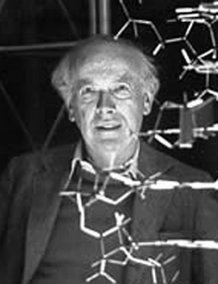 its significance for information transfer in living material." Deoxyribonucleic acid (DNA) is the substance contained in cells that controls heredity.
Crick and Watson began their collaboration in 1951, and published their paper on the double helix structure on 2 Apr 1953 in Nature. This accomplishment became a cornerstone of genetics and was widely regarded as one of the most important discoveries of 20th-century biology.
image.
Sunday, April 05, 2015
Died This Day: Hermann Joseph Muller
The  father of radiation genetics, Muller (Dec. 21, 1890 – April 5, 1967) began his career with T.H. Morgan studying mutations in fruit flies. He was the first to increase the mutation rate using heat, later using 50 kilovolt X-rays to induce an even greater incidence of mutations. Muller was awarded the Nobel Prize for Physiology or Medicine in 1946.
 Muller long warned about needless exposures to radiation and their associated risks of cancer and heritable genetic effects. By the late 1940s, the nuclear weapons testing program had begun and Muller was a vocal critic of the Atomic Energy Commission's views on the hazards of worldwide fallout.
 father of radiation genetics, Muller (Dec. 21, 1890 – April 5, 1967) began his career with T.H. Morgan studying mutations in fruit flies. He was the first to increase the mutation rate using heat, later using 50 kilovolt X-rays to induce an even greater incidence of mutations. Muller was awarded the Nobel Prize for Physiology or Medicine in 1946.

Born This Day: Alpheus Hyatt
From Today in Science History:
Hyatt (April 5, 1838 - Jan. 15, 1902) was a U.S. zoologist and paleontologist who studied invertebrate fossil records, the evolution of the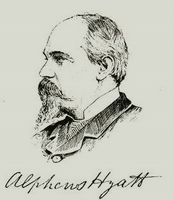 cephalopods (a class of mollusks including squids and octopuses) and the development of primitive organisms.
Along with E. Cope, Hyatt was the most prominent American neo-Lamarckian. Based on the analogy of ontogeny with phylogeny, Hyatt claimed that lineages, like individuals, had cycles of youth, old age, and death (extinction). This idea became the bulwark of orthogenetic theories in the U.S.
Hyatt was the founder and first editor of the American Naturalist, and first president of Woods Hole laboratory.
Hyatt (April 5, 1838 - Jan. 15, 1902) was a U.S. zoologist and paleontologist who studied invertebrate fossil records, the evolution of the
 cephalopods (a class of mollusks including squids and octopuses) and the development of primitive organisms.
 Along with E. Cope, Hyatt was the most prominent American neo-Lamarckian. Based on the analogy of ontogeny with phylogeny, Hyatt claimed that lineages, like individuals, had cycles of youth, old age, and death (extinction). This idea became the bulwark of orthogenetic theories in the U.S.
Hyatt was the founder and first editor of the American Naturalist, and first president of Woods Hole laboratory.
Founded This Day: The British Museum
From Today in Science History:
In 1753, the British Museum was founded by an Act of Parliament. Since then, the museum has been collecting, conserving and studying millions of artifacts. The British Museum was among the first museums to recognize that in-house scientific expertise was essential, both for the care of its collections and for their proper interpretation. Its Research Laboratory was founded in 1920 with the appointment of Dr Alexander Scott as its first scientist.


In 1753, the British Museum was founded by an Act of Parliament. Since then, the museum has been collecting, conserving and studying millions of artifacts. The British Museum was among the first museums to recognize that in-house scientific expertise was essential, both for the care of its collections and for their proper interpretation. Its Research Laboratory was founded in 1920 with the appointment of Dr Alexander Scott as its first scientist.
Friday, April 03, 2015
Born This Day: Ralph A. Bagnold
An English geologist (April 3, 1896 - May 28, 1990) who was a leading authority on the mechanics of sediment transport, especially eolian (wind) transport. While serving as a soldier in Egypt prior to WW II, Bagnold first studied sand dune formation and movement. After retiring from the army (1935), he continued his research and wrote the book "Physics of Blown Sand and Desert Dunes", investigating the physics of particles moving through the atmosphere and deposited by wind.

Art © Darwyn Cooke. Sand Seref & The Spirit © Estate of Will EisnerHe recognized two basic dune types, the crescentic dune, which he called "barchan," and the linear dune, which he called longitudinal or "sief" (Arabic for "sword"). During WW II, his avocational interest in vehicle performance on blowing sand aided the Allies in North Africa. Link

Art © Darwyn Cooke. Sand Seref & The Spirit © Estate of Will Eisner
Thursday, April 02, 2015
Published This Day: DNA Double Helix
From Today in Science History:
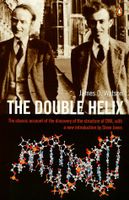
On this day in 1953, the journal Nature published a paper from Francis Crick and James Watson, titled Molecular Structure of Nucleic Acids: A Structure for Deoxyribose Nucleic Acid, in which they described a double helix structure for DNA.
Download the paper from Nature HERE.

On this day in 1953, the journal Nature published a paper from Francis Crick and James Watson, titled Molecular Structure of Nucleic Acids: A Structure for Deoxyribose Nucleic Acid, in which they described a double helix structure for DNA.
Download the paper from Nature HERE.
Wednesday, April 01, 2015
New Burial Ages for Australopithecus
New cosmogenic burial ages for Sterkfontein Member 2 Australopithecus and Member 5 Oldowan. 2015. Nature
 A skeleton named Little Foot is among the oldest hominid skeletons ever dated at 3.67 million years old, according to an advanced dating method.
Little Foot is a rare, nearly complete skeleton of Australopithecus first discovered 21 years ago in a cave at Sterkfontein, in central South Africa. The new date places Little Foot as an older relative of Lucy, a famous Australopithecus skeleton dated at 3.2 million years old that was found in Ethiopia. It is thought that Australopithecus is an evolutionary ancestor to humans that lived between 2 million and 4 million years ago.
Stone tools found at a different level of the Sterkfontein cave also were dated at 2.18 million years old, making them among the oldest known stone tools in South Africa.

Little Foot is a rare, nearly complete skeleton of Australopithecus first discovered 21 years ago in a cave at Sterkfontein, in central South Africa. The new date places Little Foot as an older relative of Lucy, a famous Australopithecus skeleton dated at 3.2 million years old that was found in Ethiopia. It is thought that Australopithecus is an evolutionary ancestor to humans that lived between 2 million and 4 million years ago.
Stone tools found at a different level of the Sterkfontein cave also were dated at 2.18 million years old, making them among the oldest known stone tools in South Africa.
Subscribe to:
Posts (Atom)