
Thursday, October 30, 2014
Zaraapelta, new ankylosaurid from Mongolia
The ankylosaurid dinosaurs of the Upper Cretaceous Baruungoyot and Nemegt formations of Mongolia. 2014. Arbour, V., et al.
 Zaraapelta nomadis from the Baruungoyot Formation of Mongolia, by Danielle DuFault


Wednesday, October 29, 2014
Born This Day: Othniel Charles Marsh
 In 1866, the Peabody Museum of Natural History was founded with a gift from George Peabody. The same year his nephew, O.C. Marsh (Oct. 29, 1831 - Mar. 18, 1899), was also named its Professor of Paleontology, the first such appointment in the United States. In 1869 Marsh used the inheritance from his uncle to start to amass large collections of vertebrate fossils. He went on to long and successful career as a vertebrate paleontologist, most of which was spent feuding with is rival, E.D.Cope.
Marsh and Cope started their careers on a cordial basis, but the relationship soon soured over an incident involving Cope's fossil of Elasmosaurus. Embarrassingly, Marsh pointed out that its backbones were mounted backwards. To settle the argument the men agreed to let Joseph Leidy decide who was right. Leidy promptly removed the head from one end and placed it on what Cope had thought was the tail. Cope than frantically tried to collect all of the copies of a recently printed publication that contained his erroneous reconstruction. From Today In Science History:
Friday, October 24, 2014
Premiered This Day (1970): Trog!

"A sympathetic anthropologist (Joan Crawford!) uses drugs and surgery to try to communicate with a primitive troglodyte found living in a local cave."Directed in 1970 by Hammer Films veteran, Freddie Francis, this was Crawford's last film. Notable for lifting the dinosaur scenes done by Willis H. O'Brien and Ray Harryhausen for the Irwin Allen-produced film The Animal World.
"After seeing this film, Joan Crawford supposedly joked that if it hadn't been for her end-of-life conversion to Christian Science, she might have committed suicide due to her embarrassment at having been in it." link
Thursday, October 23, 2014
Deinocheirus Decoded
Resolving the long-standing enigmas of a giant ornithomimosaur Deinocheirus mirificus. 2014. Lee, Y.-N., et al. Science.

 Here we describe two new specimens of Deinocheirus that were discovered in the Nemegt Formation of Altan Uul IV in 2006 and Bugiin Tsav in 2009. The Bugiin Tsav specimen (MPC-D 100/127) includes a left forelimb clearly identifiable as Deinocheirus and is 6% longer than the holotype. The Altan Uul IV specimen (MPC-D 100/128) is approximately 74% the size of MPC-D 100/127.
Cladistic analysis indicates that Deinocheirus is the largest member of the Ornithomimosauria; however, it has many unique skeletal features unknown in other ornithomimosaurs, indicating that Deinocheirus was a heavily built, non-cursorial animal with an elongate snout, a deep jaw, tall neural spines, a pygostyle, a U-shaped furcula, an expanded pelvis for strong muscle attachments, a relatively short hind limb and broad-tipped pedal unguals.
Ecomorphological features in the skull, more than a thousand gastroliths, and stomach contents (fish remains) suggest that Deinocheirus was a megaomnivore that lived in mesic environments.

a, MPC-D 100/127. b, MPC-D 100/128. c, Composite reconstruction of MPC-D 100/127 with a simple proportional enlargement of MPC-D 100/128.Abstract: The holotype of Deinocheirus mirificus was collected by the 1965 Polish–Mongolian Palaeontological Expedition at Altan Uul III in the southern Gobi of Mongolia. Because the holotype consists mostly of giant forelimbs (2.4 m in length) with scapulocoracoids, for almost 50 years Deinocheirus has remained one of the most mysterious dinosaurs. The mosaic of ornithomimosaur and non-ornithomimosaur characters in the holotype has made it difficult to resolve the phylogenetic status of Deinocheirus.

Cladistic analysis indicates that Deinocheirus is the largest member of the Ornithomimosauria; however, it has many unique skeletal features unknown in other ornithomimosaurs, indicating that Deinocheirus was a heavily built, non-cursorial animal with an elongate snout, a deep jaw, tall neural spines, a pygostyle, a U-shaped furcula, an expanded pelvis for strong muscle attachments, a relatively short hind limb and broad-tipped pedal unguals.
Ecomorphological features in the skull, more than a thousand gastroliths, and stomach contents (fish remains) suggest that Deinocheirus was a megaomnivore that lived in mesic environments.
Wednesday, October 22, 2014
Died This Day: Sir Roderick Impey Murchison
Murchison (Feb. 19, 1792 - Oct. 22, 1871) was a Scottish geologist who first differentiated the Silurian strata in the geologic sequence of Early Paleozoic strata (408-540 million years old). He believed in fossils as primary criteria. In 1831, he began researching the previously geologically unknown graywacke rocks of the Lower Paleozoic, found underlying the Old Red Sandstone in parts of Wales, which culminated in his major work the Silurian System (1839).
Murchison named the Silurian after an ancient British tribe that inhabited South Wales. He established the Devonian working with Adam Sedgwick (1839). He named the Permian (1841) after the Perm province in Russia where he made a geological survey in 1840-45. link
Murchison named the Silurian after an ancient British tribe that inhabited South Wales. He established the Devonian working with Adam Sedgwick (1839). He named the Permian (1841) after the Perm province in Russia where he made a geological survey in 1840-45. link

Tuesday, October 21, 2014
Bob Bakker: Kung Fu Stegosaurs
Stegosaurian Martial Arts: A Jurassic Carnivore Stabbed by a Tail Spike, Evidence for Dynamic Interactions between a Live Herbivore and a Live Predator. Robert Bakker, et al. GSA, 2014

Stegosaurs might be portrayed as lumbering plant eaters, but they were lethal fighters when necessary, according to paleontologists who have uncovered new evidence of a casualty of stegosaurian combat. The evidence is a fatal stab wound in the pubis bone of a predatory allosaur. The wound – in the conical shape of a stegosaur tail spike – would have required great dexterity to inflict and shows clear signs of having cut short the allosaur's life.
“A massive infection ate away a baseball-sized sector of the bone,” reports Houston Museum of Natural Science paleontologist Robert Bakker and his colleagues, who present a poster on the discovery on Tuesday at the meeting of the Geological Society of America in Vancouver, B.C.
The fighting style and skill of stegosaurs should come as no surprise to anyone familiar with the dinosaur battle scene in <a href=http://palaeoblog.blogspot.ca/2012/11/fantasia-premieres-1940.html>the 1940 Disney animated film Fantasia</a>, said Bakker. That segment of the movie shows a beefed up allosaur attacking a stegosaur. The stegosaur delivers a number of well aimed tail blows at the predator, but loses the fight. The Fantasia stegosaur tail dexterity appears to be accurate, he said.
Died This Day: John Scopes

Scopes (Oct. 21, 1970 - Aug. 4, 1900) was an American teacher and geologist who was the defendent in the infamous Scopes Monkey Trial. The trial was to challenge the constitutionality of the Butler Act, a Tennesee law signed on March 21, 1925 to prohibit the teaching of evolution in the state's schools.
He took a job at Tennessee high-school in Spring 1924, teaching algebra, chemistry and physics for one year. Then, although he wasn't sure he had actually done any teaching of evolution, at the urging of businessmen wanting publicity for Dayton, Tennessee, he agreed to stand trial in a test case funded by the American Civil Liberties Union.
Although the trial jury voted guilty, on appeal, the verdict was thrown out on a technicality. After the trial Scopes earned a master's degree in geology, and went to work for the Gulf Oil Co., and later United Gas Corp. From here
Friday, October 17, 2014
Born This Day: Julie Adams
.
 Julie starred as Kay Lawrence in The Creature From The Black Lagoon (1954). Adams has had a long career in films and TV, recently appearing on 'Lost'.


Thursday, October 16, 2014

Wednesday, October 15, 2014
Tachiraptor admirabilis, early dinosaur from Venezuela
New dinosaur (Theropoda, stem-Averostra) from the earliest Jurassic of the La Quinta formation, Venezuelan Andes. 2014. Langer, M.C., et al. Royal Society Open Science
 Tachiraptor, a 1.5-meter-long theropod dinosaur (center) that lived in what is now Venezuela just over 200 million years ago, is a close cousin of dinosaurs that later evolved into multiton meat eaters such as Allosaurus. link

On This Day (1827): Darwin Accepted into Cambridge

Disappointing his family, he left Edinburgh without graduating in April 1827. His scholastic achievements at Cambridge were unremarkable, but after graduation, Darwin was recommended by his botany professor to be a naturalist to sail on HM Sloop Beagle. Later he wrote a book of some renown. From Today in Science History
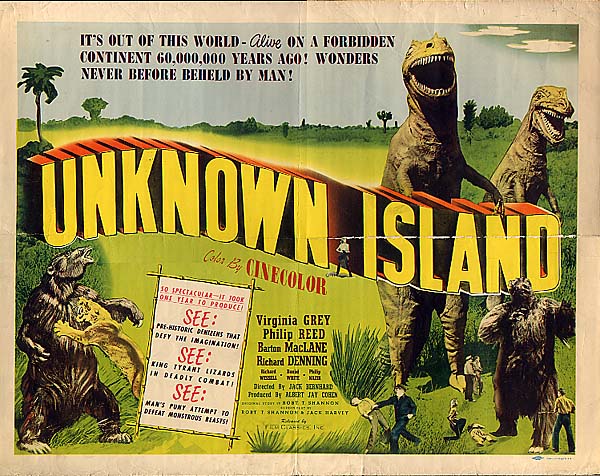
Premiered This Day: Unknown Island
This 1948 film written by Robert T. Shannon and directed by Jack Bernhard features some of the worst ‘man dressed up as a T. rex’ effects ever. Not a bad little story though.


Tuesday, October 14, 2014
Born This Day: Jack Arnold

Jack Arnold (Oct. 14, 1916 - March 17, 1992) directed a number of classic SF films including The Creature From the Black Lagoon, Revenge of the Creature, The Incredible Shrinking Man, and It Came From Outer Space, as well as few not-so-classics (but still much loved) such as Monster on Campus. Throughout the ‘60’s and into the early 80’s he had a successful career as a TV producer and director.
Died This Day: Thomas Davidson
May 17, 1817 – Oct. 14, 1885
Davison was a Scottish naturalist and paleontologist who became known as an authority on brachiopods. His major work, Monograph of British Fossil Brachiopoda, was published by the Palaeontographical Society. Together with supplements, this comprised six quarto volumes with more than 200 plates drawn on stone by the author. Upon his death, he bequeathed his fine collection of recent and fossil brachiopoda to the British Museum.
Davison was a Scottish naturalist and paleontologist who became known as an authority on brachiopods. His major work, Monograph of British Fossil Brachiopoda, was published by the Palaeontographical Society. Together with supplements, this comprised six quarto volumes with more than 200 plates drawn on stone by the author. Upon his death, he bequeathed his fine collection of recent and fossil brachiopoda to the British Museum.
Monday, October 13, 2014
Born This Day: Sir John William Dawson
Dawson (Oct. 13, 1820 - Nov. 20, 1899>) was a Canadian geologist who made numerous contributions to paleobotany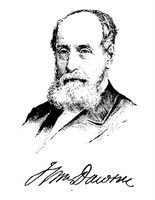 and extended the knowledge of Canadian geology. Dawson was born and raised in Pictou, Nova Scotia, where the many sandstone and coal formations provided fertile ground for his first scientific explorations, which culminated in the publication of Acadian Geology. He made many important discoveries of fossil life, great and small. These included fossil plants, trackways of lowly invertebrates, footprints, skeletons of reptiles and amphibians, millipedes and the earliest land snails. When the famous geologist Charles Lyell visited coal deposits in Pictou, Dawson acted as his guide.
In 1851, Dawson and Lyell teamed up again to examine the interiors of fossil tree trunks at Joggins,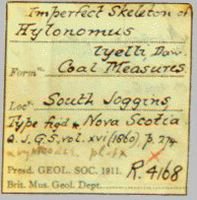 Nova Scotia. They discovered the remains of some of the earliest known reptiles, Hylonomus lyelli, along with other rare fossils, propelling this part of the world into the international spotlight.
 and extended the knowledge of Canadian geology. Dawson was born and raised in Pictou, Nova Scotia, where the many sandstone and coal formations provided fertile ground for his first scientific explorations, which culminated in the publication of Acadian Geology. He made many important discoveries of fossil life, great and small. These included fossil plants, trackways of lowly invertebrates, footprints, skeletons of reptiles and amphibians, millipedes and the earliest land snails. When the famous geologist Charles Lyell visited coal deposits in Pictou, Dawson acted as his guide.
In 1851, Dawson and Lyell teamed up again to examine the interiors of fossil tree trunks at Joggins,
 Nova Scotia. They discovered the remains of some of the earliest known reptiles, Hylonomus lyelli, along with other rare fossils, propelling this part of the world into the international spotlight.
Monday, October 06, 2014
Died This Day: George Gaylord Simpson
Simpson (June 16, 1902 - October 6, 1984) is known for his contributions to evolutionary theory and to the 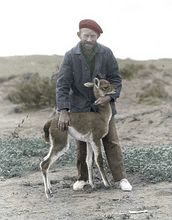 understanding of intercontinental migrations of animal species in past geological times. Simpson specialized in early fossil mammals, leading expeditions on four continents and discovering in 1953 the 50-million-year old fossil skulls of dawn horses in Colorado.
Simpson helped develop the modern biological theory of evolution, drawing on paleontology, genetics, ecology, and natural selection to show that evolution occurs as a result of natural selection operating in response to shifting environmental conditions. He spent most of his career as a paleontologist at the American Museum of Natural History. image. From Today In Science History.
 understanding of intercontinental migrations of animal species in past geological times. Simpson specialized in early fossil mammals, leading expeditions on four continents and discovering in 1953 the 50-million-year old fossil skulls of dawn horses in Colorado.
Simpson helped develop the modern biological theory of evolution, drawing on paleontology, genetics, ecology, and natural selection to show that evolution occurs as a result of natural selection operating in response to shifting environmental conditions. He spent most of his career as a paleontologist at the American Museum of Natural History. image. From Today In Science History.
Wednesday, October 01, 2014
Died This Day: Louis Leakey

Louis and Mary Leakey

From Today In Science History:
Leakey (Aug 7, 1903 – October 1, 1972), an archaeologist and anthropologist, was born in Kabete, Kenya, of English missionaries parents. Leakey was largely responsible for convincing scientists that Africa, rather than Java or China, was the most significant area to search for evidence of human origins. Leakey led fossil-hunting expeditions to eastern Africa from the 1920's.
He married Mary D. Nicol in 1936 and the couple discovered many important fossils together. In 1964, on an expedition to the Olduvai Gorge in Tanzania, he found fossil remains of, he believed, the earliest member of the genus of human beings. He named the species Homo habilis.
Subscribe to:
Posts (Atom)