Sunday, February 02, 2014
Tarzan vs. T. rex
The above image was painted by Morris "Mo" Gollub who also did the best of the Turok, Son of Stone covers.
Read more about Morris at Pete Von Sholly's website, VonShollyWood
Australornis lovei, new Paleocene bird from New Zealand
First diagnosable non-sphenisciform bird from the early Paleocene of New Zealand. Mayr, RP Scofield, J. Royal Society of New Zealand
Abstract: A new avian taxon from the early Paleocene Waipara Greensand in Canterbury, New Zealand, is described. The holotype of Australornis lovei, gen. et sp. nov. includes wing and pectoral girdle bones, which exhibit distinctive morphologies. Notable features are a very long crista deltopectoralis, a craniocaudally flattened shaft, and a large tuberculum dorsale of the humerus, as well as a ridge-like caudal surface of the proximal ulna.
Although a well-founded assignment of the new species to any of the extant higher-level taxa is not possible, key morphological features of stem group Sphenisciformes (penguins) are absent in A. lovei. Other than penguins, the holotype of A. lovei represents one of the most significant records of a marine Paleocene bird from the Southern Hemisphere, and contributes to the emerging view that Neoaves were already diversified in the earliest Paleogene. link
Saturday, February 01, 2014
Roy Chapman Andrews - Searching For Lost Worlds
From The Discovery Channels, 1998
Thursday, January 30, 2014
Yongjinglong, A New Titanosaurian Sauropod from China
A New Titanosaurian Sauropod from the Hekou Group (Lower Cretaceous) of the Lanzhou-Minhe Basin, Gansu Province, China
This sauropod belonged to a group known as Titanosauria, members of which were among the largest living creatures to ever walk the earth. At roughly 50-60 feet long, the Yongjinglong individual discovered was a medium-sized Titanosaur. Anatomical evidence, however, points to it being a juvenile; adults may have been larger. press release
Image: University of Pennsylvania
A team led by University of Pennsylvania paleontologists has characterized a new dinosaur based on fossil remains found in northwestern China. The species, a plant-eating sauropod named Yongjinglong datangi, roamed during the Early Cretaceous period, more than 100 million years ago.
This sauropod belonged to a group known as Titanosauria, members of which were among the largest living creatures to ever walk the earth. At roughly 50-60 feet long, the Yongjinglong individual discovered was a medium-sized Titanosaur. Anatomical evidence, however, points to it being a juvenile; adults may have been larger. press release
Published This Day (1868): Variation of Animals and Plants under Domestication by Darwin
From Today In Science History:
In 1868, Charles Darwin's book
- Variation of Animals and Plants under Domestication - was published. He was 58. It is probably the second in importance of all his works.
This was a follow-up work, written in response to criticisms that his
theory of evolution was unsubstantiated. Darwin here supports his views
via analysis of various aspects of plant and animal life, including an
inventory of varieties and their physical and behavioral
characteristics, and an investigation of the impact of a species'
surrounding environment and the effect of both natural and forced
changes in this environment.
In 1868, Charles Darwin's book
- Variation of Animals and Plants under Domestication - was published. He was 58. It is probably the second in importance of all his works.
This was a follow-up work, written in response to criticisms that his
theory of evolution was unsubstantiated. Darwin here supports his views
via analysis of various aspects of plant and animal life, including an
inventory of varieties and their physical and behavioral
characteristics, and an investigation of the impact of a species'
surrounding environment and the effect of both natural and forced
changes in this environment.
Sunday, January 26, 2014
Wednesday, January 22, 2014
Died This Day: Horace de Suassure
Horace Bénédict de Saussure
Born 17 Feb 1740; died 22 Jan 1799.
A Swiss physicist and geologist, he introduced the term geology into the scientific literature in the first volume of Voyages dans les Alpes (1779-96). Link
Born 17 Feb 1740; died 22 Jan 1799.
A Swiss physicist and geologist, he introduced the term geology into the scientific literature in the first volume of Voyages dans les Alpes (1779-96). Link
Sunday, January 19, 2014
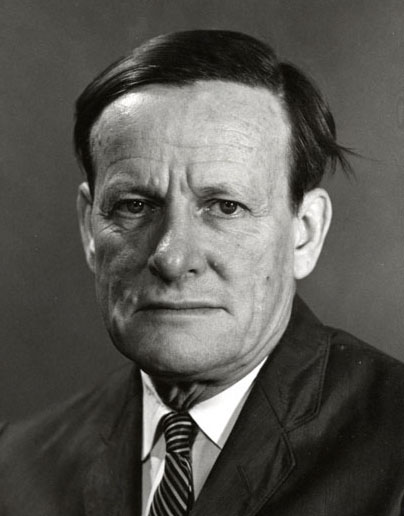
Died This Day: George Ledyard Stebbins
From the U Calif., Berkeley:
Along with Dobzhansky (1900 - 1975), animal systematist Ernst Mayr, and paleontologist George Gaylord Simpson (1902 - 1984),
Stebbins (Jan. 6, 1906 - Jan. 19 2000) is considered one of the architects of the modern evolutionary synthesis of the 1930s and 1940s, an intellectual watershed and historic turning point that brought together research in cytology, genetics, systematics, paleontology into a common evolutionary framework. This synthesis, which had the effect of reconciling the often opposing views of laboratory-oriented geneticists and natural history oriented systematists, made Charles Darwin's theory of evolution by natural selection the centerpiece of the new discipline of evolutionary biology.
In this role, Stebbins is credited with bringing a modern framework to the study of plant evolution, and he is perhaps best known for his book Variation and Evolution in Plants, published by Columbia University Press (NY) in 1950. In the 1940s, Stebbins also played an important role in organizing the nascent Society for the Study of Evolution, of which he became the third president in 1948, and used his position to speak out for the botanical side of evolutionary studies, a field that had been dominated by zoologists. Photo .
Along with Dobzhansky (1900 - 1975), animal systematist Ernst Mayr, and paleontologist George Gaylord Simpson (1902 - 1984),
Stebbins (Jan. 6, 1906 - Jan. 19 2000) is considered one of the architects of the modern evolutionary synthesis of the 1930s and 1940s, an intellectual watershed and historic turning point that brought together research in cytology, genetics, systematics, paleontology into a common evolutionary framework. This synthesis, which had the effect of reconciling the often opposing views of laboratory-oriented geneticists and natural history oriented systematists, made Charles Darwin's theory of evolution by natural selection the centerpiece of the new discipline of evolutionary biology. In this role, Stebbins is credited with bringing a modern framework to the study of plant evolution, and he is perhaps best known for his book Variation and Evolution in Plants, published by Columbia University Press (NY) in 1950. In the 1940s, Stebbins also played an important role in organizing the nascent Society for the Study of Evolution, of which he became the third president in 1948, and used his position to speak out for the botanical side of evolutionary studies, a field that had been dominated by zoologists. Photo .
Friday, January 17, 2014
Born This Day: August Weismann
From Today In Science History:
August (Friedrich Leopold) Weismann (Jan. 17, 1834 – Nov. 5, 1914)
was a German biologist and one of the founders of the science of genetics. He is best known for his opposition to the doctrine of the inheritance of acquired traits and for his "germ plasm" theory, the forerunner of DNA theory.
Weismann conceived the idea, arising out of his early observations on the Hydrozoa, that the germ cells of animals contain "something essential for the species, something which must be carefully preserved and passed on from one generation to another."
Weismann envisioned the hereditary substances from the two parents become mixed together in the fertilized egg and a form of nuclear division in which each daughter nucleus receives only half the original ancestral germ plasms.
More info from Science World. image
August (Friedrich Leopold) Weismann (Jan. 17, 1834 – Nov. 5, 1914)
was a German biologist and one of the founders of the science of genetics. He is best known for his opposition to the doctrine of the inheritance of acquired traits and for his "germ plasm" theory, the forerunner of DNA theory. Weismann conceived the idea, arising out of his early observations on the Hydrozoa, that the germ cells of animals contain "something essential for the species, something which must be carefully preserved and passed on from one generation to another."
Weismann envisioned the hereditary substances from the two parents become mixed together in the fertilized egg and a form of nuclear division in which each daughter nucleus receives only half the original ancestral germ plasms.
More info from Science World. image
Thursday, January 16, 2014
Born This Day: Ruth Rose
Ruth Rose (Jan. 16, 1896 - June 8, 1978) was the daughter of Edward E. Rose. In 1926 she meet (and later married) cinematographer Ernest Schoedsack when they were both working on a New York Geological Society expedition to the Galapagos Islands. Together with partner and fellow producer director, Meriam C. Cooper, and animator Willis O’Brien, they made “King Kong”, released in 1933. Rose shared in many of Schoedsack’s and Cooper’s wildness film productions, and worked as a writer or script doctor on King Kong, Son of Kong, She, The Last Days of Pompeii and Mighty Joe Young.
The photo from King Kong (above) is of Bruce Cabot, Fay Wray and Robert Armstrong, but Rose clearly modeled the characters they played after Schoedsack, herself, and Cooper.
Large landmasses existed 2.7 billion years ago
Decoupled Hf-Nd isotopes in Neoarchean seawater reveal weathering of emerged continents Viehmann, et al., Geology, on-line early publication.
The new findings show that 2,700 million years ago relatively large landmasses emerged from the oceans that were exposed to weathering and erosion by the sun, wind and rain.
Dr. Hoffmann: "The isotope Hafnium 176 in contrast to its counterpart Neodymium 143 was transported by means of weathering into the oceans and became part of iron-rich sediments on the sea floor 2,700 million years ago. link
Kamandi by jack Kirby © DC Comics
Researchers have determined the isotope composition of the rare trace elements Hafnium and Neodymium in 2,700 million year-old seawater by using high purity chemical sediments from Temagami Banded Iron Formation in Canada.
The new findings show that 2,700 million years ago relatively large landmasses emerged from the oceans that were exposed to weathering and erosion by the sun, wind and rain.
Dr. Hoffmann: "The isotope Hafnium 176 in contrast to its counterpart Neodymium 143 was transported by means of weathering into the oceans and became part of iron-rich sediments on the sea floor 2,700 million years ago. link
Born This Day: Caroline Munro
Munro is probably best known for her role in in the Bond film The Spy Who Loved Me (1977). She had a long career in a variety of genre films including a stint with Hammer Films, and notably with Ray Harryhausen as the slave girl, Margiana, in The Golden Voyage of Sinbad (1974).
The Palaeoblog salutes her both for being the Godmother of Ray Harryhausen’s daughter and for her role as Princess Dia in At the Earth’s Core (1976)
Wednesday, January 15, 2014
Died This Day: Jean-Baptiste-Julien d' Omalius d' Halloy
d'Halloy (Feb. 16, 1783 - Jan. 15, 1875) was a Belgian geologist who was an early proponent of evolution and was acknowledged by Charles Darwin in his preface to ‘On The Origin of the Species’ for his opinions on the origin of new species through descent with modification.He determined the stratigraphy of the Carboniferous and other rocks in Belgium and the Rhine provinces, and also made detailed studies of the Tertiary deposits of the Paris Basin. link
Died This Day: Alpheus Hyatt
From Today in Science History:
U.S. zoologist and paleontologist who studied invertebrate fossil records, the evolution of the cephalopods (a class of mollusks including squids and octopuses) and the development of primitive organisms.
Along with E. Cope, Hyatt (April 5, 1838 - Jan. 15, 1902) was the most prominent American neo-Lamarckian. Based on the analogy of ontogeny with phylogeny, Hyatt claimed that lineages, like individuals, had cycles of youth, old age, and death (extinction). This idea became the bulwark of orthogenetic theories in the U.S. Hyatt was the founder and first editor of the American Naturalist, and first president of Woods Hole laboratory.
U.S. zoologist and paleontologist who studied invertebrate fossil records, the evolution of the cephalopods (a class of mollusks including squids and octopuses) and the development of primitive organisms. Along with E. Cope, Hyatt (April 5, 1838 - Jan. 15, 1902) was the most prominent American neo-Lamarckian. Based on the analogy of ontogeny with phylogeny, Hyatt claimed that lineages, like individuals, had cycles of youth, old age, and death (extinction). This idea became the bulwark of orthogenetic theories in the U.S. Hyatt was the founder and first editor of the American Naturalist, and first president of Woods Hole laboratory.
Wednesday, January 08, 2014
Monday, January 06, 2014
Palaeoblog To Return in 2014
Good news for everyone who followed the Palaeoblog. It will be coming back in a modified form in the near future. Much like the Rhedosaurus, all it has to do is shake off the frozen ice and awaken from its cold slumber.
You can also get the usual Palaeoblog news by following my Twitter feed: https://twitter.com/DrMichaelJRyan
Monday, August 12, 2013
Paleoblog Over & Out
After an extended break, the Palaeoblog is officially closing up shop.
When it started up almost 10 years ago it was a great way to get palaeo-related news out to people who would otherwise have a hard time finding it. Blogs like this have now been largely superseded by other forms of social media, so I have no doubt that you've all got better ways to stay informed. Thanks for all the support over the years!
Wednesday, May 29, 2013
Albertadromeus syntarus, New Ornithopod from Alberta
New data on the diversity and abundance of smallbodied ornithopods (Dinosauria, Ornithischia) from the Belly River Group (Campanian) of Alberta. 2013. Brown, C.M., et al. Journal of Vert. Paleo. 33: 495-520.
Wednesday, May 08, 2013
Acrotholus audeti, a New Pachycephalosaur from Alberta
The oldest North American pachycephalosaurid and the hidden diversity of small-bodied ornithischian dinosaurs. 2013. D.C. Evans, et al. Nature Communications
Tuesday, May 07, 2013
Ray Harryhausen 1920-2013

Ray Harryhausen passed away today. No doubt his spirit is roaming a jungle somewhere "way west of Sumatra" with Willis, Merian, Ernest, Ruth, and Carl Denham looking for giant gorillas!
The Ray & Diana Harryhausen Foundation
Subscribe to:
Posts (Atom)


.jpg&container=blogger&gadget=a&rewriteMime=image%2F*)
.jpg)
.jpg)
.jpg&container=blogger&gadget=a&rewriteMime=image%2F*)
.jpg)
.jpg&container=blogger&gadget=a&rewriteMime=image%2F*)
.jpg)
.jpg&container=blogger&gadget=a&rewriteMime=image%2F*)


