Friday, December 03, 2010
Kosmoceratops: Strange Science Fantasy?
This may be the quickest turn around time for a new dino appearing in an entertainment medium...


High Temperatures Catalyzed Primordial Life
Impact of temperature on the time required for the establishment of primordial biochemistry, and for the evolution of enzymes. 2010.R. B. Stockbridge, et al. PNAS, published online before print December 1.
Disney Explains evolution. A Classic!Enzymes, proteins that jump-start chemical reactions, are essential to life within cells of the human body and throughout nature. To appreciate how powerful modern enzymes are, and the process of how they evolved, researchers measured the speed of chemical reactions. They estimated that some reactions take more than 2 billion years without an enzyme. In the process of measuring slow reaction rates, "it gradually dawned on us that the slowest reactions are also the most temperature-dependent," Wolfenden said.
In general, the amount of influence temperature has on reaction speeds varies drastically, the group found. In one slow reaction, for instance, raising the temperature from 25 to 100 degrees Celsius increases the reaction rate 10 million fold.
High temperatures were probably a crucial influence on reaction rates when life began forming in hot springs and submarine vents. Later, the cooling of the earth provided selective pressure for primitive enzymes to evolve and become more sophisticated. link.
Disney Explains evolution. A Classic!
In general, the amount of influence temperature has on reaction speeds varies drastically, the group found. In one slow reaction, for instance, raising the temperature from 25 to 100 degrees Celsius increases the reaction rate 10 million fold.
High temperatures were probably a crucial influence on reaction rates when life began forming in hot springs and submarine vents. Later, the cooling of the earth provided selective pressure for primitive enzymes to evolve and become more sophisticated. link.
Thursday, December 02, 2010
Born This Day: Capt. Englehorn

Frank Reicher (Dec. 2, 1875 – Jan. 19, 1965) was born in Munich,Germany and had a long career in Hollywood. He appeared in over 200 films, often playing small roles in minor films, and he directed over three dozen silent movies.
He is best know for playing Capt. Englehorn in King King (1933), and it’s quickie sequel Son of Kong from later that same year.
Wednesday, December 01, 2010
Rainforest Collapse Triggered Carboniferous Reptile Evolution
Rainforest collapse triggered Carboniferous tetrapod diversification in Euramerica. 2010. S. Sahney, et al. Geology 38: 1079-1082
Mike Benton of the University of Bristol added: "This is a classic ecological response to habitat fragmentation. You see the same process happening today whenever a group of animals becomes isolated from its parent population. It's been studied on traffic islands between major road systems or, as Charles Darwin famously observed in the Galapagos, on oceanic islands."
To reach their conclusions, the scientists studied the fossil record of reptiles before and after rainforest collapse. They showed that reptiles became more diverse and even changed their diet as they struggled to adapt to rapidly changing climate and environment. link

Global warming devastated tropical rainforests 300 million years ago. Now scientists report the unexpected discovery that this event triggered an evolutionary burst among reptiles -- and inadvertently paved the way for the rise of dinosaurs, 100 million years later.This event happened during the Carboniferous Period. At that time, Europe and North America lay on the equator and were covered by steamy tropical rainforests. But when the Earth's climate became hotter and drier, rainforests collapsed and fragmented into small 'islands' of forest. This isolated populations of reptiles and each community evolved in a separate direction, leading to an increase in diversity."
Mike Benton of the University of Bristol added: "This is a classic ecological response to habitat fragmentation. You see the same process happening today whenever a group of animals becomes isolated from its parent population. It's been studied on traffic islands between major road systems or, as Charles Darwin famously observed in the Galapagos, on oceanic islands."
To reach their conclusions, the scientists studied the fossil record of reptiles before and after rainforest collapse. They showed that reptiles became more diverse and even changed their diet as they struggled to adapt to rapidly changing climate and environment. link
Died This Day: Godfrey Harold Hardy
Hardy (Feb. 7, 1877 – Dec. 1, 1947) was an English mathematician known for his work in number theory and mathematical analysis. Although Hardy considered himself a pure mathematician, he nevertheless worked in applied mathematics when he formulated a law that describes how proportions of dominant and recessive genetic traits will propagate in a large population (1908). Hardy considered it unimportant but it has proved of major importance in blood group distribution. As it was also independently discovered by Weinberg, it is known as the Hardy-Weinberg principle.
The Hardy-Weinberg equation

The Hardy-Weinberg equation
Died This Day: J.B.S. Haldane
Haldane (Nov. 5, 1892 - Dec. 1, 1964) is best remembered along with E. B. Ford and R. A. Fisher one of the three major figures to develop the mathematical theory of population genetics. His greatest contribution was in a series of ten papers on "A Mathematical Theory of Natural and Artificial Selection" which was the major series of papers on the  mathematical theory of natural selection. It treated many major cases for the first time, showing the direction and rates of changes of gene frequencies. It also pioneered in investigating the interaction of natural selection with mutation and with migration.
Haldane's book, The Causes of Evolution (1932), summarized these results, especially in its extensive appendix. This body of work was a component of what came to be known as the "modern evolutionary synthesis", re-establishing natural selection as the premier mechanism of evolution by explaining it in terms of the mathematical consequences of Mendelian genetics. From Wikipedia. More info here.
 mathematical theory of natural selection. It treated many major cases for the first time, showing the direction and rates of changes of gene frequencies. It also pioneered in investigating the interaction of natural selection with mutation and with migration.
Haldane's book, The Causes of Evolution (1932), summarized these results, especially in its extensive appendix. This body of work was a component of what came to be known as the "modern evolutionary synthesis", re-establishing natural selection as the premier mechanism of evolution by explaining it in terms of the mathematical consequences of Mendelian genetics. From Wikipedia. More info here.
Monday, November 29, 2010
Mammals Got Bigger After Dino Extinction
The Evolution of Maximum Body Size of Terrestrial Mammals. 2010. F.A. Smith, et al. Science 330: 1216-1219.
Researchers have demonstrated that the extinction of dinosaurs 65 million years ago made way for mammals to get bigger - about a thousand times bigger than they had been. The study is the first to show this new pattern of increased body size of mammals after the exit of the dinosaurs. Mammals grew from a maximum of about 10 kg when they were sharing the earth with dinosaurs to a maximum of 17 tonnes afterwards.
"Basically, the dinosaurs disappear and all of a sudden there is nobody else eating the vegetation. That's an open food source and mammals start going for it, and it's more efficient to be an herbivore when you're big," says paper co-author Dr. Jessica Theodor.
Theodor says as well as confirming the dramatic growth in mammalian size after the dinosaurs, the study shows that the ecosystem is able to reset itself relatively quickly.
"You lose dinosaurs 65 million years ago, and within 25 million years the system is reset to a new maximum for the animals that are there in terms of body size. That's actually a pretty short time frame, geologically speaking," she says. "That's really rapid evolution."
"Nobody has ever demonstrated that this pattern is really there. People have talked about it but nobody has ever gone back and done the math," says Theodor one of the 20 researchers from around the world who worked on the study. link

Alison Boyer/Yale University
Researchers have demonstrated that the extinction of dinosaurs 65 million years ago made way for mammals to get bigger - about a thousand times bigger than they had been. The study is the first to show this new pattern of increased body size of mammals after the exit of the dinosaurs. Mammals grew from a maximum of about 10 kg when they were sharing the earth with dinosaurs to a maximum of 17 tonnes afterwards.

"Basically, the dinosaurs disappear and all of a sudden there is nobody else eating the vegetation. That's an open food source and mammals start going for it, and it's more efficient to be an herbivore when you're big," says paper co-author Dr. Jessica Theodor.
Theodor says as well as confirming the dramatic growth in mammalian size after the dinosaurs, the study shows that the ecosystem is able to reset itself relatively quickly.
"You lose dinosaurs 65 million years ago, and within 25 million years the system is reset to a new maximum for the animals that are there in terms of body size. That's actually a pretty short time frame, geologically speaking," she says. "That's really rapid evolution."
"Nobody has ever demonstrated that this pattern is really there. People have talked about it but nobody has ever gone back and done the math," says Theodor one of the 20 researchers from around the world who worked on the study. link

Alison Boyer/Yale University
The largest land mammals that ever lived, Indricotherium and Deinotherium, would have towered over the living African elephant. The tallest on diagram, Indricotherium, an extinct rhino relative, lived during the Eocene to the Oligocene Epoch (37 to 23 million years ago) and reached a mass of 15,000 kg, while Deinotherium (an extinct proboscidean, related to modern elephants) was around from the late-Miocene until the early Pleistocene (8.5 to 2.7 million years ago) and weighed as much as 17,000 kg.
Sunday, November 28, 2010
Born This Day: Karl Ernst Von Baer
Von Baer (Feb 29, 1792 - Nov 28, 1876) was a Prussian-Estonian embryologist who discovered the mammalian egg (1827) and the notochord. He established the new science of comparative embryology alongside  comparative anatomy with the publication of two landmark volumes (in 1828 and 1837) covering the range of existing knowledge of the prebirth developments of vertebrates.
He showed that mammalian eggs were not the follicles of the ovary but microscopic particles inside the follicles. He described the development of the embryo from layers of tissue, which he called germ layers, and demonstrated similarities in the embryos of different species of vertebrates.
From Today In Science History
 comparative anatomy with the publication of two landmark volumes (in 1828 and 1837) covering the range of existing knowledge of the prebirth developments of vertebrates.
He showed that mammalian eggs were not the follicles of the ovary but microscopic particles inside the follicles. He described the development of the embryo from layers of tissue, which he called germ layers, and demonstrated similarities in the embryos of different species of vertebrates.
From Today In Science History
Wednesday, November 24, 2010
Died This Day: Richard Carlson

Published This Day: The Origin of The Species

From Today In Science History:
In 1859, The Origin of Species by Means of Natural Selection was published in England to great acclaim. In this groundbreaking book by British naturalist Charles Darwin, he argued that species are the result of a gradual biological evolution in which nature encourages, through natural selection, the propagation of those species best suited to their environments. This book is unquestionably one of the most influential in the history of science.
Tuesday, November 23, 2010
Iguanacolossus & Hippodraco: Two New Iguanodonts
New Basal Iguanodonts from the Cedar Mountain Formation of Utah and the Evolution of Thumb-Spiked Dinosaurs. 2010. A. MacDonald, et al. PLoS ONE 5(11): e14075.
 Hippodraco scutodens (“horse-dragon, shield tooth”) (above) was found at a site north of Arches National Park. It lived approximately 124 million years ago, at the same time as the predator Utahraptor.
 Iguanacolossus fortis (“mighty colossal Iguana”) (above) was found at a site near the town of Green River. It is ~30ft long and is probably a few million years older than Hippodraco.

Click to enlarge
The Early Cretaceous of Utah has two new species of iguanodonts that are beaked herbivorous dinosaurs.Iguanodonts are found all over the world in rocks dating to the Early Cretaceous Epoch (~145.5-99.6 million years ago). Their fossils are particularly abundant and diverse in Europe and east-central Asia with Europes Iguanodon being only the second formally named dinosaur in 1825.


Click to enlarge
Reduced consensus tree of 11,850 MPTs of 358 steps each, following ordering of 22 multistate characters. Numbers below and to the left of some nodes correspond to the following clade names: 1, Ornithopoda; 2, Iguanodontia; 3, Rhabdodontidae; 4, Dryomorpha; 5, Dryosauridae; 6, Ankylopollexia; 7, Styracosterna; 8, Hadrosauriformes; 9, Hadrosauroidea.
Saturday, November 20, 2010
Born This Day: Robert Armstrong

Komodo Dragon Missing Link
Oldest known Varanus (Squamata: Varanidae) from the Upper Eocene and Lower Oligocene of Egypt: support for an African origin of the genus. 2010. R. B. Holmes Palaeontology 53: 1099–1110

Scientists say the unique shape of the vertebrae of the 33-million-year-old African lizard fossil links it with its cousin the Komodo, which has only been around for some 700,000 years.
"The African fossil was found on the surface of a windswept desert," said Holmes. "It's definitely from the lizard genus Varanus and there are more than 50 species alive today, including Komodos and other large lizards."
Holmes says the telltale African vertebrae fossils belonged to a lizard that was about a metre- and-a-half long whose ability to swim may be key to figuring out how more than 30 million years later its ancestors turned up on the other side of the world.
Holmes says the ancient African Varanus specimen was found on land that was once the bottom of a river or small lake. "Whether the animals lived in the water or surrounding land, we don't know, but we do know that some modern day species of Varanus are comfortable swimming in fresh water."
The work runs counter to some prevailing theories about the origins of some ancient fossil types found in Africa including Varanus lizards and some fresh-water fish. "The assumption for several types of ancient African fossils is that the animals didn't originate in Africa but came there from Asia," says Holmes. "But the fossil record of Varanus shows exactly the opposite path of migration." link
Died This Day: John William Dawson
Dawson (Oct. 30, 1820 - Nov. 20, 1899>) was a Canadian geologist who made numerous contributions to paleobotany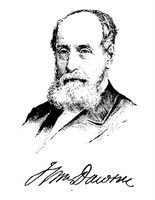 and extended the knowledge of Canadian geology. Dawson was born and raised in Pictou, Nova Scotia, where the many sandstone and coal formations provided fertile ground for his first scientific explorations, which culminated in the publication of Acadian Geology. He made many important discoveries of fossil life, great and small. These included fossil plants, trackways of lowly invertebrates, footprints, skeletons of reptiles and amphibians, millipedes and the earliest land snails. When the famous geologist Charles Lyell visited coal deposits in Pictou, Dawson acted as his guide.
In 1851, Dawson and Lyell teamed up again to examine the interiors of fossil tree trunks at Joggins,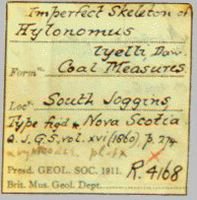 Nova Scotia. They discovered the remains of some of the earliest known reptiles, Hylonomus lyelli, along with other rare fossils, propelling this part of the world into the international spotlight.
Dawson became principal of McGill College in Montreal in 1854, which he made into a reputable institution. He remained there, teaching geology and palaeontology and acting as librarian, until his retirement. One of his lifelong dreams was realized in 1882 when Peter Redpath gave money to McGill for the construction and establishment of a museum, naming Dawson as director. Today the Peter Redpath Museum of Natural History houses many specimens from Dawson's personal collection.
Info from HERE and HERE. Images from HERE and HERE.
 and extended the knowledge of Canadian geology. Dawson was born and raised in Pictou, Nova Scotia, where the many sandstone and coal formations provided fertile ground for his first scientific explorations, which culminated in the publication of Acadian Geology. He made many important discoveries of fossil life, great and small. These included fossil plants, trackways of lowly invertebrates, footprints, skeletons of reptiles and amphibians, millipedes and the earliest land snails. When the famous geologist Charles Lyell visited coal deposits in Pictou, Dawson acted as his guide.
In 1851, Dawson and Lyell teamed up again to examine the interiors of fossil tree trunks at Joggins,
 Nova Scotia. They discovered the remains of some of the earliest known reptiles, Hylonomus lyelli, along with other rare fossils, propelling this part of the world into the international spotlight.
Dawson became principal of McGill College in Montreal in 1854, which he made into a reputable institution. He remained there, teaching geology and palaeontology and acting as librarian, until his retirement. One of his lifelong dreams was realized in 1882 when Peter Redpath gave money to McGill for the construction and establishment of a museum, naming Dawson as director. Today the Peter Redpath Museum of Natural History houses many specimens from Dawson's personal collection.
Info from HERE and HERE. Images from HERE and HERE.
Thursday, November 18, 2010
Born This Day: Noble Johnson
“Meanwhile, the light-skinned Noble Johnson (April 18, 1881 – Jan. 9, 1978) was heavily made up for his role as the village chief [in 1933's, KING KONG]—he was a leading black actor of the era (known as “America’s premiere Afro-American screen star” in the black press) and therefore worth the extra consideration. Johnson, an ex-cowboy, horse trainer, and boxer, had quite a resume before portraying the Chief of Skull Island.
He was a student of all aspects of movie making from directing to distribution, and instrumental in the 1916 formation of the Lincoln Motion Picture Company, created to produce what were called “race movies.” Johnson left the company after it had released three films, rumored to have been “encouraged” by Universal to do so or lose any opportunity for parts at the bigger studio.
Johnson - a childhood friend of Lon Chaney - portrayed a variety of ethnicities in his long career; one of the few black actors of Hollywood’s early era to be allowed any diversity in roles.” From Kong Is King.net
This Just In: Pterosaurs Can Fly!
On the Size and Flight Diversity of Giant Pterosaurs, the Use of Birds as Pterosaur Analogues and Comments on Pterosaur Flightlessness. 2010. M.P. Witton & M.B. Habib.PLoS ONE 5(11): e13982.

Grrr! Kong hate stupid press release catch phrases!
These creatures were not birds; they were flying reptiles with a distinctly different skeletal structure, wing proportions and muscle mass. They would have achieved flight in a completely different way to birds and would have had a lower angle of take off and initial flight trajectory. The anatomy of these creatures is unique.”
Drs Witton and Habib suggest that, with up to 50 kg of forelimb muscle, the creatures could easily have launched themselves into the air despite their massive size and weight.
They concluded that not only could pterosaurs fly, they could do so extremely well and could have traveled huge distances and even crossed continents. It’s unlikely that they would need to flap continuously to remain aloft but would flap powerfully in short bursts with their large size allowing them to achieve rapid cruising speeds. link

Grrr! Kong hate stupid press release catch phrases!
Controversial claims that enormous prehistoric winged beasts could not fly have been refuted by the most comprehensive study to date which asserts that giant pterosaurs were skilled in flight.New research indicates that the giant pterosaurs took off by using all four of their limbs and effectively ‘pole-vaulting’ over their wings using their leg muscles and pushing from the ground using their powerful arm muscles. Once airborne they could fly huge distances and even cross continents.
These creatures were not birds; they were flying reptiles with a distinctly different skeletal structure, wing proportions and muscle mass. They would have achieved flight in a completely different way to birds and would have had a lower angle of take off and initial flight trajectory. The anatomy of these creatures is unique.”
Drs Witton and Habib suggest that, with up to 50 kg of forelimb muscle, the creatures could easily have launched themselves into the air despite their massive size and weight.
They concluded that not only could pterosaurs fly, they could do so extremely well and could have traveled huge distances and even crossed continents. It’s unlikely that they would need to flap continuously to remain aloft but would flap powerfully in short bursts with their large size allowing them to achieve rapid cruising speeds. link
Vist Pterosaur-Net Blog, a blog in the spirit of the palaeoblog, but all about pterosaurs. Thanks for the Kong image guys!Too bad the "junk in the trunk" entry slips off the front page. Victoria, shouldn't that be immortalized in a new Currie Lab t-shirt?
Wednesday, November 17, 2010
Debuted This Day: The Ghost of Slumber Mountain
The Ghost of Slumber Mountain was written and directed by special effects pioneer Willis O'Brien and produced by Herbert M. Dawley. When O’Brien went on to greater fame with The Lost World Dawley sued the film makers for patent infrigment, claiming that he, not O’Brien, had invented stop-motion animation. Although this was not the case, filming saw head up while the case was sorted out. 
Both O’Brien and Hawley star as the ghost of Mad Dick and Uncle Jack Holmes, respectively.
Born This Day: Julie Adams

The Junk In The Trunk of T. rex
The Tail of Tyrannosaurus: Reassessing the Size and Locomotive Importance of the M. caudofemoralis in Non-Avian Theropods. 2010. W. S. Persons and P.J. Currie. The Anatomical Record, published online: Nov. 12.

Devil Dinosaur © Marvel Comics

The tails of both T.rex and modern animals are given their shape and strength by rib bones attached to the vertebrae. Persons found that the ribs in the tail of T. rex are located much higher on the tail. That leaves much more room along the lower end of the tail for the caudofemoralis muscles to bulk-up and expand. Without rib bones to limit the size of the caudofemoralis muscles, they became a robust power-plant enabling T.rex to run.
Persons extensive measurements of T.rex bones and computer modeling shows previous estimates of the muscle mass in the dinosaur's tall were underestimated by as much as 45 per cent.
That led many earlier T. rex researchers to believe the animal lacked the necessary muscle mass for running which in turn limited its hunting skills. That lack of speed cast T. rex in the role of a scavenger only able to survive by feeding on animals killed by other predators.
As for an T. rex's exact speed, researchers say that is hard to measure, but Persons says it could likely run down any other animal in its ecosystem. link

Devil Dinosaur © Marvel Comics
T. rex's rear end has been given a makeover by University of Alberta graduate student Scott Persons. His extensive research shows that powerful tail muscles made the giant carnivore one of the fastest moving hunters of its time.As Persons says, "contrary to earlier theories, T. rex had more than just junk in its trunk."

The tails of both T.rex and modern animals are given their shape and strength by rib bones attached to the vertebrae. Persons found that the ribs in the tail of T. rex are located much higher on the tail. That leaves much more room along the lower end of the tail for the caudofemoralis muscles to bulk-up and expand. Without rib bones to limit the size of the caudofemoralis muscles, they became a robust power-plant enabling T.rex to run.
Persons extensive measurements of T.rex bones and computer modeling shows previous estimates of the muscle mass in the dinosaur's tall were underestimated by as much as 45 per cent.
That led many earlier T. rex researchers to believe the animal lacked the necessary muscle mass for running which in turn limited its hunting skills. That lack of speed cast T. rex in the role of a scavenger only able to survive by feeding on animals killed by other predators.
As for an T. rex's exact speed, researchers say that is hard to measure, but Persons says it could likely run down any other animal in its ecosystem. link
Died This Day: Carl Akeley


The Hall of African Mammals at the American Museum of Natural History exists thanks to the efforts of Carl Akeley (May 19, 1864 - Nov 17, 1926) who was the kind of adventurer that Indy Jones could only dream of being.

He died on an African expedition in 1926, ten years before this hall was completed and was buried in a place depicted in the Hall's famous Gorilla Diorama. Of course we approach collecting and conservation differently today, but Akeley is to be commended for his love of nature and his desire to present its hidden corners to the world.
From Today In Science History:
Carl Ethan Akeley was an American naturalist and explorer who developed the taxidermic method for mounting museum displays to show animals in their natural surroundings. His method of applying skin on a finely molded replica of the body of the animal gave results of unprecedented realism and elevated taxidermy from a craft to an art. He mounted the skeleton of the famous African elephant Jumbo. He invented the Akeley cement gun to use while mounting animals, and the Akeley camera which was used to capture the first movies of gorillas.

Subscribe to:
Posts (Atom)