A new transitional sauropodomorph dinosaur from the Early Jurassic of South Africa and the evolution of sauropod feeding and quadrupedalism. 2009. A. Yates, et al. Proc. Royal Soc. B. Published online before print November 11.
Abstract [edit]: gen. et sp. nov. is described from the upper Elliot Formation (Early Jurassic) of South Africa. It is found to be the sister group of a clade of obligatory quadrupedal sauropodomorphs (Melanorosaurus + Sauropoda) and thus lies at the heart of the basal sauropodomorph–sauropod transition.
The narrow jaws of A. celestae retain a pointed symphysis but appear to have lacked fleshy cheeks. Broad, U-shaped jaws were previously thought to have evolved prior to the loss of gape-restricting cheeks. However, the narrow jaws of A. celestae retain a pointed symphysis but appear to have lacked fleshy cheeks, demonstrating unappreciated homoplasy in the evolution of the sauropod bulk-browsing apparatus.
The limbs of A. celestae indicate that it retained a habitual bipedal gait although incipient characters associated with the pronation of the manus and the adoption of a quadrupedal gait are evident through geometric morphometric analysis (using thin-plate splines) of the ulna and femur. Cursorial ability appears to have been reduced and the weight bearing axis of the pes shifted to a medial, entaxonic position, falsifying the hypothesis that entaxony evolved in sauropods only after an obligate quadrupedal gait had been adopted.
Read the story at Nat. Geo. News
Thursday, November 12, 2009
Born This Day: Julie Ege
Julie had the lead role as Nala in the 1971 Hammer film, “Creatures The World Forgot”.
Wednesday, November 11, 2009
Biomechanics of Running Indicates that Bipedal Dinosaurs Were Warm -Blooded
Biomechanics of Running Indicates Endothermy in Bipedal Dinosaurs. 2009. H. Ponzter, et al. PLoS ONE 4(11): e7783.
But metabolism and energy use are complex biological processes, and all that remains of extinct dinosaurs are their bones. So, the authors made use of a recent work by Pontzer showing that the energy cost of walking and running is strongly associated with leg length – so much so that hip height (the distance from the hip joint to the ground) can predict the observed cost of locomotion with 98% accuracy for a wide variety of land animals. As hip height can be simply estimated from the length of fossilized leg bones, Pontzer and colleagues were able to use this to obtain simple but reliable estimates of locomotor cost for dinosaurs.
To back up these estimates, the authors used a more complex method based on estimating the actual volume of leg muscle dinosaurs would have had to activate in order to move, using methods Hutchinson and Pontzer had previously developed. Activating more muscle leads to greater energy demands, which may in turn require an endothermic metabolism to fuel.
Results suggest that based on the energy they consumed when moving, many dinosaurs were probably endothermic, athletic animals because their energy requirements during walking and running were too high for cold-blooded animals to produce. Interestingly, when the results for each dinosaur were arranged into an evolutionary family tree (above), the authors found that endothermy might be the ancestral condition for all dinosaurs.
This early adoption of high metabolic rates may be one of the key factors in the massive evolutionary success that dinosaurs enjoyed during the Triassic, Jurassic and Cretaceous periods, and continue to enjoy now in feathery, flying form. link
Novel research on locomotion shows that the earliest dinosaurs may have been warm-blooded.Studies of present-day animals have shown that endothermic animals are able to sustain much higher rates of energy use. Following from this, if the energy cost of walking and running could be estimated in dinosaurs, the results might show whether these extinct species were warm- or cold-blooded. If walking and running burned more energy than a cold-blooded physiology can supply, these dinosaurs were probably warm-blooded.
But metabolism and energy use are complex biological processes, and all that remains of extinct dinosaurs are their bones. So, the authors made use of a recent work by Pontzer showing that the energy cost of walking and running is strongly associated with leg length – so much so that hip height (the distance from the hip joint to the ground) can predict the observed cost of locomotion with 98% accuracy for a wide variety of land animals. As hip height can be simply estimated from the length of fossilized leg bones, Pontzer and colleagues were able to use this to obtain simple but reliable estimates of locomotor cost for dinosaurs.
To back up these estimates, the authors used a more complex method based on estimating the actual volume of leg muscle dinosaurs would have had to activate in order to move, using methods Hutchinson and Pontzer had previously developed. Activating more muscle leads to greater energy demands, which may in turn require an endothermic metabolism to fuel.
Results suggest that based on the energy they consumed when moving, many dinosaurs were probably endothermic, athletic animals because their energy requirements during walking and running were too high for cold-blooded animals to produce. Interestingly, when the results for each dinosaur were arranged into an evolutionary family tree (above), the authors found that endothermy might be the ancestral condition for all dinosaurs.
This early adoption of high metabolic rates may be one of the key factors in the massive evolutionary success that dinosaurs enjoyed during the Triassic, Jurassic and Cretaceous periods, and continue to enjoy now in feathery, flying form. link
Want to learn more about dinosaur locomotion? Come check out the new dinosaur exhibit at the CMNH.
Tuesday, November 10, 2009
The Organic Preservation of Fossil Musculature
Organic preservation of fossil musculature with ultracellular detail. 2009. M. McNamara, et al. Proc. R. Soc. B published online before print October 14, 2009.
Previous examples of soft tissues fossilised in this way have been limited to samples extracted from amber or inside bone – a very rare set of circumstances. This latest discovery simply occurs inside the body of the salamander tucked in beside the spine.
“We came across the muscle tissue during our analysis of several hundred fossil samples taken from an ancient lake bed in Southern Spain. It was immediately identifiable by the sinewy texture visible under the microscope,” says Dr Patrick Orr.
”We noticed that there had been very little degradation since it was originally fossilised about 18 million years ago, making it the highest quality soft tissue preservation ever documented in the fossil record.” The muscle tissue is organically preserved in three dimensions, with circulatory vessels infilled with blood. link
Scientists have extracted organically preserved muscle tissue from an 18 million year old salamander fossil.The scientists claim that their discovery is unequivocal evidence that high-fidelity organic preservation of extremely decay prone soft tissues is more common in the fossil record – the only physical record of the history of life on earth.
Previous examples of soft tissues fossilised in this way have been limited to samples extracted from amber or inside bone – a very rare set of circumstances. This latest discovery simply occurs inside the body of the salamander tucked in beside the spine.
“We came across the muscle tissue during our analysis of several hundred fossil samples taken from an ancient lake bed in Southern Spain. It was immediately identifiable by the sinewy texture visible under the microscope,” says Dr Patrick Orr.
”We noticed that there had been very little degradation since it was originally fossilised about 18 million years ago, making it the highest quality soft tissue preservation ever documented in the fossil record.” The muscle tissue is organically preserved in three dimensions, with circulatory vessels infilled with blood. link
Born This Day: Francis Maitland Balfour
Balfour (Nov. 10, 1851 – July 19, 1882) was a British zoologist and a founder of modern embryology. Influenced by the work of Michael Foster, with whom he wrote Elements of Embryology (1883), Balfour
showed the evolutionary connection between vertebrates and certain invertebrates (similar to research being done by Aleksandr Kovalevski).
Balfour proposed the term Chordata for all animals possessing a notochord at some stage in their development. He also did pioneer work on the development of the kidneys and related organs, as well as the spinal nervous system. While convalescing from typhoid fever in Switzerland, he died at the young age of 30 from a fall while attempting an ascent of the unconquered Aiguille Blanche of Mont Blanc. From Today In Science History
showed the evolutionary connection between vertebrates and certain invertebrates (similar to research being done by Aleksandr Kovalevski).Balfour proposed the term Chordata for all animals possessing a notochord at some stage in their development. He also did pioneer work on the development of the kidneys and related organs, as well as the spinal nervous system. While convalescing from typhoid fever in Switzerland, he died at the young age of 30 from a fall while attempting an ascent of the unconquered Aiguille Blanche of Mont Blanc. From Today In Science History
Died This Day: Gideon Mantell
Mantell (Feb. 3, 1790 – Nov. 10, 1852), a physician of Lewes in Sussex in southern England, had for years been collecting fossils in the sandstone of Tilgate forest,
and he had discovered bones belonging to three extinct species: a giant crocodile, a plesiosaur, and Buckland's Megalosaurus. But in 1822 he found several teeth that "possessed characters so remarkable" that they had to have come from a fourth and distinct species of Saurian. After consulting numerous experts, Mantell finally recognized that the teeth bore an uncanny resemblance to the teeth of the living iguana, except that they were twenty times larger. 
In this paper, the second published description of a dinosaur, he concluded that he had found the teeth of a giant lizard, which he named Iguanodon, or "Iguana-tooth."
Mantell illustrated his announcement with a single lithographed plate. Mantell included at the bottom of the plate a drawing of a recent iguana jaw, which is shown four times natural size, and for further comparison, he added views of the inner and outer surface of a single iguana tooth, "greatly magnified."
The traditional story that Mantell's wife found the first teeth in 1822, while the doctor was visiting a patient, appears, alas, to be unfounded.
Info and plate from HERE.
Monday, November 09, 2009
Died This Day: Aleksandr Onufriyevich Kovalevsky
Kovalevsky (Nov. 7, 1840 – Nov. 9, 1901) was the Russian founder of comparative embryology and experimental histology, who first established that there was a common pattern in the embryological
development of all multicellular animals. He studied the lancelet, a 5 cm long fish-shaped sea animal. He then wrote Development of Amphioxus lanceolatus (1865).
In 1866, he then demonstrated the similarity between Amphioxus [=Branchiostoma] and the larval stages of tunicates and established the chordate status of the tunicates.
In 1867, Kovalevsky extended the germ layer concept of Christian Heinrich Pander and Karl Ernst von Baer to include the invertebrates, establishing an important embryologic unity in the animal kingdom. image From Today In Science History
development of all multicellular animals. He studied the lancelet, a 5 cm long fish-shaped sea animal. He then wrote Development of Amphioxus lanceolatus (1865).In 1866, he then demonstrated the similarity between Amphioxus [=Branchiostoma] and the larval stages of tunicates and established the chordate status of the tunicates.
In 1867, Kovalevsky extended the germ layer concept of Christian Heinrich Pander and Karl Ernst von Baer to include the invertebrates, establishing an important embryologic unity in the animal kingdom. image From Today In Science History
Sunday, November 08, 2009
Kevin Padian's "10 Myths About Darwin"
Two open access articles from the American Institute of Biological Sciences (AIBS) on Charles Darwin to celebrate the 150th anniversary this month of the publication of On the Origin of Species.
Ten Myths About Charles Darwin," by Kevin Padian appeared in the October issue of BioScience.
Padian explores some common inaccuracies and untruths about Darwin and his life's work, painting in the process a clear portrait of the man and his struggles to develop a theory to explain the diversity of nature.
The Darwinian Revelation: Tracing the Origin and Evolution of an Idea by James T. Costa was published in the November issue of BioScience.
Costa draws on Darwin's letters and notebooks and other sources to trace the origins of Darwin's key insights, which came to him over many years. Costa suggests that biology teachers can use Darwin's reasoning as a superb example of creative scientific thinking.
Saturday, November 07, 2009
Insect Pollination Evolved Before Flowers
A Probable Pollination Mode Before Angiosperms: Eurasian, Long-Proboscid Scorpionflies. 2009. D. Ren, et al., Science 326: 840-847.
Abstract: The head and mouthpart structures of 11 species of Eurasian scorpionflies represent three extinct and closely related families during a 62-million-year interval from the late Middle Jurassic to the late Early Cretaceous. These taxa had elongate, siphonate (tubular) proboscides and fed on ovular secretions of extinct gymnosperms. Five potential ovulate host-plant taxa co-occur with these insects: a seed fern, conifer, ginkgoopsid, pentoxylalean, and gnetalean
The presence of scorpionfly taxa suggests that siphonate proboscides fed on gymnosperm pollination drops and likely engaged in pollination mutualisms with gymnosperms during the mid-Mesozoic, long before the similar and independent coevolution of nectar-feeding flies, moths, and beetles on angiosperms. All three scorpionfly families became extinct during the later Early Cretaceous, coincident with global gymnosperm-to-angiosperm turnover.
Died This Day: Alfred Russel Wallace
Wallace (Jan. 8, 1823 – Nov. 7, 1913) was a British naturalist and biogeographer. He was the first westerner to describe some of the most interesting natural habitats in the tropics. He is best known for devising a theory of the origin of species through natural selection made independently of Darwin.
Between 1854 and 1862, Wallace assembled evidence of natural selection in the Malay Archipelago, sending his conclusions to Darwin in England. Their findings were jointly presented to the Linnaean Society in 1858. Wallace found that Australian species were more primitive, in evolutionary terms, than those of Asia, and that this reflected the stage at which the two continents had become separated. He proposed an imaginary line (now known as Wallace's line) dividing the fauna of the two regions.
From Today In Science History
The Alfred Russel Wallace page HERE. More HERE.
Between 1854 and 1862, Wallace assembled evidence of natural selection in the Malay Archipelago, sending his conclusions to Darwin in England. Their findings were jointly presented to the Linnaean Society in 1858. Wallace found that Australian species were more primitive, in evolutionary terms, than those of Asia, and that this reflected the stage at which the two continents had become separated. He proposed an imaginary line (now known as Wallace's line) dividing the fauna of the two regions.From Today In Science History
The Alfred Russel Wallace page HERE. More HERE.
Friday, November 06, 2009
The Missing Link of Ecological Speciation
Polymorphic Butterfly Reveals the Missing Link in Ecological Speciation. 2009. N. L. Chamberlain, et al. Science 326: 847-850.
Heliconius butterflies display incredible color pattern variation across Central and South America, with closely related species usually sporting different colors. In Costa Rica, for example, the two most closely related species differ in color: One species is white and the other is yellow. In addition, both species display a marked preference to mate with butter-flies of the same color.
The Ecuadorian population examined by Kronforst and his colleagues shows the same white and yellow variation found in Costa Rica but has not yet reached a level of strong reproductive isolation. The entire population lives in close proximity and individuals of both colors come in contact with – and mate with – each other.
But, by studying the Ecuadorian population in captivity, the scientists found the two colors do not mate randomly. Despite the genetic similarity between the groups – white and yellow varieties differ only at the color-determining gene – yellow Ecuadorian individuals show a preference for those of the same color. White male butterflies, most of which are heterozygous at the gene that controls color, show no color preference.
"This subtle difference in mate preference between the color forms in Ecuador may be the first step in a process that could eventually result in two species, as we see in Costa Rica," says Kronforst. link
Scientists find a population of butterflies that appears to be splitting into 2 species.
Polymorphic mimicry in Heliconius cydno alithea in western Ecuador, where the white form mimics the white species Heliconius sapho and the yellow form mimics the yellow species Heliconius eleuchia. Credit: M. Kronforst & K. KunteResearchers have investigated the relationship between diverging color patterns in Heliconius butterflies and the long-term divergence of populations into new and distinct species.
Heliconius butterflies display incredible color pattern variation across Central and South America, with closely related species usually sporting different colors. In Costa Rica, for example, the two most closely related species differ in color: One species is white and the other is yellow. In addition, both species display a marked preference to mate with butter-flies of the same color.
The Ecuadorian population examined by Kronforst and his colleagues shows the same white and yellow variation found in Costa Rica but has not yet reached a level of strong reproductive isolation. The entire population lives in close proximity and individuals of both colors come in contact with – and mate with – each other.
But, by studying the Ecuadorian population in captivity, the scientists found the two colors do not mate randomly. Despite the genetic similarity between the groups – white and yellow varieties differ only at the color-determining gene – yellow Ecuadorian individuals show a preference for those of the same color. White male butterflies, most of which are heterozygous at the gene that controls color, show no color preference.
"This subtle difference in mate preference between the color forms in Ecuador may be the first step in a process that could eventually result in two species, as we see in Costa Rica," says Kronforst. link
Sabretoothed Pussy Cats
Sexual Dimorphism and Ontogenetic Growth in the American Lion (Panthera atrox) and Sabertoothed Cat (Smilodon fatalis) from Rancho La Brea. 2009. Meachen-Samuels, J. and W. Binder. Journal of Zoology.
This study, instead, uses per cent pulp cavity closure of the lower canine tooth which is solely a measure of relative age, combined with linear measurements of the dentaries to separate the sexes of these two extinct cats. Results show that P. atrox has similar, or slightly greater, levels of sexual dimorphism than P. leo, whereas S. fatalis shows little to no sexual dimorphism. Our results also demonstrate that both Panthera species continue to grow into adulthood, strengthening the case that it is necessary to incorporate a measure of age into studies of sexual dimorphism in large carnivores, living or extinct.
Although male American lions were considerably larger than females, male and female sabertoothed cats are indistinguishable in size. This suggests that sabertooths may have been less aggressive than their fellow felines.ABSTRACT: Sexual dimorphism has long been purported in the American lion Panthera atrox well-known from the asphalt deposits at Rancho La Brea. However, few studies have quantified this dimorphism. Along with the sabertoothed cat, Smilodon fatalis, we examine sexual dimorphism in dentaries from the Rancho La Brea tar pits using extant Panthera leo as a guide. Although growth rate in large carnivores declines after a certain age, it has been demonstrated to continue well beyond adulthood, therefore age must also be incorporated into a measure of sexual dimorphism in large carnivores. Prior studies demonstrated that tooth wear can be an inaccurate measure of age in Rancho La Brean carnivores, as it is affected by both diet and age.
This study, instead, uses per cent pulp cavity closure of the lower canine tooth which is solely a measure of relative age, combined with linear measurements of the dentaries to separate the sexes of these two extinct cats. Results show that P. atrox has similar, or slightly greater, levels of sexual dimorphism than P. leo, whereas S. fatalis shows little to no sexual dimorphism. Our results also demonstrate that both Panthera species continue to grow into adulthood, strengthening the case that it is necessary to incorporate a measure of age into studies of sexual dimorphism in large carnivores, living or extinct.
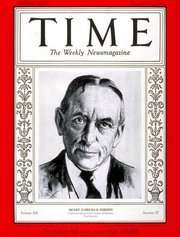
Died This Day: Henry Fairfield Osborn
August 8, 1857 - November 6, 1935
Osborn graduated at Princeton in 1877 and pursued his interest in the biological sciences and paleontology through additional study at several New York City medical schools and with Thomas Henry Huxley in Britain.
Returning to the United States, Osborn accepted a position at Princeton, teaching natural sciences from 1881 until 1891, when he moved to Columbia University to organize the Biology Department there, and in 1891, he also helped to organize the Department of Vertebrate Paleontology at the American Museum of Natural History acting as it’s first curator. Osborn's close association with American Museum continued for over 45 years, and included a long tenure as its President, 1908-1933. During these years the museum's collections expanded enormously and it became one of the preeminent research institutions for natural history in the world.
Osborn is noted for describing and naming both Tyrannosaurus rex and Albertosaurus in 1905, Pentaceratops in 1923, and Velociraptor in 1924. One of Osborn's favorite groups for study was the brontotheres, and he was the first to carry out comprehensive research on them. He also wrote an influential textbook, The Age of Mammals (1910).
Apart from his own research, Osborn is perhaps best remembered for the sponsorship of the five immensely successful Central Asiatic Expeditions during the 1920's and 30's led by Roy Chapman Andrews.
Entry from HERE and HERE.
Osborn graduated at Princeton in 1877 and pursued his interest in the biological sciences and paleontology through additional study at several New York City medical schools and with Thomas Henry Huxley in Britain.
Returning to the United States, Osborn accepted a position at Princeton, teaching natural sciences from 1881 until 1891, when he moved to Columbia University to organize the Biology Department there, and in 1891, he also helped to organize the Department of Vertebrate Paleontology at the American Museum of Natural History acting as it’s first curator. Osborn's close association with American Museum continued for over 45 years, and included a long tenure as its President, 1908-1933. During these years the museum's collections expanded enormously and it became one of the preeminent research institutions for natural history in the world.Osborn is noted for describing and naming both Tyrannosaurus rex and Albertosaurus in 1905, Pentaceratops in 1923, and Velociraptor in 1924. One of Osborn's favorite groups for study was the brontotheres, and he was the first to carry out comprehensive research on them. He also wrote an influential textbook, The Age of Mammals (1910).
Apart from his own research, Osborn is perhaps best remembered for the sponsorship of the five immensely successful Central Asiatic Expeditions during the 1920's and 30's led by Roy Chapman Andrews.
Entry from HERE and HERE.
Thursday, November 05, 2009
Proceratosaurus bradleyi
Cranial osteology and phylogenetic position of the theropod dinosaur Proceratosaurus bradleyi (Woodward, 1910) from the Middle Jurassic of England. 2009. O. Rauhut, et a. Zool. J. Linn. Soc. Published Online: 4 Nov 2009

ABSTRACT: The cranial osteology of the small theropod dinosaur Proceratosaurus from the Bathonian of Minchinhampton, England, is described in detail, based on new preparation and computed tomography (CT) scan images of the type, and only known, specimen.
Proceratosaurus is an unusual theropod with markedly enlarged external nares and a cranial crest starting at the premaxillary–nasal junction. The skull is highly pneumatic, with pneumatized nasals, jugals, and maxillae, as well as a highly pneumatic braincase, featuring basisphenoid, anterior tympanic, basipterygoid, and carotid recesses. The dentition is unusual, with small premaxillary teeth and much larger lateral teeth, with a pronounced size difference of the serrations between the mesial and distal carina. The first dentary tooth is somewhat procumbent and flexed anteriorly.
Phylogenetic analysis places Proceratosaurus in the Tyrannosauroidea, in a monophyletic clade Proceratosauridae, together with the Oxfordian Chinese taxon Guanlong. The Bathonian age of Proceratosaurus extends the origin of all clades of basal coelurosaurs back into the Middle Jurassic, and provides evidence for an early, Laurasia-wide, dispersal of the Tyrannosauroidea during the late Middle to Late Jurassic. link
Born This Day: J.B.S. Haldane
Haldane (Nov. 5, 1892 - Dec. 1, 1964) is best remembered along with E. B. Ford and R. A. Fisher one of the three major figures to develop the mathematical theory of population genetics. His greatest contribution was in a series of ten papers on "A Mathematical Theory of Natural and Artificial Selection" which was the major series of papers on the
mathematical theory of natural selection. It treated many major cases for the first time, showing the direction and rates of changes of gene frequencies. It also pioneered in investigating the interaction of natural selection with mutation and with migration.
Haldane's book, The Causes of Evolution (1932), summarized these results, especially in its extensive appendix. This body of work was a component of what came to be known as the "modern evolutionary synthesis", re-establishing natural selection as the premier mechanism of evolution by explaining it in terms of the mathematical consequences of Mendelian genetics. From Wikipedia. More info here.
mathematical theory of natural selection. It treated many major cases for the first time, showing the direction and rates of changes of gene frequencies. It also pioneered in investigating the interaction of natural selection with mutation and with migration.Haldane's book, The Causes of Evolution (1932), summarized these results, especially in its extensive appendix. This body of work was a component of what came to be known as the "modern evolutionary synthesis", re-establishing natural selection as the premier mechanism of evolution by explaining it in terms of the mathematical consequences of Mendelian genetics. From Wikipedia. More info here.
Died This Day: Alfred Sherwood Romer
Dec. 28, 1894 – Nov. 5, 1973
”Romer was director of the Museum of Comparative Zoology at Harvard University until his retirement in 1961 and was one the singularly most influential vertebrate paleontologists of the 20th Century. His work ranged over virtually every
conceivable subject within that field, although it was the osteology and taxonomy of the therapsids and other proto-mammals which was nearest his heart.
In addition to this work, Romer was acutely interested in the origin and initial adaptive radiation of tetrapods, and his work became the basis for a theory of tetrapod origins which was canon until the description of Acanthostega gunnari by Clack & Coates in the 1990s. Romer was ahead of his time in his defense of monophyly of Dinosauria though he did feel that Theropoda was not ancestral to birds.” link from EvoWiki.org
Romer’s book, Vertebrate Paleontology (1966), was for many years THE textbook on VP and is still well worth picking up. One of Romer’s students, Bob Carroll, wrote an updated version entitled, ‘Vertebrate Paleontology and Evolution’, in 1987. image
”Romer was director of the Museum of Comparative Zoology at Harvard University until his retirement in 1961 and was one the singularly most influential vertebrate paleontologists of the 20th Century. His work ranged over virtually every
conceivable subject within that field, although it was the osteology and taxonomy of the therapsids and other proto-mammals which was nearest his heart.In addition to this work, Romer was acutely interested in the origin and initial adaptive radiation of tetrapods, and his work became the basis for a theory of tetrapod origins which was canon until the description of Acanthostega gunnari by Clack & Coates in the 1990s. Romer was ahead of his time in his defense of monophyly of Dinosauria though he did feel that Theropoda was not ancestral to birds.” link from EvoWiki.org
Romer’s book, Vertebrate Paleontology (1966), was for many years THE textbook on VP and is still well worth picking up. One of Romer’s students, Bob Carroll, wrote an updated version entitled, ‘Vertebrate Paleontology and Evolution’, in 1987. image
Tuesday, November 03, 2009
Paleo Video: A Modern Day Dinosaur Extinction
As a follow up to the previous posting, here's a video by Jennifer Skene about the pachycephalosaurid research done by Jack Horner and Mark Goodwin.
Just for the record, I agree with their assessment of Dracorex being a juvenile Stygimoloch, but I'm not as convinced that both taxa are referable to Pachycephalosaurus.
Sunday, November 01, 2009
Dracorex and Stygimoloch = Juvenile Pachycephalosaurus
Extreme Cranial Ontogeny in the Upper Cretaceous Dinosaur Pachycephalosaurus. 2009. J. Horner and M. Goodwin. PLoS ONE 4(10): e7626.
Abstract [edit]: Dracorex hogwartsia (juvenile) and Stygimoloch spinifer (subadult) are reinterpreted as younger growth stages of Pachycephalosaurus wyomingensis (adult). This synonymy reduces the number of pachycephalosaurid taxa from the Upper Cretaceous of North America and demonstrates the importance of cranial ontogeny in evaluating dinosaur diversity and taxonomy. These growth stages reflect a continuum rather than specific developmental steps defined by “known” terminal morphologies.
The ontogenetically oldest adult, AMNH 1696, in (A) dorsal and (B) right lateral views. A younger adult, UCMP 556078 (cast) with inflation of the frontoparietal dome+lateral cranial elements and mature nasal and squamosal nodal ornamentation in (C) dorsal and (D) right lateral views. MPM 8111, a partial skull of “” in (E) dorsal and (F) left lateral views (reversed) illustrates the high narrow frontoparietal dome, squamosal nodes and horns characteristic of the subadult growth stage. Landmarks on the dorsal skull of MPM 8111 in orange (anterior) and red (posterior) constrain the position of the dome. The youngest growth stage in this cranial ontogenetic series is “Dracorex”, TCNI 2004.17.1 (cast) in (G) dorsal and (H) right lateral views. The position of the squamosal horns and nasal nodes are consistent in these four pachycephalosaurid skulls, which increase in overall length and size from youngest (G,H) to oldest (A,B). Scale bar is 5 cm.
Born This Day: Gavin de Beer
de Beer (Nov. 1, 1899 – June 21, 1972) was
an English zoologist and morphologist who contributed to experimental embryology, anatomy, and evolution. He refuted the germ-layer theory and developed the concept of paedomorphism - the retention of juvenile characteristics of ancestors in mature adults).
From examination of the fossil
Archaeopteryx, De Beer proposed mosaic evolution with piecemeal evolutionary changes to explain the combination of bird and reptile features.
From Today In Science History.
an English zoologist and morphologist who contributed to experimental embryology, anatomy, and evolution. He refuted the germ-layer theory and developed the concept of paedomorphism - the retention of juvenile characteristics of ancestors in mature adults).From examination of the fossil
Archaeopteryx, De Beer proposed mosaic evolution with piecemeal evolutionary changes to explain the combination of bird and reptile features.
From Today In Science History.
Born This Day: Alfred Wegener
Nov. 1, 1880 – Nov, 1930
From Today In Science History:
Visit The Paleomap Project
Alfred Lothar Wegener was a German meteorologist and geophysicist who first gave a well-developed hypothesis of continental drift. He suggested (1912) that about 250 million yrs ago all the present-day continents came from a single primitive land mass, the supercontinent Pangaea, which eventually broke up and gradually drifted apart. (A similar idea was proposed earlier by F.B. Taylor in 1910.) Others saw the fit of coastlines of South America and Africa, but Wegener added more geologic and paleontologic evidence that these two continents were once joined.
Subscribe to:
Posts (Atom)