Julie starred as Kay Lawrence in The Creature From The Black Lagoon (1954). Adams has had a long career in films and TV, recently appearing on 'Lost'.
Saturday, October 17, 2009
Happy Birthday to Julie Adams
Julie starred as Kay Lawrence in The Creature From The Black Lagoon (1954). Adams has had a long career in films and TV, recently appearing on 'Lost'.
Friday, October 16, 2009
Dr. Stephen Gatesy Talks on T. rex Locomotion at the CMNH Tonight
For the last 15 years, Dr. Stephen Gatesy, associate professor of biology at Brown University specializing in paleontology and evolutionary functional morphology, has used 3-D animation software to visualize and analyze bipedal locomotion in carnivorous dinosaurs like Tyrannosaurus rex.
He served as a scientific advisor for the American Museum of Natural History exhibition Dinosaurs: Ancient Fossils, New Discoveries now on at the CMNH. Gatesy will discuss the process and problems in reconstructing tyrannosaur locomotion and present his research on fossil footprints and the origins of bird flight.
For more information click here.

© Stephen Gatesy, Brown University
Watch Steve (and others) discusses dinosaur trackways [in Real Player]
Did 'Shiva' Crater In India Doom The Dinosaurs?
A mysterious basin off the coast of India could be the largest, multi-ringed impact crater the world has ever seen. And if a new study is right, it may have been responsible for killing the dinosaurs off 65 million years ago.
Three-dimensional reconstruction of the submerged Shiva crater (~500 km diameter) at the Mumbai Offshore Basin, western shelf of India from different cross-sectional and geophysical data. The overlying 4.3-mile-tick Cenozoic strata and water column were removed to show the morphology of the crater.“If we are right, this is the largest crater known on our planet,” Chatterjee said. “A bolide of this size, perhaps 40 kilometers (25 miles) in diameter creates its own tectonics.”
By contrast, the object that struck the Yucatan Peninsula, and is commonly thought to have killed the dinosaurs was between 8 and 10 km wide.
It's hard to imagine such a cataclysm. But if the team is right, the Shiva impact vaporized Earth's crust at the point of collision, leaving nothing but ultra-hot mantle material to well up in its place. It is likely that the impact enhanced the nearby Deccan Traps volcanic eruptions that covered much of western India. What's more, the impact broke the Seychelles islands off of the Indian tectonic plate, and sent them drifting toward Africa.
The geological evidence is dramatic. Shiva's outer rim forms a rough, faulted ring some 500 km in diameter, encircling the central peak, known as the Bombay High, which would be 3 miles tall from the ocean floor (about the height of Mount McKinley). Most of the crater lies submerged on India's continental shelf, but where it does come ashore it is marked by tall cliffs, active faults and hot springs. The impact appears to have sheared or destroyed much of the 30-mile-thick granite layer in the western coast of India.
Sankar Chatterjee will present his research at this month's Annual Meeting of the Geological Society of America in Portland, Oregon. link
Thursday, October 15, 2009
Happy 100th Birthday to Harry Redmond Jr.: The Last Survivor of Skull Island!
In last January's Video Watchdog, Mark F. Berry interviewed the last surviving member of the original KING KONG's special effects unit, who also told tales about his special effects pioneer father and how they devised the cinematic illusions for She, The Last Days of Pompeii, Lost Horizon and many other Classics. Mark also presented some previously unseen photos from the set of King Kong.
Mark is also the author of The Dinosaur Filmography that you can buy here or here
Darwinopterus: New Chinese Pterosaur
Evidence for modular evolution in a long-tailed pterosaur with a pterodactyloid skull. 2009. Junchang Lü, et al. Prod. Royal Soc. B., published online before print October 14.
Abstract: The fossil record is a unique source of evidence for important evolutionary phenomena such as transitions between major clades. Frustratingly, relevant fossils are still comparatively rare, most transitions have yet to be documented in detail and the mechanisms that underpin such events, typified by rapid large scale changes and for which microevolutionary processes seem insufficient, are still unclear.
A new pterosaur (Mesozoic flying reptile) from the Middle Jurassic of China, Darwinopterus modularis gen. et sp. nov., provides the first insights into a prominent, but poorly understood transition between basal, predominantly long-tailed pterosaurs and the more derived, exclusively short-tailed pterodactyloids.
Darwinopterus exhibits a remarkable ‘modular’ combination of characters: the skull and neck are typically pterodactyloid, exhibiting numerous derived character states, while the remainder of the skeleton is almost completely plesiomorphic and identical to that of basal pterosaurs. This pattern supports the idea that modules, tightly integrated complexes of characters with discrete, semi-independent and temporally persistent histories, were the principal focus of natural selection and played a leading role in evolutionary transitions.
Read the story at National Geographic News.
On This Day: Charles Darwin Accepted into Cambridge
In 1827, Charles Darwin was accepted into Christ's College at Cambridge, but did not start until winter term because he needed to catch up on some of his studies. A grandson of Erasmus Darwin of Lichfield, and of Josiah Wedgwood, he had entered the University of Edinburgh in 1825 to study medicine, intending to follow his father Robert's career as a doctor. However, Darwin found himself unenthusiastic about his studies, including that of geology.
Disappointing his family that he gave up on a medical career, he left Edinburgh without graduating in April 1827. His scholastic achievements at Cambridge were unremarkable, but after graduation. Today Cambridge has Darwin College, founded in 1964, for advanced study that only admits postgraduate students. From Today In Science History
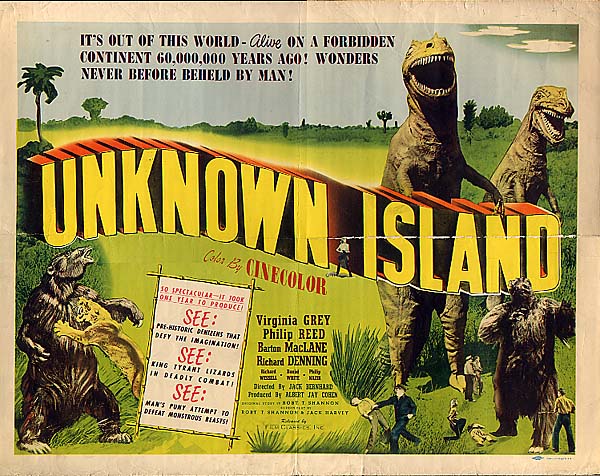
Debuted This Day (1948): Unknown Island
Written by Robert T. Shannon and directed by Bernhard, this ridiculaous little film features some of the worst ‘man dressed up as a T. rex’ effects ever. Not a bad little story though.
Wednesday, October 14, 2009
Born This Day: Jack Arnold

Jack Arnold (Oct. 14, 1916 - March 17, 1992) directed a number of classic SF films including The Creature From the Black Lagoon, Revenge of the Creature, The Incredible Shrinking Man, and It Came From Outer Space, as well as few not-so-classics (but still much loved) such as Monster on Campus. Throughout the ‘60’s and into the early 80’s he had a successful career as a TV producer and director.
Monday, October 12, 2009
Estimating the Sauropod Genome
Sauropod dinosaurs evolved moderately sized genomes unrelated to body size. 2009. C. Organ, et al. Proc. Royal. Soc. B. published online before print September 30.
Abstract: Sauropodomorph dinosaurs include the largest land animals to have ever lived, some reaching up to 10 times the mass of an African elephant. Despite their status defining the upper range for body size in land animals, it remains unknown whether sauropodomorphs evolved larger-sized genomes than non-avian theropods, their sister taxon, or whether a relationship exists between genome size and body size in dinosaurs, two questions critical for understanding broad patterns of genome evolution in dinosaurs.
Here we report inferences of genome size for 10 sauropodomorph taxa. The estimates are derived from a Bayesian phylogenetic generalized least squares approach that generates posterior distributions of regression models relating genome size to osteocyte lacunae volume in extant tetrapods. We estimate that the average genome size of sauropodomorphs was 2.02 pg (range of species means: 1.77–2.21 pg), a value in the upper range of extant birds (mean = 1.42 pg, range: 0.97–2.16 pg) and near the average for extant non-avian reptiles (mean = 2.24 pg, range: 1.05–5.44 pg). The results suggest that the variation in size and architecture of genomes in extinct dinosaurs was lower than the variation found in mammals.
A substantial difference in genome size separates the two major clades within dinosaurs, Ornithischia (large genomes) and Saurischia (moderate to small genomes). We find no relationship between body size and estimated genome size in extinct dinosaurs, which suggests that neutral forces did not dominate the evolution of genome size in this group.
Dinosaurs: Ancient Fossils, New Discoveries Opens at CMNH
The Cleveland Museum of Natural History is pleased to announce the opening of Dinosaurs: Ancient Fossils, New Discoveries, running until Jan. 31, 2010.

The exhibit focuses on current thinking about how dinosaur biology has evolved and changed dramatically over the past two decades, and highlights ongoing cutting-edge research by leading paleontologists around the world.
Highlights include a T. rex skeleton and a reconstruction of China’s famous ‘feathered dinosaur’ locality, complete with fleshed out models.
For more info click HERE
Qiaowanlong: New Asian Brachiosaurid
The first well-preserved Early Cretaceous brachiosaurid dinosaur in Asia. 2009. H.-L. You and D.-Q Li. Proc. R. Soc. B 276: 4077-4082.
Abstract: A new genus and species of brachiosaurid sauropods, Qiaowanlong kangxii gen. et sp. nov., is reported, representing the first well-preserved Early Cretaceous brachiosaurid in Asia and expanding the distribution of brachiosaurids undoubtedly into the Asian continent.
The new taxon was recovered from the late Early Cretaceous Xinminpu Group of Yujingzi Basin in northwestern Gansu Province, China, and is represented by a series of eight mid-cervical vertebrae, a right pelvic girdle and some unidentified bones.
The existence of deeply excavated cervical neural spines and a rising transition in the neural spine height among mid-cervical vertebrae clearly show the affinity of Qiaowanlong as a member of brachiosaurids.
Among brachiosaurids, Qiaowanlong shares a derived feature with the North American Early Cretaceous brachiosaurid Sauroposeidon: the lack of cranial centrodiapophyseal lamina. However, Qiaowanlong is unique in possessing a suite of features, such as a low central length/cotyle height ratio, bifurcated cervical neural spines and a much reduced ischium.
The discovery of Qiaowanlong and other new material indicates a diverse and abundant sauropod assemblage in China during the Early Cretaceous.
Friday, October 09, 2009
Evolution of the Middle Ear
Evolutionary Development of the Middle Ear in Mesozoic Therian Mammals. 2009. Q. Ji, et al. Science 326: 278 – 281.
Abstract: The definitive mammalian middle ear (DMME) is defined by the loss of embryonic Meckel’s cartilage and disconnection of the middle ear from the mandible in adults. It is a major feature distinguishing living mammals from nonmammalian vertebrates.
We report a Cretaceous trechnotherian mammal with an ossified Meckel’s cartilage in the adult, showing that homoplastic evolution of the DMME occurred in derived therian mammals, besides the known cases of eutriconodonts. The mandible with ossified Meckel’s cartilage appears to be paedomorphic. Reabsorption of embryonic Meckel’s cartilage to disconnect the ear ossicles from the mandible is patterned by a network of genes and signaling pathways.
This fossil suggests that developmental heterochrony and gene patterning are major mechanisms in homplastic evolution of the DMME.
Archaeopteryx Grew Like a Dinosaur
Was dinosaurian physiology inherited by birds? – Reconciling slow growth in Archaeopteryx. 2009. G. Erickson, et al. PLoS ONE 4(10): e7390.
The bone types for the early birds Archaeopteryx, Jeholornis, and Sapeornis are comparable to those of same-sized dinosaurs. The opposite pattern holds for more advanced bird fossils such as the roughly 94 million-year-old Ichthyornis from North America. The bone is well-vascularized, which means that it was well-supplied with blood vessels (below), and the bone structure is woven, with randomly oriented bone fibers, indicating fast growth with no annual growth lines. This is the bone histology of modern birds.
Additional information came from physical examination of more than half of the Archaeopteryx specimens. Although the young Munich specimen did not have growth lines (a characteristic marker of annual growth in dinosaurs), both the larger London and Solnhofen specimens have peeling or delaminating bone suggestive of the presence of growth lines. This means that this animal grew for more than a year and that growth ceased for part of each year as is typical of small non-avian dinosaurs. Jeholornis and Sapeornis fossils also have growth lines that suggest they grew for more than a year. All of these traits point to a more reptilian growth pattern than seen in living birds.
The team outlines a growth curve (above) that indicates that Archaeopteryx reached adult size in about 970 days, that none of the known Archaeopteryx specimens are adults (confirming previous speculation), and that adult Archaeopteryx were probably the size of a raven, much larger than previously thought.
The first Archaeopteryx skeleton was found in Germany about the same time Darwin's Origin of Species was published. This was a fortuitously-timed discovery: because the fossil combined bird-like (feathers and a wishbone) and reptilian (teeth, three fingers on hands, and a long bony tail) traits, it helped convince many about the veracity of evolutionary theory. In fact, the first suggestion that birds are related to dinosaurs was made by early proponent of evolution Thomas Henry Huxley in the 1860's. Ten skeletons and an isolated feather have been found.
"Archaeopteryx had comparable metabolism to closely related Velociraptor," says Norell. "Although the genealogy of birds is well understood, the genesis of modern bird biology has been a huge mystery. We knew that they are a kind of dinosaur, but we now know that the transition into true birds—physiologically and metabolically—happened well after Archaeopteryx."
Adds Erickson: "We show that avian flight was achieved with the physiology of a dinosaur." link
New research shows that Archaeopteryx grew much slower than living birds and more like non-avian dinosaurs. This means rapid bone growth—long thought a prerequisite for flight—was not necessary for taking to the air.250-micron chips (below) from the long bones were taken from the Munich Archaeopteryx (above) as well as Jeholornis prima, a long-tailed specimen considered an early bird, and the short-tailed Sapeornis chaochengensi. The researchers also sampled the closest relatives among dinosaurs to the birds including Velociraptor and miniaturized species such as Mahakala omnogova that is similar in size to Archaeopteryx.
The bone types for the early birds Archaeopteryx, Jeholornis, and Sapeornis are comparable to those of same-sized dinosaurs. The opposite pattern holds for more advanced bird fossils such as the roughly 94 million-year-old Ichthyornis from North America. The bone is well-vascularized, which means that it was well-supplied with blood vessels (below), and the bone structure is woven, with randomly oriented bone fibers, indicating fast growth with no annual growth lines. This is the bone histology of modern birds.
Additional information came from physical examination of more than half of the Archaeopteryx specimens. Although the young Munich specimen did not have growth lines (a characteristic marker of annual growth in dinosaurs), both the larger London and Solnhofen specimens have peeling or delaminating bone suggestive of the presence of growth lines. This means that this animal grew for more than a year and that growth ceased for part of each year as is typical of small non-avian dinosaurs. Jeholornis and Sapeornis fossils also have growth lines that suggest they grew for more than a year. All of these traits point to a more reptilian growth pattern than seen in living birds.
The team outlines a growth curve (above) that indicates that Archaeopteryx reached adult size in about 970 days, that none of the known Archaeopteryx specimens are adults (confirming previous speculation), and that adult Archaeopteryx were probably the size of a raven, much larger than previously thought.
The first Archaeopteryx skeleton was found in Germany about the same time Darwin's Origin of Species was published. This was a fortuitously-timed discovery: because the fossil combined bird-like (feathers and a wishbone) and reptilian (teeth, three fingers on hands, and a long bony tail) traits, it helped convince many about the veracity of evolutionary theory. In fact, the first suggestion that birds are related to dinosaurs was made by early proponent of evolution Thomas Henry Huxley in the 1860's. Ten skeletons and an isolated feather have been found.
"Archaeopteryx had comparable metabolism to closely related Velociraptor," says Norell. "Although the genealogy of birds is well understood, the genesis of modern bird biology has been a huge mystery. We knew that they are a kind of dinosaur, but we now know that the transition into true birds—physiologically and metabolically—happened well after Archaeopteryx."
Adds Erickson: "We show that avian flight was achieved with the physiology of a dinosaur." link
Thursday, October 08, 2009
Loyal Alligators Display the Mating Habits of Birds
Multiyear multiple paternity and mate fidelity in the American alligator, Alligator mississippiensis. 2009. S.L. Lance, et al. Molecular Ecology Published Online 5 Oct 2009.
Alligators display the same loyalty to their mating partners as birds. The ten-year-study by scientists from the Savannah River Ecology Laboratory reveals that up to 70% of females chose to remain with their partner, often for many years.
While the females move freely through male territories, leading to high mate encounter rates, this study reveals that many alligators choose to mate with the same partner over many mating seasons. This amounts to the first evidence for partial mate fidelity in any crocodilian species and reveals a similarity in mating patterns between alligators and bird species.
"Given how incredibly open and dense the alligator population is at RWR we didn't expect to find fidelity," said Lance. "To actually find that 70% of our re-trapped females showed mate fidelity was really incredible. I don't think any of us expected that the same pair of alligators that bred together in 1997 would still be breeding together in 2005 and may still be producing nests together to this day."
Crocodilians are the sole surviving reptilian archosaurs, a group of ancient reptiles that includes dinosaurs and gave rise to birds. It is this evolutionary relationship to birds which means crocodilians are in a unique phylogenetic position to provide information about the ancestral mating systems of both birds and many dinosaurs. link
Wednesday, October 07, 2009
Dynamic Dinosaur Locomotion Realed from Trackway
Dynamic locomotor capabilities revealed by early dinosaur trackmakers from southern Africa. 2009. J. Wilson, et al. PLoS ONE 4(10): e7331.
When they analyzed the tracks, the researchers determined that ornithischians changed their way of walking as surface conditions changed. In the river bed, they crouched low, adopted a sprawling four-legged stance, and crept along flat-footed, dragging their feet. On the slope, they narrowed their stance, still walking on all fours, but picking up their feet. Once they reached the flat, stable ground on top, they switched to walking on two legs.
In contrast, the theropod that crossed the surface didn't vary its posture or gait. Remaining upright on two legs, it used claws on its toes to grip slippery surfaces.
The different walking styles also foreshadow evolutionary trends in the two dinosaur lines, Wilson said. Three separate times in their evolutionary history, ornithischians switched from walking mainly on two legs to walking exclusively on all four.
"It was thought that early in their evolutionary history, they had the capacity to do both, but at Moyeni they were caught in the act, and we can analyze how and perhaps why they did it," Marsicano said.
Theropods, on the other hand, never gave up their two-legged stance. But because their lineage is believed to have given rise to birds, the possibility that their gripping claws played a key role is interesting to consider. link
A new investigation of a fossilized tracksite in southern Africa shows how early dinosaurs made on-the-fly adjustments to their movements to cope with slippery and sloping terrain.The Moyeni tracksite in Lesotho contains more than 250 footprints made by a variety of four-legged animals near the beginning of the Jurassic Period (about 200 million years ago).
When they analyzed the tracks, the researchers determined that ornithischians changed their way of walking as surface conditions changed. In the river bed, they crouched low, adopted a sprawling four-legged stance, and crept along flat-footed, dragging their feet. On the slope, they narrowed their stance, still walking on all fours, but picking up their feet. Once they reached the flat, stable ground on top, they switched to walking on two legs.
In contrast, the theropod that crossed the surface didn't vary its posture or gait. Remaining upright on two legs, it used claws on its toes to grip slippery surfaces.
The different walking styles also foreshadow evolutionary trends in the two dinosaur lines, Wilson said. Three separate times in their evolutionary history, ornithischians switched from walking mainly on two legs to walking exclusively on all four.
"It was thought that early in their evolutionary history, they had the capacity to do both, but at Moyeni they were caught in the act, and we can analyze how and perhaps why they did it," Marsicano said.
Theropods, on the other hand, never gave up their two-legged stance. But because their lineage is believed to have given rise to birds, the possibility that their gripping claws played a key role is interesting to consider. link
More nice work by CMNH Research Associate, Jeff Wilson.
Tuesday, October 06, 2009
Alioramus altai: New Asian Tyrannosaur
A long-snouted, multihorned tyrannosaurid from the Late Cretaceous of Mongolia. 2009. S. Brussatte, et al. PNAS published online before print October 5, 2009
CT scans of the braincase show the large air sacks, huge olfactory bulbs, and the small inner ear expected for a tyrannosaur. Analysis of bone microstructure determined that the animal died as a nine year old, essentially a teenager at 85% of its adult size. link
The new Alioramus altai—a horned, long-snouted, gracile cousin of Tyrannosaurus rex—shared the same environment with larger, predatory relatives.The new specimen and species, A. altai, was found on a 2001 Museum expedition to the Gobi Desert of Mongolia led by Norell and Michael Novacek. In fact, it was found at the same site as a Tarbosaurus fossil. But although its skeleton is anatomically similar to this larger relative, A. altai is half the size; the reconstructed size is about 369 kg. Its teeth are slender, the skull has small and weak muscle attachments, and the skull has a long snout with eight horns that were probably about five inches in length, features never seen in a tyrannosaur before.
CT scans of the braincase show the large air sacks, huge olfactory bulbs, and the small inner ear expected for a tyrannosaur. Analysis of bone microstructure determined that the animal died as a nine year old, essentially a teenager at 85% of its adult size. link
Died This Day: Goerge Gaylord Simpson
June 16, 1902 - October 6, 1984
From Today In Science History:
Simpson is known for his contributions to evolutionary theory and to the
understanding of intercontinental migrations of animal species in past geological times. Simpson specialized in early fossil mammals, leading expeditions on four continents and discovering in 1953 the 50-million-year old fossil skulls of dawn horses in Colorado.
Simpson helped develop the modern biological theory of evolution, drawing on paleontology, genetics, ecology, and natural selection to show that evolution occurs as a result of natural selection operating in response to shifting environmental conditions. He spent most of his career as a paleontologist at the American Museum of Natural History. image.
From Today In Science History:
Simpson is known for his contributions to evolutionary theory and to the
understanding of intercontinental migrations of animal species in past geological times. Simpson specialized in early fossil mammals, leading expeditions on four continents and discovering in 1953 the 50-million-year old fossil skulls of dawn horses in Colorado.Simpson helped develop the modern biological theory of evolution, drawing on paleontology, genetics, ecology, and natural selection to show that evolution occurs as a result of natural selection operating in response to shifting environmental conditions. He spent most of his career as a paleontologist at the American Museum of Natural History. image.
Monday, October 05, 2009
Ardipithecus ramidus
Ardipithecus ramidus and the Paleobiology of Early Hominids. 2009. T. D. White, et al. Science 326: 75-86.

Abstract: Hominid fossils predating the emergence of Australopithecus have been sparse and fragmentary. The evolution of our lineage after the last common ancestor we shared with chimpanzees has therefore remained unclear. Ardipithecus ramidus, recovered in ecologically and temporally resolved contexts in Ethiopia’s Afar Rift, now illuminates earlier hominid paleobiology and aspects of extant African ape evolution.
More than 110 specimens recovered from 4.4-million-year-old sediments include a partial skeleton with much of the skull, hands, feet, limbs, and pelvis. This hominid combined arboreal palmigrade clambering and careful climbing with a form of terrestrial bipedality more primitive than that of Australopithecus. Ar. ramidus had a reduced canine/premolar complex and a little-derived cranial morphology and consumed a predominantly C3 plant–based diet (plants using the C3 photosynthetic pathway).
Its ecological habitat appears to have been largely woodland-focused. Ar. ramidus lacks any characters typical of suspension, vertical climbing, or knuckle-walking. Ar. ramidus indicates that despite the genetic similarities of living humans and chimpanzees, the ancestor we last shared probably differed substantially from any extant African ape. Hominids and extant African apes have each become highly specialized through very different evolutionary pathways.
This evidence also illuminates the origins of orthogrady, bipedality, ecology, diet, and social behavior in earliest Hominidae and helps to define the basal hominid adaptation, thereby accentuating the derived nature of Australopithecus.
Science has 11 articles about the new hominid.
Kudos to Cleveland Museum of Natural History staff who were involved with the new find: Head of Physical Anthroplogy, Yohannes Haile-Selassie; former Director, Bruce Latimer; and PA research Associate, Scott Simpson.Watch the video from Science.
Samson Fails to Sell
A few weeks ago I noted that "Samson", a T. rex that had been loaned to the Carnegie Museum by its owner, had been put up for auction. Apparently it failed to sell.
Bouncing Back from the K/T Extinction
Rapid Resurgence of Marine Productivity After the Cretaceous-Paleogene Mass Extinction. 2009. J. Sepúlveda, et al. Science 326: 129-132.
The findings provide observational evidence supporting models suggesting that global darkness after the impact was rather short. "Primary productivity came back quickly, at least in the environment we were studying," says Summons, referring to the near-shore environment represented by the Danish sediments.
"The atmosphere must have cleared up rapidly," he says. "People will have to rethink the recovery of the ecosystems. It can't be just the lack of food supply" that made it take so long to recover. link
Researchers have found that some forms of microscopic marine life — the so called "primary producers," or photosynthetic organisms such as algae and cyanobacteria in the ocean — recovered within about a century after the mass extinction 65 million years ago that killed off the dinosaurs . Previous research had indicated the process might have taken millions of years.The analysis clarified the sequence of events after the big impact. Immediately after the impact, certain areas of the ocean were devoid of oxygen and hostile to most algae, but close to the continent, microbial life was inhibited for only a relatively short period: in probably less than 100 years, algal productivity showed the first signs of recovery. In the open ocean, however, this recovery took much longer: previous studies have estimated that the global ocean ecosystem did not return to its former state until 1 to 3 million years following the impact.
The findings provide observational evidence supporting models suggesting that global darkness after the impact was rather short. "Primary productivity came back quickly, at least in the environment we were studying," says Summons, referring to the near-shore environment represented by the Danish sediments.
"The atmosphere must have cleared up rapidly," he says. "People will have to rethink the recovery of the ecosystems. It can't be just the lack of food supply" that made it take so long to recover. link
Subscribe to:
Posts (Atom)


.jpg)