Thursday, March 23, 2006

New Sauropod From Mongolia


Illustration by Jason Brougham

From National Geographic News:
Scientists say they have found the fossil of a new species of sauropod that had special air sacs in some of its bones to help support its massively long neck.
Living more than 100 million years ago in what is now Mongolia, the dinosaur had a 7.5-meter-long neck. The newly described species is named Erketu ellisoni. Erketu, the god of might, was one of 99 deities from pre-Buddhist Mongolian tradition.

Paleontologists Daniel T. Ksepka and Mark A. Norell of the American Museum of Natural History in New York discovered the fossil in Mongolia's Gobi desert in 2002. The partial fossil skeleton includes a single neck vertebra that measures nearly 0.6 meters in length.

This is bigger than the same vertebra found in fossils of Diplodocus —another, much larger four-legged sauropod that measured up to 27 meters in length.

Their analysis of the find is detailed in last week's issue of the museum's journal, Novitates.

Postings will continue sporatically over the next few days, depending on my access to the internet, and my recovery from emergency root canal surgery.

Tuesday, March 21, 2006

More Dinos From China

From the People’s Daily Online:

A large fossilized dinosaur has recently been discovered in Central China's Henan Province during an exploration by Chinese geologists and paleontologists. This is the first time a large dinosaur fossil has been found in Central China, Dong Zhiming, a dinosaur expert, told Xinhua on Monday.

Dong, a researcher with the Institute of Vertebrate Paleontology and Paleoanthropology of the Chinese Academy of Sciences, said that the fossilized dinosaur was a vegetarian and could be dated back to the early and middle Cretaceous period, or about 100 million years ago.

"A rib of the dinosaur we found is about 2 meters long so we can estimate that the dinosaur was more than 20 meters long," said Dong. The species of the dinosaur is yet to be determined, Dong added.

The fossilized dinosaur was found in Shaping Village, Liudian Township, Ruyang County of Henan Province. A large number of fossilized dinosaur eggs were found in Xixia County, about 100 kilometers away from the Ruyang County, more than 10 years ago.

The number of the dinosaur eggs in Xixia County accounts for half of the total in China and one third of the total around the world. However, no complete dinosaur fossil had been found in the region previously.

He Mingbo, a leader of the Liudian Township, said for many years local residents believed a kind of "dragon bone stone" could be used to treat wounds. "Many people have found such kind of 'dragon bone stones' in fields or on hills," He said.

An 85-year-old villager, surnamed Cao, said "I have broken several thousand kilograms of 'dragon bone stones' to sell as traditional medicine over the past decades. I didn't know they were such a precious thing. I'm sorry about that."

Experts said more dinosaur fossils might be found in the region. Local government has posted notices in the village explaining fossils to villagers and forbidding the stealing and selling of fossils.

Monday, March 20, 2006

UALVP


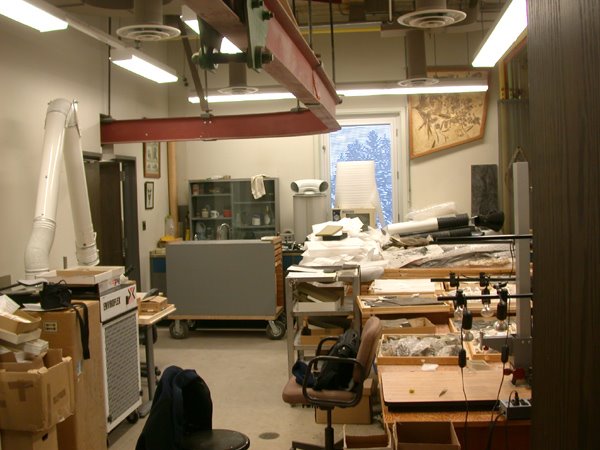
This is where I spent a long Monday photographing fossil material in one of the many rooms of the University of Alberta Laboratory for Vertebrate Palaeontology.

3D Chasmosaurus

Completely under the radar, the Canadian Museum of Nature has posted a wonderful and highly informative series of animations of one of the dinsoaurs I co-described, Chasmosaurus irvinensis, HERE.

"Here at Nature we have a special camera that can scan objects and make three-dimensional images of them. The images can then be used in such a variety of ways that the possibilities seem almost limitless. We've begun by exploring scientific hypotheses while having some fun!

Our main subject has been Chasmosaurus irvinensis, a dinosaur that lived 65 million years ago in what is now Alberta. Researchers at the CMN identified the species in 2001. This specimen is the holotype, which is the specimen upon which all future identification of other specimens is based, and it is held in our collections. You'll also see life-sized, fleshed out models of this dinosaur at our museum. These models were based on the holotype."

You can watch a series of animations of this dino walking around based upon laser scans of the individual bones of the skeleton which were then reassembled and fleshed out digitally.

You can also manipulate a 3D model of the foot based on scans of the original bones.

Sunday, March 19, 2006

Corythosaurus Pull

I’m in Edmonton at the moment helping friends dig out from the near-record snow fall. Tomorrow I head over to the University of Alberta to photograph some fossil material that Philip Currie and I are working on. Then it’s down to Drumheller to continue research at the Royal Tyrrell Museum of Palaeontology.

While I spend the evening shoveling snow enjoy these images from last summer.


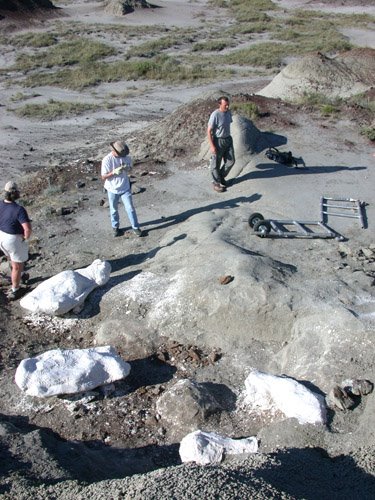
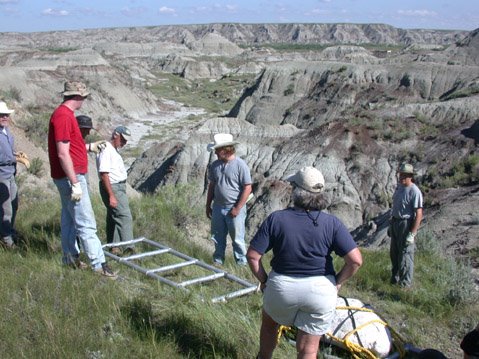
In the summer of 2005 a Corythosaurus (duck-billed dinosaur) skull was collected from quarry 246, Dinosaur Provincial Park. To get the blocks out to a place where they could be picked up by a vehicle, Dr. Don Brinkman decided to use a modification of a "palaeo-cart" first developed by then RTMP technician Kevin Kruger.


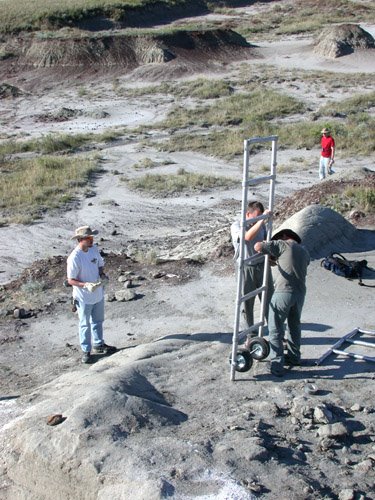
Martin Kundrat and Nick Longrich assemble the cart. It's a series of light weight, pre-assembled aluminum scaffolding bolted together, with an axle with two wheelbarrow wheels.


The first block is flipped onto the scaffolding and lashed down with mountaineering rope. That’s Nick in the middle holding the rope and Don on the right. In the back Dr. Julia Sankey (blue shirt) and Dr. Brad Belluk (in red) supervise.


After rope loops are tied for handles the 1.5 km walk out is begun.


The only major obstacle to overcome is the 30m cliff to get down. Our final destination is the just beyond the low badlands in the middle distance.


A combination of lowering and dragging the cart down the coulee wall was successful. Time to travel from quarry to truck was under 45 minutes.

Stay tuned for more updates.

All photos © Michael Ryan

Thursday, March 16, 2006

Court Dismisses Lawsuit Against Berkeley Evolution Website

From the UC Berkeley press release:
A lawsuit by a Roseville couple who claimed that a University of California, Berkeley, website used evolution to promote religion was dismissed Monday, March 13, in San Francisco federal court.


Without ruling on the merits of the suit, Judge Phyllis J. Hamilton of the U.S. District Court for the Northern District of California granted the University of California's motion to dismiss the case on the grounds that the plaintiffs lacked standing – that is, they did not have a sufficiently strong personal interest in the outcome of the case.

"We are very pleased with the judge’s decision and are hopeful that the defendants can now concentrate on helping to educate students about science," said Christopher M. Patti, university counsel with the UC Office of the President.

The lawsuit named not only two UC Berkeley professors, but also an administrator at the National Science Foundation (NSF), which partly funded the website. Judge Hamilton has yet to rule on NSF's motion to dismiss.

"The lawsuit cost us a lot of time, in terms of preparation and reviewing and Xeroxing a lot of paper, plus the legal fees," said Roy Caldwell, one of the UC Berkeley professors named in the suit. "I'm glad the court saw that the case should be dismissed."

Visit the excellent “Understanding Evolution” website.

Dinosaur Locomotion:Beyond The Bones


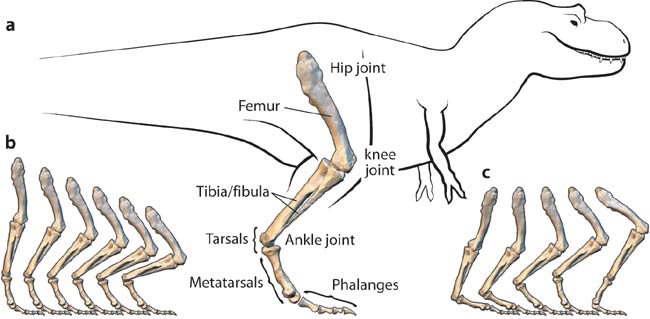
Figure 1. Basics of limb anatomy and redundant degrees of freedom in a dinosaur limb.

Scientific theory combines with Hollywood wizardry to bring dinosaurs to life in a News and Views feature in this week's Nature (but go HERE instead to John's own webpage). In films, dinosaur locomotion is a result of clever software and the artistic interpretation of special effects departments. Now scientists are using improved software tools that have a firm grounding in physical principles, rather than artistic intuition, to test their own hypotheses on how dinosaurs walked the Earth.

John Hutchinson and Stephen Gatesy present a Tyrannosaurus rex case study of how to use modern computer tools to reconstruct dinosaur movement. They focus on the problems of determining the position of the limbs - its pose - at specific instants during a stride. By using combinations of motion-based and force-based criteria, the authors are able to filter out unlikely or impossible poses and establish a motion 'starting point'. The authors demonstrate the powers of computer simulation when combined with sound scientific theory and propose its application to factors, such as feeding, in other extinct animals. They highlight the need of palaeontologists to become better functional biologists to ensure that questions on popular science don't overtake basic evidence.

From John’s web page:


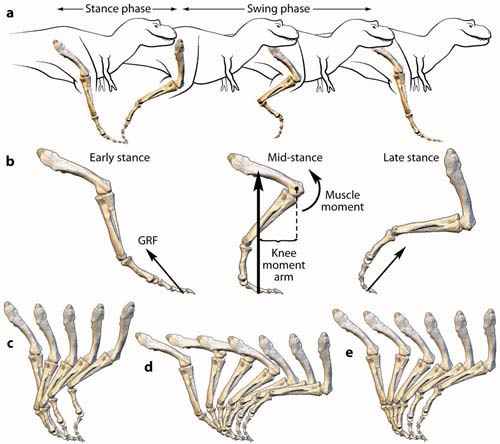
Figure 2.The stance and swing phases of a stride., and possible limb motions during stance.

What the paper DOES say:

1. Bottom Line: We critically review the many techniques used to reconstruct how dinosaurs moved. Then we take a cold hard look at increasingly popular animation and simulation methods, arguing that the best approach is not to reconstruct exactly how dinosaurs moved, but instead to use a range of criteria to exclude motions that they did NOT use.

2. Summary: We can do better than just animating dinosaur locomotion using only artistic or scientific intuition. Methods using living analogs of dinosaurs, how bone shape changes with dinosaur size (scaling), fossil footprints, functional anatomy, evolutionary analysis, and biomechanics all offer useful insights but all have their inherent limitations. A common limitation is the redundancy of the limb joints-- many poses are possible for any instant in time. Computer animation/simulation tools now can tackle any question we can think of, but they too are very limited, and sometimes these limits are overlooked. If there are thousands or millions of possible ways that any one dinosaur moved, some researchers might just choose some arbitrarily and assume these are the correct poses. We favor an approach where impossible/implausible poses are explicitly winnowed out using motion and force-based criteria. We show how this approach can be used to reveal how dinosaurs did not move, moving us progressively closer to reconstructing what kinds of motions they may have used. This approach requires extensive validation from living animals to establish constraints, and cautious sensitivity analysis of unknown parameter values.

What the paper DOES NOT say:

1. It does not give specific results on how Tyrannosaurus or other dinosaurs moved. It is more about the methods and approaches that one might use to get such results.

2. It does not say that reconstructing dinosaur locomotion is impossible, or that any one method is completely flawed. It explains that all methods have their limitations and one must be very wary of these. Animation and simulation are powerful tools, but just because something is animated, it doesn't make it physically possible or biologically plausible.

3. It does not argue that computer animation/simulation is the only method that is useful for reconstructing dinosaur locomotion. It may be the most promising method, but this promise can hide many problems. The complexity and visually seductive nature of computer graphics makes it easy to mislead viewers that there is rigorous science underlying it all. There can be, but that is far from simple to do.

Watch the videos of T. rex animations HERE.

Wednesday, March 15, 2006

Juravenator Ruffles Feathers

A new carnivorous dinosaur from the Late Jurassic Solnhofen archipelago. 2006. Ursula B. Göhlich and Luis M. Chiappe. Nature 440, 329-332.


Abstract: Small Late Jurassic theropod dinosaurs are rare worldwide. In Europe these carnivorous dinosaurs are represented primarily by only two skeletons of Compsognathus, neither of which is well preserved. Here we describe a small new theropod dinosaur from the Late Jurassic period of Schamhaupten in southern Germany. Being exquisitely preserved and complete from the snout to the distal third of the tail, the new fossil is the best-preserved predatory, non-avian dinosaur in Europe. It possesses a suite of characters that support its identification as a basal coelurosaur. A cladistic analysis indicates that the new taxon is closer to maniraptorans than to tyrannosauroids, grouping it with taxa often considered to be compsognathids. Large portions of integument are preserved along its tail. The absence of feathers or feather-like structures in a fossil phylogenetically nested within feathered theropods indicates that the evolution of these integumentary structures might be more complex than previously thought.

A 150 million-year-old fossil from southern Germany has paleontologists ruffled over how feathers arose in the line of dinosaurs that eventually produced birds.
From the Houston Chronicle comes this article:

The fossil is a juvenile carnivorous dinosaur about 2 1/2 feet long that paleontologists have named Juravenator for the Jura mountains in southern Germany where it was found.


The fossil's exceptionally well-preserved bone structure clearly puts it among feathered kin on the dinosaur family tree. Because all of its close relatives are feathered, paleontologists would expect Juravenator to follow suit.

But a small patch of skin on Juravenator's tail shows no sign of feathers. And the skin also doesn't have the follicles that are typical of feathered dinosaurs, said Luis Chiappe, director of the Dinosaur Institute at the Natural History Museum of Los Angeles County. He and Ursula B. Gohlich of the University of Munich describe the fossil in Thursday's issue of the journal Nature.

"It has a typical scaly dinosaurian skin," Chiappe said.
The paleontologists believe Juravenator's closest known relative may have been a fully feathered dinosaur from China, Sinosauropterix.

Read the rest HERE.

Tuesday, March 14, 2006

T. rex Talk At CMNH

Wednesday, March 15 at 7 pm, as part of the Curator’s Forum at the Cleveland Museum of Natural History, Dr. Michael Ryan, Curator of Vertebrate Paleontology, presents a talk entitled:

“101 Years of Tyrannosaurus rex: The Evolution of an Icon”


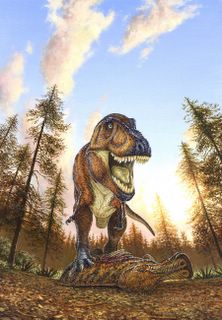
Image © Mike Skrepnick

Tyrannosaurus rex is arguably the most famous dinosaur ever discovered. First described by Henry Fairfield Osborn in 1905, it quickly caught the public's attention. More recently, the discovery and controversy surrounding the spectacular specimen "Sue" gave T. rex "dino diva" status. Dr. Michael Ryan traces T. rex's fascinating story, from its initial discovery to its present top spot in the popular imagination, by examining its evolution in the realms of science and pop-culture. Learn why T. rex is the "Tyrant King" of all dinosaurs!

Like the above image? It's the cover from "T. Rex: Hunter or Scavenger?" illustrated by Mike Skrepnick.

New Fossil Spider From Alberta

FOSSIL OONOPID SPIDERS IN CRETACEOUS AMBERS FROM CANADA AND MYANMAR. 2006. D. Penney. Palaeontology Volume 49: 229.


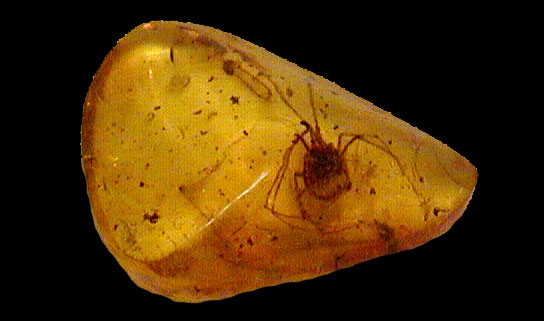
Spider from HERE(not the new species).

From Today’s Edmonton Journal:

A 75-million-year-old spider found in amber near Lethbridge has been named after Alberta. The spider, measuring only about one millimetre long, was found in the 1970s preserved in a piece of amber.

It was stored in a collection of fossils at the Royal Tyrrell Museum in Drumheller and examined in 2003 by visiting scientist David Penny of the University of Manchester, England.

The scientist determined it was a unique specimen and named in Orchestina albertensis, after the province. It is the first fossilized spider species to be identified based on a specimen from Alberta.

The new fossil species belongs to the family Oonopidae, which contains about 450 living species of small-bodied, fast-moving and nocturnal hunters. This is the first record of the family Oonopidae in Canada. Fossils of this family have also been found in New York, the Dominican Republic, Africa, Asia and Europe. No living species of this family are found in Canada, with the closest occurrences in the southern and eastern USA.

The Order Araneae, or spiders, contains approximately 40,000 living species. Spiders have a lengthy fossil record dating back 390 million years to the Middle Devonian, before the appearance of the first amphibians.

Thanks to the Digital Dream Machine Blog for this news!

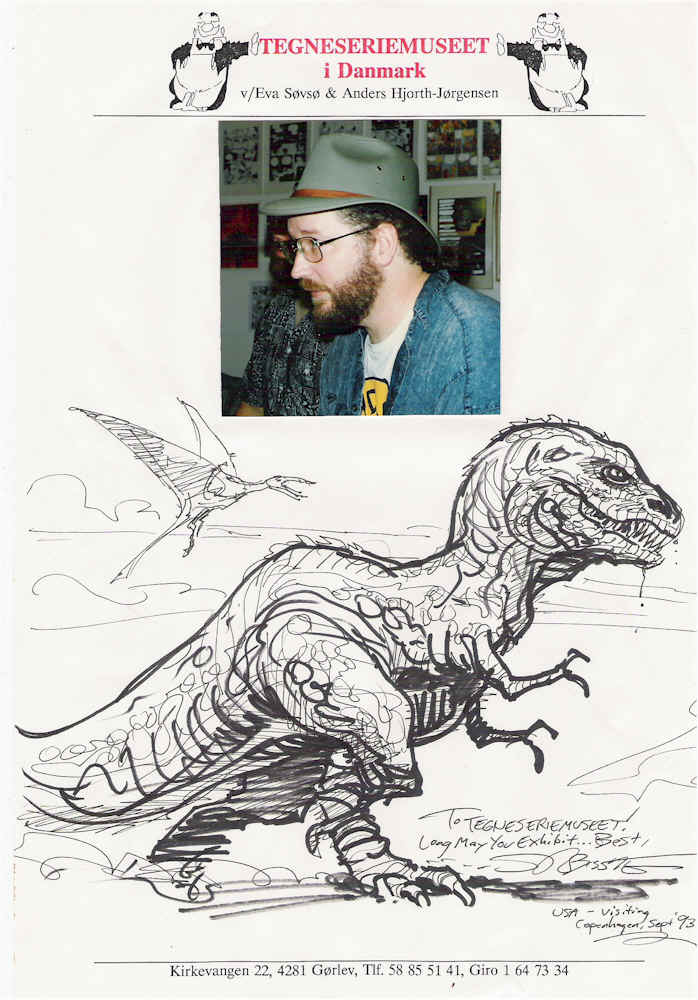
Happy Birthday: Steve Bissette


S. R. Bissette’s Tyrant is © & ® S. R. Bissette.

Steve has an always interesting blog, MyRant, that is worth a read. He features big news for Godzilla fans HERE.

Image from HERE. Visit the Wall of Fame at TEGNESERIEMUSEET I DANMARK (The Denmark Comics Museum).

Monday, March 13, 2006

Cleveland Rocks ... err, make that NYC


Released this day in 1973: Pink Floyd's "Dark Side of the Moon"

If The Rock and Roll Hall of Fame is in Cleveland why are the induction ceremonies in New York City? The Sex Pistols get the nod this year but they (ie. Mr. Lydon) are none to happy about it.

And to all my friends still asking me how I like living in Cincinatti, the last time I walked to work (today) the Cleveland Museum of Natural History is still in Cleveland.

Congratulations to Dr. Pat Druckenmiller

Pat successfully defended his Ph.D. on “something to do with plesiosaurs” today at the U of Calgary. This photo is from Pat’s days as a M.Sc. student at MSU in Bozeman.

Happy Birthday: Philip Currie


Photo of PJC in the Gobi © M. Ryan

FYI, Dr. Currie will be speaking in Calgary this Saturday at the Alberta Palaeontological Society's Annual Symposium.

Sunday, March 12, 2006

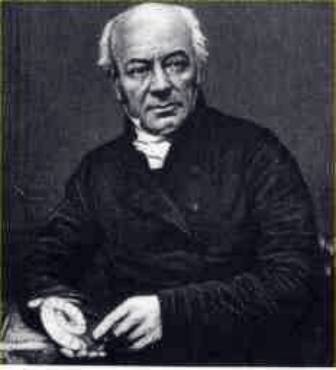
Born This Day: William Buckland

March 12, 1784 – August 15, 1856

From The Victorian Web: Buckland was the first man to identify and name a dinosaur (Megalosaurus), although the name dinosaur had not yet been coined by Richard Owen. Partly in response to the controversial works of Cuvier, Buckland wrote Reliquiae Diluvianae (1823) in which he argued that the evidence of geology alone demonstrated that a great flood had covered the entire globe. This move helped to make geology look more respectable in a religiously conservative England and perhaps to advance Buckland's own career at Oxford by making geology appear to be a respectable companion to the classics.

Buckland was a bit of an eccentric, given to outlandish dress and behavior. Although Buckland was immensely influential as a scientist, his rakish reputation gave many of his staid early Victorian contemporaries considerable difficulty in accepting his work.

More info from HERE. Image from HERE

Saturday, March 11, 2006

The Australian Museum's Support For Fossil Fish Flounders

From The Australian comes this report:
The Australian Museum (AM) is withdrawing support for a popular small regional museum despite public assurances to the contrary, local officials claim.
The Australian revealed last month that scientists and supporters of the, feared it could struggle without continued ties and scientific support from the Australian Museum in Sydney. The latest claim comes as the AM, Australia's oldest museum, considers a shift in its research priorities away from traditional fields such as paleontology and mineralogy to more "contemporary" areas.

When contacted by The Weekend Australian last month, AM assistant director and head of research and collections Les Christidis denied claims the museum was reducing support for the Age of Fishes Museum in Canowindra, near Orange in central NSW.

Although the AM provides no funding to the smaller institution, AM paleontologists such as Alex Ritchie - whose 1993 excavation at a nearby fossil site provided the inspiration for The Age of Fishes Museum - voluntarily offer scientific expertise, and AM collections manager Robert Jones advises on housing the fossils.

Dr Christidis acknowledged that monthly visits by Mr Jones would cease at the end of this year, but said the AM was providing "heaps of material and heaps of advice". He added: "There never has been an official affiliation between the two institutions."

But documents obtained by The Weekend Australian show otherwise, supporting the Age of Fishes Museum's claims that the AM is cutting back on its support.

Age of Fishes Museum manager Fiona Ferguson said she was "bitterly disappointed" by the AM's response.

Go Read A Book

The 13-strong longlist of popular science books vying for the prestigious 2006 Aventis Prize has been announced.
The award, which celebrates the very best in popular science writing, is now in its 18th year. A cash prize of £10,000 and a certain sales boost await the winner, to be announced on 16 May at a ceremony at the Royal Society in London.

Fiammetta Rocco, on announcing the longlist, said, "This year's submissions were of remarkably high quality, which made the job of picking out just a dozen books especially difficult. In fact, the longlist has 13 books because we didn't want to lose a single one.

The Aventis prize is managed by the Royal Society, the UK's academy of science, and supported by the Aventis Foundation.

The full longlist for the 2006 Aventis General Prize:

Electric Universe - How Electricity Switched on the Modern World, by David Bodanis (Little Brown)

Collapse - How Societies Choose to Fail or Survive, by Jared Diamond (Penguin Allen Lane)

The Elements of Murder - A History of Poison, John Emsley (Oxford University Press)

The Gecko's Foot - Bio-inspiration - Engineering New Materials from Nature, by Peter Forbes (Fourth Estate)

The Silicon Eye - How a Silicon Valley Company Aims to Make All Current Computers, Cameras, and Cell Phones Obsolete, by George Gilder (WW Norton)
Note: And he’s up for a Science award? Gilder helped found the Discovery Institute, originally a moderate group which aimed to privatize and modernize Seattle's transit systems but it later became the leading think tank of the intelligent design movement, with Gilder penning many articles in favor of ID and opposing evolution. (info from HERE; thanks to Sukie for pointing this out!)

Parallel Worlds - The Science of Alternative Universes and our Future in the Cosmos, by Michio Kaku (Penguin)

Power, Sex, Suicide - Mitochondria and the Meaning of Life, by Nick Lane (Oxford University Press)

Venomous Earth - How Arsenic Caused the World's Worst Mass Poisoning, by Andrew Meharg (Macmillan)

Empire of the Stars - Friendship, Obsession and Betrayal in the Quest for Black Holes, by Arthur I. Miller (Little Brown)

Seven Deadly Colours-The Genius of Nature's Palette and how it Eluded Darwin, by Andrew Parker (Simon & Schuster)

The Truth About Hormones - What's Going on when we're Tetchy, Spotty, Fearful, Tearful or Just Plain Awful, by Vivienne Parry (Atlantic Books)

Stalking the Riemann Hypothesis - The Quest to Find the Hidden Law of Prime Numbers, by Dan Rockmore (Jonathan Cape)

The Fruits of War - How War and Conflict have Driven Science, by Michael White (Simon & Schuster)

Friday, March 10, 2006

Thomas Jefferson on Megalonyx

From Today In Science History:

On this day in 1797, Thomas Jefferson (1743-1826) presented a paper on Megalonyx to the American Philosophical Society. It was published as "A Memoir on the Discovery of Certain Bones of a Quadruped of the Clawed Kind in the Western Parts of Virginia," Transactions of American Philosophical Society 4:255-256, along with an account by Caspar Wistar (1761-1818). In 1822, this huge extinct sloth was named Megalonyx jeffersoni by a French naturalist.

The species name Megalonyx is derived from the Greek language and refers to the large claw on the third digit of each of the sloths hind feet. It was a bear-sized ground sloth, over 2 meters tall, widespread in North America during the last Ice Age. Image from HERE

Laonastes & The Lazarus Effect

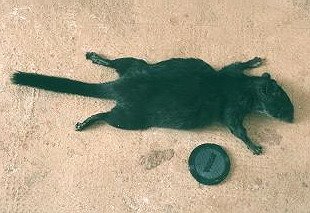
Laonastes and the "Lazarus Effect" in Recent Mammals. 2006. Mary Dawson et al. Science 311: 1456 – 1458.


Abstract: The living Laotian rodent Laonastes aenigmamus, first described in early 2005, has been interpreted as the sole member of the new family Laonastidae on the basis of its distinctive morphology and apparent phylogenetic isolation from other living rodents. Here we show that Laonastes is actually a surviving member of the otherwise extinct rodent family Diatomyidae, known from early Oligocene to late Miocene sites in Pakistan, India, Thailand, China, and Japan. Laonastesis a particularly striking example of the "Lazarus effect" in Recent mammals, whereby a taxon that was formerly thought to be extinct is rediscovered in the extant biota, in this case after a temporal gap of roughly 11 million years.

From the article at LiveScience.com byBjorn Carey:

"It is an amazing discovery and it's the coelacanth of rodents," said Dr. Mary Dawson. "It's the first time in the study of mammals that scientists have found a living fossil of a group that's thought to be extinct for roughly 11 million years. That's quite a gap. Previous mammals had a gap of only a few thousand to just over a million years." Laonastes is currently in the process of being officially reclassified in the Diatomyidae family.

Diatomyidae were squirrel-sized rodents that lived during the middle Tertiary period 34 million to 11 million years ago in southern Asia, central China, and Japan. They also had highly characteristic molar teeth and jaw structure, which is how the researchers reclassified Laonastes.

A recently discovered fossil of Laonastes matched the "living" specimen in skull shape and overall size. The only difference is that the "living" specimen's teeth are slightly more pointed.


Image of Laonastes from HERE.

"It looks like possibly one of the things that's been changing in family is improved cutting of vegetation," Dawson told LiveScience. "But over 11 million years you'd expect some differences in the structures."

Western scientists still haven't seen a living Laonastes specimen, which will be critical in conserving what may be a threatened species. "Biologists need to get out there and find some living ones," Dawson said. Finding living specimens and understanding how they live could be key to determining why the rodents moved from central Asia into the Indian subcontinent.

Thursday, March 09, 2006

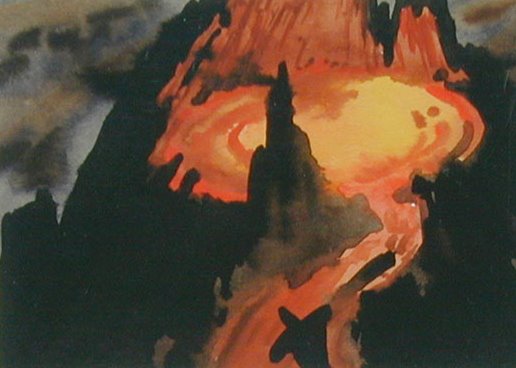
Siberian Trap=Mass Dino Extinction?

University of Leicester geologists, Professor Andy Saunders and Dr Marc Reichow, are taking a fresh look at what may actually have wiped out the dinosaurs 65 million years ago and caused other similarly cataclysmic events.
The idea that meteorite impacts caused mass extinctions has been in vogue over the last 25 years, since Louis Alverez’s research team in Berkeley, California published their work about an extraterrestrial iridium anomaly found in 65-million-year-old layers at the Cretaceous-Tertiary boundary. This anomaly only could be explained by an extraterrestrial source, a large meteorite, hitting the Earth and ultimately wiping the dinosaurs – and many other organisms - off the Earth’s surface.

Current research suggests that the causes of the extinctions may come from within our own planetthe eruption of vast amounts of lava that brings a cocktail of gases from deep inside the Earth and vents them into the atmosphere.

Flood basalt eruptions are an alternative kill mechanism. These do correspond with all main mass extinctions, within error of the techniques used to determine the age of the volcanism. Furthermore, they may have released enough greenhouse gases (SO2 and CO2) to dramatically change the climate. The largest flood basalts on Earth (Siberian Traps and Deccan Traps)coincide with the largest extinctions (end-Permian, and end-Cretaceous). The gases released by volcanic activity lead to a prolonged volcanic winter induced by sulphur-rich aerosols, followed by a period of CO2-induced warming.

The 250 million year old Siberian Traps are the largest known continental flood basalt province. Using radiometric dating techniques, they hope to constrain the age and, combined with geochemical analysis, the extent, of the Siberian Traps. Using these data they hope to be able to assess the amount of SO2 and CO2 released into the atmosphere 250 million years ago, and whether or not this caused climatic havoc, wiping out nearly all life on earth.

More information is available HERE.

Volcano from HERE.

NB: This is an interesting example of a press release for work that has not yet been done – it’s an announcement for a grant that has been received to start the research. The suggestion that the Siberian and/or Deccan Traps are the real cause of Earth’s major extinction events has been around for some time now. We’ll see what they come with in a year or two.

Wednesday, March 08, 2006

Early Land Animals Could Walk & Run Like Mammals

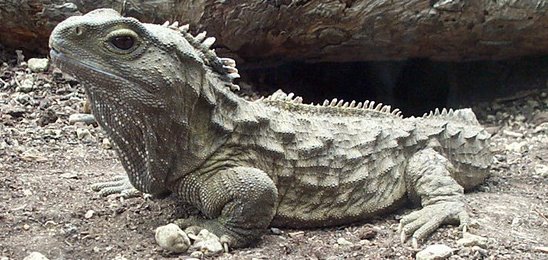
Tuataras and salamanders show that walking and running mechanics are ancient features of tetrapod locomotion. 2006. S. M. Reilly et al. Proceedings: Biological Sciences. Early on-line publication.


Tuatara from HERE.
Salamanders and the tuatara, a lizard-like animal that has lived on Earth for 225 million years, were the first vertebrates to walk and run on land.
From Ohio University Research News:

Tuataras (above) are the oldest living models of early tetrapods (four-legged animals) still alive today; that’s what makes them so interesting,” Reilly said.

After studying the creatures at the Toledo Zoo, Stephen Reilly and Eric McElroy determined that they use both forms of locomotion, which are energy-saving mechanisms generally believed to be important only in fast-running animals such as mammals and birds.

Force data used to study the movement of these creatures’ center of mass showed the telltale vault and dip of center of mass movements in different strides – confirmation that the creatures mechanically walk and run. Because they are the oldest living examples of four-legged animals, the new findings suggest that both energy saving mechanisms appeared when the first vertebrates moved onto land, Reilly explained. In comparison to previous research on other vertebrates, this also suggests that all terrestrial vertebrates – except for turtles, which are limited by their shell – can walk and run.

The researchers also showed, however, that walking and running in tuataras occur at the same speed and use about the same amounts of energy. Reilly believes that this could be a pre-adaptation in these primitive animals that have not evolved the need for speed, unlike other animals.

The research also shows for the first time a clear difference in locomotor mechanics between “lumbering” animals with clumsy, ungraceful gaits and “cursorial” animals that move fast and smoothly. In lumbering animals, up and down movements dominate the mechanical energy of locomotion. These movements are smoothed out in cursorial animals such as in dogs and horses, where more energy is shifted to forward movement, and the center of mass oscillates relatively less with each step.

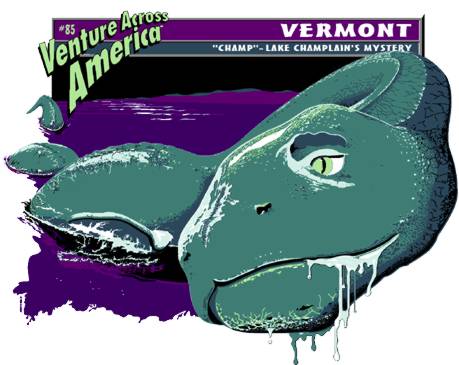
Lake Champlain's Monster Sighted Again


"Champ" from www.uhaul.com.

From an article by Joe Nickell in the Skeptical Inquirer as reported by LiveScience.com:
Dubbed “North America’s Loch Ness Monster,” the purported leviathan of Lake Champlain, “Champ,” has just resurfaced. On Feb. 22, 2006, Good Morning America aired exclusive video footage of “something” just below the surface of the water, possibly the lake’s fabled creature.
The incident added to a long list of Champ sightings, which have described a chameleonesque creature that is black, gray, brown, moss green, reddish bronze or other colors, and is between 10 and 187 feet long, with multiple humps or coils as well as horns or a mane or glowing eyes or “jaws like an alligator”—or none of those features.

Such sightings may be due to large fish like sturgeon, schools of fish, and other marine creatures. For example, otters, swimming in a line, can mimic a single long, serpentine creature moving in an undulating fashion. Other Champ suspects include wind slicks, boat wakes, driftwood, long-necked birds, and many other possibilities.

The newspaper noted that the Champ legend dated from 1609 when French explorer Samuel de Champlain described a creature the Native Americans called Chaousarou. In his journal, Champlain wrote that the species was reputed to range up to 10 feet long and that he had personally seen some half that length and “as big as my thigh”—words subsequently echoed by eyewitness Bodette. Champlain noted that Chaousarou resembled a pike with an exceedingly long snout and “dangerous teeth”—certainly alligator-like features. In short, Champlain’s description seemingly tallies with the creature the Vermont fishermen encountered.

The apparent match is instructive: the explorer was almost certainly describing a longnose gar, one of the Ganoidei subclass, which includes sturgeons and other varieties.

Although the video is insufficient for a positive identification, the men’s description does permit this tentative solution to the mystery. For four centuries gar have been astonishing people on Lake Champlain. During one of my investigative trips to the lake I interviewed a fisherman who had just witnessed a friend hook a longnose gar that—he insisted—was “monster” sized, measuring about 6 feet 4 inches long. He called this “the real Champ,” and dubbed it, appropriately, “Gar-gantua.”

Read the rest of the article HERE.

Tuesday, March 07, 2006

Bakker On Dinos

The traveling AMNH exhibit “Dinosaurs: Ancient Fossils, New Discoveries” opens Friday at Houston Museum of Natural History. Read an article featuring Dr. Bob Bakker, curator of paleontology for the HMNS.
"You can proclaim, you can shout down the hall, that dinosaurs are not extinct, because birds are dinosaurs," Bakker said. "They're not cousins, they're not nieces and nephews, they're not relations that crossed the bayou. They are dinosaurs. If you want to understand the essence of Tyrannosaurus rex, you must think big bird, really big bird."

Born This Day (1930): Stanley Lloyd Miller

Miller is an American chemist who made a series of famous experiments beginning in 1953, to determine the possible origin of life from inorganic chemicals on the primeval earth.

Read about it HERE.

Monday, March 06, 2006

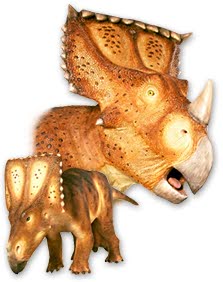
Smallest Triceratops Skull Described


Photo by Mark Goodwin, UC Berkeley Museum of Paleontology
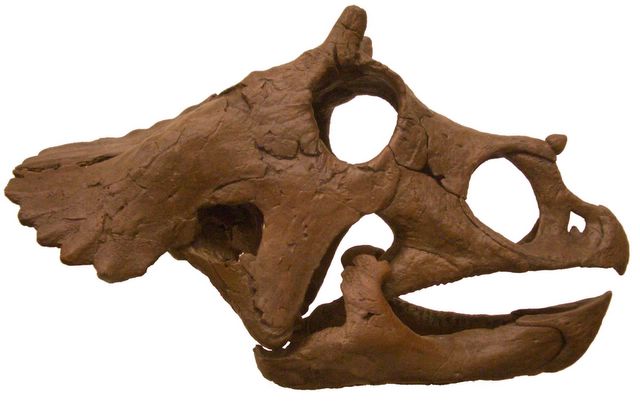
A cast of the foot-long skull from the youngest Triceratops fossil ever found is on display in the Library of University of California, Berkeley's Valley Life Sciences Building. The actual skull is described by Mark Goodwin in the March issue of the Journal of Vertebrate Paleontology
"The baby Triceratops confirmed our argument that the horns and frill of the skull likely had another function other than sexual display or competition with rivals, which people have often argued, and allows us to propose that they were just as important for species recognition and visual communication in these animals," Goodwin said.

The baby's skull, along with a few vertebrae, teeth and bony tendons, were discovered by amateur fossil hunter Harley Garbani in 1997 in Montana's Hell Creek Formation, the source of many Triceratops and T. rex fossils

Although Goodwin's conclusions about the lifelong growth of Triceratops will be published later this year, the baby skull offers its own insights. For one, the surface of the skull shows grooves were blood vessels used to be, evidently to nourish a fingernail-hard covering of keratin that was similar to the thicker layer that covered the adult skull. Such horny coverings are often brightly colored in the living descendents of dinosaurs - the birds - suggesting that adult Triceratops and their young may have been colorful, too.

In addition, the scalloped edges of the baby's frill became mere wavy edges in the adults, although the scallops foreshadowed the development of triangular scales along the edge of the adult frill, probably an attribute of sexual maturity, Goodwin said. The two brow horns started out straight and short in the baby - they're about an inch long - but ended up long and curved forward in the adult, while the nose horn became larger, like that of a rhinoceros, although it was made of bone in Triceratops.

The brain case of the baby also changed significantly, he said. Hidden beneath the boney frills of the skull, the hazelnut-sized brain of the baby fit snuggly within protective bones not yet fused, so as to allow further brain growth. In the adult, the brain, about the shape and size of a small sweet potato, was completely encased in fused bones. The relative position of the bones of the braincase as the animal matured recapitulates the cranial evolution of Triceratops from a more basal ancestor, such as Protoceratops.

Mark’s coauthors on the new paper are William A. Clemens, a UC Berkeley professor of integrative biology and Museum of Paleontology emeritus curator who opened up the Montana area for fossil exploration more than 30 years ago; field colleague Jack Horner of the Museum of the Rockies at Montana State University in Bozeman; and Kevin Padian, UC Berkeley professor of integrative biology and Museum of Paleontology curator.

Submitted This Day: Structure of DNA


Image from HERE.

From Today In Science History:

Today in 1953, Watson and Crick submitted to the journal Nature their first article on the structure of DNA, ”Molecular Structure of Nucleic Acids: A structure for deoxyribose nucleic acid”, which was published on April 25.
"We wish to put forward a radically different structure for the salt of deoxyribose nucleic acid. This structure has two helical chains each coiled around the same axis... Both chains follow right-handed helices... The novel feature of the structure is the manner in which the two chains are held together by purine and pyrimidine bases... They are joined together in pairs, a single base from one chain being hydrogen-bonded to a single base from the other chain, so that the two lie side by side with identical z-co-ordinates. One of the pair must be a purine and the other a pyrimidine in order for bonding to occur."

Sunday, March 05, 2006

Nessie Is A Jumbo Dumbo


Nessie from HERE.

From the Glasgow Sunday Mail :

Scotland’s top dinosaur expert has stunned the science world by claiming the Loch Ness Monster is an elephant. Palaeontologist Dr Neil Clark thinks the Nessie myth is "a magnificent piece of marketing" thought up by a 1930s circus boss.

Dr Clark says unexplained photos of Nessie could be of the trunk, head and back of a swimming elephant. He claims the phenomenon may have been started by circus impresario Bertram Mills in 1933 after he saw one of his elephants bathing in Loch Ness.

Mills, who died in 1938, offered £20,000 to anyone who could capture the Loch Ness Monster for his circus, sparking international interest. Clark - who spent two years investigating the unexplained sightings - said: "Nessie as we know it today is largely a product of the 20th century.

Mars Needs Bikinis


Art © Tom Bagley

Now really, what’s going to get your attention – a headline like “Mars Needs Bikinis” or “ALBERTA PALAEONTOLOGICAL SOCIETY 2006 SYMPOSIUM” to be held in Calgary, Alberta, on March 18th?

Go to their website for more information. I’ll be there, this time presenting a poster looking at the validity of Nanotyrannus with my co-authors Larry Witmer and Eric Snively.

And since I’ll be in Calgary that’s as good as excuse as any to once again plug the art of the very talented Tom Bagley. I’ve just found out that Tom and six other artistic conspirators have their own shared blog, “7 Deadly Sinners”, which is great fun to cruise around. So why hasn’t the usually ahead of the curve "Drawn!" not featured this site yet?

The ‘sinners’ even feature links to this very blog (thanks!) and others like genius cartoonist Carol Lay (Hi Carol!).

For more great art that you’ll usually see stapled to a lamppost (at least the old wooden ones) go visit Gigposters.com.

Saturday, March 04, 2006

New Fossil Snakes From Australia

From seven.com.au:
Snake fossils up to 25 million years old unearthed in north-west Queensland strongly suggest snakes evolved from lizards, says Palaeontologist John Scanlon.
Scanlon said the bones in the jaws and faces of the two large snakes, which were well preserved in limestone in the Riversleigh world heritage area near Mount Isa, were closer to those of lizards than modern snakes.

The two snakes were part of the Madtsoiid branch of the snake family that "split off" about 95 million years ago, said Dr Scanlon, who works at the Riversleigh Fossils Centre at Mount Isa. "The way the upper jaws are connected to the brain case and the structure of the ear region ... supports their origin from goanna-like lizards."

He said the snakes, which were almost five and six metres long, were part of a species that died out in Australia about 50,000 years ago. "They died out about 40 million years ago outside of Australia but because the country is isolated, it became like this lost world," Dr Scanlon said.

He said the Madtsoiid snakes were not venomous and are not closely related to any modern species of snakes.

Ohio Paleo Helps Find 45 Million Yr Old Croc In India

From The Times of India:

In a rare discovery last week, a team from the earth sciences department of IIT, Roorkee in Uttaranchal, along with an American researcher, found a 45 million-year-old fossil of a crocodile in Julrai village in Lakhpat taluka of Kutch district.


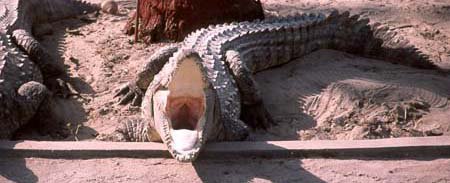
Croc pic from HERE.

According to palaeontologist Sunil Bajpai, associate professor in the department, the crocodile skull that the team found is about 70 cm long, suggesting that the body must have been about eight to 10 metre long.

In the past couple of years, the team has also discovered an assemblage of fossil land mammals from a coal (lignite) mine at Vastan near Surat. The collection includes distant ancestors of modern horses, humans, deer and cattle, bats, insectivores and many more groups.

PhD scholar Debasis Das — part of the team comprising Hans Thewissen, professor of Anatomy at North-eastern Ohio University's College of Medicine — found the crocodile fossil which has been gifted to Kutch Sanskriti Darshan museum.

Bajpai said "We have also found molar teeth for the first time in India that suggest the presence of animals related to kangaroos in India approximately 52 million years ago".

Kong's Chinese Box Office


Hey Kids! More Kong art © Pete Von Sholly!

From Sina English:

Big budget epic "King Kong" has generated 100.3 million yuan (about 12.5 million U.S. dollars) on the Chinese mainland, becoming the box office king among imported films in the past five years.

Peter Jackson's remake of the great-ape adventure took in over one million yuan last weekend, which brought its total box office to 100.3 million yuan since its release in the Chinese mainland on Jan. 12, a source with the film's distributor in China, the Huaxia Film Distribution Co., Ltd said on Tuesday.

" King Kong," with a 207 million US budget and 540 million US in global box office revenues, has received four 2006 Oscar's nominees-- Art Direction, Sound Mixing, Sound Editing and Visual Effects.

"Titanic" still holds the record of China's box office with 320 million yuan(some 40 million U.S. dollars).

Liu Shusen, vice president of the Huaxia, said they imported "King Kong" for its high artistic quality and production level and it can benefit home-made films. The overseas box office result was also a factor, he said.

"King Kong" holds the common interest of all people, so I believe it can strike the chord with Chinese audiences likewise," Liu said.

Dapingfangornis, New Fossil Bird Part 2

From The People’s Daily On-line:

Dr. Li Li from the Institute of Mesozoic Paleontology of Western Liaoning of the Shenyang Normal University and her colleagues discovered the fossil about 16 meters underground. The well-preserved remains include a complete skeleton with a skull. The total length of the bird fossil is 216 mm and its head is 28 mm with a high crista, said Li, adding the bird was named as Dapingfangornis after the place where it was found.

The long tail feathers of the bird indicated it was male and its toothed jaws and strong ungula feet proved that it was small and carnivorous, said Li. In addition, many fragmentary skeletons of fish and small reptiles were preserved under the feet of the Dapingfangornis, indicating that the bird liked eating animals alive, said Li.

Li's findings have been published in the February English version of Acta Geologica Sinica, a monthly by the Geological Society of China.

NOTE: I've added Acta Geologica Sinica to the journal list at the right.

Friday, March 03, 2006

New Fossil Bird Species Found

From the Shanghai Daily:
The remains of a new species of 100-million-year-old bird have been found in a fossil-rich area of northeastern China's Liaoning Province.
"The bird is different from other known birds of the Mesozoic in the medium- to small-size range with a distinct thorn-like process on its nose, which has never been found among other known fossil birds," said Dr Li Li from the Institute of Mesozoic Paleontology of Western Liaoning at Shenyang Normal University.

Li and her colleagues unearthed the fossil last October at Dapingfang in the west of Liaoning where the remains of dinosaurs, fish and early bird species have also been found.

The well-preserved remains include a complete skeleton with a skull. The total length of the bird fossil is 216 millimeters, said Li.

NB: When I find out more info I'll post it ASAP.

Star-Spangled Dinosaurs


© Pete Von Sholly

More fun stuff from Pete Von Sholly!

NOTE: The cool 'Space Thing' figure I mentioned HERE was sculpted by Pete's talented wife, Andrea, and is available NOW in better shops everywhere, or you can order it HERE.

Largest, Oldest Female Adapted To Cold

From Bruce Bower at Science News:
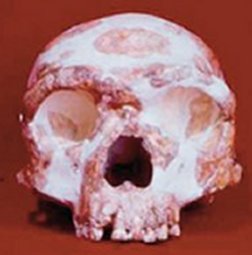
A 260,000-year-old partial skeleton excavated in northwestern China 22 years ago represents our largest known female ancestor, according to a new analysis of the individual's extensive remains.
This ancient woman puts a modern twist on Stone Age human evolution, say Karen R. Rosenberg of the University of Delaware. The fossil individual's large size and the apparent adaptation of her body to cold conditions are "consistent with the idea that patterns of human anatomical variation that we see today have deep evolutionary roots," Rosenberg asserts.

Although the woman belonged to the Homo genus, her species is uncertain. Now known as the Jinniushan specimen, she stood roughly 5 feet, 5-1/2 inches tall and tipped the scales at 173 pounds, the three anthropologists estimate. The only Stone Age Homo woman known to have approached that size weighed an estimated 163 pounds. Her partial skeleton came from a 100,000-year-old Neandertal site in France.

The Jinniushan specimen's size reflects her membership in a population that, as an adaptation for retaining heat in a cold climate, evolved large, broad bodies with short limbs, a shape similar to that of near-polar populations today. The work will be published in an upcoming issue of the Proceedings of the National Academy of Sciences.

The large estimated brain size of the Chinese fossil supports a current theory of mid–Stone Age brain expansion in Homo species, the researchers say. Earlier analyses of other fossils' skulls and lower-body bones—not including multiple bones from single individuals—had indicated that, between 1 million and 200,000 years ago, the Homo lineage peaked in body size and displayed considerable brain growth relative to body size.

Thursday, March 02, 2006

Debuted This Day (1933): King Kong


Read all about it HERE.

Born This Day: Willis O’Brien


March 2, 1886 - November 8, 1962

“O’Bie” was the special effects wizard best known to the world as the man who created King Kong. Read about him HERE.

Wednesday, March 01, 2006

Spiders In Amber

Comparing amber fossil assemblages across the Cenozoic. 2006, David Penney, and A. Mark Langan.
Scientists have carried out the first comparative scientific study of ancient spiders trapped in amber more than 30 millions years ago.

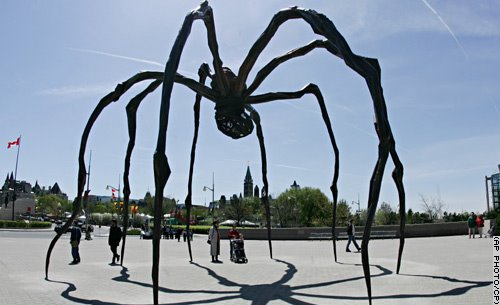
Giant Spider menacing the Parliment Buildings, Ottawa, Canada, from HERE.

The study of fossilised spiders from the Baltic (Poland) and the Dominican (Caribbean) regions has revealed new insights into the ecologies of spiders dating back to the Cenozoic period.

671 species of spiders were compared in the study of ancient spiders from different parts of the world. Dr David Penney analysed the size distributions of the spiders and comparing the distinct hunting traits of each species. He found that web-spinning spiders were bigger in Baltic amber than in Dominican amber, but that there was no difference between hunting spiders in either region. It was also found the fauna of the amber producing trees in each region accounted for this difference in size.

"Several lines of evidence show that greater structural complexity of Baltic compared to Dominican amber trees explains the presence of larger web-spinners. The Dominican trees are long, thin and smooth whereas the Baltic trees are wide and bushy, providing a much better environment for web-spinners to prosper," says Dr Penney.

Pete's Prehistoric Times


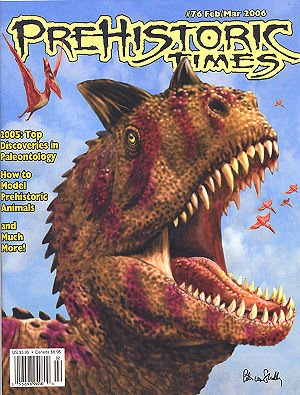
Artist Pete Von Sholly has been burning up his drawing table recently, having produced the above cover for the current issue of Prehistoric Times.

And, although it’s not palaeo, I can't help but point out that Pete’s illo for his faux-Aurora model kit box of the “The Thing (from Another World) is so cool that someone (DHC) is putting out a real statue based on it!