Friday, March 25, 2005

Steve R. Bissette's The Paleo Path: The History of Dino-Comics - Part 2

Note: The following is modified from Steve Bissette's introduction to the new collection of the comic book PALEO by Jim Lawson.

The Paleo Path Part 2: From Alley Oop to The Ancient Great Plains.

V.T. Hamlin's popular comic strip ALLEY OOP established prehistoric themes for its medium, a tradition that continued into the 1990s with Bill Watterson's CALVIN & HOBBES. There were comic cavemen-and-dinosaurs before Hamlin -- I have comic postcards in my own collection dating back to the late 1800s, and comic strips featuring the occasional dinosaur (Winsor McCay's "Dreams of a Rarebit Fiend") and 'lost world' sequence dating back to the early 1900s -- but for the sake of this chronology, take my word for it: Hamlin's the man. Dig, though, that Alley Oop was not a 'dinosaur comic'. Though Alley Oop and his kin cavorted with dinosaurs (including 'Dinny', Oop's faithful brontosaurian steed), "Alley Oop" was not, per se, a 'dinosaur comic'. Like most prehistoric novels, comics, and movies, Hamlin's comic was set in a fantasy universe where men and dinosaurs co-habitated (and yes, there was, later, a time machine involved).


Between 1951-52, Texan cartoonist (and journalist, author, and film historian, among other things) George E. Turner crafted a regionally-published weekly comic strip, "The Ancient Great Plains", for the Amarillo-based SUNDAY NEWS-GLOBE. Working under the guidance of West Texas State College geology professor Dr. Roy H. Reinhart, Turner undertook nothing less than a painstakingly illustrated science comic strip detailing the evolution of life in his home state, rich with the myriad forms of flora and fauna that swam, slithered, stalked and soared across millions of years.

Turner's love of films colored the strip -- the ad art announcing the strip's debut offered Turner's line rendition of the Allosaurus-vs.-Trachodon attack in the 1925 THE LOST WORLD, and King Kong himself made an appearance in a later installment -- and his reconstructions were often drawn from the work of Knight and others. Nevertheless, his work had its own flavor, and one cannot help but be struck by the accomplishments showcased in the sampler of "The Ancient Great Plains" offered by Turner's longtime friend and writing partner Michael H. Price in the revised edition of Turner and Orville Goldner's collaborative KING KONG book, "Spawn of Skull Island" (revised and expanded by Michael H. Price and Douglas Turner; Luminary Press, 2002; see pp. 232-241).

To my knowledge, there had never been anything quite like it in newspapers, comic strips, or comic books, and until someone proffers a precursor, I hereby nominate George Turner as the creator of the first true American 'dinosaur comic'.

The collected THE ANCIENT SOUTHWEST is now available from Texas Christian University Press of Fort Worth. The TCU Press edition contains extensive digital refinements of the surviving newsprint images, scattered revisions in the text, and a standardized job of re-lettering for consistency and clarity.


Next Week: Part 3 - Jesse Marsh and TARZAN.

Read Part 1 of the series HERE.

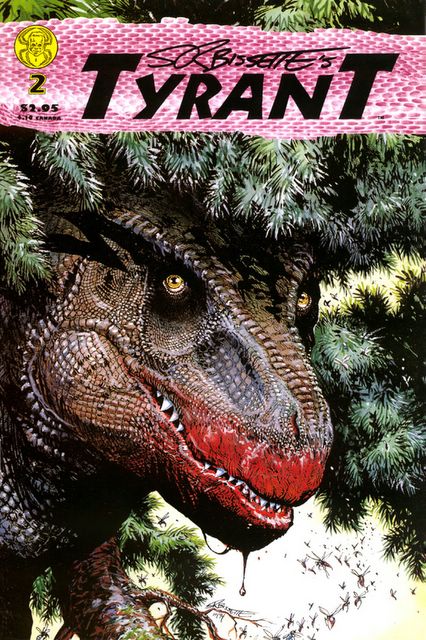
Steve R. Bissette is an artist, writer and film historian who lives in Vermont. He is noted for, amongst many things, his long run as illustrator of SWAMP THING for DC Comics in the 1980's and for self-publishing the acclaimed horror anthology TABOO and a 'real' dinosaur comic TYRANT(R).

Thursday, March 24, 2005

NC State Paleontologist Discovers Soft Tissue in Dinosaur Bones

Soft-Tissue Vessels and Cellular Preservation in Tyrannosaurus rex. Mary H. Schweitzer, Jennifer L. Wittmeyer, John R. Horner, and Jan B. Toporski. 2005. Science 307: 1952-1955.

Abstract: Soft tissues are preserved within hindlimb elements of Tyrannosaurus rex (Museum of the Rockies specimen 1125). Removal of the mineral phase reveals transparent, flexible, hollow blood vessels containing small round microstructures that can be expressed from the vessels into solution. Some regions of the demineralized bone matrix are highly fibrous, and the matrix possesses elasticity and resilience. Three populations of microstructures have cell-like morphology. Thus, some dinosaurian soft tissues may retain some of their original flexibility, elasticity and resilience.

Branching vessels found in bone matrix of T. rex (A) and ostrich (B)

From the NC State University Press Release:

Dr. Mary Schweitzer, assistant professor of paleontology with a joint appointment at the N.C. Museum of Natural Sciences, has succeeded in isolating soft tissue from the femur of a 68-million-year-old Tyrannosaurus rex. Not only is the tissue largely intact, it’s still transparent and pliable, and microscopic interior structures resembling blood vessels and even cells are still present.

All bone is made up of a combination of protein (and other organic molecules) and minerals. In modern bone, removing the minerals leaves supple, soft organic materials that are much easier to work with in a lab. In contrast, fossilized bone is believed to be completely mineralized, meaning no organics are present. Attempting to dissolve the minerals from a piece of fossilized bone, so the theory goes, would merely dissolve the entire fossil.

But the team was surprised by what actually happened when they removed the minerals from the T. rex femur fragment. The removal process left behind stretchy bone matrix material that, when examined microscopically, seemed to show blood vessels, osteocytes, or bone building cells, and other recognizable organic features.

Since current data indicates that living birds are more closely related to dinosaurs than any other group, Schweitzer compared the findings from the T. rex with structures found in modern-day ostriches. In both samples, transparent branching blood vessels were present, and many of the small microstructures present in the T. rex sample displayed the same appearance as the blood and bone cells from the ostrich sample.

Schweitzer then duplicated her findings with at least three other well-preserved dinosaur specimens, one 80-million-year-old hadrosaur and two 65-million-year-old tyrannosaurs. All of these specimens preserved vessels, cell-like structures, or flexible matrix that resembled bone collagen from modern specimens.
For color photos of the soft tissue structures read the article covering the story in Geotimes HERE.

New Sauropod Found In Patagonia

From News24.com:

The remains of a new species of sauropod, christened "bonitasaura", were discovered in southern Argentina after scientists were led to them by a 98-year-old woman who had known of their existence since her childhood. She eventually led Sebastian Apesteguia and his team to a site in the semi-desert Patagonian steppes, where they recovered enough bones to reconstitute 70% of the animal's skeleton. The existence of the fossil beds in the region were known since the 1922 expedition of geologist Walter Shiller and palaeontologist Santiago Roth, but their precise location had been lost and remained unknown except to Dona Tica, who as a young girl had assisted the early expedition.

Christened "bonitasaura salgadoi", after the Bonita Mountains near the discovery site, the long-necked, plant-eating sauropod lived 83 million years ago in the Late Cretaceous period, and may have weighted up to 20 tons. Its unique characteristic is the sharp ridge which runs behind its teeth which allows it to sever tree branches without damaging its frontal teeth.

Hunting The Tasmanian Tiger

The Bulletin of Sydney, Australia, is offering $1.25 million dollars Australian for the discovery of a living Tasmanian Tiger.

"Over the past 70 years more than 4000 alleged sightings of the believed-to-be-extinct Tasmanian tiger have been reported. Yet not one solid shred of evidence - not a bone, a hair, much less a body - has ever been put forward to prove that the thylacine is the greatest escape artist in the animal kingdom.

If the tiger has somehow managed to cling to survival, proving its existence would be one of the greatest scientific stories of the century. A live thylacine would have many profound implications, including forcing a rethinking of our understanding about how endangered species can survive. So in this, our 125th year of publication, The Bulletin is prepared to help solve one of Australia’s most enduring mysteries.

We’re offering a total reward of $1.25m for conclusive proof of the tiger’s existence in the Tasmanian wild. Our terms and conditions are strict and unbending. A live, uninjured animal must be produced. All government regulations and provisions must be adhered to. A panel of eminent experts chosen by us will have the final say - along with conclusive DNA testing.

The reward is open until June 30. It’s a pretty safe bet that if a tiger is not found by then, we’ll know the truth is just a myth."
Get info on spotting the Tasmanina Tiger by clicking HERE

Born This Day: Georgius Agricola

(March 24, 1494 - November 21, 1555)

From Today In Science History:

He was a German scholar and scientist known as "the father of mineralogy." His work paved the way for further systematic study of the Earth and of its rocks, minerals, and fossils. He made fundamental contributions to mining geology and metallurgy, mineralogy, structural geology, and paleontology. He Latinized his real name of Georg Bauer, to be known as Georgius Agricola. Having studied medicine, he became interested in mineralogy through his study of miners' diseases. His most important work, "De Re Metallica", (published a year after his death) summarized all the practical knowledge gained by Saxon miners. He was among the first to found a natural science upon observation. He may have coined the word petroleum ("rock oil").

The Ancient Southwest

If you're going to be in Fort Worth, Texas, on April 2 you're invited to meet Michael Price and pick up a copy of the newly published book collecting the legendary newspaper strip, THE ANCIENT SOUTHWEST.

Steve Bissette will be discussing this strip in the this Friday's edition of THE PALEO-PATH: The History of Dino-Comics, Pt. 2.

Wednesday, March 23, 2005

Europe's Largest Dinosaur?

Recently in Cretaceous Research:

Europe's largest dinosaur? A giant brachiosaurid cervical vertebra from the Wessex Formation (Early Cretaceous) of southern England. Darren Naisha, David M. Martill, David Cooper, and Kent A. Stevens. 2005. Cretaceous Research 25: 787-795.
A single brachiosaurid sauropod cervical vertebra from the Wessex Formation (Barremian, Early Cretaceous) of the Isle of Wight is remarkable for its size. With a partial centrum length (i.e., excluding evidence of the anterior condyle) of 745 mm it represents the largest sauropod cervical reported from Europe and is close in size to cervical vertebrae of the giant brachiosaurid Brachiosaurus brancai from Late Jurassic Tanzania. The complete animal probably exceeded 20 m in total length. The specimen shares important morphological characters with Sauroposeidon proteles from Early Cretaceous USA, including extensive lateral fossae and well-developed posterior centroparapophyseal laminae, indicating that it is part of a Brachiosaurus–Sauroposeidon clade, and in some characters is intermediate between the two. Owing to the complexities of Isle of Wight sauropod taxonomy the specimen is not attributed to a named taxon.

New Journals Added

Geology and the Geological Society of America Bulletin have now been added to the Palaeoblog list of journals.

T.rex Takes Flight

From the BBC News:

A life-size model of a Tyrannosaurus rex dinosaur has been flown into place at an exhibition in Somerset. The fibre glass replica model, weighing just under one tonne and measuring 25-feet long, was flown for one mile dangling from a helicopter. The T-rex and two other dinosaurs, including a Brontosaurus[sic], were too large to be brought to Wookey Hole Caves by road. They will form the centrepiece of a new Valley of the Dinosaurs attraction. The replica dinosaurs were flown from one side of Wookey to the other directly into the park. The owner of Wookey Hole Caves, Gerry Cottle, said: "They're built life size, according to the latest scientific knowledge and we've made them correct in every possible detail."

The palaeoblog is not absolutely convinced of the last statement but we wish the new attraction all the best.

Born This Day: William Smith

March 23, 1769 - August 28, 1839)

From Today In Science History:

An English engineer and geologist who is best known for his development of the science of stratigraphy. Smith's great geologic map of England and Wales (1815) set the style for modern geologic maps, and many of the colorful names he applied to the strata are still in use today.

Tuesday, March 22, 2005

Born This Day: Adam Sedgwick

From Today In Science History:

Adam Sedgwich (March 22, 1785 - January 27, 1873)

English geologist who first applied the name Cambrian to the geologic period of time, now dated at 570 to 505 million years ago. In 1818 he became Woodwardian Professor of Geology at Cambridge, holding a chair that had been endowed ninety years before by the natural historian John Woodward. He lacked formal training in geology, but he quickly became an active researcher in geology and paleontology. Many years after Sedgwick's death, the geological museum at Cambridge was renamed the Sedgwick Museum of Geology in his honor. The museum is now part of the Department of Earth Sciences at Cambridge University

Monday, March 21, 2005

Happy Birthday to Mark Boucher!

Before the day fades away here in the EST I'd like to take the time to wish a very happy birthday to the friend I've known longer than anyone (meeting up when we were 4 years old!) - my buddy, Mark Boucher. Mark helped me build my first dinosaur museum in my parents basement when we were in grade school, and we co-taught a class on dinosaurs to out fellow students when we were in grade 5. Mark was there when I took my first steps in this career and has been an avid supporter of it even though his own interests run to large felids and politics. All the best!

Devil Dinos

While waiting for this Friday's second installment of the Steve Bissette's PALEO PATH, go over to the Four Realities related site, Kirby Comics, and read about one of the oddest books to ever feature dinosaurs -- Jack Kirby's DEVIL DINOSAUR.

Then go over to the Digital Dream Machine blog and read an appreciation of Jack "The King" Kirby HERE

The Worlds Of William Stout


Speaking of DRAGONS, one of the best illustrators of dragons, dinosaurs, and other things fantastic is Bill Stout. Got check out his great site HERE.

Acta Palaeontologica Polonica 50(1), 2005

From the latest volume of Acta Palaeontologica Polonica:

Osteology of the sauropod embryos from the Upper Cretaceous of Patagonia Leonardo Salgado, Rodolfo A. Coria, and Luis M. Chiappe. 2005. Acta Palaeontologica Polonica 50: 79-92

Exceptionally well-preserved embryonic skulls of Upper Cretaceous (Campanian Anacleto Formation) sauropods from Auca Mahuevo (Neuquén Province, Argentina) provide important insights into the ontogeny and evolution of titanosaurian neosauropods. The most important cranial modifications occurring during titanosaurian ontogeny appear to be centered on the infraorbital and narial regions, which exhibit a substantial degree of “mosaic” evolution. On one hand, the Auca Mahuevo embryos show a large jugal that forms part of the lower margin of the skull and unretracted external nares, as indicated by the position and orientation of the lacrimals as well as the anterior extension of the frontals. Both of these features are ancestral for neosauropods, being present in prosauropods. On the other hand, the embryonic skull exhibits a large ventral notch, tentatively interpreted as homologous to the neosauropod preantorbital fenestra, that opens ventral to the jugal and between the maxilla and the quadratojugal, and a temporal region that closely resembles the adult neosauropod condition. This mosaic of character states indicates that different regions of the skull of titanosaurian neosauropods acquired their characteristic morphology at substantially different rates during their ontogenetic development.
Caudipteryx as a non-avialan theropod rather than a flightless bird Gareth J. Dyke and Mark A. Norell. 2005. Acta Palaeontologica Polonica 50: 101-116
Caudipteryx zoui is a small enigmatic theropod known from the Early Cretaceous Yixian Formation of the People’s Republic of China. From the time of its initial description, this taxon has stimulated a great deal of ongoing debate regarding the phylogenetic relationship between non-avialan theropods and birds (Avialae) because it preserves structures that have been uncontroversially accepted as feathers (albeit aerodynamically unsuitable for flight). However, it has also been proposed that both the relative proportions of the hind limb bones (when compared with overall leg length), and the position of the center of mass in Caudipteryx are more similar to those seen in extant cusorial birds than they are to other non-avialan theropod dinosaurs. This conclusion has been used to imply that Caudipteryx may not have been correctly interpreted as a feathered non-avialan theropod, but instead that this taxon represents some kind of flightless bird. We review the evidence for this claim at the level of both the included fossil specimen data, and in terms of the validity of the results presented. There is no reason—phylogenetic, morphometric or otherwise—to conclude that Caudipteryx is anything other than a small non-avialan theropod dinosaur.

On A Dark Scottish Loch


Prince Valiant began when Hal Foster, who had spent several years drawing the popular "Tarzan" feature, was asked by William Randolph Hearst to create a strip for Hearst's chain of newspapers. Thrilled by tales of chivalry, Foster returned to the rich literary tradition of King Arthur and the Knights of the Round Table and created Prince Valiant, first appearing on Feb. 13, 1937. It remains unique in the world of contemporary comic features, with its combination of narrative adventure and sometimes humorous family drama, its bold artistic realism combined with hints of fantasy, and its historical accuracy in the portrayal of life "in the days of King Arthur." It is a historical novel in serialized form, one in which characters have more than two dimensions — the virtuous have flaws, and the villainous are frequently not without some small virtue.

Currently the strip is in the capable hands of writer Mark Schultz and artist Gary Gianni. The image below is from the March 6th, 2005 strip and foreshadows Price Valiant’s coming battle with a plesiosaur in the waters of a Scottish Loch.


Schultz is perhaps best known for writing and drawing his own critically acclaimed book, Xenozoic Tales, that was adapted as the CBS animated series Cadillacs and Dinosaurs. Along the way he also found time to co-create and co-write the Dark Horse series, SubHuman, with the palaeoblogger.

Gianni’s artwork has appeared in numerous newspapers, magazines, paperbacks, comic books and children’s books. Both men have recently been producing hundred’s of original illustrations and dozens of oil paintings for a series of books collecting the original stories of Robert E. Howard for prestigious publisher Wandering Star including Conan of Cimmeria, Vol. 1 for Schultz, and The Savage Tales of Solomon Kane and Conan of Cimmeria, Vol. 2 for Gianni.

Animal Planet's 'Dragons"

Animal Planet recently debuted their new “docu-fantasy” DRAGONS that takes a ‘what if’ approach to these imaginary creatures. The palaeoblogger did not see the show so he can’t comment on its content, but from all accounts it made for an entertaining evening.


You can click HERE to go to the show’s website for a short blurb on how prehistoric reptiles influenced the development of the show.

Sunday, March 20, 2005

This Week In Science: Horsing Around


Fossil Horses--Evidence for Evolution
Bruce J. MacFadden. Science 307: 1728-1730.

In the latest issue of Science Dr. Bruce Macfadden presents an overview on the evolution of horses. You can read a summary of the article in the press release from the University of Florida:

The fossil record shows horses originated in North America at least 55 million years ago and roamed the continent before becoming extinct at the end of the last Ice Age, about 10,000 years ago. They were reintroduced into the New World in the 1500's by the Spanish and have helped to shape our culture.


Scientists once universally thought the more primitive horses, which lived from about 55 million to 20 million years ago, were primarily leaf-eating browsers, only becoming grass eaters as the prairie grasslands began to spread rapidly across North America during the Miocene Epoch about 20 million years ago. The reality is not so clear cut according to Dr. Bruce MacFadden of the University of Florida. During times of transition, some groups of horses actually became mixed feeders, eating both grasses and leafy material, he said.

Although modern horses are primarily grazers, they will feed on fruits and leaves when grass is in short supply, MacFadden said. "Horses are highly adaptable," he said. "They can exploit different food resources when they have to and are able to withstand a wide range of climates. They live in the tropics. They extend all the way up to the Arctic." Just as the scientific knowledge about whether horses were browsers or grazers has changed, so have ideas about the evolution of body size, he said.

The preconceived notion that the horse was once as small as a dog but progressively grew to its present stature now can be proven to be incorrect, MacFadden said. About 20 million years ago during the Miocene Epoch, horses diversified in size rather than just becoming larger, MacFadden said. While some grew larger, others became smaller or remained the same size, he said.

MacFadden, who was able to estimate the body size of various species of fossil horses by measuring their teeth because they are proportional to the rest of the body, said the old idea was based on the research of 19th-century paleontologist Edward Drinker Cope. Cope's Law states that within any group of animals there is a tendency for the descendants of a species to grow increasingly larger. "But there are so many exceptions where you go from small to large and back to small again that you have to ask how many exceptions to the rule you can accept before the central concept is no longer correct, he said.
Visit the Fossil Horse Cybermuseum at the Florda Museum of Natural History by clicking here

Saturday, March 19, 2005

Darwin’s First Discovery

From Today In Science History:

On this day in 1827, at the age of 18, Charles Darwin dissected some specimens of a baranacle-like marine organism, the polyzoan Flustra begining his lifelong career in natural history.

Friday, March 18, 2005

Steve R. Bissette's The Paleo Path: The History of Dino-Comics - Part 1

Note: The following is modified from Steve Bissette's introduction to the new collection of the comic book PALEO by Jim Lawson. We'll be covering PALEO in the penultimate installment of this column.
The Paleo Path Part 1: Unearthing Origins:

A genuine dinosaur comic is a rare thing. A true dinosaur comic is something unique, unblemished by human characters. We don’t need no stinking ‘lost world,’ lost island, time machine, or atom-age mutations stomping cities into dust. Forget about RIP HUNTER, TIME MASTER and “The War That Time Forgot” (of STAR-SPANGLED WAR STORIES) or GORGO or KONGA; forget KONA, MONARCH OF MONSTER ISLE and GODZILLA, KING OF THE MONSTERS. Those comics indeed feature dinosaurs, and were great fun, but they weren’t and aren’t dinosaur comics.
The precursors were, of course, the dinosaur artists. These were the illustrators and painters who first put pencil, pen, and brush to paper or canvas and fleshed out the fossil reconstructions to create panoramas of what the prehistoric world must have, might have, maybe was like.


Prominent among these is the pioneer Charles R. Knight (above), who established the field almost single-handedly in the very early 1900s. Working hand-in-glove with the premiere paleontologists of his day, Knight was the first ‘pop paleo artist,’ if you will. His vivid reconstructions of prehistoric life graced the walls of museums (Chicago’s Field Museum, for instance), the pages of books, periodicals, and journals, and became the standard illustrations for school and home texts like the ENCYCLOPEDIA BRITANNICA and NATIONAL GEOGRAPHIC.

Others followed in Knight’s footsteps: Rudolph Zallinger (left) here in the U.S., Zdenak Burian (below) in Czechoslovakia, and many others. Many of you may have grown up in the thrall of William Stout’s marvelous prehistoric creations, or the generation of exquisite paleontological artists who rose to prominence in the 1980s and early ‘90s. But Knight’s paintings and drawings were the wellspring from which all dinosaur imagery flowed, and countless illustrators and cartoonists have done little more but slavishly copy Knight’s work for generations.

The ache, then, for many of us, was the urge to see Knight’s paintings move -- or at least enjoy a fuller life on the page. That urge impelled pioneer stop-motion animator Willis O’Brien to bring dinosaurs to life on the big screen (THE LOST WORLD, 1925; KING KONG, 1933; etc.), as it moved his teenage successor Ray Harryhausen to labor over his own (never-completed) epic EVOLUTION before graduating to continuing O’Brien’s legacy in films like BEAST FROM 20,000 FATHOMS (1953) and others.

The same urge drove Disney Studio cartoon animators to create the memorable “Rites of Spring” sequence for FANTASIA (1940), and cartoonists like Joe Kubert or Ross Andru & Mike Esposito to sneak dinosaurs into every comic book job they could. Thus, Kubert’s GREEN LANTERN and Andru & Esposito’s WONDER WOMAN and STAR-SPANGLED WAR STORIES G.I.’s fought living dinosaurs -- even the Metal Men fought robot dinosaurs!; but these weren’t dinosaur comics -- they were comics with dinosaurs.

The dinosaurs were props, cameo villains, guest-stars; they weren’t the stars of their own stories, as Knight had portrayed them in his evocative tableaus. Many of us wanted to just read comics about dinosaurs -- the animals themselves, their lives and times, sans the trappings imposed by quickly formalized fantasy and science-fiction templates. The first place we found them were in the Funny Pages of the newspapers.

Next Week: Part 2 - From Alley Oop to The Ancient Great Plains
.

Steve R. Bissette is an artist, writer and film historian who lives in Vermont. He is noted for, among many things, his long run as illustrator of SWAMP THING for DC Comics in the 1980's and for self-publishing the acclaimed horror anthology TABOO and a 'real' dinosaur comic TYRANT(R).

For more information on oddball dinosaur comics check through the archives of Scott Shaws! ODDBALL COMICS by clicking here.

Died This Day: Othniel Charles Marsh

From Today In Science History:

O.C. Marsh (October 29, 1931 - March 18, 1899)

In 1866, the Peabody Museum of Natural History was founded with a gift from George Peabody. The same year his nephew, O.C. Marsh, was also named its Professor of Paleontology, the first such appointment in the United States. In 1869 Marsh used the inheritance from his uncle to start to amass large collections of vertebrate fossils. He went on to long and successful career as a vertebrate paleontologist, most of which was spent fueding with is rival, E.D.Cope.

Marsh and Cope started their careers on a cordial basis, but the relationship soon soured over an incident involving Cope's fossil of Elasmosaurus. Embarassingly, Marsh pointed out that its backbones were mounted backwards. To settle the arguement the men agreed to let Joseph Leidy decide who was right. Leidy promptly removed the head from one end and placed it on what Cope had thought was the tail. Cope than frantically tried to collect all of the copies of a recently printed publication that contained his erroneous reconstruction.

Thursday, March 17, 2005

Dr. Philip Currie Accepts Position At U of Alberta


Dr. Currie uncovers the skull of an ornithomimid in Dinosaur Provincial Park, Alberta.

Dr. Philip J. Currie will be leaving his job as Head of Dinosaur Research for the Royal Tyrrell Museum in Drumheller to start a new position with the University of Alberta in Edmonton come this October. The move has been rumored for some time but is now being reported in the Canadian media here and here. Coincidental with this news is the recent posting for a "two-year Post Doctorate in Ornithischian Dinosaurs" at the RTMP that can be viewed here.

For Currie it will be a bit of a homecoming considering that he started his dinosaur-hunting career in Alberta as Head of Vertebrate Palaeontology for the Provincial museum of Alberta located not far from the U of A. Currie's move will also come shortly after the 20 anniversary celebrations this September for the Royal Tyrrell Museum, a world-reknowned center of palaeontological research that he was instrumental in helping to create.

We wish he and his wife, palynologist Dr. Eva Koppelhus, all the best in their trek north from Drumheller.


Tarbosaurus jaw found by Dr. Currie in the Gobi Desert.

Wednesday, March 16, 2005

Research Road Trip

I'm enroute today to the Royal Ontario Museum/University of Toronto to work on some long-delayed papers with David Evans, a former employee of mine in the Royal Tyrrell Museum's 'Day Dig' program, and now a hot-shot Ph.D. student working on (amongst many things) hadrosaurs and other ornithischian dinosaurs.

I'll also be taking in the ROM's new Feathered Dinosaur Show and will (hopefully) be posting more information about this next week when I'm back in Cleveland. My weekend will be spent in Ottawa doing some work at the Canadian Museum of Nature where I'm also a Research Associate. I'll also be posting some interesting pictures of dinosaurs from that museum next week.

FYI, postings at the Palaeoblog will continue as per usual while I'm traveling.

Thanks to Steve Bissette for the plug over at his site.

New Kong To Break Free

For anyone still under a rock, there's a new film remake of King Kong coming to the movie screens this Dec 15.

Directed by Peter "Lord of The Rings" Jackson, this version boasts a $150 million dollar budget and most of the behind-the-scenes talent that made LOTR an Academy Award-winning success. The palaeoblog is skeptical about the need to remake such a classic film, but we'll give it the benefit of the doubt based on Jackson's track record of superb craftsmanship. We can at least be guaranteed that the dinosaurs featured in it will be state of the art. Above is a very unofficial teaser poster for the movie.

For an update of what's going on with the production read an article from the New York Post by clicking here

Born This Day: Ami Boué

From Today In Science History:

Ami Boué (March 16, 1794 - Nov. 21, 1881)

Austrian geological pioneer who fostered international cooperation in geological research. While studying medicine in Edinburgh, he was influenced by the noted Scottish geologist Robert Jameson and studied the volcanic rocks in various parts of Scotland and the Hebrides. He settled in Paris in 1830 and was a founder of the Société Géologique de France. For the next four years he published reports on geological progress in other countries. In 1845 he finished his comprehensive overview of geology, Essai de carte géologique du globe terrestre ("Essay on a Geological Map of the World").
Tuesday, March 15, 2005

First Fully Jointed Neandethal Skeleton Built

Neanderthal reconstructed. G.J. Sawyer and Blaine Maley The Anatomical Record Part B: The New Anatomist, Vol. 283B: 23 - 31
Stefan Lovgren of National Geographic News discusses the new findings:

Scientists have for the first time constructed a fully articulated Neandertal skeleton using castings from real Neanderthal bones. The skeleton was reconstructed by G.J. Sawyer, an anthropologist at the American Museum of Natural History, and Blaine Maley, a graduate student in the Department of Anthropology at Washington University in St. Louis, Missouri. It was primarily based on the La Ferrassie 1 specimen discovered in France in 1909, with missing or incomplete elements filled in from other Neanderthal cast collections.

Neanderthals lived in Europe and some parts of Asia from 300,000 years ago. The last of them mysteriously disappeared in present-day Spain and Portugal 28,000 years ago. Modern humans, many scientists believe, arose in Africa less than 200,000 years ago and appeared in great numbers in Europe starting about 40,000 years ago.

The relationship between Neanderthals and the early modern humans, commonly known as Cro-Magnon beings, is fuzzy. The two groups overlapped in Europe for 10,000 years. The reconstruction could provide scientists with a more complete picture of the stature differences between modern humans and Neandertals.

The new reconstruction suggests some strong differences in the form of the Neanderthal's rib cage and pelvis compared to those of modern humans. The skeleton is 5.4 feet tall although this might have been slightly underestimated, due partly to the use of bone casts from a potentially shorter individual.

The reconstructed skeleton is currently on display at the Dolan DNA Learning Center in Cold Spring Harbor, New York. It will eventually go on permanent display at the American Museum of Natural History in New York City.

Monday, March 14, 2005

Happy Birthday to Steve Bissette!

The palaeoblog wishes all the best to


creator of TYRANT(R) (below) and many other cool books.


Art (c) Steve Bissette

Steve will be teaching at the Center for Cartoon Studies in White River Junction, Vermont, beginning this fall.

“This feels right, given the fact that my comics career began as a first-year student in the first class ever of a great experiment in comics learning, The Joe Kubert School of Cartoon and Graphic Art, Inc. in Dover, NJ. I graduated from the Kubert School in 1978, and owe my career to Joe and the school. Now I’ll be on the other end of the classroom, teaching the first class ever at a great new experiment in comics learning, the Center for Cartoon Studies. The first-year lineup of students is nearly filled to capacity. We’ll be savoring our first-ever summer workshop session, June 27th to July 1st, which promises to be an intense five-day whirlwind of creativity."

Get more info about the workshop here. I'm sure more than a few dinosaurs will be drawn during the week!
Also: Pick up Steve’s latest book, Green Mountain Cinema I: Green Mountain Boys, by clicking here

And: Don't forget that Steve's first installment on the history of dinosaurs in comic books starts on the Palaeoblog this Friday.

Happy Birthday to Albert Einstein!


March 14, 1879 - April 18, 1955

All about Sidney Harris here. Buy the book pictured above here

Sunday, March 13, 2005

A Nobel Laureate Confronts Pseudoscience

A distinguished Russian physicist (co-winner of the 2003 Nobel Prize in Physics) battles the pseudoscience and charlatanism that he feels is duping his country’s population. Sadly these issues are not just the problem of North America. Read the entire article in the recent issue of The Skeptical Inquirer.

Sunday Dinosaurs

In today's episode of Liberty Meadows:

Died This Day: Charles Lapworth

From Today In Science History:

Charles Lapworth (Sept. 30, 1842 - March 13, 1920)

Lapworth was an English geologist who proposed what came to be called the Ordovician period (505 to 438 million years old) of geologic strata. Lapworth is famous for his work with marine fossils called graptolites. By fastidiously collecting the tiny, colonial sea creatures, he figured out the original order of layered rocks that had been faulted and folded in England's Southern Uplands. This method of correlating rocks with graptolites became a model for similar research throughout the world. In 1879, Lapworth proposed a new classification of Lower Paleozoic rocks with the Ordovician, between the redefined Cambrian and Silurian periods. The name comes from an ancient Welsh tribe, the Ordovices.

Bringing Up Baby


When a man is wrestling a leopard in the middle of a pond, he's in no position to run.” Cary Grant as paleontologist David Huxley

Coming in at #97 on the American Film Institute's list of greatest films, ‘Bringing Up Baby’, co-starring Cary Grant and Kate Hepburn, is acknowledged as the archetypical screwball comedy. Directed by Howard Hawks in 1938, Grant plays paleontologist David Huxley who is trying to secure a $1,000,000.00 endowment for his museum. He meets up with Hepburn’s seemingly scatterbrained heiress, Susan Vance, who becomes determined to derail Grant’s next day wedding. Over the course of the next 24 hours Grant gets completely mired in Hepburn’s whirlwind ad hoc plans to catch her new (and completely reluctant) beau that includes hunting for her leopard (the ‘Baby’ of the title), having her steal his clothes, ending up in jail, falling in a stream, and finally losing his “intercostal clavicle” to Hepburn’s dog that was to be the final element needed complete the Brontosaurus skeleton he’s been working on for four years. In the end they end up in each others arms but suspended over the destroyed skeleton. The fast-paced, witty script, sharp direction and comedic chemistry between Grant and Hepburn all combine to make this film worthy of multiple repeat viewings.

A newly restored, two DVD set of the film has just been released and is soon to be added to the palaeoblog’s DVD collection.

Saturday, March 12, 2005

Duck! Mass Extinction Every 62 Million Years

In this week's Nature:

Cycles in fossil diversity Robert A. Rohde and Richard A. Muller. 2005. Nature 434: 208 - 210.

Rohde and Muller are two University of Berkeley scientists who have discovered a pattern of mass extinctions every 62 million years. By using the late J. John Sepkoski's compendium of the first and last stratigraphic appearances of 36,380 marine genera over the past 500 million years, the two found a strong statistically 62.3-million-year extinction cycle.

This differs from the work published in 1984 by Sepkoski and Raup who argued that there is a 26 million year cyclical pattern to the extinction events recorded in the fossil record, possibly caused by an extra-terrestrial cause (a Planet X or a Nemesis Star).


David Perlman of the San Francisco Chronicle has this article on the new findings.

Visit Dr. Muller's home page and see the extinction graph here

Friday, March 11, 2005

Died This Day: Roy Chapman Andrews

From Today in Science History

Roy Chapman Andrews (January 26, 1884 - March 11, 1960)

American naturalist, explorer, and author, who spent his entire career at the American Museum of Natural History. He led many important scientific expeditions with financial support through his public lectures and books, particularly in central Asia and eastern Asia. On his 1925 central Asian expedition, the first known dinosaur eggs were discovered,as well as skull and parts of Baluchitherium, the largest known land mammal. During his career Andrews was the museum's best promoter, creating immense excitement and successfully advancing research there.

Andrews was also acknowledged as one of the more important inspirations for the creation of the character of Indiana Jones.

Thursday, March 10, 2005

Oldest Fossil Human Protein Ever Sequenced

From the Proceedings of the Academy of National Sciences:

Osteocalcin protein sequences of Neanderthals and modern primates. Christina M. Nielsen-Marsh, Michael P. Richards, Peter V. Hauschka, Jane E. Thomas-Oates, Erik Trinkaus, Paul B. Pettitt, Ivor Karavani , Hendrik Poinar, and Matthew J. Collins. PNAS published March 7, 2005, 10.1073 (note: temporary link)


Art (c) Frank Frazetta
"An international team led by researchers at the Department of Human Evolution, Max Planck Institute for Evolutionary Anthropology in Liepzig, Germany and Washington University in St. Louis, has extracted and sequenced protein from a Neanderthal from Shanidar Cave, Iraq dating to approximately 75,000 years old.

The research presents the sequence for the bone protein osteocalcin from a Neanderthal from Shandivar Cave as well as osteocalcin sequences from living primates (humans, chimpanzees, gorillas and orangutans). The team found that the Neanderthal sequence was the same as modern humans. The team also found a marked difference in the sequences of Neanderthals, humans, chimpanzees and orangutans from that of gorillas and most other mammals. This sequence difference is at position nine where the amino acid hydroxyproline is replaced by proline.

The authors suggest that this is a dietary response, as the formation of hydoxyproline requires vitamin C, which is ample in the diets of herbivores like gorillas, but may be absent from the diets of the omnivorous primates such as humans and Neanderthals, orangutans and chimpanzees. Therefore, the ability to form proteins without the presence of vitamin C may have been an advantage to these primates if this nutrient was missing from their diets regularly."

Wednesday, March 09, 2005

Dinosaurs From Kenya

Greg Lavine in the Salt Lake Tribune reports on last summer’s expedition to Kenya by Utah paleontologist Scott Sampson (L) and his crew to uncover new dinosaurs from the 100 million year old rocks. Scott, an old friend (and follow Canadian) of the palaeoblogger, worked in the Lokitaung Gorge in the northwestern part country. Finds included the 2-foot-long jaw bone found from a relative of Spinosaurus, a theropod dinosaur made famous in the 3rd Jurassic Park movie, and the fossilized armor plating from a titanosaurid sauropod.

Coming Soon: Steve Bissette's History of Dino-Comics


Stayed tuned to the palaeoblog in the weeks ahead as we present a special multi-part series by artist, writer, film historian, and creator of TYRANT, Steve Bissette, on the history of dinosaurs in the comic book. Look for the first installment of this new weekly feature starting on March 18 (just in time for Spring).

New Ichythosaur Unveiled

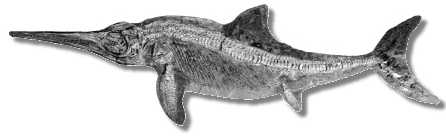
The Fort Francis Times reports on the unveiling of a new marine reptile, Shonisaurus sikanniensis, a species of ichthyosaur, at the Royal Tyrrell Museum. The event marked the culmination of a large-scale effort following the 1994 discovery of the marine reptile’s long and slender remains, said Royal Tyrrell curator Don Brinkman.

Shonisaurus sikanniensis is the legacy of Royal Tyrrell’s Betsy Nicholls (L), who collected and prepared the nearly complete skeleton found along British Columbia’s Sikanni Chief River. The 56-year-old good friend of the palaeoblog died of cancer in November but not before seeing through the major life achievement that began with the challenging excavation in 1998 and lasted until 2000, when she won an award for dedication to the project.

Nicholls and Japan’s Makoto Manabe described Shonisaurus sikanniensis as a three-metre-long creature with a thin-boned skull and no signs of teeth, although it’s believed this species of ichthyosaur lost them as it grew.

“Imagine a dolphin at whale size but not quite as big as a blue whale, the world’s largest animal,” Don Brinkman, Head of Research at the RTMP said.

“It’s the first evidence we have of filter-feeding animals—those that take in water and screen out small food particles, much like a whale does,” he added.

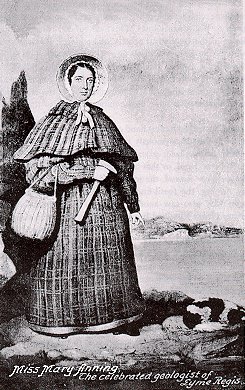
Died This Day: Mary Anning

From Today in Science History:

Mary Anning (May, 21 1799 - March 9, 1847)

English fossil collector who made her first significant discovery at the age of 11 or 12 (sources differ on the details), when she found a complete skeleton of an Ichthyosaurus, from the Jurassic period. The ten-meter (30 feet) long skeleton created a sensation and made her famous. Anning's determination and keen scientific interest in fossils derived from her father's interest in fossil hunting, and a need for the income derived from them to support her family after his death. in 1810. She sold large fossils to noted paleontologists of the day, and smaller ones to the tourist trade. In 1823, Anning made another great discovery, found the first complete Plesiosaurus. Later in her life, the Geological Society of London granted Anning an honorary membership.

Tuesday, March 08, 2005

Japanese Robo-Saurs

Japanese scientists and engineers have built mini-robotic replicas of T. rex and the duck-billed dinosaur Parasaurolophus for a new World Exposition to open in their country later this year.


Picture: AFP Photo/Toru Yamanaka

Read the full story at AnimalPlanet.com here.
Watch the video from NBC4.TV of the "robo-saurs" here (for a limited time).

Monday, March 07, 2005

Born This Day 1930: Stanley Lloyd Miller

From Today in Science History:


Miller is an American chemist who made a series of famous experiments beginning in 1953, to determine the possible origin of life from inorganic chemicals on the primeval earth. He passed electrical discharges (simulating thunderstorms) through mixtures of reducing gases, such as hydrogen, ammonia, methane and water, that were believed to have formed the earliest atmosphere. An analysis days later showed that the resulting chemicals included glycine and alanine, the simplest amino acids & the basic building blocks of proteins. Other compounds included urea, aldehydes and carboxylic acids. Thus, a "primeval soup" is the currently accepted most plausible explanation, though incomplete, of the origin of the complex organic molecules of life.

Saturday, March 05, 2005

CMNH Team Discovers Humankind's First Walking Ancestor

Various news sources, including Anthony Mitchell of the CBC, are reporting on a new find made by researcher’s from the Cleveland Museum of Natural History that has been whispered around the halls here for the past week.


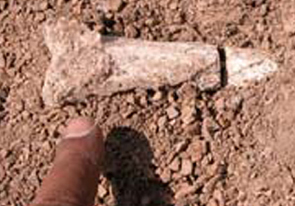
Tibia of new hominid

Yohannes Haile-Selassie, an Ethiopian scientist and curator at the Cleveland Museum of Natural History as well a co-leader of the discovery team believes that they have found the fossilized remains of what they believe is humankind's first walking ancestor, a hominid that lived in the wooded grasslands of the Horn of Africa nearly 4 million years ago. The bones were discovered in February at a new site called Mille, in the northeastern Afar region of Ethiopia, said Bruce Latimer, director of the Cleveland Museum of Natural History in the U.S. state of Ohio. They are estimated to be 3.8-4 million years old.

The fossils include a complete tibia from the lower part of the leg, parts of a thighbone, ribs, vertebrae, a collarbone, pelvis and a complete shoulder blade, or scapula. There is also an anklebone which, with the tibia, proves the creature walked upright, said Latimer, co-leader of the team that discovered the fossils.
The bones are the latest in a growing collection of early human fragments that help explain the evolutionary history of man.

"Right now we can say this is the world's oldest bipedal and what makes this significant is because what makes us human is walking upright," Latimer said. "This new discovery will give us a picture of how walking upright occurred."

Paleontologists previously discovered in Ethiopia the remains of a hominid called Ardipithecus ramidus, a transitional creature with significant ape-like characteristics that lived as far back as 4.5 million years. Scientists know little about A. ramidus. A few skeletal fragments suggest it was even smaller than Australopithecus afarensis, the 3.2 million-year-old species widely known by the nearly complete "Lucy" fossil, which measures about 4 feet tall.

Scientists are yet to classify the new find, which they believe falls between A. ramidus and A. afarensis. The specimen is the only the fourth partial skeleton ever to be discovered that is older than 3 million years. It was found after two months of excavation at Mille, 37 miles from the famous Lucy discovery.

Friday, March 04, 2005

Kong vs. T.rex


Art (c) Frank Cho
Not much in the news today so we exit the week with a beautiful rendition of King Kong from Frank Cho's art gallery over at his Liberty Meadows home page (warning: Frank has several drawings of neked women posted here so enter at your own risk!)

Thursday, March 03, 2005

New Human Species Smarter Than The Average Bear?

This week in Science:
Small but Smart? Flores Hominid Shows Signs of Advanced Brain Michael Balter. 2005. Science 307: 1386-1389

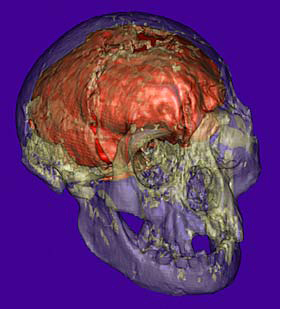
National Geographic News has an article on the recently discovered new species of 18,000-year old human, Homo florenensis. The new species has been verified based on the study of the braincase published today in Science.

The little human was discovered on the isolated of island of Flores in Indonesia and occupied it from at least 95,000 years ago until around 12,000 years ago.

H. floresiensis grew to be only about one meter high and, despite having a very small brain (roughly the size of a chimpanzee's) they appear to have hunted animals twice their size, made stone tools for hunting and butchering, and used fire for cooking.

"It's remarkable. We've always been taught and thought that as humans evolved, the bigger the brain, the better they are," said Charles Hildebolt, a physical anthropologist at Washington University in St. Louis, Missouri.

"If this little creature actually made the tools and was using the tools, built the fire and was using the fire, then that really tips human evolution upside down and changes the way we have to think about brain evolution. It may indicate that the reorganization of the brain was just as important and may be even more important than size."

Hildebolt was a member of the team, led by paleoneurologist Dean Falk of Florida State University, that studied the braincase of the species.

Dinosaur Extinction in North America

From the March issue of GSA TODAY:

The extinction of the dinosaurs in North America
David E. Fastovsky, Department of Geosciences, University of Rhode Island, and Peter M. Sheehan, Department of Geology, Milwaukee Public Museum.

Did the dinosaurs really go abruptly extinct 65 million years ago at the Cretaceous-Tertiary ("K-T") time boundary, or was their K-T extinction the end result of a gradual decline over millions of years? The imperfect record available from scarce dinosaur remains has made this question a true enigma and the source of a long-standing and contentious debate. David E. Fastovsky and Peter M. Sheehan conclude, after a careful review of the fossil record from the best-documented dinosaur sites (in North America), that the extinction was indeed geologically instantaneous. The authors argue that the sudden die-off was different in scope from previous fluctuations in dinosaur diversity through the dinosaurs' 160 million years on Earth. The authors consider the dinosaurs to have been direct casualties of the K-T impact of an asteroid with Earth and review several potential explanations for the mechanism of the extinction. All of these are concordant with the asteroid with Earth and review several potential explanations for the mechanism of the extinction. All of these are concordant with the asteroid impact as the ultimate cause.

1.85 billion Year Old Impact Ejecta Found In Canada

From the March issue of Geology:

Discovery of distal ejecta from the 1850 Ma Sudbury impact event
William D. Addison, Kakabeka Falls, Ontario P0T 1W0, Canada; et al. Pages 193-196.
Impact ejecta has been found from the Sudbury, Ontario, Canada, structure, the second largest and third or fourth oldest extraterrestrial Earth impact site. At 1.85 billion years old, these Paleoproterozoic ejecta are three times older than the previous oldest dated ejecta linked to a specific impact (Acraman, Australia, 0.59 billion years old). It is also larger than the well-known Chicxulub, Mexico (0.065 billion years old) impact linked to the extinction of the dinosaurs and many other species. The debris (ejecta) studied here, landed 650 km west northwest of Sudbury near Thunder Bay, Ontario, Canada, and 875 km west of Sudbury near Hibbing, Minnesota, United States. This huge impact likely deposited debris all around Earth, but it is very difficult to find because so much of the evidence has been destroyed in the recycling of Earth's crust by plate tectonics. Life at the time of the Sudbury impact was confined to the oceans and consisted of unicellular and colonial unicellular organisms.
Also noted:

A Jurassic-Cretaceous boundary age and mid-ocean-ridge¡Vtype mantle source for Shatsky RiseJ.J. Mahoney,et al. Geology 15:185-188.
Basalt sills were cored recently in Ocean Drilling Program Hole 1213B in the southern part of the rise. Dating of the basalic sills in the Shatsky Rise, a large oceanic plateau in the northwest Pacific.provides an important new age estimate of the boundary between two geological periods, the Jurassic and the Cretaceous; this age is 144.6 +/- 0.8 million years before present.

Wednesday, March 02, 2005

KING KONG: Released This Day In 1933


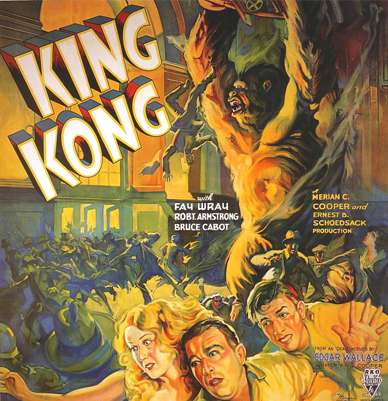
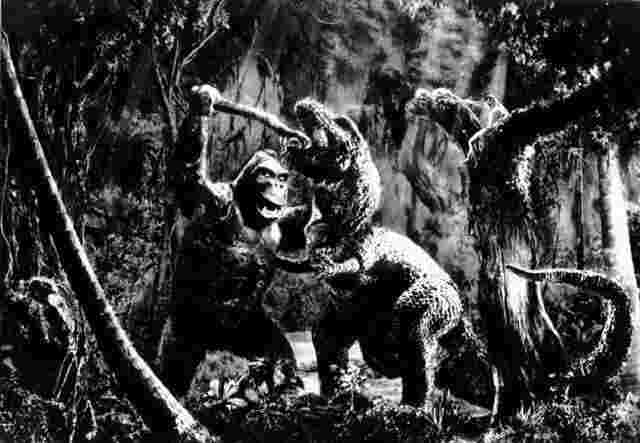
The movie King Kong was one of the most successful films released in 1933. It went on to inspire many young fans (both in its initial release, numerous re-releases, and on television) to take up the professions of either film-making or paleontology. The field of dinosaur paleobiology would be very different today if King Kong had never met Fay Wray on Skull Island "way west of Sumatra" and been taken to the concrete jungle of New York.

In a remarkable coincidence the artist, Willis O'Brien, who created and brought Kong to life, celebrated his 47th birthday on the day the movie debuted in New York City.

Thanks to Tim Cole for the head's up on this date.

Father of King Kong Born This Day

A tip of the fedora to the late, great Willis O'Brien who breathed life into the fur and armature that become King Kong, the Seventh Wonder of the World!


His biography from Leonard Maltin's Movie Encyclopedia:

Willis O'Brien (March 2, 1886 - November 8, 1962)
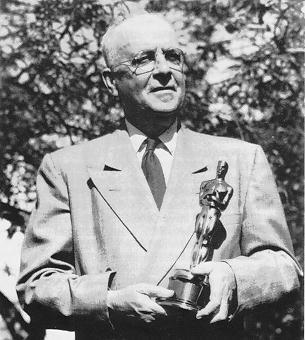
Special effects wizard best known to the world as the man who created King Kong. O'Brien was a sculptor and cartoonist for the San Francisco "Daily News" before he first dabbled in the medium of film during the 'teens. His work caught the attention of the Edison company, for whom he produced several short subjects with a prehistoric them.Titles include The Dinosaur and the Missing Link, RFD 10,000 B.C and Prehistoric Poultry. His method of animating small rubber figures, carefully molded over metal skeletons with movable joints, by moving them a fraction of an inch for each frame of film exposed, became the standard process of live-action animation. In 1918 he made his most ambitious film yet, The Ghost of Slumber Mountain paving the way for The Lost World (1925), a major Hollywood feature which told of a search for prehistoric creatures. O'Brien's dinosaurs were his most realistic yet, and still impress today, even in the wake of Jurassic Park Still, Obie (as he was known) kept experimenting. When producer Merian C. Cooper saw his work, he hired O'Brien to animate King Kong (which, up to that point, was to have been shot with an actor in a gorilla suit). The extraordinary success of King Kong (1933) spawned an immediate sequel, The Son of Kong (also 1933), and made O'Brien a hero to several generations of fantasy filmmakers to come. O'Brien won his only Oscar for his effects in Mighty Joe Young (1949), another giant-monkey movie, on which his protégé (and successor) Ray Harryhausen worked. O'Brien worked on other giant-monster movies (including 1957's The Black Scorpion his last) before dying in 1962. Today, O'Brien would be kingpin of his own studio, but even in the wake of King Kong he had trouble launching other film projects, and many promising ideas languished on studio drawing boards for decades to follow. One of the RKO staff with whom he'd worked in the 1930s, Linwood Dunn, gave O'Brien his final employment, doing stop-motion figures for It's a Mad Mad Mad Mad World (1963).


In 1950 O'Brien received (finally!) a special Oscar for his work on Mighty Joe Young which was the first such award ever given for special effects. This film also launched the career of the next great stop-motion animator, Ray Harryhausen.

Tuesday, March 01, 2005

Today In History: Cope vs. Marsh


From Today Today In Science History:

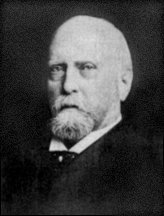
In 1872, rival paleontologists Edward Drinker Cope (R) and O.C. Marsh(L) vie for recognition of their work on the fossilized remains of an animal with large wings from the dinosaur era. Today, Cope reads his paper to the American Philosophical Society in Philadelphia in which he named the creature as Ornithochirus. However, Marsh beat him into print in the American Journal of Science a few days earlier, and the name he used, Pterodactylis, was thus established.

For more information on the Cope-Marsh Wars read the book, The Gilded Dinosaur by Mark Jaffe. For a limited time pick the book up cheap at Edward R Hamilton Bookseller. This book dealer frequently has recent books on paleontology on sale for a fraction of their original price.

Cretaceous Chicxulub Impact Crater Update


Chris Hawley of the Arizona Republic writes an update about the research currently being done on the Chicxulub crater site, the point of impact for an asteroid that lead to the demise of the dinosaurs at the end of the Cretaceous 65 million years ago.

The Chicxulub (pronounced CHEEK-SHOO-LOOB) Crater is more than 120 miles wide. It lies half on land and half underwater on the northern coast of the Yucatán Peninsula. Chicxulub Puerto, a beachside village 12 miles north of the town of Chicxulub, was ground zero. The area was under water at the time of the disaster 65 million years ago, and coral reefs and sediment have since buried the crater a half-mile deep.

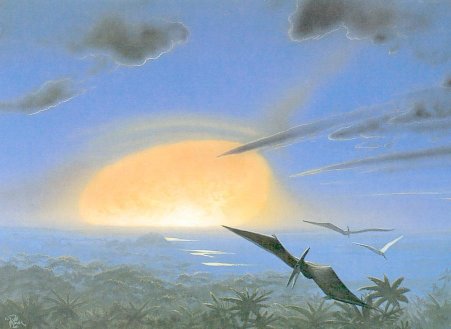
Scientists aren't sure whether it was a comet or meteorite that hit the Earth, but the impact vaporized everything around it, turning Chicxulub into a lake of molten rock, Kring said. The blast threw 25 trillion tons of rock into space. The pieces fell back as a fiery rain of rocks, killing animals and setting most of the world's vegetation on fire. Dust and smoke blotted out the sun, causing an artificial winter.

"You could go on for weeks talking about all the environmental effects this caused," David Kring, University of Arizona geologist said. "There were magnitude 10 earthquakes, tsunamis that dwarfed what happened recently in Indonesia, and incinerating heat."