Tuesday, June 30, 2015

Monday, June 29, 2015

Born This Day: Ray Harryhausen


Ray would have been 95 today.
Visit Ray's official site.

Died This Day: Thomas Huxley

From the UC Berkeley Page:

Huxley (May, 4, 1825 - June 29, 1895) was born in Ealing, near London, the seventh of eight children in a family that was none too affluent. At 21, Huxley signed on as assistant surgeon on the H.M.S. Rattlesnake, a Royal Navy frigate assigned to chart the seas around Australia and New Guinea. Huxley collected and studied marine invertebrates, in particular cnidarians, tunicates, and cephalopod mollusks. After leaving the Navy in 1854, Huxley managed to secure a lectureship at the School of Mines in London.
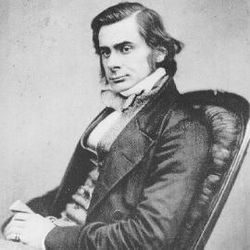
Huxley was a passionate defender of Darwin's theory -- so passionate that he has been called "Darwin's Bulldog" – and also a great biologist in his own right, who did original research in zoology and paleontology.

He is best known for his famous debate in June 1860, at the British Association meeting at Oxford. His opponent, Archbishop Samuel Wilberforce, was not-so-affectionately known as "Soapy Sam" for his renowned slipperiness in debate. During the debate, Archbishop Wilberforce ridiculed evolution and asked Huxley whether he was descended from an ape on his grandmother's side or his grandfather's. Accounts vary as to exactly what happened next, but according to one telling of the story, Huxley muttered "The Lord hath delivered him into my hands," and then rose to give a brilliant defense of Darwin's theory, concluding with the rejoinder, "I would rather be the offspring of two apes than be a man and afraid to face the truth."

All accounts agree that Huxley trounced Wilberforce in the debate, defending evolution as the best explanation yet advanced for species diversity.

However, Huxley did not blindly follow Darwin's theory, and critiqued it even as he was defending it. In particular, where Darwin had seen evolution and a slow, gradual, continuous process, Huxley thought that an evolving lineage might make rapid jumps, or saltations. As he wrote to Darwin just before publication of the Origin of Species, "You have loaded yourself with an unnecessary difficulty in adopting Natura non facit saltum [Nature does not make leaps] so unreservedly."
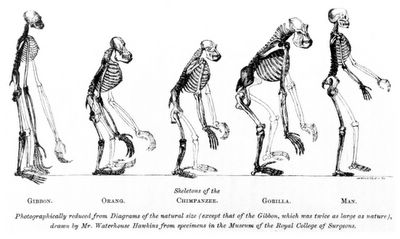


Huxley's most famous writing, published in 1863, is Evidence on Man's Place in Nature. This book, published only five years after Darwin's Origin of Species, was a comprehensive review of what was known at the time about primate and human paleontology and ethology. More than that, it was the first attempt to apply evolution explicitly to the human race. Huxley explicitly presented evidence for human evolution.

Huxley founded a remarkable dynasty of English scientists and thinkers. His son Leonard was a noted biographer and "man of letters." Leonard's oldest son Julian was one of the authors of the evolutionary synthesis of the early 20th century; Julian's son Francis became a noted anthropologist. Julian's brother Aldous Huxley was a novelist, screenwriter and essayist; his best-known book is the anti-utopia Brave New World.

Saturday, June 27, 2015

Friday, June 26, 2015

Hallucigenia’s Head

Hallucigenia’s head and the pharyngeal armature of early ecdysozoans. 2015. Nature

Illo by Danielle Dufualt

Abstract: The molecularly defined clade Ecdysozoa comprises the panarthropods (Euarthropoda, Onychophora and Tardigrada) and the cycloneuralian worms (Nematoda, Nematomorpha, Priapulida, Loricifera and Kinorhyncha). These disparate phyla are united by their means of moulting, but otherwise share few morphological characters—none of which has a meaningful fossilization potential. As such, the early evolutionary history of the group as a whole is largely uncharted.

Here we redescribe the 508-million-year-old stem-group onychophoran Hallucigenia sparsa from the mid-Cambrian Burgess Shale. We document an elongate head with a pair of simple eyes, a terminal buccal chamber containing a radial array of sclerotized elements, and a differentiated foregut that is lined with acicular teeth. The radial elements and pharyngeal teeth resemble the sclerotized circumoral elements and pharyngeal teeth expressed in tardigrades, stem-group euarthropods and cycloneuralian worms.

Phylogenetic results indicate that equivalent structures characterized the ancestral panarthropod and, seemingly, the ancestral ecdysozoan, demonstrating the deep homology of panarthropod and cycloneuralian mouthparts, and providing an anatomical synapomorphy for the ecdysozoan supergroup.

The topology shown denotes a newly retrieved ‘hallucishaniid’ clade—diagnosed by a swollen head, dorsal spines, and the differentiation of the anterior trunk and trunk appendages—includes luolishaniids, Orstenotubulus (not shown) and Carbotubulus within a paraphyletic ‘Hallucigenia’.

Tuesday, June 23, 2015

Died This Day: William Crawford Williamson - Father of Paleobotany


Williamson (Nov. 24, 1816-June 23, 1895) was an English naturalist who founded modern paleobotany. His father, John Williamson, was a Yorkshire geologist and the friend of William Smith, the father of English geology. Dr. Williamson's first paper (on organic remains in the Lias of Yorkshire) was published in 1834, when he was only 18.. In 1835 he was appointed curator of the Manchester Natural History Museum, a post which he held while pursuing his medical studies. His numerous earlier papers include one of the first memoirs on Foraminifera, a series of papers on the development of the scales and teeth of fishes.

Williamson was one of the oldest Fellows of the Royal Society, having been elected in 1854. He produced 19 memoirs on the "Organization of the Fossil Plants of the Coal-measures" between 1871 and 1893. He was appointed Professor of Natural History and Geology at Owens College, in 1851, and continued to hold the Chair of Botany until 1892. From here

Monday, June 22, 2015

Premiered This Day (1925): The Lost World


The first and greatest of the film versions of Sir Arthur Conan Doyle's classic book.

Starring the great Wallace Beery as Prof. Challenger, with stunning stop-motion animation by Willis O'Brien

Thursday, June 18, 2015

Giant 16 Million Year Old Walking Bats Discovered in New Zealand

Miocene Fossils Reveal Ancient Roots for New Zealand’s Endemic Mystacina (Chiroptera) and Its Rainforest Habitat. 2015. PLoS One

Kamandi by Jack Kirby © DC Comics

The new fossil bat species, Mystacina miocenalis, which lived 16 million years ago, walked on four limbs and was three times larger than today's average bat, have been discovered in New Zealand.

"Our discovery shows for the first time that Mystacina bats have been present in New Zealand for upwards of 16 million years, residing in habitats with very similar plant life and food sources," says Suzanne Hand.

These bats were believed to have an ancient history in New Zealand, but until now, the oldest fossil of a Mystacina bat in New Zealand was from a cave in South Island, dating to 17,500 years ago. This latest discovery forces a rethink of when these peculiar, walking bats first crossed the ditch, arriving from what is present-day Australia. PR

The Dragon from Die Nibelungen (1924)


From Gifts From The Sea, with more info.

Wednesday, June 17, 2015

Tuesday, June 16, 2015

Born This Day: George Gaylord Simpson

Simpson (June 16, 1902 - October 6, 1984) is known for his contributions to evolutionary theory and to the understanding of intercontinental migrations of animal species in past geological times. Simpson specialized in early fossil mammals, leading expeditions on four continents and discovering in 1953 the 50-million-year old fossil skulls of dawn horses in Colorado.
Simpson helped develop the modern biological theory of evolution, drawing on paleontology, genetics, ecology, and natural selection to show that evolution occurs as a result of natural selection operating in response to shifting environmental conditions. He spent most of his career as a paleontologist at the American Museum of Natural History. image. From Today In Science History.

Saturday, June 13, 2015

Born This Day: Luis Alvarez

Alverez (June 13, 1911 - Sept. 1, 1988) was an American experimental physicist who was awarded the Nobel Prize for Physics in 1968 for work that included the discovery of many resonance particles --subatomic particles having extremely short lifetimes and occurring only in high-energy nuclear collisions.

In about 1980 Alvarez (left) helped his son, the geologist Walter Alvarez (right), publicize Walter's discovery of a worldwide layer of clay that has a high iridium content and which occupies rock strata at the geochronological boundary between the Mesozoic and Cenozoic eras; i.e., about 66.4 million years ago.

They postulated that the iridium had been deposited following the impact on Earth of an asteroid or comet and that the catastrophic climatic effects of this massive impact caused the extinction of the dinosaurs. Though initially controversial, this widely publicized theory gradually gained support as the most plausible explanation of the abrupt demise of the dinosaurs.

Read more HERE. Image from HERE.

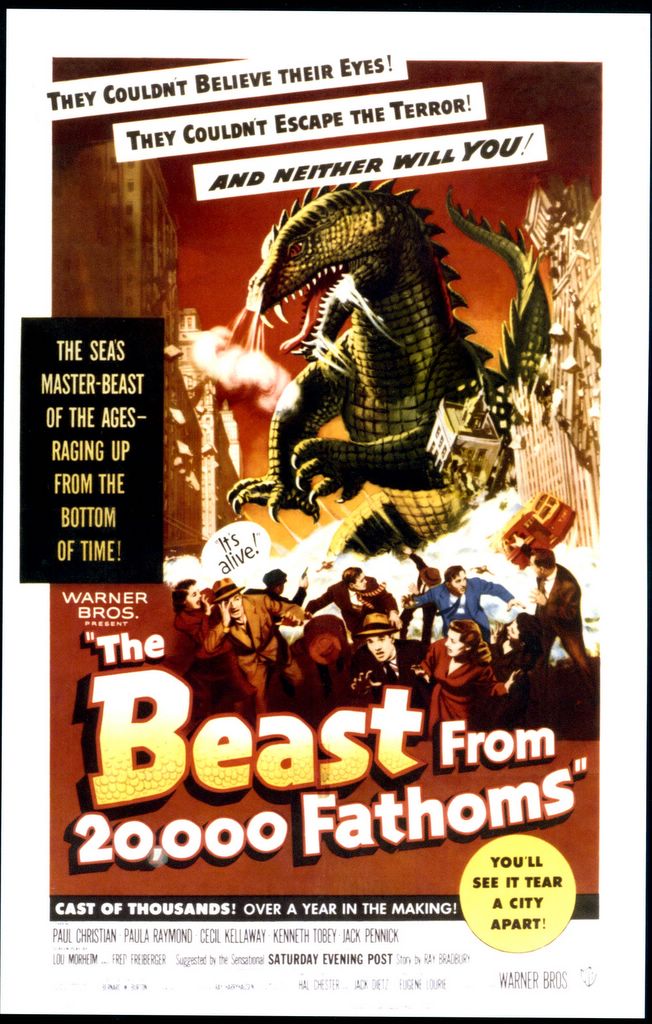
Premiered This Day (1958): The Beast From 20,000 Fathoms

Directed by Eugène Lourié, this was Ray Harryhausen’s first solo film after having finished his apprenticeship with Willis O’Brien on Mighty Joe Young. Apparently the dinosaur skeleton in the museum sequence was the same one used in Bringing Up Baby.

Thursday, June 11, 2015

Downsizing Dreadnoughtus?

Downsizing a giant: re-evaluating Dreadnoughtus body mass. 2015. Biology Letters.


Scientists have shown that the most complete giant, 26 metres long sauropod dinosaur, Dreadnoughtus, discovered in South America in 2014, was not as large as previously thought.

To estimate the mass of Dreadnoughtus scientists originally used a scaling equation that predicts body mass based on the size of thigh and arm bones. This method produced a range of estimates with the average being a colossal 60 tonnes.

Now another group of scientists have used a three-dimensional skeletal modelling technique to examine body mass more directly and found that the mass of the Dreadnoughtus was more likely to be between 30 and 40 tonnes, considerably less than originally thought.
Ah yes, the 'digitally dunking a toy model in water to measure displacement' method of estimating mass. I'll stick to the 'mass estimation' technique of Campione, et. al., 2014.

Premiered This Day (1993): Jurassic Park

The modern game-changer of dinosaur movies.