(Jean) Louis (Rodolphe) Agassiz (May 28, 1807 - Dec. 14, 1873) was a Swiss-born U.S. naturalist, geologist, and teacher who made revolutionary contributions to the study of natural science with landmark work on glacier activity and extinct fishes. Agassiz began his work in Europe, having studied at the University of Munich and then as chair in natural history in Neuchatel in Switzerland. While there he published his landmark multi-volume description and classification of fossil fish.
In 1846 Agassiz came to the U.S. to lecture before Boston's Lowell Institute. Offered a professorship of Zoology and Geology at Harvard in 1848, he decided to stay, becoming a citizen in 1861. His innovative teaching methods altered the character of natural science education in the U.S. Link
More info HERE
Thursday, May 28, 2015

Wednesday, May 27, 2015
CMNH Curator Describes New Human Ancestor, Australopithecus deyiremeda
New species from Ethiopia further expands Middle Pliocene hominin diversity. 2015. Nature.

Australopithecus deyiremeda is a new 3.3 to 3.5 million-year-old human ancestor. Its upper and lower jaw fossils were recovered from the Woranso-Mille area of the Afar region of Ethiopia. This hominin lived alongside the famous “Lucy’s” species, Australopithecus afarensis. PR

Australopithecus deyiremeda is a new 3.3 to 3.5 million-year-old human ancestor. Its upper and lower jaw fossils were recovered from the Woranso-Mille area of the Afar region of Ethiopia. This hominin lived alongside the famous “Lucy’s” species, Australopithecus afarensis. PR


Died This Day: Sandra Shaw

Arbogast on Film blog has nice appreciation of Sandra Shaw’s few famous film moments.
Tuesday, May 26, 2015
Giant Brains Are Better
Brain size affects female but not male survival under predation threat. 2015. Biological Letters.

New research has shown that in the course of evolution larger brains offer a higher survival potential than smaller brains. PR

New research has shown that in the course of evolution larger brains offer a higher survival potential than smaller brains. PR
Monday, May 25, 2015

Friday, May 22, 2015

Born This Day: Oliver Perry Hay
Hay (May 22, 1846 – Nov. 2, 1930) was an American paleontologist whose catalogs of fossil vertebrates greatly organized existing knowledge and became standard references. Hay's primary scientific interest was the study of the Pleistocene vertebrata of North America and he is renowned for his work on skull and brain anatomy. His first major work was his Bibliography and Catalogue of the Fossil Vertebrata of North America (1902), supplemented by two more volumes (1929-30). Hay also wrote on the evidence of early humans in North America. link
Thursday, May 21, 2015
The First Dinosaur from Washington State

The First Dinosaur from Washington State. 2015. PLoS One
The fossil is 16.7 inches long and 8.7 inches wide. Because the fossil is incomplete, paleontologists aren't able to identify the exact theropod family or species it belonged to. However, Sidor and Peecook compared the fossil to other museums' specimens and were able to calculate that the complete femur would have been over 3 feet long -- slightly smaller than T. rex. The fossil is from the Late Cretaceous period and is approximately 80 million years old. PR
Born This Day: Mary Anning
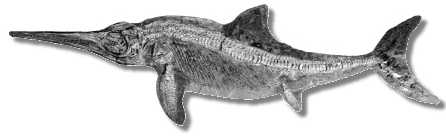
Mary Anning (May 21, 1799 - March 9, 1847) was an English fossil collector who made her first significant discovery at the age of 11 or 12 (sources differ on the details),  when she found a complete skeleton of an Ichthyosaurus, from the Jurassic period. The ten-meter (30 feet) long skeleton created a sensation and made her famous.
Anning's determination and keen scientific interest in fossils derived from her father's interest in fossil hunting, and a need for the income derived from them to support her family after his death. in 1810. She sold large fossils to noted paleontologists of the day, and smaller ones to the tourist trade. In 1823, Anning made another great discovery, found the first complete Plesiosaurus.
Later in her life, the Geological Society of London granted Anning an honorary membership.
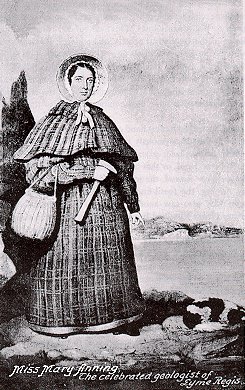 when she found a complete skeleton of an Ichthyosaurus, from the Jurassic period. The ten-meter (30 feet) long skeleton created a sensation and made her famous.
Anning's determination and keen scientific interest in fossils derived from her father's interest in fossil hunting, and a need for the income derived from them to support her family after his death. in 1810. She sold large fossils to noted paleontologists of the day, and smaller ones to the tourist trade. In 1823, Anning made another great discovery, found the first complete Plesiosaurus.
Later in her life, the Geological Society of London granted Anning an honorary membership.
Wednesday, May 20, 2015
Died This Day: Stephen Jay Gould
Here’s a nice piece on Gould by Henry Lowood from the Stanford Presidential Lectures in the Humanities and Arts.

Tuesday, May 19, 2015
Born This Day: William King Gregory
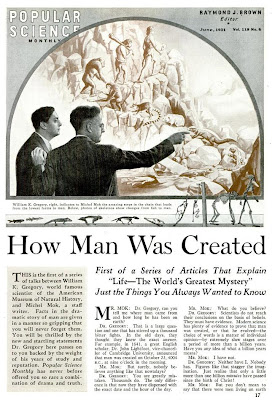
William King Gregory (May, 19 1876 – Dec. 29, 1970) was an American zoologist and paleontologist who studied under Henry Fairfield Osborn and joined the American Museum of Natural History in 1911. As a professor at Columbia University one of his students was Alfred Sherwood Romer. His work charted the evolution from the early fishes through the various branches to birds and mammals, with numerous papers and two important books: Our Face from Fish to Man (1929) and Evolution Emerging (1951).
In the early 1920s he also became interested in recent human evolution and joined the Central Asiatic Expedtions lead by Roy Chapman Andrews whose original goal was to find evidence of human ancestors in the Gobi Desert. With C.C. Mook he wrote the paper, On Protoceratops, a primative ceratopsian dinosaur from the Lower Cretaceous of Mongolia and well as numerous papers on Cretaceous mammals.
Gregory wrote a number of popular articles on evolution and fossils that you find through the Google Books on-line archive of old magazines.


In the early 1920s he also became interested in recent human evolution and joined the Central Asiatic Expedtions lead by Roy Chapman Andrews whose original goal was to find evidence of human ancestors in the Gobi Desert. With C.C. Mook he wrote the paper, On Protoceratops, a primative ceratopsian dinosaur from the Lower Cretaceous of Mongolia and well as numerous papers on Cretaceous mammals.
Gregory wrote a number of popular articles on evolution and fossils that you find through the Google Books on-line archive of old magazines.


Premiered This Day (1915): The Dinosaur & The Missing Link
On this day back in 1915, The Dinosaur and The Missing took its bow in US cinemas. It features the earliest work of a young Willis O'Brien who would go on to bring King Kong to life. Watch the film thanks to The Library of Congress.
Born This Day: Carl Akeley

The Hall of African Mammals at the American Museum of Natural History exists thanks to the efforts of Carl Akeley (May 19, 1864 - Nov 17, 1926) who was the kind of adventurer that Indy Jones could only dream of being.

He died on an African expedition in 1926, ten years before this hall was completed and was buried in a place depicted in the Hall's famous Gorilla Diorama. Of course we approach collecting and conservation differently today, but Akeley is to be commended for his love of nature and his desire to present its hidden corners to the world.
From Today In Science History:
Carl Ethan Akeley was an American naturalist and explorer who developed the taxidermic method for mounting museum displays to show animals in their natural surroundings. His method of applying skin on a finely molded replica of the body of the animal gave results of unprecedented realism and elevated taxidermy from a craft to an art. He mounted the skeleton of the famous African elephant Jumbo. He invented the Akeley cement gun to use while mounting animals, and the Akeley camera which was used to capture the first movies of gorillas.

Monday, May 18, 2015

Sunday, May 17, 2015
Scopes Monkey Trail Law Repealed
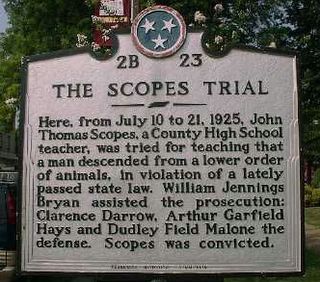
On this day in 1967, the governor of Tennessee signed into law the repeal of the 1925 state law prohibiting the teaching of evolution.From Today In Science History
The original law had made it "unlawful for any teacher in any of the Universities, Normals and all other public schools of the State which are supported in whole or in part by the public school funds of the State, to teach any theory that denies the story of the Divine Creation of man as taught in the Bible, and to teach instead that man has descended from a lower order of animals."
It was this law that was tested in what became known as the "Scopes monkey trial." Scopes was found guilty, but acquitted on a technicality upon appeal. The law itself remained a Tennessee state statute for 42 years.
Born This Day: Thomas Davison
May 17, 1817 – Oct. 14, 1885
Davison was a Scottish naturalist and paleontologist who became known as an authority on brachiopods. His major work, Monograph of British Fossil Brachiopoda, was published by the Palaeontographical Society. Together with supplements, this comprised six quarto volumes with more than 200 plates drawn on stone by the author. Upon his death, he bequeathed his fine collection of recent and fossil brachiopoda to the British Museum.
Davison was a Scottish naturalist and paleontologist who became known as an authority on brachiopods. His major work, Monograph of British Fossil Brachiopoda, was published by the Palaeontographical Society. Together with supplements, this comprised six quarto volumes with more than 200 plates drawn on stone by the author. Upon his death, he bequeathed his fine collection of recent and fossil brachiopoda to the British Museum.
Saturday, May 16, 2015

Friday, May 15, 2015


Thursday, May 14, 2015
New Dino-Birds: How the Beak Evolved
A molecular mechanism for the origin of a key evolutionary innovation, the bird beak and palate, revealed by an integrative approach to major transitions in vertebrate history. 2015. Bhullar, B-A. S., et al. Evolution

Scientists have successfully replicated the molecular processes that led from dinosaur snouts to the first bird beaks. PR
Abstract: The avian beak is a key evolutionary innovation whose flexibility has permitted birds to diversify into a range of disparate ecological niches. We approached the problem of the mechanism behind this innovation using an approach bridging paleontology, comparative anatomy, and experimental developmental biology.
First we used fossil and extant data to show the beak is distinctive in consisting of fused premaxillae that are geometrically distinct from those of ancestral archosaurs. To elucidate underlying developmental mechanisms, we examined candidate gene expression domains in the embryonic face: the earlier frontonasal ectodermal zone (FEZ) and the later midfacial Wnt-responsive region, in birds and several reptiles. This permitted the identification of an autapomorphic median gene expression region in Aves.
In order to test the mechanism, we used inhibitors of both pathways to replicate in chicken the ancestral amniote expression. Altering the FEZ altered later Wnt responsiveness to the ancestral pattern. Skeletal phenotypes from both types of experiments had premaxillae that clustered geometrically with ancestral fossil forms instead of beaked birds.
The palatal region was also altered to a more ancestral phenotype. This is consistent with the fossil record and with the tight functional association of avian premaxillae and palate in forming a kinetic beak.

Scientists have successfully replicated the molecular processes that led from dinosaur snouts to the first bird beaks. PR
Abstract: The avian beak is a key evolutionary innovation whose flexibility has permitted birds to diversify into a range of disparate ecological niches. We approached the problem of the mechanism behind this innovation using an approach bridging paleontology, comparative anatomy, and experimental developmental biology.
First we used fossil and extant data to show the beak is distinctive in consisting of fused premaxillae that are geometrically distinct from those of ancestral archosaurs. To elucidate underlying developmental mechanisms, we examined candidate gene expression domains in the embryonic face: the earlier frontonasal ectodermal zone (FEZ) and the later midfacial Wnt-responsive region, in birds and several reptiles. This permitted the identification of an autapomorphic median gene expression region in Aves.
In order to test the mechanism, we used inhibitors of both pathways to replicate in chicken the ancestral amniote expression. Altering the FEZ altered later Wnt responsiveness to the ancestral pattern. Skeletal phenotypes from both types of experiments had premaxillae that clustered geometrically with ancestral fossil forms instead of beaked birds.
The palatal region was also altered to a more ancestral phenotype. This is consistent with the fossil record and with the tight functional association of avian premaxillae and palate in forming a kinetic beak.
Wednesday, May 13, 2015
Died This Day: Georges Cuvier

August 23, 1769 – May 13, 1832
Read about him at the University of California Museum of Paleontology.
Subscribe to:
Posts (Atom)