Wednesday, April 29, 2015

Yi qi, The Chinese Gliding Dinosaur


A new scansoriopterygid theropod, Yi qi from the Middle–Upper Jurassic period Tiaojishan Formation of Hebei Province, China has large stiff filamentous feathers of an unusual type on both the forelimb and hindlimb.

These feathers resemble pinnate feathers in bearing morphologically diverse melanosomes. Most surprisingly, Yi has a long rod-like bone extending from each wrist, and patches of membranous tissue preserved between the rod-like bones and the manual digits.

Analogous features are unknown in any dinosaur but occur in various flying and gliding tetrapods, suggesting that Yi was a gliding dinosaur.

Read Brian Switek's story about Yi qi at Smithsonian.com


Born This Day: Richard Carlson


Carlson (April 29, 1912 – Nov. 24, 1977) starred as Dr. David Reid (center)in the classic Creature From The Black Lagoon (1957). You know that he was the “good” scientist cuz he got the girl, even though he let a cover story for Nature skulk back into the Lagoon.

Died This Day: Julie Ege


Nov. 12, 1943 – April 29, 2008
The late Julie Ege had the lead role as Nala in the 1971 Hammer film, “Creatures The World Forgot”.

Monday, April 27, 2015

Chilesaurus, A Plant-Eating Theropod from Chile

An enigmatic plant-eating theropod from the Late Jurassic period of Chile. 2015. Novas, F., et al. Nature.


Chilesaurus diegosuarezi is a new, bizarre herbivorous basal tetanuran discovered at Aysén, a fossil locality in the Upper Jurassic Toqui Formation of southern Chile. The site yielded abundant and exquisitely preserved three-dimensional skeletons of small archosaurs. Several articulated individuals of Chilesaurus at different ontogenetic stages have been collected, as well as less abundant basal crocodyliforms, and fragmentary remains of sauropod dinosaurs (diplodocids and titanosaurians).

Chilesaurus had robust forelimbs similar to Jurassic theropods such as Allosaurus, although its hands were provided with two blunt fingers, unlike the sharp claws of fellow theropod Velociraptor. Chilesaurus' pelvic girdle resembles that of the ornithischian dinosaurs.

Chilesaurus can be considered a 'platypus' dinosaur because different parts of its body resemble those of other dinosaur groups due to mosaic convergent evolution. PR

Sunday, April 26, 2015

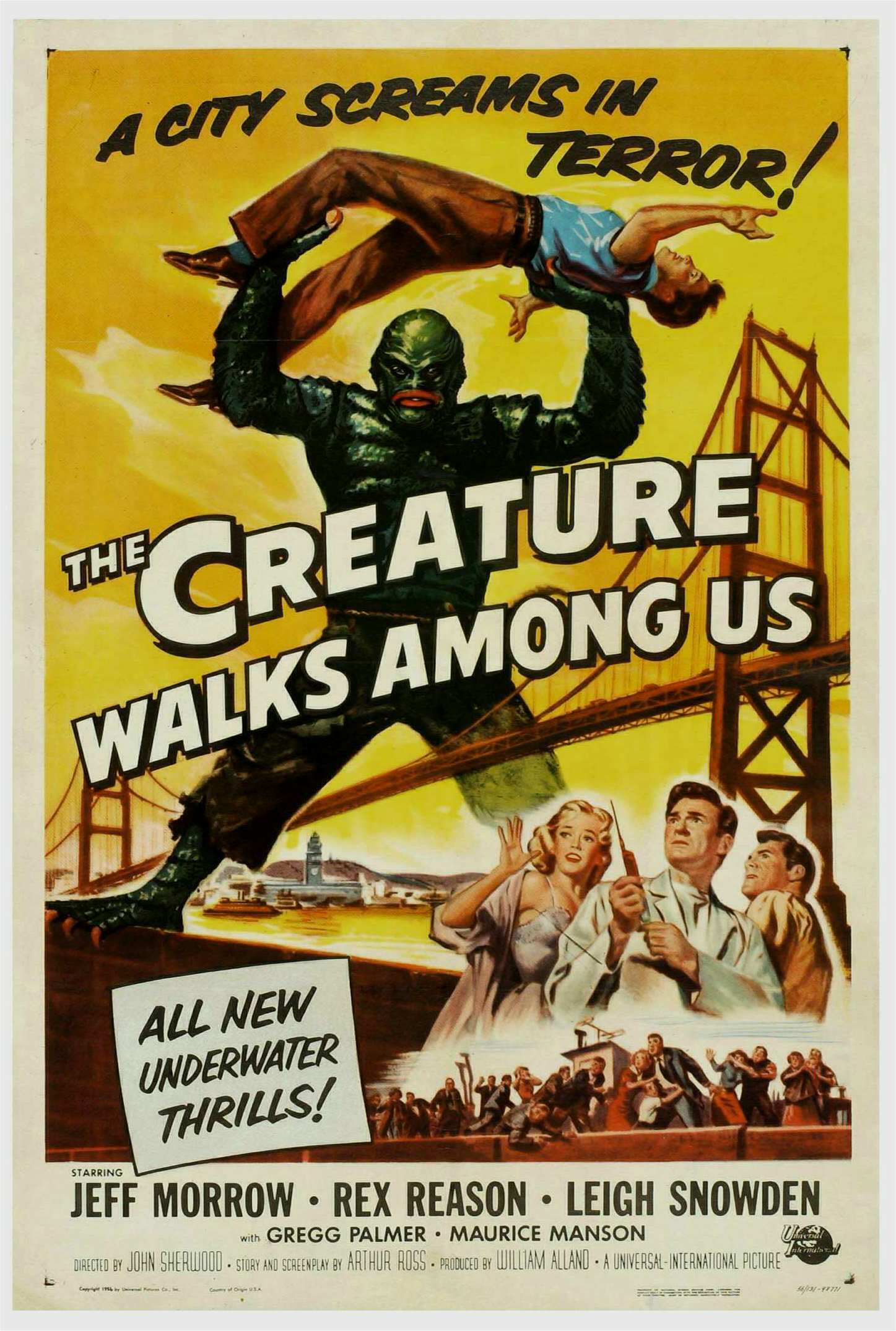
Premiered This Day (1956): The Creature Walks Among Us

Back on this day in 1956 the second sequel to The Creature From the Black Lagoon debuted. It's long been considered the weakest film in the trilogy, and it's hard to argue this given that they drag The Creature out of the Amazon, burn him in a fire, and convert him into an air-breathing humanoid with no hope of ever returning to the lagoon. But, when viewed today, the film reveals some deeper tones than I'm sure were originally intended.

The plot and language of the film can now be taken to speak directly to the hot-button topics of genetic manipulation of animals and foods, and man's destructive meddling with nature leading to accelerated rates of extinction. The movie moves beyond being a simple “monster on the rampage” story and actually has some pointed comments to make about science and politics. It's well worth watching on one of those upcoming hot, humid summer nights.

Watch the film in 8 minutes thanks to the Castle Films Super 8mm edited home version:

Saturday, April 25, 2015

Chicken Fest, London, UK


Here's a great blog post from our friend and master artist, Luis Rey, on his participation in Chicken Fest in London on April 23, 2015. Luis joined paleontologist, John Hutchinson, to talk about the links between chickens and dinosaurs and marvel at the giant chicken skeletons made by children as part of this art & science installation.

Friday, April 24, 2015

Wooly Mammoth Genome

Complete genomes reveal signatures of demographic and genetic declines in the woolly mammoth. 2015. Palkopoulou et al. Current Biology.


Before the world's last woolly mammoth took its final breath, the iconic animals had already suffered from a considerable loss of genetic diversity. These findings, based on a comparison of the first complete genome sequences isolated from two ancient mammoth specimens.

One of those mammoths, representing the last population on Russia's Wrangel Island, is estimated to have lived about 4,300 years ago. The other specimen, from northeastern Siberia, is about 44,800 years old. The younger of the two specimens showed much lower genetic variation, including large stretches of DNA with no variation whatsoever - the mark of living in a very small population in which related individuals unavoidably mate with each other. PR

Thursday, April 23, 2015

Born This Day: James Flavin

Flavin (May 14, 1906 – April 23, 1976) starred in his first film (The Airmail Mystery) in 1932. After that he played mostly supporting characters in nearly four hundred films between 1932 and 1971, and in almost a hundred television episodes. He takes a bow here for playing Second Mate Briggs in King Kong (1933).

Sexual Dimorphism in Stegosaurus

Evidence for Sexual Dimorphism in the Plated Dinosaur Stegosaurus mjosi (Ornithischia, Stegosauria) from the Morrison Formation (Upper Jurassic) of Western USA.. 2015. PLoS ONE

Stegosaurs plates may have differed between males and females.
Stegosaurus, a large, herbivorous dinosaur, lived roughly 150 million years ago and had two staggered rows of bony plates along its back. Some individuals had tall plates and others had wide plates, which could be up to 45% larger than the tall plates.

Evan Saitta found that the tall-plated Stegosaurus and the wide-plated Stegosaurus were not two distinct species, nor were they individuals of different age: they were actually males and females. CT scanning and microscope analysis of the plates showed that the differences were not a result of growth, as the bone tissues had ceased growing in both varieties.

The presence of sexual dimorphism in an extinct species may provide scientists with a much clearer picture Stegosaurus behavior than would otherwise be possible. PR

Wednesday, April 22, 2015

Changing the Picture of Earth’s Earliest Fossils

Changing the picture of Earth's earliest fossils (3.5-1.9 Ga) with new approaches and new discoveries. 2015. PNAS
New analysis of world-famous 3.46 billion-year-old rocks shows that structures once thought to be Earth's oldest microfossils do not compare with younger fossil candidates but have, instead, the character of peculiarly shaped minerals.
In 1993, US scientist Bill Schopf described tiny carbon-rich filaments within the 3.46 billion-year-old Apex chert (fine-grained sedimentary rock) from the Pilbara region of Western Australia, which he likened to certain forms of bacteria, including cyanobacteria.

New high-spatial resolution data clearly demonstrate that the 'Apex chert microfossils' comprise stacks of plate-like clay minerals arranged into branched and tapered worm-like chains. Carbon was then absorbed onto the edges of these minerals during the circulation of hydrothermal fluids, giving a false impression of carbon-rich cell-like walls. PR

Tuesday, April 21, 2015

Darwin, Wallace & Patrick Matthew: Who's Ideas on Evolution Came First?

Patrick Matthew (1790-1874) was a Scottish landowner with a keen interest in politics and agronomy who also came up with the concept of 'evolution by natural selection' 27 years before Charles Darwin did.
Matthew's version of evolution by natural section captures a valuable aspect of the theory that isn't so clear in Darwin's version - namely, that natural selection is a deductive certainty more akin to a 'law' than a hypothesis or theory to be tested.

Whilst Darwin and Wallace's 1858 paper to the Linnean Society, On the Origin of Species, secured their place in the history books, Matthews had set out similar ideas 27 years earlier in his book On Naval Timber and Arboriculture. The book, published in 1831, addressed best practices for the cultivation of trees for shipbuilding, but also expanded on his concept of natural selection.

"There is a law universal in nature, tending to render every reproductive being the best possibly suited to its condition that its kind, or that organized matter, is susceptible of, which appears intended to model the physical and mental or instinctive powers, to their highest perfection, and to continue them so. This law sustains the lion in his strength, the hare in her swiftness, and the fox in his wiles." (Matthew, 1831: 364) PR

Monday, April 20, 2015

Born This Day: Willi Henning

From the Willi Hennig Society :

Hennig (April 20, 1913 – Nov. 5, 1976) is best known for developing phylogenetic systematics,  a coherent theory of the investigation and presentation of the  relations that exist among species. Contrary to the position generally  held during his time, Hennig viewed historical inference as a strictly  logical and scientific endeavor. He first summarized his ideas in 1950  in German which became more widely known with the publication of the  English revision, Phylogenetic Systematics (Hennig, 1966).


image.

Major Hennigian principles are:
1. Relationships among species are to be interpreted strictly genealogically, as sister-lineages, as clade relations. Empirically, a phylogenetic hypothesis may be determined.
2. Synapomorphies provide the only evidence for identifying relative recency of common ancestry. Synapomorphies are understood to be the shared-derived (evolved, modified) features of organisms.

3. Maximum conformity to evidence is sought  (his auxiliary principle). Choice among competing cladistic  propositions (cladograms) is decided on the basis of the greatest amount  of evidence, the largest number of synapomorphies explainable as  homologues.

4. Whenever possible, taxonomy must be logically consistent with the inferred pattern of historical relationships. The rule of monophyly is to be followed, thereby each clade can have its unique place in the hierarchy of taxonomic names.
More info about Henning HERE. photo.

Born This Day: Sir William Logan

From Today in Science History:

Logan (April 20, 1798 – June 22, 1875) was a Canadian geologist dubbed the "Father of Canadian Geology." He began is career making geologic maps of coalfields in Wales, noting the relationship between the underlying clay layers and fossil tree roots with local coal beds. This substantiated the theory that coal beds are formed in place.

When he began as director (1842-69) of the new Geological Survey of Canada, its geology was virtually unknown. He produced the monumental Report on the Geology of Canada (1863) which recorded 20 years of research, fieldwork, plotting maps, preparing reports, and examining fossil and mineral specimens.

Image and more info from Natural Resources Canada. For a more colourful summary of the man and his life go HERE.

Born This Day: Bruce Cabot


Cabot (April 20, 1904 – May 3, 1972) saved Fay Wray from King Kong back in 1933, one of eight films he made that year.

Died This Day: Robert Armstrong

Armstrong (Nov. 20, 1890 – April 20, 1973) took Fay Wray to Skull Island in 1933. He returned later the same year to find The Son of Kong, only to lose him as the island sank, as these things are prone to doing.

Sunday, April 19, 2015

Died This Day: Charles Darwin

Feb. 12, 1809 – April 19, 1882


stamp

More about Darwin HERE.

Died This Day: Louis Dollo

Louis Antoine Marie Joseph Dollo (Dec. 7, 1857 – April 19, 1931) was a French vertebrate paleontologist who stated Dollo's Law of Irreversibility whereby in evolution an organism never returns exactly to its former state such that complex structures, once lost, are not regained in their original form. (While generally true, some exceptions are known.)

He began as an assistant (1882), became keeper of mammals (1891) at the Royal Museum of Natural History in Brussels where he stayed most of his life. He was a specialist in fossil fishes, reptiles, birds, and their palaeoecology. He supervised the excavation of the famous, multiple Iguanodons found in 1878 by miners deep underground, at Bernissart, Belgium. image From Today In Science History

Born This Day: The Father of Micropaleontology


Christian Gottfried Ehrenberg (April 19, 1795 - June 27, 1876) was a German biologist, microscopist, explorer and micropaleontologist who has been called the founder of micropaleontology. 

Ehrenberg's microscopical research was the first to treat in a scientific way that mass of minute beings that had formerly been vaguely known as the “infusoria,” both living or fossils.

He revealed that certain forms of rock, especially chalk, were composed of minute forms of animals or plants, among which were forms he was first to discover and characterize. Ehrenberg also did extensive work on diatoms and the foraminifera. From Today in Science History

Saturday, April 18, 2015

Died This Day: Erasmus Darwin

Erasmus (Dec. 12, 1731 – April 18, 1802) was a prominent English physician, poet, philosopher, botanist, naturalist and the grandfather of naturalist Charles Darwin and the biologist Francis Galton. Erasmus Darwin was one of the leading intellectuals of 18th century England.

As a naturalist, he formulated one of the first formal theories on evolution in Zoonomia, or, The Laws of Organic Life (1794-1796). Although he did not come up with natural selection, he did discuss ideas that his grandson elaborated on sixty years later, such as how life evolved from a single common ancestor, forming "one living filament".

Although some of his ideas on how evolution might occur are quite close to those of Lamarck, Erasmus Darwin also talked about how competition and sexual selection could cause changes in species. link

Download Zoonomia HERE

Died This Day: William Arkell

Arkell (June 9, 1904 - April 18, 1958) was an English paleontologist who was an authority on Jurassic ammonites and their environments. He wrote Jurassic Geology of the World (1956), which critically reviewed the information dispersed throughout the world's enormous literature on the world's Jurassic stratigraphy.

He made numerous contributions to knowledge of the Jurassic stratigraphy, and gradually stabilized many stratigraphically significant zonal assemblages. In 1946, his "Standard of the European Jurassic" advocated a commission formulate a code of rules for stratigraphical nomenclature. image From Today In Science History: