It's been a busy week for ceratopsids. Here's a nice Luis Rey illustration for a new chasmosaur from the Judith River Formation of Montana.
It's another one from the new book, "New Perspectives on Horned Dinosaurs", from Indiana University Press. press release
Monday, May 31, 2010

Sunday, May 30, 2010
The Hero of 50,000,000 B.C.

© DC Comics


How To End An Ice Age
Ventilation of the deep Southern Ocean and deglacial CO2 rise. 2010. L.C. Skinner, et al. Science 328: 1147 - 1151.

Working on a marine sediment core recovered from the Southern Ocean floor between Antarctica and South Africa, the international team radiocarbon dated shells left behind by tiny marine creatures called foraminifera.
By measuring how much carbon-14 (14C) was in the bottom-dwelling forams' shells, and comparing this with the amount of 14C in the atmosphere at the time, they were able to work out how long the CO2 had been locked in the ocean.
According to Dr Skinner: "Our results show that during the last ice age, around 20,000 years ago, carbon dioxide dissolved in the deep water circulating around Antarctica was locked away for much longer than today. If enough of the deep ocean behaved in the same way, this could help to explain how ocean mixing processes lock up more carbon dioxide during glacial periods."
Because the ocean is a large, dynamic reservoir of carbon, it has long been suspected that changes in ocean circulation must have played a major role in motivating these large changes in CO2. In addition, the Southern Ocean around Antarctica is expected to have been an important centre of action, because this is where deep water can be lifted up to the sea surface and 'exhale' its CO2 to the atmosphere.
Scientists think more CO2 was locked up in the deep ocean during ice ages, and that pulses or 'burps' of CO2 from the deep Southern Ocean helped trigger a global thaw every 100,000 years or so. The size of these pulses was roughly equivalent to the change in CO2 experienced since the start of the industrial revolution. link

Scientists have found the possible source of a huge carbon dioxide 'burp' that happened some 18,000 years ago and which helped to end the last ice age.The results provide the first concrete evidence that carbon dioxide (CO2) was more efficiently locked away in the deep ocean during the last ice age, turning the deep sea into a more 'stagnant' carbon repository – something scientists have long suspected but lacked data to support.
Working on a marine sediment core recovered from the Southern Ocean floor between Antarctica and South Africa, the international team radiocarbon dated shells left behind by tiny marine creatures called foraminifera.
By measuring how much carbon-14 (14C) was in the bottom-dwelling forams' shells, and comparing this with the amount of 14C in the atmosphere at the time, they were able to work out how long the CO2 had been locked in the ocean.
According to Dr Skinner: "Our results show that during the last ice age, around 20,000 years ago, carbon dioxide dissolved in the deep water circulating around Antarctica was locked away for much longer than today. If enough of the deep ocean behaved in the same way, this could help to explain how ocean mixing processes lock up more carbon dioxide during glacial periods."
Because the ocean is a large, dynamic reservoir of carbon, it has long been suspected that changes in ocean circulation must have played a major role in motivating these large changes in CO2. In addition, the Southern Ocean around Antarctica is expected to have been an important centre of action, because this is where deep water can be lifted up to the sea surface and 'exhale' its CO2 to the atmosphere.
Scientists think more CO2 was locked up in the deep ocean during ice ages, and that pulses or 'burps' of CO2 from the deep Southern Ocean helped trigger a global thaw every 100,000 years or so. The size of these pulses was roughly equivalent to the change in CO2 experienced since the start of the industrial revolution. link
Alanqa saharicafrom, A New Pterosaur From Morocco
A New Pterosaur (Pterodactyloidea: Azhdarchidae) from the Upper Cretaceous of Morocco. Ibrahim, N., et al. PLoS ONE 5(5): e10875.

"This pterosaur is distinguished from all others by its lance-shaped lower jaw which had no teeth and looked rather like the beak of a heron," says Nizar Ibrahim. "During the excavation, we also discovered a partial neck vertebra that probably belonged to the same animal, inferring a wing span of about six metres."
The scientists have named the new pterosaur Alanqa saharicafrom the Arabic word 'Al Anqa' meaning Phoenix, a mythological flying creature that dies in a fire and is reborn from the ashes of that fire. On the same expedition, and in the same region as where the fossils of Alanqa saharica were uncovered, the scientists also discovered fossils of two other previously identified types of pterosaur. This suggests that several types of pterosaurs lived alongside one another in the same region at the time, each probably specializing in a different ecological niche.
"When this pterosaur was alive, the Sahara desert was a river bed basin lush with tropical plant and animal life," explains Ibrahim. "This means there were lots of opportunities for different pterosaurs to co-exist, and perhaps feeding on quite different kinds of prey." link

Scientists have announced the discovery of Alanqa saharicafrom, an early pterosaur that lived 95 million years ago in Morocco.Unearthed in three separate pieces, the jaw bone has a total length of 344 mm. Each piece is well preserved, uncrushed, and unlike most other pterosaur fossils, retains its original three dimension shape.
"This pterosaur is distinguished from all others by its lance-shaped lower jaw which had no teeth and looked rather like the beak of a heron," says Nizar Ibrahim. "During the excavation, we also discovered a partial neck vertebra that probably belonged to the same animal, inferring a wing span of about six metres."
The scientists have named the new pterosaur Alanqa saharicafrom the Arabic word 'Al Anqa' meaning Phoenix, a mythological flying creature that dies in a fire and is reborn from the ashes of that fire. On the same expedition, and in the same region as where the fossils of Alanqa saharica were uncovered, the scientists also discovered fossils of two other previously identified types of pterosaur. This suggests that several types of pterosaurs lived alongside one another in the same region at the time, each probably specializing in a different ecological niche.
"When this pterosaur was alive, the Sahara desert was a river bed basin lush with tropical plant and animal life," explains Ibrahim. "This means there were lots of opportunities for different pterosaurs to co-exist, and perhaps feeding on quite different kinds of prey." link
Saturday, May 29, 2010
Coahuilaceratops , First Horned Dinosaur From Mexico

A new species of horned dinosaur unearthed in Mexico has larger horns that any other species - up to 4 feet long - and has given scientists fresh insights into the ancient history of western North America.The 72-million-year-old rhino-sized creature - Coahuilaceratops magnacuerna - was a four- to five-ton plant-eater belonging to a group called horned dinosaurs, or ceratopsids. The name Coahuilaceratops magnacuerna (Koh-WHE-lah-SARA-tops mag-NAH-KWER-na), refers to the Mexican state of Coahuila where it was found, and to the Greek word "ceratops" meaning "horned face." The second part of the name, magnacuerna, is a combination of Latin and Spanish meaning "great horn," in reference to the huge horns above the eyes of this dinosaur.
The study, partially funded by the National Geographic Society, was conducted by Mark Loewen, Scott Sampson, Eric Lund and Mike Getty, paleontologists at the Utah Museum of Natural History. Also involved were Andrew Farke of the Raymond M. Alf Museum in Claremont, Calif.; Martha Aguillón-Martínez, Claudio de Leon and Rubén Rodríguez-de la Rosa from the Museum of the Desert in Saltillo, Mexico; and David Eberth of the Royal Tyrrell Museum of Palaeontology in Alberta, Canada.
The new species is to be announced in the book "New Perspectives on Horned Dinosaurs" to be released next week by Indiana University Press.

Loewen explained that Coahuilaceratops represents the first occurrence of an identifiable species of horned dinosaur in southern Mexico. "The horned dinosaurs are an extraordinary example of vertebrate evolution," he said. They evolved and diversified on Laramidia along a thin strip of land that stretched from Alaska to Mexico. "Finding this horned dinosaur so far south in Mexico offers us a different picture of what the ancestors of Triceratops were like."
Born This Day: Louis-Jean-Marie Daubenton
Daubenton (May 29, 1716 – Jan 1, 1800) was a French naturalist who was a prolific pioneer in the fields of comparative anatomy and paleontology. Daubenton completed many zoological descriptions (including 182 species of quadrupeds for the first section of  Daubenton (May 29, 1716 – Jan 1, 1800) was a French naturalist who was a prolific pioneer in the fields of comparative anatomy and paleontology. Georges Buffon's work Histoire naturelle, 1794-1804). His dissections contributed to productive studies in the comparative anatomy of recent and fossil animals, plant physiology, and mineralogy.
In 1793, he became the first director of the Museum of Natural History in Paris. From Today in Science History Image
 Daubenton (May 29, 1716 – Jan 1, 1800) was a French naturalist who was a prolific pioneer in the fields of comparative anatomy and paleontology. Georges Buffon's work Histoire naturelle, 1794-1804). His dissections contributed to productive studies in the comparative anatomy of recent and fossil animals, plant physiology, and mineralogy.
In 1793, he became the first director of the Museum of Natural History in Paris. From Today in Science History Image
Friday, May 28, 2010
Out of The Woods For 'Ardi'?

A palaeoblog tip of the hat to Howie Post, creator of Anthro (here inked by Wally Wood), who passed away earlier this month.
Instead, "there is abundant evidence for open savanna habitats," says University of Utah geochemist Thure Cerling, lead author of a critique published as a "technical comment" in the Friday, May 28 issue of Science.
The criticism – by eight geologists and anthropologists from seven universities – is important because the claim that the 4.4-million-year-old fossil nicknamed Ardi lived in woodlands and forest patches was used as an argument against a longstanding theory of human evolution known as the savanna hypothesis.
That hypothesis holds that an expansion of savannas – grassy plains dotted with trees and shrubs – prompted ape-like ancestors of humans to descend from the trees and start walking upright to find food more efficiently or to reach other trees for shelter or resources.
In December, Science named the research that uncovered Ardipithecus and her environment as the 2009 "Breakthrough of the Year," citing how the fossils were more than a million years older than those of the previously oldest known hominid partial skeleton – that of Lucy, or Australopithecus afarensis.
But a month earlier, in November, Cerling and the seven other scientists submitted their critique to Science. The journal didn't publish it until now – when Cerling and his University of Utah coauthor, geologist Frank Brown, are in the field in Kenya and difficult to reach. Both expressed frustration it took so long.
The critique concludes that Ardi most likely lived in tree or bush savanna with 5 percent to 25 percent of the area covered by trees or shrubs, not the minimum 60 percent to meet the definition of a closed-canopy woodland. Cerling acknowledges Ardi could have lived in a wooded river corridor, but it was a river that flowed through savanna. link
Follow the debate here:
Comment on the Paleobiology and Classification of Ardipithecus ramidus
Response to Comment on the Paleobiology and Classification of Ardipithecus ramidus
Comment on the Paleoenvironment of Ardipithecus ramidus
Response to Comment on the Paleoenvironment of Ardipithecus ramidus
Ajkaceratops kozmai, New Neoceratopsian from Europe
A Late Cretaceous ceratopsian dinosaur from Europe with Asian affinities. 2010. A. Ősi, et al. Nature 465: 466-468.

Abstract: Ceratopsians (horned dinosaurs) represent a highly diverse and abundant radiation of non-avian dinosaurs known primarily from the Cretaceous period (65–145 million years ago). This radiation has been considered to be geographically limited to Asia and western North America, with only controversial remains reported from other continents. Here we describe new ceratopsian cranial material from the Late Cretaceous of Iharkút, Hungary, from a coronosaurian ceratopsian, Ajkaceratops kozmai. Ajkaceratops is most similar to ‘bagaceratopsids’ such as Bagaceratops and Magnirostris, previously known only from Late Cretaceous east Asia.
The new material unambiguously demonstrates that ceratopsians occupied Late Cretaceous Europe and, when considered with the recent discovery of possible leptoceratopsid teeth from Sweden, indicates that the clade may have reached Europe on at least two independent occasions. European Late Cretaceous dinosaur faunas have been characterized as consisting of a mix of endemic ‘relictual’ taxa and ‘Gondwanan’ taxa, with typical Asian and North American groups largely absent. Ajkaceratops demonstrates that this prevailing biogeographical hypothesis is overly simplified and requires reassessment. Iharkút was part of the western Tethyan archipelago, a tectonically complex series of island chains between Africa and Europe, and the occurrence of a coronosaurian ceratopsian in this locality may represent an early Late Cretaceous ‘island-hopping’ dispersal across the Tethys Ocean.
Sinoceratops zhuchengensis, First Ceratopsid from China
First ceratopsid dinosaur from China and its biogeographical Implications. 2010. Xu Xing, et al. Geology 55: 1631-1635

CLICK TO ENLARGEAbstract: Ceratopsid dinosaurs represent one of the best known dinosaur groups in the Late Cretaceous, and their unquestionable fossil records are exclusively restricted to western North America. Here we report a new ceratopsid dinosaur, Sinoceratops zhuchengensis gen. et sp. nov., from the Upper Cretaceous Wangshi Group of Zhucheng, Shandong Province, China. Cladistic analysis places this new taxon as the only known ceratopsid from outside North America, in a basal position within the Centrosaurinae. It is considerably larger than most other centrosaurines but similar in size to basal chasmosaurines. Furthermore, it is more similar to chasmosaurines than to other centrosaurines in several features, thus blurring the distinction of the two ceratopsid subgroups. This new find not only provides significant information on the morphological transition from non-ceratopsid to ceratopsid dinosaurs, but also complicates the biogeography of the Ceratopsidae, and further demonstrates that fossil sampling has profound effects on reconstructing dinosaurian biogeography.

CLICK TO ENLARGE
Born This Day: Louis Agassiz

May 28, 1807 - Dec. 14, 1873
(Jean) Louis (Rodolphe) Agassiz was a Swiss-born U.S. naturalist, geologist, and teacher who made revolutionary contributions to the study of natural science with landmark work on glacier activity and extinct fishes. Agassiz began his work in Europe, having studied at the University of Munich and then as chair in natural history in Neuchatel in Switzerland. While there he published his landmark multi-volume description and classification of fossil fish.
In 1846 Agassiz came to the U.S. to lecture before Boston's Lowell Institute. Offered a professorship of Zoology and Geology at Harvard in 1848, he decided to stay, becoming a citizen in 1861. His innovative teaching methods altered the character of natural science education in the U.S. Link
More info HERE
Died This Day: Ralph A. Bagnold
From the always excellent Today in Science History:
Bagnold (April 3, 1896 - May 28, 1990) was an English geologist who was a leading authority on the mechanics of sediment transport, especially eolian (wind) transport. While serving as a soldier in Egypt prior to WW II, Bagnold first studied sand dune formation and movement. After retiring from the army (1935), he continued his research and wrote the book "Physics of Blown Sand and Desert Dunes", investigating the physics of particles moving through the atmosphere and deposited by wind.

Art © Darwyn Cooke. Sand Seref & The Spirit © Estate of Will EisnerHe recognized two basic dune types, the crescentic dune, which he called "barchan," and the linear dune, which he called longitudinal or "sief" (Arabic for "sword"). During WW II, his avocational interest in vehicle performance on blowing sand aided the Allies in North Africa.
Bagnold (April 3, 1896 - May 28, 1990) was an English geologist who was a leading authority on the mechanics of sediment transport, especially eolian (wind) transport. While serving as a soldier in Egypt prior to WW II, Bagnold first studied sand dune formation and movement. After retiring from the army (1935), he continued his research and wrote the book "Physics of Blown Sand and Desert Dunes", investigating the physics of particles moving through the atmosphere and deposited by wind.

Art © Darwyn Cooke. Sand Seref & The Spirit © Estate of Will Eisner
Thursday, May 27, 2010
Nectocaris, A Primative Cephalopod from the Burges Shale
Primitive soft-bodied cephalopods from the Cambrian. 2010. M. R. Smith and J.-B. Caron. Nature 465: 469–472.
 Abstract [edit]: We reinterpret the problematic Middle Cambrian animal Nectocaris pteryx as a primitive, non-mineralized cephalopod, based on new material from the Burgess Shale. Together with Nectocaris, the problematic Lower Cambrian taxa Petalilium and (probably) Vetustovermis form a distinctive clade, Nectocarididae, characterized by an open axial cavity with paired gills, wide lateral fins, a single pair of long, prehensile tentacles, a pair of non-faceted eyes on short stalks, and a large, flexible anterior funnel.
This clade extends the cephalopods’ fossil record by over 30 million years, and indicates that primitive cephalopods lacked a mineralized shell, were hyperbenthic, and were presumably carnivorous. The presence of a funnel suggests that jet propulsion evolved in cephalopods before the acquisition of a shell. The explosive diversification of mineralized cephalopods in the Ordovician may have an understated Cambrian ‘fuse’

Arrows indicate the crown groups of 1, molluscs; 2, conchifera; 3, cephalopods. Stars represent the earliest record of mineralization in each lineage.
Jeyawati rugoculus

Image by Lukas Panzarin
The partial skull and other fragments of Jeyawati were discovered by paleontologist Douglas Wolfe, principal investigator of the Zuni Basin Paleontological Project. Subsequent excavation and collection was carried out for 13 years with the aid of James Kirkland, state paleontologist with the Utah Geological Survey, and volunteers from the Southwest Paleontological Society, among others.
The research team published their findings in the May issue of the Journal of Vertebrate Paleontology. link
Born This Day: Sandra Shaw

Arbogast on Film blog has nice appreciation of Sandra Shaw’s few famous film moments.
Wednesday, May 26, 2010
New Perspectives On Horned Dinosaurs Now Published

FYI, the cover is by the very talented Donna Sloan, who works at the Royal Tyrrell Museum. However, it does not actually actually represent one of the 8 new taxa described in the book; but it is a nice Chasmosaurus!
Measuirng A Dinosaur's Body Temperature
Body temperatures of modern and extinct vertebrates from 13C-18O bond abundances in bioapatite. 2010. R. A. Eagle, et al. PNAS published online before print May 24.

Metal Men © DC ComicsResearchers have described the first method for the direct measurement of the body temperatures of large extinct vertebrates—through the analysis of rare isotopes in the animals' bones, teeth, and eggshells.
The technique the team has developed to measure body temperature in extinct vertebrates looks at the concentrations of two rare isotopes—carbon-13 and oxygen-18. "These heavy isotopes like to bond, or clump together, and this clumping effect is dependent on temperature," says Robert Eagle. "At very hot temperatures, you get a more random distribution of these isotopes, less clumping. At low temperatures, you find more clumping."
In living creatures, this clumping can be seen in the crystalline lattice that makes up bioapatite—the mineral from which bone, tooth enamel, eggshells, and other hard body parts are formed. "When the mineral precipitates out of the blood—when you create bone or tooth enamel—the isotopic composition is frozen in place and can be preserved for millions of years," he adds.
"This is not quite like going back in time and sticking a thermometer up a creature's back end," says John Eiler, "but it's close." link

Metal Men © DC Comics
The technique the team has developed to measure body temperature in extinct vertebrates looks at the concentrations of two rare isotopes—carbon-13 and oxygen-18. "These heavy isotopes like to bond, or clump together, and this clumping effect is dependent on temperature," says Robert Eagle. "At very hot temperatures, you get a more random distribution of these isotopes, less clumping. At low temperatures, you find more clumping."
In living creatures, this clumping can be seen in the crystalline lattice that makes up bioapatite—the mineral from which bone, tooth enamel, eggshells, and other hard body parts are formed. "When the mineral precipitates out of the blood—when you create bone or tooth enamel—the isotopic composition is frozen in place and can be preserved for millions of years," he adds.
"This is not quite like going back in time and sticking a thermometer up a creature's back end," says John Eiler, "but it's close." link
Sunday, May 23, 2010
Born This Day: Carolus Linnaeus
From the Linnean Society:
Linnaeus (May 23, 1707 – Jan. 10, 1778) was born in Sweden. He headed an expedition to Lapland in 1732, travelling 4,600 miles and crossing the Scandinavian Peninsula by foot to the Arctic Ocean. On the journey he discovered a hundred botanical species. He undertook his medical degree in 1735 in the Netherlands. In 1735, he published Systema Naturae, his classification of plants based on their sexual parts.
His method of binomial nomenclature using genus and species names was further expounded when he published Fundamenta Botanica (1736) and Classes Plantarum (1738). This system used the flower and the number and arrangements of its sexual organs of stamens and pistils to group plants into twenty-four classes which in turn are divided into orders, genera and species.
In his publications, Linnaeus provided a concise, usable survey of all the world's plants and animals as then known, about 7,700 species of plants and 4,400 species of animals. These works helped to establish and standardize the consistent binomial nomenclature for species which he introduced on a world scale for plants in 1753, and for animals in 1758, and which is used today.
His Systema Naturae 10th edition, volume 1(1758), has accordingly been accepted by international agreement as the official starting point for zoological nomenclature. Scientific names published before then have no validity unless adopted by Linnaeus or by later authors. This confers a high scientific importance on the specimens used by Linnaeus for their preparation, many of which are in his personal collections now treasured by the Linnean Society.
He was granted nobility in 1761, becoming Carl von Linné. He continued his work of classification and as a physician, and remained Rector of the University until 1772.
Linnaeus (May 23, 1707 – Jan. 10, 1778) was born in Sweden. He headed an expedition to Lapland in 1732, travelling 4,600 miles and crossing the Scandinavian Peninsula by foot to the Arctic Ocean. On the journey he discovered a hundred botanical
 species. He undertook his medical degree in 1735 in the Netherlands. In 1735, he published Systema Naturae, his classification of plants based on their sexual parts.
His method of binomial nomenclature using genus and species names was further expounded when he published Fundamenta Botanica (1736) and Classes Plantarum (1738). This system used the flower and the number and arrangements of its sexual organs of stamens and pistils to group plants into twenty-four classes which in turn are divided into orders, genera and species.
In his publications, Linnaeus provided a concise, usable survey of all the world's plants and animals as then known, about 7,700 species of plants and 4,400 species of animals. These works helped to establish and standardize the consistent binomial nomenclature for species which he introduced on a world scale for plants in 1753, and for animals in 1758, and which is used today.
His Systema Naturae 10th edition, volume 1(1758), has accordingly been accepted by international agreement as the official starting point for zoological nomenclature. Scientific names published before then have no validity unless adopted by Linnaeus or by later authors. This confers a high scientific importance on the specimens used by Linnaeus for their preparation, many of which are in his personal collections now treasured by the Linnean Society.


He was granted nobility in 1761, becoming Carl von Linné. He continued his work of classification and as a physician, and remained Rector of the University until 1772.
Saturday, May 22, 2010
Born This Day: Sir Arthur Conan Doyle
From HERE:
Sir Arthur Conan Doyle (May 22, 1859 – July 7, 1930) was a British writer and creator of Sherlock Holmes. He was born in Edinburgh. His father and uncle were both book illustrators and his mother encouraged his son to explore the world of books. Doyle studied at Edinburgh University and in 1884 he married Louise Hawkins. Doyle qualified as doctor in 1885 and practiced medicine as an eye specialist in Hampshire until 1891 when he became a full time writer. Doyle's first novel about Sherlock Holmes,’ A Study in Scarlet’, was published in 1887.
During the South African war (1899-1902) Doyle served for a few months as senior physician at a field hospital, and wrote ‘The War in South Africa’, in which he defended England's policy. When his son Kingsley died from wounds incurred in World War I, the author dedicated himself in spiritualistic studies.

Doyle's stories of Professor George Edward Challenger in ‘The Lost World’ (1912). The model for the professor was William Rutherford, Doyle's teacher from Edinburgh. Doyle's practice, and other experiences, expeditions as ship's surgeon to the Arctic and West Coast of Africa, service in the Boer War, defenses of George Edalji and Oscar Slater, two men wrongly imprisoned, provided much material for his writings.
The Lost World:
Sir Arthur Conan Doyle (May 22, 1859 – July 7, 1930) was a British writer and creator of Sherlock Holmes. He was born in Edinburgh. His father and uncle were both book illustrators and his mother encouraged his son to explore the world of books. Doyle studied at Edinburgh University and in 1884 he married Louise Hawkins. Doyle qualified as doctor in 1885 and practiced medicine as an eye specialist in Hampshire until 1891 when he became a full time writer. Doyle's first novel about Sherlock Holmes,’ A Study in Scarlet’, was published in 1887.
During the South African war (1899-1902) Doyle served for a few months as senior physician at a field hospital, and wrote ‘The War in South Africa’, in which he defended England's policy. When his son Kingsley died from wounds incurred in World War I, the author dedicated himself in spiritualistic studies.

The Lost World:
Born This Day: Oliver Perry Hay
May 22, 1846 – Novemeber 2, 1930
Hay was an American paleontologist whose catalogs of fossil vertebrates greatly organized existing knowledge and became standard references. Hay's primary scientific interest was the study of the Pleistocene vertebrata of North America and he is renowned for his work on skull and brain anatomy. His first major work was his Bibliography and Catalogue of the Fossil Vertebrata of North America (1902), supplemented by two more volumes (1929-30). Hay also wrote on the evidence of early humans in North America. link
Hay was an American paleontologist whose catalogs of fossil vertebrates greatly organized existing knowledge and became standard references. Hay's primary scientific interest was the study of the Pleistocene vertebrata of North America and he is renowned for his work on skull and brain anatomy. His first major work was his Bibliography and Catalogue of the Fossil Vertebrata of North America (1902), supplemented by two more volumes (1929-30). Hay also wrote on the evidence of early humans in North America. link
Friday, May 21, 2010
Born This Day: Mary Anning
May 21, 1799 - March 9, 1847
From Today in Science History:
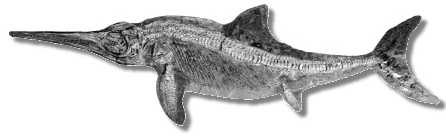
Mary was an English fossil collector who made her first significant discovery at the age of 11 or 12 (sources differ on the details), when she found a complete skeleton of an Ichthyosaurus, from the Jurassic period. The ten-meter (30 feet) long skeleton created a sensation and made her famous.
Anning's determination and keen scientific interest in fossils derived from her father's interest in fossil hunting, and a need for the income derived from them to support her family after his death. in 1810. She sold large fossils to noted paleontologists of the day, and smaller ones to the tourist trade. In 1823, Anning made another great discovery, found the first complete Plesiosaurus.
Later in her life, the Geological Society of London granted Anning an honorary membership.

From Today in Science History:
Mary was an English fossil collector who made her first significant discovery at the age of 11 or 12 (sources differ on the details),
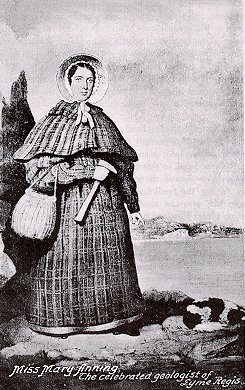 when she found a complete skeleton of an Ichthyosaurus, from the Jurassic period. The ten-meter (30 feet) long skeleton created a sensation and made her famous.
Anning's determination and keen scientific interest in fossils derived from her father's interest in fossil hunting, and a need for the income derived from them to support her family after his death. in 1810. She sold large fossils to noted paleontologists of the day, and smaller ones to the tourist trade. In 1823, Anning made another great discovery, found the first complete Plesiosaurus.
Later in her life, the Geological Society of London granted Anning an honorary membership.
Subscribe to:
Posts (Atom)