Friday, April 30, 2010

The Development of Fossil Feathers

Exceptional dinosaur fossils show ontogenetic development of early feathers. 2010. Xing X., et al. Nature 464: 1338–1341


Abstract [edit]: We describe an early-juvenile specimen and a late-juvenile specimen, both referable to the oviraptorosaur Similicaudipteryx, recovered from the Lower Cretaceous Yixian Formation of western Liaoning, China. The two specimens have strikingly different remiges and rectrices, suggesting that a radical morphological change occurred during feather development, as is the case for modern feathers.

However, both the remiges and the rectrices are proximally ribbon-like in the younger specimen but fully pennaceous in the older specimen, a pattern not known in any modern bird.

In combination with the wide distribution of proximally ribbon-like pennaceous feathers and elongate broad filamentous feathers among extinct theropods, this find suggests that early feathers were developmentally more diverse than modern ones and that some developmental features, and the resultant morphotypes, have been lost in feather evolution.


Note: The blog will be taking a short break until the middle of next week.

Died This Day: Joseph Leidy


Sept. 9, 1823 - April 30, 1891

From The Academy of Natural Sciences:

Leidy is known as the "Father of American Vertebrate Paleontology". He described the first relatively complete dinosaur skeleton, Hadrosaurus, and introduced many American and European scientists to the fossil riches of the American West. Leidy's consummate skill in comparative anatomy would allow him to identify and characterize even the most fragmentary fossil material.

Leidy was also the "Founder of American Parasitology," a Professor of Anatomy at the University of Pennsylvania, a pioneering protozoologists, an influential teacher of Natural History, an accomplished microscopist and scientific illustrator, and an expert on a variety of subjects encompasing the earth and natural sciences. He published scientific papers on more than a thousand extinct and living protozoa, fungi and invertebrates and vertebrates as well as an assortment of publications on human biology and medicine. He was also one of the earliest supporters of Charles Darwin.

Tuesday, April 27, 2010

How To Make A Rib

Evidence for a Myotomal Hox/Myf Cascade Governing Nonautonomous Control of Rib Specification within Global Vertebral Domains. 2010. T. Vinagre, et al. Developmental Cell 18: 655-661


Mice have a ribcage with 12 pairs of ribs (top). When the gene Hox6 is activated in ribless regions of the embryo, extra ribs are formed, extending from the ribcage to the tail (bottom). Image: M. Mallo.

Making ribs is not the default state for vertebrates, but is actually an active process of balancing the activities of a remarkable class of genes - the Hox genes.

It was thought that the rib less region of the mouse embryo was the result of a rib-inhibiting programme, driven by Hox10 genes. Indeed, previous studies, in which Hox10 genes were inactivated in the embryo, generated mice with extra ribs. However, by forcing another class of Hox genes (Hox6) to be activated in future rib-less regions of the mouse embryo, scientists have bred mice that also have extra ribs, both in the neck area, and from just after the rib cage, all the way down to the tail, resembling a snake-like skeleton.

These two groups of Hox genes balance each other out: one actively promotes rib formation to produce the thoracic region, while the other blocks this activity in the lumbar region. The whole process relies on first hitting so-called muscle genes in the embryo, which then provide signals to switch on the 'rib' genes to make both ribs and muscle, in a coordinated process. link

Monday, April 26, 2010

Did Dinosaurs and Plants Evolve Together?

Testing coevolutionary hypotheses over geological timescales: interactions between Cretaceous dinosaurs and plants. 2010. R. J. Butler, et al. Biol. J. Linn Soc. 100: 1-15.


image
Dinos made from 50,000 flowers during Lalbagh flower show
Abstract [edit]: Distributional data for Cretaceous dinosaur and plant groups were mapped onto palaeogeographical reconstructions in a series of time-slices. Within each time-slice, palaeocontinental surfaces were divided into a series of grids, each of which was scored as present, absent or inapplicable (unsampled) for each group. Distributions were compared statistically to determine whether the putative coevolving groups co-occurred within grid squares more or less frequently than expected by chance.

Pairwise comparisons were made between herbivorous dinosaur clades and major plant groups (e.g. cycads, angiosperms) on a global scale. Only three nonrepeated associations of marginal significance were recovered, demonstrating that, in general, current knowledge of the spatiotemporal distributions of these groups provides little support for coevolutionary hypotheses.

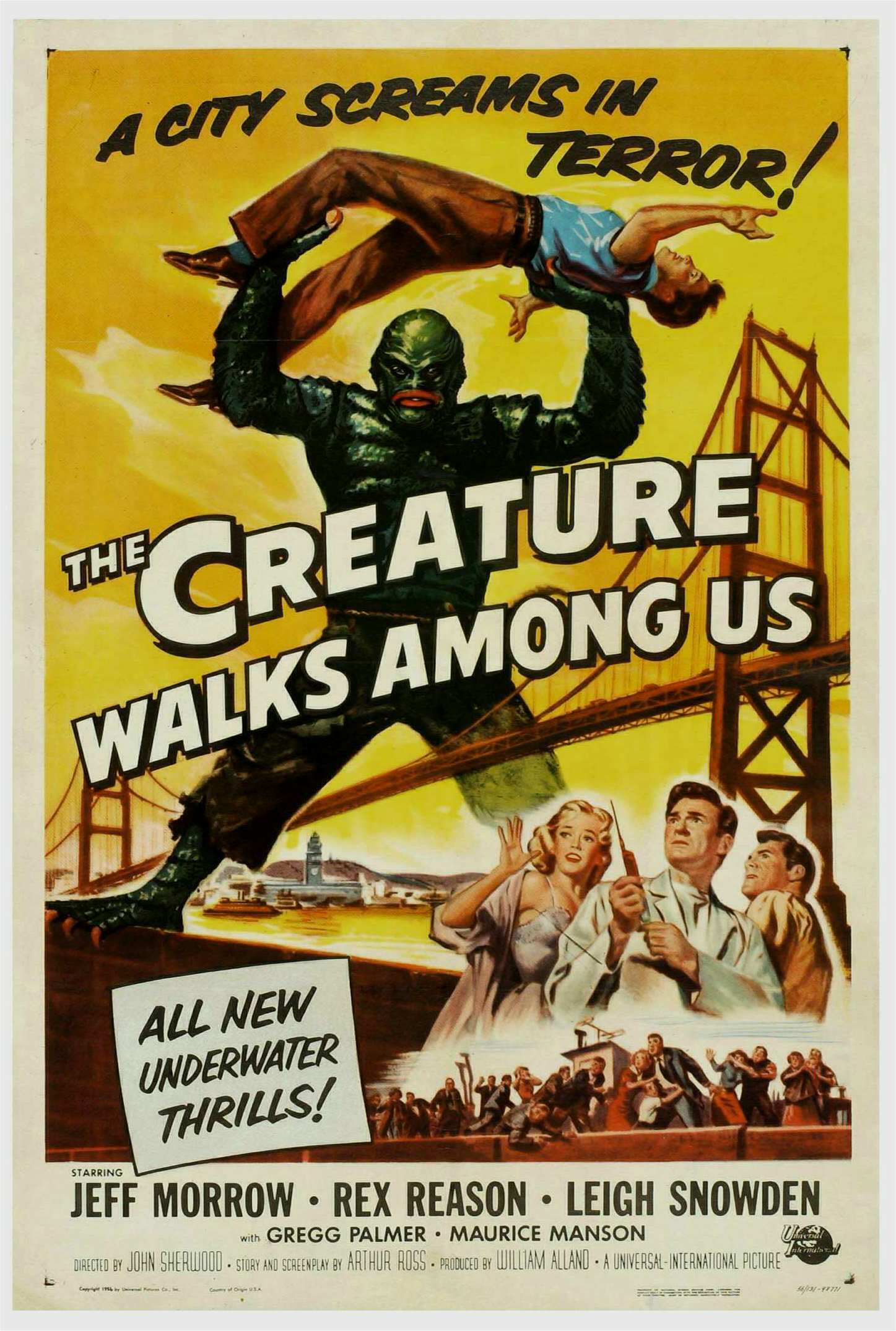
Premiered This Day: The Creature Walks Among Us

Back on this day in 1956 the second sequel to The Creature From the Black Lagoon debuted. It's long been considered the weakest film in the trilogy, and it's hard to argue this given that they drag The Creature out of the Amazon, burn him in a fire, and convert him into an air-breathing humanoid with no hope of ever returning to the lagoon. But, when viewed today, the film reveals some deeper tones than I'm sure were originally intended.

The plot and language of the film can now be taken to speak directly to the hot-button topics of genetic manipulation of animals and foods, and man's destructive meddling with nature leading to accelerated rates of extinction. The movie moves beyond being a simple “monster on the rampage” story and actually has some pointed comments to make about science and politics. It's well worth watching on one of those upcoming hot, humid summer nights.

Watch the film in 8 minutes thanks to the Castle Films Super 8mm edited home version:

Died This Day: Eduard Suess

Suess (Aug. 20, 1831 – April 26, 1914) was an Austrian geologist who helped lay the basis for paleogeography and tectonics. He was an authority on structural geology, especially of mountains, and postulated the existence of the giant land mass Gondwanaland.

While he was a professor (1857–1901) at the Univ. of Vienna, he also served for more than 20 years in the Austrian parliament. His Austrian-born son, Hans Suess, became a geochemist who pioneered radiocarbon dating techniques and was a founding faculty member of the University of California, San Diego.

From Today In Science History

Sunday, April 25, 2010

Dinosaur Land in Muskoka, Ontario


Cartoonist and rock ‘n roller, Tom Bagley, also one of the 7 Deadly Sinners, recently sent me this past from his past – a childhood visit to Dinosaur Land in Muskoka, Ontario. That’s Tom (left) and his brother helping Mary Anning excavate an ichythosaur. This place seems to have literally vanished off the face of the Earth, so if anyone has any info about it I’d appreciate hearing it.

Tom adds:
"They even had a caveman village down in a valley that I'm sure was pretty spectacular. The coolest part was that you went into a little theatre that ran "A World Is Born" (the "Rite of Spring" sequence from Fantasia) continuously."


Art © Tom Bagley

Humans & Neanderthals Interbred Twice?


Anthro © DC Comics
An examination of the DNA of 1,983 people from around the globe suggests that extinct human species such as Homo neanderthalensis or Homo heidelbergensis interbred with our own ancestors during two separate periods, and their genes remain in our DNA today. The findings mean Neanderthals did not completely disappear, but “there is a little bit of Neanderthal left over in almost all humans.”

Read the story at PhysOrg.

Saturday, April 24, 2010

Cretaceous Dino Deep Freeze

Valanginian isotope variation in glendonites and belemnites from Arctic Svalbard: Transient glacial temperatures during the Cretaceous greenhouse. 2010. G.D. Price and E. V. Nunn. Geology 38: 251-254.
Scientists studying fossils and minerals from Arctic Svalbard, in Norway, have discovered evidence that the ‘greenhouse’ climate of the Cretaceous period was punctuated by a sudden drop in global temperatures.


The drop is estimated to have occurred some 137 million years ago during a time when dinosaurs roamed the Earth, and would have seen the islands fall from an average of 13°C (ocean temperature) to as low as four degrees.

Despite being located in the Arctic Circle, Svalbard was home to numerous species of dinosaur and was typically characterised by warm, shallow seas and swamps. But the researchers found evidence in fossils and carbonate materials preserved in marine rocks in the region of a transient shift to cooler glacial conditions around 137 million years ago.

“But over a period of a few hundred or a few thousand years, ocean temperatures fell from an average of 13°C to between eight and four degrees.


“Although a short episode of cool polar conditions is potentially at odds with a high CO2 world, our data demonstrates the variability of climate over long timescales.” link

Friday, April 23, 2010

Born This Day: James Flavin

Flavin (May 14, 1906 – April 23, 1976) starred in his first film (The Airmail Mystery) in 1932. After that he played mostly supporting characters in nearly four hundred films between 1932 and 1971, and in almost a hundred television episodes. He takes a bow here for playing Second Mate Briggs in King Kong (1933).

Wednesday, April 21, 2010

Died This Day: Mark Twain

I’d forgotten that Mark Twain (November 30, 1835 – April 21, 1910) had written about dinosaurs.


Illustration from first edition of EVE'S DIARY
"When the mighty brontosaurus came striding into camp, she regarded it as an acquisition, I considered it a calamity; that is a good sample of the lack of harmony that prevails in our views of things. She wanted to domesticate it, I wanted to make it a present of the homestead and move out. She believed it could be tamed by kind treatment and would be a good pet; I said a pet twenty-one feet high and eighty-four feet long would be no proper thing to have about the place, because, even with the best intentions and without meaning any harm, it could sit down on the house and mash it, for any one could see by the look of its eye that it was absent-minded." - Eve's Diary

"The less said about the pterodactyl the better. It was a spectacle, that beast! a mixture of buzzard and alligator, a sarcasm, an affront to all animated nature, a butt for the ribald jests of an unfeeling world. After some ages Nature perceived that to put feathers on a reptile does not ennoble it, does not make it a bird, but only a sham, a joke, a grotesque curiosity, a monster; also that there was no useful thing for the pterodactyl to do, and nothing likely to turn up in the future that could furnish it employment. And so she abolished it." - "Flies and Russians," Fables of Man

From Twainquotes.com. Thanks to Judy!

Pliopithecus Gervais, New Miocene Primate

New Species of Pliopithecus Gervais, 1849 (Primates: Pliopithecidae) from the Middle Miocene (MN8) of Abocador de Can Mata (els Hostalets de Pierola, Catalonia, Spain). 2010. D.M. Alba, et al. American Journal of Physical Anthropology 141: 52-75.

Catalan researchers have discovered in the rubbish dump a new species of Pliopithecus primate, considered an extinct family of primitive Catarrhini primates (or "Old World monkeys"). The fragments of jaw and molars found in this large site demonstrate that Pliopithecus canmatensis belongs to this group, which includes the first Catarrhini that dispersed from Africa to Eurasia.

Named Pliopithecus canmatensis, in honour of the place they were discovered in Catalonia, the new fossil species sheds light on the evolution of the superfamily of the Pliopithecoidea, primates that include various genera of basal Catarrhini, a group that diverged before the separation of the two current superfamilies of the group: the cercopithecoids (Old World monkeys) and the hominoids (anthromorphs and humans); and which prospered in Eurasia during the Early and Late Miocene (between 23.5 and 5.3 million years ago).

Tuesday, April 20, 2010

Phil Currie Awarded Alberta Order of Excellence


Photo (c) M. Ryan
The Alberta Order of Excellence is the highest honour the province can bestow on a citizen "in recognition of their lasting contributions on the provincial, national and international stage."

The new members will be invested into the Order in a ceremony in Edmonton on Oct. 20. This will bring the total AOE membership to 109.

The other members chosen for investiture in 2010 are Alex Janvier (Cold Lake), Ralph Klein (Calgary), Janice McTighe (Calgary), Louise Miller (Edmonton), Bill Mooney (Calgary), Reza Nasseri (Edmonton) and Bob Steadward (Edmonton).

“These eight remarkable Albertans have all made very positive contributions to our province, and they have done so while forging a unique path and encouraging others to follow their lead," said outgoing Alberta Lieutenant-Governor Norman Kwong, who's also chancellor of the Order. link

Born This Day: Willi Henning

From the Willi Hennig Society :

Hennig (April 20, 1913 – Nov. 5, 1976) is best known for developing phylogenetic systematics, a coherent theory of the investigation and presentation of the relations that exist among species. Contrary to the position generally held during his time, Hennig viewed historical inference as a strictly logical and scientific endeavor. He first summarized his ideas in 1950 in German which became more widely known with the publication of the English revision, Phylogenetic Systematics (Hennig, 1966).


image.

Major Hennigian principles are:
1. Relationships among species are to be interpreted strictly genealogically, as sister-lineages, as clade relations. Empirically, a phylogenetic hypothesis may be determined.

2. Synapomorphies provide the only evidence for identifying relative recency of common ancestry. Synapomorphies are understood to be the shared-derived (evolved, modified) features of organisms.

3. Maximum conformity to evidence is sought (his auxiliary principle). Choice among competing cladistic propositions (cladograms) is decided on the basis of the greatest amount of evidence, the largest number of synapomorphies explainable as homologues.

4. Whenever possible, taxonomy must be logically consistent with the inferred pattern of historical relationships. The rule of monophyly is to be followed, thereby each clade can have its unique place in the hierarchy of taxonomic names.
More info about Henning HERE. photo.

Born This Day: Sir William Logan

From Today in Science History:

Logan (April 20, 1798 – June 22, 1875) was a Canadian geologist dubbed the "Father of Canadian Geology." He began is career making geologic maps of coalfields in Wales, noting the relationship between the underlying clay layers and fossil tree roots with local coal beds. This substantiated the theory that coal beds are formed in place.

When he began as director (1842-69) of the new Geological Survey of Canada, its geology was virtually unknown. He produced the monumental Report on the Geology of Canada (1863) which recorded 20 years of research, fieldwork, plotting maps, preparing reports, and examining fossil and mineral specimens.

Image and more info from Natural Resources Canada. For a more colourful summary of the man and his life go HERE.

Died This Day: Robert Armstrong


Armstrong (Nov. 20, 1890 – April 20, 1973) took Fay Wray to Skull Island in 1933. He returned later the same year to find The Son of Kong, only to lose him as the island sank, as these things are prone to doing.

Born this Day: Bruce Cabot


Cabot (April 20, 1904 – May 3, 1972) saved Fay Wray from King Kong back in 1933, one of eight films he made that year.

Monday, April 19, 2010

Died This Day: Charles Darwin

Feb. 12, 1809 – April 19, 1882


stamp

More about Darwin HERE.

Died This Day: Louis Dollo

From Today In Science History:

Louis Antoine Marie Joseph Dollo (Dec. 7, 1857 – April 19, 1931) was a French vertebrate paleontologist who stated Dollo's Law of Irreversibility whereby in evolution an organism never returns exactly to its former state such that complex structures, once lost, are not regained in their original form. (While generally true, some exceptions are known.)

He began as an assistant (1882), became keeper of mammals (1891) at the Royal Museum of Natural History in Brussels where he stayed most of his life. He was a specialist in fossil fishes, reptiles, birds, and their palaeoecology.

He supervised the excavation of the famous, multiple Iguanodons found in 1878 by miners deep underground, at Bernissart, Belgium. image