
Monday, April 05, 2010
Premiered This Day (1940): One Million B.C.


Founded This Day: The British Museum
From Today in Science History:
In 1753, the British Museum was founded by an Act of Parliament. Since then, the museum has been collecting, conserving and studying millions of artifacts. The British Museum was among the first museums to recognize that in-house scientific expertise was essential, both for the care of its collections and for their proper interpretation. Its Research Laboratory was founded in 1920 with the appointment of Dr Alexander Scott as its first scientist.

In 1753, the British Museum was founded by an Act of Parliament. Since then, the museum has been collecting, conserving and studying millions of artifacts. The British Museum was among the first museums to recognize that in-house scientific expertise was essential, both for the care of its collections and for their proper interpretation. Its Research Laboratory was founded in 1920 with the appointment of Dr Alexander Scott as its first scientist.
Sunday, April 04, 2010

The Man Who Conquered Time!

Temporal Resolution of The Fossil Record
The effects of temporal resolution on species turnover and on testing metacommunity models. 2010. A. Tomašových and S. Kidwell. The American Naturalist 175, pp. 587–606.

Devil Dinosaur © Marvel Comics
The amount of variability seen among successive fossil assemblages tends to be low compared to that ecologists see over shorter time periods. This suggests that communities are extremely resilient or resistant to change over decades to centuries.
Scientists used data on living and fossil communities to explore where the low variability in fossil assemblages comes from. Does it come from the natural "time averaging" of skeletal remains that occurs after death, or from biological processes that act as a stablizing force over time?
Processes in the latter category include strong species preferences for particular niches that may enable them to avoid extinction owing to high growth rates at small population sizes, or the buffering of population growth during unfavorable times.
On most seafloors, lake bottoms and land surfaces, however, sediment accumulates quite slowly compared to the rates at which local animal populations generate skeletal remains. Multiple generations of skeletal remains may therefore become mixed within a single fossil assemblage.
Simulating the effects of time-averaging on living communities from a Texas lagoon and an east African lake found that low temporal variation in species composition can be produced or reinforced by time averaging alone. Typical paleoecological data will thus seem to support models of local community stability, whether those communities have actually been stable.
Although many fossil assemblages will be too time-averaged to discriminate variability generated by biological processes operating at small spatial scales (approximately a meter) —such as competition or predation-prey interactions—they excel at capturing the larger picture, such as the identities and relative abundances of species in the regional diversity pool that local communities draw upon.
The composition of that pool is determined by speciation, extinction and biogeographic processes that are usually extremely challenging to measure using the limited spatial and temporal scope of conventional biological sampling. "It's a matter of scale," Kidwell said. "The fossil record can't give us everything we want at the fine scale, but for some questions, we can get what we need." link

Devil Dinosaur © Marvel Comics
Scientists used data on living and fossil communities to explore where the low variability in fossil assemblages comes from. Does it come from the natural "time averaging" of skeletal remains that occurs after death, or from biological processes that act as a stablizing force over time?
Processes in the latter category include strong species preferences for particular niches that may enable them to avoid extinction owing to high growth rates at small population sizes, or the buffering of population growth during unfavorable times.
On most seafloors, lake bottoms and land surfaces, however, sediment accumulates quite slowly compared to the rates at which local animal populations generate skeletal remains. Multiple generations of skeletal remains may therefore become mixed within a single fossil assemblage.
Simulating the effects of time-averaging on living communities from a Texas lagoon and an east African lake found that low temporal variation in species composition can be produced or reinforced by time averaging alone. Typical paleoecological data will thus seem to support models of local community stability, whether those communities have actually been stable.
Although many fossil assemblages will be too time-averaged to discriminate variability generated by biological processes operating at small spatial scales (approximately a meter) —such as competition or predation-prey interactions—they excel at capturing the larger picture, such as the identities and relative abundances of species in the regional diversity pool that local communities draw upon.
The composition of that pool is determined by speciation, extinction and biogeographic processes that are usually extremely challenging to measure using the limited spatial and temporal scope of conventional biological sampling. "It's a matter of scale," Kidwell said. "The fossil record can't give us everything we want at the fine scale, but for some questions, we can get what we need." link
Saturday, April 03, 2010
New Alvarezsaurid, Xixianykus zhangi
A basal parvicursorine (Theropoda: Alvarezsauridae) from the Upper Cretaceous of China. 2010. X. Xing, et al., Zootaxa 2413: 1–19.

Illo: Matt Van Rooijen
Abstract [edit]: A new alvarezsaurid theropod, Xixianykus zhangi gen. et sp. nov., is described based on a partial postcranial skeleton collected from the Upper Cretaceous Majiacun Formation of Xixia County, Henan Province.
Cladistic analysis places this taxon as a basal parvicursorine within the Alvarezsauridae, a position consistent with the presence of several incipiently developed parvicursorine features in this taxon and also with its relatively early geological age. A brief analysis of vertebral functional morphology, together with data from the hindlimb, suggests that parvicursorines represent extreme cursors among non-avian dinosaurs.

Illo: Matt Van Rooijen
Cladistic analysis places this taxon as a basal parvicursorine within the Alvarezsauridae, a position consistent with the presence of several incipiently developed parvicursorine features in this taxon and also with its relatively early geological age. A brief analysis of vertebral functional morphology, together with data from the hindlimb, suggests that parvicursorines represent extreme cursors among non-avian dinosaurs.
Friday, April 02, 2010
Today In History: DNA Double Helix Described
From Today in Science History:

On this day in 1953, the journal Nature published a paper from Francis Crick and James Watson, titled Molecular Structure of Nucleic Acids: A Structure for Deoxyribose Nucleic Acid, in which they described a double helix structure for DNA.
Download the paper from Nature HERE.

On this day in 1953, the journal Nature published a paper from Francis Crick and James Watson, titled Molecular Structure of Nucleic Acids: A Structure for Deoxyribose Nucleic Acid, in which they described a double helix structure for DNA.
Download the paper from Nature HERE.
Thursday, April 01, 2010
The Museum of Paleontology Egidio Feruglio, Argentina
Roving Palaeoblog reporter, Steve Hunta, send these photos from The Museum of Paleontology Egidio Feruglio (MEF) from his recent trip to Argentina. The museum is located in the Patagonian city of Trelew. Opened to the public in its current location in June 1999, the MEF quickly became a focal point for the study and exhibition of Patagonia’s fossils.

The MEF is named after Italian geologist Egidio Feruglio, pioneer in the study of Patagonia’s geology and paleontology

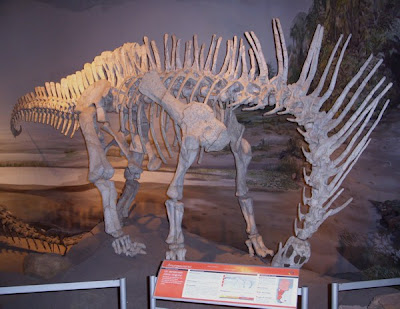
Amargasaurus – this small South American sauropod sports a double roll of tall spins down its neck and spine.

Titanosaur egg – in the lobby are displayed these remarkable sauropod eggs; one has be sawed in half exposing its geode-like interior

Fororraco (paraphysornis brasiliensis) – found in the Taubaté Basin of southern brazil, this “terror bird” stood over 2 m tall.

Argentinosaurus – while little of this huge Cretaceous sauropod has been discovered, what has been found indicates it was of prodigious size. In the double picture, Steve is dwarfed by the animal – although he is 6ft. tall.

Toxodonte platensis – this hippo-sized pleistocene mammal is thought to be, at the time of its existence, probably the most common large-hoofed mammal in South America.
See more of Steve's photos HERE

The MEF is named after Italian geologist Egidio Feruglio, pioneer in the study of Patagonia’s geology and paleontology


Amargasaurus – this small South American sauropod sports a double roll of tall spins down its neck and spine.


Toxodonte platensis – this hippo-sized pleistocene mammal is thought to be, at the time of its existence, probably the most common large-hoofed mammal in South America.
See more of Steve's photos HERE
Wednesday, March 31, 2010
Juvenile Diplodocus Skull
Description of a nearly complete juvenile skull of Diplodocus (Sauropoda: Diplodocoidea) from the Late Jurassic of North America. J.A. Whitlock, et al. JVP 30: 442–457.

Diplodocus carnegii adult and juvenile feeding,
Illo: Mark A Klingler/Carnegie Museum of Natural History
The skull of a juvenile sauropod dinosaur, rediscovered in the collections of Pittsburgh's Carnegie Museum of Natural History, illustrates that some sauropod species went through drastic changes in skull shape during normal growth.
"Diplodocus had an unusual skull," said Jeff Wilson, "Adults had long, square snouts, unlike the rounded or pointed snouts of other sauropods. Up until now, we assumed juveniles did too."
The small Diplodocus skull, however, has a pointed, rather than square, snout like the adults. This gives us a whole new perspective on what these animals may have looked like at different points in their lives."
The researchers believe these changes in skull shape may have been tied to feeding behavior, with adults and juveniles eating different foods to avoid competition. Young Diplodocus, with their narrower snouts, may also have been choosier browsers, selecting high quality plant parts.

Diplodocus carnegii adult and juvenile feeding,
Illo: Mark A Klingler/Carnegie Museum of Natural History
"Diplodocus had an unusual skull," said Jeff Wilson, "Adults had long, square snouts, unlike the rounded or pointed snouts of other sauropods. Up until now, we assumed juveniles did too."
The small Diplodocus skull, however, has a pointed, rather than square, snout like the adults. This gives us a whole new perspective on what these animals may have looked like at different points in their lives."
The researchers believe these changes in skull shape may have been tied to feeding behavior, with adults and juveniles eating different foods to avoid competition. Young Diplodocus, with their narrower snouts, may also have been choosier browsers, selecting high quality plant parts.
Tuesday, March 30, 2010
Trackways Made By Two Dinosaurs, Probably Megalosaurus

Monday, March 29, 2010
Premiered This Day: Gorgo

Over at Atomic Surgery the good doctors present a double bill to commemorate the day: a story by Steve Ditko from Gorgo #15 and a Gorgo filmbook from Famous Monsters of Filmland #50.
Sunday, March 28, 2010
The Diet of Giant Dino-Eating Crocs

A Deinosuchus lunges at an Albertosaurus in an artist's conception.
Illustration by Raul D. Martin, National Geographic Stock
"We're pretty sure it was the apex predator in this region," said Samantha Harrell, an undergraduate at Columbus State University in Georgia, who presented her research March 17 at a Geological Society of America meeting in Baltimore.
Read the story at National Geographic News.
1st Southern Tyrannosaur
A Southern Tyrant Reptile. 2010. R. B. J. Benson, et al. Science 327: 1613
 A 30 cm long pubis (above) found at Dinosaur Cove in Victoria, Australia has been identified as belonging to an ancestor of Tyrannosaurus rex. The find sheds new light on the evolutionary history of this group of dinosaurs. It also raises the crucial question of why it was only in the north that tyrannosaurs evolved into the giant predators like T. rex.
"Although we only have one bone, it shows that 110 million years ago small tyrannosaurs like ours might have been found worldwide. This find has major significance for our knowledge of how this group of dinosaurs evolved." says Dr Benson.
The bone would have come from an animal about 3m long and weighing around 80 kg, similar to a human, and would have had the large head and small arms that make tyrannosaurs so distinctive.
Compared with T. rex, which lived about 70 million years ago at the end of Cretaceous period, NMV P186069 lived earlier during the Cretaceous, around 110 million years ago.
While answering the question of whether or not tyrannosaurs lived in both the southern and northern hemispheres, the new find leaves another, deeper mystery: why did tyrannosaurs evolve into giant predators such as T. rex only in the northern hemisphere? link

"Although we only have one bone, it shows that 110 million years ago small tyrannosaurs like ours might have been found worldwide. This find has major significance for our knowledge of how this group of dinosaurs evolved." says Dr Benson.
The bone would have come from an animal about 3m long and weighing around 80 kg, similar to a human, and would have had the large head and small arms that make tyrannosaurs so distinctive.
Compared with T. rex, which lived about 70 million years ago at the end of Cretaceous period, NMV P186069 lived earlier during the Cretaceous, around 110 million years ago.
While answering the question of whether or not tyrannosaurs lived in both the southern and northern hemispheres, the new find leaves another, deeper mystery: why did tyrannosaurs evolve into giant predators such as T. rex only in the northern hemisphere? link
Saturday, March 27, 2010
Born This Day: Richard Denning

He had starring roles in a number of Sci-Fi flicks including Unknown Island (1948), Day the World Ended (1955), Creature with the Atom Brain (1955) and Black Scorpion (1957), but he takes a bow here for playing the greedy Dr. Mark Williams in 1954’s, Creature from the Black Lagoon.
Friday, March 26, 2010
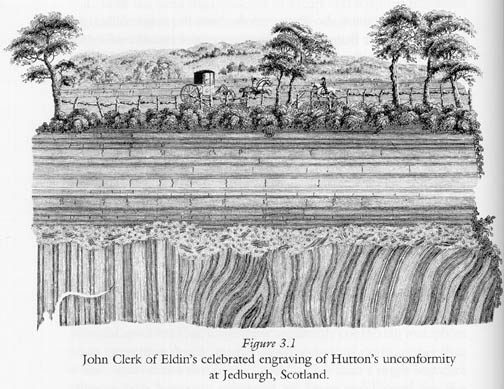
Died This Day: James Hutton
Hutton (June 3, 1726 – March 26, 1797) is the 'Father of Uniformitarianism' which explains the features of the Earth's crust by means of natural processes over geologic time. Link
Thursday, March 25, 2010
Unknown Hominin from Siberia
The complete mitochondrial DNA genome of an unknown hominin from southern Siberia. 2010. J. Krause, et al. Nature, published online 24 March.
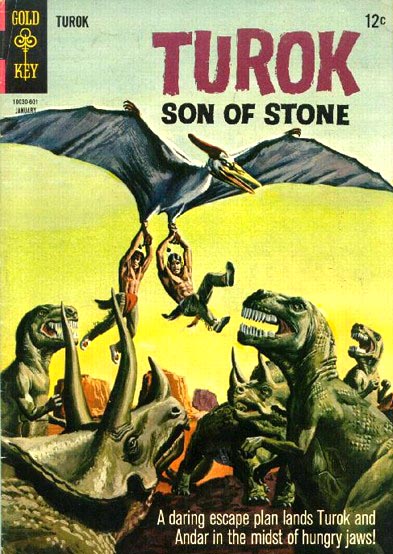
 Hmm..., we haven’t featured a Turok cover for a while. Let’s fix that right now...
Abstract: With the exception of Neanderthals, from which DNA sequences of numerous individuals have now been determined, the number and genetic relationships of other hominin lineages are largely unknown.
Here we report a complete mitochondrial (mt) DNA sequence retrieved from a bone excavated in 2008 in Denisova Cave in the Altai Mountains in southern Siberia. It represents a hitherto unknown type of hominin mtDNA that shares a common ancestor with anatomically modern human and Neanderthal mtDNAs about 1.0 million years ago.
This indicates that it derives from a hominin migration out of Africa distinct from that of the ancestors of Neanderthals and of modern humans. The stratigraphy of the cave where the bone was found suggests that the Denisova hominin lived close in time and space with Neanderthals as well as with modern humans.
Abstract: With the exception of Neanderthals, from which DNA sequences of numerous individuals have now been determined, the number and genetic relationships of other hominin lineages are largely unknown.
Here we report a complete mitochondrial (mt) DNA sequence retrieved from a bone excavated in 2008 in Denisova Cave in the Altai Mountains in southern Siberia. It represents a hitherto unknown type of hominin mtDNA that shares a common ancestor with anatomically modern human and Neanderthal mtDNAs about 1.0 million years ago.
This indicates that it derives from a hominin migration out of Africa distinct from that of the ancestors of Neanderthals and of modern humans. The stratigraphy of the cave where the bone was found suggests that the Denisova hominin lived close in time and space with Neanderthals as well as with modern humans.
The Unknown Hominin sings the "homininah" song with The Muppets:
Hillary Maddin Talks Dinosaurs...
... to a kindergarden class in Calgary.
 Hillary is a Ph.D. candidate at the University of Calgary and a long time field colleague helping to collect dinos in Alberta. When my friend Lisa Z. e-mailed me if I knew someone in town who could talk to her son's class, I immediately thought of Hillary. A great time was had by all!


Lisa's son Markus.
Thanks for the pix Lisa!


Lisa's son Markus.
Thanks for the pix Lisa!
Wednesday, March 24, 2010
Seitaad ruessi, New Sauropodomorph from Utah
A New Basal Sauropodomorph Dinosaur from the Lower Jurassic Navajo Sandstone of Southern Utah. 2010. J. J. W. Sertich & M. A. Loewen, PLoS ONE 5(3): e9789.
Utah’s red rocks have yielded a rare skeleton of a new species of sauropodomorph, Seitaad ruessi, that lived 185 million years ago and may have been buried alive by a collapsing sand dune. The discovery confirms the widespread success of sauropodomorph dinosaurs during the Early Jurassic Period.
 Seitaad ruessi (SAY-eet-AWD ROO-ess-EYE), is derived from the Navajo word, “Seit’aad,” a sand-desert monster from the Navajo (Diné) creation legend that swallowed its victims in sand dunes (the skeleton of Seitaad had been “swallowed” in a fossilized sand dune when it was discovered); and Ruess, after the artist, poet, naturalist and explorer Everett Ruess who mysteriously disappeared in the red rock country of southern Utah in 1934 at age 20.
In life, Seitaad would have stood about about 1 m tall at the hips and was 3 to 4.5 m long. It would have weighed approximately 70 to 90 kg, and could walk on two or four legs. Like its later gigantic sauropod relatives, Seitaad most likely ate plants.

Life on the edge of the Navajo Erg by Russell HawleyThe closest relatives of Seitaad are known from similar-aged rocks in South America and southern Africa. Other, less complete, fossils from northern Arizona hinted at the presence of sauropodomorphs like Seitaad, but none were complete enough to understand exactly what species was living in the American Southwest. The discovery of Seitaad confirms that this group of dinosaurs was extremely widespread and successful during the Early Jurassic, approximately 175 million to 200 million years ago.
Utah’s red rocks have yielded a rare skeleton of a new species of sauropodomorph, Seitaad ruessi, that lived 185 million years ago and may have been buried alive by a collapsing sand dune. The discovery confirms the widespread success of sauropodomorph dinosaurs during the Early Jurassic Period.


In life, Seitaad would have stood about about 1 m tall at the hips and was 3 to 4.5 m long. It would have weighed approximately 70 to 90 kg, and could walk on two or four legs. Like its later gigantic sauropod relatives, Seitaad most likely ate plants.

Life on the edge of the Navajo Erg by Russell Hawley
Monday, March 22, 2010
Born This Day: Adam Sedgwick
From Today In Science History:
Adam Sedgwich (March 22, 1785 - January 27, 1873) was an English geologist who first applied the name Cambrian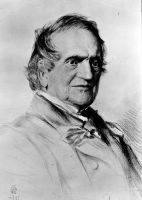 to the geologic period of time, now dated at 570 to 505 million years ago. In 1818 he became Woodwardian Professor of Geology at Cambridge, holding a chair that had been endowed ninety years before by the natural historian John Woodward.
He lacked formal training in geology, but he quickly became an active researcher in geology and paleontology. Many years after Sedgwick's death, the geological museum at Cambridge was renamed the Sedgwick Museum of Geology in his honor. The museum is now part of the Department of Earth Sciences at Cambridge University
Adam Sedgwich (March 22, 1785 - January 27, 1873) was an English geologist who first applied the name Cambrian
 to the geologic period of time, now dated at 570 to 505 million years ago. In 1818 he became Woodwardian Professor of Geology at Cambridge, holding a chair that had been endowed ninety years before by the natural historian John Woodward.
He lacked formal training in geology, but he quickly became an active researcher in geology and paleontology. Many years after Sedgwick's death, the geological museum at Cambridge was renamed the Sedgwick Museum of Geology in his honor. The museum is now part of the Department of Earth Sciences at Cambridge University
Sunday, March 21, 2010
New Chinese Dromaeosaur, Linheraptor exquisitus
A new dromaeosaurid (Dinosauria: Theropoda) from the Upper Cretaceous Wulansuhai Formation of Inner Mongolia, China. 2010. Xu Xing, et al. Zootaxa, March 19. Download the PDF.

Linheraptor exquisitus was approximately eight feet long and 50 pounds, and would have been a fast, agile predator that preyed on protoceratopsians. Within the Dromaeosauridae family, Linheraptor is most closely related to another recently discovered species Tsaagan mangas. Tsaagan's skull indicates that it is more primitive than Velociraptor, and the skeleton of the new species should help reconstruct the series of evolutionary changes within the Dromaeosauridae.
Linheraptor was found by the researchers in approximately 75 million year-old red sandstone rocks during a 2008 field expedition in Inner Mongolia, China. It is the fifth dromaeosaurid discovered in these rocks, which are famous for their preservation of uncrushed, complete skeletons. These red sandstones are best known from the Flaming Cliffs field site in outer Mongolia, the location where Velociraptor was discovered and dinosaur eggs and nests were first found. link

Linheraptor exquisitus was approximately eight feet long and 50 pounds, and would have been a fast, agile predator that preyed on protoceratopsians. Within the Dromaeosauridae family, Linheraptor is most closely related to another recently discovered species Tsaagan mangas. Tsaagan's skull indicates that it is more primitive than Velociraptor, and the skeleton of the new species should help reconstruct the series of evolutionary changes within the Dromaeosauridae.
Linheraptor was found by the researchers in approximately 75 million year-old red sandstone rocks during a 2008 field expedition in Inner Mongolia, China. It is the fifth dromaeosaurid discovered in these rocks, which are famous for their preservation of uncrushed, complete skeletons. These red sandstones are best known from the Flaming Cliffs field site in outer Mongolia, the location where Velociraptor was discovered and dinosaur eggs and nests were first found. link
Subscribe to:
Posts (Atom)