Sunday, April 05, 2009

Died This Day: Hermann Joseph Muller

21 Dec. 21, 1890 – April 5, 1967

Click To Enlarge
The father of radiation genetics, Muller began his career with T.H. Morgan studying mutations in fruit flies. He was the first to increase the mutation rate using heat, later using 50 kilovolt X-rays to induce an even greater incidence of mutations. Muller was awarded the Nobel Prize for Physiology or Medicine in 1946

Muller long warned about needless exposures to radiation and their associated risks of cancer and heritable genetic effects. By the late 1940s, the nuclear weapons testing program had begun and Muller was a vocal critic of the Atomic Energy Commission's views on the hazards of worldwide fallout.


FF © Marvel Comics
Info from here and here.

Founded This Day: The British Museum

From Today in Science History:

In 1753, the British Museum was founded by an Act of Parliament. Since then, the museum has been collecting, conserving and studying millions of artifacts. The British Museum was among the first museums to recognize that in-house scientific expertise was essential, both for the care of its collections and for their proper interpretation. Its Research Laboratory was founded in 1920 with the appointment of Dr Alexander Scott as its first scientist.

Born This Day: Alpheus Hyatt

April 5, 1838 - January 15, 1902

From Today in Science History:

U.S. zoologist and paleontologist who studied invertebrate fossil records, the evolution of the cephalopods (a class of mollusks including squids and octopuses) and the development of primitive organisms.

Along with E. Cope, Hyatt was the most prominent American neo-Lamarckian. Based on the analogy of ontogeny with phylogeny, Hyatt claimed that lineages, like individuals, had cycles of youth, old age, and death (extinction). This idea became the bulwark of orthogenetic theories in the U.S.

Hyatt was the founder and first editor of the American Naturalist, and first president of Woods Hole laboratory.

Saturday, April 04, 2009

Indentification Guide For Late Cretaceous Plants


One of the questions that I’m most frequently asked is what the plants were like during the age of the dinosaurs. This book will go a long way in answering that question. Kevin’s done a superb job sorting out the Late Cretaceous flora of Alberta. I’d highly recommend this book to everyone once it comes out this summer.

It can eventually be ordered from U of Calgary Press.

Ancient Viruses From The Dawn of Time

Did the Ancient Crenarchael Viruses from the Dawn of Life Survive Exceptionally Well the Eons of Meteorite Bombardment?. 2009. M. Jalasvuoro and K. Jaana. Astrobiology 9: 131-137.


Weird Science #22 © EC Comics. Art by Wally Wood
A new study shows that life may have never achieved the complexity necessary for the development of advanced multi-cellular organisms without recurring extinction events.
Their model is based on a type of virus in the archaeal kingdom called Crenarchaeota, which thrives in extremely hot, acidic environments like those found on the bottom of the ocean, where the viruses infiltrate hosts called acidophilic hyperthermophiles. Because crenarchaeal viruses share almost no similarities with other viruses or organisms, they likely originated very early in Earth’s history.

Jalasvuori and Bamford propose that mass extinctions caused by meteorites and volcanoes might have wiped out many cellular organisms, but the hyperthermophiles at the bottom of the ocean would have survived, along with their parasitic viruses.

Acidophilic hyperthermophiles survived the global thermal rises and, therefore, still host a wide variety of ancient virus morphotypes. In contrast, other, more “recent” cellular lineages have lost the majority of their original viruses, as they have been separated geologically and genetically, and have gone through several near-extinction-level episodes of decimation.

This view suggests that, among crenarchaeal viruses, the direct descendants of very early genetic elements are well preserved; thus, their examination would improve our understanding as to how life actually evolved from its origins to the complex cellular systems we see today.

They also present a hypothesis that describes the role of viral armadas and extinctions during evolution, as extinctions may have episodically eliminated most of the abusive parasites. Part of this post from this link.

Wednesday, April 01, 2009

Turtle 1, Avian Theropod 0


Nuff' Said!

Terminal Cretaceous Fish Extinction Explained

Ecomorphological selectivity among marine teleost fishes during the end-Cretaceous extinctionz. 2009. M. Friedman. PNAS, Published online before print March 10, 2009.


Painting by Dan Erickson
Large size and a fast bite spelled doom for bony fishes during the last mass extinction 65 million years ago.
Today, those same features characterize large predatory bony fishes, such as tuna and billfishes, that are currently in decline and at risk of extinction themselves, said Matt Friedman.

"The same thing is happening today to ecologically similar fishes," he said. "The hardest hit species are consistently big predators."

Studies of modern fishes demonstrate that large body size is linked to large prey size and low rates of population growth, while fast-closing jaws appear to be adaptations for capturing agile, evasive prey—in other words, other fishes. The fossil record provides some remarkable evidence supporting these estimates of function: fossil fishes with preserved stomach contents that record their last meals.

Scientists had speculated that during that Cretaceous extinction predatory fishes might have been more likely than other fishes to go extinct because they tended to have slowly increasing populations, lived more spread out, took longer to mature, and occupied precarious positions at the tops of food chains. Today, ecologically similar fishes appear to be the least able to rebound from declining numbers due to overfishing.

Ironically, today's large fishes with fast bites evolved relatively shortly after the end-Cretaceous extinction, apparently filling the functional and ecological roles vacated by the victims of that mass extinction. Although the two groups of fishes are not related to each other, their fates may end up being similar. link

Monday, March 30, 2009

Permian Extinction Caused By Halogenated Gases?

Late Permian Changes in Conditions of the Atmosphere and Enviroments Caused by Halogenated Gases. 2009. L. Weissflog, et al. Dokladi Earth Sciences 424: 818-823.

Did volatile halogenated gases from giant salt lakes at the end of the Permian Age lead to a mass extinction of species?
The team of researchers found that microbial processes in present-day salt lakes in the south of Russia and South Africa naturally produce and emit highly volatile halocarbons such as chloroform, trichloroethene, and tetrachloroethene. They applied these findings to the Zechstein Sea, which about 250 million years ago in the Permian Age, was situated about where present day Central Europe is. With a total surface area of around 600.000 km2 the Zechstein Sea was almost as large as France is today.

The scientists calculated that from the Zechstein Sea alone an annual VHC emissions rate of at least 1.3 million tonnes of trichloroethene, 1.3 million tonnes of tetrachloroethene, 1.1 million tonnes of chloroform as well as 0.050 million tonnes of methyl chloroform can be assumed. By comparison, the annual global industrial emissions of these compounds amount to only about 20 percent of that respectively.

"Using steppe plant species we were able to prove that halogenated gases contribute to speeding up desertification: The combination of stress induced by dryness and the simultaneous chemical stressor `halogenated hydrocarbons´ disproportionately damages and destabilize the plants and speeds up the process of erosion," Dr. Karsten Kotte.

Based on both of these findings the researchers were able to form their new hypothesis: At the end of the Permian Age the emissions of halogenated gases from the Zechstein Sea and other salt seas were responsible in a complex chain of events for the world’s largest mass extinction in the history of the earth, in which about 90 percent of the animal and plant species of that time became extinct. link

Sunday, March 29, 2009

Premiered This Day: Gorgo

Gorgo premiered on this day in 1961. Directed by Eugène Lourié from a script by John Loring and Daniel Hyat, it featured a man in a rubber suit ala Toho’s Godzilla.

Over at Atomic Surgery the good doctors present a double bill to commemorate the day: a story by Steve Ditko from Gorgo #15 and a Gorgo filmbook from Famous Monsters of Filmland #50.

Saturday, March 28, 2009

Paleonauts by Schultz


Paleonauts © Mark Schultz
For a couple of years now Mark Schultz has kicked around the idea of contributing a weekly comic strip to the Palaeoblog. Given his busy schedule and other commitments, realistically that’s never going to happen. However, if he did do one it would look like the above.

For this strip Mark channels the spirit of Charles M. via Walt Kelly. Paleonauts will appear in Vol. 4 of Mark’s “Various Drawings” series that will be out this summer from Flesk Publications.

Thursday, March 26, 2009

Guiyu: The Oldest Articulated Osteichthyan

The oldest articulated osteichthyan reveals mosaic gnathostome characters. 2009. M. Zhu, et al. Nature 458: 469-474.


Illo by B. Choo
Abstract: The evolutionary history of osteichthyans (bony fishes + tetrapods) extends back to the Ludlow epoch of the Silurian period. However, these Silurian forms have been documented exclusively by fragmentary fossils. Here we report the discovery of an exceptionally preserved primitive fish from the Ludlow of Yunnan, China, that represents the oldest near-complete gnathostome (jawed vertebrate).

The postcranial skeleton of this fish includes a primitive pectoral girdle and median fin spine as in non-osteichthyan gnathostomes, but a derived macromeric squamation as in crown osteichthyans, and substantiates the unexpected mix of postcranial features in basal sarcopterygians, previously restored from the disarticulated remains of Psarolepis.

As the oldest articulated sarcopterygian, the new taxon offers insights into the origin and early divergence of osteichthyans, and indicates that the minimum date for the actinopterygian–sarcopterygian split was no later than 419 million years ago.

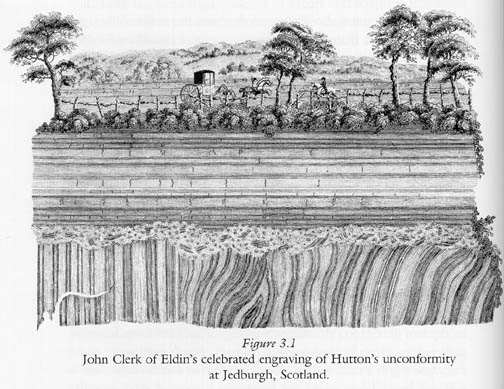
Died This Day: James Hutton

June 3, 1726 – March 26, 1797

Hutton is the 'Father of Uniformitarianism' which explains the features of the Earth's crust by means of natural processes over geologic time. Link


More Info Here

Tuesday, March 24, 2009

Talk On Mongolian Dinos At CMNH


If you’re in the Cleveland area tomorrow (Weds.), I’m giving a talk on my work in Mongolia at 7pm at the Cleveland Museum of Natural History. Details Here.

The Evolution of Gills & Limbs

Shared developmental mechanisms pattern the vertebrate gill arch and paired fin skeletons. 2009. J. A. Gillis, et al. PNAS, published online before print March 24, 2009.

The genetic toolkit that animals use to build fins and limbs is the same genetic toolkit that controls the development of part of the gill skeleton in sharks
The skeleton of any appendage off the body of an animal is probably patterned by the developmental genetic program that has been traced back to formation of gills in sharks.

A dearth of fossils prevents us from definitely concluding that fins evolved from gills -- nevertheless, this research shows that the genetic architecture of gills, fins and limbs is the same.

The research also showed for the first time that the gill arch skeleton of embryonic skates (a living relative of sharks that has gill rays) responds to treatment with the vitamin A derivative retinoic acid in the same way a limb or fin skeleton does: by making a mirror image duplicate of the structure as the embryo develops. According to the researchers, the genetic circuitry that patterns paired appendages (arms, legs and fins) has a deep evolutionary origin that actually predates the origin of paired appendages themselves.


The deep structural, functional, and regulatory similarities between paired appendages and developing gill rays, as well as the antiquity of gills relative to paired appendages, suggest that the signaling network that is induced by retinoic acid had a patterning function in gills before the origin of vertebrate appendages, the research concludes. And this function has been retained in the gill rays of living cartilaginous fishes. link

The shark arch gill skeleton (left) shows primitive gill rays that are found only in sharks and other cartilaginous fishes. The gills of other fishes (right) are also arched but lack gill rays. This primitive feature of sharks allowed the researchers to link the developmental genetic program for fins and limbs to the more primitive one for gill rays.Image by J.A. Gillis, U of Chicago

Monday, March 23, 2009

Pete's Unseen Dinos

Over at his VonShollyWood blog, out pal Pete has a bunch of his great unused art from some big dinosaur movie from some years ago. Pete does not say what it is but I suspect that it was Disney’s Dinosaur (which I never did see – talking Cretaceous gibbons? No thanks!). Anyhow, check it out HERE. Be warned that not all the language Pete’s uses is squeaky clean, so discretion is advised as they say.

Sunday, March 22, 2009

Medal For A Dinosaur


Atomic Surgery presents a wacky tale from The War That Time Forgot – “Medal For A Dinosaur.” Featuring “Baby Dino!”
You must go read it HERE

Your Sunday Funnies


Liberty Meadows © Frank Cho

Born This Day: Adam Sedgwick

March 22, 1785 - January 27, 1873

From Today In Science History:

Adam Sedgwich was an English geologist who first applied the name Cambrian to the geologic period of time, now dated at 570 to 505 million years ago. In 1818 he became Woodwardian Professor of Geology at Cambridge, holding a chair that had been endowed ninety years before by the natural historian John Woodward.

He lacked formal training in geology, but he quickly became an active researcher in geology and paleontology. Many years after Sedgwick's death, the geological museum at Cambridge was renamed the Sedgwick Museum of Geology in his honor. The museum is now part of the Department of Earth Sciences at Cambridge University.

Saturday, March 21, 2009

The Evolution of the Lepidosaurian Lower Temporal Bar

The evolution of the lepidosaurian lower temporal bar: new perspectives from the Late Cretaceous of South China. 2009. Jin-You Mo, et al. J. Exp. Biol. Published online before print March 18, 2009.

Abstract: Until recently, it was considered axiomatic that the skull of lizards and snakes arose from that of a diapsid ancestor by loss of the lower temporal bar. The presence of the bar in the living New Zealand Tuatara, Sphenodon, was thus considered primitive, corroborating its status as a ‘living fossil’.

A combination of new fossils and rigorous phylogeny has demonstrated unequivocally that the absence of the bar is the primitive lepidosaurian condition, prompting questions as to its function.


Click to Enlarge
Here we describe new material of Tianyusaurus, a remarkable lizard from the Late Cretaceous of China that is paradoxical in having a complete lower temporal bar and a fixed quadrate. New material from Jiangxi Province is more complete and less distorted than the original holotype.

Tianyusaurus is shown to be a member of the Boreoteiioidea, a successful clade of large herbivorous lizards that were dispersed through eastern Asia, Europe and North America in the Late Cretaceous, but disappeared in the end-Cretaceous extinction. A unique combination of characters suggests that Tianyusaurus took food items requiring a large gape.

Friday, March 20, 2009

500 Million Year Old Predator Reconstructed

The Burgess Shale Anomalocaridid Hurdia and Its Significance for Early Euarthropod Evolution. 2009. A. C. Daley, et al. Science 323: 1597 – 1600.


Hurdia victoria was originally described in 1912 as a crustacean-like animal from the famous 505 million year old Burgess Shale, a UNESCO World Heritage Site in British Columbia, Canada. Researchers have found more pieces of this critter and reconstructed it as a formidable predator.

When the first fragments of Hurdia were described nearly one hundred years ago, they were assumed to be part of a crustacean-like animal. It was not then realised that other parts of the animal were also in collections, but had been described independently as jellyfish, sea cucumbers and other arthropods. New material collected in the 1990s and the discovery of the best-preserved specimen in the collections at the Smithsonian Museum shows Hurdia to be related to Anomalocaris. Like Anomalocaris, Hurdia had a segmented body with a head bearing a pair of spinous claws and a circular jaw structure with many teeth. But it differs from Anomalocaris by the possession of a huge three-part carapace that projects out from the front of the animal's head.

"The use of the large carapace extending from the front of its head is a mystery. In many animals, a shell or carapace is used to protect the soft-parts of the body, as you would see in a crab or lobster, but this structure in Hurdia is empty and does not cover or protect the rest of the body. We can only guess at what its function might have been."


Hurdia and Anomalocaris are both early offshoots of the evolutionary lineage that led to the arthropods, the large modern group that contains the insects, crustaceans, spiders, millipedes and centipedes. They reveal details of the origins of important features that define the modern arthropods such as their head structures and limbs. As well as its bizarre frontal carapace, Hurdia reveals exquisite details of the gills associated with the body, some of the best preserved in the fossil record.