An overlooked pink species of land iguana in the Galápagos. 2008. G. Gentile et. al. PNAS. Published online before print January 5, 2009.
Abstract: Despite the attention given to them, the Galápagos have not yet finished offering evolutionary novelties. When Darwin visited the Galápagos, he observed both marine (Amblyrhynchus) and land (Conolophus) iguanas but did not encounter a rare pink black-striped land iguana (herein referred to as “rosada,” meaning “pink” in Spanish), which, surprisingly, remained unseen until 1986.
Here, we show that substantial genetic isolation exists between the rosada and syntopic yellow forms and that the rosada is basal to extant taxonomically recognized Galápagos land iguanas. The rosada, whose present distribution is a conundrum, is a relict lineage whose origin dates back to a period when at least some of the present-day islands had not yet formed.
So far, this species is the only evidence of ancient diversification along the Galápagos land iguana lineage and documents one of the oldest events of divergence ever recorded in the Galápagos. Conservation efforts are needed to prevent this form, identified by us as a good species, from extinction.
Read the story at National Geographic News.
Tuesday, January 06, 2009
Died This Day: Gregor Mendel
July 22, 1822 – Jan. 6, 1884
From Today In Science History:
Mendel was an Austrian pioneer in the study of heredity. He spent his adult life with the Augustinian monastery in Brunn, where as a geneticist,
botanist and plant experimenter, he was the first to lay the mathematical foundation of the science of genetics, in what came to be called Mendelism.
Over the period 1856-63, Mendel grew and analyzed over 28,000 pea plants. He carefully studied for each their plant height, pod shape, pod color, flower position, seed color, seed shape and flower color. He made two very important generalizations from his pea experiments, known today as the Laws of Heredity. Mendel coined the present day terms in genetics: recessiveness and dominance.
From Today In Science History:
Mendel was an Austrian pioneer in the study of heredity. He spent his adult life with the Augustinian monastery in Brunn, where as a geneticist,

botanist and plant experimenter, he was the first to lay the mathematical foundation of the science of genetics, in what came to be called Mendelism.
Over the period 1856-63, Mendel grew and analyzed over 28,000 pea plants. He carefully studied for each their plant height, pod shape, pod color, flower position, seed color, seed shape and flower color. He made two very important generalizations from his pea experiments, known today as the Laws of Heredity. Mendel coined the present day terms in genetics: recessiveness and dominance.
Born This Day: George Ledyard Stebbins
Jan. 6, 1906 - Jan. 19 2000.
From the U Calif., Berkeley:
Along with Dobzhansky (1900 - 1975), animal systematist Ernst Mayr, and paleontologist George Gaylord Simpson (1902 - 1984),
Stebbins is considered one of the "architects" of the modern evolutionary synthesis of the 1930s and 1940s, an intellectual watershed and historic turning point that brought together research in cytology, genetics, systematics, paleontology into a common evolutionary framework. This synthesis, which had the effect of reconciling the often opposing views of laboratory-oriented geneticists and natural history oriented systematists, made Charles Darwin's theory of evolution by natural selection the centerpiece of the new discipline of evolutionary biology.
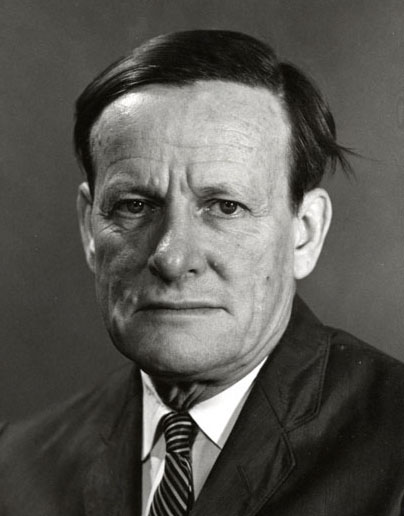
In this role, Stebbins is credited with bringing a modern framework to the study of plant evolution, and he is perhaps best known for his book Variation and Evolution in Plants, published by Columbia University Press (NY) in 1950. In the 1940s, Stebbins also played an important role in organizing the nascent Society for the Study of Evolution, of which he became the third president in 1948, and used his position to speak out for the botanical side of evolutionary studies, a field that had been dominated by zoologists. Photo .
From the U Calif., Berkeley:
Along with Dobzhansky (1900 - 1975), animal systematist Ernst Mayr, and paleontologist George Gaylord Simpson (1902 - 1984),
Stebbins is considered one of the "architects" of the modern evolutionary synthesis of the 1930s and 1940s, an intellectual watershed and historic turning point that brought together research in cytology, genetics, systematics, paleontology into a common evolutionary framework. This synthesis, which had the effect of reconciling the often opposing views of laboratory-oriented geneticists and natural history oriented systematists, made Charles Darwin's theory of evolution by natural selection the centerpiece of the new discipline of evolutionary biology. In this role, Stebbins is credited with bringing a modern framework to the study of plant evolution, and he is perhaps best known for his book Variation and Evolution in Plants, published by Columbia University Press (NY) in 1950. In the 1940s, Stebbins also played an important role in organizing the nascent Society for the Study of Evolution, of which he became the third president in 1948, and used his position to speak out for the botanical side of evolutionary studies, a field that had been dominated by zoologists. Photo .
Saturday, January 03, 2009
Buddy's Lost World (1935)
Jack King (1895-1958) was an American animator best known for his work at Walt Disney Productions where he directed many classic Donald Duck cartoons between 1936 and 1948. Before that, between 1933 and 1936, he worked for Warner Bros. producing a variety of Looney Tunes and Merrie Melodies, including many featuring the now forgotten, Buddy.
Buddy’s Lost World features everything you’d want from a “lost world” story – cavemen, dinosaurs and man-eating plants – as well as some novel camera angles for such an early cartoon.
Thursday, January 01, 2009
Born This Day: Carole Landis
Jan. 1, 1919 - July 5, 1948
Born Frances Lillian Mary Ridste, Carole quit school at 15 go into show business. She had bit parts until 1940 when Hal Roach cast her as the cave girl, Lorna, along side leading man Victor Mature in One Million B.C., the film that made her a star. Landis became a popular pin-up with servicemen during World War II. She was an accomplished writer; her 1944 book Four Jills in a Jeep was later made into a movie. After a turbulent love life she commited suicide at age 29.
Wednesday, December 31, 2008
Acinonyx jubatus: World’s Oldest Cheetah?
A primitive Late Pliocene cheetah, and evolution of the cheetah lineage. 2008. P. Christiansen and J. H. Mizak. PNAS. Published online before print Dec. 29, 2008
Read the story at National Geographic News.
Tuesday, December 30, 2008
7th Voyage of Sinbad Named To National Film Registry
Each year the National Film Preservation Board of The Library of Congress names 25 films to the National Film Registry, a collection of movies selected to be preserved for all time. Among this year’s inductees is Ray Harryhausen’s classic The 7th Voyage of Sindbad (1958). Although there are no dinos in the film, it does have a snazzy dragon
.
.
Competition Caused Neanderthal Extinction
Neanderthal Extinction by Competitive Exclusion. 2008. W.E. Banks, et al PLoS ONE 3(12): e3972.
The researchers used geographic locations of archaeological sites dated by radiocarbon, in conjunction with high-resolution simulations of past climates for specific periods to analyze relationships between the potential areas occupied by each human population. This modeling approach also allows the projection of the ecological footprint of one culture onto the environmental conditions of a later climatic phase―by comparing this projected prediction to the known archaeological sites dated to this later period, it is possible to determine if the ecological niche exploited by this human population remained the same, or if it contracted or expanded during that period of time.
Comparing these reconstructed areas for Neanderthals and anatomically modern humans during each of the climatic phases concerned, and by projecting each niche onto the subsequent climatic phases, Banks and colleagues determined that Neanderthals had the possibility to maintain their range across Europe during a period of less severe climatic conditions called Greenland Interstadial 8 (GI8).
However, the archaeological record shows that this did not occur, and Neanderthal disappearance occurs at a point when we see the geographic expansion of the ecological niche occupied by modern humans during GI8.
The researchers conclude that the Neanderthal populations that occupied what is now southern Spain were the last to survive because they were able to avoid direct competition with modern humans since the two populations exploited distinct territories during the cold climatic conditions of H4. They also point out that during this population event contact between Neanderthals and modern humans may have permitted cultural and genetic exchanges.
Neanderthal populations disappeared from Europe prior to the arrival of human populations around 40,000 years ago. Researchers have determined that their extinction was principally a result of competition with Cro-Magnon populations, rather than the consequences of climate change.From the press release:
The researchers used geographic locations of archaeological sites dated by radiocarbon, in conjunction with high-resolution simulations of past climates for specific periods to analyze relationships between the potential areas occupied by each human population. This modeling approach also allows the projection of the ecological footprint of one culture onto the environmental conditions of a later climatic phase―by comparing this projected prediction to the known archaeological sites dated to this later period, it is possible to determine if the ecological niche exploited by this human population remained the same, or if it contracted or expanded during that period of time.
Comparing these reconstructed areas for Neanderthals and anatomically modern humans during each of the climatic phases concerned, and by projecting each niche onto the subsequent climatic phases, Banks and colleagues determined that Neanderthals had the possibility to maintain their range across Europe during a period of less severe climatic conditions called Greenland Interstadial 8 (GI8).
However, the archaeological record shows that this did not occur, and Neanderthal disappearance occurs at a point when we see the geographic expansion of the ecological niche occupied by modern humans during GI8.
The researchers conclude that the Neanderthal populations that occupied what is now southern Spain were the last to survive because they were able to avoid direct competition with modern humans since the two populations exploited distinct territories during the cold climatic conditions of H4. They also point out that during this population event contact between Neanderthals and modern humans may have permitted cultural and genetic exchanges.
Monday, December 29, 2008
First Chinese Ceratopsid?
A dinosaur fossil field discovered this year in eastern China appears to be the largest in the world, a paleontologist told Xinhua on Monday.From Window of China:
More than 7,600 fossils have been discovered so far in Zhucheng City in eastern Shandong Province and the number is climbing, said Zhao Xijin from the IVPP, the paleontologist in charge of the project.
The city has a major field of large hadrosaurs, discovered in the 1960s by a Chinese oil expedition. More than 50 tons of fossils have been discovered since then. The world's largest hadrosaurs fossil was found here in the 1980s and exhibited in the local museum.
A new fossil site was found during another mining expedition in March in Longdu, Shunwang, Jiayue and Zhigou Towns. One field in Longdu is 300meters long by 10m wide and 5m deep. More than 3,000 fossils have been found at that site, among which new genera or species might be found, Zhao said.
A 2m skull of a large ceratopsian was found here, the first such discovery outside of North America, said Xu Xing, researcher from the IVPP.
In the 15 sub-fields, other new genera of ankylosaurs, tyrannosaurs and coelosaurs were also found, Xu said.
Mining had been suspended because of weather but would resume in the spring, Zhao said.
Research on the findings would be published at the end of next year, he said. A fossil park will be built in the region, local authorities said.
Thanks to David Evans for the lead.
2008 Top 10 Fossil Finds
From National Geographic, based on their “most read” articles. Number 1 is the “ancient Praying Mantis found in amber. Our friend Jorn Hurum's work came in at #5 (above) while Pat Druckenmiller and Tony Russell ranked #6.
Sunday, December 28, 2008
New Triassic Turtle: Chinlechelys tenertesta
A thin-shelled reptile from the Late Triassic of North America and the origin of the turtle shell . 2008. W. Joyce, et. al. Proc. Royal Soc. B 276: 1656
More on turtle orgins:
Abstract: A new, thin-shelled fossil from the Upper Triassic (Revueltian: Norian) Chinle Group of New Mexico, Chinlechelys tenertesta, is one of the most primitive known unambiguous members of the turtle stem lineage. The thin-shelled nature of the new turtle combined with its likely terrestrial habitat preference hint at taphonomic filters that basal turtles had to overcome before entering the fossil record.
Chinlechelys tenertesta possesses neck spines formed by multiple osteoderms, indicating that the earliest known turtles were covered with rows of dermal armour. More importantly, the primitive, vertically oriented dorsal ribs of the new turtle are only poorly associated with the overlying costal bones, indicating that these two structures are independent ossifications in basal turtles.
These novel observations lend support to the hypothesis that the turtle shell was originally a complex composite in which dermal armour fused with the endoskeletal ribs and vertebrae of an ancestral lineage instead of forming de novo. The critical shell elements (i.e. costals and neurals) are thus not simple outgrowths of the bone of the endoskeletal elements as has been hypothesized from some embryological observations.
Born This Day: Alfred Sherwood Romer
Dec. 28, 1894 – Nov. 5, 1973
”Romer was director of the Museum of Comparative Zoology at Harvard University until his retirement in 1961 and was one the singularly most influential vertebrate paleontologists of the 20th Century. His work ranged over virtually every
conceivable subject within that field, although it was the osteology and taxonomy of the therapsids and other proto-mammals which was nearest his heart.
In addition to this work, Romer was acutely interested in the origin and initial adaptive radiation of tetrapods, and his work became the basis for a theory of tetrapod origins which was canon until the description of Acanthostega gunnari by Clack & Coates in the 1990s. Romer was ahead of his time in his defense of monophyly of Dinosauria though he did feel that Theropoda was not ancestral to birds.” link from EvoWiki.org
Romer’s book, Vertebrate Paleontology (1966), was for many years THE textbook on VP and is still well worth picking up. One of Romer’s students, Bob Carroll, wrote an updated version entitled, ‘Vertebrate Paleontology and Evolution’, in 1987. image
”Romer was director of the Museum of Comparative Zoology at Harvard University until his retirement in 1961 and was one the singularly most influential vertebrate paleontologists of the 20th Century. His work ranged over virtually every
conceivable subject within that field, although it was the osteology and taxonomy of the therapsids and other proto-mammals which was nearest his heart.In addition to this work, Romer was acutely interested in the origin and initial adaptive radiation of tetrapods, and his work became the basis for a theory of tetrapod origins which was canon until the description of Acanthostega gunnari by Clack & Coates in the 1990s. Romer was ahead of his time in his defense of monophyly of Dinosauria though he did feel that Theropoda was not ancestral to birds.” link from EvoWiki.org
Romer’s book, Vertebrate Paleontology (1966), was for many years THE textbook on VP and is still well worth picking up. One of Romer’s students, Bob Carroll, wrote an updated version entitled, ‘Vertebrate Paleontology and Evolution’, in 1987. image
Saturday, December 27, 2008
Aquaman in The Ocean of 1,000,000 B.C
Never the brightest of heroes, poor Aquaman doesn’t realize that he can’t control these ‘sea’ creatures because none of them are sea creatures. I guess the flying pterosaur wasn’t enough of a clue. Or the lack of fins or flippers. And riding a rainbow out of a brontosaur’s nose doesn’t help his credibility any.
Read the whole silly story over at Atomic Surgery.
Set Sail Today: HMS Beagle
From Today In Science History:
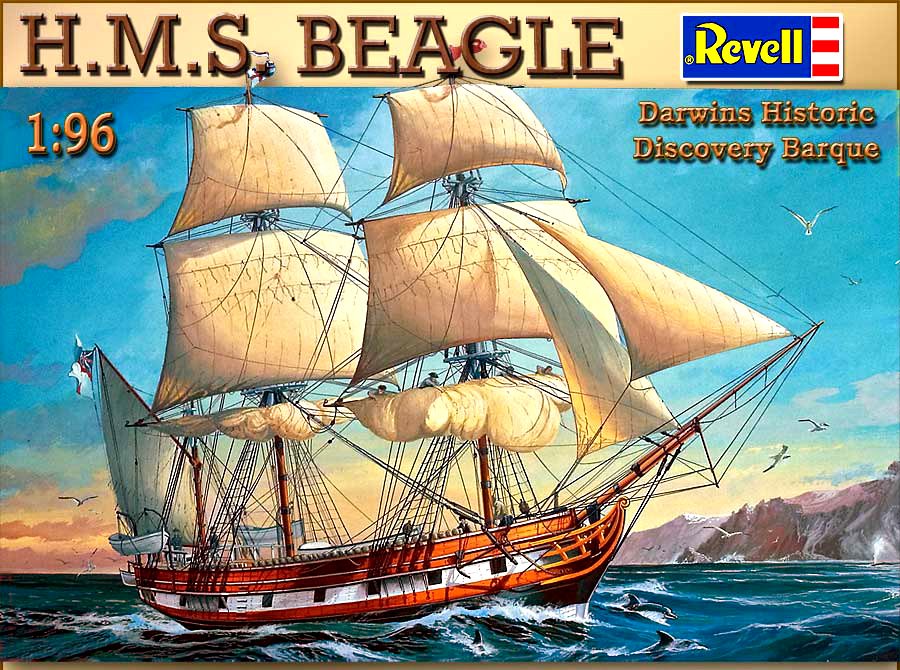
In 1831, Charles Darwin set sail from Plymouth harbour on his voyage of scientific discovery aboard the HMS Beagle, a British Navy ship. The Captain Robert FitzRoy was sailing to the southern coast of South America in order to complete a government survey. Darwin had an unpaid position as the ship's naturalist, at age 22, just out of university.
Originally planned to be at sea for two years, the voyage lasted five years, making stops in Brazil, the Galapogos Islands, and New Zealand. From the observations he made and the specimens he collected on that voyage, Darwin developed his theory of biological evolution through natural selection, which he published 28 years after the Beagle left Plymouth.
Friday, December 26, 2008
El Bello Durmiente
Caveman Triquitrán is given a potion that puts him to sleep on his wedding night. A volcanic eruption buries him, leaving him in suspended animation until he’s found during an archaeological excavation. Hilarity ensues in the modern world.
I post it here for its animated dinosaur sequence during the opening (about four plus minutes into this clip). I’ve not seen these animations before so I’m not sure if they were done for this movie or recycled from somewhere else.
El Bello Durmiente aka The Beautiful Dreamer (U.S. Title):
Wednesday, December 24, 2008
Evolving Giants
Two-phase increase in the maximum size of life over 3.5 billion years reflects biological innovation and environmental opportunity. 2008. J. Payne, et al. PNAS published online before print December 23, 2008. This is an open access article
"What is really interesting is that each of these 'steps' correlate with a time in life's history where there is innovation in the complexity of life, the first one being the eukaroytic cell and the second is the mulitcellularity of life," said Stempien.
During the first 1.5 billion years of the recorded history of life -- from about 3.5 billion to 2 billion years ago -- only bacteria-like fossils are found. Maximum size to which a bacteria cell can grow is severely limited. After the appearance of photosynthetic bacteria 3 billion years ago, the bacteria released oxygen making it possible for the evolution of a more complex cellular structure. In about two hundred million years, organisms went from cells not visible to the naked eye to macroscopic organisms, some about the size of a dime.
Life languished as single cells for another billion years or so, until just before the Precambrian-Cambrian transition about 540 million years ago, when atmospheric oxygen again increased notably reaching as much as 10 percent of its current concentration. Many scientists argue that the second increase in oxygen levels was a key prerequisite for evolution of yet more complex, multi-cellular (tissue-forming) life.
Once this new level of complexity was achieved, body size limits imposed on single-celled organisms were removed and larger organisms started appearing in the fossil record. Relatively quickly in evolutionary terms – in about one hundred million years – largest life forms transitioned from dime-size, single-celled forms to giant marine animals such as Ordovician cephalopods, tens of feet in length. Dinosaurs, which came much later, come to mind, although not mentioned in the PNAS paper.
Over 3.5 billion years the maximum body size of organisms increased by 16 orders of magnitude in two distinct bursts tied to the geological evolution of the planet.From the press release:
"What is really interesting is that each of these 'steps' correlate with a time in life's history where there is innovation in the complexity of life, the first one being the eukaroytic cell and the second is the mulitcellularity of life," said Stempien.
During the first 1.5 billion years of the recorded history of life -- from about 3.5 billion to 2 billion years ago -- only bacteria-like fossils are found. Maximum size to which a bacteria cell can grow is severely limited. After the appearance of photosynthetic bacteria 3 billion years ago, the bacteria released oxygen making it possible for the evolution of a more complex cellular structure. In about two hundred million years, organisms went from cells not visible to the naked eye to macroscopic organisms, some about the size of a dime.
Life languished as single cells for another billion years or so, until just before the Precambrian-Cambrian transition about 540 million years ago, when atmospheric oxygen again increased notably reaching as much as 10 percent of its current concentration. Many scientists argue that the second increase in oxygen levels was a key prerequisite for evolution of yet more complex, multi-cellular (tissue-forming) life.
Once this new level of complexity was achieved, body size limits imposed on single-celled organisms were removed and larger organisms started appearing in the fossil record. Relatively quickly in evolutionary terms – in about one hundred million years – largest life forms transitioned from dime-size, single-celled forms to giant marine animals such as Ordovician cephalopods, tens of feet in length. Dinosaurs, which came much later, come to mind, although not mentioned in the PNAS paper.
Note: The Palaeoblog will slow down for the next 10 days or so.
Have a happy holiday!
Tuesday, December 23, 2008
This Day In History: 1st Australopithecus africanus Skull Prepared

On this day in 1924 Raymond Dart finished preparing the first fossil skull of Australopithecus africanus. Known as the “Taung child”, he was only three years old at the time of death.
Click to download the PDF: Australopithecus africanus The Man-Ape of South Africa. 1925. Raymond Dart. Nature 115: 195.
Monday, December 22, 2008
Premiered This Day (1933): Son of Kong
With the fantastic success of “King Kong”, RKO tried to cash in by rushing this sequel into production and release within the same year (1933). It did not do nearly as well, but animator Willis O’Brien did manage to bring some of the same charm to the big white ape that he did to Kong.
Evolution by Max Fleischer
The Fleischer Brothers, Max and Dave, made some of the greatest animated cartoons an audience ever watched with their Inkwell Studios between 1921 to 1942. From their early success with Betty Boop, they also created the now legendary Superman and Popeye cartoons. Although their names are largely forgotten by the public today, the style and genius of their films still inspire each new generation of animators.
In addition to cartoons, the studio also made non-animated films such as “Evolution” (1923 [according to IMDB]). The film was Max Fleischer’s response to the high profile 1925 trial of John Scopes for teaching evolution in Tennessee.
“The trial was a fight between science and religion, and since science was involved Max [Fleischer] was once again completely captivated. He decided to make another long film that would present the scientific argument for Darwin’s theory. He contacted the American Museum of Natural History in New York and, with its cooperation and assistance, produced Darwin’s Theory of Evolution, a five-reel feature combining animation and live action. Once again, the man who had earned his reputation making people laugh had taken on a profoundly serious subject. The film was another surprise hit. Its first public screening was held in the Kaufman Theater of the American Museum of Natural History.”From Out of the Inkwell: Max Fleischer and the Animation Revolution by Richard Fleischer and Leonard Maltin.
Subscribe to:
Posts (Atom)