Monday, July 28, 2008

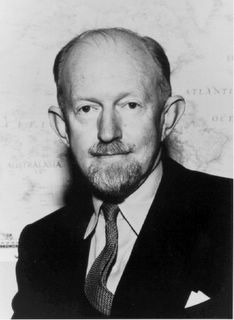
Died This Day: Francis Crick

June 8, 1916 – July 28, 2004

From Today In Science History:

Crick was a British biophysicist, who, with James Watson and Maurice Wilkins, received the 1962 Nobel Prize for Physiology or Medicine for their determination of the molecular structure of deoxyribonucleic acid (DNA), the chemical substance ultimately responsible for hereditary control of life functions.


Crick and Watson began their collaboration in 1951, and published their paper on the double helix structure on April 2, 1953 in Nature. This accomplishment became a cornerstone of genetics and was widely regarded as one of the most important discoveries of 20th-century biology.
[ a palaeoblog autopost]

Tuesday, July 22, 2008

Born This Day: Gregor Mendel

July 22, 1822 – Jan. 6, 1884

From Today In Science History:

Mendel was an Austrian pioneer in the study of heredity. He spent his adult life with the Augustinian monastery in Brunn, where as a geneticist,
botanist and plant experimenter, he was the first to lay the mathematical foundation of the science of genetics, in what came to be called Mendelism.

Over the period 1856-63, Mendel grew and analyzed over 28,000 pea plants. He carefully studied for each their plant height, pod shape, pod color, flower position, seed color, seed shape and flower color. He made two very important generalizations from his pea experiments, known today as the Laws of Heredity. Mendel coined the present day terms in genetics: recessiveness and dominance.

[ a palaeoblog autopost]

Sunday, July 20, 2008

Born This Day: Sir Richard Owen

July 20, 1804 – Dec. 18, 1892

From Today In Science History:

Owen was an English anatomist and paleontologist who is remembered for his contributions to the study of fossil animals and for his strong opposition to the views of Charles Darwin.

He coined the word "Dinosaur" meaning "terrible reptile" (1842). Owen synthesized French anatomical work, especially from Cuvier and Geoffroy, with German transcendental anatomy. He gave us many of the terms still used today in anatomy and evolutionary biology, including "homology". In 1856, he was appointed Superintendent of the British Museum (Natural History).

[ a palaeoblog autopost]

Monday, July 14, 2008

Born This Day: Florence Bascom


July 14, 1862 – June 18, 1945

From Today In Science History:
Bascom was an American geologist and teacher. She was the first woman to receive a doctorate from Johns Hopkins University. Two years later she launched the geology department at Bryn Mawr. Bascom was the first woman to work as a geologist for the U.S. Geological Survey and to be made a fellow of the Geological Society of America. Bascom was an expert in crystallography, mineralogy, and petrography. She is known for inventing techniques that used microscopic analysis in the study of the oil-bearing rocks.
[ a palaeoblog autopost]

Friday, July 11, 2008

SADRG Update #2

A few more photos from the Southern Alberta Dinosaur Research Group:


Swimming in the Milk River after a hard day in "Club Med Bone Bed".


David Eberth (background) collects a bentonite for dating from above one of the newly discovered ceratopsian bone beds in the Oldman Formation. David Evans (ROM) is in the foreground.

A few of the students working with us:


Robin Sessons, U of Alberta grad student.


Caleb Brown, U of Calgary grad student.


Derek Larsons, U of Alberta grad student.


Plus, David Lloyd, RTMP technician.

Monday, July 07, 2008

Died This Day: Sir Arthur Conan Doyle

May 22, 1859 – July 7, 1930

From HERE:

Sir Arthur Conan Doyle was a British writer and creator of Sherlock Holmes. He was born in Edinburgh. His father and uncle were both book illustrators and his mother encouraged his son to explore the world of books. Doyle studied at Edinburgh University and in 1884 he married Louise Hawkins. Doyle qualified as doctor in 1885 and practiced medicine as an eye specialist in Hampshire until 1891 when he became a full time writer. Doyle's first novel about Sherlock Holmes,’ A Study in Scarlet’, was published in 1887.

During the South African war (1899-1902) Doyle served for a few months as senior physician at a field hospital, and wrote ‘The War in South Africa’, in which he defended England's policy. When his son Kingsley died from wounds incurred in World War I, the author dedicated himself in spiritualistic studies.


Doyle's stories of Professor George Edward Challenger in ‘The Lost World’ (1912). The model for the professor was William Rutherford, Doyle's teacher from Edinburgh. Doyle's practice, and other experiences, expeditions as ship's surgeon to the Arctic and West Coast of Africa, service in the Boer War, defenses of George Edalji and Oscar Slater, two men wrongly imprisoned, provided much material for his writings.

The Lost World:


[ a palaeoblog autopost]

Sunday, July 06, 2008

SADRG Update #1

The Southern Alberta Dinosaur Research Group is just finishing off the first of four weeks in southern Alberta working in the badlands adjacent to the Milk and Oldman rivers. Dr. Michael Ryan (your palaeoblogger) from the Cleveland Museum of Natural Museum and Dr. David Evans from the Royal Ontario Museum have a crew of about 15 people per week working on a series of projects including the collection of two potentially new duck-billed dinosaurs, and the on-going excavation of a juvenile duck-billed dinosaur bone bed from the Belly River Group and earlier sediments. The crews are made up of collaborators such as Dr. Nick Longrich from the U of Calgary; technician Ian Morrison, undergrad and grad students from the U of Toronto; Technician David Lloyd from the Royal Tyrrell Museum; grad students from U of Calgary and Alberta; with undergrad students from Case Western Reserve U. to arrive later this month (I’m sure that I’ve forgetting someone).

It’s been a busy week and I’ve not taken many photos but here’s a short selection:


The rattler that greeted us as we set up camp.


The red arrow points to the first hadrosaur quarry that we opened this week. Here the crew is removing overburden.


More overburden removal in the same quarry. The specimen is the brown bone exposed in the sandstone under the hard capstone. The specimen was originally reported to Wann Langston, Jr., in 1960.


David Evans takes a break in the quarry.


Ian Morrison (white cap) does the impossible by fixing a broken jackhammer starter spring with a multitool. A week of jack hammering was required to take off the capstone.


U of T undergrad, Jill Gallimore, rocks out in the quarry


A double rainbow seen from camp after a recent evening thunderstorm.

Saturday, July 05, 2008

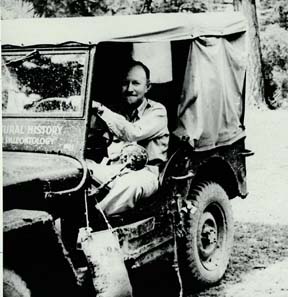
Born This Day: Ernst Mayr


Any student of biology, or anyone with an interest in the natural world, will be familiar with Ernst Mayr who passed away on February 3rd in Bedford, Mass. Born in Kempton, Germany he joined the American Museum of Natural History as a curator in 1931. In 1953 he left the museum to work at Harvard University where he stayed until his retirement in 1975.

While working on the problem of speciation in the birds of New Guinea, Mayr realized that the multitude of species and and subspecies that he saw could best be explained as being a snapshot of evolution in action. He suggested that new species could arise when the range of one species was fractured long enough for members in different parts of the range to evolve characters that would not allow individuals to reproduce when they were brought back together again. This lead to him developing the “biological species concept” in which species are defined as populations of interbreeding organisms rather than just a collection of characters. This idea, along with his theory of “allopatric speciation” was published in his book “Systematics and the Origin of the Species” (1942) and later contributed to the “Punctuated Equilibrium” theory of Niles Eldredge and Stephen Jay Gould.

Ernst Mayr was himself inspired by the work of geneticist Theodosius Dobzhansky on the fruit fly Drosophila melanogaster and his book “Genetics and the Origin of the Species” (1937). These two men, together with the paleontologist George Gaylord Simpson, combined the sciences of genetics, zoology and paleontology into what is now known as “the new synthesis” that provides the modern experimental underpinning to the concepts that Charles Darwin presented in his book, “On the Origin of the Species” .

For anyone interested in learning more about modern evolutionary theory I’d recommend Mayr’s recent book “What Evolution Is” (2002). It’s written in an engaging and readable format from the perspective of someone who’s thought about evolution all his life.

[ a palaeoblog autopost]

Sunday, June 29, 2008

Died This Day: Thomas Huxley

May 4, 1825 - June 29, 1895

From the UC Berkeley Page:

Huxley was born in Ealing, near London, the seventh of eight children in a family that was none too affluent. At 21, Huxley signed on as assistant surgeon on the H.M.S. Rattlesnake, a Royal Navy frigate assigned to chart the seas around Australia and New Guinea. Huxley collected and studied marine invertebrates, in particular cnidarians, tunicates, and cephalopod mollusks. After leaving the Navy in 1854, Huxley managed to secure a lectureship at the School of Mines in London.
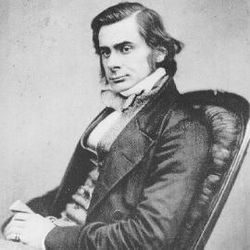
Huxley was a passionate defender of Darwin's theory -- so passionate that he has been called "Darwin's Bulldog" – and also a great biologist in his own right, who did original research in zoology and paleontology.

He is best known for his famous debate in June 1860, at the British Association meeting at Oxford. His opponent, Archbishop Samuel Wilberforce, was not-so-affectionately known as "Soapy Sam" for his renowned slipperiness in debate. During the debate, Archbishop Wilberforce ridiculed evolution and asked Huxley whether he was descended from an ape on his grandmother's side or his grandfather's. Accounts vary as to exactly what happened next, but according to one telling of the story, Huxley muttered "The Lord hath delivered him into my hands," and then rose to give a brilliant defense of Darwin's theory, concluding with the rejoinder, "I would rather be the offspring of two apes than be a man and afraid to face the truth."

All accounts agree that Huxley trounced Wilberforce in the debate, defending evolution as the best explanation yet advanced for species diversity.

However, Huxley did not blindly follow Darwin's theory, and critiqued it even as he was defending it. In particular, where Darwin had seen evolution and a slow, gradual, continuous process, Huxley thought that an evolving lineage might make rapid jumps, or saltations. As he wrote to Darwin just before publication of the Origin of Species, "You have loaded yourself with an unnecessary difficulty in adopting Natura non facit saltum [Nature does not make leaps] so unreservedly."
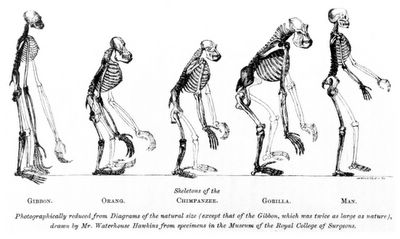


Huxley's most famous writing, published in 1863, is Evidence on Man's Place in Nature. This book, published only five years after Darwin's Origin of Species, was a comprehensive review of what was known at the time about primate and human paleontology and ethology. More than that, it was the first attempt to apply evolution explicitly to the human race. Huxley explicitly presented evidence for human evolution.

Huxley founded a remarkable dynasty of English scientists and thinkers. His son Leonard was a noted biographer and "man of letters." Leonard's oldest son Julian was one of the authors of the evolutionary synthesis of the early 20th century; Julian's son Francis became a noted anthropologist. Julian's brother Aldous Huxley was a novelist, screenwriter and essayist; his best-known book is the anti-utopia Brave New World.

[ a palaeoblog autopost]

Happy Birthday to Ray Harryhausen


Visit Ray's official site.

[a palaeoblog autopost]

Friday, June 27, 2008

Drumheller IGA T. rex Is Back


The newly repainted T. rex has reappeared on the IGA here in Drumheller.

I'm finishing up my week here at the RTMP editing the 'Horned Dino' book, and will be off shortly to southern Alberta with a big crew for the month of July.

Tuesday, June 24, 2008

Fedex Caveman


This is old news now, but I just saw it thanks to Don C. and had to share it. I'm almost in the field....!

Friday, June 20, 2008

Off To The Field: Stay Tuned For Updates

It's that time of year again gentle readers...


I'm all packed...


and off for another exciting summer of field work.


What could possibly go wrong?
Of course I'll post intermittently as access to the 'net allows, and post field photos from time to time. I'll be out of the office from about now until the end of Sept(!). Have a good summer!

New Discovery Proves Selfish Gene Exists

Four QTLs that Influence Worker Sterility in the Honey Bee (Apis mellifera). 2008. P.R. Oxley et al. Genetics Published Ahead of Print: June 18, 2008, Copyright © 2008.


(note the price on this 'comic' book!)
A new discovery provides conclusive evidence which supports decades-old evolutionary doctrines long accepted as fact.
From the press release:

Since renowned British biologist Richard Dawkins ("The God Delusion") introduced the concept of the 'selfish gene' in 1976, scientists the world over have hailed the theory as a natural extension to the work of Charles Darwin.

In studying genomes, the word 'selfish' does not refer to the human-describing adjective of self-centered behavior but rather to the blind tendency of genes wanting to continue their existence into the next generation. Ironically, this 'selfish' tendency can appear anything but selfish when the gene does move ahead for selfless and even self-sacrificing reasons.

For instance, in the honey bee colony, a complex social breeding system described as a 'super-organism,' the female worker bees are sterile. The adult queen bee, selected and developed by the worker bees, is left to mate with the male drones.

Because the 'selfish' gene controlling worker sterility has never been isolated by scientists, the understanding of how reproductive altruism can evolve has been entirely theoretical, until now.

Researchers have, for the first time-ever, isolated a region on the honey bee genome that houses this 'selfish' gene in female workers bees. This means that the 'selfish' gene does exist, not just in theory but in reality. "We don't know exactly which gene it is, but we're getting close."

Indy Gets The Paper


© Pete Von Sholly
CLICK TO ENLARGE
Apparently Pete Von Sholly did not think much of the latest Indy flick...

Gryposaurus: #2 With A Bullet


Something called the “International Institute for Species Exploration” at Arizona State University has listed their top ten new species for 2007. Coming in at #2 is Gryposaurus monumentensis.

The Palaeoblog needs one of them new-fangled institutes, too.

The Amphioxus Genome

The amphioxus genome and the evolution of the chordate karyotype. 2008. N. H. Putnam et al. Nature 453: 1064-1071.

The newly sequenced genome of the lancelet (amphioxus) provides the evidence that vertebrates evolved over the past 550 million years through a four-fold duplication of the genes of more primitive ancestors.
From the press release:

“amphioxus and humans had a common ancestor 550 million years ago, which allows us to use amphioxus as a surrogate for that ancestor in terms of understanding how vertebrate genomes evolved. If you compare the 23 chromosomes of humans with the 19 chromosomes of amphioxus, you find that both genomes can be expressed in terms of 17 ancestral pieces. So, we can say with some confidence that 550 million years ago, the common ancestor of amphioxus and humans had 17 chromosomal elements.”

Each of those 17 ancestral segments was duplicated twice in the evolution of vertebrates, after which most of the routine "housekeeping" genes lost the extra copies. Those left, totaling a couple thousand genes, found new functions that make us different from all other creatures.

"These few thousand genes have been retooled to make humans more elaborate than their simpler ancestors. They are involved in setting up the body plan of an animal and differentiating different parts of the animal. The hypothesis, pretty strongly supported by this data, is that the multiplication of this particular kind of gene and differentiation into different functions was important in the formation of vertebrates as we know them."

The researchers are trying to reconstruct what happened at the end of the Cambrian period 550 million years ago, when a creature similar to the lancelet evolved and diverged into three types of chordates: cephalocordates like the lancelet; urochordates like the sea squirt; and vertebrates like us. Cephalocordates and urochordates are invertebrates that have a flexible notochord rather than a bony spine protecting their spinal cord.


Interestingly, the sea squirt Ciona intestinalis, a tunicate, was previously thought to belong to the the earliest chordate lineage because of the sea squirt's very simple body plan. Comparison of the lancelet, sea squirt and human genomes, however, show instead that the lancelet lineage diverged before the tunicates and vertebrates.

Monday, June 16, 2008

New Data On Psittacosaurus major

New data on cranial anatomy of the ceratopsian dinosaur Psittacosaurus major. 2008. H.−L. You et al. Acta Palaeontologica Polonica 53: 183-196

Abstract [edit]: An exceptionally preserved skull and mandible of the ceratopsian dinosaur Psittacosaurus major revealed the existence of an elliptical median interpremaxillary foramen, a prominent neurovascular canal on the internal wall of the beak, long, slightly divergent basipterygoid processes developed as vertical blades with a deep cleft between them, and horizontally oriented vomer.

The new specimen shows two autapomorphies of P. major, the transversely narrow dorsal skull roof and very prominent dentary flanges, confirming the presence of two large−skulled psittacosaur species in the Lujiatun Bed of the Lower Cretaceous Yixian Formation in Beipiao City, western Liaoning Province, China, the long− and narrow−skulled P. major, and broad−skulled P. lujiatunensis.


As always, the PDF is a free download from APP.

Born This Day: George Gaylord Simpson

June 16, 1902 - Oct 6, 1984.
"Life is the most important thing about the world, the most important thing about life is evolution. Thus, by consciously seeking what is most meaningful, I moved from poetry to mineralogy to paleontology to evolution." G.G. Simpson
From the web site supporting the excellent PBS show “Evolution”:

As one of the founders of the "modern synthesis" of evolution, paleontologist George Gaylord Simpson argued that the fossil record supports Darwin's theory that natural selection acting on random variation in a population is the driving force behind evolution. Simpson was among the first to use mathematical methods in paleontology, and he also took into account newly discovered genetic evidence for evolution in his study of paleontology.

In his 1944 book, Tempo and Mode in Evolution, Simpson divided evolutionary change into "tempo," the rate of change, and "mode," the manner or pattern of change, with tempo being a basic factor of mode. Simpson saw paleontology, revealing the long history of life on earth, as a unique field through which to study the history of evolution.

The early part of the twentieth century saw evolutionary theory embattled by disagreements over Darwin's emphasis on natural selection. The then-newly rediscovered work of Gregor Mendel in the nineteenth century was an uncomfortable fit with evolution, as many scientists saw it. They weren't at all certain that natural populations contained enough genetic variation for natural selection to create new species. So they entertained other explanations, including inheritance of acquired characteristics, "directed" variation toward a goal, or sudden large mutations that resulted in new species.

In the field of paleontology, the scientist who did most to resolve these questions was George Gaylord Simpson, who was on the staff of the American Museum of Natural History for 30 years.At a time when other paleontologists were convinced that the fossil record could best be explained by directed variation, Simpson disagreed. He said that fossil patterns needed no mystical or goal-oriented processes to explain them. For example, where others saw the modern horse as having arisen in a single advance toward the specialized form, Simpson saw the path as that of an irregular tree that had many side-branches leading off to extinction.

Simpson argued that the evolution of mammals, as seen in their fossilized remains, fit perfectly well with the new mechanisms of population genetics being studied at the time. He used the then-new mathematical methods to clarify how evolution occurred in "gene pools" in populations, not in individual members of the population.

Importantly, he showed that gaps in the fossil record reflected periods of substantial change through rapid "quantum evolution" in small populations, leaving little fossil evidence behind. At other times, he observed, rates of change could be so slow as to seem almost nonexistent.

Read more about Simpson HERE.

Ebb & Flow of Seas Drives Mass Extinctions

Environmental determinants of extinction selectivity in the fossil record. 2008. S. E. Peters. Nature advance online publication 15 June 2008.
A new study suggests that the epic ebbs and flows of sea level and sediment over the course of geologic time is the primary cause of the world's periodic mass extinctions during the past 500 million years.
From the (mostly uninformative) press release:

Since the advent of life on Earth 3.5 billion years ago, scientists think there may have been as many as 23 mass extinction events, many involving simple forms of life such as single-celled microorganisms. During the past 540 million years, there have been five well-documented mass extinctions, primarily of marine plants and animals, with as many as 75-95 percent of species lost.

The new study is striking because it establishes a clear relationship between the tempo of mass extinction events and changes in sea level and sediment. Peters measured two principal types of marine shelf environments preserved in the rock record, one where sediments are derived from erosion of land and the other composed primarily of calcium carbonate, which is produced in-place by shelled organisms and by chemical processes. "The physical differences between (these two types) of marine environments have important biological consequences," Peters explains, noting differences in sediment stability, temperature, and the availability of nutrients and sunlight.

In the course of hundreds of millions of years, the world's oceans have expanded and contracted in response to the shifting of the Earth's tectonic plates and to changes in climate. There were periods of the planet's history when vast areas of the continents were flooded by shallow seas, such as the shark- and mosasaur-infested seaway that neatly split North America during the age of the dinosaurs.

As those epicontinental seas drained, animals such as mosasaurs and giant sharks went extinct, and conditions on the marine shelves where life exhibited its greatest diversity in the form of things like clams and snails changed as well.


CLICK TO ENLARGE
a, Total number of genera. b, Per-capita, per-interval extinction rates. Error bars show 95% binomial confidence limits. Major mass extinctions are labelled (O/S, end-Ordovician; D, late-Devonian; P/T, end-Permian; Tr/J, end-Triassic; K/Pg, end-Cretaceous). O, Ordovician; S, Silurian; D, Devonian; C, Carboniferous; P, Permian; Tr, Triassic; J, Jurassic; K, Cretaceous; Pg, Palaeogene; Ng, Neogene. Myr ago, million years ago.