Friday, January 11, 2008

Prehistoric Armoured Worms

Machaeridians are Palaeozoic armoured annelids. 2007. Jakob Vinther et al. Nature 451: 185-188.

From the press release:

The new fossil is of an machaeridian, an invertebrate that existed for about 180 million years from 485 to 305 million years ago discovered in southeastern Morocco preserves evidence of the animal’s soft tissues.


Fossil (left) and depiction (right) of extinct armored machaeridian worm. Coluors indicate the trunk (yellow), limb (red), bristles (gray), attachment of shell plates (green), gut (purple) and dorsal linear structure (blue). Credit: Vinther, et al.
“The new specimen unequivocally identifies machaeridians as annelid worms, an extremely successful and diverse group of animals that includes familiar living animals like the sea mouse, the earthworm and the leech,” said Jakob Vinther.

First described over 150 years ago, armor plates of these strange animals have been found in marine fossil deposits worldwide covering the time span of their existence, and indicating that they were an important component of ancient seafloor ecosystems. Until now there was little information about their body design or how they might be related to other ancient — or currently living — animals.

This inch-long specimen that was recently discovered shows that, below the dorsal armor, the machaeridians had an elongate body with paired, soft, limb-like extensions on each segment, and two bundles of long, stiff bristles on each extension. The segmented nature of the body, and especially the presence of soft “limbs” carrying bristles, unequivocally identified the machaeridians as annelid worms, say the scientists.

According to the authors, although the exact relationship of machaeridians within the annelid worms is still uncertain, the presence of modified scales suggests that they may even belong to a group of marine bristle worms that are still in existence today.

Poncho's Resolutions


click to enlarge
Paul Gilligan has a new blog for his 'Pooch Cafe' strip. Poncho's new year's resolutions oddly overlap some my own. Guess which ones.

Cretaceous Polar Ice Caps

Isotopic Evidence for Glaciation During the Cretaceous Supergreenhouse. 2007. André Bornemann et al., Science 319: 189-192.


Abstract: The Turonian (93.5 to 89.3 million years ago) was one of the warmest periods of the Phanerozoic eon, with tropical sea surface temperatures over 35°C. High-amplitude sea-level changes and positive δ18O excursions in marine limestones suggest that glaciation events may have punctuated this episode of extreme warmth.


New δ18O data from the tropical Atlantic show synchronous shifts ~91.2 million years ago for both the surface and deep ocean that are consistent with an approximately 200,000-year period of glaciation, with ice sheets of about half the size of the modern Antarctic ice cap. Even the prevailing supergreenhouse climate was not a barrier to the formation of large ice sheets, calling into question the common assumption that the poles were always ice-free during past periods of intense global warming.

Thursday, January 10, 2008

When is a T. rex not a T. rex?

Every once in a while my friend Lisa will send me some photos from her travels. She was recently out to Drumheller with her kids to visit the Royal Tyrrell Museum and sent these back.

This is the infamous giant ‘T.rex’-like thing, the unofficial mascot of Drum (as the city is often called).

If you pay the price you can crawl up its butt (no kiddin’!) and look out its mouth (note the icicles hanging from the teeth) over the city. Across the highway in the foreground is the frozen Red Deer River that Barnum Brown, the Sternbregs and other palaeontologists have floated down in search of fossils in milder weather. In the distance you can see the coulee where Joseph Tyrrell found the 1st Albertosaurus skull (trust me).


Lisa takes her life in her hands as she tests the bite of the CMNH’s Dunkleosteous on display at the RTMP.

The Most Romantic Spot On Earth?


Barry White presents the Dinosaur Park Formation. Oh yeah.

Born This Day: Nicolaus Steno

Jan. 10 – Nov. 26, 1686

Steno (a.k.a. Niels Steensen, or Stensen) was a Danish geologist and anatomist who first made unprecedented discoveries in anatomy, then established some of the most important principles of modern geology. He was Danish royal anatomist for 2 years.

Interested by the characteristics and origins of minerals, rocks, and fossils, he published in Prodromus (1669) the law of superposition (if a series of sedimentary rocks has not been overturned, upper layers are younger and lower layers are older) and the law of original horizontality (although strata may be found dipping steeply, they were initially deposited nearly horizontal.) link image

Wednesday, January 09, 2008

Argentinosaurus vs. Giganotosaurus

OK, I'm back. Things will return to normal over the next few days while I get caught up.

To ease our way back into things, here's a posting from the palaeoblog’s sometime foreign correspondent, Eric Snively, who spent several weeks in Argentina before Christmas working on a number of projects. He kindly sent along these photos. The captions are all Eric's.


Phil Currie, Eva Koppelhus, and I (all from the University of Alberta) recently went o Neuquen province and Buenos Aires. Here Eva, Premji Paulina Carabajal, Phil, and Rodolfo Coria examine the type specimen of Megaraptor. The melodramatic setting is the repository museum overlooking the high-desert Barreales reservoir. Jorge Calvo and his great technicians run a pay-for-dig program here, with most of the quarry right down by the water.


Plaza Huincul, Neuquen (=Vernal, Utah and Drumheller, Alberta) has several happy municipal trash cans.


Museo Carmen Funes, Plaza Huincul.


Giganotosaurus (Museo Carmen Funes), perhaps the largest and second-mightiest land carnivore that ever lived,...


... is reduced to daschund stature by Argentinosaurus, a sure inducement of Tourette symptoms in palaeontologists.

The thoracic column of Argentinosaurus. Based on casts of the preserved dorsals and the sacrum, Rodolfo Coria's mount accurately captures the scale of this region. The bones are in appallingly hard rock: think Chuck Norris meets Metallica, times 12.


Argentinosaurus with humans for scale.


Argentinosaurus with more humans for scale. There are relatively few original bones, but it is difficult to scale the trunk and limbs any smaller. These casts are on their way to Germany.

Rodolfo Coria and Premji Paulina Carabajal take inventory of Argentinosaurus.

Born Today: Amadeus William Grabau

Jan 9, 1870 – March 20, 1946.

From Today In Science History:

Grabau was an American geologist and paleontologist, known for his work on world stratigraphic deposits and the deciphering of Earth history. In 1899, he published an early paper that studied the environment of old sedimentary rocks in light of knowledge of the conditions of life among modern organisms, The Relations of Marine Bionomy to Stratigraph, which was a step toward the development of paleoecology. For more than a quarter of a century, he worked on the geologic survey of China. In 1940, he developed a theory of rhythms in the growth of the Earth's crust, and of repetitions in mountain building. image

Tuesday, January 08, 2008

Born This Day: Alfred Russel Wallace

Jan. 8, 1823 – Nov. 7, 1913

From Today In Science History:

Wallace was a British naturalist and biogeographer. He was the first westerner to describe some of the most interesting natural habitats in the tropics. He is best known for devising a theory of the origin of species through natural selection made independently of Darwin.

Between 1854 and 1862, Wallace assembled evidence of natural selection in the Malay Archipelago, sending his conclusions to Darwin in England. Their findings were jointly presented to the Linnaean Society in 1858. Wallace found that Australian species were more primitive, in evolutionary terms, than those of Asia, and that this reflected the stage at which the two continents had become separated. He proposed an imaginary line (now known as Wallace's line) dividing the fauna of the two regions.

The Alfred Russel Wallace page HERE. More HERE.

Sunday, January 06, 2008

Born This Day: George Ledyard Stebbins

Jan. 6, 1906 - Jan. 19 2000.

From the U Calif., Berkeley:

Along with Dobzhansky (1900 - 1975), animal systematist Ernst Mayr, and paleontologist George Gaylord Simpson (1902 - 1984), Stebbins is considered one of the "architects" of the modern evolutionary synthesis of the 1930s and 1940s, an intellectual watershed and historic turning point that brought together research in cytology, genetics, systematics, paleontology into a common evolutionary framework. This synthesis, which had the effect of reconciling the often opposing views of laboratory-oriented geneticists and natural history oriented systematists, made Charles Darwin's theory of evolution by natural selection the centerpiece of the new discipline of evolutionary biology.

In this role, Stebbins is credited with bringing a modern framework to the study of plant evolution, and he is perhaps best known for his book Variation and Evolution in Plants, published by Columbia University Press (NY) in 1950. In the 1940s, Stebbins also played an important role in organizing the nascent Society for the Study of Evolution, of which he became the third president in 1948, and used his position to speak out for the botanical side of evolutionary studies, a field that had been dominated by zoologists. Photo .

Wednesday, January 02, 2008

Top Fossil Finds of 2007

National Geographic has posted their "Top 10 Fossil Finds of 2007". I have no idea how they come up with these. I did chuckle at #1...


I'll be back full time next Monday

New ROM Dinos

The Royal Ontario Museum recently reopened their revamped dinosaur halls. Curator David Evans sent along some before and after shots of some of the new specimens. The mounts were done by Research Casting International.


Friday, December 28, 2007

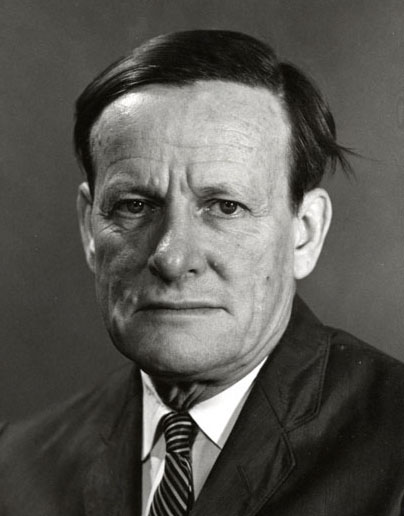
Born This Day: Alfred Sherwood Romer

Dec. 28, 1894 – Nov. 5, 1973

”Romer was director of the Museum of Comparative Zoology at Harvard University until his retirement in 1961 and was one the singularly most influential vertebrate paleontologists of the 20th Century. His work ranged over virtually every conceivable subject within that field, although it was the osteology and taxonomy of the therapsids and other proto-mammals which was nearest his heart.

In addition to this work, Romer was acutely interested in the origin and initial adaptive radiation of tetrapods, and his work became the basis for a theory of tetrapod origins which was canon until the description of Acanthostega gunnari by Clack & Coates in the 1990s. Romer was ahead of his time in his defense of monophyly of Dinosauria though he did feel that Theropoda was not ancestral to birds.” link from EvoWiki.org

Romer’s book, Vertebrate Paleontology (1966), was for many years THE textbook on VP and is still well worth picking up. One of Romer’s students, Bob Carroll, wrote an updated version entitled, ‘Vertebrate Paleontology and Evolution’, in 1987. image

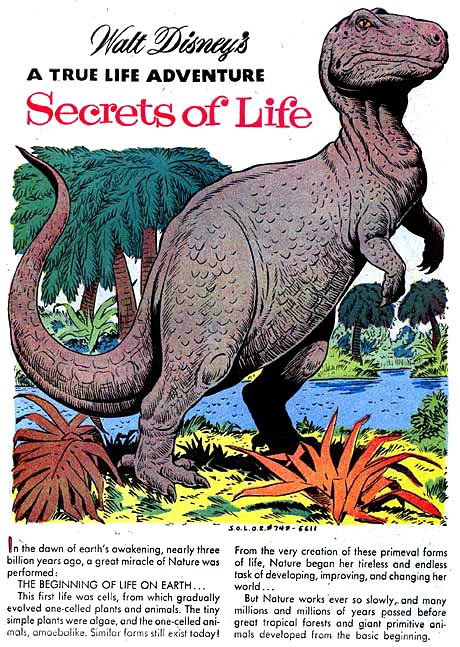
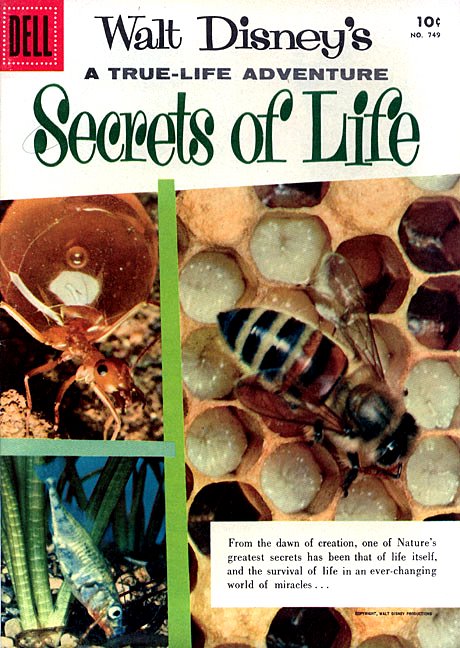
The Secrets of Life


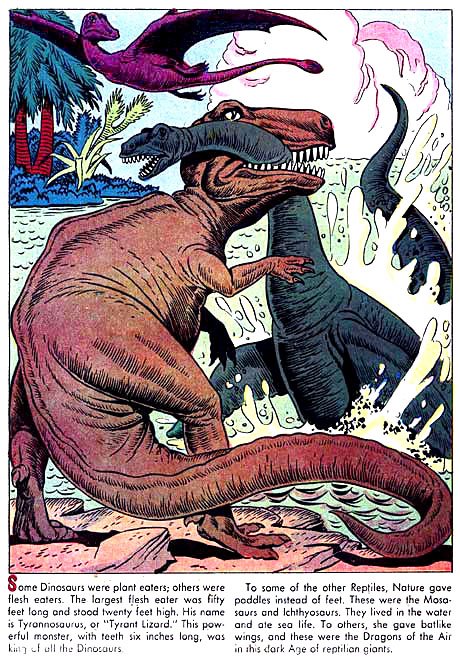
This comic is based on SECRETS OF LIFE, a 1956 feature-length film in WALT DISNEY'S TRUE-LIFE ADVENTURES Academy Award-winning series of nature documentaries. This 33-page adaptation of the feature-length documentary opens with a splash-page depicting an Allosaurus. Then we're shown the origins of life on primitive Earth, with prehistoric invertebrates such as trilobites, scorpions and giant cockroaches.

As land-life flourishes, we're treated to shots of dinosaurs, including an improbable battle (below) between a Tyrannosaurus rex and a sea-going Pleisosaurus. Finally, we see the development of birds (this comic was produced decades before theories about feathered dinosaurs) and mammals, such as the saber-toothed Smilodon.


A back-cover summary of the contents of WALT DISNEY'S SECRETS OF LIFE, which reads:"Thus does Nature show us that in any small part of her broad world maybe seen and explored some of her many Secrets of Life - those strange and ingenious talents for survival with which she has equipped the life she created, whether they be found on the fantastic floor of her oceans, high on her frozen mountain peaks, above her earth or under its crust…or revealed to us in a single fragile flower and one tiny Honeybee."

All the above is from the Oddball Comics site of Scott Shaw!

Thursday, December 27, 2007

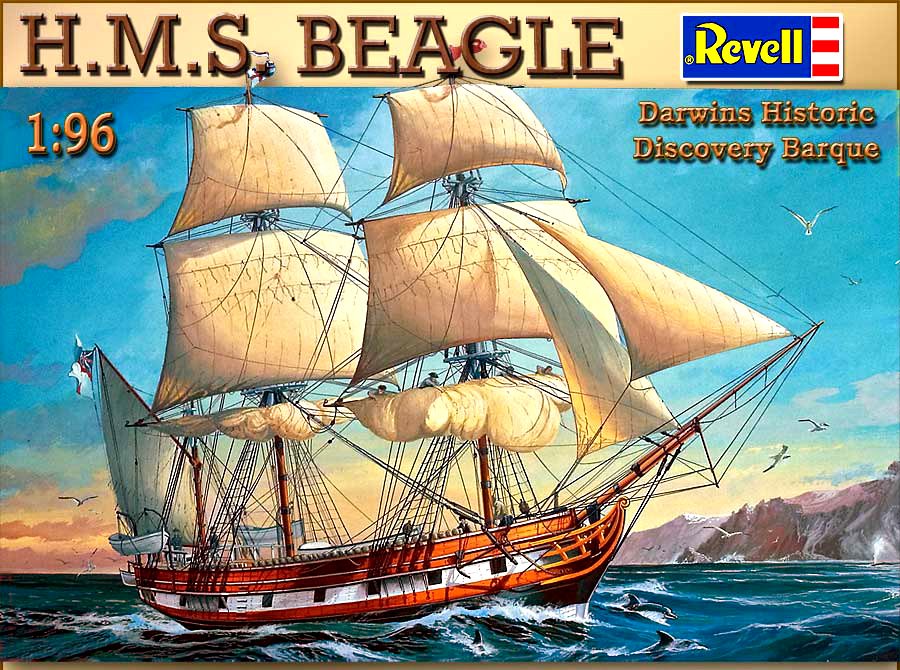
Set Sail Today: HMS Beagle


Image from HERE.

From Today In Science History:

In 1831, Charles Darwin set sail from Plymouth harbour on his voyage of scientific discovery aboard the HMS Beagle, a British Navy ship. The Captain Robert FitzRoy was sailing to the southern coast of South America in order to complete a government survey. Darwin had an unpaid position as the ship's naturalist, at age 22, just out of university.

Originally planned to be at sea for two years, the voyage lasted five years, making stops in Brazil, the Galapogos Islands, and New Zealand. From the observations he made and the specimens he collected on that voyage, Darwin developed his theory of biological evolution through natural selection, which he published 28 years after the Beagle left Plymouth.


The path of The HMS Beagle. © Pearson Education, Inc. Click to enlarge.

Saturday, December 22, 2007

Discovered This Day: A Living Coelacanth


Internal anatomy of the coelacanth, Latimeria chalumnae.

From Today In Science History:

In 1938, a coelacanth, a primitive fish thought extinct, was discovered. Marjorie Courtenay-Latimer was curator of the museum in the port town of East London, northeast of Cape Town, South Africa, and always interested in seeing unusual specimens. Hendrik Goosen, captain of the trawler Nerine, called her to see his catch of the day before, made at about 70-m depth, off the Chalumna River southwest of East London. She spotted an unusual 5-ft fish in his "trash" fish pile. It was pale mauvy-blue with iridescent silver markings. She sent a sketch to Dr J.L.B. Smith, a senior lecturer in chemistry from Rhodes University in Grahamstown for identification. It was hailed as the zoological discovery of the century and equated to finding a living dinosaur!

“December 22, 1938, Captain Goosen and the Nerine put into East London harbour with the usual catch of sharks, rays, starfish and rat-tail fish. But there was one unusual fish amongst the catch that had been caught in about 70 meters, near the mouth of the Chalumna River. Once ashore Captain Goosen left word at the Museum that there were several specimens at the ship for Miss Latimer. At first she said that she was too busy because she was hard at work cleaning and articulating the fossil reptile bones collected from Tarkastad. But as it was so near Christmas time she decided to go and wish the crew a “Happy Christmas” and took a taxi to the docks. There, attracted by a blue fin amid the pile of sharks, she found a magnificent fish. She and her assistant put it in a bag and persuaded a reluctant taxi driver to take it to the museum in the boot of the car. It measured 150 cm and weighed 57.5 kg. From its hard bony scales with sharp, prickly spines and paired fins looking rather like legs, she knew that it must be some kind of primitive fish.


But her greatest problem was to preserve it until it could be identified. It was extremely hot, the fish, was too big to go into a bath and she could not find any organization willing to store it in a freezer. Although she was told by experts that it was only a type of rock cod and that she was making a fuss about nothing, she persisted in her attempts to save the fish for science. At first it was wrapped in cloths soaked in formalin but eventually, on the 26th, Mr. Center, a taxidermist, skinned it. Unfortunately the internal organs were thrown away. Marjorie went home disappointed and worried that she had not saved all the soft parts. What she had done, however, was to write immediately to her friend, JLB Smith, and send him her famous sketch of the strange fish.”


Miss Courtenay-Latimer's sketch of the first coelacanth which she posted to JLB Smith.

Learn more about Latimeria chalumnae at the Australian Museum fish web page.

Wednesday, December 19, 2007

KID 2007 Expedition

Time for a few quick updates where we shovel the city of Ottawa out of its latest snowstorm. I don't think I've posted any photos from my time with the KID expedition in Mongolia this past summer. You can get my summary of last year's work at my Phaeton web site HERE; I'll have an update for 2007 on that site soon.


Just some of the the 2007 crew.


One of several vehicle problems we had.


Yoshi and Dr. Song work on the sauropod that Yoshi found in 2006. In just under two weeks the crew completely collected the >60% complete skeleton.


Puzzling over how to move the pelvic block.


Dr. Darla.


In the middle of nowhere we had to replace an engine in one of the trucks. Dr. Lee shots some pool as we wait for our drivers to get the job done.


Our camp at Kermin Tsav I


Yosuki and friend.


Khermin Tsav II

Ulzi - ace mechanic, tech and driver!

More Photos


CMNH Ace photographer, Liz Russell, photographs the U of A Centrosaurus skull that I'm having prepped.


Katie Russell and David Chapman mold a small Dunkleosteous that we'll be selling in the new year. This small specimen will be a nice alternative for museum's who don't have space for or can't afford the larger cast we also sell (see below). Many thanks to David and Katie for burning the midnight oil to finish this before Christmas!


The CMNH Dunkleosteous skull cast on display at the State Museum of Pennsylvania in Harrisburg.


Bob Sullivan (left) explains Dracorex to funny book artist, Mark Schultz on our recent visit to Harrisburg.


One of the Coelophysis displays in Harrisburg.