Wednesday, August 30, 2006

More Gobi Pix


The famous Flaming Cliffs.


A lizard found on the Flaming Cliffs posted especially for Dr. Tony Russell.


Saurolophus mounted at the Mongolian Academy of Sciences. This thing is as big as T. rex!


Tarbosaurus premaxilla for sale at a tourist stall at a small airport in the Gobi.

Tuesday, August 29, 2006

New Gobi Photos

I'm back in Ulaanbaatar for a few days before heading out to the Gobi again this weekend with a multinational crew to look at new fossil producing regions. The first trip (2 weeks) went very well with lots of new finds and only one big sand storm.

Over the next few days I'll try to squeeze some photos down the internet connection to the rest of the world.


Drs. Eva Kopplehus, Bagamgarov, and Phil Currie at our departure point into the southcentral Gobi. We're at a small airport at the edge of the Gobi about an hours flight south of UB.


The dinosaur collections (at least the prepared and accessable portion) at the Mongolian Academy of Sciences that we are working with is made up of approximately 1/3 material collected by Phil's expeditions over the last ten years.


Another shot from above of the famous 'fighting dinosaurs' (Protoceratops (L) and Velociraptor (R) at the Natural History Museum next door to the palaeo labs.

More soon about some of the exciting finds we've made this trip. Check the news for the press conference that we're holding later today (Weds. here).

Friday, August 11, 2006

Back to the Gobi


I'm off in a few hours back to Mongolia to hopefully finish up some work started last year, and to find some new sites. I'll be back sometime in Sept. with a few pix (hopefully!) from the field in between.

Wednesday, August 09, 2006

Southern Alberta Dinosaur Research Group Photos

Some more random photos from this season's SADRG field work:


Tetsuto and Delina at the associated hadrosaur quarry.


'Happy Jack' Jackson's old cabin in Dinosaur Provincial Park (actually on private land within the bounderies of the Park).


Donna MacLoed (RTMP technician) collects a Centrosaurus quadrate from BB 43 (my old MSc. locality).


Dr. Brad Belluk collects a postorbital from BB 43.


The 'Citadel' dominates BB 43.


Finishing up the hadrosaur quarry (From L to R: Nick Longrich, Jim Brown, MJR, Delina Christopher, Tetsuto Miyashita, Liz Russell).


David Evans strikes a pose in DPP.


The 'pachyrhinosaur' quarry in DPP. We moved a ton more rock this summer trying to find the ever elusive parietal.


Darren Tanke works the jackhammer in the 'pachyrhinosaur' quarry.

Tuesday, August 08, 2006

Fay Wray


Link

Two years ago today Fay Wray passed away.

The Canadian Fay Wray stamp is now available.

Reverse Evolution In Mice

Reversal of Hox1 Gene Subfunctionalization in the Mouse.2006. P. Tvrdik and M. R. Capecchi. Developmental Cell 11: 239-250
Researchers have taken a mouse back in time some 500 million years by reversing the process of evolution.
From BBC News.com:

By engineering its genetic blueprint, they have rebuilt a gene that was present in primitive animals. The ancient gene later mutated and split, giving rise to a pair of genes that play a key role in brain development in modern mammals.

Until about 500 million years ago, early animals had 13 such Hox genes. Then each gene split into four, making 52 genes. Over the course of evolution, further mutations occurred, and some genes became redundant and disappeared, leading to today's tally in mammals of 39 Hox genes.

The Utah pair combined critical sections of Hoxa1 and Hoxb1, reconstructing a gene similar to its equivalent some 530 million years ago. The hybrid gene is not completely identical to the ancient one, but the scientists say it performs essentially the same functions.

"It gives a real example of how evolution works because we can reverse it."

Monday, August 07, 2006

Born This Day: Louis Leakey

Aug 7, 1903 – October 1, 1972.


Louis and Mary Leakey. Link
From Today In Science History:

Leakey, an archaeologist and anthropologist, was born in Kabete, Kenya, of English missionaries parents. Leakey was largely responsible for convincing scientists that Africa, rather than Java or China, was the most significant area to search for evidence of human origins. Leakey led fossil-hunting expeditions to eastern Africa from the 1920's.

He married Mary D. Nicol in 1936 and the couple discovered many important fossils together. In 1964, on an expedition to the Olduvai Gorge in Tanzania, he found fossil remains of, he believed, the earliest member of the genus of human beings. He named the species Homo habilis.

Sunday, August 06, 2006

Fossil Frog Marrow

High-fidelity organic preservation of bone marrow in ca. 10 Ma amphibians. 2006. M. E. McNamara et al.. Geology 34:641–644.

Abstract: Bone marrow in ca. 10 Ma frogs and salamanders from the Miocene of Libros, Spain, represents the first fossilized example of this extremely decay-prone tissue. The bone marrow, preserved in three dimensions as an organic residue, retains the original texture and red and yellow color of hematopoietic and fatty marrow, respectively; moldic osteoclasts and vascular structures are also present. We attribute exceptional preservation of the fossilized bone marrow to cryptic preservation: the bones of the amphibians formed protective microenvironments, and inhibited microbial infiltration. Specimens in which bone marrow is preserved vary in their completeness and articulation and in the extent to which the body outline is preserved as a thin film of organically preserved bacteria. Cryptic preservation of these labile tissues is thus to a large extent independent of, and cannot be predicted by, the taphonomic history of the remainder of the specimen.

From the Yahoo News Article:
The first fossilized bone marrow has been found in the bones of 10-million-year-old frogs, salamanders and tadpoles by scientists working in northeastern Spain.
"It is still organic in composition, whereas most traces of soft tissues you find in the fossil record, which are very rare anyway, have rotted away and just the shape of the tissue is preserved in mineral," she told AFP.

McNamara said researchers were now doing tests in UCD to see if any bio-molecules, like amino acids and proteins, are preserved. The researchers were able to access the marrow from the fossils because they were found in rock that had split and some of the bones had fractured as a result. McNamara said the original red and yellow colours of the marrow had been preserved. Image Link

More Than A Monkey's Uncle

A survey of primate IQ has concluded that orang-utans and chimps are the chief eggheads, with monkeys and lemurs trailing in their intellectual wake.

From News@nature.com:

The study has produced a table (below) of overall cognitive ability among primates. Previous research had attempted to compare different primates' abilities at specific tasks, but no one had ever combined this data into an overall measure of intelligence.

The researchers compiled results from dozens of problem-solving puzzles given to different types of primates by researchers. These included tests of ability to navigate mazes, to untangle a jumble of differently coloured threads to find food, and to spot the odd-one-out in a series of images. They ranked each species and calculated the overall average intelligence of each.

Overall, intelligence seems to be correlated with absolute brain size, rather than brain size relative to body size, or the relative sizes of different brain regions, Deaner says. Previous theories had suggested that a critical factor may be the size of the brain's neocortex, a region that seems to vary in size depending on the size of the social groups in which an animal lives, and that might therefore reflect cognitive skills.

The league table of primate intelligence
1. Orang-utan
2. Chimpanzee
3. Spider monkey
4. Gorilla
5. Surili
6. Macaque
7. Mandrill
8. Guenon
9. Mangabey
10. Capuchin
11. Woolly monkey
12. Gibbon
13. Baboon
14. Slow loris
15. Night monkey
16. Ruffed lemur
17. Brown lemur
18. Fork-marked lemur
19. Ring-tailed lemur
20. Bushbaby
21. Squirrel monkey
22. Mouse lemur
23. Marmoset
24. Talapoin

Captain Caveman Returns!


Macfarlane Toys brings back another dino-themed Hanna-Barbara cartoon character as an 'action figure' for grown-up kids with too much money to burn.

Thursday, August 03, 2006

Dry Island Albertosaurus Bone Bed

Tyrannosaur Life Tables: An Example of Nonavian Dinosaur Population Biology. G. M. Erickson, et al. Science 313: 213-217.

Abstract: The size and age structures for four assemblages of North American tyrannosaurs—Albertosaurus, Tyrannosaurus, Gorgosaurus, and Daspletosaurus—reveal a pronounced, bootstrap-supported pattern of age-specific mortality characterized by relatively high juvenile survivorship and increased mortality at midlife and near the maximum life span. Such patterns are common today in wild populations of long-lived birds and mammals. Factors such as predation and entrance into the breeding population may have influenced tyrannosaur survivorship. This survivorship pattern can explain the rarity of juvenile specimens in museum collections.

I'm late on the above article because I've been in the field. Much of the data comes from the work done by co-author Philip Currie (U of Alberta) on his Albertosaurus bone bed in Dry Island Provincial Park, north of Drumheller.


Originally found and collected by Barnum Brown in 1910
, Currie relocated it in the late 1990's and has been excavating it ever since. This year he was working the original 1910 portion of the quarry. I had the chance to spend a few days at the locality and take these photos:

Phil maps the quarry.

Happy crew works miserably difficult matrix to find great elements.

The 2006 quarry. The horizon in the distance was the starting point each morning for the hike to the bone bed.

A newly exposed tibia and fibula.

Dr. Julia Sankey and Rasmus Koppelhus.

Don's Turtle


Last Thursday I while I was in Dinosaur Provincial Park with Don Brinkman from the Royal Tyrrell Museum, long time volunteer Sue Marsland (above left, with Donna ) found a beautiful Aspideroides turtle carapace for Don in BB 50.

Don helps with the excavation.

The pedestalled turtle before the field jacket was applied.

A turtle a day keeps Don happy!

Monday, July 24, 2006

Southern Alberta Dinosaur Research Group


Hey Look! I'm back! But only briefly... today is my first day out of the field since arriving in Albera almost a month ago, and I'm only here in Calgary to pick up a colleague who's flying in to join me in the next phase on my field work. So, I just have time for a few quick posts.

First up, the t-shirt design (thanks to Mark Schultz) for this year's SADRG field season. I should have a few left when the season is over and I'll let you readers know how to snap these up when they become available.

For more information on the Southern Alberta Dinosaur Research Group click HERE.

SADRG Photos

Photo © M. Ryan

As part of my work this year with the SADRG I opened a dinosaur bone bed with David Evans in the lower part of the Oldman Formation in the badlands along the Milk River in the the southeasternmost part of Alberta. The site was very productve and I plan to return in 2007 for a larger excavation of the quarry. The bone layer is at waist level of the crew in the above photo.
This photo was taken just before we began overburden removal. Pictured above are (L to R, foreground) David Evans (U Toronto), The Flying Tetsuto (U Alberta), Caleb Brown (U Calgary/RTMP) and Nick Longrich (U Calgary); background (L to R), Liz Russell (CMNH), Dr. Eric Snively (U Calgary), and Delina Christopher (CMNH).

Photo © M. Ryan

Fortunately the overburden was loose shale so its removal went relatively quickly.

Photo © M. Ryan

David Evans explains it all to Delina!

The Scabby Butte

Photo © M. Ryan
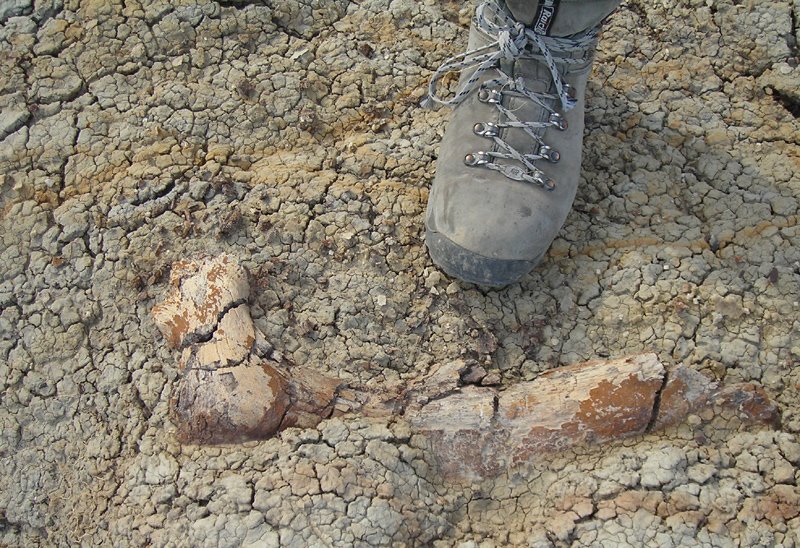
Back in the '50's Wann Langston, Jr. collected Pachyrhinosaurus material from a bone bed at Scabby Butte (above) north of Lethbridge, Alberta. Last week David Evans and I revisited the site trying to relocate the quarry. It appears that the original site has been lost to erosion and slumping but we did find a few bones (below) weathering out in the same region.
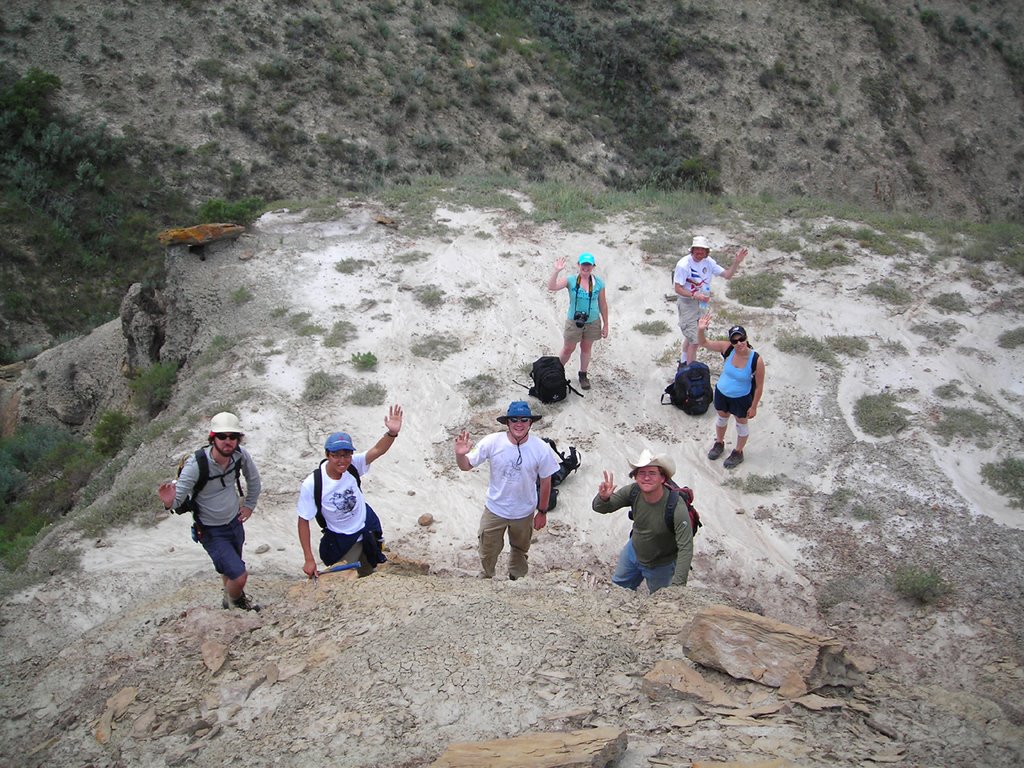
Photo © M. Ryan
A large ceratopsid dentary with my boot for scale.

Photo © M. Ryan
A small (juvenile) hadrosaur pubis.

Monday, June 26, 2006

To The Field


From Pete Von Sholly's Extremely Weird Tales.
CLICK TO ENLARGE
I'm off to the field for most of the July and August. I'll post when I can--hopefully lots of field photos. See you all soon!

Saturday, June 24, 2006

Cretaceous Glaciers

Detection of Late Cretaceous eustatic signatures using quantitative biostratigraphy. 2006. J. S. Crampton et al. GSA Bulletin 118: 975–990.
Abstract: Paleontology is a data-rich science--so rich, in fact, that most geological dating using fossils has traditionally been based on just a minor subset of the total information available. This practice limits the resolution that can be achieved in dating, a particular problem when testing contentious theories about the existence of continental-scale ice sheets in the Cretaceous period, a time of global greenhouse climate. To demonstrate the presence of such ice sheets, it is necessary to prove that sea-level fluctuations resulting from apparent changes in ice volume were global and synchronous.

In this paper we use a newly-developed quantitative approach to integrate very large amounts of paleontological data and to date the geological evidence for sea-level changes in New Zealand. We show that some Cretaceous sea-level changes in New Zealand were apparently synchronous (with 92% probability) with changes in eastern United States, thereby supporting hypotheses of Cretaceous polar continental glaciation in the Cretaceous greenhouse world.

Friday, June 23, 2006

Spinning An Ancient Tale

Silk Genes Support the Single Origin of Orb Webs. 2006. J. E. Garb, et al. Science 312: 1762.
New evidence indicates that the orb web common to two different groups of spiders had a single evolutionary origin and may have been snagging flying insects as early as 136 million years ago.

From the AAAS press release:

New genetic evidence from one set of orb-web spinners called the Deinopoidea confirms that the group shares some key silk proteins with its fellow orb weavers the Araneoidea, according to Jessica Garb. Based on fossil evidence, the ancestor of the two spider groups probably lived at least 136 million years ago, making the orb web an ancient adaptation.

In addition to spiders that construct typical orb-webs, deinopoids include the ogre-faced, net-casting spiders that throw a modified orb web stretched between their legs over their prey. Araneoids include the orb weavers such as golden silk spiders with their traditional spiraling web as well as sheet-web weaving spiders. Garb says the finding "does not support a double origin for the orb web," but indicates that the unique design evolved only once.
Early Cretaceous Spider Web with Its Prey. 2006. E. Peñalver et al. Science 312: 1761
In a second study researchers found pieces of a web with several insects still entangled encased in a 110-million year old piece of amber from a site in Spain.

Although Grimaldi and colleagues say there is not enough of the web preserved to know for sure, the parts that are preserved suggest an orb web design. In any case, Grimaldi says, the find indicates that the challenging silken traps of Early Cretaceous spiders may have put the pressure on many types of flying insects to evolve.

"Apparently, spiders have been fishing insects from the air for a very long time."

Thursday, June 22, 2006

Mesomyzon mengae, New Early Cretaceous Lamprey

A lamprey from the Cretaceous Jehol biota of China. 2006. M.-m. Chang et al. Nature 441: 972-974

Abstract: Widespread nowadays in freshwater and coastal seas of the cold and temporal zones, lampreys are a jawless vertebrate group that has been in existence for more than 300 million years but left a meagre fossil record. Only two fossil, lamprey species, Mayomyzon pieckoensis and Hardistiella montanensis, have been recognized with certainty from North American Carboniferous marine deposits.

We report a freshwater lamprey from the Early Cretaceous epoch (about 125 million years ago) of Inner Mongolia, China. The new taxon, Mesomyzon mengae, has a long snout, a well-developed sucking oral disk, a relatively long branchial apparatus showing branchial basket, seven gill pouches, gill arches and impressions of gill filaments, about 80 myomeres and several other characters that are previously unknown or ambiguous.

Our finding not only indicates Mesomyzon's closer relationship to extant lampreys but also reveals the group's invasion into a freshwater environment no later than the Early Cretaceous. The new material furthers our understanding of ancient lampreys, bridges the gap between the Carboniferous ones and their recent relatives, and adds to our knowledge of the evolutionary history of lampreys.

Royal Society Issues Statement On Teaching Evolution

The world's leading scientists Wednesday urged schools to stop denying the facts of evolution amid controversy over the teaching of creationism.

Archaeopteryx from Gerhard Heilmann's books 'Vor Nuvaerende Viden om Fuglenes Afstamning' (1916). Link

From The Guardian article by Rebecca Smithers:

The national science academies of 67 countries - including the UK's Royal Society - issued a joint statement warning that scientific evidence about the origins of life was being "concealed, denied, or confused". It urged parents and teachers to provide children with the facts about the origins and evolution of life on Earth.

The statement was drafted by members of the Inter Academy Panel on International Issues, a global network consisting of 92 science academies. It points out that "within science courses taught in certain public systems of education, scientific evidence, data, and testable theories about the origins and evolution of life on Earth are being concealed, denied, or confused with theories not testable by science".

Martin Rees, president of the Royal Society, said: "There is controversy in some parts of the world about the teaching of evolution to pupils and students, so this is a timely statement that makes clear the views of the scientific community.

"I hope this statement will help those who are attempting to uphold the rights of young people to have access to accurate scientific knowledge about the origins and evolution of life on Earth."

READ THE FULL STATEMENT FROM THE ROYAL SOCIETY HERE.