Monday, July 24, 2006

Southern Alberta Dinosaur Research Group


Hey Look! I'm back! But only briefly... today is my first day out of the field since arriving in Albera almost a month ago, and I'm only here in Calgary to pick up a colleague who's flying in to join me in the next phase on my field work. So, I just have time for a few quick posts.

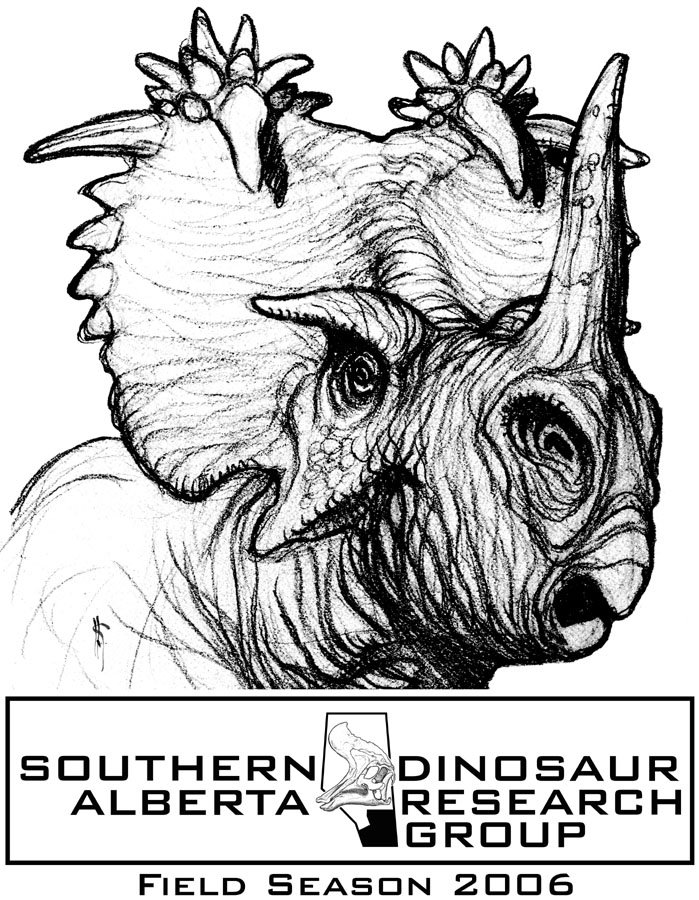
First up, the t-shirt design (thanks to Mark Schultz) for this year's SADRG field season. I should have a few left when the season is over and I'll let you readers know how to snap these up when they become available.

For more information on the Southern Alberta Dinosaur Research Group click HERE.

SADRG Photos

Photo © M. Ryan

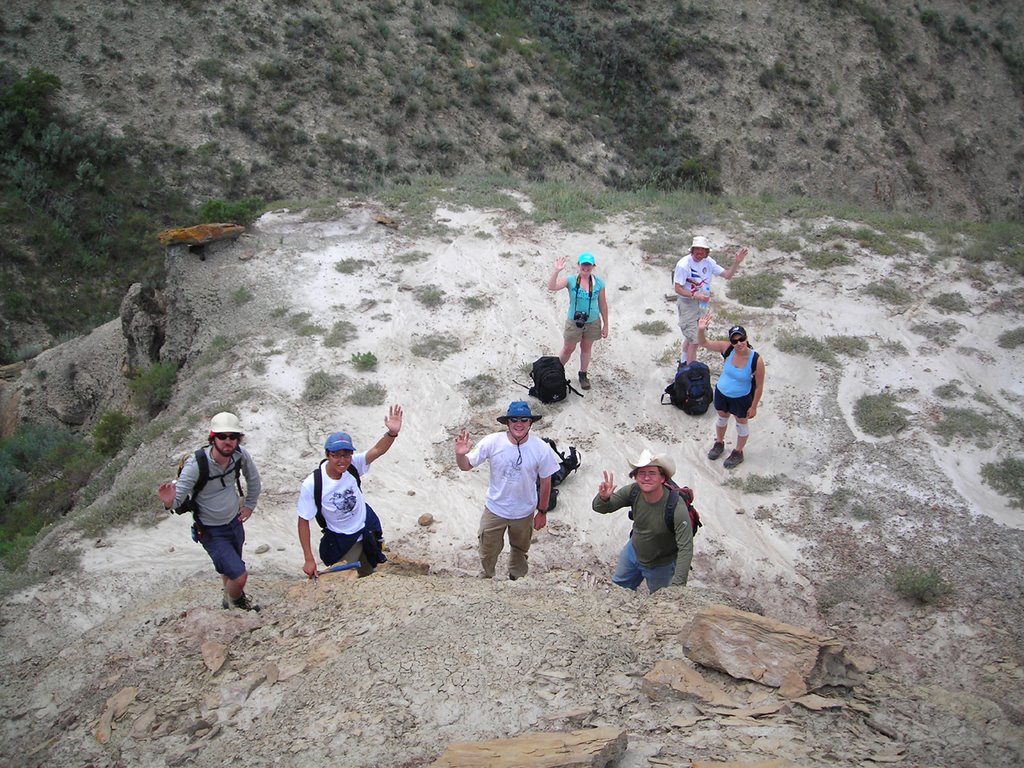
As part of my work this year with the SADRG I opened a dinosaur bone bed with David Evans in the lower part of the Oldman Formation in the badlands along the Milk River in the the southeasternmost part of Alberta. The site was very productve and I plan to return in 2007 for a larger excavation of the quarry. The bone layer is at waist level of the crew in the above photo.

This photo was taken just before we began overburden removal. Pictured above are (L to R, foreground) David Evans (U Toronto), The Flying Tetsuto (U Alberta), Caleb Brown (U Calgary/RTMP) and Nick Longrich (U Calgary); background (L to R), Liz Russell (CMNH), Dr. Eric Snively (U Calgary), and Delina Christopher (CMNH).

Photo © M. Ryan

Fortunately the overburden was loose shale so its removal went relatively quickly.

Photo © M. Ryan

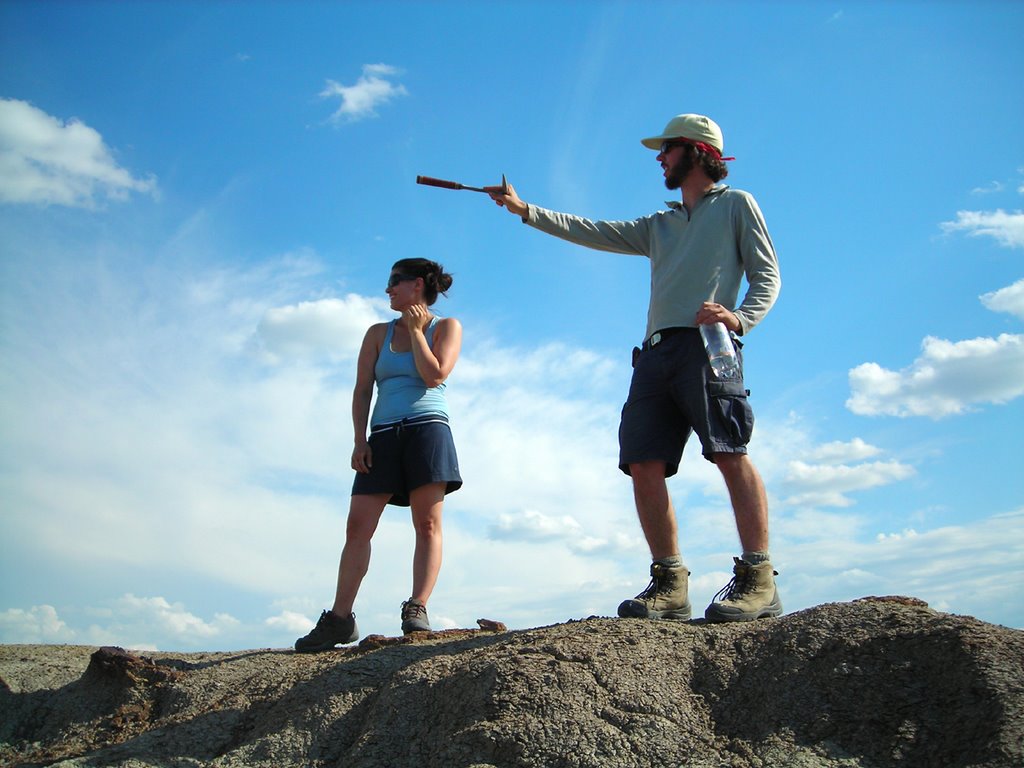
David Evans explains it all to Delina!

The Scabby Butte

Photo © M. Ryan
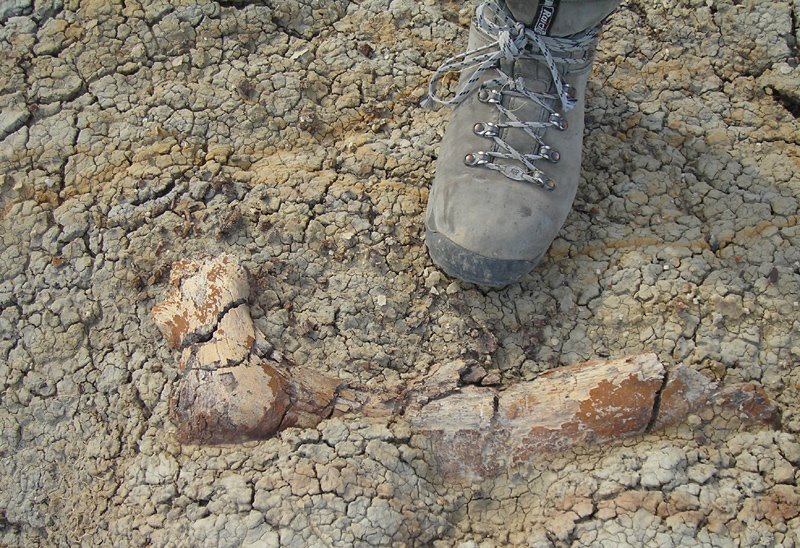
Back in the '50's Wann Langston, Jr. collected Pachyrhinosaurus material from a bone bed at Scabby Butte (above) north of Lethbridge, Alberta. Last week David Evans and I revisited the site trying to relocate the quarry. It appears that the original site has been lost to erosion and slumping but we did find a few bones (below) weathering out in the same region.

Photo © M. Ryan
A large ceratopsid dentary with my boot for scale.

Photo © M. Ryan
A small (juvenile) hadrosaur pubis.

Monday, June 26, 2006

To The Field


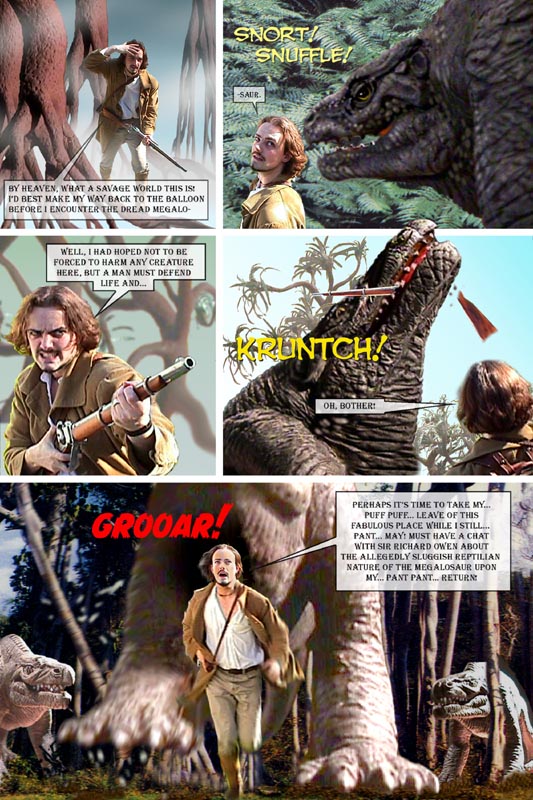
From Pete Von Sholly's Extremely Weird Tales.
CLICK TO ENLARGE
I'm off to the field for most of the July and August. I'll post when I can--hopefully lots of field photos. See you all soon!

Saturday, June 24, 2006

Cretaceous Glaciers

Detection of Late Cretaceous eustatic signatures using quantitative biostratigraphy. 2006. J. S. Crampton et al. GSA Bulletin 118: 975–990.

Abstract: Paleontology is a data-rich science--so rich, in fact, that most geological dating using fossils has traditionally been based on just a minor subset of the total information available. This practice limits the resolution that can be achieved in dating, a particular problem when testing contentious theories about the existence of continental-scale ice sheets in the Cretaceous period, a time of global greenhouse climate. To demonstrate the presence of such ice sheets, it is necessary to prove that sea-level fluctuations resulting from apparent changes in ice volume were global and synchronous.

In this paper we use a newly-developed quantitative approach to integrate very large amounts of paleontological data and to date the geological evidence for sea-level changes in New Zealand. We show that some Cretaceous sea-level changes in New Zealand were apparently synchronous (with 92% probability) with changes in eastern United States, thereby supporting hypotheses of Cretaceous polar continental glaciation in the Cretaceous greenhouse world.

Friday, June 23, 2006

Spinning An Ancient Tale

Silk Genes Support the Single Origin of Orb Webs. 2006. J. E. Garb, et al. Science 312: 1762.
New evidence indicates that the orb web common to two different groups of spiders had a single evolutionary origin and may have been snagging flying insects as early as 136 million years ago.

From the AAAS press release:

New genetic evidence from one set of orb-web spinners called the Deinopoidea confirms that the group shares some key silk proteins with its fellow orb weavers the Araneoidea, according to Jessica Garb. Based on fossil evidence, the ancestor of the two spider groups probably lived at least 136 million years ago, making the orb web an ancient adaptation.

In addition to spiders that construct typical orb-webs, deinopoids include the ogre-faced, net-casting spiders that throw a modified orb web stretched between their legs over their prey. Araneoids include the orb weavers such as golden silk spiders with their traditional spiraling web as well as sheet-web weaving spiders. Garb says the finding "does not support a double origin for the orb web," but indicates that the unique design evolved only once.
Early Cretaceous Spider Web with Its Prey. 2006. E. PeƱalver et al. Science 312: 1761
In a second study researchers found pieces of a web with several insects still entangled encased in a 110-million year old piece of amber from a site in Spain.

Although Grimaldi and colleagues say there is not enough of the web preserved to know for sure, the parts that are preserved suggest an orb web design. In any case, Grimaldi says, the find indicates that the challenging silken traps of Early Cretaceous spiders may have put the pressure on many types of flying insects to evolve.

"Apparently, spiders have been fishing insects from the air for a very long time."

Thursday, June 22, 2006

Mesomyzon mengae, New Early Cretaceous Lamprey

A lamprey from the Cretaceous Jehol biota of China. 2006. M.-m. Chang et al. Nature 441: 972-974

Abstract: Widespread nowadays in freshwater and coastal seas of the cold and temporal zones, lampreys are a jawless vertebrate group that has been in existence for more than 300 million years but left a meagre fossil record. Only two fossil, lamprey species, Mayomyzon pieckoensis and Hardistiella montanensis, have been recognized with certainty from North American Carboniferous marine deposits.

We report a freshwater lamprey from the Early Cretaceous epoch (about 125 million years ago) of Inner Mongolia, China. The new taxon, Mesomyzon mengae, has a long snout, a well-developed sucking oral disk, a relatively long branchial apparatus showing branchial basket, seven gill pouches, gill arches and impressions of gill filaments, about 80 myomeres and several other characters that are previously unknown or ambiguous.

Our finding not only indicates Mesomyzon's closer relationship to extant lampreys but also reveals the group's invasion into a freshwater environment no later than the Early Cretaceous. The new material furthers our understanding of ancient lampreys, bridges the gap between the Carboniferous ones and their recent relatives, and adds to our knowledge of the evolutionary history of lampreys.

Royal Society Issues Statement On Teaching Evolution

The world's leading scientists Wednesday urged schools to stop denying the facts of evolution amid controversy over the teaching of creationism.

Archaeopteryx from Gerhard Heilmann's books 'Vor Nuvaerende Viden om Fuglenes Afstamning' (1916). Link

From The Guardian article by Rebecca Smithers:

The national science academies of 67 countries - including the UK's Royal Society - issued a joint statement warning that scientific evidence about the origins of life was being "concealed, denied, or confused". It urged parents and teachers to provide children with the facts about the origins and evolution of life on Earth.

The statement was drafted by members of the Inter Academy Panel on International Issues, a global network consisting of 92 science academies. It points out that "within science courses taught in certain public systems of education, scientific evidence, data, and testable theories about the origins and evolution of life on Earth are being concealed, denied, or confused with theories not testable by science".

Martin Rees, president of the Royal Society, said: "There is controversy in some parts of the world about the teaching of evolution to pupils and students, so this is a timely statement that makes clear the views of the scientific community.

"I hope this statement will help those who are attempting to uphold the rights of young people to have access to accurate scientific knowledge about the origins and evolution of life on Earth."

READ THE FULL STATEMENT FROM THE ROYAL SOCIETY HERE.

Wednesday, June 21, 2006

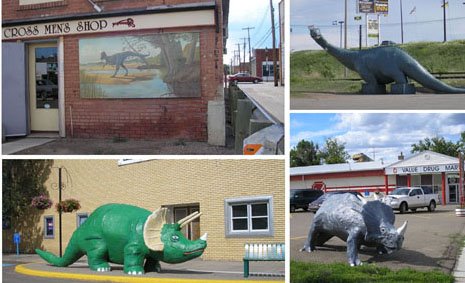
DINO TOWN


Our buddy Tom Bagley has a nice post up over at
7 Deadly Sinners
on just a few of the seemingly hundreds of bad dinosaur sculptures that populate Drumheller, Alberta, home of the wonderful Royal Tyrrell Museum of Palaeontology.

I see that they’ve repainted the dinos for the summer and did up my personal fav, the Styracosaurus in front of the Valu Drug Mart, a fetching blue-ish tone. Ah, the stories I could tell about these things!

Note to Tom: pencil crayons are not un-hip!

Tuesday, June 20, 2006

Tinker, T. rex, Trouble

Thanks to everyone who wrote in with info on ‘Tinker’, esp. Dan, Ed, and Toni!

Ed tells me that Tinker used to have a website, kidrex.com, and that you can still access a partial archive of the website through archive.org and HERE.

According to the old site:
"Tinker" is the near-complete skeleton of a rex youngster, an individual two-thirds adult size, but only one-fourth adult weight. We think we have over 70% of Tinker with at least something from each section of the body, from jaws to tail tip vertebrae."
Also from the site:
The Discovery Team was Ron "Tinker" Frithiof, Mike Harrell, Melody Harrell, Kim Hollrah with Dr. Robert T. Bakker, paleontologist and D.L. Grimm & Associates, marketing and promotion.

Photo from the now defunct website of some of the skull of Tinker.
Dan also points us to a post over at the Dinosaur Mailing List (hosted by the CMNH) that explains all.

Has there been a T.rex dug up since ‘Sue’™ that has NOT caused trouble for someone? Let’s cue up Alan Price singing a reworked version of “The House of The Rising Sun” as we ride into the night:
“There is a [T.rex] in [western USA]
They call the [insert ‘cute’ name]
And it's been the ruin of many a poor boy
And God I know I'm one”

Giraffe Necks & Big-Hearted Sauropods

The origin of mean arterial and jugular venous blood pressures in giraffes. 2006. G. Mitchell et al. Journal of Experimental Biology 209: 2515-2524.


From Science Now:

“Thanks to its long neck, a giraffe's head can rise up to 5 meters in mere seconds after the creature takes a drink. One would expect this dramatic motion to trigger a massive drain of blood from the brain, but giraffes obviously aren't fainting all over the place.

To solve the dizzying conundrum built a machine that replicated the length, rigidity, and pressure of the blood-flow system in a giraffe's neck. Rubber or PVC tubes substituted for the jugular vein and carotid artery, an electric pump became the heart, and water was used instead of blood. The siphon model only worked when stiff PVC tubing was used. When the researchers substituted rubber tubing, which more closely matches the flexibility seen in giraffe blood vessels, "blood" was not sucked up into the "brain."

Making the "heart" do all the work, however, solved the problem: "blood" efficiently reached the "brain" even when rubber tubing was used.

The model explains why a giraffe's blood pressure is about twice as high as that seen in people
, says Mitchell. He suspects that a muscular cuff at the base of the jugular vein constricts as the giraffe stands to maintain that pressure in the brain.”

The implication for sauropods is obvious.

Monday, June 19, 2006

Lease of Juvenile T. rex Land Invalid

From the Grand Forks Herald:

The remains of a juvenile Tyrannosaurus rex unearthed from northwest South Dakota in 1998 eventually could be headed back to the state.

A federal judge has ruled that a lease between Harding County and the team of fossil hunters that dug up the fossil, nicknamed Tinker, was invalid because it did not follow South Dakota law.

Ken Barker, a Belle Fourche, S.D., attorney representing Harding County, said the effect of the order is that the county owns Tinker and any other dinosaurs found on its site. But the homecoming for Tinker, 65 million years old and believed to be about 90 percent complete, is not certain.

The T. rex is sitting in storage in Pennsylvania under the jurisdiction of a federal bankruptcy court after the man hired to restore the fossils filed for Chapter 7 bankruptcy protection.

Does anyone know which specimen this is?

UPDATE: Of course they do! And HERE it is.

Sunday, June 18, 2006

The Land Unknown!


In 1957, an expedition led by Commander Allen Roberts (Jock Mahoney), and including reporter Margaret Hathaway (Shawn Smith) and Lt. Jack Carmen (William Reynolds), heads via helicopter to the Antarctic. However, they are forced to make an emergency landing and touch down in a Mesozoic-era time warp, where dinosaurs roam and carnivorous plants dot the landscape. Soon they meet mad explorer Carl Hunter (Henry Brandon), who has lived in this amazing place ever since his own helicopter crashed ten years earlier. The group tries to organize an escape while staying free of hungry flora and fauna.”Synopsis from HERE.

Watch the tralier in glorious B&W!:

Alley Oop Sunday Strip


Click image to enlarge

Saturday, June 17, 2006

Bob Bakker Vs. Harry Potter


Bob Bakker calls in the experts to consult on details of the new pachycephalosaur, Dracorex hogwartsia, at a recent event at the Houston Museum of Natural History.

Friday, June 16, 2006

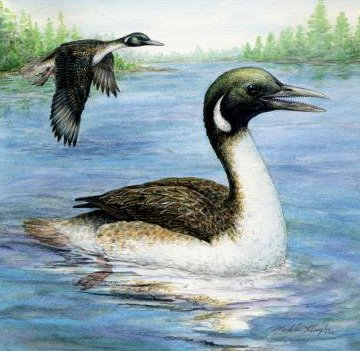
Gansus, Earliest Amphibious Bird

A Nearly Modern Amphibious Bird from the Early Cretaceous of Northwestern China 2006. Hai-lu You et al. Science 312: 1640 – 1643.


Image courtesy of Mark A. Klingler/CMNH, via Science-AAAS.
At about 110 million years, Gansus yumenensis is one of the oldest members of the lineage leading to modern birds. New fossil specimens of the loon-like ancient bird help fill in the avian family tree and suggest that today's birds may have gotten their start in aquatic environments.
From the AAAS press release:

The five well-preserved fossils of Gansus described include nearly complete skeletons consisting of three-dimensional, mostly uncrushed bones. Several of the specimens are so exquisitely preserved that the carbonized remains of feathers and even webbing in the foot can be seen clearly.

Details in the hind legs and feet of Gansus indicate that the bird was probably a foot-propelled diver like today's grebes, loons, and many ducks, although they may not have been as good at diving as their modern counterparts, according to Hai-lu You. Gansus belongs to a lineage of birds called the Ornithurae, which includes all modern birds (Neornithes) and their immediate fossil ancestors. Gansus is not a member of the Neornithes, but it is the oldest known ornithurae. Ornithuran birds probably arose in the Early Cretaceous, sometime between 140 and 110 million years ago.

The new fossils were discovered by You and his team near the town of Changma, about 2,000 km west of Beijing, where the first Gansus fossil (a partial hind leg) was found in 1981. Most of the nearly 50 bird specimens found so far at the site appear to be Gansus, the researchers say, which would make it the oldest known fossil locality dominated by ornithuran birds.

Abstract:Three-dimensional specimens of the volant fossil bird Gansus yumenensis from the Early Cretaceous Xiagou Formation of northwestern China demonstrate that this taxon possesses advanced anatomical features previously known only in Late Cretaceous and Cenozoic ornithuran birds. Phylogenetic analysis recovers Gansus within the Ornithurae, making it the oldest known member of the clade. The Xiagou Formation preserves the oldest known ornithuromorph-dominated avian assemblage. The anatomy of Gansus, like that of other non-neornithean (nonmodern) ornithuran birds, indicates specialization for an amphibious life-style, supporting the hypothesis that modern birds originated in aquatic or littoral niches.

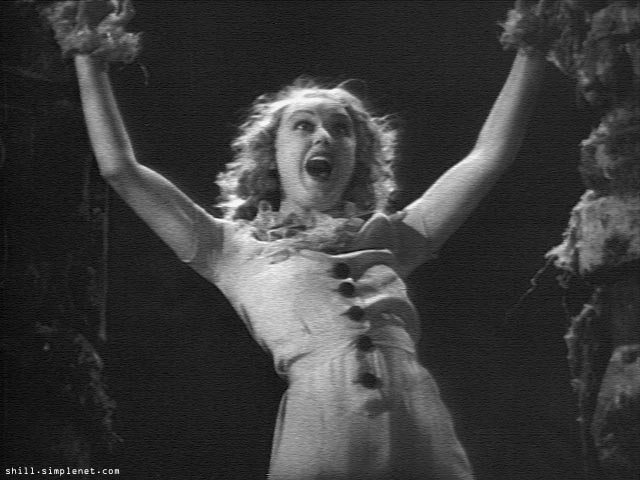
“You’re despicable.”
Peace


‘Peace’ by Steff Geissbuhler (1985)
The image encourages reconciliation between two "giant" nations, the U.S. and the U.S.S.R., symbolized by Godzilla and King Kong. The poster was designed to commemorate the 40th Anniversary of the bombing of Hiroshima. It was included in the "Images of Survival" exhibition project organized by the Shoshin Society, Washington, DC.

The poster is part of the show entitled ‘The Graphic Imperative” that is a collection of posters for peace, social justice, and the environment ranging from the years 1965-2005. It’s at the AIGA national Design Center in New York City until August 18, 2006.

Thanks to Drawn! for the alert on this.

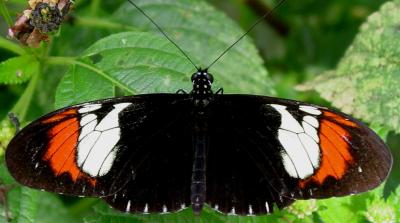
Butterfly Speciation Via Hybridization

Speciation by hybridization in Heliconius butterflies. 2006. J. MavƔrez et al. Nature 441: 868-871.

Heliconius heurippa, hybrid species resulting from mating of H. cydno x H. melpomene. Credit: Christian Salcedo, U. Florida Gainesville
In a matter of months, butterflies sporting the yellow and red wing color pattern of a wild species were created through simple laboratory crosses of two other wild species.
From the press release:

"We recreated the evolutionary steps that may have given rise to Heliconius heurippa, a hybrid butterfly species, in the lab," explains Jesus Mavarez.

Sexual encounters between species resulting in hybrid offspring may be common in nature. However, homoploid hybrid species -- fully sexual hybrid species resulting from crosses between two different parent species -- are still considered to be quite rare. This report of the laboratory creation of a hybrid butterfly nearly identical to a known wild species, and the observation that hybrid individuals don't mate with either parent species, provides the most convincing case to-date for homoploid hybrid speciation in animals.

The process of speciation usually occurs when one species splits into two, but there are some cases in which new species result from the mating between two good species. Usually when members of different species mate, their offspring die or are infertile. On occasion, polyploid hybrids -- individuals with multiple copies of their parents' chromosomes, survive and establish a new lineage or species. Polyploid hybrid speciation often occurs in plants when polyploid individuals go on to reproduce asexually. Some lizards, frogs, fish and many invertebrates also pull this trick.

Thursday, June 15, 2006

Isisfordia, New Fossil Croc From Australia

The origin of modern crocodyliforms: new evidence from the Cretaceous of Australia. 2006. S.W. Salisbury et al. Proceedings of the Royal Society B: Biological Sciences. Early on-line publication.
A new fossil from the Age of the Dinosaurs suggests modern crocodiles first evolved in Gondwana.
From ABC News:

The fossilised remains of the most primitive ancestor of modern crocodiles were discovered near an outback Australian town in Queensland. Until now the kinds of creatures that seemed to be the ancestors of all modern crocodiles have come from places like Belgium, from England, from the USA," says team member Dr Paul Willis.

But he says the new specimen, Isisfordia duncani, shares more features in common with modern crocodiles than any specimens found in the northern hemisphere. The 98 to 95 million years old, Isisfordia predates modern crocodiles by about 20 million years.

Willis and colleagues analysed two fossilised skeletons first discovered in the mid-1990s in a creek bed in Isisford, in central-western Queensland, by former deputy mayor of the town, Ian Duncan. One specimen is almost a complete skeleton with just the snout and face of the crocodile missing. The other is a complete skull.

"Between the two we have a complete skeleton," says Willis. "We know what the whole animal looked like and it's very rare to get that."

Read the rest of the article HERE.

Image: The palaeoblogger's old buddy, Matt Herne

Summer Field Work

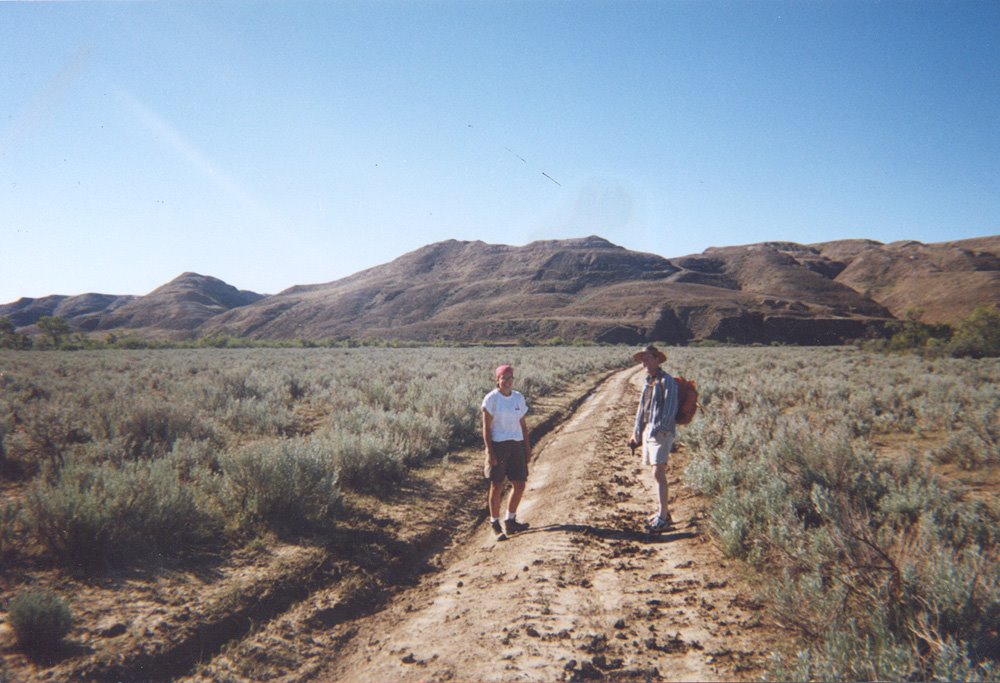
Since people have been asking me what I'll be up to when I'm in southern Alberta later this summer I thought I'd post a couple photos from work I did in that region a few years ago.


Photo © M. Ryan
That's Heather Jamniczky (now Ph.D) & Nova Scotia's-own Brian Matthews en route to a locality in the badlands in the background.


Photo © M. Ryan
Don Brinkman, Heather, and Brian digging a big hole to collect a dino skull.