A primitive fish provides key characters bearing on deep osteichthyan phylogeny. 2006. M. Zhu, et al. Nature 441: 77-81.
Abstract: Osteichthyans, or bony vertebrates, include actinopterygians (teleosts and their relatives) and sarcopterygians (coelacanths, lungfishes and tetrapods). Despite features found in basal actinopterygians (for example, Dialipina and Ligulalepis) and basal sarcopterygians (for example, Psarolepis and Achoania), the morphological gap between the two lineages remains wide and how sarcopterygians developed a dermal surface covering known as cosmine (composed of a pore–canal network and a single layer of odontodes and enamel) is still poorly known. Here we describe a primitive fossil fish, Meemannia eos gen. et sp. nov., that possesses an actinopterygian-like skull roof and a cosmine-like dermal surface combining a pore–canal network (found in various fossil sarcopterygians) with superimposed layers of odontodes and enamel (previously known in actinopterygians and some acanthodians).
This 405-million-year-old fish from the Lower Devonian of Yunnan (China) demonstrates that cosmine in many fossil sarcopterygians arose step by step through the acquisition of a pore–canal network followed by the subsequently developed ability to resorb previous generations of odontodes and enamel. Meemannia provides key characters for studying deep osteichthyan phylogeny and indicates a possible morphotype for the common ancestor of actinopterygians and sarcopterygians.
Sunday, May 07, 2006
The Lancelet On-Line

The Lancelet is the excellent blog by Martin Brazeau, a Canadian grad student studying in Sweden, who posts his interesting thoughts on palaeontlogy and evolutionary theory. Check it out HERE.


The Secret Of Dinosaur Island
It's Sunday again so let's open the funny pages for the kids.

Jimmy Olsen and Superman © DC Comics. Cover from HERE.
CLICK ON ALL IMAGES TO ENLARGE AND READ.
Today we go back to the April 1956 issue #53 of "Superman's Pal, Jimmy Olsen" for a suitably goofy story with some dinosaurs in it. The story's by Otto Binder with art (pencils) by Curt Swan.


Jimmy runs into a robot that is programmed to keep the island secret from snoopy reporters. It reminds me of Woody Guthrie's guitar that was labeled, "This machine kills fascists."

The dying Prof. March explains it all:

Superman ends up inside the shell of the robot to foil Jimmy's picture taking and protect the dinosaurs from discovery:

The Prof. and Superman (Clark Kent) team up to save the Prof's research:


The cover at the start of the post has nothing to do with the story -- in fact it's from a different issue -- but it's more interesting than the one for the book that the story is from. Above right is the July 1940 issue of Thrilling Wonder Stories that the JO cover was "borrowed" from.
Friday, May 05, 2006
Landing On Titan Videos

No, it’s not palaeo but it is very cool science, and well worth your attention:
Watch videos of Huygens descending to and landing on Titan HERE.A little more than one year after the spectacular descent of ESA’s Huygens on Saturn’s giant moon Titan, scientists from the probe’s Descent Imager/Spectral Radiometer (DISR) have released two new movies of the descent. These represent the best visual product from the mission obtained so far and the most realistic way yet to experience the landing on a far-away world.
The first movie ‘View from Huygens on 14 January 2005’ shows in 4 minutes 40 seconds what the probe actually ‘saw’ within the few hours of the descent and the eventual landing. "At first the Huygens camera just saw haze over the distant surface," said DISR team member Erich Karkoschka, from the DISR team at the University of Arizona and creator of the movies.
The second, more technical movie (called ‘DISR movie’), shows DISR's 4-hour operating life in less than five minutes, too. A detailed caption to explain how the movie is structured is provided with the video.
Arrested This Day: John T. Scopes
From Today In Science History:
In 1925, John T. Scopes was taken under arrest for violating a new state law against the teaching of Darwin's theory of evolution in a Tennessee public school. He was found guilty at what became known as the Scope's Monkey Trial the following month, and fined $100. Although upon appeal the fine was ruled excessive and over-ruled, the state law itself was not found unconstitutional.
NPR has a good article on “Remembering the Scopes Monkey Trial.

Cartoon © Aron Bothman from HERE. Scopes photo from HERE
In 1925, John T. Scopes
 was taken under arrest for violating a new state law against the teaching of Darwin's theory of evolution in a Tennessee public school. He was found guilty at what became known as the Scope's Monkey Trial the following month, and fined $100. Although upon appeal the fine was ruled excessive and over-ruled, the state law itself was not found unconstitutional.
NPR has a good article on “Remembering the Scopes Monkey Trial.

Cartoon © Aron Bothman from HERE. Scopes photo from HERE
Thursday, May 04, 2006
Born This Day: Thomas Huxley
May, 4, 1825 -- June 29, 1895.
From the UC Berkeley Page:
Huxley was born in Ealing, near London, the seventh of eight children in a family that was none too affluent. At 21, Huxley signed on as assistant surgeon on the H.M.S. Rattlesnake, a Royal Navy frigate assigned to chart the seas around Australia and New Guinea. Huxley collected and studied marine invertebrates, in particular cnidarians,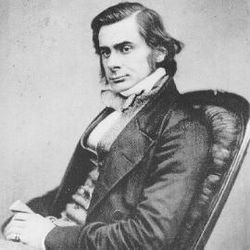 tunicates, and cephalopod mollusks. After leaving the Navy in 1854, Huxley managed to secure a lectureship at the School of Mines in London.
Huxley was a passionate defender of Darwin's theory -- so passionate that he has been called "Darwin's Bulldog" – and also a great biologist in his own right, who did original research in zoology and paleontology.
He is best known for his famous debate in June 1860, at the British Association meeting at Oxford. His opponent, Archbishop Samuel Wilberforce, was not-so-affectionately known as "Soapy Sam" for his renowned slipperiness in debate. During the debate, Archbishop Wilberforce ridiculed evolution and asked Huxley whether he was descended from an ape on his grandmother's side or his grandfather's. Accounts vary as to exactly what happened next, but according to one telling of the story, Huxley muttered "The Lord hath delivered him into my hands," and then rose to give a brilliant defense of Darwin's theory, concluding with the rejoinder, "I would rather be the offspring of two apes than be a man and afraid to face the truth."
All accounts agree that Huxley trounced Wilberforce in the debate, defending evolution as the best explanation yet advanced for species diversity.
However, Huxley did not blindly follow Darwin's theory, and critiqued it even as he was defending it. In particular, where Darwin had seen evolution and a slow, gradual, continuous process, Huxley thought that an evolving lineage might make rapid jumps, or saltations. As he wrote to Darwin just before publication of the Origin of Species, "You have loaded yourself with an unnecessary difficulty in adopting Natura non facit saltum [Nature does not make leaps] so unreservedly."
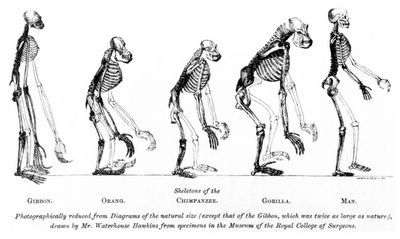
Huxley's most famous writing, published in 1863, is Evidence on Man's Place in Nature. This book, published only five years after Darwin's Origin of Species, was a comprehensive review of what was known at the time about primate and human paleontology and ethology. More than that, it was the first attempt to apply evolution explicitly to the human race. Huxley explicitly presented evidence for human evolution.
Huxley founded a remarkable dynasty of English scientists and thinkers. His son Leonard was a noted biographer and "man of letters." Leonard's oldest son Julian was one of the authors of the evolutionary synthesis of the early 20th century; Julian's son Francis became a noted anthropologist. Julian's brother Aldous Huxley was a novelist, screenwriter and essayist; his best-known book is the anti-utopia Brave New World.
From the UC Berkeley Page:
Huxley was born in Ealing, near London, the seventh of eight children in a family that was none too affluent. At 21, Huxley signed on as assistant surgeon on the H.M.S. Rattlesnake, a Royal Navy frigate assigned to chart the seas around Australia and New Guinea. Huxley collected and studied marine invertebrates, in particular cnidarians,
 tunicates, and cephalopod mollusks. After leaving the Navy in 1854, Huxley managed to secure a lectureship at the School of Mines in London.
Huxley was a passionate defender of Darwin's theory -- so passionate that he has been called "Darwin's Bulldog" – and also a great biologist in his own right, who did original research in zoology and paleontology.
He is best known for his famous debate in June 1860, at the British Association meeting at Oxford. His opponent, Archbishop Samuel Wilberforce, was not-so-affectionately known as "Soapy Sam" for his renowned slipperiness in debate. During the debate, Archbishop Wilberforce ridiculed evolution and asked Huxley whether he was descended from an ape on his grandmother's side or his grandfather's. Accounts vary as to exactly what happened next, but according to one telling of the story, Huxley muttered "The Lord hath delivered him into my hands," and then rose to give a brilliant defense of Darwin's theory, concluding with the rejoinder, "I would rather be the offspring of two apes than be a man and afraid to face the truth."
All accounts agree that Huxley trounced Wilberforce in the debate, defending evolution as the best explanation yet advanced for species diversity.
However, Huxley did not blindly follow Darwin's theory, and critiqued it even as he was defending it. In particular, where Darwin had seen evolution and a slow, gradual, continuous process, Huxley thought that an evolving lineage might make rapid jumps, or saltations. As he wrote to Darwin just before publication of the Origin of Species, "You have loaded yourself with an unnecessary difficulty in adopting Natura non facit saltum [Nature does not make leaps] so unreservedly."

Huxley's most famous writing, published in 1863, is Evidence on Man's Place in Nature. This book, published only five years after Darwin's Origin of Species, was a comprehensive review of what was known at the time about primate and human paleontology and ethology. More than that, it was the first attempt to apply evolution explicitly to the human race. Huxley explicitly presented evidence for human evolution.
Huxley founded a remarkable dynasty of English scientists and thinkers. His son Leonard was a noted biographer and "man of letters." Leonard's oldest son Julian was one of the authors of the evolutionary synthesis of the early 20th century; Julian's son Francis became a noted anthropologist. Julian's brother Aldous Huxley was a novelist, screenwriter and essayist; his best-known book is the anti-utopia Brave New World.
Wednesday, May 03, 2006
Mobile DNA Shared by Man and Coelacanth
A distal enhancer and an ultraconserved exon are derived from a novel retroposon. 2006. G. Bejerano, et al. Nature 441: 87-90.

Art © Mark Schultz
The discovery is "tantalizing evidence" that copied DNA elements known as retroposons could be an important source of evolutionary innovations. Haussler and his colleagues were led to the discovery through their work on what they call "ultraconserved elements" -- segments of DNA hundreds of nucleotides long that are almost exactly the same in a wide variety of vertebrate organisms.
Comparing one sequence to other species also turned up a big surprise. When the researchers compared the human ultraconserved element to all the DNA sequences in the public database GenBank, the closest match was to DNA from the coelacanth. The coelacanth is a descendant of the ancient marine organism that gave rise to the terrestrial vertebrates more than 360 million years ago, yet the two organisms still share critical DNA sequences.
Bejerano and Haussler's results support the hypothesis that the movement of retroposons can generate evolutionary experiments by adding new regulatory modules to genes. Most of these experiments will have no effects or will harm an organism. But every once in a while, the movement of a regulatory element will give an organism an evolutionary advantage. "And to the extent that [such changes] improve the fitness of an organism," says Haussler, "they eventually will become fixed in a population."

Art © Mark Schultz
The repeated copying of a small segment of DNA in the genome of a primeval fish may have been crucial to the transition of ancient animals from sea to land.From the Howard Hughes Medical Institute press release:
The discovery is "tantalizing evidence" that copied DNA elements known as retroposons could be an important source of evolutionary innovations. Haussler and his colleagues were led to the discovery through their work on what they call "ultraconserved elements" -- segments of DNA hundreds of nucleotides long that are almost exactly the same in a wide variety of vertebrate organisms.
Comparing one sequence to other species also turned up a big surprise. When the researchers compared the human ultraconserved element to all the DNA sequences in the public database GenBank, the closest match was to DNA from the coelacanth. The coelacanth is a descendant of the ancient marine organism that gave rise to the terrestrial vertebrates more than 360 million years ago, yet the two organisms still share critical DNA sequences.
Bejerano and Haussler's results support the hypothesis that the movement of retroposons can generate evolutionary experiments by adding new regulatory modules to genes. Most of these experiments will have no effects or will harm an organism. But every once in a while, the movement of a regulatory element will give an organism an evolutionary advantage. "And to the extent that [such changes] improve the fitness of an organism," says Haussler, "they eventually will become fixed in a population."
Testing Sexual Selection In Flycatchers
Testing the genetics underlying the co-evolution of mate choice and ornament in the wild. 2006. A. Qvarnström, et al. Nature 441: 84-86.

Image from HERE
We found significant additive genetic variances of all the main components: male ornament (forehead patch size), female mate choice for this ornament, male fitness and female fitness. However, when the necessary genetic correlations between these components were taken into account, the estimated strength of indirect sexual selection on female mate choice was negligible.
Our results show that the combined effect of environmental influences on several components reduces the potential for indirect sexual selection in the wild. This study provides insight into the field of sexual selection by showing that genes coding for mate choice for an ornament probably evolve by their own pathways instead of 'hitchhiking' with genes coding for the ornament.

Image from HERE
Abstract: One of the most debated questions in evolutionary biology is whether female choice of males with exaggerated sexual displays can evolve as a correlated response to selection acting on genes coding for male attractiveness or high overall viability.To date, empirical studies have provided support for parts of this scenario, but evidence for all key genetic components in a natural population is lacking. Here we use animal-model quantitative genetic analysis on data from over 8,500 collared flycatchers (Ficedula albicollis) followed for 24 years to quantify all of the key genetic requirements of both fisherian4, 5 and 'good-genes' models6, 7 on sexual selection in the wild.
We found significant additive genetic variances of all the main components: male ornament (forehead patch size), female mate choice for this ornament, male fitness and female fitness. However, when the necessary genetic correlations between these components were taken into account, the estimated strength of indirect sexual selection on female mate choice was negligible.
Our results show that the combined effect of environmental influences on several components reduces the potential for indirect sexual selection in the wild. This study provides insight into the field of sexual selection by showing that genes coding for mate choice for an ornament probably evolve by their own pathways instead of 'hitchhiking' with genes coding for the ornament.
Pleistocene Horse Extinction
On the Pleistocene extinctions of Alaskan mammoths and horses. A.R. Solow, et al. PNAS published on-line May 1, 2006
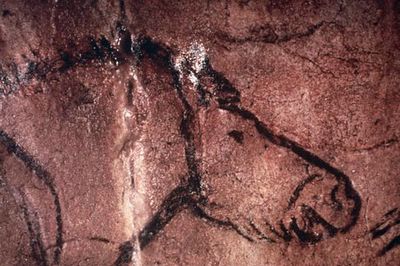
Image from HERE
Abstract: The fossil record has been used to shed light on the late Pleistocene megafaunal extinctions in North America and elsewhere. It is therefore important to account for variability due to the incompleteness of the fossil record and error in dating fossil remains. Here, a joint confidence region for the extinction times of horses and mammoths in Alaska is constructed. The results suggest that a prior claim that the extinction of horses preceded the arrival of humans cannot be made with confidence.
Now a new study of the fossil record fuels the debate about the cause of the creatures' fate. In North America two major events occurred at about the same time as the megafaunal extinctions: The planet cooled, and early humans arrived from Asia to populate the continent. For decades scientists have debated which of these factors was responsible for widespread megafaunal extinctions.
Previous research had suggested that Alaska's caballoid horse species became extinct some 500 years before the first humans arrived.
Those dates would mean that overhunting could not have contributed to the extinction of Alaska's ancient horses — though humans could have contributed to the demise of North American mammoths, which stayed on the scene for perhaps another thousand years.
New data reveal that horses did disappear before mammoths, though only by perhaps 200 years. Their findings also suggest that both species may not have gone extinct until after human arrival—so human hunting may well have played a role in their demise.

Image from HERE
Abstract: The fossil record has been used to shed light on the late Pleistocene megafaunal extinctions in North America and elsewhere. It is therefore important to account for variability due to the incompleteness of the fossil record and error in dating fossil remains. Here, a joint confidence region for the extinction times of horses and mammoths in Alaska is constructed. The results suggest that a prior claim that the extinction of horses preceded the arrival of humans cannot be made with confidence.
From National Geographic News.com:Large animals' disappearance at the end of the Pleistocene era (50,000 to 10,000 years ago) happened at about the same time that many large animals, or megafauna, went extinct around the globe. Victims included species such as the saber-toothed cat and the Diprotodon—a rhinolike beast that was the world's largest marsupial.
Now a new study of the fossil record fuels the debate about the cause of the creatures' fate. In North America two major events occurred at about the same time as the megafaunal extinctions: The planet cooled, and early humans arrived from Asia to populate the continent. For decades scientists have debated which of these factors was responsible for widespread megafaunal extinctions.
Previous research had suggested that Alaska's caballoid horse species became extinct some 500 years before the first humans arrived.
Those dates would mean that overhunting could not have contributed to the extinction of Alaska's ancient horses — though humans could have contributed to the demise of North American mammoths, which stayed on the scene for perhaps another thousand years.
New data reveal that horses did disappear before mammoths, though only by perhaps 200 years. Their findings also suggest that both species may not have gone extinct until after human arrival—so human hunting may well have played a role in their demise.
Tuesday, May 02, 2006
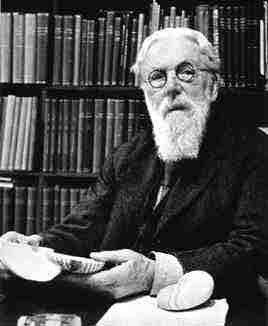
Born This Day: Sir D'Arcy Thompson
May 2, 1860 – June 21, 1948
From cscs.umich.edu:
D'Arcy Thompson was a British biologist whose masterwork, On Growth and Form, is a profound consideration of the shapes of living things, starting from the simple premise that "everything is the way it is because it got that way." Hence one must study not only finished forms, but also the forces that moulded them: "the form of an object is a 'diagram of forces', in this sense, at least, that from it we can judge of or deduce the forces that are acting or have acted upon it."
Now by "forces" Thompson meant forces, and one of his great themes is the tremendous light cast on living things by using mathematics to describe their shapes and fairly simple physics and chemistry to explain them. In other words, Thompson wrote a thousand page treatise on self-organization long before the word existed. one another. The most thoroughly worked out modern example of this is Raup's analysis of snail shell shapes with a morphospace.
With some simplification, the axes on the fish grids in here or the snails of the morphospace can be thought of as growth gradients. The evolutionary change between the species would then have been produced by a genetic change in the regulatory mechanisms controlling those gradients.
If we looked at these fish without the grids we might think that an evolutionary change from one into the other would be at least moderately complicated. The interest of D'Arcy Thompson's diagrams is then to show that shape changes could have been produced by heterochrony - a change in the rate or timing of development of some cell lines in the body relative to others.

Figure: a D'Arcy Thompson transformational diagram. The shapes of two species of fish have been plotted on Cartesian grids. Image from HERE.
From cscs.umich.edu:
D'Arcy Thompson was a British biologist whose masterwork, On Growth and Form, is a profound consideration of the shapes of living things, starting from the simple premise that "everything is the way it is because it got that way." Hence one must study not only
 finished forms, but also the forces that moulded them: "the form of an object is a 'diagram of forces', in this sense, at least, that from it we can judge of or deduce the forces that are acting or have acted upon it."
Now by "forces" Thompson meant forces, and one of his great themes is the tremendous light cast on living things by using mathematics to describe their shapes and fairly simple physics and chemistry to explain them. In other words, Thompson wrote a thousand page treatise on self-organization long before the word existed.
From Blackwell Publishing:D'Arcy Thompson found that related species superficially looking very different could in some cases be represented as simple Cartesian transformations of
 one another. The most thoroughly worked out modern example of this is Raup's analysis of snail shell shapes with a morphospace.
With some simplification, the axes on the fish grids in here or the snails of the morphospace can be thought of as growth gradients. The evolutionary change between the species would then have been produced by a genetic change in the regulatory mechanisms controlling those gradients.
If we looked at these fish without the grids we might think that an evolutionary change from one into the other would be at least moderately complicated. The interest of D'Arcy Thompson's diagrams is then to show that shape changes could have been produced by heterochrony - a change in the rate or timing of development of some cell lines in the body relative to others.

Figure: a D'Arcy Thompson transformational diagram. The shapes of two species of fish have been plotted on Cartesian grids. Image from HERE.
Monday, May 01, 2006
What Use is Half a Wing?
Even wings that are still in development help living birds gain traction on slopes and scale obstaclesFrom the American Institute of Biological Sciences press release:
Ken Dial and his co-authors present the experimental evidence indicating that ancestral protobirds incapable of flight could have used their protowings to improve hindlimb traction and thus better navigate steep slopes and obstructions.
 By using their protowings in this way, they would presumably have had an advantage when pursuing prey and escaping from predators.
Dial and colleagues performed experiments on several species of juvenile galliform (chicken-like) birds, concentrating on chukar partridges. Chukars can run 12 hours after hatching, but they cannot fly until they are about a week old. Even before they are able to fly, however, the birds flap their developing wings in a characteristic way while running, which improves their ability to climb steep slopes and even vertical surfaces.
They propose that incipiently feathered forelimbs of bipedal protobirds may have provided the same advantages for incline running as have now been demonstrated in living juvenile birds.
Dial and colleagues posit that ancestors of birds, which may have resembled the bipedal theropod dinosaur Caudipteryx, employed their protowings in wing-assisted incline running, which helps answer the seminal question for bird evolution first posed by St. George Jackson Mivart in 1871: "What use is half a wing?"
The article is published in the May 2006 issue of Bioscience.
Watch videos of running chukar’s in the lab HERE.
Empire State Building Turns 75

From CNN.com:
The Empire State Building, once the tallest building in the world and again the tallest in New York City, is turning 75 years old on Monday.
Construction of the Empire State Building was one of the most remarkable feats of the 20th century. It took only 410 days to build -- by 3,400 workers, many of them desperate for work at the height of the Depression. The work force was made up largely of immigrants, along with hundreds of Mohawk Indian iron workers.
The 1,453-foot tower opened on May 1, 1931, with President Herbert Hoover pressing a button in Washington to turn on its lights. Architect William Lamb, the chief designer, messaged former New York Gov. Al Smith from a ship at sea: "One day out and I can still see the building."
Along with "Kong" movies, the skyscraper was featured in such films as "An Affair to Remember" and "Sleepless in Seattle." In one of Japan's "Godzilla" films, the flying monster Rodan borrowed King Kong's perch to wail at the moon.
Empire State Human
Sunday, April 30, 2006
Flight Vol. 3

© Michel Gagné
The graphic anthology “Flight” will shortly be releasing it’s third annual volume into book stores through Ballantine Books. Each issue has offered a wonderful assortment of top illustrators presenting beautifully crafted stories. This new 352 page volume will be no exception.
You can read an interview with the editor, Kazu Kibuishi, HERE and view samples of each story HERE.
The featured page (above) is from "Underworld" by artist and animator Michel Gagné. You can see more of Michel’s work HERE and sample some of his innovative animations HERE
Ice Age Mammals
From The Montreal Gazette:
The Montreal Science Centre presents “Ice Age Mammals”, an inspiring exploration of all things ice age, filled with fossils, mega fauna and lots of fun. The exhibition comes courtesy, in part, of the Canadian Museum of Nature in Ottawa.
But to mention the Canadian Museum of Nature, one must pay credit to Richard "Dick" Harington, a McGill University alumnus, an Order of Canada recipient and a paleontologist who has devoted his life to studying ice age animals.
"Part of the motivation for the exhibit was to feature the career of Dick Harington," Natalia Rybczynski said. "When he started working at the museum, the ice age collections only had about 60 specimens. It's now over 40,000. So he has single-handedly transformed our understanding of ice age mammals."
Rybczynski, herself a paleomammalogist at the Canadian Museum of Nature and adviser to the exhibition, speaks quite highly of Harington with good reason: as a teenage high school student in Ottawa, Rybczynski was paired with Harington through a mentorship program. She has since completed her master's degree and doctorate in the field.
"I've had the extreme pleasure of working with him," she said. "He's been a mentor to me."
Ice Age Mammals opens Saturday and continues until March 2007. The Montreal Science Centre is at the King Edward Pier in the Old Port. For more information, call (514) 496-4724 or visit the website at www.montrealsciencecentre.com.
The Montreal Science Centre presents “Ice Age Mammals”, an inspiring exploration of all things ice age, filled with fossils, mega fauna and lots of fun. The exhibition comes courtesy, in part, of the Canadian Museum of Nature in Ottawa.
But to mention the Canadian Museum of Nature, one must pay credit to Richard "Dick" Harington, a McGill University alumnus, an Order of Canada recipient and a paleontologist who has devoted his life to studying ice age animals.
"Part of the motivation for the exhibit was to feature the career of Dick Harington," Natalia Rybczynski said. "When he
 started working at the museum, the ice age collections only had about 60 specimens. It's now over 40,000. So he has single-handedly transformed our understanding of ice age mammals."
Rybczynski, herself a paleomammalogist at the Canadian Museum of Nature and adviser to the exhibition, speaks quite highly of Harington with good reason: as a teenage high school student in Ottawa, Rybczynski was paired with Harington through a mentorship program. She has since completed her master's degree and doctorate in the field.
"I've had the extreme pleasure of working with him," she said. "He's been a mentor to me."
Ice Age Mammals opens Saturday and continues until March 2007. The Montreal Science Centre is at the King Edward Pier in the Old Port. For more information, call (514) 496-4724 or visit the website at www.montrealsciencecentre.com.
Bakker In Houston

If you’re in Houston take note that The Houston Museum of Natural Science is having a family Dino-Day (called “Dinopalooza”) May 13 from 12 – 5 p.m.
Bob Bakker will kick off the day with a special interactive children’s event, The Secret Lives of Dinosaurs, from 9:30 – 10:30 a.m. in the Burke Baker Planetarium. Budding paleontologists can answer questions for a chance to win one of Bakker’s dino-drawings and get tips on how to draw their own dinosaurs
Bakker will also be signing copies of his new book, Dactyls: Dragons of the Air, illustrated by our old friend Luis Rey.


Saturday, April 29, 2006
Sue in Singapore

DINOSAURS! A T. rex named SUE and Friends!Marcus Ng at Budak.blogs.com lets us know that ‘Sue’ the T. rex will be in Singapore this summer:
20 May to 20 August 2006
The Faculty of Science (FoS), National University of Singapore (NUS), together with the Singapore Science Centre (SSC) will be presenting “DINOSAURS! A T. rex named SUE and Friends”.
Together with Sue, SSC’s detailed cast of another T. rex, named Stan, will be exhibited at the same time. Stan is the second most complete T. rex skeleton unearthed to-date. Another portion of the exhibition is “Dinosaur of Darkness” from Monash University. This is an extensive exhibition of “polar” dinosaurs from four continents (Australia, Antarctica, South America and North America) as well as fossil plants and microfossils
Friday, April 28, 2006
The Digital Evolution Slide Rule

John Kyrk has developed a great Evolution Slider that takes you from the origin of the universe to the present day and tracks a variety of parameters. I’m behind the curve on posting this but I can’t find out much about it on the web.
My head’s up came from Neatorama.com.
Hominid Evolution Explained

News@Nature.com has an article about the recent Australopithecus anamensis n. sp. find in Ethiopia including this nifty chart outlining the current thinking on hominid evolution. It also discusses the possibility that the new material supports an anagenetic (phyletic) rather than cladogenetic mode of evolution for these hominids.
“The latest Afar discovery is exciting experts because it shows that the three hominids existing in the same area, but in successive time periods. Tim White of the University of California, Berkeley, co-leader of the Awash team, believes this points to a direct lineage between the three — a process called phyletic evolution.”Read the full article HERE.
Thursday, April 27, 2006
Canada's Fossil Record
 Kyl Chhatwal of the Waterloo Record has an article on the recent find of Tiktaalik roseae in Nunavat and the abundance of fossils in Canada.
Photo of Neil Shubin and Tikaalik from the Canadian Press.
Conquering the Darkness: The Art of Charles Knight

“Conquering the Darkness,” an exhibit on the work of the famous artist, Charles Knight, is closing soon at the Museum of the Earth in Ithica, New York.From the Ithican Online:
From the 1890s until his death in 1953, Knight filled the public imagination with larger-than-life monsters at a time when paleontologists knew dinosaurs as more than just giant lizards, but not yet as the lively relatives of modern birds.
The exhibit has showcased rarely seen sculptures, preliminary paintings and group images since October. These include many from the collection of Knight’s granddaughter, Rhoda Kalt.
Supplementing the exhibit are sculptures from the Academy of Natural Sciences in Philadelphia, including dinosaurs and giant mammals.
“There’s work from a fairly broad spectrum of his career, ranging probably from the early middle part of his career right up to near his death,”
 said Robert Ross, the PRI's Head of Education. Ross’s favorite, though, is a model (left) on which Knight based his famous Dryptosaurus painting (above).
“He was legally blind for most of his life, and yet he painted these huge murals,” Baines said. “Holding [the murals] in his mind to that extent, to be able to envision those while working so intricately six inches from his paintings, created a kind of mental duality in him that comes through in his work sometimes.”
The exhibit runs until Sunday at the Museum of the Earth, 1259 Trumansburg Road. Call the museum for daily hours, 273 -6623.
Subscribe to:
Posts (Atom)